1
Tetrodotoxin functions as a stress relieving substance in juvenile tiger puffer Takifugu rubripes
1 2 3
Masafumi Amano
1*, Noriko Amiya
1, Minami Takaoka
1, Haruka Sato
2, Tomohiro Takatani
3, Osamu
4
Arakawa
3, Yoshitaka Sakakura
35 6
1
School of Marine Biosciences, Kitasato University, Sagamihara, Kanagawa 252-0373, Japan
7
2
Faculty of Fisheries, Nagasaki University, Nagasaki 852-8521, Japan
8
3
Graduate School of Fisheries and Environmental Sciences, Institute of Integrated Science and
9
Technology, Nagasaki University, Nagasaki 852-8521, Japan
10 11 12 13
Short title: Tetrodotoxin as a stress relieving substance in puffer
14 15
*
Corresponding author: Tel & Fax: +81-42-778-8884
16
E-mail: [email protected]
17 18
2
ABSTRACT
19 20
We tested whether tetrodotoxin (TTX) functions as a stress relieving substance in puffer fish. We
21
orally administered TTX to the juveniles of hatchery-reared non-toxic tiger puffer Takifugu rubripes
22
and measured the effects of TTX on brain corticotropin-releasing hormone (CRH) mRNA
23
expression and plasma cortisol levels in comparison with effects in non-toxic juveniles. Firstly, the
24
reciprocal connections of CRH and adrenocorticotropic hormone (ACTH) were confirmed by
25
dual-label immunohistochemistry. CRH-immunoreactive (ir) cell bodies were detected in the
26
hypothalamus and CRH-ir fibers were observed to project to ACTH-ir cells in the rostral pars
27
distalis of the pituitary. Next, a TTX-containing diet (2.35 mouse units (517 ng)/g diet) or a
28
non-toxic diet were fed to the fish for 28 days under a recirculating system. Standard length and
29
body weight became significantly larger in the TTX-treated group. The degree of loss of the caudal
30
fin, which is an indicator of the degree of agonistic interactions, where high values show a higher
31
loss of caudal fin of a fish due to nipping by other individuals, was significantly lower in the
32
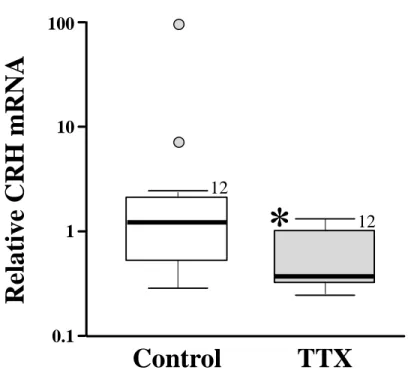
TTX-treated group. Relative CRH mRNA expression levels in the brain and cortisol levels in the
33
plasma were significantly lower in the TTX-treated group. These results indicate that TTX functions
34
as a stress relieving substance by affecting the CRH-ACTH-cortisol axis and reducing agonistic
35
interactions in tiger puffer juveniles.
36 37 38
Key words: TTX, CRH, ACTH, cortisol, stress, tiger puffer
39 40
3
1. Introduction
41 42
Tiger puffer Takifugu rubripes is well known to contain a potent neurotoxin “tetrodotoxin
43
(TTX)”, and is a commercially important fish species in Japan (Noguchi and Arakawa, 2008).
44
Owing to the decrease in natural stocks of tiger puffer in Japan, artificial propagation is conducted
45
widely both for aquaculture and stock enhancement programs (Katamachi and Ishida, 2013). These
46
hatchery-reared tiger puffers are known to become non-toxic when fed non-toxic diets in an
47
environment where TTX-bearing organisms are absent (Matsui et al., 1982; Noguchi et al., 2006;
48
Saito et al., 1984). Further, agonistic interactions, such as nipping the fins and bodies of other
49
conspecifics, are frequently observed in the hatcheries caused by stress from high individual
50
densities (Ohgami and Suzuki, 1982; Han et al., 1994). Saito et al. (2002) found that the frequency
51
of nipping behavior decreased in hatchery-reared juveniles of tiger puffer when they were fed with a
52
TTX containing diet. When juvenile tiger puffer was fed with TTX containing diet for 10 days, the
53
degree of loss of the caudal fin (DLCF) was lower in the orally TTX-administered fish than control
54
fish (Sakakura et al., 2017), where DLCF is used as an indicator of degree of agonistic interactions
55
in tiger puffer where high values show higher loss of caudal fin of a fish due to nipping by other
56
individuals (Shimizu et al., 2006). Assuming that nipping is caused by rearing stress, these findings
57
suggest that TTX functions as a stress relieving substance in juvenile tiger puffer.
58
Stress is regulated by the hypothalamo-pituitary-interrenal (HPI) axis in fish. Stress stimulates
59
the synthesis of corticotropin-releasing hormone (CRH) in the hypothalamus, which in turn
60
stimulates the synthesis of the proopiomelanocortin (POMC) and cleavage of POMC to
61
adrenocorticotropic hormone (ACTH) in the pituitary (see Pankhurst, 2011). ACTH stimulates the
62
release of cortisol from the interrenal gland and then cortisol increases glucose through
63
glucogenesis. In teleost fish, CRH-immunoreactive (ir) cell bodies in the nucleus preopticus project
64
directly to ACTH cells in the rostral pars distalis (RPD) and to α -melanocyte stimulating hormone
65
(α-MSH) cells in the pars intermedia (PI) of the pituitary (see Flik et al., 2006).
66
Recently, the presence of TTX in the brain of the tiger puffer has been reported. TTX was
67
detected by immunohistochemistry in the brain of wild toxic tiger puffer and orally
68
TTX-administered hatchery-reared tiger puffer (Okita et al., 2013). Moreover, TTX was detected by
69
LC/MSMS analysis in the brain of orally TTX-administered hatchery-reared tiger puffer (Sakakura
70
et al., 2017). Considering that TTX is present in the brain of toxic tiger puffer and that the brain
71
(hypothalamus) is the center of endocrine system, we hypothesized that TTX in the brain relieves
72
rearing stress by affecting the CRH-ACTH-cortisol axis. In our previous study, the oral
73
administration of TTX to hatchery-reared non-toxic tiger puffer juveniles resulted in the
74
accumulation of the toxin in various tissues, such as the skin, muscle, liver, and brain, similar to that
75
seen in wild toxic juveniles (Sakakura et al., 2017). This indicates that fish with orally administered
76
TTX can be considered to reflect the physiological characteristics of wild toxic fish.
77
Therefore, in the present study, we first confirmed the reciprocal connection of CRH and ACTH
78
in the pituitary of juvenile tiger puffer by dual-label immunohistochemistry. Then, we examined the
79
effects of oral administration of TTX on somatic growth and agonistic interactions, brain CRH
80
mRNA expression, and plasma cortisol and glucose levels in the hatchery-reared non-toxic juvenile
81
tiger puffer in order to examine our hypothesis that TTX functions as a stress relieving substance by
82
affecting the CRH-ACTH-cortisol axis.
83 84
4
2. Materials and methods
85 86
2.1. Dual-label immunohistochemistry for CRH and ACTH
87
The juveniles of hatchery-reared non-toxic tiger puffer (mean body weight (BW): 1.3 g)
88
obtained from Nagasaki Fishery Public Corporation, Sasebo, Nagasaki, Japan, were anesthetized by
89
immersion in 200 ppm of MS222. The brain with pituitary was excised, fixed with Bouin’s fluid for
90
24 hours at 4
oC, rinsed in cold 70% ethanol, dehydrated through a graded series of ethanol
91
concentrations, and embedded in paraplast (Monoject, Sherwood Medical, St Louis, MO, USA).
92
Sagittal sections were cut at 8 μm and mounted on MAS-GP coated slides (Matsunami, Osaka,
93
Japan). To examine the innervation of CRH-ir fibers to ACTH cells in the pituitary, dual-label
94
immunohistochemistry was conducted according to Amano et al (2016), using a rabbit polyclonal
95
antibody raised against human/mouse/rat CRH (Cat. # AB-02, Advanced Targeting Systems, San
96
Diego, CA, USA) and the mouse monoclonal antibody raised against ACTH (Cat. # MS-452-P0,
97
Thermo Scientific, Fremont, CA, USA). CRH and ACTH immunoreactivities were visualized by
98
3,3’-diaminobenzidine tetrahydrochloride (DAB, brown) and nitro blue tetrazolium chloride, and
99
5-bromo-4-chloro-3-indolyl phosphate, toluidine salt (NBT/BCIP, blue), respectively. mRNA
100
sequences encoding CRH in tiger puffer has been updated in NCBI database (NCBI Reference
101
Sequence: XM_003967938.1). The deduced amino acid sequence of tiger puffer CRH is
102
SEDPPISLDLTFHLLREMMEMSKAEQLAQQAQNNRIMMELV-NH
2and the sequence identity
103
with human/mouse/rat CRH is 73%. The cross-reactivity of the anti-CRH antibody against CRH
104
family peptides such as urocortin-I, II, III, urotensin-I, and sauvagine, was less than 0.01%,
105
indicating the specificity of the antibody (Amano et al., 2016). To test the specificity of the
106
immunohistochemical reactions for CRH, control sections were incubated in antisera that had been
107
pre-absorbed overnight at 4
oC with an excess amount of synthetic CRH (2.5 μ g CRH in 1 mL of
108
diluted antiserum). The subsequent procedure was identical to that used for the experimental
109
sections.
110 111
2.2. TTX administration experiment
112
2.2.1. Preparation of the TTX containing diet
113
The present study aimed to investigate the effects of dietary TTX on the growth performance
114
and stress-related hormone levels in juvenile tiger puffer. Fish meal is a common ingredient for fish
115
diets, however, it contains various nutritional factors that may affect the physiology of fish. Thus,
116
we used casein-based semi-purified diets (1.2 mm in diameter) with small amount of fish meal in
117
this study following the method described by Matsunari et al. (2008) as shown in Table 1. TTX
118
(Wako Pure Chemical, Osaka, Japan) was dissolved in Milli-Q water (Merck Millipore, Billerica,
119
MA, USA) at a toxicity of 46 mouse units (MU)/mL. TTX solution (32.5 mL) and 7.5 g of soy
120
lecithin (Nacalai Tesque Inc., Kyoto, Japan) were homogenized in an ice bath for 3 min at 14,000
121
rpm. Then, a TTX containing emulsion was made by adding 20 mL of salad oil and homogenizing
122
the TTX solution in an ice bath for 3 min at 14,000 rpm. The control emulsion was also prepared in
123
the same manner as the TTX containing emulsion but replacing the amount of TTX solution with
124
Milli-Q water. Each emulsion was sprayed onto 250 g of diet material, respectively. Concentrations
125
of adsorbed TTX in the diet were measured in diet samples. TTX were extracted with 0.1% acetic
126
acid following the standard protocol by Japan Food Hygiene Association (2015). Then, the extract
127
was partially purified with Bio-Gel P-2 column (Bio-Rad Laboratories Inc., Hercules, CA, USA)
128
and the absorbed TTX was eluted with 0.05 M AcOH from the gel. The TTX fraction was analyzed
129
by LC/MS/MS according to the method described by Nakashima et al (2004) and Gao et al (2019).
130
The chromatography was carried out on an Alliance 2690 Separations Module (Waters, Milford,
131
MA, USA) with a Mightysil RP-18 GP column (2.0 x 250 mm, Kanto Chemical Co., Inc., Japan).
132
The mobile phase comprised 30 mM heptafluorobutyric acid in 1 mM ammonium acetate buffer
133
(pH 5.0), at a flow rate of 0.2 ml/min. The eluate was introduced into a Quattro micro
TMAPI
134
5
detector (Waters), with a desolvation temperature of 350 °C, source block temperature of 120 °C,
135
and cone voltage of 50 V. Therein, the TTX was ionized by positive-mode electrospray ionization
136
and then monitored as product ions (collision voltage 38 V) at m/z 162 (for quantitative measure)
137
and 302 (for qualitative measure), and as the precursor ion at m/z 320, using a MassLynx
TMNT
138
operating system (Waters). The amount of TTX (in ng) determined by LC/MS/MS was converted to
139
MU based on the specific toxicity of TTX (220 ng/MU). The effective concentrations of TTX in the
140
diet was 2.35 MU (517 ng)/g·diet.
141 142
2.2.2. Experimental fish
143
Hatchery-reared non-toxic tiger puffer juveniles (mean BW: 1.7 g) were obtained from Nagasaki
144
Fishery Public Corporation. Fish were transferred to The Graduate School of Fisheries and
145
Environmental Sciences, Nagasaki University on June 7, 2017. The fish were kept as a stock in a
146
120-L cylindrical tank with pure-oxygen supply in a temperature-controlled room at 25°C. The
147
experiment was performed following the guidelines of the animal care committee of Nagasaki
148
University and Kitasato University.
149
On June 8, 2017 (Day 0), a total of 40 fish were taken from the stock tank and were randomly
150
divided into two groups. Each fish was anesthetized using 200 ppm of MS222, their total length
151
(TL) and standard length (SL) were measured by a digital caliper (CD20-GM; Mitsutoyo
152
Cooperation, Kanagawa, Japan), and BW was weighed with an electric balance (PB153-S;
153
Mettler-Toledo, OH, USA) with an accuracy of up to two decimal points. Then the fish was marked
154
individually using visible implant elastomer tags (VIE; Northwest Marine Technology, WA, USA)
155
at the base of the anal fin according to Shimizu et al (2008) to track individual growth performance.
156
Fish were kept in 200-L black polyethylene tank (20 fish each) equipped with recirculating system
157
(about 50 L/h) and were fed a non-toxic commercial diet (Otohime S2; Marubeni Nisshin Feed,
158
Tokyo, Japan) at satiety at 9:00 and 15:00 for 7 days for acclimatization to the experimental settings.
159
Then, fish were fed the non-toxic test diet at satiety at 9:00 and 15:00 until June 21, 2017 (Day 13)
160
to acclimatize to test diets. The TTX-containing diet and the non-toxic test diet were fed to the
161
TTX-treated group and control group, respectively, for 28 days, from June 22, 2017 (Day 14) to
162
July 19, 2017 (Day 41).
163 164
2.2.3. Fish sampling
165
Fish were sampled at Day 42, on July 20, 2017. All fish that had survived were anesthetized
166
using 200 ppm of MS222, and the TL, SL, and BW were measured; 17 and 18 fish survived in the
167
control and the TTX-treated groups, respectively.
168
DLCF was calculated with following equation:
169
DLCF (%) = 100× {1–(Lth-Lsh)/ (Ltw-Lsh)}.
170
Where Lth and Lsh indicate the TL and SL of a measured fish, and Ltw is an estimated TL from
171
the wild fish of the same SL that has no loss of caudal fin from the following equation:
172
Ltw=1.1806×Lsh+6.0142 (Shimizu et al. 2006).
173
Specific growth rate (SGR) was also calculated as follows:
174
SGR (BW/day) = {ln (final BW)–ln (initial BW)} ×100/day.
175
For measurements of the brain CRH mRNA expression and plasma cortisol and glucose levels,
176
12 fish were randomly selected from both groups. Blood was collected from the sinus venosus using
177
heparinized syringe to measure the plasma levels of cortisol and glucose. Blood samples were
178
centrifuged at 2500 g for 15 min and plasma was stored at –35
oC until analysis.
179
To measure brain CRH mRNA levels by quantitative Real-Time PCR (qRT-PCR), the brain
180
without the pituitary was quickly dissected out, immersed in RNAlater (Sigma-Aldrich, CA, USA),
181
and stored at –80
oC until analysis.
182
To confirm the accumulation of TTX in the fish, liver, skin, and muscle of each fish were
183
dissected and were stored at –20
oC until LC/MS/MS analysis (Nakashima et al., 2004; Gao et al.,
184
6
2019). TTX content in each tissue was pooled for each individual to calculate the TTX amount per
185
BW.
186 187
2.2.4. Quantitative Real-Time PCR for CRH
188
Total RNA was prepared from each brain tissue sample using the RNeasy Lipid Tissue Mini Kit
189
(Qiagen, Germantown, MD, USA) and treated with the RNase-Free DNase Set (Qiagen) to
190
eliminate genomic DNA contamination. The RNA yield was measured spectrophotometrically by
191
absorbance at 260 nm. Single-strand cDNA was reverse transcribed from 1 μg of total RNA using
192
the PrimeScript
TM1st strand cDNA Synthesis Kit (Takara-Bio, Shiga, Japan). All procedures were
193
performed according to the manufacturer’s instructions.
194
qRT-PCR was performed with specific primers and TaqMan Minor Groove Binder (MGB)
195
probes designed from sequence data of tiger puffer from GenBank; CRH (GenBank accession
196
number; XM_003967938.1) and β-actin (GenBank accession number; XM_003964421.1). All
197
primer pairs and hybridization probes were designed using qPCR Primer & Probe Design Tool
198
(Eurofins Genomics, Ebersberg, Germany), as shown in Supplementary Fig. S1.
199
qRT-PCR was conducted using StepOnePlus
TMReal Time PCR System (Applied Biosystems,
200
CA, USA). We used TaqMan
○ROne Step PCR Master Mix Reagents Kit (Applied Biosystems).
201
Each well contained a reaction mixture of 5 μL of 2× Master Mix without UNG, 0.4 μL of forward
202
primer (10 μ M), 0.4 μ L of reverse primer (10 μ M), 0.16 μ L of TaqMan MGB probe (10 μ M), 0.25
203
μ L of 40× MultiScribe
TMand RNase Inhibitor Mix, 1.79 μ L of sterilized distilled water, and 2 μ L of
204
first-strand cDNA sample. The cycling parameters were as follows: 10 min at 95
oC followed by 50
205
cycles of 95
oC for 30 sec and 60
oC for 2 min. Ct (threshold cycle) values corresponding to the
206
cycle number at which the fluorescent emission was monitored in real time were measured. The
207
threshold and Ct values acquired via qRT-PCR were used to analyze CRH mRNA levels according
208
to the 2
-ΔΔCtmethod. Final output was expressed as relative CRH mRNA expression by correcting
209
values of corresponding β -actin. To validate this qRT-PCR for CRH, the amplification efficiencies
210
(e) of CRH and β -actin were examined by calculating e = 10
-1/slope– 1. Each sample was analyzed in
211
triplicate.
212 213
2.2.5. Plasma cortisol levels
214
Plasma cortisol levels were measured by a time-resolved fluoroimmunoassay (TR-FIA) for
215
cortisol (Yamada et al., 2002). Cross-reactivities of the anti-cortisol antibody (Cat. # FKA-402,
216
Cosmo-Bio, Tokyo, Japan) against chemically resembled steroids are as follows:
217
deoxycorticosterone (12%), 18-OH-deoxycorticosterone (8.5%), corticosterone (8%),
218
17α -OH-progesterone (5%), progesterone (2%), aldosterone (0.5%), androstendione (0.4%),
219
testosterone (0.1%), dehydroeplandrosterone (less than 0.01%), and estradiol (less than 0.01%)
220
(Amano et al., 2016).
221 222
2.2.6. Plasma glucose levels
223
Plasma glucose levels were measured by Autokit Glucose (FUJIFILM Wako Pure Chemical
224
Corporation, Osaka, Japan), according to the manufacturer’s instructions.
225 226
2.2.7. Statistics
227
Fisher’s exact test was performed to compare the survival rate at Day 42 of treatment. All
228
collected data from each treatment group were tested the same day for normality by Shapiro-Wilk
229
normality test and for equal variance by the Bartlett test. When data were recognized as parametric
230
values, then the Student’s t-test was performed to compare the difference between treatments (SGR
231
and glucose). Wilcoxon rank sum test was performed between treatments in case of non-parametric
232
values (CRH and cortisol levels). Growth parameters (SL, BW) and parameters for agonistic
233
interactions (DLCF) were judged as non-parametric values. Then, differences in values of SL, BW
234
7
and DLCF between treatment groups during the experimental period were compared using two-way
235
repeated ANOVA of Aligned Rank Transformed Data followed by pairwise comparison of least
236
squares means with Bonferroni adjustment.
237
Statistical analysis was carried out using R. version 3.5.2 (R: A language and environment for
238
statistical computing, R Foundation for Statistical Computing, Vienna, Austria,
239
http://www.R-project.org/ “Accessed 2 April 2019”) with ‘ARTool’ and ‘emmeans’ packages, and
240
p-values < 0.05 were considered significant in all analyses.
241 242
8
3. Results
243 244
3.1. Dual-label immunohistochemistry for CRH and ACTH
245
CRH-ir cell bodies were detected in the hypothalamus and CRH-ir fibers were observed to
246
project to ACTH-ir cells in the RPD of the pituitary (Fig. 1A, B, D). No CRH-ir cell bodies or fibers
247
were observed when the anti-CRH antibody was pre-absorbed overnight at 4
oC with an excess
248
amount of synthetic human/mouse/rat CRH (Fig. 1C), indicating the specificity of immunoreaction.
249
ACTH-ir cells, and α -MSH-ir cells cross-reacted with anti-ACTH antibody, were detected in the
250
RPD and the PI of the pituitary, respectively (Fig. 1D). CRH-ir fibers were observed to project to
251
ACTH-ir cells in the RPD of the pituitary (Fig. 1E). CRH-ir fibers were also observed to project to
252
α -MSH-ir cells in the PI of the pituitary (Fig. 1D).
253 254
3.2. TTX administration experiment
255 256
3.2.1. Survival and growth of fish
257
Survival rate of the control (85%) and the TTX-treated groups (90%) was not significantly
258
different (Fisher’s exact test, p=1.0). Fish fed with the TTX-containing diet showed significantly
259
larger SL and BW than those fed with the control diet (Aligned Rank Transform for nonparametric
260
factorial ANOVAs, factors=diet×day, df=1, F=9.1848, p<0.01 for SL, and F=27.785, p<0.001 for
261
BW) (Fig. 2A, B). SGR of the TTX-treated group (4.3 ± 0.5, mean ± SD, n=18) was also
262
significantly higher than that of the control group (3.8 ± 0.5, n=17; t-test, t = –2.7735, df=31.716,
263
p<0.01), indicating that juveniles of the TTX-treated group showed better growth than those of the
264
control group.
265 266
3.2.2. Accumulation of TTX
267
TTX was detected in all the fish of the TTX-treated group (0.4 ± 0.2 MU (88 ± 44 ng)/g BW,
268
n=18), whereas TTX was below detectable limit (<0.05 MU (11 ng)/ml sample) in the fish of the
269
control group.
270 271
3.2.3. DLCF (%)
272
On the initial sampling (Day 0), no significant differences were observed in DLCF between the
273
groups. On the final sampling (Day 42), DLCF was significantly smaller in the TTX-treated group
274
than that in the control group (Aligned Rank Transform for nonparametric factorial ANOVAs,
275
factors=diet×day, df=1, F=5.5398, p= 0.025) (Fig. 2C).
276 277
3.2.4. Relative CRH mRNA expression levels in the brain
278
The amplification efficiencies of the qRT-PCR for CRH and β -actin were 1.026 and 0.972,
279
respectively, and both standard curves were regarded as parallel (Supplementary Fig. S2), indicating
280
the validity of this qRT-PCR. Relative CRH mRNA expression levels in the brain were significantly
281
lower in the TTX-treated group than those in the control group (Wilcoxon-test, W=116, p=0.012)
282
(Fig. 3).
283 284
3.2.5. Plasma cortisol and glucose levels
285
Plasma cortisol levels were significantly lower in the TTX-treated group than those in the
286
control group (Wilcoxon-test, W=116, p=0.010) (Fig. 4A). As for plasma glucose levels, no
287
significant differences were observed between the groups (t-test, t = 0.11859, df=21.999, p=0.9067)
288
(Fig. 4B).
289 290 291 292
9
4. Discussion
293 294
In the present study, the reciprocal connections of CRH and ACTH in the hatchery-reared
295
non-toxic juvenile tiger puffer were first demonstrated by dual-label immunohistochemistry. Oral
296
administration of TTX to hatchery-reared non-toxic juvenile tiger puffer resulted in lower brain
297
CRH mRNA expression and plasma cortisol level when compared with the control fish. Moreover,
298
fish fed with the TTX-containing diet showed lower caudal fin loss, indicating less agonistic
299
interactions such as nipping among the TTX-treated fish, which is the same as in the previous
300
studies (Saito et al., 2002; Sakakura et al., 2017). These evidences support our hypothesis that TTX
301
functions as a stress relieving substance. Thus, our results propose a novel physiological function of
302
TTX in puffer fish, as described below.
303
Okita et al. (2013) examined the immunohistochemical localization of TTX in the brain of a
304
TTX-administered juvenile tiger puffer and detected a high TTX concentration at the molecular
305
layer and in Purkinje cells in the brain. It is known that Purkinje cells serve as the sole output of the
306
cerebellar cortex of the cerebellum (Voogd and Glickstein, 1998). Considering that the teleost
307
cerebellar corpus may play a role in motor learning and motor control, it is indicated that TTX
308
transferred to the brain is neurologically functional in juvenile tiger puffer. Incidentally, the brain
309
(hypothalamus) is the center of endocrine system; endocrine system of the vertebrate is regulated by
310
the hypothalamo-pituitary-target organ axis. Our present results indicate that TTX transferred to the
311
brain is neuro-endocrinologically functional in juvenile tiger puffer, because oral administration of
312
TTX affected the gene expression of one of the hypothalamic hormones (neuropeptides), CRH.
313
As for plasma glucose levels, no significant differences were observed between the groups,
314
although plasma cortisol levels were significantly lower in the TTX-treated group. In general, when
315
fish are subjected to stress, energy metabolism increases to cope with stress response, and glucose is
316
used as the main energy resources (Wendelaar Bonga, 1997; Fabbri et al., 1998). Thus, it is
317
speculated that prolonged rearing stress of a total of 42 days in the present study, resulted in a
318
sustained consumption of energy resources especially in the control group, as has been reported in
319
rainbow trout Onchorhynchus mykiss (Conde-Sieira et al., 2014).
320
Oral administration of TTX on hatchery-reared non-toxic juvenile tiger puffer stimulated
321
somatic growth in the present study. Since we used casein-based semi-purified diets to exclude
322
various nutritional factors that may stimulate food intake of the tiger puffer, the orexigenic effect of
323
TTX is considered to be detected. Here, a question arises how TTX stimulates food intake. One
324
possible explanation is that TTX reduces CRH gene expression in the brain. It has been
325
demonstrated that CRH suppresses appetite and feeding behavior in the goldfish Carassius auratus
326
(Bernier and Peter, 2001; Bernier and Craig, 2005; Bernier, 2006; Maruyama et al., 2006; Matsuda
327
et al., 2013). Supposing that this is also true for the tiger puffer and considering that oral
328
administration of TTX resulted in lower brain CRH mRNA expression, it is suggested that
329
decreased brain CRH mRNA in the TTX-treated group consequently stimulated food intake
330
compared to the control group. Furthermore, it has also been reported that CRH increases locomotor
331
activity in Chinook salmon O. tshawytscha (Clements et al., 2002; Lowry and Moore, 2006) and
332
rainbow trout (Carpenter et al., 2007). If this is also true for the tiger puffer, decreased brain CRH
333
mRNA in the TTX-treated group may have inhibited locomotor activity compared to the control
334
group, resulting in reduction of energy loss. More precise research integrating the mode of action of
335
TTX in the brain and behavioral differences caused by TTX administration in puffer fish is needed
336
to clarify this hypothesis.
337
It is widely accepted that puffer fish do not produce TTX by themselves. Puffer fish accumulate
338
TTX by ingesting toxic food organisms. Indeed, hatchery-reared tiger puffer is known to become
339
non-toxic when fed with non-toxic diets in an environment where TTX-bearing organisms are
340
absent (Matsui et al., 1982; Noguchi et al., 2006; Saito et al., 1984). Moreover, it has been known
341
that TTX levels in the wild tiger puffer juveniles vary largely due to the location the fish are
342
10
collected in different years (0.6-6.0 MU/fish, Shimizu et al. 2007; Sakakura et al. 2017). Thus, it has
343
been regarded that TTX in puffer fish is not indispensable for maintenance of life; then, a question
344
arises why puffer fish possess TTX. One convincing hypothesis is that TTX is involved in
345
avoidance from predators (Itoi et al., 2014). Indeed, TTX is primary localized in the larval body
346
surface of the tiger puffer, revealed by immunohistochemistry, and when predators ingested the
347
puffer fish larva (0-4 days post-hatch), they quickly spat out the larva (Itoi et al., 2014). Many
348
predatory fish seem to quickly sense TTX on the body surface of the prey larvae; for example, it has
349
been reported through electrophysiological method that rainbow trout and arctic char Salvelinus
350
alpinus can sense extremely low levels of TTX (Yamamori et al., 1988). The reason why toxic wild
351
tiger puffer juveniles possess TTX in the brain could also be related to the fear response. With
352
regard to the fear response, it has been reported that a difference exists between non-toxic
353
hatchery-reared tiger puffer juveniles and toxic wild juveniles (Shimizu et al., 2007, 2008); when
354
tiger puffer juveniles are moved to a new environment, wild juveniles swim around the bottom,
355
whereas non-toxic hatchery-reared juveniles swim at the water surface. It has been shown that
356
behavioral deficits in the fear response can be a major cause of mortality in hatchery-reared
357
juveniles shortly after their release (Shimizu et al., 2007, 2008). The reason for higher survival rate
358
of toxic wild fish in these studies may be not only accumulated TTX in the skin of fish, which acts
359
as a predator defense chemical, but also because TTX in the brain activates the expression of the
360
fear response, which is advantageous for survival. Further study is needed to clarify whether oral
361
TTX administration affects the fear response in non-toxic hatchery-reared tiger puffer juveniles.
362
In summary, we have indicated that oral administration of TTX reduces rearing stress by
363
affecting the CRH-ACTH-cortisol axis in the juvenile tiger puffer. The relationship between stress
364
and CRH activity of the tiger puffer should be clarified in future studies.
365 366 367
5. Conclusions
368 369
To investigate a physiological function of TTX in puffer fishes, we tested a hypothesis whether
370
TTX functions as a stress relieving substance. Our results indicate that TTX functions as a stress
371
relieving substance by affecting the CRH-ACTH-cortisol axis and reducing agonistic interactions in
372
tiger puffer juveniles.
373 374
Ethical statement
375 376
The authors declare that this manuscript complies with the Elsevier Ethical Guidelines for
377
Journal Publication.
378 379
Acknowledgments
380 381
This study was supported in part by Grants-in-Aid for Scientific Research (C) (15K07581 and
382
19K06225) from Japan Society for the Promotion of Science to M. A., Y. S., and M. A., T. T., Y. S.,
383
respectively. O. A., T. T., and Y. S. were supported by Nagasaki University Priority Research Project
384
Based on Mid-term Goals and Plans. We thank Mr. Ryo Shirato of the School of Marine
385
Biosciences, Kitasato University, for his help in immunohistochemistry.
386 387
Conflict of interest statement
388 389
The authors declare that there are no conflicts of interest.
390 391
11
References
392 393
Amano, M., Amiya, N., Yokoyama, T., Onikubo, K., Yamamoto, N., Takahashi, A., 2016.
394
Immunohistochemical detection of corticotropin-releasing hormone (CRH) in the brain and
395
pituitary of the hagfish, Eptatretus burgeri. Gen. Comp. Endocrinol. 236, 174–180.
396
https://doi.org/10.1016/j.ygcen.2016.07.018.
397
Bernier, N.J., Peter, R.E., 2001. The hypothalamic–pituitary–interrenal axis and the control of food
398
intake in teleost fish. Comp. Biochem. Physiol. 129B, 639–644.
399
https://doi.org/10.1016/S1096-4959(01)00360-8.
400
Bernier, N.J., Craig, P.M., 2005. CRF-related peptides contribute to stress response and regulation
401
of appetite in hypoxic rainbow trout. Am. J. Physiol. Regul. Integr. Comp. Physiol. 289,
402
R982–R990. https://doi.org/10.1152/ajpregu.00668.2004.
403
Bernier, N.J., 2006. The corticotrophin-releasing factor system as a mediator of the
404
appetite-suppressing effects of stress in fish. Gen. Comp. Endocrinol. 146, 45–55.
405
https://doi.org/10.1016/j.ygcen.2005.11.016.
406
Carpenter, R.E., Watt, M.J., Forster, G. L., Øverli, Ø., Bockholt, C., Renner, K.J., Summers, C.H.,
407
2007. Corticotropin releasing factor induces anxiogenic locomotion in trout and alters
408
serotonergic and dopaminergic activity. Horm. Behav. 52, 600–611.
409
https://doi.org/10.1016/j.yhbeh.2007.07.012.
410
Clements, S., Schreck, C.B., Larsen, D.A., Dickhoff, W.W., 2002. Central administration of
411
corticotropin-releasing hormone stimulates locomotor activity in juvenile chinook salmon
412
(Oncorhynchus tshawytscha). Gen. Comp. Endocrinol. 125, 319–327.
413
https://doi.org/10.1006/gcen.2001.7707.
414
Conde-Sieira, M., Muñoz, J.L., López-Patiño, M.A., Gesto, M., Soengas, J.L., Míguez, J.M., 2014.
415
Oral administration of melatonin counteracts several of the effects of chronic stress in rainbow
416
trout. Domest. Anim. Endocrinol. 46, 26–36. https://doi.org/10.1016/j.domaniend.2013.10.001.
417
Fabbri, E., Capuzzo, A., Moon, T.W., 1998. The role of circulating catecholamines in the regulation
418
of fish metabolism: an overview. Comp. Biochem. Physiol. C. 120, 177–192.
419
https://doi.org/10.1016/S0742-8413(98)10017-8.
420
Flik, G., Klaren, P.H.M., Van den Burg, E.H., Metz, J.R., Huising, M.O., 2006. CRF and stress in
421
fish. Gen. Comp. Endocrinol. 146, 36–44. https://doi.org/10.1016/j.ygcen.2005.11.005.
422
Gao, W., Kanahara, Y., Yamada, M., Tatsuno, R., Yoshikawa, H., Doi, H., Takatani, T., Arakawa, O.,
423
2019. Contrasting toxin selectivity between the marine pufferfish Takifugu pardalis and the
424
freshwater pufferfish Pao suvattii. Toxins. 11, 470. doi:10.3390/toxins11080470.
425
Han, K., Matsui, S., Furuichi, M., Kitajima, C., 1994. Effect of stocking density on growth, survival
426
rate, and damage of caudal fin in larval to young puffer fish, Takifugu rubripes.
427
SUISANZOSHOKU. 42, 507–514. https://doi.org/10.11233/aquaculturesci1953.42.507.
428
Itoi, S., Yoshikawa, S., Asahina, K., Suzuki, M., Ishizuka, K., Takimoto, N., Mitsuoka, R.,
429
Yokoyama, N., Detake, A., Takayanagi, C., Eguchi, M., Tatsuno, R., Kawane, M., Kokubo, S.,
430
Takanashi, S., Miura, A., Suitoh, K., Takatani, T., Arakawa, O., Sakakura, Y., Sugita, H., 2014.
431
Larval pufferfish protected by maternal tetrodotoxin. Toxicon. 78, 35–40.
432
https://doi.org/10.1016/j.toxicon.2013.11.003.
433
Japan Food Hygiene Association (2015) Puffer toxin. In: Environmental Health Bureau, Ministry of
434
Health and Welfare (ed.), Shokuhin Eisei Kensa Shishin (Manual for Methods for Food
435
Sanitation Testing). Tokyo, pp. 813–820 (in Japanese)
436
Katamachi, D., Ishida, M., 2013. Stock assessment and evaluation for tiger puffer in the Sea of
437
Japan, the East China Sea and the Seto Inland Sea (fiscal year 2012). In: Marine fisheries stock
438
assessment and evaluation for Japanese waters (fiscal year 2012/2013). Fisheries Agency and
439
Fisheries Research Agency of Japan, Tokyo, pp 1589–1613 (in Japanese).
440
Lowry, C.A., Moore, F.L., 2006. Regulation of behavioural responses by corticotrophin-releasing
441
12
factor. Gen. Comp. Endocrinol. 146, 19–27. https://doi.org/10.1016/j.ygcen.2005.12.006.
442
Maruyama, K., Miura, T., Uchiyama, M., Shioda, S., Matsuda, K., 2006. Relationship between
443
anorexigenic action of pituitary adenylate cyclase-activating polypeptide (PACAP) and that of
444
corticotropin-releasing hormone (CRH) in the goldfish, Carassius auratus. Peptides. 27,
445
1820–1826. https://doi.org/10.1016/j.peptides.2006.01.013.
446
Matsuda, K., Hagiwara, Y., Shibata, H., Wada, K., 2013. Ovine corticotropin-releasing hormone
447
(CRH) exerts an anxiogenic-like action in the goldfish, Carassius auratus. Gen. Comp.
448
Endocrinol. 188, 118–122. https://doi.org/10.1016/j.ygcen.2013.01.001.
449
Matsui, T., Sato, H., Hamada, S., Shimizu, C., 1982. Comparison of toxicity of the cultured and
450
wild puffer fish Fugu niphobles. Bull. Jpn. Soc. Sci. Fish. 48, 253.
451
https://doi.org/10.2331/suisan.48.253.
452
Matsunari, H., Furuita, H., Yamamoto, T., Kim, S.K., Sakakura, Y., Takeuchi, T., 2008. Effect of
453
dietary taurine and cystine on growth performance of juvenile red sea bream Pagrus major.
454
Aquaculture. 274, 142–147. https://doi.org/10.1016/j.aquaculture.2007.11.002.
455
Nakashima, K., Arakawa, O., Taniyama, S., Nonaka, M., Takatani, T., Yamamori, K., Fuchi, Y.,
456
Noguchi, T., 2004. Occurrence of saxitoxins as a major toxin in the ovary of a marine puffer
457
Arothron firmamentum. Toxicon. 43, 207–212. https://doi.org/10.1016/j.toxicon.2003.05.001.
458
Noguchi, T., Arakawa, O., 2008. Tetrodotoxin – distribution and accumulation in aquatic organisms,
459
and cases of human intoxication. Mar. Drugs. 6, 220–242. https://doi.org/10.3390/md20080011.
460
Noguchi, T., Arakawa, O., Takatani, T., 2006. Toxicity of puffer fish Takifugu rubripes cultured in
461
netcages at the sea or aquaria on land. Comp. Biochem. Physiol. D1, 153–157.
462
https://doi.org/10.1016/j.cbd.2005.11.003.
463
Ohgami, H., Suzuki, Y., 1982. The influence of rearing conditions on survival and cannibalism on
464
fingerlings of tiger puffer (Takifugu rubripes T. et S.). Bull. Shizuoka Prefect. Fish. Exp. Stn.
465
16, 79–85. (in Japanese)
466
Okita, K., Takatani, T., Nakayasu, J., Yamazaki, H., Sakiyama, K., Ikeda, K., Arakawa, O.,
467
Sakakura, Y., 2013. Comparison of the localization of tetrodotoxin between wild pufferfish
468
Takifugu rubripes juveniles and hatchery-reared juveniles with tetrodotoxin administration.
469
Toxicon. 71, 128–133. https://doi.org/10.1016/j.toxicon.2013.05.018.
470
Pankhurst, N.W., 2011. The endocrinology of stress in fish: an environmental perspective. Gen.
471
Comp. Endocrinol. 170, 265–275. https://doi.org/10.1016/j.ygcen.2010.07.017.
472
Saito, T., Horiguchi, S., Saito, H., Maita, T., 2002. Effect of tetrodotoxin feeding on bite behavior of
473
cultured tiger puffer (Takijugu rubripes). J. Sch. Mar. Sci. Technol. Tokai Univ. 55, 79–87. (in
474
Japanese with English abstract)
475
Saito, T., Maruyama, J., Kanoh, S., Jeon, J.K., Noguchi, T., Harada, T., Murata, O., Hashimoto, K.,
476
1984. Toxicity of the cultured puffer fish Fugu rubripes rubripes along with their resistibility
477
against tetrodotoxin. Bull. Jpn. Soc. Sci. Fish. 50, 1573–1575. (in Japanese with English
478
abstract) https://doi.org/10.2331/suisan.50.1573.
479
Sakakura, Y., Takatani, T., Nakayasu, J., Yamazaki, H., Sakiyama, K., 2017. Administration of
480
tetrodotoxin protects artificially raised juvenile tiger puffer Takifugu rubripes from predators.
481
Fish. Sci. 83, 191–197. https://doi.org/10.1007/s12562-016-1046-0.
482
Shimizu, D., Sakiyama, K., Takahashi, Y., 2006. Predation of stocked hatchery-reared juveniles of
483
ocellate puffer Takifugu rubripes in salt pond mesocosm. Nippon Suisan Gakkaishi. 72,
484
886–893. (in Japanese with English abstract) https://doi.org/10.2331/suisan.72.886.
485
Shimizu, D., Sakiyama, K., Sakakura, Y., Takatani, T., Takahashi, Y., 2007. Predation differences
486
between wild and hatchery-reared tiger puffer, Takifugu rubripes, juveniles in a salt pond
487
mesocosm. Nippon Suisan Gakkaishi. 73, 461–469. (in Japanese with English abstract)
488
https://doi.org/10.2331/suisan.73.461.
489
Shimizu, D., Sakiyama, K., Sakakura, Y., Takatani, T., Takahashi, Y., 2008. Quantitative evaluation
490
of post-release mortality using salt pond mesocosm: case studies of hatchery and wild juvenile
491
13
tiger puffer. Rev. Fish. Sci. 16, 195–203. https://doi.org/10.1080/10641260701681755.
492
Voogd, J., Glickstein, M., 1998. The anatomy of the cerebellum. Trends. Cogn. Sci. 2, 307–313.
493
https://doi.org/10.1016/S1364-6613(98)01210-8.
494
Wendelaar Bonga, S.E., 1997. The stress response in fish. Physiol. Rev. 77, 591–625.
495
https://doi.org/10.1152/physrev.1997.77.3.591.
496
Yamada, H., Satoh, R., Fujimoto, Y., Takaji, K., Hakuba, T., Chiba, H., Iwata, M., 2002. Circadian
497
changes in serum concentrations of steroids in Japanese char Salvelinus leucomaenis at the
498
stage of final maturation. Zool. Sci. 19, 891–898. https://doi.org/10.2108/zsj.19.891.
499
Yamamori, K., Nakamura, M., Matsui, T., Hara, T.J., 1988. Gustatory responses to tetrodotoxin and
500
saxitoxin in fish: a possible mechanism for avoiding marine toxins. Can. J. Fish. Aqua. Sci. 45,
501
2182–2186. https://doi.org/10.1139/f88-253.
502
Highlights
We tested whether TTX functions as a stress relieving substance in Takifugu rubripes.
CRH-ir fibers were observed to project to ACTH-ir cells in the pituitary.
The degree of loss of the caudal fin was lower in the TTX-treated group.
CRH mRNA levels and cortisol levels were lower in the TTX-treated group.
TTX affects the CRH-ACTH-cortisol axis and reduces agonistic interactions.
Table 1. Composition of the experimental diet
Ingredients (% dry weight) Control TTX
Casein 51.7 51.7
Fish meal 10.0 10.0
Krill meal 5.0 5.0
Soybean lectin 14.0 14.0
α-Starch 5.0 5.0
Feed oil 4.5 4.5
Others (vitamin mix, etc.) 9.8 9.8
Tetrodotoxin 0.0 2.35 MU
Fig. 1. (A) Sagittal section through the hypothalamus. CRH-ir cell bodies (boxed area) and fibers (brown, arrowheads) are observed. (B) Higher magnification of boxed area in ‘A’. CRH-ir cell bodies (brown, arrowheads) are observed. (C) Adjacent section of ‘A’. No CRH-ir cell bodies and fibers are observed when the anti-CRH antibody was pre-absorbed overnight at 4
oC with an excess amount of synthetic human/mouse/rat CRH. (D) Sagittal section through the
hypothalamus and the pituitary. CRH-ir fibers projecting to the pituitary are found (brown, arrows). ACTH-ir cells in the RPD (boxed area) and α-MSH-ir cells in the PI of the pituitary (white asterisks) are observed. CRH-ir fibers (brown, arrowheads) are in close apposition with α- MSH-ir cells (blue, white asterisks) in the PI of the pituitary. (E) Higher magnification of the boxed area in ‘D’. CRH-ir fibers (brown, arrowheads) are in close apposition with ACTH-ir cells (blue, white asterisks) in the RPD of the pituitary. Left indicates the rostral. Bars indicate 100 μm.
Hyp hypothalamus, PI pars intermedia of the pituitary, RPD rostral pars distalis of the pituitary.
E
* * * *
C
D A
...
...
B
... ...
...
*
. ..
...