1
Dissertation
Comparative Analysis on Logo Design Cultural Difference (ロゴデザインの文化的差異における比較分析)
October 2017
Supervisor: Prof. Keiko Kasamatsu
-14993502- Eibo Ahmad
Tokyo Metropolitan University Graduate School of System Design
Department of Industrial Art Doctoral Course
Submitted on: 2017/11/12
i
Acknowledgment
The writing of a dissertation can be a lonely and isolating experience, yet it is obviously not possible without the personal and practical support of numerous people. Thus my sincere gratitude goes to my parents, friends, companions and superiors in the Society for their love, support, and patience over the last few years.
I wish to express my warm and sincere thanks to professor kasamatsu Keiko in Industrial Art Department of System Design, Tokyo Metropolitan University, Japan, for her continuous support in this Ph.D. program. She was always there to listen and to give favorable advice. Her kind support and guidance have been of great value in this research. She taught me a lot and showed me different ways to approach problems occurred during this research implementation.
I also owe my most sincere gratitude to my esteemed advisors professor Komma Toshihiro and professor Watanabe Hidenori. They both were responsible for the success of this research through their extensive discussions as well as suggestion of new ideas and concepts which had a remarkable influence on this research progress.
My warm thanks are due to Professor Toshiyuki Yamashita, Department of Psychology, Tokyo Metropolitan University, Japan. He is responsible for involving me in the Ph.D. program in the first place. He guided my study within this research, in fact, this dissertation would not have been possible without his generous support though busy situations.
I am particularly thankful to my friend Professor David L. Bevett, Department of Psychology, University of Hawaii for his detailed review, constructive criticism and excellent advice during the preparation of this dissertation.
Many people on the faculty and staff of Tokyo Metropolitan University have assisted and encouraged me in various ways during my course of studies. I am especially grateful to all my student-colleagues in the Department of System Design.
I alone remain responsible for the content of the following, including any errors or omissions which may unwittingly remain.
ii
Abstract
The importance of branding has become crucial to international corporate in marketing from low cost to higher cost premium products. The success in introducing appropriate logo to consumers can only be reached by the continuous observation of global strategies. As small and medium sized enterprises (SMEs) evolving from local to international marketplace logo design has become the new trend in global market strategies. Commonly, international corporate try to take advantage of familiarity effects in order to develop greater preference for the logo and the brand, through repeated exposures of the logo. Some logos, such as the Coca Cola trademark, have remained the same for decades while other corporate, however, wish to take advantage of novelty effects or to avoid boredom effects.
Chapter 1: A brief historical background about the relationship between Japan and the Arab world in addition to specifying factors of both internal and external relationship to the research organizations in its environment, the purpose of this research was directed to conducting an academic explanatory investigation of how we can strengthen the business relationship between SMEs in Japan and the Arab world since detected reasons showed that Arab and Japan cultures have more differences, less similarities in general and more importantly is that evidence to clarify similar researches being published were limited. Hence our objective intended to plan and implement a multi-comparative analysis on corporate and products logo between Japan and Arab world to grasp logo most influential factors that can be used as guidance for logo designers.
Chapter 2: Although the relationship between Arab and Japan is historical, effort for understanding cultural differences between both areas is insufficient. Apparently our preliminary investigation showed that researches with key words such as logo design or logos psychological effect and other related keywords are between hands. But we did not find any one that is relevant to the topic of our research. Given considerations Japan- Arab growing relation, a comparison can be made on cultural differences between Japan and the Arab world. However we were able to aggregate those similar ones, precisely previously done by Japanese researchers in this chapter.
Chapter 3: The concept of our research was triggered by Charles Morris Theory concerning the study of the “relation of signs to their interpreters. Therefore in this chapter, we argued that
iii
the use of a comparative analysis, especially when the boundaries between the phenomenon of and the context are not clearly evident and that a renewable knowledge derived from a comparative analysis could be classified as more direct and realistic, rather than theoretical. To reach a good result, we primary had to look for explicit analyses methods related to psychological studies because we anticipated that participants’ impressions of the same experiment differ by ethnic and cross culture sets of activities. Structurally, building the frame work for this research was compartmentalized into various subunits of logos elements and psychological influence against personality perception traits. In our research we individually introduced three distinct psychological approaches to perception analyses: 1) Factor analysis, 2) Rough Sets Analysis, and 3) Cluster Analysis (Ragin, 1995). We decided to select these approaches from the range of different perspectives within human sensory analysis on the grounds that we think that they represent particularly fruitful theories.
Chapter 4: It targeted only corporate logos and comprises of Study 1): with the process of investigating the differences between Japanese and Arabic logotypes influence of well-known international corporate on Japanese people and Study 2): conducting a comprehensive study between a variety of English, Japanese, and Arabic logotypes that included globalization as a factor that influence Japanese consumer responses.
Chapter 5: It targeted only products logos/marks and comprises of Study1): comparing the influence between Japanese and Arabic logotypes of the same products on Japanese people and Study 2): to increase the generalizability of our results, we passed an additional study in United Arab Emirates Arab (UAE) comparing Japanese and English products logotypes influence on Arab people.
Chapter 6: Although the first phase of analysis in study (2) suggested that unobserved
“globalism” factor can represent the image of globalization level in logos, we considered only Japanese and Arabic logotypes as logical variable for further analysis in corresponding to analysis results in study (1) and study (3) as well. Hence we were able to prioritize the following logo images: 1) “Innovative-Creative” image, 2) “Familiar-Favorable” image, 3)
“Traditional-Consistent” image, and 4) “Global) image. Moreover, the secondary analysis phase indicated some correlations between above images and logo elements, precisely Language used in logo design and its mark features. Thus we considered it to propose two guidance for logo Arabic and Japanese designers.
iv
Chapter 7: Relatively since our research results supported Charles Morris Theory of logo attribute elements. Thus we considered it to propose two guidance Logo design system for Japanese and Arab consumers. Finally we were able to implement our research results by the collaboration of two Japanese SMEs. As a case study based on our proposed guidance, we were able to successfully design a logo for Arab marketplace and evaluate our work as well for future investigation.
Chapter 8: Our research revealed that the perception of Arabic and English logos by Japanese consumers for the same company differs because of the unfamiliarity with Arabic alphabets and familiarity with the English alphabet. Further examination of the psychological effect of corporate logo, Japanese or English (or together) was relatively effective but ineffective for Arabic logos. Moreover out findings appointed that Arabic logotypes design seem to impart rather the image of creativity and suggested that the globalism image can be obtained by only the utilization of English language as a main element in logos attribute. The final data examination clearly indicated that Japanese character logotypes designs are likely to impart high image of reliability and creativity by Arab people perception although Japanese language is not familiar in the Arab world.
v
TABLE OF CONTENTS
ACKNOWLEDGMENT………..i
ABSTRACT………...ii
CHAPTER 1 BACKGROUND……….…...…1
1.1 Introduction…………...……….………...1
1.2 Research Reason……….………...3
1.3 Research Environment……….………….…..5
1.4 Research Purpose…….………....7
1.5 Research Objective.….………....8
CHAPTER 2 RELATED RESEARCH……….………....9
CHAPTER 3 METHODOLOGY………..……….…….12
2.1 Research Concept……….……….…...……….12
2.2 Analyses Method….……….………...14
2.2.1 Factor Analysis………....……..……..….15
2.2.1.1 Mathematical Model……….………...16
2.1.1.2 Geometric Model…….……….…..……...16
2.2.1.3 Communality …….………...18
2.2.1.4 Data Matrix …….………...19
2.2.1.5 Rotations …….……….………...20
CHAPTER 4 CORPORATE LOGOS IMAGE DESIGN………...21
3.1 Introduction………...……….………..……...21
3.2 Aim………...……….…….………….…...22
3.3 Problem statement……….…….……….…..22
3.4 Study 1……….…………..……….….………….….……….…...23
3.4.1 Stimulus and Questionnaire.…....……….……….………...…..25
3.4.2 Factor analysis……….……….…….……...27
3.4.3 Results……….……...…28
vi
3.4.4 Rough sets analyses……….………..……….………....30
3.4.5 Results..……….……..……….…….………...34
3.5 Study 2….………...……….…...35
3.5.1 Questionnaire & participants………...35
3.5.2 Factor analysis……….……….……….…...37
3.5.3 Boolean analysis……….………..………...38
3.5.4 Results..……….………..………...49
CHAPTER 5 PRODUCTS LOGOS IMAGE DESIGN………..……….…..…50
4.1 Introduction………...………..……….….50
4.2 Purpose……….……….………....52
4.3 Study 1……….……….….52
4.3.1 Stimulus for analyzation……….……….………...53
4.3.2 Factor analysis……….……….………..55
4.3.3 Cluster analyses……….………….……56
4.3.4 Results..……….……….….…...58
4.4 Study 2………..……….59
4.4.1 Stimuli……….……….…………....59
4.4.2 Factor analyses……….………....61
4.4.3 Cluster analyses……….….………..62
4.4.4 Results..……….………….……….……….64
CHAPTER 6 DISCUSSION……….….……...66
CHAPTER 7 CASE STUDY………..……….….………....71
CHAPTER 8 CONCLUSION…….………....……….….….…...78
REFERENCES………79
APPENDEX A-QUESTIONNAIRES……….84
A1. QUESTIONNAIRE 1………..85
A2. QUESTIONNAIRE 2.……….…………97
A2.1 QUESTIONNAIRE .……….…..………..97
A2.2 QUESTIONNAIRE .……….………..110
vii
A3. QUESTIONNAIRE 3………...……….123
A4. QUESTIONNAIRE 4………..………..…136
A5. QUESTIONNAIRE 5………..………..…149
A6. QUESTIONNAIRE 6………..………..…150
A7. QUESTIONNAIRE 7………..………..…151
A8. QUESTIONNAIRE 8………..………..…152
A9. QUESTIONNAIRE 9………..………..…153
APPENDEX B-LOGOS………...……….154
B1 ARABIC CORPORAET LOGOS………...154
B2 ENGLISH CORPORAET LOGOS……….156
B3 ARABIC & ENGLISH CORPORATE LOGOS………..158
B4 JAPANESE CORPORATE LOGOS………159
B5 JAPANESE & ENGLISH CORPORATE LOGOS………..160
B6 ARABIC LOGOTYPE PRODUCTS………161
B 7 ENGLISH LOGOTYPE PRODUCTS………163
B8 JAPANESE LOGOTYPE PRODUCTS...165
viii
Figures
1. Figure 1.1: Silk Road……….1
2. Figure 1.2: Diversity Causal Model………..…4
3. Figure 1.3: Research Environment………...………6
4. Figure 1.4: Research Design………..8
5. Figure 3.1: Example of Logo Changes………12
6. Figure 3.2: Logo Attribute Hypothesis………13
7. Figure 3.3: Example of Geometrical Factor Analysis Representation……….17
8. Figure 3.4: Factor Matrix……….19
9. Figure 3.5: Rotating Factor………..20
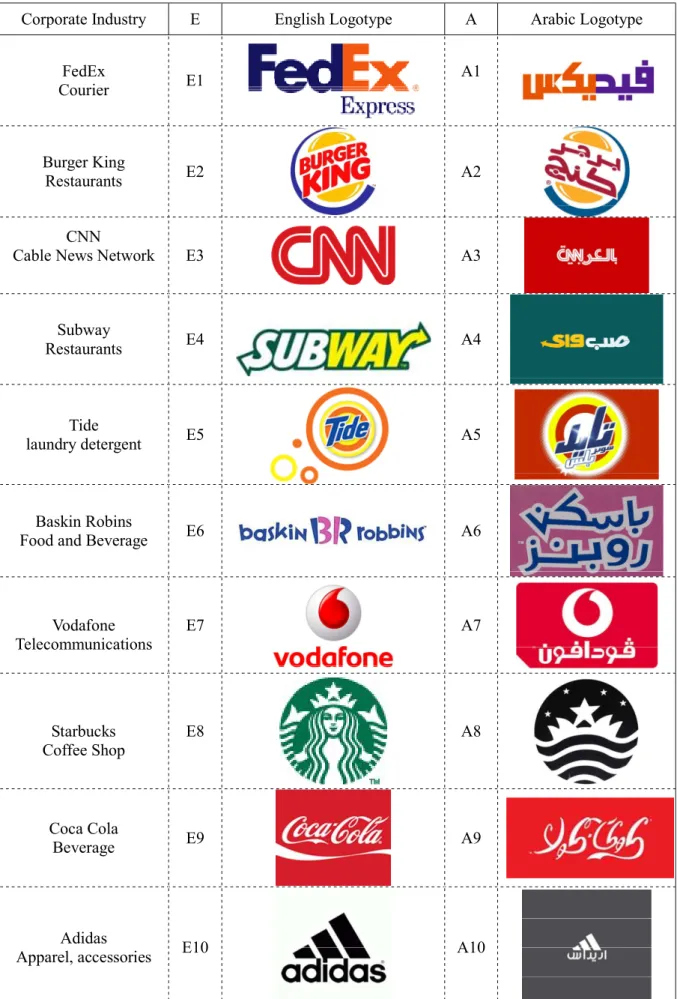
10. Figure 4.1: International Corporate Logos………..………...…….26
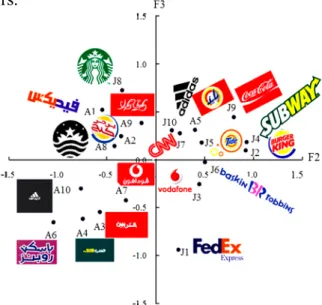
11. Figure 4.2: Average Scores of Factor 1 and Factor 2………...29
12. Figure 4.3: Average Scores for Factor 2 and Factor 3……….29
13. Figure 4.4: Variety of Corporate Logos………..……….36
14. Figure 5.1: Japanese & Arabic Products Logos………..………54
15. Figure 5.2: English & Japanese Products Logos………60
16. Figure 6.1: Logo Design Guidance for Japanese Consumers………..66
17. Figure 6.2: Logo Design Guidance for Arab Consumers………69
18. Figure 7.1: FS and Plan Flowchart………..72
19. Figure 7.2: Logo Structure..……….74
20. Figure 7.3: Logo Elements………..74
21. Figure 7.4: Logo Design by (Ai)……….74
22. Figure 7.5: Logo Evaluation Graph……….75
23. Figure 7.6: Natural Mineral Water Label………76
24. Figure 7.7: Japanese Cracker Label………76
ix
TABLES
1. Table 1.1: Arab World………...2
2. Table 3.2: Example of Variable Communality……….18
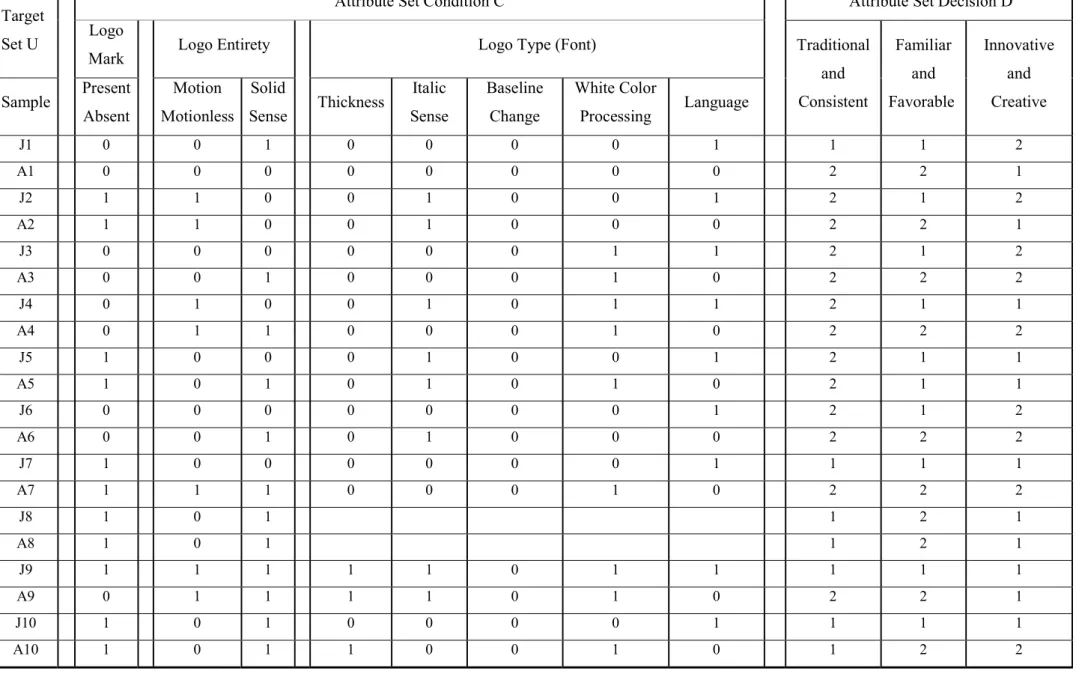
3. Table 4.1: International Corporate Logo Attribute………..24
4. Table 4.2: Factor Loadings………..………28
5. Table 4.3. Decision……..………...……….31
6. Table 4.4: Contraction……….33
7. Table 4.5: Factor Loadings………..………37
8. Table 4.6: Truth…….………..42
9. Table 4.7 Prime Implicants………...45
10. Table 4.8: Coverage of Minterms by Prime Implicants………...46
11. Table 4.9: The most Parsimonious Solution………46
12. Table 5.1: Factor Loadings………..55
13. Table 5.2: Cluster……..………...57
14. Table 5.3: Distribution of Cases in Cluster………..58
15. Table 5.4: Factor Loadings………..61
16. Table 5.5: Cluster………..………...63
17. Table 5.6: Distribution of Cases in Cluster………..64
1
CHAPTER 1 BACKGROUND 1.1 Introduction
The Arab world was once a global commercial hub laying at the intersection of the three continents. Arab traders shipped goods between Asia, Africa, and Europe crossing vast expanses of land and sea. However, the world’s center of gravity subsequently shifted toward the West and the Arab world’s fortunes faded and the caravans traveling the Silk Road, linking Asia to Europe, all disappeared. There is no accurate data about caravans and caravan trade before the beginning of the 2nd millennium BC, however, one references can be gained form South Arabian land inscriptions where evidence of long-distance trade in the early 2nd millennium clarifies that caravan occurred from approximately 1950 BC.
Figure 1.1: Silk Road (Silk Road’ routes illustrated by author)
■ Arab World ■ Caravan Route ■ Ocean Route
Although profound evidence from the fact that among the treasures kept at the Shosoin storehouse in Nara revealed that various handicraft items of Persian origin, including glassware and musical instruments bearing depictions of camels have been used by Emperor Shomu (A.D.
701-756) in ancient times, literally the existence of some active trading exchanges between Japan and the Arab world seems far away from reality historically because caravan route stopped at the end of East Asia land, what is called today Korea and ocean route ended at Malay islands. Figure 1.1 shows caravan & ocean routs of Silk Road as is being historically registered.
2
The relationship between Japan and the Arab world grew during the second half of the 19th century as a result of Japan’s victory in the Russo-Japan war of 1904-1905. A warm friendly shared sense of nationalism for being members in the same Orient. After the World War II, Japan’s relationship with the Arab countries developed gradually in conjunction with the recovery of Japan’s economy. The fourth Middle East War and the oil crises in the 1970s, the Iran-Iraq War in the 1980s, and the Gulf War in the 1990s were factors behind Japan’s growing interest in the Middle East. Recently the relationship between Japan and the Arab counties has strengthened steadily, particularly in the diplomatic and economic spheres. Japan and the Arab world countries have traditionally built strong ties in energy-related fields. Japan depends on the Middle East for approximately 90% of its crude oil imports and 9.7 trillion Yen of overall import from the Arab countries indicating extremely interdependent economic relationship between Japan and the Arab world. Since The Arabian region is recently at turning point in terms of democratization and reform processes, the political and economic stability in this region, which was the site of the Middle East War and numerous other conflicts, is considered to be extremely important to the peace and stability of Japan and the rest of the world. The Arab world as is categorized in Table 1.1, which had once been known as the Arab caravan spread out trade among Asian, African, and European contents, cannot compete today’s international trade arena by only oil revenue. A number of Arab countries such as GCC (Bahrain, Kuwait, Oman, Qatar, Saudi Arabia, and UAE) are becoming much more aware of products diversification and quality control needs to set foot in today’s global market. Recently the importance of globalization has become crucial to the evolution of Arab entities from low cost production to higher cost premium production in marketplace. Some Arab countries such as KSA (Kingdom of Saudi Arabia) has adopted a plan for exchange students to study in different countries abroad.
As this plan moves forward, efforts should be made to increase the number of foreign students who find employment in Japan’s creative content industries. The plan goal would be to develop a good understanding of foreign cultures and create new employment opportunities in a variety of industries.
Table 1.1: Arab World (22 Courtiers)
Arabian Peninsula North Africa Middle East
GCC Yemen Algeria
Chad Comoros Djibouti Egypt Mauritania
Libya Malta Morocco Somalia Sudan Tunisia
Iraq Jordan Lebanon Palestine Syria Bahrain
Kuwait Oman
Qatar Saudi Arabia UAE
3
1.2 Research Reason
Although history recorded strained relationship between the Arab and West due to the imperialistic attitudes of Western, Japan has none of the historic residues of imperialism against the Arab world. For this reason the possibility of having fruitful relationship between Arab and Japan is extremely high. Fortunately, with the present announcement of the International Olympic Committee (IOC) that upcoming 2020 Olympic Games is scheduled to be held in Tokyo and with various initiatives of Japanese government aimed at increasing foreign visitors to Tokyo and stimulating greater foreign products consumption, Arabian products are beginning to spread throughout Japan reginal market. However the lack of resources in Japan, the Arab world with its resource of oil has been important to Japan great economic development.
Although Arab oil contribution to Japan is historical, it is unfortunate to declare that Japan’s image in Arab world is still ambivalent in contrast to the Arab world where people’s image in Japan is being extremely positive due to the diverse curricula of compulsory education being taught in most of the Arab countries. Although this had reflected trade relation unfavorably between both ends (Tatsuki, 2011) “made in Arab” products have begun to increase recently in Japan marketplace, in part, as a result of the development of diplomatic and commercial communications between Japan and Arab countries (Okai at el 200). Since Japan has adopted English in compulsory education even daily life Japanese people have become much more knowledgeable of English language alphabets than other alphabetic foreign languages (Adams at el 2003). The need for appropriate image of Arabic alphabetic logotype design to influence Japanese people positively is compelling. As the marketing strategies are evolving from company-centered rational solutions to customer-centered emotional solutions the concept of Visual Identity (VI) has become the new trend in the global market. Well-known trademarks, logos and other corporate identity designs are valuable assets of the companies that own them and an integral part of the persuasion efforts. Many companies concern themselves with maintaining the value of these visual assets. Logo designs appear on advertisements, packaging, annual reports, letterhead, business cards, signs, and are incorporated into the designs of the products themselves (Zhang at el 1998). Identifying the brand of a product by recognizing the logo is a major aspect of the purchase process (Yorkston at el 2004) and is a particularly important function in this age when so many brands and promotional messages compete for consumer attention. Surely the Arab logo design industry has being growing but not to the level of recognition in international market. Thus all size of Arab corporate including small and medium enterprises (SMEs) became more concern about corporate and products logos design.
4
Non arguably it is fair to tell that some institutions with broader diverse participation, may also sometimes causes unintended negative consequences, the integration of positive approach to diversity results positively and reveals complementary directions for future. A positive approach to diversity can more powerfully facilitate making diversity a resource for positive outcomes in commercial sector. In this research we assume that diversity is the outcomes of cultural differences generated by people behavior and that culture differences would likely influence diversity outcomes and visa-versa. Figure 1.2 represents diversity causal model that guided the design of this study. We hypothesized our model based on comprehensive reviews of a number of diversity empirical studies (Richard at el 200).
Figure 1.2: Diversity Causal Model
The awareness level of cultural differences between Arab and Japan nations is what determine diversity’s performance whether would likely be positive or negative and how Arab and Japanese people percept each other. The trend of globalization has made the different culture walk onto a worldwide stage (McLean at el 2010). In the business world, culture is treated as an important contribution to success. Since the historic background and geographic situations are different from Arab to Japanese people, Arab and Japan cultures have more differences, less similarities in general. Cultural influence on language mainly embodies in cultural differences' influence on language. The use of a country language is not separable from its culture. Arab culture is quite different from that of Japan culture due to linguistic substantial differences.
There are several different aspects between Arabic and Japanese in the information processing of natural language where in contrast to Arabic as an alphabetic language, Japanese characters are regarded as elements of words, at the same time, they function to characterize the syntactic or semantic classes of words and express word boundaries in a character string. In particular, Japanese language logographic script has been widely used in psychological studies as experimental materials to examine cognitive processing comparing to alphabetic language systems. However graphic Arabic alphabetic and Japanese characters are to be creative to people by own calligraphy uniqueness (Tsuzuki, 1993).
People behavior
Cultural differences Outcomes
Diversity
5
1.3 Research Environment
In order to provide an academic basis for defining the research environment and its impact on this research, it is necessary to articulate a conceptual framework that delineates the various components of this environment and the relationships between these factors. In this chapter, we will specify factors of both internal and external relationship to the research organization that is relevant to understanding the procedures of this research planning and implementation. We found that empirical researches concerning Japan and Arab corporate logos have not been conducted yet by any organization in both ends, surely after running a preliminary inspection based on face to face consultation with recognized organizations such JETRO (Japan External Trade Organization) and others. Thus, we drew a general framework proposal of organizations and the interrelationships between and among relevant factor. Fairly Japan may well have much in common with other countries in matters of family life, childrearing, and personality development but when comparison is limited to the Arab world, the differences may appear to be more prominent. The external conditions influence the inputs into variables for this research and also affect the outputs of its results directly. Similarly logos structures and their elements are interrelated and influence one another in multi-linear relationships. Relatively understanding the psychological personality traits of two different societies in ethnic and culture is unbearable. The endeavor to compare between Japan and Arab people personality encompasses internal variations within Japan and Arab boundaries. In compulsory education, large numbers of Arab learn and study about Japanese people but not vice versa since what is taught in Japan does not what so ever reflect the true Arab personality. We hope that our work will persuade researchers for future psychological studies for Japan and Arab because it obvious that Japanese need better understandings of Arab personality. Our concern of finding much more explicit analyses methods for psychological studies was primary as well as our attention to synchronic and diachronic comparisons between Japan and Arab corporate logos because of the lack of guidance. The operation of analyses methods shall identify the significant - psychological influence of a variety of corporate logos differing in ethical and cultural aspects towards Japanese and Arab’ perceptions. We anticipate that participants’ impressions of the same experiment differ by ethnic and cross culture sets of activities. Structurally, building the frame work for this research was compartmentalized into various subunits of logos elements and psychological influence against personality perception traits, including advisory groups of professors, participants from Japan and Arab, and few interested Japanese SMEs. Thus the inputs and resources for this research were extracted from a diverse organizations and finally
6
associated with a study case for evaluation although the levels and sources of funding for it was all provided by the researcher alone as our research environment related organization participants preferred to provide only technical advice and comments. However the outputs were well-deserved and persuasive for future work, luckily.
Figure 1.3: Research Environment
Although it is a bit of a paradox saying that American culture has become the world’s most widespread and influential today. Indeed, it has become so powerful and ever-present that some fear it may actually interrupt their own national cultures as America’s position in world has become dominant right after World War II in 1950s, when American popular culture went global. This was the reason to broaden our comparison to including American corporate logos aside Japanese and Arab corporate logos. Figure 1.3 depicts the environmental elements of research related organizations, showing the relationships among the inputs and the outputs of that are carried out by individually by researcher. The outputs and outcomes will definitely affect future inputs of further works. However, all of these mentioned elements exist within the context of organizations of distinct cultural and behavioral background. As far as the overall level of budget available for this research, the level of funding coming into from research related organization was too limited but did not affects its implementation plan. The impacts that the level of funding may have on the conduct of a research could be unfavorable when not available. Since there has been only limited evidence to clarify the importance level of this research to the university professors board members, the environment in which the research had been conducted was competitive and at high risk for engaging in misconduct, particularly when they came to face a diverse situation of Arab culture that they lack access to acquiring its Knowledge, hence expectations for success was poor.
Related Organization Outputs
Inputs
- Board Professor Advisory - Japanese Small & Medium Sized Enterprises (SMEs) - Arab Small & Medium Sized Enterprises (SMEs)
- Logo Design Guidance - Case Study
- Future work (Artificial Intelligent Tokyo Metropolitan University
(TMU)
Japan External Trade Organization (JETRO)
Japan International Cooperation Agency (JICA)
American & Japanese SMEs
7
1.4 Research Purpose
Since researches on logo design are as important as logo design, we did not want to start this research without well- preparation because poor preliminary inspection is likely to influence the research unfavorably and prevent understanding its relevant problems. Our research environment allowed us to understand those problems we might face during research implementation, which in a way will enable us to design appropriate solutions meet the purpose of this research and can be presented with confidence in any conference with the association of knowledge needed to back up our arguments. What logos should we study? How much knowledge of foreign marketplace do participants have? Are two key questions and areas to focus preliminary inspection on before research start? Logos basically comes with ethos of different business in many forms for such as ownership, management, products or service, and others. Before designing process take place by designers it is essential that we understand logos vary by reasons of designing. New logos, old logos, redesign logos of corporate are endless.
While young corporate may have designed the logo in-house with fair quality, new brands and well-established businesses will, however, have high-quality logs design. Ensuring that we had a comprehensive understanding about the past and current situation of corporate trend and logo design change happening alongside was important to simply decide to choose corporate logos randomly for meaningful data. Since the consumers are targeted by corporate based on marketplace location as one factor among others, the demographics of consumers’ behavioral reaction towards foreign logo designs may not be accurate when interacting for the first time.
For this case, we provided brief verbal introductory about corporate origin and consumer marketplace before survey conduction to maintain some sort of understanding of corporate intended objective and ideal consumer, what message is trying to communicate with its target consumer, and how does it want consumer to feel when they engage with the brand. This will often heavily influence the consumer response. Although the Japanese government extensive effort in the Arab world that helped many Arab countries maintaining their progress over the last decade in terms of rolling out education access and information and communication technologies (ICT), gradually improving the institutional environment for private-sector led growth, most of the Japanese companies still regard the Middle East only as a region that poses risks to the running Japanese economy which is, in reality, just a sole negative perception of the Middle East that does not anyhow support the Japanese government effort in the Arab world. In response to this problem, we would like to conduct an academic research of how we can strengthen the business relationship between SMEs in Japan and the Arab world.
8
1.5 Research Objective
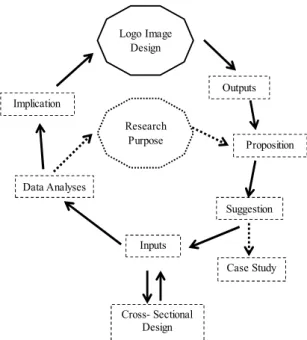
Relatively logos are important assets to corporate and products. Identifying and understanding various factors that influence consumer perceptions of logos is one key aspect in creating in building corporate identity and products trademark. The current exploratory research investigates several factors of logo design that may influence consumer personality. Traditional research in logo design, particularly the study by Ohkata and Yamashita (2007), has identified numerous factors that influence consumers’ personality response to logos. However, in this study, benefiting from previous research, we proposed to explore several factors that influence consumer responses to logos between Japan and Arab world through more controlled experimental designs. Particularly, we intended to conduct a multi-comparative analysis on corporate and products logo between Japan and Arab to grasp logo most influential factors that can be used as guidance for logo designers. We firstly begin the process of investigating the differences between Japanese and Arabic versions logotypes’ influence of well-known international corporate on Japanese people, secondly comparing the influence between Japanese and Arabic logotypes of the same products on Japanese people, thirdly conducting a comprehensive study between a variety of English, Japanese, and Arabic logotypes that included globalization as a factor that influence Japanese consumer responses. Finally, to increase the generalizability of the results, we pass an additional study in Arab (UAE) comparing Japanese and English corporate logotypes on Arab people and implement a case study as Figure 1.4 below.
Figure 1.4: Research Design
Logo Image Design
Research Purpose
Outputs
Suggestion Inputs
Data Analyses Implication
Cross- Sectional Design
Proposition
Case Study
9
CHAPTER 2 RELATED RESEARCH
As globalization keeps expanding throughout the world, nowadays lots of corporate and products are being introduced to marketplace by Arabic calligraphy logotypes in order to get consumers attention. As the matter of fact the application of simple circularity and angularity as well as language calligraphy in logo design is likely to be powerful enough to affect one’s perception and therefore consumer behavioral response counts mainly on logo image caused by elements used in design.
Many of these paper topics of logo design are still fairly broad. What makes a topic successful isn’t necessarily that it’s presenting an ideas throughout one angle, but that it might take a look at an idea from different perspectives or that it delivers new ideas. Logo design is rich subject with an abundance of areas to study. Naturally, this makes choosing a research theme a bit difficult at times, especially if not such research have been approached yet.Relatively a great number of professional journals are being published containing research studies that are relevant to ours from a growing array of references. Research contents will vary in terms of quality as it may seem in some published researches due to aspects of research design. Our research plan was conducted based on systematic procedures, from problem identification to conclusion through data collection and methods of analysis used to create our work.
We believe that our research topic should fits its background, purpose, and objective and more importantly it is needed. Feelings of uniqueness and creativity for what we’re going to investigate genuinely between Arab and Japan shall be favorable for both ends. The interest of studying visual signs had started way before in the 19th century when most visual sings researches were either syntactic or semantic and therefore the interpretation of visual sign kept vague until the 20th when pragmatic features of visual sings studies took pride in research course (Maciej, 2005).
Nevertheless the visual sings of logos for corporate and products are their valuable identity and assets since, in addition to, the cognitive responses by individuals of identifying the logo and remembering information, logo design can also elicit affective responses by individuals’
personality traits and charge memories of experiences with associated corporate image or products. According to the discrepancy hypothesis (Haber 1958; Hansen 1972) visual sign of logos allows psychological effects to influence people perception. Relatively people are
10
conditioned to respond to logos visual stimuli and then become adapted to a particular stimulus, but slightly altered versions of stimuli for a logo design would result in an effect of preference for a particular stimulus than others. It assumes, that traditional research of logo design is consistent with logos elements analysis representation, whereas, logo designers’ claim, the primary functioning logotypes in marketplace without logical explanation. Some well-reputed researchers specifically addresses preferences for changes in logo designs and have implemented leading work for logo analysis and left rich exploratory studies as references.
In 1998 Henderson and Cote, investigated various designing elements of logos. Previous academic research regarding preference for visual images had been characterized by tightly controlled experiments. These studies examined very specific variables such as the effect of time on preference for logo colors (Zuber & Ekehammar, 1988).
Another study in 1988 to recall is the one of Irena & Ekehammar who used different logo designs as stimuli and found differences in the way naive and trained viewers would interpret logos, followed up on an emergent finding from the first study, that an individual with more visual design background evaluated visual images differently from those with less background in visual design.
Traditional research on logo design, particularly the study by Harmon developed a succinct listing of the seven factors that have shown the most robust familiarity effects in 1995. Further related large body of research exists on the psychological effects of corporate logos by Janiszewski (2001), Melewar (2005), and Mori (2004)
The trend of globalization accelerates the occurrence of international trades. Cultural differences between Arab and Japan are awaiting to be discovered by researchers in order to keep pace with globalization. More recently, drawing upon much more sophisticated psychological researches on logo design effect, well-reputed Japanese researchers begin the process of exploring several factors that influence consumer responses to logos through more controlled experimental designs particularly based on new methodology. Ohkata & Yamashita (2007) hypothesized that logo design psychological influence comprises of three effects: 1) Recognition, 2) A common shared meaning, and 3) Positive effect which was consistent with later study of logo design perception and consumer response by Der Lans, R. V., Cote, J. A., Cote, C. A., Leong, S. M, Smidth, S., Henderson, P. W, Bluemelhuber, C., Bottomley,P. A.,
11
Doyle, J.R., Fedorikhin, A., Moorthy, J., Ramaseshan, B., and Schmitt, B. H. in 2009 which suggested that elaborateness, naturalness, and harmony seem to be designing factors that exist across stimuli. Even when the design elements are quite different, these three factors appear repeatedly also across cultures.
Logo colors correspond psychologically with consumer awareness, thus designers focus on selecting colors that represent high values in corporate or products. In an emotional connotations of color a study was done by Clarke, Tom, and Alan in 2008 explored how the psychology of color influences consumer purchasing behavior as it pertains to corporate product logos design, it was found that designers use color associations in logos to promote corporate and increase products marketing. Moreover it suggested that colors are likely to be associated with visual state, for instance blue color impart sense of cleaning state while green color reflect nature, therefore the first is widely used for clean related corporate and products and the latter is used for healthy food industry.
Apparently our preliminary investigation showed that researches with key words such as logo design or logos psychological effect and others are between hands and it is not very hard to aggregate a list of researches such as above. But we did not find any study that is directly related to our research theme. Therefore, it really calls for an action especially at that time when Japan has started strengthening foreign relationship with Arab world. Although a research on logos of pictorial and alphabetic characters is crucial to study, it is not easy task to analyze differences between Arabic and Japanese logotypes, where each logographic character is likely to impart distinct image to consumers (Philiastides & Ratcliff, 2013).
Arabic and Japanese logotype psychological influence is in awe because of the new and increasing amount of trading between both areas. Arabic logotypes influence Japanese people personality with cultural difference evolving today, yet most Japanese are kept up-to-date with confusion to whether or not accept Arabic logotypes usage in Japan marketplace. Anticipating and understanding cultural differences and being able to adapt the way we communicate accordingly is the foundation of any successful relationships between nations. Our research raises awareness of cross-culture differences between Arab and Japan ethnics, and serves as a reference for those Japanese people who seek to adapt their communication skills to the international arena. Hence, when designed our studies for research, we focused on selecting different elements for Arabic and Japanese logotypes.
12
CHAPTER 3 METHODOLOGY
3.1 Research Concept
The importance of branding has become crucial to international corporate in marketing from low cost to higher cost premium products. The success in introducing logo corporate can only be reached by the continuous observation of global strategies. As small and medium sized enterprises (SMEs) evolving from local to international marketplace logo design has become the new trend in global market strategies. Commonly, international corporate try to take advantage of familiarity effects in order to develop greater preference for the logo and the brand, through repeated exposures of the logo. Some logos, such as the Coca Cola trademark, have remained the same for decades. Many corporate, however, also wish to take advantage of novelty effects (Suzuki &Yamamoto, 2013) or to avoid boredom effects. Consequently, many logos, such as Burger King has evolved over the years through successive changes as is shown in Figure 2.1.
Figure 3.1: Example of Logo Changes (Bur King)
A corporate logo is the relationship between the corporate and people. Thus designing influential logo is significant for international corporate in foreign countries. Building and enhancing a corporate brand is extremely competitive in nowadays global market. Among the brand strategies used by all sized of Enterprises is logo design, which is the most visually appealing means in commercial advertisements for consumer products. Logos appear in TV commercials, packaging and product designs, letterheads, business cards, print advertisements, and annual reports, among others. Logos are a critical in-store recognition aid, speeding selection of the preferred product. A large body of research exists on the psychological effects of corporate logos (e.g., Janiszewski et al. 2001, Melewar et al. 2005, Mori et al. 2004). Ohkata and Yamashita have aggregated these studies into three effects: 1) Recognition: Consumer awareness of corporate logo existence, 2) A common shared meaning: Commonality between consumer perception of corporate logo and corporate intended logo image, and 3) Positive Logo 1954 1954-1957 1957-1969 1969-1994 1994-1999 1999-present
Burger King
13
effect: Corporate logo favorable impression on consumers. Since these three effects not only persuade consumers in their purchasing decisions but they also support companies with needed human resources employment as well as increasing corporation employees’ motivation, in this way, it is arguable that the influence of corporate logos is significant (Okata & Toshiyuki, 2007).
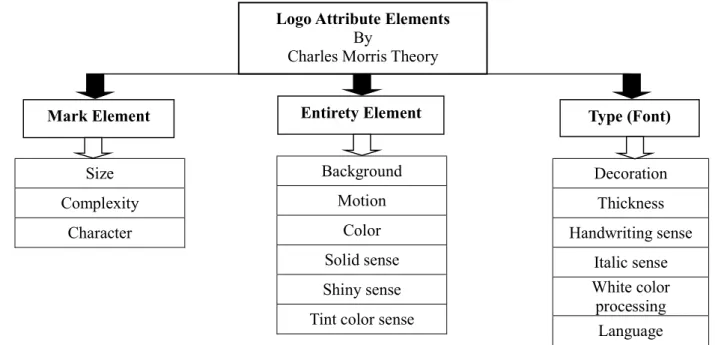
The concept of our research was triggered by Charles Morris Theory (Morris 1964). Charles laid down the foundation of the Theory of Signs in 1938 suggesting that comparative semiotic investigation between measurable quantities of signs is divided into three kinds: 1) Syntactics:
it deals with formal relations between signs in abstraction from their signification and their interpreters, 2) Semantics: It examines the relations between signs and their referents independently of the way signs are used, and 3) Pragmatics: The study of the “relation of signs to their interpreters. The third is our concern because it defines logo attribute elements which we need to investigate the influence of logo image design on people as is categorized in Figure 2.2. Recently pragmatic features investigation turn in modern philosophy of language due to globalization where the meaning of a word is its use in the language, giving rise to the development of various kinds of investigation. Therefore, we argues that the use of a comparative analysis, especially when the boundaries between the phenomenon of and the context are not clearly evident and that a renewable knowledge derived from a comparative analysis could be classified as more direct and realistic, rather than theoretical. To reach a good result, this study should provide a comprehensive comparison between Arab and Japan Logos which would generates hypothesis by combining complex phenomena (Yin, 1994).
Figure 3.2: Logo Attribute Hypothesis Size
Complexity Character
Background Motion
Color Solid sense Shiny sense Tint color sense
Decoration Thickness Handwriting sense
Italic sense White color
processing Language Mark Element
Logo Attribute Elements By
Charles Morris Theory
Type (Font) Entirety Element
14
3.2 Analyses Method
The approaches on which we have chosen to focus as frameworks for analyses method share certain key premises about how “Human Perception” is to be understood. They also have in common the aim of carrying out critical explanatory research, that is, to investigate and analyze relationships between one emotions towards particular objects within society. The formulation of normative perspectives from which a critique of such relationships can be made with an eye focus on the possibilities of globalization although, each perspective has a range of distinctive philosophical and theoretical premises, including particular understandings of sensory analytic methods. For decades, the word “Human Perception” has been a fashionable term used indiscriminately, often without being defined. The concept has become vague, but rather different, meanings in different contexts with human psychological reactions towards tangible and nontangible objectives. In many cases, underlying the word “Perception” is our general sense when we take part in different domains of our social life. In order to construct a coherent framework between Arab world and Japan for this research, it is crucial to be aware of the philosophical, theoretical and methodological differences and similarities among analytic methods. Although our knowledge of the world may not be treated as objective truth.
Perception is only accessible to us through sensational categories, so our knowledge and representations of the world are not actually the reflections of our reality but rather are products of our ways of categorizing the world itself. In this chapter, we will individually introduce three psychological different approaches to perception analyses: 1) Factor analysis, 2) Rough Sets Analysis, and 3) Cluster Analysis. We decided to select these approaches from the range of different perspectives within human sensory analysis on the grounds that we think that they represent particularly fruitful theories and good comparative methods for our research between Arab world and Japan history, culture, tradition, language, and society. Obviously, this requires an overview of the field. The aim of our presentation of the three perspectives is to contribute to the acquisition of this overview by introducing the key features of three important sensory analytical methods benefiting from other academic works concerning these features. It is important to stress that different perspectives provide different forms of knowledge about a phenomenon so that, together, they produce a broader understanding in the light of these considerations. The three analyses methods on which we have chosen to concentrate are all based on a range of new theories about culture and society known as social constructivism. Our analytics tool is just one method among others shared by empirical researches in psychology.
15
3.2.1 Factor Analysis
By way of orientation, we will present a comprehensive conceptual review of Factor Analysis method. Factor Analysis is a statistical toll that measures the impact of a few un-observed variables called factors on a large number of observed variables. It is used as a data reduction method. It may be used to uncover and establish the cause and effect relationship between variables or to confirm a hypothesis. It is often used to determine a linear relationship between variables before subjecting them further analysis. Factor Analysis is often conducted by the application SPSS. It is an open source programming package used for statistical analysis and we can use it to conduct exploratory factor analysis as well as confirmatory factor analysis.
Factor Analysis is also extensively used in the field of market research related to product attributes and perceptions as well as sensory evaluation. The detection of psychological effect towards human sensory are some crucial areas where Factor Analysis is widely used along with other quantitative research and analysis tools. When confrontation with entangled behavior, unknown interdependencies, masses of qualitative and quantitative variables in data, many social scientists tend to apply Factor Analysis to uncover main factors and simultaneously manage over a large number of variables and disentangle complex interrelationships into their main distinct regularities. In mathematics, however, it is a complicated method that entails numerous considerations in an application. Several groups of variables have been proposed to explain or describe the complex variety and interconnections of visual images and one’s personality. In our research, since hypotheses abound regarding dimensions of human behaviorism and sensory in respect to graphic image of corporate and products logos, we used factor analysis to test logos features influence on people perception and clarify major factors in which logos features and one’s perception should be related to appropriately postulated dimensions. Besides those relating to dimensions, Ohkata and Yamashita have aggregated logo main attributes: 1) Logo mark, 2) Logo Entirety, 3) Logo type (font) as well as logo image perception: “1. Energetic: motion sense”, “2. Innovative: inspiration sense, “3. Familiar:
recognition sense”, “4. Consistent: solid sense”, “5. Reliable: professionalism sense”, “6.
Favorable: goodness sense”, “7. Traditional: custom sense”, “8. Promotable: progress sense”,
“9. Futuristic: vision sense”, “10. Creative: skill sense”, “11. Characteristic: feature sense”, and
“12. Luxurious: class sense. A large body of research exists on the psychological effect (e.g., Janiszewski et al. 2001, Melewar et al. 2005, Mori et al. 2004) have hypnotized the magnitude of involvement of above variables. The systematic and correlations among these variables to be measured only on rank order scales can be done by the face of well-constructed questionnaire.
16
3.2.1.1 Mathematical Model
In application, there are not one but several factor models which differ in significant respects.
A model most often applied in psychology is called common factor analysis. Indeed, psychologists usually reserve the term "factor analysis" for just this model. Common factor analysis is concerned with defining the patterns of common variation among a set of variables.
Variation unique to a variable is ignored. In contrast, another factor model called component factor analysis is concerned with patterning all the variation in a set of variables, whether common or unique. Other factor models are image analysis, canonical analysis, and alpha analysis. Image analysis has the same purpose as common factor analysis, but more elegant mathematical properties. Canonical analysis defines common factors for a sample of cases that are the best estimates of those for the population; it enables tests of significance. Alpha analysis defines common factors for a sample of variables that are the best estimates of those in a universe of content (Tabachnick & Fidell, 2007).
3.2.1.2 Geometric Model
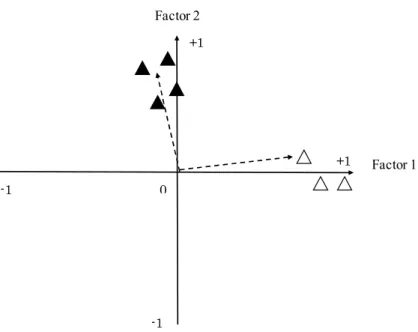
Factor analysis can be examined through a geometrical approach to gain a better understanding of how the technique works. In a coordinate system, the factors are represented by the axes and the variables are lines or vectors (Mulaik, 1972). When a variable is in close proximity to a certain factor, this means that the variable is associated with that particular factor. When there are more than three factors, this exceeds the three-dimensional space thus the dimensions are represented in hyperspace (Kim & Mueller, 1978). Figure 2.3 is an example of geometrical representation for factor analysis in two dimensional space and the variables plotted as a function of the factors. The factor axes act as a reference frame to determine where the data-variable vectors can be placed by giving factor loadings or coordinates, that is, the numerical labels on the axes represent factor loadings (Comrey & Lee, 1992). The length of the vector is equal to the square root of the communalities; variance explained by the common factors. Using Pythagorean Theorem (a2 + b2+ c2) the squared hypotenuse can be found if the other two variables are known by the following formula: c2 = √ a2 + b2 . The cosine of the angle between the variable and the factor gives insight to the correlation between each variable and each factor (Gorsuch, 1983). The correlation between a vector and one of the factors or with another variable (vector) can be determined as a function of the angle between them. In the
17
equation r12 =h1h2 cos⍺12, the length of the vector is represented by h. The length of the first vector times the length of the second one times the cosine of the angle between the two vectors will give the correlation. Since all the variance in a factor is included in the dimension that it defines, its length is 1.0 (Comrey & Lee, 1992).
Factor 1 0
Factor 2
+1 +1
-1
-1
Figure 3.3: Example of Geometrical Factor Analysis Representation
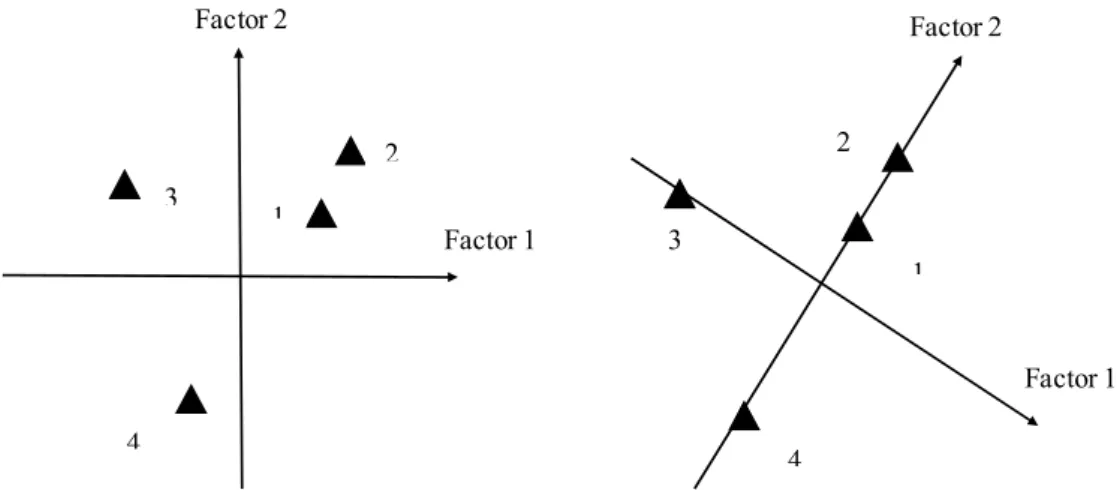
Although Factors successively define the most general patterns of relationship in the data, Factors are rotated for better interpretation since un-rotated factors are ambiguous. The goal of rotation is to attain an optimal simple structure which attempts to have each variable load on as few factors as possible, when the first factor solution does not reveal the hypothesized structure of the loadings, it is customary to apply rotation in an effort to find another set of loadings that fit the observations equally well but can be more easily interpreted. In our example in Figure IV, it shows that white triangles load onto factor 1 and black triangles load onto Factor 2.
As it is impossible to examine all such rotations, computer programs carry out rotations satisfying certain criteria. Perhaps the most widely used of these is the varimax criterion. It seeks the rotated loadings that maximize the variance of the squared loadings for each factor;
the goal is to make some of these loadings as large as possible, and the rest as small as possible in absolute value. The varimax method encourages the detection of factors each of which is related to few variables. It discourages the detection of factors influencing all variables. The quartimax criterion, on the other hand, seeks to maximize the variance of the squared loadings for each variable, and tends to produce factors with high loadings for all variables. But not used in behavioral psychology.