Introduction
Intensity modulated radiation therapy (IMRT) is a treat- ment that concentrates a radiation dosage in a target vol- ume
1. The normal tissue dose can be reduced to the greatest extent by optimization calculations according to the treat- ment plan
2. Simulations need to be performed to investigate the effect of secondary radiation on these optimization cal- culations, with corrections based on differences in pene- trated organ density. For this purpose, highly complex cal- culations and verification experiments using a phantom are
necessary prior to the treatment by a method called inverse planning
3.
The exposure time in IMRT (150 to 300 seconds or more) is generally longer than that in conventional radiation ther- apy because IMRT employs many narrow photon beams
7. Moreover, according to the algorithm used for the optimi- zation calculations, the dose in the vicinity of the body sur- face, such as the breasts and eyes is affected by factors such as the airspace surrounding the body; thus, the optimized calculation value for the treatment plan and the actual ab- sorbed dose might not be in agreement. The likelihood of Address correspondence: Department of Radiological Sciences, Nagasaki University Graduate School of Biomedical Science, 1-7-1 Sakamoto, Nagasaki 852-8501, Japan
TEL: +81-03-3816-2129, FAX: +81-03-5803-1990, E-mail: [email protected] Received Fabruary 2, 2010; Accepted November 30, 2010
MS#AMN 07076
Peripheral Organ Dose Evaluation using a Human Body Phantom in Intensity Modulated Radiation Therapy for Lung Cancer with Helical Type Accelerator
Shinichi G OTOH ,
1Yasuhiro K AWAHARADA ,
2Satoshi S UDA ,
3Masataka U ETANI
11
Department of Radiological Sciences, Nagasaki University Graduate School of Biomedical Sciences, 1-7-1 Sakamoto, Nagasaki 852-8501, Japan
2
Department of Radiological Technology, Gunma Prefectural College of Health Sciences, 323-1 Kamioki-cho, Maebashi-shi, Gunma 371-0052, Japan
3
Oncology Center of Hidaka Hospital, 886 Nakao-cyo, Takasaki-shi, Gunma 370-0001, Japan
Purpose: Intensity modulated radiation therapy (IMRT) is characterized by a relatively long period for beam exposure and consequently the risk for unnecessary exposure to non-targeted organs, mainly due to the scattered radiation, should be con- sidered. The puposes of this study are to measure the absorbed dose of the peripheral organs during helical IMRT using a fluorescent glass dosimeter.
Materials and Methods: In this research, we took lung cancer as a model and measured the absorbed dose of the periph- eral organs during helical IMRT using a fluorescent glass dosimeter. The planning target volume (PTV) dose of 95% was set to be 5 Gy in the phantom.
Results and Discussion: The highest exposure dose was observed for the breasts, which were on the PTV trajectory, with the left and right breasts receiving doses of 227.94 mGy and 371.90 mGy, respectively. The exposure doses of the left and right lenses were 3.13 mGy for the left lens and 3.22 mGy for the right lens. An exponential dose reduction to the distance from PTV was confirmed. Our data suggest that the doses for peripheral organs were acceptable in lung cancer case based on past literature search. However, the use of custom blocks for the eyes should be considered to prevent possible late occurance of cataract.
ACTA MEDICA NAGASAKIENSIA 55: 61−67, 2011
Keywords: helical tomotherapy, intensity modulated radiation therapy, peripheral organ dose, glass dosimeter
errors is especially high in the low-dose region because the measurement performance of the ionization chamber detec- tor is relatively poor at such doses.
The purpose of this study is to measure the absorbed dose of the risk organs during helical tomotherapy IMRT using a fluorescent glass dosimeter.
Materials and Methods Helical Tomotherapy
Helical tomotherapy is one of the most advanced IMRT equipment, which has computerized tomography (CT) based helical type exposure functions
4-6. In this system, radiation therapy is executed as the couch moves through the gantry, which rotates in the same manner as a CT apparatus for di- agnostic use. The beam used for exposure is a slit shaped narrow beam called a beamlet. As the apparatus rotates, the beam is modulated with exposure time, and thereby IMRT can be effectively performed
9-11. We smployed TomoTherapy Hi-Art System (TomoTherapy, Wisconsin, USA) for heli- cal tomotherapy. , The treatment beam energy was applied via a 6 MV convex beam without use of a flattening filter.
The radiation source to isocenter separation was 85 cm and the maximum irradiation field was 5×40 cm
2at the isocenter.
Fluorescent Glass Dosimeter
The beam generated in helical tomotherapy is a slit nar- row beam, which can be as small as 0.6×1.25 cm
2. For this reason, we used a fluorescent glass dosimeter, which is suitable for measurements in the low-dose region for ex- tremely narrow beams
8. A glass dosimeter (Asahi Glass, Japn) was used to measure the absorbed dose values in various parts of the phantom (RAN-100, THE PHANTOM LABORATORIES,INC., USA) (Fig.1). This apparatus util- izes radiophotoluminescence, a luminescent phenomenon which occurs when certain types of glass are struck by ul- traviolet rays after exposure to radiation. Fluorescent glass dosimeters exploit the chemical transition of silver ions in silver-activated phosphate glass; because the fluorescence center produced by the divalent silver ion (Ag
2+) or silver particles (Ag
0) due to the radiation is exceedingly stable, the loss of dose information, called fading, is extremely small at less than 1% per year. Moreover, as the fluores- cence center does not vanish when measured and can be re- peatedly read many times, the statistical accuracy of the measurements is enhanced and a stable measurement value can be acquired
12,13. We used GD-352 for the phosphate
glass element. In addition, we used it as a bare element without an additional filter for low energy and calibrated it with 6MV X-ray. As a result, the calibration constant we obtained was 1.16.
Experimental Measurements
We carried out absorbed dose measurements by estab- lishing a virtual target in the chest of a human-body phan- tom. Measurements were carried out at the locations corre- sponding to the left and right breasts on the exposure trajectory and at locations corresponding to the thyroid, pelvic region, and left and right crystalline lenses outside the exposure trajectory. We calibrated each detection ele- ment of the florescent glass dosimeter by using a standard- ized linear accelerator. Exposure was carried out with an ir- radiation field of 15 cm×15 cm and a radiation source to ionization chamber detector separation of 100 cm accord- ing to the 6 MV X-rays acquired from a standard linear ac- celerator (Varian Torilogy, USA). A conventional standard ionization chamber was used in this study (M30013, PTW, Germany).
For the treatment plan, we adopted a right lung cancer as
a model and set the PTV at 15 cm below the thyroid gland
(Fig.2). We assumed spheres of 2 cm in diameter for the
PTV. The exposure dose was established such that the dose
at 95% volume of the PTV curve in DVH for the treatment
plan optimized calculation was 5 Gy. We verified the model
for this treatment plan using an ionization chamber dosime-
ter (A1Sl, Standard Imaging Inc., USA) and a cylindrical
solid phantom (cheese phantom, TomoTherapy Inc., USA)
(Fig.3). This phantom is a cylinder of 30 cm in diameter
Fig. 1. Human body Rando-phantom on the Helical type accelera-
tor treatment couch.
and 18 cm in height. The phantom can be split in half from the central part, and the beam profile can be measured using EDR film. Also, there are holes for point dosimetry measurement, and the absorbed dose can be measured with an ionization chamber dosimeter. The absorbed dose as de- termined from actual measurements and the values from the optimized calculations for the treatment plan were com- pared in the region where the dose distribution inside the PTV was flat.
The absorbed dose of the peripheral organ was measured with a fluorescent glass dosimeter in the location of the left and right eyes, the thyroid, the left and right breasts, and the pelvic region. For this purpose, the florescent glass do- simeter was used in conjunction with an MIX-R
14of 2 mm in thickness for the left and right eyes and a MIX-R of 1 cm in thickness for all other locations. The basic ingredients of MIX-R were polyisoprene, sulfur, zinc oxide, stearic acid and Nocceler CZ. The florescent glass dosimeters were used in a set of five, and evaluations were carried out using the mean value. The X-rays used in helical tomotherapy had energy of 6 MV, which approximates 1.25 MV cobalt gamma rays. Thus, a conversion was carried out for the ac- quired absorbed dose by using the following equation, where 1 Gy = 1 Sv:
H = D・Q・N.
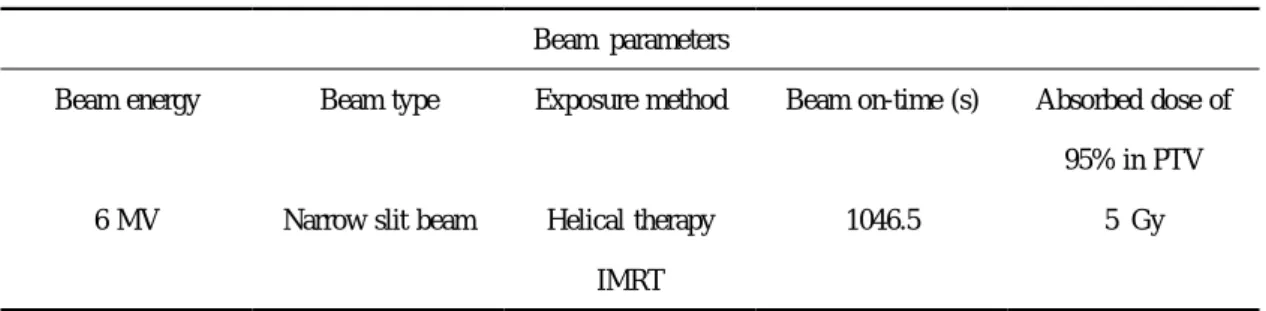
Here, H is the patient dose [Sv], D is the absorbed dose [Gy], Q is the beam quality factor [Q = 1 MV], and N is a correction factor [N = 1.0]. The treatment beam parameters at time of exposure are shown in Table 1. In addition, to in- vestigate the dose due to the change of dosimetry distance, we used a glass dosimeter to measure the relationship be- tween the distance and dose. This measurement was per- formed in the same manner as the measurement of the ab sorbed dose at the phantom body. Dosimetry was performed at the points along the central axis at 10, 20, 30, 40 and 50 cm from the axial plane including PTV center.
Fig. 2. A PTV position in the Rando-Phantom. (a) an axial and (b) an coronal CT images.
Fig. 3. Dedicated QA phantom used to verify the absorbed dose values acquired through the treatment plan optimization calcula- tions for IMRT and the beam profile. The dose profile on the coronal plane is measured by EDR-2 film. Then, point absorbed dose is measured by a small ionization chamber detector. We start radiotherapy when the actual measurement value shows variance within 3% of the calculated value in the treatment plan.
Beam parameters
Beam energy Beam type Exposure method Beam on-time (s) Absorbed dose of 95% in PTV
6 MV Narrow slit beam Helical therapy 1046.5 5 Gy
IMRT
Table 1. Exposure parameters used in optimization calculation for lung cancer treatment plan simulations.
Results
The measured doses were 3.13 mGy for the left lens and 3.22 mGy for the right lens. These doses were less than 0.1% of the established dose of 95% PTV at 5 Gy. The thy- roid received a dose of 13.26 mGy (0.27% of the PTV dose), which was an exposure dose of approximately 4 times higher than the dose received by the lenses, owing to the proximity of the thyroid to the PTV.
The left and right breasts, which were on the trajectory of the helical tomotherapy, received doses of 227.94 mGy and 371.90 mGy, respectively. This confirmed that the left breast on the non-treated side received an equivalent of 4.6% of the PTV dose and the right breast on the treated side an equivalent of 7.4%. The pelvic region received a dose of 1.47 mGy, which was the lowest exposure dose among the target measurements, owing to its distance from the PTV. This represented less than 0.05% of the PTV dose.
The relation between the distance from the PTV and the dose is shown in Fig. 3. The dose is exponentially attenu ated with increasing the distance from the PTV, 20 to 30
mGy at 10 cm, less than 10 mGy at 20 cm and around 2 mGy at 50 cm (Fig.4).
Fig. 4. Absorbed dose relation to the distance from the axis plane including PTV center.
organ No. 1
rod
No. 2 rod
No. 3 rod
No. 4 rod
No. 5 rod
Mean dose
a(mGy) SD
bRight eye 3.08 3.17 3.20 3.29 3.34 3.22 0.10
Left eye 3.15 3.16 3.09 3.14 3.12 3.13 0.03
Thyroid 13.35 12.75 13.16 13.17 13.85 13.26 0.40
Right breast
c292.90 350.40 395.50 389.90 430.80 371.90 52.57
Left breast
c235.60 243.20 239.60 202.50 218.80 227.94 17.02
Pelvic area 1.44 1.57 1.44 1.46 1.43 1.47 0.06
Table 2. Absorbed dose for each position during helical tomotherapy treatment as measured with a fluorescent glass dosimeter.
a
A group of five fluorescent glass dosimeters was used for each position of the phantom and the absorbed dose (mGy) was cal- culated as the mean.
b
SD: standard deviation
c