Competing Spin Liquids and Hidden Spin‑Nematic Order in Spin Ice with Frustrated Transverse Exchange
Author Mathieu Taillefumier, Owen Benton, Han Yan, L.
D. C. Jaubert, Nic Shannon journal or
publication title
Physical Review X
volume 7
number 4
page range 041057
year 2017‑12‑06
Publisher American Physical Society Rights (C) American Physical Society Author's flag publisher
URL http://id.nii.ac.jp/1394/00000304/
doi: info:doi/10.1103/PhysRevX.7.041057
Creative Commons Attribution 4.0 International
Competing Spin Liquids and Hidden Spin-Nematic Order in Spin Ice with Frustrated Transverse Exchange
Mathieu Taillefumier,
1Owen Benton,
2Han Yan,
1L. D. C. Jaubert,
3and Nic Shannon
11
Okinawa Institute of Science and Technology Graduate University, Onna-son, Okinawa 904-0495, Japan
2
RIKEN Center for Emergent Matter Science (CEMS), Wako, Saitama 351-0198, Japan
3
CNRS, Universit´e de Bordeaux, LOMA, UMR 5798, 33400 Talence, France
(Received 29 April 2017; revised manuscript received 23 October 2017; published 6 December 2017) Frustration in magnetic interactions can give rise to disordered ground states with subtle and beautiful properties. The spin ices Ho
2Ti
2O
7and Dy
2Ti
2O
7exemplify this phenomenon, displaying a classical spin- liquid state, with fractionalized magnetic-monopole excitations. Recently, there has been great interest in closely related
“quantum spin-ice
”materials, following the realization that anisotropic exchange interactions could convert spin ice into a massively entangled, quantum spin liquid, where magnetic monopoles become the charges of an emergent quantum electrodynamics. Here we show that even the simplest model of a quantum spin ice, the XXZ model on the pyrochlore lattice, can realize a still-richer scenario. Using a combination of classical Monte Carlo simulation, semiclassical molecular-dynamics simulation, and analytic field theory, we explore the properties of this model for frustrated transverse exchange. We find not one, but three competing forms of spin liquid, as well as a phase with hidden, spin-nematic order. We explore the experimental signatures of each of these different states, making explicit predictions for inelastic neutron scattering. These results show an intriguing similarity to experiments on a range of pyrochlore oxides.
DOI:10.1103/PhysRevX.7.041057 Subject Areas: Condensed Matter Physics,
Magnetism, Strongly Correlated Materials
I. INTRODUCTION
The search for spin liquids — disordered phases of magnets that support entirely new forms of magnetic excitation — has become one of the defining themes of modern condensed-matter physics [1–3]. In this context, the pyrochlore lattice, a corner-sharing network of tetra- hedra found in a wide range of naturally occurring minerals, has proved to be an amazing gift to science.
Pyrochlore magnets play host to a variety of unconven- tional forms of magnetic order and include systems that have not been observed to order at any temperature [4].
Perhaps the most celebrated of these is the “ spin ice ” found in the Ising magnets Ho
2Ti
2O
7and Dy
2Ti
2O
7[5], a classical spin liquid described by an emergent U(1) lattice gauge theory with magnetic-monopole excitations [6].
As the understanding of spin ice has grown, so more attention has been given to the role of quantum effects.
These are of particular relevance where a spin ice arises through anisotropic exchange interactions in a pyrochlore magnet [7–12] and have the potential to convert classical spin ice into a massively entangled, quantum spin liquid, described by an emergent U(1) quantum electrodynamics [12 – 25]. At the same time, great progress has been made in
synthesizing and characterizing magnetic pyrochlore oxides. As well as revealing a number of candidates for quantum spin-ice behavior [26 – 34], these experiments have turned up many unusual and unexpected magnetic states in systems with strongly anisotropic exchange [35–45].
The main message of this article is that even the simplest model of a quantum spin ice — the XXZ model on a pyrochlore lattice — has far more to offer than spin ice alone.
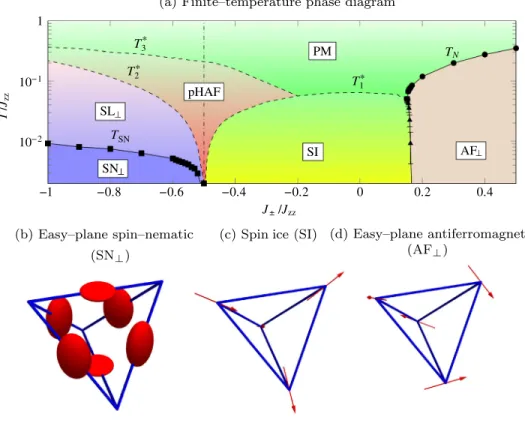
Working in the classical limit, accessible to large-scale simulation, we find that frustrated transverse exchange gives rise to not one, but three distinct spin-liquid regimes (Fig. 1).
We explore the way in which these spin liquids compete, identify the different gauge groups associated with each spin liquid, and make explicit predictions for their experimental signatures (Fig. 2). We find that one of these spin liquids posses a highly unusual Uð1Þ × Uð1Þ gauge structure and, as an added bonus, undergoes a phase transition into a state with hidden, spin-nematic, order. We also use molecular dynamics simulations to characterize the excitations of this spin- nematic phase (Fig. 5). The portrait that emerges has striking similarities to the behavior of a number of pyrochlore materials.
The simplest model able to capture quantum effects in a spin ice [7 – 12] is the XXZ model on the pyrochlore lattice
H
XXZ¼ X
hiji
J
zzS
ziS
zj− J
ðS
þiS
−jþ S
−iS
þjÞ; ð1Þ where S
i¼ ðS
xi; S
yi; S
ziÞ is a (pseudo-)spin-half operator describing the two states of the lowest-energy doublet of a Published by the American Physical Society under the terms of
the
Creative Commons Attribution 4.0 Internationallicense.
Further distribution of this work must maintain attribution to
the author(s) and the published article
’s title, journal citation,
and DOI.
TN
T3
TSN
T1* T2*
−1 −0.8 −0.6 −0.4 −0.2 0 0.2 0.4
10−2 10−1 1
J±/Jzz
T/Jzz
*
⊥
pHAF
PM
SL⊥
SN⊥
SI AF⊥
FIG. 1. (a) Finite-temperature phase diagram of the minimal model of a quantum spin ice,
HXXZ[Eq. (1)], as found in classical Monte Carlo simulation. The model possesses three distinct spin-liquid regimes, spin ice (SI), an easy-plane spin liquid (SL
⊥), and the pseudo- Heisenberg antiferromagnet (pHAF), as well as phases with easy-plane antiferromagnetic (AF
⊥) and easy-plane spin-nematic (SN
⊥) order. Associated crossover (phase-transition) temperatures are indicated with dashed (solid) lines. For
J=Jzz¼−1=2(dashed-dotted line), the model has an SU(2) symmetry and is thermodynamically equivalent to the Heisenberg antiferromagnet on a pyrochlore lattice.
(b) Representation of bond quadrupolar order in the easy-plane spin-nematic phase (SN
⊥) (cf. Appendix A). SN
⊥breaks both the
Uð1Þspin rotational symmetry of Eq. (1) and the point-group symmetry of the lattice. (c)
“Two-in, two-out
”configuration of spins in the spin ice regime (SI). (d) Representative configuration of spin dipoles in the easy-plane antiferromagnet (AF
⊥).
FIG. 2. Comparison of correlations in different spin-liquid and spin-nematic regimes. Left half of each panel: Equal-time structure factor
SðqÞ, as measured in unpolarized neutron-scattering experiments. Right half of each panel:SðqÞresolved into spin-flip (SF, top) and non-spin-flip (NSF, bottom) components, as measured in polarized neutron-scattering experiments (cf. Ref. [46]). Definitions of these structure factors are given in Appendix C. (a) Spin ice (SI), showing
“pinch points
”indicative of algebraic spin correlations.
(b) Phase with easy-plane spin-nematic order (SN
⊥), showing the absence of magnetic Bragg peaks and persistence of algebraic spin
correlations. The same correlations are also observed in the easy-plane spin liquid (SL
⊥). (c) Spin liquid associated with the pseudo-
Heisenberg antiferromagnet (pHAF), showing algebraic spin correlations distinct from those in spin ice (SI) or the easy-plane spin liquid
(SL
⊥). Results are taken from Monte Carlo simulations of
HXXZ[Eq. (1)], for a cubic cluster of
N¼8192spins.
magnetic ion subject to a strong crystal electric field (CEF).
The symmetry of the lattice requires the quantization axis of each spin (here, S
zi) to lie on a local [111] axis, as defined in Appendix A.
Ising interactions, J
zz> 0 , favor states obeying the “ ice rules ” in which two spins point into and two spins point out of each tetrahedron on the lattice. The transverse term, J
, introduces dynamics about these spin-ice configurations and, for larger, positive values of J
=J
zz, drives the system into a state with easy-plane order [17,18,47–50]. The physical meaning of this easy-plane order depends on the nature of the magnetic ion. For Kramers ions like Yb
3þand Er
3þ, all components of S relate to a magnetic dipole moment [11], and the ordered phase is an easy-plane antiferromagnet. However, for non-Kramers ions such as Pr
3þand Tb
3þ[9,43] or “ dipolar-octupolar ” Kramers ions like Nd
3þor Ce
3þ[51], the easy-plane order may have quadrupolar (octupolar) character. In what follows, we consider explicitly the case of Kramers ions. However, suitably reinterpreted, these results also have important implications for non-Kramers ions.
For J
> 0 , H
XXZ[Eq. (1)] is unfrustrated, in the sense that it is free of sign problems in quantum Monte Carlo (QMC) simulation. In this case, the phase diagram is already well established [14,21]. For J
=J
zz≲ 0 . 05 , QMC simulations find a crossover from a conventional paramagnet into a classical spin liquid (spin ice) at a temperature T
=J
zz∼ 0 . 2 and a second crossover into a quantum spin liquid (QSL) at a much lower temperature T
QSL=J
zz∼ ðJ =J
zzÞ
3. In the low-temperature quantum spin-liquid regime, the magnetic monopoles of classical spin ice become dynamic, fractional, spin excitations (spinons), while the spectrum of the model also includes gapless photons [13,16]. For J
=J
zz≳ 0.05, the U(1) QSL gives way to easy-plane antiferromagnetic order (AF
⊥), in which spins lie in the plane perpendicular to the local S
zaxis [14,21].
Very little is known about the properties of H
XXZfor J
< 0 [10,18,43]. On perturbative grounds, it is expected that the ground state for jJ
j=J
zz≪ 1 will also be a U(1) QSL [13], albeit one with a modified spinon dispersion [18,52]. Gauge mean-field calculations suggest that this QSL persists over a broad range of parameters, −4.13 ≲ J
=J
zz< 0 [18]. But the nature of competing ordered — or disordered — phases for J
< 0 remains an open question.
There are many reasons to believe that the properties of the quantum spin-ice model, H
XXZ[Eq. (1)] for frustrated coupling J
< 0 , could be even richer than for J
> 0 . In particular, for J
=J
zz¼ −
12, H
XXZ[Eq. (1)] is equivalent (up to a site-dependent spin rotation), to the Heisenberg antiferromagnet (HAF) on a pyrochlore lattice. Like spin ice, the HAF is known to support a classical spin liquid [53 – 56], and it has also been argued to support a QSL ground state [57 – 60]. Crucially, both the classical and quantum spin liquids in the HAF have a qualitatively different character from those found in spin ice. This sets up
a competition between two different kinds of spin liquid, namely, spin ice for J
=J
zz≈ 0 and a state homologous to the HAF for J
=J
zz≈ −
12. It also opens the door for yet more novel magnetic phases for J
=J
zz< −
12.
II. PHASE DIAGRAM DETERMINED BY CLASSICAL MONTE CARLO SIMULATIONS Since the quantum spin-ice model, H
XXZ[Eq. (1)], is inaccessible to QMC for J
< 0 , we instead study its finite- temperature properties using classical Monte Carlo (MC) simulation — the results are summarized in the phase diagram Fig. 1. For J
> 0 , this phase diagram is very similar to that previously found in QMC simulations [14,21] — at a quali- tative level, the only significant difference is the absence of a QSL below T
QSL=J
zz∼ ðJ
=J
zzÞ
3≲ 0 . 005 . At a quantita- tive level, we find changes in numerical values of the crossover temperature associated with the spin-ice regime, T
1, and the position of the zero-temperature boundary between SI and AF
⊥. These changes can be ascribed to the fact that the magnetic monopoles (spinons) are not quantized in classical simulations and do not develop phase coherence [61]. Further details of classical MC simulations for J
> 0 will be presented elsewhere [62].
We now turn to the frustrated case, J
< 0. At low temperatures, spin-ice correlations persist up to J
=J
zz¼
−
12[10,43], as illustrated in Fig. 2(a). Upon reaching J
=J
zz¼ −
12, the system becomes thermodynamically equivalent to a HAF. This high-symmetry point gives rise to a new form of spin liquid at finite temperature, labeled a pseudo-Heisenberg antiferromagnet (pHAF) in Fig. 1.
Once again, this spin liquid has algebraic correlations, as shown in Fig. 2(c), but with qualitatively different character from spin ice [Fig. 2(a)]. These correlations persist up to a crossover temperature T
3associated with the Curie-law crossover (CLC) in the magnetic susceptibility [63].
While the correlations measured in the equal-time structure factor SðqÞ are also different from those found in the HAF [54,55,64], the two models are equivalent up to a local coordinate transformation. By analogy with earlier work on the HAF [55,56,65], the spin liquid pHAF can be described by a Uð1Þ × Uð1Þ × Uð1Þ gauge theory.
The situation for J
=J
zz< −
12is even more interesting.
Below a second crossover scale, T
2< T
3, identifiable by a reduction in the fluctuations of the z-components of the spins (see Appendix B), the pHAF gives way to an easy- plane spin liquid, labeled SL
⊥in Fig. 1. Spin correlations in this regime have algebraic character, with pinch points in SðqÞ [Fig. 2(b)]. However these correlations are qualita- tively different from those in either spin ice [Fig. 2(a)]
or the pHAF [Fig. 2(c)]. At a still lower temperature, T
SN< T
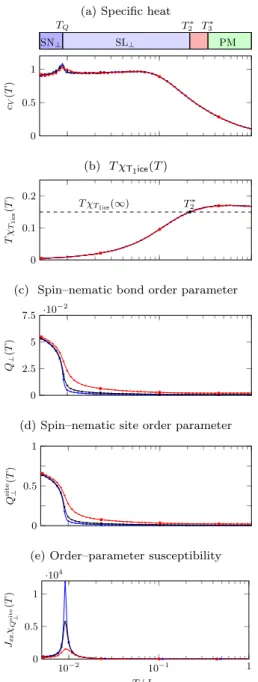
2, the system undergoes a thermodynamic phase transition, marked by a clear anomaly in the specific heat.
Nonetheless, this phase transition does not give rise to any
magnetic Bragg peaks in SðqÞ and, at least as far as dipolar
spin correlations are concerned, the system remains disordered.
While the new phase for T < T
SN— labeled SN
⊥in Fig. 1 — does not exhibit any conventional magnetic order, it does possess a hidden, spin-nematic order. The ordered state does not break translational symmetry, but breaks the U(1) symmetry of H
XXZ[Eq. (1)] by selecting an axis within the local xy-plane. Such an order can be described by the bond-based order parameter [66 – 68]
Q
⊥¼ X
hiji
1 3 N
S
xiS
xj− S
yiS
yjS
xiS
yjþ S
yiS
xj; ð2Þ
where the sum on hiji runs over the nearest-neighbor bonds of the lattice, and S
i¼ ðS
xi; S
yi; S
ziÞ is expressed in the local frame of site i (cf. Appendix A).
This type of easy-plane order is formally identical to the spin-nematic phases found in a range of frustrated magnets in applied magnetic fields [68 – 70]. In common with these systems, the associated Landau theory
F
SN⊥¼ a
2ðTÞQ
2⊥þ a
4Q
4⊥þ ð3Þ lacks a cubic term and therefore permits a continuous phase transition. Simulations suggest that the phase tran- sition at T ¼ T
SNis indeed continuous for J
=J
zz≲ −
12, becoming first order approaching the high-symmetry point J
=J
zz→ −
12. Further details of the thermodynamics of this transition are given in Appendix B.
III. THEORY OF THE EASY-PLANE SPIN LIQUID Spin correlations in spin ice (SI) can be described using a U(1) lattice gauge theory [6,56,71], which gives rise to characteristic “ pinch points ” in the spin structure factor SðqÞ [Fig. 2(a)]. Meanwhile, for classical spins, spin correlations in the Heisenberg AF on the pyrochlore lattice — and by extension in the pHAF — can be described using a Uð1Þ × Uð1Þ × Uð1Þ gauge theory [53–56]. The pHAF has quali- tatively different pinch points from spin ice, as illustrated in Fig. 2(c). It is clear that the correlations of the easy-plane spin liquid, SL
⊥[Fig. 2(b)], are very different from either spin ice [Fig. 2(a)] or the pHAF [Fig. 2(c)]. Nonetheless, the presence of pinch points suggests that SL
⊥, too, may be described by some form of gauge theory.
We can develop a field theory for the spin liquid SL
⊥by applying the methods developed in Refs. [50,72]. The starting point of this approach is to recast the spins S
iin H
XXZ[Eq. (1)] in terms of five order-parameter fields
fm
λg ¼ fm
A2; m
E; m
T1ice; m
T1planar; m
T2g; ð4Þ defined on each tetrahedron r . These objects m
λðrÞ describe the different kinds of four-sublattice magnetic orders consistent with the point-group symmetry of the pyrochlore lattice. Definitions of each field m
λin terms of the spins S
iare given in Appendix D.
The most general exchange Hamiltonian on the pyro- chlore lattice can be transcribed exactly in terms of m
λ[49].
This greatly simplifies the determination of classical ground states and, where classical ground states form an extensive manifold, one can use this approach to determine the local constraints that control the resulting spin liquid [50,72]. In the case of SL
⊥, for T → 0 , we have
m
A2ðrÞ ¼ 0 ; m
EðrÞ ¼ 0 ; m
T1iceðrÞ ¼ 0 ∀ r : ð5Þ The spin fluctuations at low temperature are thus dominated by the fluctuations of the remaining fields m
T2ðrÞ and m
T1planarðrÞ. These fields have significance as the order parameters of the competing four-sublattice magnetic orders that would be induced by the symmetry- allowed perturbation
δH ¼ X
hiji
J
½γ
ijS
þiS
þjþ γ
ijS
−iS
−j; ð6Þ where γ
ijare complex phase factors arising from the change in coordinate frame between different lattice sites [7,9 – 11,47,73]. For this reason, the spin liquid SL
⊥falls very naturally into the “multiple-phase competition” sce- nario for pyrochlore magnets [49,50,74,75].
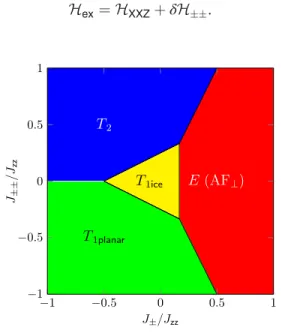
In Fig. 3, we show the classical ground-state phase diagram of the anisotropic exchange model
H
ex¼ H
XXZþ δH : ð7Þ
FIG. 3. Classical ground-state phase diagram of the anisotropic
exchange model
Hex[Eq. (7)], for
Jzz>0. Different phases are
labeled in terms of the irreps of the tetrahedral symmetry group,
Td[Eq. (4)], as described in Ref. [49]. The minimal model of a
quantum spin ice
HXXZ[Eq. (1)] exists on the line
J¼0—for
J<−12(white line), two phases with four-sublattice easy-plane
order meet, and the resulting enlarged ground-state manifold
gives rise to the easy-plane spin liquid SL
⊥and spin-nematic
phase SN
⊥. A closely related mean-field phase diagram for non-
Kramers ions is given in Refs. [10,43].
This contains three distinct regions of four-sublattice order:
the easy-plane ordered phases described by the fields m
E(denoted AF
⊥in Fig. 1), m
T1planar, and m
T2(Palmer- Chalker state [76]). These border a region of spin ice (denoted SI in Fig. 1) dominated by fluctuations of m
T1ice. We note that a closely related phase diagram has been derived for non-Kramers ions [10,43]; in this case, easy- plane order must be interpreted in terms of the quadrupole moment of the magnetic ion.
The nontrivial correlations in the spin liquid SL
⊥arise from the fact that neighboring tetrahedra share a spin, so that the fields m
λðrÞ on neighboring tetrahedra are not independent of one another. This point, combined with Eq. (5), imposes spatial constraints on the fluctuations of m
T2ðrÞ and m
T1planarðrÞ. After coarse graining to extract the long wavelength physics, these constraints may be written in terms of two independent vector fluxes, B
1¼ 1
2 ð2 m
xT1planar
; − ffiffiffi p 3
m
yT2
− m
yT1planar
; ffiffiffi p 3
m
zT2
− m
zT1planar
Þ B
2¼ 1
2 ð2 m
xT1planar
; − m
yT2
þ ffiffiffi p 3
m
yT1planar
; − m
zT2
− ffiffiffi p 3
m
zT1planar
Þ; ð8Þ
which each separately obey their own Gauss ’ s law:
∇ · B
1¼ 0 ; ∇ · B
2¼ 0 : ð9Þ We can therefore write
B
1¼ ∇ × A
1; B
2¼ ∇ × A
2; ð10Þ and the theory has two independent U(1) gauge degrees of freedom.
The free energy associated with the fluctuations of these fields is of entropic origin [65]. The only choice of Gaussian free-energy consistent with both the point-group symmetry and the Uð1Þ symmetry of H
XXZis
F
SL⊥¼ T V
Z
d
3rλðB
21þ B
22Þ
¼ T V
Z
d
3r λ½ð∇ × A
1Þ
2þ ð∇ × A
2Þ
2; ð11Þ where the coefficient λ can be determined through fits to simulation or a large-N expansion [55,72].
It follows from the existence of the conserved fluxes B
1and B
2and the free-energy Eq. (11) that SL
⊥is a Coulomb phase with algebraic correlations [65]. The validity of this description is demonstrated in Fig. 4, where we compare analytic calculations of the flux structure factor
S
αβBμ
ðqÞ ¼ hB
αμð−qÞB
βμðqÞi; ð12Þ
based on Eq. (11) with the results of Monte Carlo simulation. Pinch-point singularities are clearly seen in both analytic and numerical calculations. It is the same fluctuations of B
1and B
2that are responsible for the characteristic pinch-point structures in the (spin) structure factor measured by neutron scattering, as shown in Fig. 2(b).
At finite temperature, we anticipate that the spin liquid SL
⊥will be perturbatively stable against terms such as δH [Eq. (6)], which retain the point-group symmetry of the lattice but lift the Uð1Þ symmetry of the spins. In this case, the free energy will be modified:
F
SL⊥→ F
SL⊥þ δF
SL⊥ð13Þ δF
SL⊥¼ T
V Z
d
3r λ
0ðB
x1Þ
2− 1
2 ½ðB
y1Þ
2þ ðB
z1Þ
2−ðB
x2Þ
2þ 1
2 ½ðB
y2Þ
2þ ðB
z2Þ
2− ffiffiffi p 3
½B
z1B
z2− B
y1B
y2:
ð14Þ This form of free energy will still lead to pinch points in S
αβBμ
ðqÞ and SðqÞ, but these will take on a more anisotropic character.
IV. DYNAMICS IN THE SPIN-NEMATIC PHASE
For temperatures T < T
SN, the easy-plane spin liquid
(SL
⊥) gives way to a phase with hidden spin-nematic order,
FIG. 4. Uð
1Þ× Uð
1Þgauge structure of the easy-plane spin
liquid (SL
⊥), as demonstrated by pinch points in equal-time
structure factors
SαβBμðqÞ[Eq. (12)]. Left half of panel: Structure
factor
SxxB1ðqÞas calculated from the theory Eq. (11), with
λ¼1.
Right half of panel: Structure factor
SxxB1ðqÞas calculated in
classical Monte Carlo simulations of
HXXZ[Eq. (1)]. The pinch
point centered on
q¼ ð0;0;0Þfollows from the zero-divergence
conditions on the fields
Bμ[Eq. (9)]. Simulations were carried out
for a cubic cluster of
N¼8192spins, with
J=Jzz¼−1,
T¼0.
01Jzz, as described in Appendix E.
labeled SN
⊥in Fig. 1. As far as the dipole moments of spins are concerned, the spin-nematic phase is disordered, and neutron scattering experiments would reveal algebraic correlations, as in the spin liquid SL
⊥. However, the pinch points in SðqÞ [cf. Fig. 2(b)] hide a great wealth of interesting spin excitations.
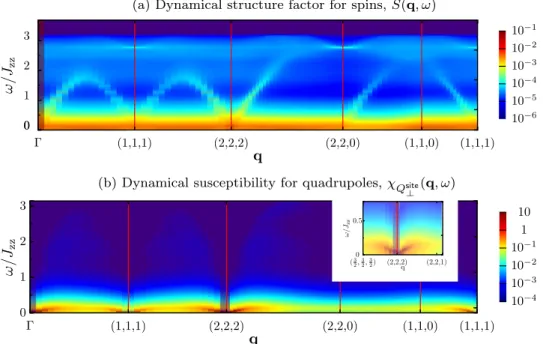
To better understand the dynamics of the spin-nematic phase, we have calculated the dynamical structure factor Sðq ; ωÞ, within a semiclassical molecular-dynamics (MD) simulation, using the methods described in Ref. [77].
Relevant definitions are given in Appendix C. For ω =J
zz≲ 0 . 2 , Sðq ; ωÞ presents a featureless, nondispersing continuum [Fig. 5(a)]. Relics of dispersing excitations are visible in Sðq; ωÞ at higher energies, but these are explicitly not Goldstone modes and have nothing to do with the hidden spin-nematic order. Examining the evolution of Sðq ; ωÞ as a function of temperature, we find that results for Sðq ; ωÞ in the spin-nematic phase for T < T
SNare very similar to those found in the spin liquid SL
⊥for T > T
SN. Incoherent, nondispersing structure of the type shown in Fig. 5(a) is reminiscent of theoretical predictions [78 – 80] and experimental measurements [43,81,82], for a wide range of different spin liquids. In a quantum spin liquid, the presence of a nondispersing continuum reflects the fact that, unlike conventional spin waves (magnons), single elementary excitations of a spin liquid cannot be created by local processes. It follows that, when a neutron scatters from a spin liquid, the energy, momentum, and angular momentum (spin) transferred are not absorbed by a single excitation with
a well-defined energy and momentum, but rather they are shared between multiple excitations [83]. In the semiclassical limit studied here, it is probably unsafe to attribute such a continuum to fractionalized excitations [62]. However, the fact that Sðq ; ωÞ only records dipolar spin correlations obscures a more important fact — the spin-nematic order that is present for T < T
SNthat breaks a continuous, U(1) symmetry of the Hamiltonian. By Goldstone ’ s theorem, it must, therefore, also support gapless Goldstone modes.
In order to resolve this conundrum, it is necessary to examine the dynamical correlations of the quadrupole moments of spin. In Fig. 5(b), we present MD simulation results for the dynamical susceptibility χ
Qsite⊥
ðq ; ωÞ, which measures fluctuations of the on-site quadrupolar moments, which are well defined for classical spins [cf. Appendix B].
A sharp excitation, with dispersion
ω ≈ v
Qjq − q
rlj; ð15Þ can now be resolved close to the zone centers with q
rl¼ ð0 ; 0 ; 0Þ, (1,1,1), (2,2,2). These are the same zone centers for which the Bragg peaks associated with the hidden spin-nematic order SN
⊥would occur in a quad- rupolar structure factor, which might, in principle, be measured in resonant x-ray experiments [84].
At present, relatively little is known about the dynamical properties of spin-nematic states. Field-theoretic analysis [70,85 – 87], based on the symmetry of the order parameter, predicts that spin-nematics support gapless Goldstone
0
FIG. 5. Spin dynamics in the phase with hidden spin-nematic order (SN
⊥). (a) Dynamical structure factor for spin degrees of freedom,
Sðq;ωÞ, showing gapless continuum of excitations at low energies. (b) Dynamical susceptibility for fluctuations of on-site quadrupolemoments,
χQsite⊥ ðq;ωÞ[cf. Appendix F]. Inset: Details of correlations at low energies near the zone center
qrl¼ ð2;2;2Þ, showing alinearly dispersing Goldstone mode at low energies. Results are taken from molecular-dynamics simulations of
HXXZ[Eq. (1)] for a
cluster of
N¼65 536spins, with
J=Jzz¼−1.
0,
T=Jzz¼0.
002.
modes, visible in χ
Q⊥ðq ; ωÞ. This Goldstone mode has dispersion ω ∝ jqj [cf. Eq. (15)], and at zero temperature the associated intensity diverges as ∼1 = ω for ω → 0 [70].
The same behavior is seen in “ flavor-wave ” calculations and QMC simulations of spin-1 models constructed to support quadrupolar order [88 – 90]. The dynamics of the spin- 1 = 2 frustrated ferromagnetic spin chain have also been studied using density matrix renormalization group (DMRG) cal- culations, and they reveal a broad continuum of excitations at high energies [91]. However, because of the absence of long-range order, no Goldstone modes can be resolved. A continuum of excitations at high energies is also found in calculations for two-dimensional frustrated ferromagnets, within a slave-particle mean-field picture [92].
Our MD simulations of SN
⊥clearly reveal a linearly dispersing Goldstone mode, with intensity that diverges for ω → 0 [cf. inset in Fig. 5(b)]. The form of this divergence is
∼1 = ω
2, rather than ∼1 = ω . This follows from the fact that simulations are carried out at finite temperature and probe thermal, rather than quantum, fluctuations. Most striking, however, is the broad continuum of excitations visible in both spin and quadrupole structure factors. It is also interesting to note that the way in which the Goldstone mode “ dissolves ” into this continuum bears some resem- blance to what is seen in QMC simulations of a spin-1 model at higher temperature [90]. Overall, the picture that emerges from MD simulation is consistent with all known facts about spin-nematics and should provide a reliable guide for comparison with experiment.
Further details of the spin dynamics in the spin-nematic phase and specifically the characterization of the Goldstone mode are given in Appendix F. We note that the U(1) symmetry of H
XXZ[Eq. (1)] is not a necessary condition for spin-nematic order to exist. However, if this symmetry were broken, the low-energy (pseudo-)Goldstone mode associ- ated with SN
⊥would acquire a small gap.
V. DISCUSSION
Spin liquids [1 – 3] and spin nematics [66 – 68] are prime examples of unconventional states of matter and have many unusual and interesting properties. The experimental search for these exotic states has a long history, with many twists and turns, and not a few dead ends. Given this, finding both in one simple, canonical, and experimentally motivated model is remarkable. It is therefore worth considering the possibilities for observing the unconventional spin liquid SL
⊥and the spin nematic SN
⊥in the type of rare-earth pyrochlore magnet described by Eq. (1).
In the case of SN
⊥, it is important to make a distinction between the type of spin-nematic order considered in this manuscript, which is driven by fluctuations, and the quadrupolar or octupolar order, which can arise directly from the ground states of rare-earth ions. Here we particu- larly have in mind the non-Kramers ions Pr
3þ[9,18,43] and Tb
3þ[9,38,44,93] and Kramers doublets of dipolar-
octupolar character, such as Nd
3þ[51] and Ce
3þ[94].
For these ions, quadrupolar or octupolar order may occur as a “ classical ” order of the transverse part of the pseudospins S
i. The multipolar character of the order follows from the symmetry of the crystal-field ground state (doublet) of the magnetic ion, which is described by S
i. Where multipolar order of this kind occurs, experiments that probe the dynamics of dipoles will see a gapped response and a sharp excitation spectrum. In contrast, in the easy-plane spin nematic SN
⊥, dipole moments remain in a spin-liquid- like state, with strong fluctuations at low temperature and a broad, gapless response coexisting with the hidden nematic order [Fig. 5(a)].
Where, then, might we observe these unusual magnetic states? Further experimental work will be necessary to definitively answer this question, but there are already a few trails to follow. In particular, the Pr-based pyrochlores have the recommended single-ion and interaction anisot- ropies [9,18,43]. Coupling parameters of Pr
2Zr
2O
7, for example, have been suggested to sit in the AF
⊥phase of Fig. 1 [43], although it seems that the coupling of structural disorder to the non-Kramers doublets plays a significant role [23,33,95,96]. Since chemical pressure has already proven to be a useful tool to move a family of compounds across a phase diagram [41,49,75,97,98], Pr
2X
2O
7(X ¼ Sn, Hf, Pb) are promising candidates to investigate, with ferromagnetic correlations consistent with positive J
zzand no dipole order yet observed [26,31,32,40,99].
The notion of hidden order also resonates with the elusive physics of Yb-based pyrochlores. As far as we know, Yb pyrochlores lie in a different regime of magnetic interactions than the H
XXZmodel of Eq. (1). Specifically, experiments on Yb
2Ti
2O
7point to an unfrustrated value of J
> 0 [11,100,101] and to an important role for other competing exchange interactions. In light of this, the properties of that particular material seem to be connected with a different phase boundary from that associated with SL
⊥[45,49,75]. That being said, some of the similarities between our results and the Yb pyrochlores are striking: a gapless continuum of spin excitations, oblivious to thermo- dynamic phase transitions [41,102 – 104] [Fig. 5(a)] and robust in temperature up to a broad feature in specific heat [41] (in the present article, between pHAF and SL
⊥). While the magnetic order in Yb-pyrochlores is, at least partially, an order of dipolar moments [27,36,37,105 – 107], recent experiments have indicated that the primary order param- eter may be “hidden, ” and distinct from a standard dipole order [41]. Thus, while the specific case developed in this article probably does not apply to the Yb pyrochlores, related physics may be at play.
Furthermore, since the spin-nematic phase SN
⊥is found
within the spin liquid SL
⊥(Fig. 1), this work provides a
prototype for the peaceful coexistence of emergent gauge
fields and long-range order. In this sense, SN
⊥is an
interesting new addition to the other phases where gauge
fluctuations and broken symmetries coexist, such as the Coulombic ferromagnet [17,108] and states with magnetic- moment fragmentation [109], as recently observed in Nd
2Zr
2O
7[42,110] and Ho
2Ir
2O
7[111].
We also note that many other magnetic systems outside the rare-earth oxides R
2X
2O
7feature moments located on a pyrochlore lattice. Of particular interest are materials such as NaCaCo
2F
7and NaSrCo
2F
7[112,113] that boast XY-like interactions with much higher energy scales than those observed in the rare-earth oxides. If such a case could be found with frustrated transverse coupling J
< 0 , then it would render the physics discussed here accessible at a much more amenable temperature range.
In almost all spin-liquid candidates, the role of quenched structural and chemical disorder is an important issue [33,38,95,96,114 – 119]. Depending on the type and strength of disorder, its consequences can vary. It is worth noting, however, that disorder is not necessarily deleterious to spin-liquid physics. It is known, for example, that weak disorder in non-Kramers pyrochlores, which leads to splittings in the low-energy non-Kramers doublet, can actually play a role in promoting a Uð1Þ spin-liquid ground state [23]. The spin-liquid states discussed in this manu- script do not depend on the translational symmetry of the Hamiltonian, but rather on the emergent gauge symmetries that arise from the local constraints in the ground state [Eq. (5)]. Thus, as long as the disorder is not so strong that these constraints are strongly violated, the essence of the spin liquids should be maintained in the presence of disorder, at least at finite temperature. For sufficiently strong disorder or sufficiently low temperature, disorder may lead to order by disorder or glassiness [120,121]. A quantitative study of the effects of disorder on the phase diagram in Fig. 1 is a large undertaking and is beyond the scope of the present work but may be an interesting direction for future consideration.
VI. SUMMARY AND CONCLUSIONS
“ Quantum spin ice, ” in which magnetic ions on a pyrochlore lattice interact through highly anisotropic exchange interactions, has become an important paradigm in the search for quantum spin liquids. In this article, we use large-scale classical Monte Carlo simulation to explore the physics of the canonical model of a quantum spin ice, the XXZ model on a pyrochlore lattice H
XXZ[Eq. (1)]. We find that this model has far more to offer than spin ice alone, supporting three distinct types of spin liquid, each with a different emergent gauge symmetry. Each of these spin liquids has a different signature in neutron scattering (Fig. 2). The states found include a completely new form of spin liquid, described by a Uð1Þ × Uð1Þ gauge theory. At low temperatures, this novel spin liquid undergoes a phase transition to a state with hidden spin-nematic order (Fig. 1) but retains algebraic correlations of the spin dipoles. We have studied the excitations of this phase using state-of-the-
art dynamical simulations, revealing a sharply defined Goldstone mode that would be hidden from conventional neutron scattering techniques.
So far as experiment is concerned, the main lesson of these results is that “ quantum spin-ice ” materials can play host to a great many different spin-liquid and (hidden-) order phases, even where they are described by a Hamiltonian as simple as H
XXZ[Eq. (1)]. This reinforces the point that pinch points in pyrochlore magnets need not imply spin ice [65,72]. The existence of a sharp Goldstone mode in the nematic phase SN
⊥also serves as a salutary reminder that broad, nondispersing continua of excitations can hide a multitude of secrets (Fig. 5).
From the theoretical point of view, this work identifies a new spin liquid, a novel spin-nematic phase, and opens an interesting new perspective on the way in which different spin liquids can compete. The effect of quantum fluctua- tions on the phase diagram shown in Fig. 1 for J
< 0 remains a subject for future study. However, experience with QMC simulation of H
XXZ[Eq. (1)] for J
> 0 suggests that quantitative values of the crossover temper- ature T
2and T
3may be substantially renormalized, but that the qualitative structure of the phase diagram should remain the same down to very low temperatures [14,21,25]. The high-symmetry point, J
=J
zz¼ −1 = 2 , is also a high- symmetry point for quantum spins, and so remains the anchor for the spin liquid pHAF. Nonetheless, the fate of this Uð1Þ × Uð1Þ × Uð1Þ spin liquid for quantum spins at T ¼ 0 remains an open question [57,58,60,122]. To the best of our knowledge, quantum analogues of the new spin liquid, SL
⊥, which has a Uð1Þ × Uð1Þ gauge structure, remain unexplored [123]. However, it seems reasonable to speculate that quantum effects will enhance, rather than suppress, the fluctuations that drive SL
⊥and pHAF, and that the phase SN
⊥will survive as hidden quantum spin- nematic order, within a quantum spin liquid. Preliminary numerical results for the spin- 1 = 2 model at high temper- atures are entirely consistent with the topology of the phase diagram shown in Fig. 1 [124]. All of these questions open exciting avenues for future research.
ACKNOWLEDGMENTS
We are pleased to acknowledge many helpful discus- sions with Karim Essafi, Jaan Oitmaa, and Rajiv Singh.
This work was supported by the Theory of Quantum Matter Unit of the Okinawa Institute of Science and Technology Graduate University (OIST). Numerical calculations were carried out using HPC facilities provided by OIST.
APPENDIX A: DEFINITION OF LOCAL-COORDINATE FRAME
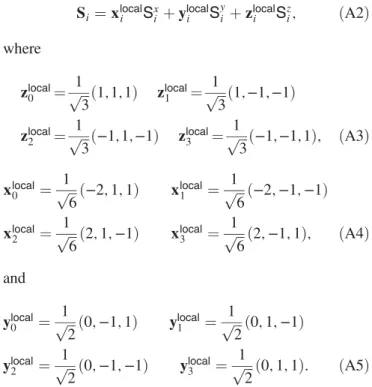
We describe the local-coordinate frame that is defined
for four spins on a pyrochlore tetrahedron S
0, S
1, S
2, S
3,
occupying positions
r
0¼ a
8 ð1 ; 1 ; 1Þ r
1¼ a
8 ð1 ; −1 ; −1Þ r
2¼ a
8 ð−1; 1; −1Þ r
3¼ a
8 ð−1; −1; 1Þ; ðA1Þ where a is the length of a cubic, 16-site unit cell of the pyrochlore lattice.
The pseudospins in the global, crystal, coordinate frame S
irelate to the pseudospins in the local frame S
i[Eq. (1)] as S
i¼ x
localiS
xiþ y
localiS
yiþ z
localiS
zi; ðA2Þ where
z
local0¼ 1 ffiffiffi 3
p ð1 ; 1 ; 1Þ z
local1¼ 1 ffiffiffi 3
p ð1 ; −1 ; −1Þ z
local2¼ 1 ffiffiffi
p ð 3 −1 ; 1 ; −1Þ z
local3¼ 1 ffiffiffi
p ð 3 −1 ; −1 ; 1Þ; ðA3Þ x
local0¼ 1 ffiffiffi
p ð−2; 6 1; 1Þ x
local1¼ 1 ffiffiffi
p ð−2; 6 −1; −1Þ x
local2¼ 1
ffiffiffi 6
p ð2 ; 1 ; −1Þ x
local3¼ 1 ffiffiffi 6
p ð2 ; −1 ; 1Þ; ðA4Þ and
y
local0¼ 1 ffiffiffi
p ð0; 2 −1; 1Þ y
local1¼ 1 ffiffiffi
p ð0; 2 1; −1Þ y
local2¼ 1
ffiffiffi 2
p ð0 ; −1 ; −1Þ y
local3¼ 1 ffiffiffi 2
p ð0 ; 1 ; 1Þ: ðA5Þ We have used this relationship between the local coordinate frame of Eq. (1) and the crystal coordinate frame to plot a representation of the bond quadrupolar order in real space in Fig. 1(b). The ellipsoid on each bond ij in Fig. 1(b) has principal axes aligned along the cubic axes of the pyrochlore lattice, with the length of each principal axis given by
l
α¼ 4ðc þ hS
αiS
αjiÞ; ðA6Þ where c ¼ 0 . 08 is chosen to make the figure readable and S
αiis the component of spin i in the global frame, along crystal axis α ¼ x, y, z.
APPENDIX B: DETAILS OF THE NUMERICAL DETERMINATION OF THE PHASE DIAGRAM The phase diagram shown in Fig. 1 is extracted from classical Monte Carlo (MC) simulations of the quantum spin-ice model, H
XXZ[Eq. (1)]. Spins are treated as classical vectors with fixed length jS
ij ¼
12. These simu- lations are carried out for a cubic cluster of 8192 spins, using a single spin-flip algorithm combined with simulated annealing, parallel tempering, and overrelaxation. The
phase diagram is obtained using 75000 simulated annealing steps using a stepwise decrease of temperature, starting from T ¼ 10 J
zzdown to the target temperature. Each annealing step consists of ten Monte Carlo steps (a Monte Carlo step consists of a full sweep of the lattice combined with overrelaxation). The simulated annealing is followed by 1000 parallel tempering steps with 500 Monte Carlo steps in between and then by 200 000 Monte Carlo steps for thermalization at fixed temperature.
Measurements consist of 200 000 samples separated by ten Monte Carlo steps and combined to parallel tempering every 50 measures. We use 256 different replicas with temperature set in linear scale for J
=J
zz> −
12and 256 temperatures in logarithmic scale for J
=J
zz≤ −
12.
The phase boundary of the antiferromagnetically ordered (AF
⊥) phase, T
N, is extracted from the susceptibility of the relevant order parameter, m
E, as defined in Appendix D.
The crossover scale for the spin-ice regime (SI), T
1, is estimated from the Schottky-like peak in the heat capacity.
The crossover scale T
3for the spin liquid pHAF is estimated from the Curie-law crossover shown in Fig. 6.
For J
< −
12, the crossover scale T
2is associated with a weakening of the correlations of the local z-components of the spins. This can be observed by measuring the suscep- tibility, χ
T1IceðTÞ, of the field m
T1Ice, defined in Appendix D.
Decreasing the temperature for −1 < ðJ
=J
zzÞ < −0 . 5 , the quantity Tχ
T1IceðTÞ first increases during the crossover from the paramagnet to pHAF and then drops as the system enters SL
⊥. We define the crossover temperature T
2as the point at which the quantity T χ
T1iceðTÞ drops below its infinite temperature value
T
2χ
T1iceðT
2Þ ¼ lim
T→∞
Tχ
T1iceðTÞ: ðB1Þ
This is illustrated in Fig. 7(b).
0
FIG. 6. Crossover in the magnetic susceptibility
χðTÞ, from atraditional Curie law in the high-temperature paramagnet to a
low-temperature Curie law in the spin liquids, as seen by different
plateaus in the function
Tχ, plotted as a function of logðTÞ. The
crossover temperature
T3=Jzz≈0.
3(red dot) is estimated from
the point of inflection of
Tχ. The extraction of the crossover
temperature
T2is explained in Fig. 7. Results are taken from
classical Monte Carlo simulations of
HXXZ[Eq. (1)], for a cubic
cluster of
N¼8192spins, with
J=Jzz¼−1.
For quantum, spin- 1 = 2 moments, the onset of spin- nematic order is heralded by the bond-based order parameter Eq. (2). However, for the purpose of classical simulation, it is sufficient to consider the simpler, site-based order parameter
Q
site⊥¼ 4 N
X
i
S
xi2− S
yi22S
xiS
yi: ðB2Þ
Please note the prefactor of 4 in the definition of the spin-nematic site order parameter [Eq. (B2)] to account for the spin length jS
ij ¼
12. The onset of spin-nematic order in simulations can be observed in either the site-based [cf. Fig. 7(d)] or bond-based order parameters [cf. Fig. 7(c)].
However, for simplicity, the values of the spin-nematic ordering temperature T
SNshown in Fig. 1 are extracted from the peak in the order-parameter susceptibility,
χ
Qsite⊥¼ N
T ðhQ
site⊥ 2i − hjQ
site⊥ji
2Þ; ðB3Þ associated with the site-based order parameter, Eq. (B2) [cf. Fig. 7(e)].
Figure 7 is obtained using 300 temperatures in logarithmic scale covering three orders of magnitude, parallel tempering every 100 Monte Carlo steps, simulated annealing, and thermalization at temperature T for 100 000 Monte Carlo steps each. Measurements consist of 100 000 different samples with ten Monte Carlo steps between each sample.
Error bars were estimated by comparing the results of three independent runs of the simulation.
APPENDIX C: DEFINITIONS OF DYNAMICAL STRUCTURE FACTORS
In Fig. 2 we show predictions for neutron scattering experiments, based on the equal-time (i.e., energy-inte- grated) structure factor
SðqÞ ¼ Z
d ω Sðq ; ωÞ; ðC1Þ
where the dynamical structure factor Sðq ; ωÞ is defined through
Sðq ; ωÞ ¼ X
αβ
δ
αβ− q
αq
βq
2hm
αð−q ; ωÞm
βðq ; ωÞi
m
αðq ; ωÞ ¼ X
iβγ
R
αβig
βγiZ
S
γiðtÞe
iωtdt
e
iq·ri; ðC2Þ
and the g
βγiis the g-tensor written in the local coordinate frame [49]. For simplicity, we have here taken g
βγi¼ 2δ
βγfor all of the calculations in this paper. R
αβiis a rotation matrix that rotates from the local coordinate frame on site i, to the global, crystal coordinate frame. The definition of the FIG. 7. Thermodynamics of the QSI in the region of spin-nematic
order. (a) Specific heat
cVðTÞ, showing an upturn followed by ashallow maximum in the region of the crossover into the spin liquid SL
⊥at
T2=Jzz∼10−1, and small peak associated with the onset of spin-nematic order at
TSN=Jzz≈10−2. (b) Correlation function
TχT1iceðTÞused to determine the crossover temperature into the spin liquid SL
⊥.
χT1iceis the susceptibility of the field
mT1icedefined in Appendix D. The crossover temperature
T2is defined as the point at which
TχT1icedrops below its infinite temperature limit [Eq. (B1)].
(c) Norm of the bond order parameter
Q⊥ðTÞ[cf. Eq. (B2)], showing
a continuous phase transition into the phase with hidden spin-nematic
order at
TSN=Jzz≈10−2. (d) Norm of the site order parameter
Qsite⊥ ðTÞ[cf. Eq. (B2)], also showing the phase transition into the
spin-nematic phase. (e) Order-parameter susceptibility
χQsite⊥ ðTÞ[Eq. (B3)], used to estimate the transition temperature
TSN. Results
are taken from classical Monte Carlo simulation of
HXXZ[Eq. (1)],
for cubic clusters of
N¼1024, 8192, and 27 648 spins, with
J=Jzz¼−1.
local coordinate frame is given in Appendix A. Results for SðqÞ are shown in the left-half panels of Fig. 2. These results are taken from classical MC simulations of H
XXZat a given temperature, with further averaging provided by numerically integrating the semiclassical equations of motion for the spins. This secondary MD simulation is carried out using methods described in Ref. [77].
It is also useful to decompose the structure factor into the spin-flip (SF) and non-spin-flip (NSF) channels measured in polarized neutron-scattering experiments:
S
SFðqÞ ¼ 1 q
2Z
dωhjmðq; ωÞ · ð n ˆ × qÞj
2i S
NSFðqÞ ¼
Z
d ωhjmðq ; ωÞ · nj ˆ
2i; ðC3Þ where n ˆ is the direction of polarization of the neutron magnetic moment. Following Fennell et al. [46], we take n ˆ ¼ ð1 ; −1 ; 0Þ= ffiffiffi
p 2
. Simulation results for S
SFðqÞ and S
NSFðqÞ are shown in the right-half panels of Fig. 2.
We also use MD simulation to calculate the dynamical structure factor Sðq ; ωÞ. Results for Sðq ; ωÞ within the spin- nematic phase of the quantum spin-ice model are shown in Fig. 5(a). Further details of the calculation of dynamical properties can be found in Appendix F .
APPENDIX D: DEFINITIONS OF LOCAL ORDER-PARAMETER FIELDS
The definitions of the local order-parameter fields m
λthat appear in the theory of the spin liquid SL
⊥(Sec. III) are given in Table I.
Here we give the definitions in terms of the spins written in the local coordinate frame S
i(defined in Appendix A;
cf. Ref. [49], where definitions are given in the global, crystal basis).
APPENDIX E: NUMERICAL SIMULATION OF THE CORRELATIONS OF THE FLUX Values of the flux field B
μðrÞ are calculated for each tetrahedron r according to Eq. (8) and the definitions of m
λgiven in Table I.
The tetrahedra of the pyrochlore lattice may be divided into two sets A and B. The centers of each set of tetrahedra each form a face-centered cubic (FCC) lattice.
To calculate S
αβBμ, we use Eq. (12), where B
μðqÞ is defined as the lattice Fourier transform of B
μðrÞ over only the A sublattice of tetrahedra:
B
μðqÞ ¼ ffiffiffiffiffiffiffiffiffiffi
1 N
uccs X
r∈rA
expð− i q · r
AÞB
μðrÞ; ðE1Þ
where N
u:c:is the number of unit cells in the system.
Simulations are carried out using local spin updates, augmented by overrelaxation, within a parallel tempering scheme with 300 temperatures distributed on a log scale between T ¼ 0 . 003 J
zzand T ¼ 0 . 1 J
zz. Thermalization is accomplished through a process of simulated annealing, with 10
4Monte Carlo steps (MCs) of annealing from high temperature to temperature T, followed by 10
4MCs of thermalization at temperature T, and 10
5MCs of measure- ments at temperature T. Spin configurations are sampled every 100 MCs during the measurements, giving an ensemble of 1000 samples.
APPENDIX F: DYNAMICS OF EXCITATIONS IN THE SPIN-NEMATIC PHASE
To study the Goldstone mode associated to the develop- ment of spin-nematic order, we calculate the dynamical correlation function
χ
Qsite⊥
ðq ; ωÞ ¼ hjδQ
site⊥ðq ; ωÞj
2i; ðF1Þ where fluctuations of spin-nematic order are given by δQ
site⊥ðq ; ωÞ ¼ X
i
Z
dt½Q
site⊥ðr
i; tÞ − Q ¯
site⊥ðtÞe
iωte
iq·riQ ¯
site⊥ðtÞ ¼ 1
N X
i
Q
site⊥ðr
i; tÞ; ðF2Þ
and the order parameter Q
site⊥ðr
i;tÞ is defined through Eq. (B2).
χ
Qsite⊥ðq; ωÞ is calculated numerically from 200 sample configurations extracted from Monte Carlo simulations on TABLE I. Order-parameter fields
mλ, derived from irreducible
representations (irreps) of the tetrahedral point group T
d. Spin components
Si¼ ðSxi;Syi;SziÞare written in the local frame of the magnetic ions; see Appendix A for a definition of this coordinate frame. The convention for the labeling of the spins with a tetrahedron is given in Appendix A.
Definition in terms of spins within tetrahedron
mA2 12ðSz0þSz1þSz2þSz3ÞmE 1
2
Sx0þSx1þSx2þSx3 Sy0þSy1þSy2þSy3
mT1;ice
12
Sz0þSz1−Sz2−Sz3 Sz0−Sz1þSz2−Sz3 Sz0−Sz1−Sz2þSz3
! mT1;planar
0 B@
12ðSx0þSx1−Sx2−Sx3Þ
14ð−Sx0þ ffiffiffi p3
Sy0þSx1− ffiffiffi p3
Sy1−Sx2þ ffiffiffi p3
Sy2þSx3− ffiffiffi p3
Sy3Þ
14ð−Sx0− ffiffiffi p3
Sy0þSx1þ ffiffiffi p3
Sy1þSx2þ ffiffiffi p3
Sy2−Sx3− ffiffiffi p3
Sy3Þ 1 CA mT2
0 B@
12ð−Sy0−Sy1þSy2þSy3Þ
14ð ffiffiffi p3
Sx0þSy0− ffiffiffi p3
Sx1−Sy1þ ffiffiffi p3
Sx2þSy2− ffiffiffi p3
Sx3−Sy3Þ
14ð− ffiffiffi p3
Sx0þSy0þ ffiffiffi p3
Sx1−Sy1þ ffiffiffi p3
Sx2−Sy2− ffiffiffi p3
Sx3þSy3Þ 1 CA