• 検索結果がありません。

A Study on the Secure Online Examination System

N/A
N/A
Protected

Academic year: 2021

シェア "A Study on the Secure Online Examination System"

Copied!
94
0
0

読み込み中.... (全文を見る)

全文

(1)

A Study on the Secure Online Examination System

著者 ワヒド ユヌス アブドゥル

著者別表示 Wahid, Yunus Abdul journal or

publication title

博士論文本文Full 学位授与番号 13301甲第4475号

学位名 博士(工学)

学位授与年月日 2016‑09‑26

URL http://hdl.handle.net/2297/46575

doi: 10.19732/10.19732/vol1122016

(2)

DISSERTATION

A Study on the Secure Online Examination System

Graduate School of

Natural Science & Technology Kanazawa University

Division of Electrical Engineering and Computer Science

Student Number: 1323112010 Name : Abdul Wahid

Chief advisor : Prof. Masahiro MAMBO

July 1, 2016

(3)

Acknowledgements

First of all, I would like to express my gratitude to my academic supervi- sor, Professor Masahiro Mambo, for his guidance, suggestion and feedback.

During the three year doctoral course taught me how to do research and to write paper, which have supported in achieving my academic goal of getting a Ph.D. in information security. Thank you very much for your time, effort, knowledge, motivation and dedication during supervising me. I wish to ex- press grateful acknowledgement to Professor Yasushi Sengoku and Professor Kenji Yasunaga for the discussion and comments. I would also like to thank for staffs of Graduate School of Natural Science and Technology, Kanazawa University for their kind help and care during the years I was studying here.

I am deepest thankful for my parents (H.M.Yunus-Hj.Nuhuriah) and my parents in law (H.Hairil Muin-Hj.Rahmawati) for supporting, praying, pay- ing and motivating me in my study and life. My wife, Dian Herawati Hairil, my daughters, Alya and Aisyah, my sister, Tetty Wahyuni, thank for sup- porting and praying for me. Without their boundless love, endless patience, encouragement and sacrifice, I would not accomplish my study. I am thankful to all members of ISec laboratory for their valuable helps, especially for Mr.

Takahashi, Mr. Nakamura and Mr. Kosugi for discussing, sharing knowledge and helping me for my daily activities here. All members of Indonesian Stu- dent Assosiations in Kanazawa, thank you very much for all of your support and discussion.

I am also grateful to Indonesian Directorate Higher Education Ministry of Education and Culture (DIKTI), Indonesia, and Kanazawa University, Japan, for fellowship and to Universitas Negeri Makassar for allowing me to continue my Ph.D. study.

Finally, the last but not least, I would like to thank for the deepest heart to my God ALLAH S.W.T. Without ALLAH SWT, I can not do everything.

Thank you everything, Abdul Wahid

Kanazawa, June 2016

(4)

Abstract

Implementation of secure online examination system has been a hot topic in the educational world in the last decade. Issues that should be addressed in the secure online examination system are computer and network secu- rity issues of the systems and prevention of cheating by participants. In our research, we provide a website application and a secure network design which prevents cheating by any participant among examinee, administrator, and examiner. Different security features of the online examination system are discussed both from the website application aspect and network design aspect.

Unfortunately, website application and network design cannot meet some security requirements because of several inside and outside attacks and mali- cious behaviors of bribed, corrupted or unfair examiners and untrusted exam authority, and we construct a particular online examination protocol to pre- vent them.

We design an online examination protocol based on certificateless sign- cryption and prove their security properties under the formal analysis using ProVerif software. The proposed online examination protocol has several ad- vantages over existing protocols such that there is no certificate unlike public key infrastructure, no key escrow and lower computational cost by virtue of the signcryption scheme.

Our results show that some of OES problems both of data security issue

such that scanning port attack and cheating problem especially by examinee

can be handled over the web application and network design system. While

some others will be handled by particular OES protocol. ProVerif shows

that our proposed protocol is secure under some privacy and authentication

properties.

(5)

Contents

Acknowledgements i

Abstract ii

Contents iii

List of Figures v

List of Tables vi

1 Introduction 1

1.1 Aims and Objectives . . . . 2

1.2 Contributions . . . . 3

1.3 Outline of the Dissertation . . . . 3

2 Preliminaries 5 2.1 Mathematic of Cryptography . . . . 5

2.1.1 Modular Arithmetic . . . . 5

2.1.2 Algebraic Structures . . . . 6

2.2 Elliptic Curve Cryptography . . . . 8

2.3 Security Protocols . . . . 9

2.4 ProVerif . . . . 11

3 Online Examination Systems 17 3.1 Problem on OES . . . . 18

3.2 Related Work . . . . 19

3.3 Model and Implementation . . . . 22

3.3.1 Web Security Design . . . . 22

3.3.2 General Network Security Design . . . . 25

3.3.3 System Implementation . . . . 25

3.4 Security Considerations . . . . 34

3.4.1 Security and Reliability . . . . 34

(6)

3.4.2 Cheating Prevention . . . . 35

3.4.3 Additional features . . . . 38

4 Certificateless Signcryption Scheme 40 4.1 Background . . . . 41

4.2 Related Work . . . . 42

4.3 Certificateless Signcryption . . . . 44

4.3.1 Formal Model CLSC . . . . 44

4.3.2 Proposed CLSC based on Elliptic Curve . . . . 45

4.4 Implementation in Javascript . . . . 47

4.5 Analysis of the Proposed CLSC . . . . 52

4.5.1 Formula Correctness . . . . 52

4.5.2 Security Analysis . . . . 52

4.5.3 Computational Cost Analysis . . . . 54

5 Secure Online Examination Protocol 58 5.1 Background . . . . 58

5.2 OES Basic Assumptions and Network Architecture . . . . 60

5.3 Threats and Security Properties . . . . 61

5.4 Our Proposed OES Protocol . . . . 63

5.4.1 Notation . . . . 63

5.4.2 Set-Up of System . . . . 65

5.4.3 Set-Up of an Exam Question . . . . 65

5.4.4 Testing Process . . . . 66

5.4.5 Marking Process . . . . 68

5.4.6 Notification Process . . . . 69

5.5 Formal Analysis of Our Protocol . . . . 71

5.5.1 Model Choices . . . . 74

5.5.2 Results . . . . 74

6 Concluding Remarks 80 6.1 Conclusion . . . . 80

6.2 Future Work . . . . 81

Publications 82

Bibliography 83

(7)

List of Figures

2.1 graphical representation of elliptic curve y 2 = x 3 − x + 1 . . . 8

2.2 Simplified Denning-Sacco key distribution Protocol . . . . 10

2.3 Attacking of Denning-Sacco key distribution Protocol . . . . . 10

2.4 Revision of Denning-Sacco key distribution Protocol . . . . 10

3.1 Problems of Online Examination System . . . . 19

3.2 Online Examination System . . . . 23

3.3 Network design of Online Examination Systems . . . . 26

3.4 Flowchart of Random Question Algorithm . . . . 28

3.5 Flowchart of Registration Process . . . . 29

3.6 Random Password Generating function . . . . 30

3.7 Question Analysis Function . . . . 31

3.8 Global and Specified Rule of Firewall . . . . 32

3.9 Rule of proxy Squid Server . . . . 33

3.10 Microsoft Management Console Configuration . . . . 34

4.1 Certificateless Signcryption Protocol . . . . 46

4.2 Key Generation function in javascript . . . . 49

4.3 Snapshot of Key Generation Result . . . . 50

4.4 Snapshot of Signcryption and Unsigncryption Result . . . . . 51

4.5 Comparison of performance of the CLSC schemes based on elliptic curve . . . . 57

5.1 The process of Examiner . . . . 76

5.2 The process of Examinee . . . . 77

5.3 The process of KGC . . . . 77

5.4 The process of Manager . . . . 78

5.5 The exam process . . . . 79

(8)

List of Tables

2.1 Key sizes foe equivalent security levels (in bits) [6] . . . . 9

2.2 Syntax of Process Calculus . . . . 12

2.3 Constructor and Destructor in Process Calculus . . . . 14

3.1 Features comparison of Online Examination Systems . . . . . 22

3.2 Sample of Fisher-Yates algorithm Shuffle . . . . 27

3.3 Scanning port simulation attack . . . . 36

3.4 Active proxy Server testing . . . . 38

3.5 Not active proxy Server testing . . . . 38

3.6 MMC testing simulation . . . . 39

4.1 Elliptic curve values of our implementation . . . . 48

4.2 Comparison of security properties of certificateless signcryp- tion schemes and their variants . . . . 55

4.3 Computational costs of different schemes . . . . 56

4.4 Ciphertext size comparison . . . . 56

5.1 Equational theory to model OES Protocol . . . . 74

5.2 Summary of privacy and authentication analysis of OES Protocol 75

(9)

Chapter 1 Introduction

The examination is one way to measure the success of learning process or obtaining qualified human resources. In the field of training, the exam is intended to measure the level of achievement by students or learners, so that we can determine the level of understandings of the study being taken. In the context of the recruitment of new employees, the exam is intended to obtain qualified human resources [1], [2].

All of the examination systems including the national exam system in all levels of education, whether it is an exam for students or exams for teachers, have begun to shift from the manual or paper-based exam system to electronic exam systems in order to make it more practical and effective. According to the resources utilization, electronic exam can be categorized into three types that is:

1. Computer-assisted examination; This type is not fully use computer.

Computer is only used to support the exam, i.e. exam uses computer only for showing the exam questions or only for marking the exam results.

2. Computer-based examination; Here, exam is taken on computer.

3. Online examination; Here, besides exam is taken on computer, exam requires Internet connection to distribute the questions, answers and results of exam. Online exam supports long distance or remote exam.

Nowadays, online examination systems becomes a hot topic. This type of

examination system is computerized, in which examinees answer test ques-

tions through a computer. Assessment is conducted directly by the system,

and examinees will receive their results immediately after the exam [3]. Sev-

eral researches and applications with any features have proposed to imple-

ment it.

(10)

Although the online examination system has its advantages, computeriza- tion incurs security problems. Each exam sessions need to deal with cheating that could occur. So far, online examination system has mostly focused on system security itself, such as the design of access control, defense against attacks, closing security holes in the application such as PHP, SQL and op- erating system or applications of encryption encryptions to database and communication. However, there are a variety of cheating methods more cru- cial in online examination systems than in conventional exam systems.

Cheating usually exploits weaknesses in the implementation of conven- tional and online exams. Along with the development of information tech- nology, there is also an increase in more diverse and sophisticated cheating methods. An example is the use of spy cameras or modern communication tools that are modified to make it undetectable by the exam committee.

1.1 Aims and Objectives

This research aims to study the problems in Online Examination System which has described above, especially those which still has not been consid- ered in the previous research. We intend to achieve those aims through four objectives.

1. To identify problems in Online Examination systems (OES).

This is a very fundamental objective as it provides the basis of further research and determines the model of framework and protocol of OES that will be developed.

2. To develop a basic framework of OES. This is an important ob- jective to achieve a solution in OES problems. We will construct web- based application OES and design network system which solves some problems which have been identified.

3. To design a new fast and secure protocol for developed frame- work of OES.This objective consists in proposing a new faster and effective exam protocols that meet the security requirements which sat- isfies to our application and network design. It requires combining secure cryptographic schemes to guarantee the often contrasting re- quirements. This protocol is expected to be a future security protocol, especially for OES.

4. To evaluate, security aspects of the designed OES protocol. To

this end, we evaluate the designed protocol under the com-

putational model and formal model. This objective is to expand

(11)

the formal model analysis of OES protocol by considering also the user.

The desired outcome is to understand how user’s choices may influence the security of exam protocols.

1.2 Contributions

This dissertation addresses the four objectives outlined in the previous sec- tion. The dominant aim of this work is to construct a secure Online Exami- nation System which secures in both of network system and several common cheating methods. We claim the following issues as the contributions derived from our work:

1. We have constructed a basic framework of secure online examination system which can prevent several network penetration attacks and com- mon cheating methods without a special browser and e-monitoring sys- tem.

2. We have designed a secure and efficient communication protocol using certificateless signcryption method.

1.3 Outline of the Dissertation

This dissertation is structured in five chapters. Most of the contents of the dissertation have been published in conference papers or submitted to journal articles. In the following, we outline the contents of each chapter.

1. Chapter 1: In this chapter, we have discussed the introduction to OES, aims, objectives and contributions of our research.

2. Chapter 2: In this chapter, we present the preliminaries where are required for implementation of our proposed scheme. Here, we will dis- cuss mathematic of cryptography, elliptic curve cryptography, security protocols and a little describing Proverif tools.

3. Chapter 3: Here we will discuss the problem of Online Examination System, several related works and then our proposed model and imple- mentation. In the end of this chapter, we will analyze our features.

4. Chapter 4: Here we have proposed a Certificateless Signcryption (CLSC)

protocol scheme and try to analyze the security and compared their

complexities and efficiency with another scheme.

(12)

5. Chapter 5: In this chapter, we describe our OES protocol based on Certificateless Signcryption which has been proposed in the previous chapter. Here, we will explain the formal analysis for proving the se- curity of this proposed EOS protocol.

6. Chapter 6: The last chapter, we present conclusion our research and

future work.

(13)

Chapter 2

Preliminaries

2.1 Mathematic of Cryptography

In this section, we will be going to explain various mathematical properties of cryptography that is useful to understand the mathematics description of this dissertation. Some important function like group, ring, field, elliptic curve will be discussed here.

2.1.1 Modular Arithmetic

Modular arithmetic is defined as a system of arithmetic for integers, where we are interested in the only remainder, not quotient [4].

Set of Residues: Z n Here Z is the set of an integer. Modulo operations re- sult always gives a non-negative integer. Suppose n is the modulo operation then the value of n is between 0 to n − 1 , suppose a mod n is any modulo operation where 0 a 0 is any integer then result varies between 0 to n − 1 . As example: Z n = {0 , 1 , 2 , · · · , (n − 1 )}

Z 2 = {0 , 1 }

Z 7 = {0 , 1 , 2 , 3 , 4 , 5 , 6 }

Z 11 = {0 , 1 , 2 , 3 , 4 , 5 , 6 , 7 , 8 , 9 , 10 }

Additive Inverse: Suppose x and y are two number in Z n then it is called additive inverse of one another if x + y = 0 (mod n )

As an example: in Z 14 , 14 − 4 = 10 is additive inverse of 4 , so in generalized way for Z n , y = n − x

Multiplicative Inverse: If there are two numbers x and y which are multi-

plicative inverse of each other. If x × y ≡ 1 (mod n) in Z 10 , the multiplicative

inverse of 3 is 7 because 3 × 7 ≡ 1 (mod 10 ). The integer x in Z n has a mul-

tiplicative inverse exist only if gcd(n, x ) = 1 .

(14)

For example, 8 have no multiplicative inverse in Z 10 because gcd(10 , 8 ) 6= 1 . The Set Z n : Its 3 instances are shown below:

1. Z n : The set, Z n is defined as a subset of Z n and it contains elements of set Z n that have a multiplicative inverse. In the set Z n , all the elements have an additive inverse, but only some members have a multiplicative inverse.

Example:Z 10 = {0 , 1 , 2 , 3 , 4 , 5 , 6 , 7 , 8 , 9 }, Z 10 = {1 , 3 , 7 , 9 }

2. Z p : In the set Z p , p is a prime number and same as Z n i.e., contains all elements from 0 to p − 1 . In Z p , all the elements. Note: We need to use Z n when additive inverses are needed; we need to use Z n when multiplicative inverses.

Example:Z 13 = {0 , 1 , 2 , 3 , 4 , 5 , 6 , 7 , 8 , 9 , 10 , 11 , 12 }

3. Z p : In the Set Z p , p is a prime number and same as Z n i.e., contains all the elements from 1 to p − 1 . In Z p , all the elements have additive and multiplicative inverse.

Example:Z 13 = {1 , 2 , 3 , 4 , 5 , 6 , 7 , 8 , 9 , 10 , 11 , 12 }

2.1.2 Algebraic Structures

In this session, we briefly discuss the subject of algebraic structure. An algebraic structure is defined as the set of the element with an operation that is applied to the element of the set. There are three common algebraic structures known as groups, rings, and fields [4].

1. Groups: A group (G) can be defined as a set of elements, which satisfies the following four properties with a binary operation, denoted as G = h{· · ·}, · i.

• Closure: We can define as, If a , b ∈ G, then c = a · b ∈ G.

• Associativity: We can define as, If a, b, c ∈ G then (a· b)· c = a· (b· c).

• Identity: We can define as, ∀a ∈ G , there exists an identity ele- ment e , such that e· a = a · e = a.

• Inverse: We can define as, ∀a ∈ G , ∃¯ a , called the inverse of a, such that a· ¯ a = ¯ a· a = e.

If there is a group which satisfies above four properties along with commutative property, it is called commutative group or Abelian group.

Commutative property means ∀a ∈ G, we have a· b = b· a.

(15)

Finite Group: A set can be called as finite group if it contains a finite number of elements, otherwise it is an infinite group.

Order of a Group: Order of a group is total number of elements that contains in a group, i.e., |G|.

Subgroups: A subgroup is a subset of group and subgroup itself is a group. If G and H are two groups of the same operation and elements of H is a subset of element of G, then H is subgroup of G. The above definition implies that:

• If a , b ∈ G and H , then c = a· b ∈ G and H .

• Both group and subgroup share the same identity element.

• If a ∈ G and H , then ¯ a ∈ G and H .

• The group made of identity element of G, H = h{e }, · i is a sub- group of G.

• Each group is a subgroup of itself.

Cyclic Subgroups: A subgroup of a group is called cyclic subgroup if all the elements of the group generated using the power of an element.

The term power means repeatedly applying the group operation to the element.

a n → a · a· a· · · · · a (n times).

Cyclic Groups: The element that generates all the elements of the cyclic subgroup can also generate all the elements group is called a generator. A cyclic group is a group that itself own cyclic subgroup.

If g is a generator, the element in the finite group can be written as {e , g , g 2 , · · · , g n−1 },where g n = e.

2. Rings: A Ring(R) is a set of two binary operations. It is denoted as R = h{· · ·}, · , +i. The first and second operation must satisfy all five and two properties respectively. In addition, the second operation must be distributed over first, means that for all a , b and c elements of R.

We have a + (b· c) = (a + b)· (a + c) and (a · b) + c = (a + c)· (b + c).

If the second operation satisfies commutative operation, then the ring is called commutative ring.

3. Fields: A Field (F ) is a set of elements with a binary operation, de-

noted as F = h{· · ·}, · , +i. Both two operations satisfy all five proper-

ties except the identity of the first operation has no inverse.

(16)

2.2 Elliptic Curve Cryptography

Elliptic-curve system in cryptography is suggested in 1985 [5] by Victor Miller and Neal Koblitz as an alternative mechanism for implementing public-key cryptography based on an elliptic curve over a finite field. ECC is based on discrete logarithm that is much more difficult to challenge at equivalent key lengths as compared to other public key cryptography. ECC will use the smaller key if we compare to other public key cryptography in the same security level. So, it is used widely in lower resource system like mobile communication.

Definition : An Elliptic-curve [5] over a field which is finite, is a non-singular cubic curve that has 2 variables, where f (P , Q ) = 0 . The field P is usually taken to be the complex numbers, real numbers, rational numbers, algebraic expressions of rational numbers or a finite field. By, non-singular means all 3 roots of EC must be distinct.

General form of elliptic-curve (EC):

Figure 2.1: graphical representation of elliptic curve y 2 = x 3 − x + 1 Properties:

1. Symmetric over x -axis.

2. The cubic curve in the variable x .

Any elliptic curve can be defined by following equation. A 2 = B 3 + aB + b, here B is not a continuous point, chosen from particular field GF (P) or GF (2 k ). The figure 2.1 shows the elliptic curve of equation y 2 = x 3 − x + 1 . The advantages of ECC:

The National Institute of Standards and Technology recommended the

key sizes to protect keys used in conventional encryption algorithms like the

(DES) and (AES) together with the key sizes for RSA, Diffie-Hellman and

elliptic curves that are needed to provide equivalent security are given in

Table 2.1.

(17)

Table 2.1: Key sizes foe equivalent security levels (in bits) [6]

Symmetric ECC DH/DSA/RSA

80 160 1024

112 185 2024

120 237 2560

128 256 3072

256 512 15360

From above table, we can see that if the symmetric key size increases the required key sizes for RSA and Diffie-Hellman increase at a much faster rate than the required key sizes for elliptic curve cryptosystems. Hence, elliptic curve systems offer more security per bit increase in key size than either RSA or Diffie-Hellman public key systems.

Elliptic Curve Hardest Problem

This section describes the definition of the hard computational problems in which the security of the proposed scheme relies on [7].

1. Elliptic Curve Discrete Logarithm Problem

With the given two point of an elliptic curve A and B , where A = k · B , it is difficult to find out the value of k .

2. Elliptic Curve Diffie-Hellman Problem

With the given two points of elliptic curve A and B , where A = c· G and B = d · G without c and d , it is difficult to find out another point K = c· d · G. The ECDLP and ECDHP are computationally infeasible problems.

2.3 Security Protocols

Security protocol is one of the most important mechanisms in providing se- curity networks because crucial data or information is hidden by this mech- anism. Some security protocols are built for a specific use with a variety of purposes, such as secure channel (SSH/SSL or TLS/IPSec), wi-fi (WEP/

WPA/ WPA2), banking, e-voting, certified mail, mobile phone, etc. Fig-

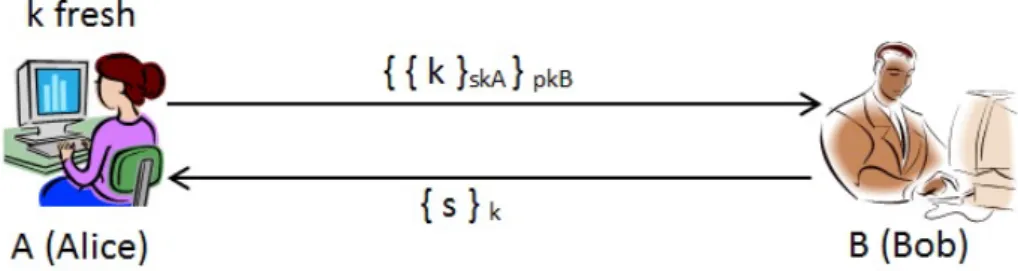
ure 2.2 illustrates one example of a protocol, namely the Denning-Sacco key

distribution protocol [8]. The goal of this protocol is for the key k to be a

secret key shared between A and B, so that s can be kept confidential upon

delivery because it is encrypted by using a key k.

(18)

Figure 2.2: Simplified Denning-Sacco key distribution Protocol

In reality, this protocol still cannot be considered secure, for an active C attacker could impersonate A and obtain the secret s. Figure 2.3 illustrates how the (well-known) attack is against this protocol.

Figure 2.3: Attacking of Denning-Sacco key distribution Protocol

With a little analysis and modifications to this protocol, C cannot imper- sonate A as shown in the Figure 2.4. This is because in the previous attack, the first message namely {{A, C, k} skA } pkB ,cannot be accepted by B.

Figure 2.4: Revision of Denning-Sacco key distribution Protocol

In order to analyzing and proofing security level of protocol, cryptogra-

pher needs to verify the protocols. Now, the verification of protocols has

(19)

been and still a very active research topic because the protocol design is er- ror prone and these errors are not detected by testing, they appear only in the presence of an adversary. Besides, errors can have serious consequences.

There are two main frameworks for analyzing security protocols:

1. The Dolev - Yao model: a formal or abstract model. Here, the crypto- graphic primitives are ideal black boxes and adversary or attacker uses only those primitives. Proof can be done automatically by Pro Verif tool [9].

2. The Computational model: a realistic model which the cryptography primitives are functions on bit-strings and the adversary is a polynomial- time Turing machine. Several proofs are done manually but some auto- matic prover sound in the computational model. One of them is Crypto Verif [10].

Both of models usually assume active attackers which have some ability, e.g. the attacker can intercept all messages sent through the network, com- pute messages and send messages through the network.

The Dolev-Yao Model for OES Protocol: The threat model of an online examination protocol consist of a Dolev-Yao attacker who has full control of the network, namely of the public channel. In the public channels, an at- tacker can eavesdrop, drop, substitute, duplicate, and delay messages that senders sent to receivers. In addition the ability of an attacker can be ex- tended with corrupted principals. He can also inject message of his choice into the public channel, and exploid the algebraic properties of cryptographic primitives because a theory of equational. However, We has private chan- nel. In private channel, attackers has not control which are normally used to model out-of-band communication between processes. The attacker cannot see and know all communications happen over private channel.

2.4 ProVerif

ProVerif is a tool created specifically to verify cryptographic protocol [9].

ProVerif has the ability to verify the protocol with an unlimited number

of sessions. A model that is run on a limited number of sessions has the

disadvantage of if the user has specified the number of sessions and the results

issued by the tool indicates that there was no attack on the protocol according

to the number of sessions stated. Thus, the existence of attacks in a larger

number of sessions cannot be ascertained. ProVerif allows users to find the

attack that occurred by using a representation with an unlimited number of

sessions.

(20)

At first, ProVerif can only accept modeling input that is written using Horn clause representation. With this representation, ProVerif can verify security secrecy objectives explicitly and authenticate implicitly. ProVerif was then developed in order to receive modeling input written in the cal- culus model representation, as well as to verify the authentication security objectives explicitly.

When ProVerif claims that a protocol does meet the security secrecy objectives and/or authentication, the secrecy and/or authentication of the protocol is definitely guaranteed. In other words, no attacks were found.

However, if ProVerif issues an output of a possible attack channel, then the output should still be examined. The results of this output can be either an actual attack channel or only a false attack.

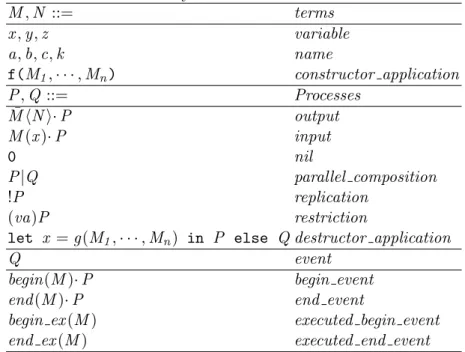
Process calculus is an approach used to model processes that run in par- allel. ProVerif uses a representation of pi calculus enriched with some syntax (Table 2.2) to model the cryptographic protocol and security objectives. This representation is hereinafter referred to as the representations process calcu- lus.

Table 2.2: Syntax of Process Calculus

M , N ::= terms

x , y, z variable

a , b, c, k name

f(M 1 , · · · , M n ) constructor application

P , Q ::= Processes

M ¯ hN i· P output

M (x)· P input

0 nil

P |Q parallel composition

!P replication

(va )P restriction

let x = g(M 1 , · · · , M n ) in P else Q destructor application

Q event

begin(M )· P begin event

end (M )· P end event

begin ex (M ) executed begin event

end ex (M ) executed end event

The syntax of process calculus consists of definitions of terms and process.

Terms could be a variable, name, or constructor application. While the

process can be:

(21)

• Process output M hN i· P means sending message N to channel M and then executing process P .

• Process input M (x )· P means receiving message x from channel M and then executing process P . In executing process P , x in P will be substituted with a message received through M .

• Process 0 (zero) will not do anything.

• Process P|Q is a parallel composition of P and Q .

• Replication !P represents a number of process P copies that are unlim- ited in number and run parallel, namely P |P |P · · ·.

• Restriction (va )P form a new name a and then executes process P .

• A process that is a destructor application have the form of

let x = g (M 1 , · · · , M n ) in P else Q . This process means it will evalu- ate destructor x = g(M 1 , · · · , M n ). If evaluation is successful, then the evaluation result becomes the value of evaluation x and process P is then executed.

Process begin(M )· P , end (M )· P , begin ex (M ), and end ex (M ) is typ- ically used in specifying authentication. Process begin(M )· P issues event begin(M ) and then executes process P . This process is used as a sign that the protocol participant has started its role in a protocol session. This process is paired with the end(M )· P process which means issuing event end (M ) and then executing P . This process is used as a sign that the protocol participants have terminated its role in a protocol session. begin ex (M ) and end ex (M ) processes are used to remember that event begin(M ) and end(M ) has been executed. Both of these processes are not used directly in the modeling pro- tocol but in the reduction process that defines the semantics of the process calculus being used.

In addition to the definition of the term process above, there is also the definition of let x = M in P that gives the same meaning to run process P in which the emergence of x in P will be substituted with M . Addi- tionally, the definition if M = N then P else Q gives the same meaning as let x = equal (M , N ) in P else equal Q . Equal destructor has a definition of equal (M , N ) → M . The constructor and destructor for the cryptography operations can be found in table 2.3.

As an example, a simplified Needham-Schoeder Public Key protocol is used with the following specifications:

1. A → B : {NA} pkB

(22)

Table 2.3: Constructor and Destructor in Process Calculus Symmetric key encryption

Constructor Encrypt message M with key N , senc(M , N ) Destructor Decrypt sdec (senc(M , N ), N ) → M

Asymmetric key encryption Constructor Generate public key from private N , pk(N )

Encrypt message M with public key N , penc(M , N ) Destructor Decrypt pdec (penc(M , pk(N )), N ) → M

Digital Signature

Constructor Signature message M with private key N , sign (M , N ) Destructor Verify signature checksign(sign (M , N ), pk(N ) → M

Message without signature getmess(sign (M , N ) → M Hash Function

Constructor Hash function of message M , H (M ) Destructor -

Tuple with n arity Constructor Tuple ntuple (M 1 , · · · , M n )

Destructor Projection, i n th (ntuple (M 1 , · · · , M n )) → M i , i ∈ (1 , · · · , n)

2. B → A : {NA, NB } pkA 3. A → B : {NB } pkB

The protocol can be represented with process calculus as seen in the following process P:

P = (vskA)(vskB )letpkA = pk(skA)inletpkB = pk (skB)in cpkA.cpkB .((!PA(skA, pkA))(!PB (skB, pkB , pkA))) With P A dan P B defined as follows:

P A (skA, pkA) = c(x pkB ).begin(x pkB ).(v .Na )c hpenc(Na , x pkB)i.c(m 2 ).

let w = pdec (m 2 , skA) in let na = 1 2 st (w )in let nb = 2 2 nd (w) in if na = Na then

chpenc(Nb, x p kB )i.0

P B (skB, pkB , pkA) = c(m 1 ). let y Na = pdec(m 1 , skB ) in

let (vNb)chpenc(2tuple(y N a , Nb), pkA)i.c(m 3 ).

let y Nb = pdec (m 3 .skB ) in if y Nb = Nb then

end (pkB ).0

(23)

Channel c has access to the public, including to the attacker. According to the Dolev-Yao model, the attacker can find out all the messages exchanged in this channel, create a new message from this information, and then send it to the same channel.

Process P begins with the creation of private and public keys of A and B . The public key is then sent via channel c to model the public key that is made known to the public and became the initial information of the attacker.

After that processes P A and P B will be run in parallel where each process is executed with an unlimited number of sessions.

Process P A represents messages received and sent by A. In this process, A first receive the public key via channel c to indicate with whom A com- municates. A then issues event begin(x pkB ) as a sign that it had started a session with parties that have x pkB . A then creates nonce Na, encrypts it with the public key that it received and sends it through channel c. A later receives message m 2 which it decrypts with its private key and obtains two nonce, namely na and nb. If nonce na is the same as nonce Na previously sent through channel c, then A will be confident that it communicated with the owner of x pkB and send the last message in the protocol, namely nonce nb (which it previously received) encrypted with public key x pkB .

Meanwhile process P B represents messages received and sent by B . In this process, B receives message m 1 that corresponds to a message sent by A, namely Na encrypted with public-key B . It then encrypts this message with its private-key and obtains nonce y Na. Next, it creates nonce Nb and sends the nonce and y Na encrypted with public-key A. B then receives message m 3 which corresponds to the message sent by A, namely Nb encrypted with public-key B . It then decrypts it with its private-key and obtains nonce y Nb.

If y Nb is the same as the previous nonce Nb, it is sent through channel c then, B is convinced that it is communicating with A. It then issues event end (pkB ) as a sign that it has completed a session with A.

In applied phi-calculus, secrecy can be modelled as a reachability prop- erty. The secrecy of a term m is preserved if an attacker, defined as arbitrary process, cannot construct m from any run in of protocol. There are two definitions to model secrecy, name-distinct and reachability-based secrecy.

A name-distinct process signifies that the name mentioned in a term appear unambiguously in the process either free or bound names. While reachability- based secrecy says that an attacker cannot build a process A that can output the secret term m .

In the other hand, the notion of observational equivalence can capture

privacy requirements. Informally, two processes are observational equiva-

lence if an observer cannot distinguish the process despite they might handle

different data or perform distinct computation.

(24)

Authentication can be defined using correspondence assertions. An event e is a message emitted into a special channel that is not under the control of attacker. Event may contain arguments M 1 , , M n , which are never revealed to the attacker . Events do not change the behavior of process in which they are located, but normally flag important steps in the execution of protocol. To model correspondence assertions, we annotate processes with events such as e hM 1 , , M n i and reason about the relationship (→) between events and their arguments in the form if an event ehM 1 , , M n i has been executed, then event e hM 1 , , M n i has been previously executed, which formalized as the following form:

e hM 1 , , M n i → ehM 1 , , M n i

By adding key word inj, it is possible to model injective correspondence assertions, which signifies that if an event ehM 1 , , M n i has been executed, then a distinct earlier occurrence of event e hM 1 , , M n i has been previously executed. we formalized as the following form:

ehM 1 , , M n i → injehM 1 , , M n i

(25)

Chapter 3

Online Examination Systems

Online examination system (OES) is an exam based on the Internet without paper, each action of examination is conducted through the network e.g.

the delivery of question sheets and answers to the test. In recently years, OES are really a research challenge for any situation of exam related with long distance learning and truly online. The environment situation of online examination cannot be totally controlled or can be fully controlled depend on the situations during an exam. We have to consider which situation of our online exam because the situation of exam will influence how to keep the security of our system and how to prevent cheating during the exam.

In order to make easier for design our system, we consider and make several assumptions as a target situation of our OES:

1. In the OES framework, there is a basic computer used by each par- ticipant. A large number of participants located in several places take exam at a fixed time and at a fixed axam seat.Limited number of su- pervisors are in each room during the exams.

2. OES consists of 3 entities which are the examinee, administrator and examiner. Each of this entity has a privileged access to different pages.

3. Examinees take the exam in a secure place or room such as a computer lab or ICT center which has already been set and registered for OES.

4. The examiner executes set-up exam questions from registered place or computer.

5. Whether grading process can be done automatically by the system or manually by the examiner depends on their type of questions.

6. Manual grading will be performed by examiner in a registered place.

(26)

3.1 Problem on OES

Before we go to the next step, we need to identify the problem of our OES related to the target situation above. As we know, OES cannot separate with computer network systems and the main problem here is security. Computers and network security problems occur due to the presence of securities hole in the system both of its network design and program coding. The existence of security hole allows someone both of inside attacker and outside attackers to access the system by illegally stealing exam questions and answers, making changes to existing value, or another type of modifications. Web design security is very important because it has a content that must be protected.

Without any prevention method, anyone can penetrate into the web and obtain data stored on the web. There are several security aspects that should be guaranteed in the OES:

1. Database secrecy; There are so many sensitive data in OES that should be kept secret.

2. Data Integrity; We have to ensure that all received data during com- munication is real data.

3. Authenticity; Authenticities of all messages, transactions or other ex- change of information before, during and after the exam must be en- sured.

4. Data secrecy of transmission; OES is often constructed as a server and client system. Sensitive data transmitted among them should be protected.

5. Data access control; Data on OES only should be accessed on the spe- cific time and place.

In addition to the security issue of the computer and networking systems, the other important issue in the OES is cheating prevention. There are many techniques that are often used by the examinee to obtain exam answers illegally, for instance, browsing the Internet, using messenger communication or other common cheating techniques. The following are some of the basic techniques used to get answers illegally during the exam:

1. Browsing on the Internet; Examinee can seek answers to questions by utilizing existing search engines like Google or Yahoo.

2. Using the Internet messenger for communication; Examinee can have

discussions with others either existing in the same network or outside

networks by using the messenger facility.

(27)

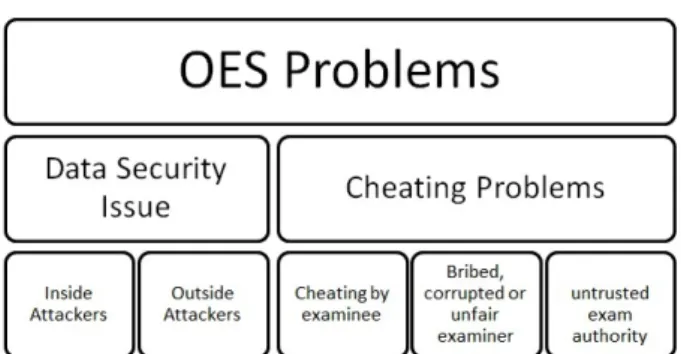
Figure 3.1: Problems of Online Examination System

3. Communication with others; Without or limited proctor supervision, the examinee can have discussions with other examinees in the same room or at a far distance via a portable device brought in by the ex- aminee.

4. Access to local or external storage; Examinee can find an answer to ac- cessing files on local or external storage such as flash drive or CD/DVD installed on the PC where they are doing the test.

5. Reading a book or tutorial directly; Examinee can find the answer by reading a book or tutorial directly because there is no exam supervisor.

6. Collusion; Examinee and administrator or examiner can have collude in order to increase their exam score.

Besides the cheating by examinee, there are some threats possible occurs in online examination system such that bribed, corrupted or unfair examiner and dishonest or untrusted exam authority. Figure 3.1 shows the problems diagram of online examination systems.

3.2 Related Work

According to [11], the basics dilemma in Online Examination system is in-

tegrity and secrecy of the questions, answers, grades and examines itself,

collaborating and cheating examinees. These ”honesty control issues” also

apply to traditional classroom courses in which the instructor uses online,

out-of-class exams to save classroom time for non-exam purposes. They pro-

pose eight control procedure to solve this dilemma, they are an exam should

be scheduled for a specific date and time, an exam should close when the

(28)

allotted time period for work expires, an exam should be open to Internet access for only a limited time period, examinees can only solve one question at a time and cannot access completed questions. A student can access the exam only once, an exam should be limited to special purpose browser, an exam should be a randomizing question and answer choices, and about one- third of objective type questions should be rotated or modified in each exam every term.

There are several Content Management System (CMS) for online educa- tion that utilizes web-based commercial courses management software such as Moodle, Web CT, Blackboard, or software developed in-house. This soft- ware is not used widely for online exams, due to security vulnerabilities, and the system must rely on students honesty or their having an honour code [1].

Besides, CMS still does not have enough cheating control in their system. In order to prevent cheating by examinee, many general CMSs have functions to form test-problem sets randomly from pools and to analyze answers from students. For example of Blackboard, one of the famous CMSs, can compose a test which poses a different set of problems to every student based on a pool and categories of problems, and inform its examiner of statistics such as difficulties and discrimination of the problems by analyzing student answers based on the item responses theory.

A simple solution to the issue of computer and network security and cheating on online exams was proposed in many papers [1, 2, 3, 12, 13, 14].

One solution is called an enhanced Security Control System in the Online Exam (SeCOnE) which is based on group cryptography with an e-monitoring scheme [13]. The other cryptographic schemes was proposed [1, 2, 12, 15].

The control of cheating problems in online examination system by using camera as e-monitoring was proposed in [1, 2, 15].

Implementation of online examination system has been offered in [16, 17].

They tried to build OES by offering some important features in their models such as the user’s registration, examination instruction, a valid time of exam and time reminders. They used three entities that will access to their system namely admin, teacher, and student.

On the other hand, the characteristics and potential ways of cheating dur- ing the online exam process and the shortage of existing Online Examination Systems, anti-cheating measures were analyzed by [14]. They provide two solutions to prevent cheating. The first solution is based on the automatic generating examination paper algorithm which takes advantage of the knap- sack problem principle. The other solution is based on the self-developed ActiveX control.

Another thing that has not been considered in the existing system is the

possibility of collusion between the examinees with examiner or administrator

(29)

to improve the exam results. Or cheating can be committed by the examiner or administrator to change the results of an exam.

After reviewing several working above, we found some existing problems which will be considered in our discussion as follow:

1. E-monitoring as a solution for cheating problem needs high cost and widely bandwidth, so we try to reduce some examinee cheating tech- niques by another method without e-monitoring.

2. In order to prevent cheating by examinee like browsing, using messen- ger, accessing local or external storage in the network system, several OES applications use special purpose browser e.g. Safe Exam Browsers (SEB) or Respondus Lockdown Browser as one of solution. Unfortu- nately, this is compatible only for specific web based exam which offer a quiz mode. Besides, special purpose browser can be high cost and difficult to use for partial examinees. We need to design a cheaper and more practice way to handle this condition.

3. Cheating can be done by some examinees if they can set their own schedule and prepare their seating position when to take an exam.

There is no referenced paper or application which is special solving this problem.

4. Until recently in several online exam application, password hash was established as sort of de facto standard to use MD5 hash algorithm for protecting passwords. It becomes so popular that various public hash databases appeared online like http://www.md5decrypter.com. We need to construct our online exam with another newest hash algorithm like SH3 algorithm.

5. We need a perfect distribution of random algorithm of questions be- cause the shuffle methods used by some CMSs are not fully uniform distributions.

6. Collusion between examinee and administrator can be done if examiner could not access to the system even just looking and downloading the exam result.

In order to ensure fairness of online examination and solving some existing

problems above, our challenge here is to make a secure online examination

system application with several new features that are not owned by any other

systems that we referenced. Table 3.1 shows a comparison of several online

examination systems with our scheme.

(30)

Table 3.1: Features comparison of Online Examination Systems

Features Ours SI[1] LG[14] CDS[15] HB[16] IRI[17]

Browsing Guard Yes No Yes No No No

The Internet Messenger Guard Yes No Yes No No No

Time Limit Yes Yes Yes Yes Yes Yes

Local Data Accessing Prevention Yes No Yes No No No Ext.Storage Accessing Prevention Yes No Yes No No No

Random Question Yes Yes Yes Yes Yes Yes

Random Scheduling Yes No No No No No

Random Seating Yes No No No No No

Bank Question Yes No No No Yes Yes

Question Analyzing Yes No No No No No

Collusion Prevention Yes No No No No Yes

E-Monitoring No Yes No Yes No No

Yes/No: Feature shown in the left column is/is not held.

3.3 Model and Implementation

In this section, we offer a secure web-based online examination system along with network design so that the system [18] is expected to prevent cheating and network security that often occurs, which is either done by the partici- pants taking the exam or by persons outside the system trying to penetrate.

3.3.1 Web Security Design

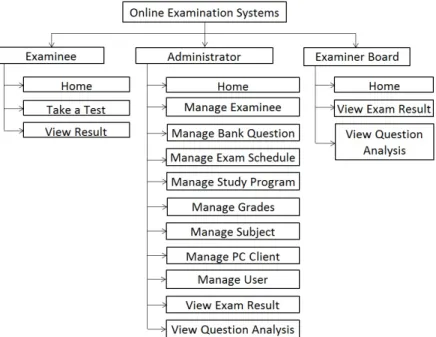
We try to utilize a secure website, which follows the recommendation by [11] about online exam control procedure. We can see the detail of pages in Figure 3.2.

The examinee page consists of 3 sub pages which are Home, Take a Test and View Result. To access these pages, an examinee must have a registered user name and password. Home is the first page that can be accessed after successful login. The most important subpage for the examinee is Take a Test page. The examinee must be aware of some properties when this page has been accessed, which are:

1. The type of test that will appear on this page and which will be accessed by the examinee is the test that has been registered as the test program.

2. Be at the place (PC Client’s identity) that has been determined by the

system when registration process.

(31)

Figure 3.2: Online Examination System

3. Be at the time range that has been determined by the system when registration process.

4. After selecting the test subject, the timer will start and not be stopped until the time run out.

5. The questions will appear one by one on each page with the questions and candidates of answer appearing randomly for each examinee.

6. Each examinee can do the test only once. After that, the examinee will no longer be able to access the test questions.

7. Results are displayed for each examinee at the end of exam for automat- ically grading. Such a treatment rules out of manipulation of results.

While for manually grading, the system will follow some procedure until the examinee gets his result (see: chapter 5.).

8. An honest examinee can see their result of the test but not that of other examinees.

9. Communication process of each processes will run on the particular

secure protocol.

(32)

The second page is the administrator page. This page is the most im- portant element of the online test system. In this page, all of the test terms are organized, such as the test schedule organization, examinee organization, inputting of test questions to the bank question, managing the study pro- gram, managing grades, managing subject, managing PC client which will be used by examinee to take an exam and manage of username and password.

Besides, the administrator can view an exam result and question analysis when the examination has finished. It is recommended that there should be a limited number of people who can access the page for maximizing the security of data and system. The administrator has several terms too, which are:

1. Administrators can add, change and remove the question in a Bank Questions or Test Managing. In addition, we have feature for import questions from Excel file (*.xls or *.xlsx) with the particular format to the bank question.

2. Administrator can see the test result but they could not edit it.

3. The administrator registers an examinee but they could not see or edit the User name or password. User name and password are generated by the system at randomly and sent directly to the examinee’s email when registration process.

4. The administrator manages an exam schedule but they could not see or edit the examinee’s schedules and examinee’s place to take the exam.

Schedule and place are generated by the system at randomly and sent directly to the examinee’s email when registration process.

5. The administrator could not deceive or make collusion with examinee because the result of an exam can be seen by the examiner board.

Examiners board can be teachers association or school leaders.

The third page is examiner board page. It requires username and pass-

word authentication to access it, even though this page is only a viewing

mode page. For those who can access this page, they can only view the test

results and question analysis in several options like viewing the overall sub-

ject and all examinees for each grade, viewing daily results of each subject

and viewing the question analysis. Questions Analysis page analyzes the dif-

ficulty of the question based on the answer of examinee and output of three

categories of question, hard, moderate or easy. The Questions Analysis page

can be used as a reference for teachers to know which materials are still not

understood by the students.

(33)

3.3.2 General Network Security Design

Network design is also one of the main elements of the online examination system. We consider to easier and cheaper way to achieve goals both of security view and features view in OES. We have several points of interest in designing a network for security, which are:

1. All access to the web and online examination server database is blocked, except for access from registered proxy. It is hoped that this solution can become one of the guarantees for high security in overcoming illegal access from unauthorized users, as well as to prevent malpractice or illegal use.

2. All outgoing accesses of the client, by which the examinee is taking the examination, will be blocked except access to the online examination server. By blocking all accesses to the outside from client, it is hoped that cheating by looking for answers through the Internet or by using Messenger applications can be overcome.

3. The operating system of the client uses Windows OS which will restrict some actions during the examination, which are: prohibiting access to Windows explorer, prohibiting access to external ports such as USB port, CD/DVD drives, floppy drives, tape drives and others. This is done because cheating in examination has frequently occurred through obtaining answers from outside sources using drives on the client PC.

Figure 3.3 is a block diagram of the online examination system network that we suggest. In this diagram, we assume that the data is transmitted through the Internet using a secure system such as using https protocol or other protocols that can hide data from eavesdroppers.

3.3.3 System Implementation

a.Web Application

For security on the website programming side, we provide initial au- thentication facility which uses the user’s login and password. Moreover, in the database, we hide several parts such as the password of each user that is used for login using hash function SHA-3 which is taken from https:

//github.com/jedisct1/keccak-php, as well as all exam questions stored in the database. We use mcrypt function of PHP with the most effective encryption algorithm in [42].

We achieve cheating prevention with several features by making random

questions for each examinee algorithm, session system for one time login,

(34)

Figure 3.3: Network design of Online Examination Systems

question bank, random seat order, randomizing exam schedule and time limit algorithm for every question. This is based on a recommendation by [11].

We only will explain some new features which still not exist in the others system.

Random Question algorithm

Randomization algorithms of exam questions that are widely used by on- line examination systems today still use the shuffle function, which is owned by the programming language, such as shuffle() or rand() in PHP and ran- dom() in ASP. The weakness of this model is the randomness that is not completely uniform so that in the case of this online exam, there are ques- tions that occur very frequently and there are those that rarely occur. One algorithm which is famous for its near-perfect uniform randomization is the Fisher-Yates Algorithm [19].

The Fisher-Yates shuffle (named after Ronald Fisher and Frank Yates) or also known as the Knuth shuffle (taken from the name of Donald Knuth), is an algorithm to generate a random permutation of a finite set, in other words, to shuffle that set. If implemented correctly, the results of this algorithm will not be biased, so that every permutation is equally likely. The basic method used to generate a random permutation of the numbers 1 through N is as follows:

1. Write number 1 to N.

2. Choose a random K between 1 and N that has not yet been scratched

out.

(35)

3. Scratch out the K, and write that number in another location.

4. Repeat steps 2 and 3 until all numbers have been scratched out.

5. The order of number written in step 3 is the random permutation from the beginning numbers.

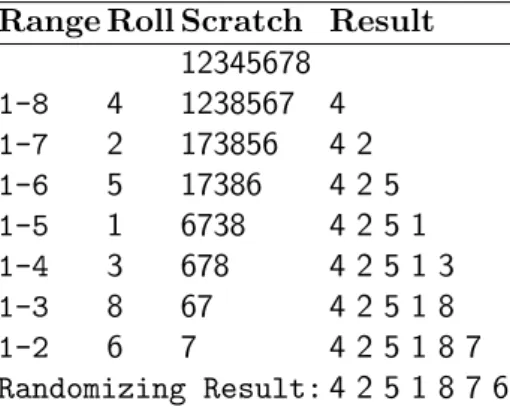
In the modern version currently used, the numbers chosen is not scratched, but its position is exchanged with the last digit of the numbers that have not been selected. Table 3.2 shows the flow of Fisher-Yates algorithm.

Table 3.2: Sample of Fisher-Yates algorithm Shuffle Range Roll Scratch Result

12345678 1-8 4 1238567 4 1-7 2 173856 4 2 1-6 5 17386 4 2 5 1-5 1 6738 4 2 5 1 1-4 3 678 4 2 5 1 3

1-3 8 67 4 2 5 1 8

1-2 6 7 4 2 5 1 8 7

Randomizing Result: 4 2 5 1 8 7 6

With a little modification from original Fisher-Yates algorithm, we con- struct our random question algorithm. Figure 3.4 illustrates the steps of our algorithms.

With this Fisher-Yates shuffle algorithm, we can assume that choosing the set of questions for each examinee is done by uniform random distribution.

Let X = The number of questions in Bank question, Y = The numbers of questions at exam and Z = Total of examinees who takes an exam in the same place and time. Based on the permutation theory, we can compute several things below:

1. We can compute how many possibilities different set of questions if we choose Y questions from X total questions (X > Y ).

n = P (X, Y ) = (X−Y X! )!

2. Then, we can compute how many probability of Z examinees for getting same set of question.

P r[Q] = Z n = P (X,Y Z )

(36)

Figure 3.4: Flowchart of Random Question Algorithm

As an example, If there are 150 questions in the Bank Question and we will choose 100 questions for exam then we will have around 1 , 879x10 198 possibilities of set questions. If we choose one of them for 10 examinees only, then they only have probability of getting same set question around 5 .3233x10 −198 . It is very small probabilities, close to 0%.

Automatic scheduling and seating arrangement

In an automatic scheduling and seating arrangement system, we also use

the randomization method. The system with database of identities of exam

schedule and client PC selects an exam schedules, generates an exam both

at random and provide them to examinee during registration, by checking

whether the schedule and exam location have not been taken by examinees

who have registered previously.

(37)

This process is performed by the system when examinee registered, along with the generation of a user name and password that will be used by the examinee to log in to OES. User name, password, exam schedules and exam’s place are directly sent to the examinee’s email address by the system without administrator intervention. In this case, an administrator is only in charge of inputting the personal data of the examinees into system. This idea is based on the suggestion from [20]. According to them, one of technique that can be used to reduce cheating on exams is automated sitting positions. Figure 3.5 is an illustration of the registration process that will generate a user name, password, automatic scheduling, and sitting position. If we assume that our

Figure 3.5: Flowchart of Registration Process

automatic scheduling and seating arrangement algorithm is uniform random distribution, we can compute the probability of examinee who try to do cheating by get a seat position side by side. Let X = Total examinees who want to take an exam, Y = total available seats and Z = The numbers of dishonest examinees.

P r[R] = P((X P −Z),(Y (X,Y ) −Z))

(38)

As an example, If there are 100 examinees and 10 available seats in one time exam. Then we can compute probability of 2 dishonest examinees will get side by side seats as follow :

P r[R] = P((100−2),(10−2))

P(100,10) = P P ((98),(9)) (100,10) = 100! 98! = 0.0001 = 0, 01%.

To generate random passwords, we create sets using scrambler function which generates, for example, 8 digits derived from the numbers 0-9 and the letters a - z. Figure 3.6 is a function of the scrambler password.

Question analyzing algorithm

Figure 3.6: Random Password Generating function

One advantage of our application compared to previous applications is a feature to analyze the question which exists on the Bank Question. After the exam is done, the examiner can see each question in the category of hard, medium or easy. This analysis is based on a comparison of the number of correct answers to the total numbers of answer which we call the difficulty index [21]. The index value is calculated using equation below.

p = R

T

Where:

p = Difficulty Index

R = Number of correct answers to the exam and T = Total numbers of the answer to the exam.

If the difficulty index is smaller than 0.2, then the question is considered

hard. If the difficulty index is in the range 0.2 to 0.9, then the question is

considered medium or moderate. While the difficulty index is bigger than

0.9, then the question is considered easy. The following figure 3.7 is our

questions analysis function.

(39)

Figure 3.7: Question Analysis Function

b.Network Configuration

Several OES use Safe Exam Browser or Respondus Lockdown Browser at the client side for security and cheating prevention. Creating special browser using ActiveX [14] is another way, but both of them need high costs and sometimes uncomfortable for all examinee. So, we remove these techniques to make easier and cheaper. Our solution is using proxy and firewall system, utilization of MMC (Microsoft Management console) and some additional features for security goal.

Server Security

In the server, all data and application for online examination are stored.

We propose to use Linux server 14.04, using LAMP for web servers, using MySQL for database server, using BIND9 for DNS system and Shorewall [43] for Firewall system. The policy in Shorewall firewall server is to block all incoming access, except accessing from listed proxy servers. We have to set-up global rule to block all connection and a specified rule to accept access from specified network at Shorewall firewall server. Besides, we also optimize the configuration in iptables which is provided in the Linux kernel firewall to set up and maintain tables of IP packet filter rules in the Linux kernel.

We have to set-up global and specified rule at Shorewall firewall server as figure 3.8. However to ensure security on the server side, it is not enough just with this configuration. Here, there are several addition features that we have used for the server side:

1. We have installed the Intrusion Detection System (IDS) which serves

to check incoming and outgoing data packet activity in the network.

(40)

Besides, it can identify suspicious pattern that possibly happen in the network. We used ”snort” software as IDS because it is open source GNU and it can also be modified as needed.

2. We have activated and configured the Malicious Code detector. Here, we used ”tripwire” software which also open source and easy to config- ure.

3. We do not allow the user to use remote programs such as telnet. All remote programs are switched off after installation. To ensure security, the administrative processing must be done with locally accessing.

4. We added ”Disallow: /administrator/” in robots.txt file or ”Disallow:

/[directory name]/”, where [directory name] is a directories which does not want published in search engine. We need to protect these files as good as possible because it is always used by a hacker to know our website structure.

5. After completing development, we need to do restriction (chmod) for all files and directories starting from the root of our website. all access –rwx group should be disabled and accessing to ”other” user should not be able to do ”write” process unless directories like cache which is needed by the web server or directories where the file will be upload.

Figure 3.8: Global and Specified Rule of Firewall

Client Security

We adopt the squid proxy server because it has several advantages [44].

The policy in the proxy server is to block all http accesses, except access

(41)

to the online examination web page. We have to set-up rule at proxy squid server to block all http accesses, except the websites listed in the proxy list.

We can make a proxy list which can be accessed by client or examinee. We have to set-up rule at proxy squid server too as show in figure 3.9.

Figure 3.9: Rule of proxy Squid Server

We assume that every client uses Windows operating system. In this system, we want to make a policy that each examinee which uses this system cannot access Windows explorer and external device port. Examine also can not run several application softwares. Besides, we propose to use Microsoft Management console (MMC) as a solution. It is a graphical user interface- based component in Windows that accommodates administrative tools called snap-ins [45].

As we have explained above, that we have prevented some cheating tech- niques from configuring some of the ”group policy” on the client computer to make a ”consoleonlineexam” using MMC. In addition, we also did some security configuration in order to ensure some level of security on the client side. In the ”consoleonlineexam”, we added the ”Security Template” and

”Security Configuration and Analysis” snap-in. This configurations aim to limit the examinee user group permissions to access system file and registry, so they cannot change the ”group policy” that has been set before. This configuration also assumes that the administrator does not want the user entered into the Power Users Group. The advantage of MMC is simpler for an administrator with enough once to configure and can be applied to all client computers in the network. Figure 3.10 is MMC configuration in the

”consoleonlineexam”. Besides, it can configure or analyze Windows oper-

ating system security. Its operation is based on the contents of a security

template that was created using the Security Templates snap-in.

Table 2.1: Key sizes foe equivalent security levels (in bits) [6]
Figure 2.2: Simplified Denning-Sacco key distribution Protocol
Table 2.2: Syntax of Process Calculus
Figure 3.1: Problems of Online Examination System
+7

参照

関連したドキュメント

Eskandani, “Stability of a mixed additive and cubic functional equation in quasi- Banach spaces,” Journal of Mathematical Analysis and Applications, vol.. Eshaghi Gordji, “Stability

On the other hand, when M is complete and π with totally geodesic fibres, we can also obtain from the fact that (M,N,π) is a fibre bundle with the Lie group of isometries of the fibre

The aim of this work is to prove the uniform boundedness and the existence of global solutions for Gierer-Meinhardt model of three substance described by reaction-diffusion

We prove an existence result of entropy solutions for a class of strongly nonlinear parabolic problems in Musielak-Sobolev spaces, without using the sign condition on the

Keywords and Phrases: The Milnor K-group, Complete Discrete Val- uation Field, Higher Local Class Field Theory..

In order to be able to apply the Cartan–K¨ ahler theorem to prove existence of solutions in the real-analytic category, one needs a stronger result than Proposition 2.3; one needs

From the delayed cosine and sine type matrix function on the fractal set R αn (0 < α ≤ 1) corresponding to second order inhomogeneous delay differential equations with

Com- pared to the methods based on Taylor expansion, the proposed symplectic weak second-order methods are implicit, but they are comparable in terms of the number and the complexity