バデレアイトを用いた SHRIMP 年代測定における問題点
新原 隆史1、堀江 憲路1、海田 博司1、外田 智千1
1国立極地研究所
Problem on baddeleyite U-Pb dating using SHRIMP II
Takafumi Niihara1, Kenji Horie1, Hiroshi Kaiden1and Tomokazu Hokada1
1National Institute of Polar Research
Baddeleyite (ZrO2) is widely accepted to use as U-Pb chronometer for mafic rocks (zircon poor rocks) as well as zircon (ZrSiO4) [Heaman and LeCheminant 1993; Heaman 2009]. Baddeleyite retains abundant uranium and exclude initial Th and Pb at the time of crystallization. Those signatures are convenient for U-Pb dating by SHRIMP II. Niihara et al. (2011) conduct high-pressure (up to 57 GPa) and high-temperature (up to 1300 °C) experiments to test U and/or Pb loss/gain under shock metamorphic condition and conclude that U-Pb isotopic system of baddeleyite does not change severely under experimental conditions, and might not reset easily by secondary thermal events as well as zircon.
NIPR SHRIMP Laboratory tries to analyze U-Pb isotopes in baddeleyite from several meteorite samples [Misawa and Yamaguchi 2007; Niihara 2012]. However, there is a technical problem need to solve to analyze with SHRIMP II to obtain robust U-Pb mineral age. Wingate and Compston (2000) reported that 206Pb/238U ratios by ion microprobe vary significantly up to ±10% and systematically with the relative orientation of the baddeleyite crystal structure and primary ion beam; so called orientation effect. They speculated the reason of this effect as channeling of primary beam into the crystal, emission of secondary ions along preferred direction, and/or differential ionization of secondary species. However, the reason of orientation effect is still unclear.
We observed apparent primary beam current and secondary beam count get continuously down over 14% causing large analytical error (over 10%) in some grains during one-spot
analysis. Actual primary beam current does not change; primary beam current recover on next analyses spot. Therefore we can monitor the actual primary beam intensity only on surface of baddeleyite grains. It may imply the conductivity between baddeleyite and resin is bad and change ionization rate during one-spot analysis.
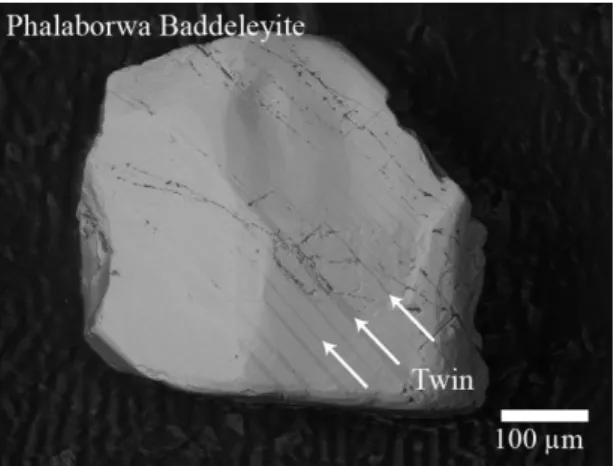
Baddeleyite has clear twin along {100} and {110} (Figure 1), and cleavage along {001}. These discontinuous planes are possible channel of the primary beam [Wingate and Compston, 2000].
We are planning to solve this problem and need to understand mineralogical aspect of baddeleyite under ion beam to develop analytical techniques to obtain precise U-Pb ages from baddeleyite.
Figure 1. Backscattered electron image of baddeleyite grain.
References
Heaman, L.M., LeCheminant, A.N., 1993. Paragenesis and U-Pb systematics of baddeleyite (ZrO2). Chem. Geol., 110, 95–
126.
Heaman, L.M., 2009. The application of U-Pb geochronology to mafic, ultramafic and alkaline rocks: An evaluation of three mineral standards. Chem. Geol., 261, 43–52.
Misawa, K., Yamaguchi, A. 2007. U-Pb ages of NWA 856 baddeleyite. Meteoritics and Planetary Science 42, A108.
Niihara, T. 2011. Uranium–lead age of baddeleyite in shergottite Roberts Massif 04261: Implications for magmatic activity on Mars. Journal of Geophysical Research, Vol. 116, E12008, 12 pp. doi:10.1029/2011JE003802.
Niihara, T, Kaiden, H., Misawa, K., Sekine, T., Mikouchi, T., 2012. U-Pb isotopic systematics of shock-loaded and annealed baddeleyite: Implications for crystallization ages of Martian meteorite shergottites. Earth and Planetary Science Letters 341-344, 195–210.
Wingate, M.T.D., Compston, W., 2000. Crystal orientation effects during ion microprobe U-Pb analysis of baddeleyite. Chem.
Geol. 168, 75–97.