北海道医療大学学術リポジトリ
Health‑Promoting Behavior of The International Student Study in Hamburg,Germany
著者 Gazi Mehedi HASAN, Azmeree JAHAN, Syed
Taufiqul ISLAM, Akashlynn BADRUDDOZA DITHI, Md Riasat HASAN, Takashi SAITO
journal or
publication title
北海道医療大学歯学雑誌
volume 37
number 1
page range 25‑31
year 2018‑06‑30
URL http://id.nii.ac.jp/1145/00064603/
Introduction
About 218,848 international students (non−European) en- rolled in 2014 through all German academic institute, which is 8.4% of total students enrolled in Germany (Exchange Service, DA, 2005) (Fig 1). The numbers of foreign student are increasing every year in Germany. In addition, eco- nomic, political and cultural networking between continents and countries has started an ever−increasing globalization that includes the invasion of health−related behaviors, health system model and diseases as well (Chandler et al., 2004).
University students symbolize the future of family, com- munity and country. They are facing many stresses during the attempts of achieving success in their academic goals (Al
Ansari et al., 2013) and are likely to become future leaders in their society whether in economy, education or politics. It has been mentioned that health is an important factor for academic achievement at school and in higher education (Al Ansari et al., 2010). University students have widely been neglected in health research, hence data about this group is scarce (Tobisch et al., 2015). However, health behavior sur- vey of school aged children is always being focused in dif- ferent research in the previous years in Germany and glob- ally (Hölling et al., 2012 ; Roberts et al., 2009 ; Kann et al., 2014).
According to the World Health Organization, health is not only the absence of disease but a state of complete mental and physical well−being in relation to the productivity and
〔Original〕
HealthPromoting Behavior of The International Student Study in Hamburg, Germany
Gazi Mehedi HASAN1), Azmeree JAHAN2), Syed Taufiqul ISLAM3), Akashlynn BADRUDDOZA DITHI4), Md Riasat HASAN4), Takashi SAITO4)
)Division of Biomaterials and Bioengineering, Department of Dental Materials Science, School of Dentistry, Health Science University of Hokkaido, Japan
)Division of Oral Biology, Department of Dental Pharmacology, School of Dentistry, Health Science University of Hokkaido, Japan
)Division of Pediatric Dentistry, School of Dentistry, Health Science University of Hokkaido, Japan
)Division of Clinical Cariology and Endodontology, Department of Oral Rehabilitation, School of Dentistry, Health Science University of Hokkaido, Japan
Key words: Questionnaire, Health behavior, International Students, Germany
Abstract In 2014 a new peak of 301,305 foreign students were estimated in Germany. Some 54% of international stu- dents who finished their study program in Germany be- tween 2005 and 2013 were still living in Germany in 2014. This study was aimed to know about the health−
related risk and behaviors of international student studying in Hamburg University of Applied Science, Germany. A cross−sectional paper−pencil questionnaire is being used during the course that consist questions about socio−demography, well−being, health−promoting and health−risk behaviors, in 2015. Results shows that there is a high prevalence of low fruits and vegetable
intake among the students (55% took <3 portions per day). Average physical activity hours per week is 5.2 though 21% performs no physical activity that causes sweating. The response rate of this survey was 100%.
Large number of international students continue living in Germany after their completion of the study, so their health−related risk and behavior status should be taken in concern and regular investigation is recommended.
The Importance of knowing about the health behaviors of the international students living in Germany is sup- ported by these finding.
performance by the intake of food and utilization of nutri- ents (Tontisirin et al., 2004).
Though several studies were undertaken in different Ger- man universities to know about German student’s health be- havior but very few are known about international students.
By ignoring those number of international student’s health status, it is unrealistic to conclude the health status of the students in Germany or to define quality of life of students in Germany (Stock et al., 2003). Data regarding the health status of international students in Germany are inadequate (Chandler et al., 2004). Therefore, this survey was carried out to investigate the socio−demographic, health behavior status of the international master’s students at Hamburg Uni- versity of Applied Science. This target group do not repre- sent the whole international students neither in Germany nor in Hamburg. However, it consists of important groups of in- ternational students such as increase of students from South−
Asia and Africa. In Germany, trends on surveying among students about their health behavior have been rarely done.
Upcoming revisions will be needed to monitoring student’s health as basis for development and evaluating health−pro- moting intervention at universities. These movements should set out to encourage individual future health and social de- velopment of students (Gusy et al., 2010 ; Franzkowiak et al., 2000 ; Meier et al., 2010).
This is therefore a cross−sectional study referring to cal- culate the socio−demographic status, health behavior, nutri- tion and vaccination variabilities of the international students using a standardized questionnaire.
Methods
Study design :A cross sectional study was accompanied us- ing a second−generation surveillance system (Fragebogen : Surveillance des Gesundheitsverhaltens von Studierenden ; Version 1.3) to identify issues in health and health related behaviors of international health science student (MPH and MHS) in Hamburg, Germany.
Target group :The target group is made up of matriculated Master of Public Health and Master of Health Science stu- dents at HAW Hamburg. Students must be at least 18 years old and sufficient English language skill was needed to par- ticipate this study. No other criteria were required.
Sample size :The study participant consists of matriculated master’s students of Hamburg University of Applied Science (Faculty of Life Science). The (n = 38) sample clearly repre- sent international cohort as students of this survey were from 18 countries with diverse religious, socio−culture, and economic background.
Data collection :Self−administered paper−pencil question- naire had been scattered and completed directly during course. It took around five minutes to fulfill the question- naire. For guaranteeing privacy, participant is folded their completed questionnaire to cover answer and placed into a closed box. The closed box was collected and carefully pre- served.
Instrument :Short questionnaires with a limited number of questions were needed that focus on health behavior of high- est significance. Total of 38 structured questionnaires were administered to the eligible respondents. The questionnaire Figure 1 :International students in Germany (2004−2014)(Source : Federal Statistical Office ; DZHW calculation)
Gazi Mehedi HASAN et al./Health−Promoting Behavior of The International Student Study in Hamburg, Germany
第37巻1号 4C150 1C133/本文 ※31‐1から組体裁変更 OTF/025〜031 原著 Gazi 4C 2018.06.07 21.42.47 Page 26
was made up of social−demographic, health−promoting and health risk behavior, stress and well−being of the participant.
Recommendations for health behavior were considered relat- ing to various institutes. For example : health nutrition and physical activity (World Cancer Research Fund / American Cancer Research 2007a).
Data management and plausibility checks : Completed questionnaires were thoroughly checked for irregularities.
Data were entered into an access data base through Epi Info 7 data entry tools from completed questionnaire. Plausibility checks compromised comparison of datasets, review of miss- ing values, verification of logical combinations, all carried out with Epi Info 7.1.5.0.
Statistical analysis :According to the study protocol, each participant must meet the required criteria for subsequent analyses. Data quality was assessed by relative and absolute frequencies of complete and incomplete questionnaires. So- cio−demographic characteristic and prevalence of selected health behaviors were presented by absolute and relative fre- quencies. Analyses were stratified for surveys.
Results
Participation :All the participants meet the criteria for the survey (eligible student 100%). Among the total participant, 26 students were from Master of Public Health department and 12 students were from Master of Health Science depart- ment (Tab 1).
Socio−demographic characteristics :The average reported age of the participants was 33 years while the youngest stu- dent was 21 years and the oldest one was 54 years. 80% of the students were in between the age group of 21−30 years.
Table 2 shows that the number of female participants were slightly higher than the male participants, in between 38 stu- dents, 53% were female where as 47% were male. Partici- pated students represent 18 countries among these 38 partici- pants six students are from Pakistan (15.79%) and five stu- dents from India (10.53%). Bangladesh and Nigeria hold 7.89% of the students each. Table 2 also indicate that major- ity of the student’s monthly income was less than or equal to 400 euro, that is 44.74% while 13.16% answered they have earn more than 1,000 euro per month. 7.89% students avoided this question.
Prevalence of health−promoting behaviors :Most of the participant reported that they have not vaccinated against in- fluenza (flu) (86.84%) and half of the participant took 1−2
portion of fruits and vegetable every day (52.53%). One per- son reported that’s he/she takes less than 1 portion [One portion is approximately one hand full] while another one said to have more than 6 portions per day. 42.1% participant reported in between 3−6 portions of fruits and vegetable per day (Tab 3).
Physical activity value :Participants were asked questions regarding weekly physical activities and 21% of the student reported that they do zero hour of exercise per week in- cludes equally four male and four females. Table 3 shows that 21% of the students does not do moderate physical ac- tivity and 6% does more than 7 hours of physical activities per week. Maximum 45% participants mentioned that they do 1−3 hours of moderate physical activities every week and 28% does 4−7 hours per week (Tab 3). The minimum mod- erate physical activity was 0 hours (both male and female) per week and maximum was 14 hours (male : 14h, female :
Department Number of students
Answered questionnaires Response rate
MPH 26 26 100%
MHS 12 12 100%
Total 38 38 100%
Sex n %
Women 20 53
Men 18 47
Financing
Family 16 43.24
Scholarship 4 10.81
Student loan 1 2.70
Occupation 8 21.62
Others 8 21.62
Monthly Income
!400 17 44.74
401−600 3 7.89
601−800 7 18.42
801−1000 3 7.89
"1000 5 7.89
Relationship
Single 15 39.47
Partnership 10 26.32
Married 13 34.21
Housing
Alone 5 13.16
Shared flat 7 18.42
Student dorm 11 28.95
With my partner 12 31.58
With my Parent 2 5.26
Table 1 :Response and participation rate of the students
Table 2 :Socio−demographic characteristics of the students
7h) per week with a median of 4.5 hours per week and stan- dard deviation of 4.2 hours per week (Tab 4). The average moderate physical activity was 5.2 hours per week (male : 5.2h ; female 3.5h).
Cross − tabulation of fruits & vegetable intake with monthly income :Table 5 shows the cross tabulation of fruits and vegetable intake with monthly income of the par- ticipants. Result shows that there is slight indication of in-
crease of intake of fruits and vegetable with increase of the income of the students. Therefore, who earns!400 euro per month, in−between those group 47.06% took 1−2 portion of fruits and vegetable while 52.94% took 3−4 portions a day.
So, this result indicate that majority of the students eat 1−4 portions fruits and vegetable who earns !400 euro per month and students who ate more than that also had more income (Tab 5). One person took more than 6 portion fruits and vegetable on an average day and earns over 1,000 euro per month.
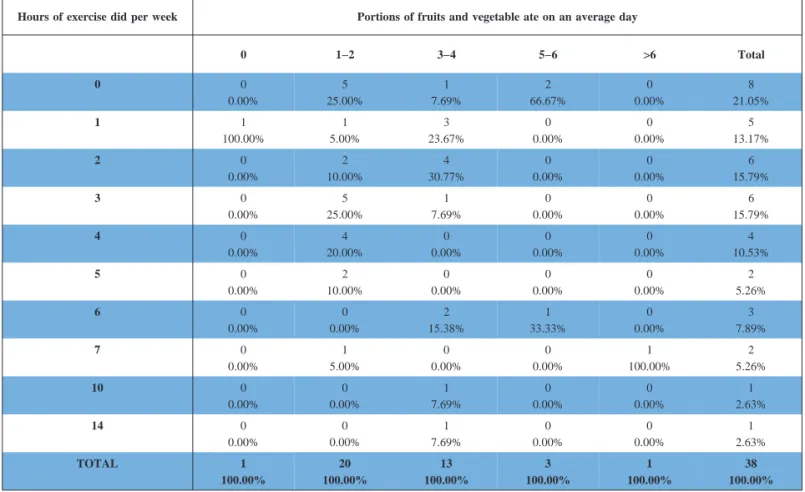
Cross−tabulation of physical activity with fruits & vege- table intake :Table 6 shows that students who did zero hours of physical exercise per week, among them 62.5%
took 1−2 portion of fruits & vegetable on an average day while 25% took 5−6 portion a day. 86.84% (n=33) partici- pants took 1−4 portions a day and in between them 18.18%
did no exercise at all. Participants who did 4−6 hours of ex- ercise per week, 88.89% of them took 1−4 portions of fruits and vegetable per day. The trends of exercise and fruits and vegetable intake ratios are quite relative. Though 21% stu- dents reported no kind of exercise per week, but they took enough fruits and vegetable (Tab 6).
Discussions
In this section we are going to discuss about the results of this survey and simple health−promoting behaviors of inter- national students studying in Hamburg university of applied science. In this sample, unhealthy diet was dominant, most of them perform physical activities which increase sweating though significant number of students did not do any. Com- pare to the bachelor Health Science students, they were
n %
Influenza vaccination
Yes 5 13.86
No 33 86.84
Fruit and vegetable intake (portion per day)
0 1 2.63
1−2 20 52.63
3−4 13 34.21
5−6 3 7.89
>6 1 2.63
Physical activity
No moderate physical activity 8 21
1 − 3 h moderate physical activity / week
17 45
4 – 7 h moderate physical activity /week
11 28
More than 7 h moderate physical activity/week 4 6
Portions of fruits and
vegetable intake per day Participants monthly income (euro)
!400 400−600 601−800 801−1000 "1000 missing Total
0 0
0.00%
0 0.00%
1 14.29%
0 0.00%
0 0.00%
0 0.00%
1 2.63%
1−2 8
47.06%
2 66.67%
5 71.43%
1 33.33%
2 40.00%
2 66.67%
20 52.63%
3−4 9
52.94%
1 33.33%
0 0.00%
2 66.67%
1 20.00%
0 0.00%
13 34.21%
5−6 0
0.00%
0 0.00%
1 14.29%
0 0.00%
1 20.00%
1 33.33%
3 7.89%
>6 0
0.00%
0 0.00%
0 0.00%
0 0.00%
1 20.00%
0 0.00%
1 2.63%
TOTAL 17
100.00%
3 100.00%
7 100.00%
3 100.00%
5 100.00%
3 100.00%
38 100.00%
Total Male Female
Number (n) 38 18 20
Min 0 h/w 0 h/w 0 h/w
Median 4.5 h/w 4 h/w 3.5 h/w
Max 14 h/w 14 h/w 7 h/w
SD 4.2 h/w 4.5 h/w 2.5 h/w
Average 5.2 h/w 5.2 h/w 3.5 h/w
Table 3 :Prevalence of health−promoting behaviors of the students
Table 4 :Physical activity value of the participant (h/w = hours per week)
Table 5 :Cross−tabulation of fruits & vegetable intake with monthly income
[One portion is approximately one hand full]
Gazi Mehedi HASAN et al./Health−Promoting Behavior of The International Student Study in Hamburg, Germany
第37巻1号 4C150 1C133/本文 ※31‐1から組体裁変更 OTF/025〜031 原著 Gazi 4C 2018.06.07 21.42.47 Page 28
more positive towards diet and physical activity than master students (Tobisch et al., 2015).
More particularly, we found high prevalence of low fruits and vegetable consumption, 55% reported that they took <3 servings per day. If we compare this with bachelor students, Master of Health Sciences students eat a lower diet, though the gap with other survey was not much (Al Ansari et al., 2013 ; Meier et al., 2017 ; Keller et al. , 2008 ; American College Health Association, 2010). Small differences were seen between the subjects, while 94.6% of medical students did not meet the recommendation related to approximately 97.5% of law or teaching students (Keller et al. , 2008 ).
Similar results have been reported previously among stu- dents in Asia, Africa and the America, whereas differences were seen between countries (Peltzer & Pengpid 2014). Sev- eral reasons for inadequate fruits and vegetable consumption were discussed (e.g. lack of economic resources, living situ- ation, psychosocial factors) (Peltzer & Pengpid 2014). In consideration of health benefits from fruits and vegetable consumption in reducing non−communicable diseases (Lock et al., 2005), this result emphasizes the urgent needs for fur- ther behavioral and conditional approach of health promo- tion among Master of Health Sciences students (MPH &
MHS ) , who are generally assumed to be well informed
about the necessity of a healthy diet and physical activities.
This survey indicates that’s, 45% students mentioned that they do 1−3 hours of moderate physical activities per week and 28% does 4−7 hours of physical activities per week. In general, university students are physical active, whereas variations can be seen in Germany, partly due to different definitions. In Heidelberg, 70 % of the participating students are physical active while the prevalence is somewhat in- creased among women related to men (72.5% vs. 69.6%) (Gusy et al., 2014). Gender differences could also be seen relating to the frequency of active sports. Male participants practiced active sports more than four times a week (37.8%) whereas their female peers did it twice a week ( 28.8% ) (Gusy et al., 2014). Although students are generally physi- cally active, 16% of surveyed students in Marburg reported to do no physical activity at all (Keller et al., 2008) while we found 21% do no physical activities among this surveyed student but the average moderate physical activity was 5.2 hours per week (male : 5.2h ; female 3.5h). So, compare to other survey, the target group of this study is somehow physically active. In this survey, influenza vaccination is as- sumed as one indicator of health−promoting life−style, in the direction to shield oneself against seasonal influenza.
Less is identified about vaccination among university stu-
Hours of exercise did per week Portions of fruits and vegetable ate on an average day
0 1−2 3−4 5−6 >6 Total
0 0
0.00%
5 25.00%
1 7.69%
2 66.67%
0 0.00%
8 21.05%
1 1
100.00%
1 5.00%
3 23.67%
0 0.00%
0 0.00%
5 13.17%
2 0
0.00%
2 10.00%
4 30.77%
0 0.00%
0 0.00%
6 15.79%
3 0
0.00%
5 25.00%
1 7.69%
0 0.00%
0 0.00%
6 15.79%
4 0
0.00%
4 20.00%
0 0.00%
0 0.00%
0 0.00%
4 10.53%
5 0
0.00%
2 10.00%
0 0.00%
0 0.00%
0 0.00%
2 5.26%
6 0
0.00%
0 0.00%
2 15.38%
1 33.33%
0 0.00%
3 7.89%
7 0
0.00%
1 5.00%
0 0.00%
0 0.00%
1 100.00%
2 5.26%
10 0
0.00%
0 0.00%
1 7.69%
0 0.00%
0 0.00%
1 2.63%
14 0
0.00%
0 0.00%
1 7.69%
0 0.00%
0 0.00%
1 2.63%
TOTAL 1
100.00%
20 100.00%
13 100.00%
3 100.00%
1 100.00%
38 100.00%
Table 6 :Cross−Tabulation of physical activity with fruits & vegetable intake
[One portion is approximately one hand full]
dents and, to my best knowledge, none of the described sur- veys explore this topic. Most of the participants of this study have not been vaccinated against influenza (86.84%). One hint for influenza vaccination coverage in comparable groups was presented by the Robert Koch institute because of the “Gesundheit in Deutschland aktuell” study. 18.9%
[95% confidence interval (95% CI) : 14.7% − 24.0%] of bet- ter educated women aged 18−29 years, who participated in this telephone survey, and 13.2% (95% CI : 9.0% − 18.8%) of corresponding men have been vaccinated against seasonal influenza in the winter season 2008–2009 (Robert Koch In- stitute). Therefore, we can conclude that the rate vaccinated students against the influenza virus is very poor in this sur- veyed group.
Conclusion
As previously described, only few studies were carried out in Germany, which focused on these topics. Trends in health and health behaviors of the target group have been rarely studied in Germany. Future studies will be necessary to describe and to longitudinal monitor students’ health as basis for planning and evaluating health−promoting interven- tions at universities. These campaigns should set out to pro- mote individual future health and social development of stu- dents. The need of information is also growing due to the current reorganization of academic structures ( bachelor / master studies) and their potential impact on student’s health and well−being.
Therefore, this health behavior survey for international Health Sciences (MPH & MHS) students is exceptional in Hamburg, Germany. Different health behavior survey among German students were conducted and will be conducted in different universities in Germany where they can include the international students also (e.g. health behavior survey in HAW Hamburg ). This result indicates area where health professional and policy makers should tackle health behavior deficits of international students. More data about interna- tional student’s health behavior will indicates area where further exploration should be needed.
References
1. Al Ansari W., Labeeb S., Moseley L., Kotb S., and El−
Houfy A. Physical and Psychological Well−being of Uni- versity Students : Survey of Eleven Faculties in Egypt ;Int J Prev Med. Mar ; 4(3) : 293−310. 2013
2. Al Ansari, Ashker S.E., Moseley L. Association between physical activity and health parameters in adolescent pu- pils in Egypt ;Int. J. Environ. Res. Public Health, 7(4), 1649−1669. 2010.
3. American College Health Association, American College Health Association– National College Health Assessment Spring 2008 Reference Group Data Report (Abridged). J Am Coll Heal 57 : 477–488. 2010.
4. Chandler, A., Examiner Krämer, L., Stock, C., & Tshi- ananga, JT. Differences in health determinants between international and domestic students at a German univer- sity. Journal of American college health, 53( 3 ) , 127.
2004.
5. Exchange Service, DA (2005). Science cosmopolitan.
Facts and Figures on the International Nature of Studies and Research in Germany. Bertelsmann Verlag, Gütersloh. University choice situation at baseline. HIS In- formation note A, 12, of 2005.p (6−14), 2005. “Gesund- heit in Deutschland aktuell 2010” Beiträge zur Gesund- heitsberichterstattung des Bundes [Facts and figures : Re- sults of the study “Health in Germany currently” Contri- butions to the Federal Health Reporting]. Berlin ; p. 154–
156, 2012.
6. Franzkowiak, P. Health Monitoring in Setting College.
Health Promoting Universities. Concepts, strategies, prac- tical examples, 71−79.
7. Gusy B, Lohmann K, Wörfel F, Abt H, Schenk A. Wie gesund sind Studierende der Pädagogischen Hochschule Heidelberg ? Ergebnisse der Befragung 01 / 13 [ How healthy are students at the University of Education Heidelberg? Results of the survey 01/13]. Schriftenreihe des AB Public Health : Prävention und psychosoziale Ge- sundheitsforschung. Berlin : Freie Universität Berlin ; 2014.
8. Gusy, B. (2010). Health coverage for students. Preven- tion and Health Promotion, 5 (3), 250−256. 2010.
9. Hölling H, Schlack R, Kamtsiuris P, et al, The KiGGS study. Nationwide representative longitudinal and cross−
sectional. doi : 10.1007/s00103−012−1486−3. 2012.
10. Kann L, Kinchen S, Shanklin SL, et al (2014). Youth Risk Behavior Surveillance — United States, 2013.
MMWR 63 : 1–48. 2014.
11. Keller S, Maddock JE, Hannöver W, et al (2008). Mul- tiple health risk behaviors in German first year university students. Prev Med ( Baltim ) . doi : 10.1016 / j. yp- Gazi Mehedi HASAN et al./Health−Promoting Behavior of The International Student Study in Hamburg, Germany
第37巻1号 4C150 1C133/本文 ※31‐1から組体裁変更 OTF/025〜031 原著 Gazi 4C 2018.06.07 21.42.47 Page 30
!!!!!!!!!!!!!!!!!!!!!!!!!!!!!!!!!!!!!!!!!!!!!!!!!!!!!!!!!!!!!!!!!!!
!!!!!!!!!!!!!!!!!!!!!!!!!!!!!!!!!!!!!!!!!!!!!!!!!!!!
!!!!!!!!!!!!!!!
med.2007.09.008. 2008.
12. Lock K, Pomerleau J, Causer L, et al ( 2005 ) The global burden of disease attributable to low consumption of fruit and vegetables : implications for the global strat- egy on diet. Bull World Health Organ 83 : 100 – 108.
2005.
13. Meier S, Milz S, Krämer A. Projektbericht : Gesund- heitssurvey für Studierende in NRW [ Project report : Health survey in North Rhine−Westphalia]. 1–31. 2007.
14. Meier, S., Mikolajczyk, RT, Helmer, S., Akmatov, MK, Steinke, B., & Kramer, A. Health status of students : re- sults from a multicentre cross−sectional study in North Rhine−Westphalia. Germany.Prevention and Health Pro- motion, 5, 257−264. 2010.
15. Peltzer K, Pengpid S, : Correlates of healthy fruit and vegetable diet in students in low, middle and high income countries. Int J Public Health. doi : 10.1007/s00038−014−
0631−1. 2014.
16. Robert Koch Institut. Inanspruchnahme von Leistungen des Gesundheitssystems : Grippeschutzimpfung [ Utiliza- tion of benefits of the healthcare system : Influenca vacci- nation]. In : Robert Koch−Institut, editor. Daten und Fak- ten : Ergebnisse der Studie.
17. Roberts C, Freeman J, Samdal O, et al. The Health Be- havior in School−aged Children (HBSC) study : methodo- logical developments and current tensions. Int. J Public Health. doi : 10.1007/s00038−009−5405−9. 2009.
18. Stock C, Kücük N, Miseviciene I, et al (2003). Differ- ences in health complaints among university students from three European countries. Prev Med ( Baltim ) . doi : 10.1016/j.ypmed.2003.07.001. 2003.
19. Tobisch, S., von Borczyskowski, A., & Reintjes, R.
Health behaviour surveillance of Health Sciences students in Northern Germany : Design and first results.Epidemiol-
ogy, Biostatistics and Public Health, 12. 2015.
20. Tontisirin K. : Incorporating Nutrition Considerations into Development Policies and Programmes ; Brief for Policy −makers and Programme Planners in Developing Countries ;FAO Rome Italy.2004.
Gazi Mehedi HASAN
Education :
2010 : Graduated from Pioneer Dental Collage, Dhaka, Bangladesh
2016 : Post Graduation from Hamburg University of Applied Science, Hamburg Ger- many.
2017 : Post Graduate student in Division of Biomaterials and Bioengineering, School of Dentistry, Health Science University of Hokkaido, Japan. (running)