Annual Report of the Institute of Space and Astronautical Science 201 5
Annual Report of the
Institute of Space and Astronautical Science
2015
(C) JAXA
FUNAKI, Ikkoh (Chair) KAWADA, Mitsunobu SAITO, Yoshifumi SAITO, Yoshitaka NONAKA, Satoshi MIZUNO, Takahide IKUTA, Chisato TSUJI, Hiroji
Publisher Institute of Space and Astronautical Science Japan Aerospace Exploration Agency
http://www.isas.jaxa.jp/en/
3-1-1 Yoshinodai, Chuo-ku, Sagamihara, Kanagawa 252-5210, Japan
Contact ISAS Library,
Management and Integration Department, Institute of Space and Astronautical Science
3-1-1 Yoshinodai, Chuo-ku, Sagamihara, Kanagawa 252-5210, Japan
TEL: +80-42-759-8014
Annual Report of the
Institute of Space and Astronautical Science
2015
On March 26, 2016, we discovered communication anomalies with the X-ray Astronomy Satellite ASTRO-H
“HITOMI“, which was launched on February 17, 2016. JAXA has made every effort to clarify the details of this anomaly, to confirm the status of the satellite, and to restore satellite functions. Unfortunately, we determined that functional recovery would not be possible, and made the difficult decision to abandon operation of the ASTRO-H on April 28. Having to abandon the satellite without making any full-scale observations was extremely regrettable to everyone at overseas and domestic research institutions and universities who spent many years developing ASTRO-H, as well as to researchers throughout the world who were planning to use the observational results from ASTRO-H for their studies. We also apologize for failing to meet the expecta- tions of Japanese citizens and government in the arena of astronautical science and exploration. The burden of responsibility lies heavily on the Institute of Space and Astronautical Science (ISAS). As Director General, I fully recognize my own personal responsibility, and will ensure that our organization makes every possible effort to analyze what went wrong and what can be done to prevent this from happening in the future.
On June 14, JAXA submitted a report entitled “Hitomi Experience Report: Investigation of Anomalies Affect- ing the X-ray Astronomy Satellite “Hitomi” (ASTRO-H)” to the MEXT’s Committee of Space Development. The report proposed four measures to address the factors of the incident: 1) revision of ISAS project management systems, 2) clarification of roles and responsibilities of ISAS and corporations, 3) documentation of ISAS proj- ect duties and quality assurance records, and 4) thorough review and evaluation. In order to realize effective implementation of these measures, discussions at our Institute are being led by staff with experience as proj- ect managers and we are establishing an “Action Plan for Reforming the Institute of Space and Astronautical Science Based on the Anomaly Experienced by Hitomi.” The Action Plan will be applied to other projects such as SLIM (Smart Lander for Investigating Moon) and a PDCA cycle will be established in order to further refine both current and future endeavors. (Efforts to clarify factors in the anomalies affecting “HITOMI“ were taken from the end of 2015 until 2016. Accordingly, this message refers to conditions as of June 30, 2016.)
The ISAS is currently operating six satellites and space probes: “Hayabusa2“, “HISAKI“, “AKATSUKI“, “HI- NODE“, “SUZAKU“, and “GEOTAIL“. In particular, although the Venus Climate Orbiter “AKATSUKI“ was not able to enter into an orbit of Venus in late 2010, it succeeded in entering orbit on December 7, 2015. “AKATSUKI“
is sending detailed images of Venus, and there are great expectations for future research results. This marks the first time that a Japanese space probe has entered into orbit around a planet other than the Earth. The Asteroid Explorer “Hayabusa2“ succeeded in making a swing-by of Earth on December 3, 2015, and it is
Director General
June 2016
Saku Tsuneta
Director General
Institute of Space and Astronautical Science
Japan Aerospace Exploration Agency
(*1) The inter-university research institute system refers to how ISAS serves as a central Japanese research institution for academic study on space science by conducting joint activities in organic and diverse forms with university research- ers (excerpt from the Regulations for Space Science Research via the Inter-University Research System).
orbital control approximately 10 times greater than with conventional technology. This increases Japan’s ability to freely conduct deep space exploration. During its initial functional confirmation phase, “HITOMI“ achieved stable operation of prescribed sensors at a temperature of 50 mK and succeeded in observing the Perseus Cluster with extremely high energy resolution. The total number of peer review papers for the solar observa- tion satellite “HINODE“ has reached 1,024 as of June 2016, and the satellite continues to function as an international astronomical observatory.
The BepiColombo/MMO for exploration of Mercury has been transferred to the European Space Agency (ESA). The launch of BepiColombo by the ESA has been postponed until 2018 for reasons attributable to Europe. The satellite is now scheduled to enter an orbit around Mercury in 2024. The flight model for the Exploration of energization and Radiation in Geospace (ERG) is undergoing testing in preparation for its launch in 2016. Furthermore, in addition to testing for two sounding rockets and two tests in Japan for scientific bal- loons, we held our first-ever scientific balloon test in Australia in May 2015. The test in Australia realized a long flight duration and collection of the balloon on the ground. Moving forward, we plan to periodically conduct balloon testing in Australia as complementary flights to testing in Japan. This is also an important development in regards to how project managers and other JAXA staff are expected to have experience as PI (principal investigators) in testing for sounding rockets and scientific balloons.
The next few years are a critical stage in determining the orientation of the astronautical missions until the 2030s. In this context, the new “Basic Plan on Space Policy: Implementation Schedule” has been revised (December 8, 2015; Strategic Headquarters for Space Policy). Mars Moon eXploration (MMX) has been pro- posed as the first satellite of the strategically-implemented Large-size plan, and we are currently establishing a system for international cooperation while obtaining approval from research councils, management commit- tees, and the Astronomy and Astrophysics Sub-Committee of the Physics Committee at the Science Council of Japan. The goal of the mission is to collect samples which will settle the debate on the composition of the Mars moons, to obtain new knowledge regarding the process in which planets are formed and the transportation of matter in the solar system, and to obtain new knowledge regarding the transitions and evolution of Mars by using the merits of the moons orbiting Mars. Furthermore, the Smart Lander for Investigating Moon (SLIM) is being developed as the first satellite of the competitively-chosen Midium-sized focused missions. The goal of this project is to demonstrate technology for pin-point landings on gravity celestial bodies and to realize significant reductions in the weight of lunar probe system technology. Moreover, in regards to initiatives for 2016 and beyond for the missions opportunities, the plan states that Japan will actively move forward with de- liberations concerning participation in large-scale international projects such as the Jupiter Icy Moons Explorer (JUICE).
These missions are developed through international cooperation. The strategically-implemented Large- sized missions of ISAS are fully incorporated into the scientific roadmaps of international space institutions.
Accordingly, in addition to administrative meetings with overseas space institutions, we have held a total of six bilateral meetings in Japan and overseas, with the participants mainly from NASA and ESA. These meetings give priority to fostering strategic dialog.
While existing as a division of the Japan Aerospace Exploration Agency (JAXA), the Institute of Space and
Astronautical Science is also operated as an inter-university research institute system
(*1). With the goal of
strategically enhancing the comprehensive level of space science in Japan through cooperation with universi-
ties, ISAS has started centralization with universities which possess outstanding potential and records of per-
formance in certain fields of space science (requires operation through JAXA capital and a university matching
Research, which was added as an affiliated university center in 2013, we have now selected the Kobe Univer- sity Center for Planetary Science and the Center for Ultra-Compact Probe Development in the University of Tokyo as new partners. Kobe University is working to develop exploratory missions and to cultivate personnel in the long-term through consideration of missions, while the University of Tokyo is creating systems to realize high-frequency exploration on a low budget.
In order to respond to the growing field of space science, we have newly established the Astromaterials Science Research Group which conducts R&D for technology used in analyzing astromaterials and conducts research based on analysis of samples, the Lunar and Planetary Exploration Data Analysis Group which promotes advanced processing and utilization of lunar exploration data, the Deep Space Tracking Technology Group which supports projects related to deep space tracking, and the Advanced Machining Technology Group which conducts machining/precision machining technology and precision measurement technology required for spacecraft. Furthermore, we merged the Systems Engineering Office and the ISAS Program Office in order to strengthen seamless support for all stages from project preparation to completion, with particular focus on supporting the difficult transition from a working group to pre-project. In conjunction, we also improved the method for internal review of projects. We are working to establish non-Japanese examiners as normal mem- bers of review committees, and have already had non-Japanese scholars participate in review for the Space Infrared Telescope for Cosmology and Astrophysics (SPICA) and Lite (Light) satellite for the studies of B-mode polarization and Inflation from cosmic background Radiation Detection (LiteBIRD). Moreover, we have revised the scope of jurisdiction for Program Directors and for Senior Chief Officers of Fundamental Technology for Space Science, and have restructured the organization of the Management and Integration Department.
As yet another initiative, we have clarified the previously unclear goals for each of the five research departments at ISAS. As a result, the research departments are expected to serve as a platform for bringing together educational faculty, postdoctoral researchers, and graduate students at ISAS, as well as including researchers in related fields from outside our institute. The departments will facilitate cooperation between these professionals and the Advisory Comittee for Space Science and Engineering in order to create new proj- ects. In addition to fulfilling a leading role in academic research and development of personnel, the members and directors of the departments are expected to provide leadership in organizing researchers from Japan and overseas in order to create new fields and projects.
The evaluation system and human resources system for educational faculty are of vital importance for the invigoration of a research institute. Our newly-established system for evaluating the performance of educational faculty enables faculty to actively engage in project promotion and graduate education in addition to their academic research. Academic research, project research, and instruction of graduate students and general engineers are inherently part of the same whole. The lifecycle of each researcher contains a period for focusing exclusively on research projects, a period for reaping the academic results of their research, and a period for creating new projects. Accordingly, we have abolished evaluation which separated conventional academic research from all other areas, and have instituted an integrated evaluation method.
Human resources for faculty are administered using a long-term vision which is based on our institute’
s orientation as defined in the Roadmap for Space Science and from the perspective of personnel required for new projects in the future. From 2013 to 2015, six employees transferred out of our institute (four from 2010 to 2012). During the same period, we recruited sixteen faculty positions even while reducing personnel expenses (there was recruitment for nine positions from 2010 to 2012). We also recruited for faculty positions limited to female and non-Japanese applicants, and hired two non-Japanese women as associate professors.
Furthermore, two researchers belonging to external institutions became ISAS staff members via the Cross Ap- pointment System. In the future, we plan to hire more outstanding female faculty and non-Japanese faculty.
Additionally, we are promoting the transition from faculty positions to general positions, and one associate
professor transitioned to a general position through the new system. Through a system for specially-appointed
special missions. Moreover, we have also conducted movement between research departments (four employ- ees) and promotion which spans multiple departments (two employees). Although these efforts for detailed improvement of human resources are gradually producing results, there is still the need for continuous reform in order to address the aging of faculty and to expand interaction of personnel. Moving forward, we will review an initiative to assign general employees to positions previously filled by educational faculty, thus creating an environment which allows faculty to concentrate on academic research and projects.
Through partnerships with universities such as The Graduate University for Advanced Studies (Sokendai) and the University of Tokyo, we are implementing graduate school education through actual development of flying objects, and are working to cultivate successors who will be involved in space development and R&D for space science. In 2015, we assisted 12 students in acquiring their PhD and 51 students in obtaining their master’s degree. There were 30 researchers conducting research as JAXA Project Research Associates, and of which 26 were Japanese (inclusding 8 female) and 4 were non-Japanese (including 1 famale). 5 researchers (no female) were conducting research as Research Associates at the Japan Society for the Promotion of Sci- ence. We also hired 1 International Top Young Fellow, making a total of 5 fellows at ISAS. The total amount of external fund acquired was 1.36 billion yen, a major increase over the previous year despite a reduction in the amount of Grants-in-Aid for Scientific Research (KAKENHI).
2015 marked a further increase in cooperation between ISAS and other departments at JAXA. ISAS and the Research and Development Directorate agreed to a Basic Cooperation Plan in order to promote coopera- tion in projects and exchange of personnel. This agreement has enabled systematic deployment of staff with specialized skills to space science projects and systematic training of young (first to fifth year employees) general staff through actual space science projects to instill them with specialized skills. ISAS staff participates in projects of the Research and Development Directorate including research on electric propulsion systems for fully-electrical satellites, SOI-ASIC development, and research on highly-integrated semiconductor components for use in outer space. Furthermore, based on technology demonstrated by “HITOMI“, we have started joint development with the National Centre for Space Studies, France (CNES) and the Research and Development Directorate for space freezers required for LiteBIRD, SPICA, and the large-scale X-ray observatory mission Athena at ESA. This project is positioned as the first phase of technological development through programming defined in the new Basic Plan on Space Policy. We are also continuing to cooperate with the Space Technology Directorate I to develop a enhanced Epsilon Launch Vehicle. A combustion test for the second stage motor (M- 35) was successfully performed at the Noshiro Rocket Center. Another joint project being advanced by ISAS through cooperation with the Space Tracking and Communications Center is development of a deep space antenna to serve as a successor of the Usuda Deep Space Center. Although this project was made difficult by the contradiction of high-level required specifications and a strict budget, a definite plan has been formulated through the hard work of the development team. In addition to being used in Japanese deep space exploration missions such as “Hayabusa2“, “BepiColombo“, and the prospective mission for collecting samples from a Mars moon, this antenna is also expected to support missions by NASA and ESA.
In terms of public relations and public outreach, we issued ten press releases to convey significant research results to the general public. This is double the number of press releases issued in 2013. A wide range of research fields are covered in the press releases, from observational/theoretical research results in planetary science to results of observation for distant areas of the universe. All in all, it was a highly successful year for the institute in terms of press releases. We are also utilizing this opportunity to have even more people become interested in space science and have conducted PR activities for research which supports the foundation of space science. Specific examples include open application of names for the target asteroid of “Hayabusa2“, the Earth swing-by of “Hayabusa2“, and the entry of “AKATSUKI“ into orbit around Venus. Moreover, we are continuing our efforts to improve the content of media such as comprehensive pamphlets and annual reports.
We are also preparing English-language versions of these publications.
Building (provisional name). This facility will be constructed adjacent to the Space Exploration Test Building of the Space Exploration Innovation Hub Center (hereinafter referred to as the “Exploration Hub”) and is scheduled to be developed as an exchange facility for the Exploration Hub. The facility aims to deepen the re- lationship between space science and society, and to create further innovation in industry. To achieve this goal, the facility will introduce technological developments, academic research results, and future-oriented activities, and will provide opportunities for exchange among ISAS staff and external parties. Currently, the facility is scheduled to open in the second half of fiscal 2017. Land preparation is scheduled to be completed in the first half of fiscal 2016, and construction of the building will then proceed.
This annual report is a summary of ISAS activities in 2015. It has been three years since I assumed the position of Director General. During that time, through the cooperation of individuals both inside and outside our institute, I have been able to implement a large number of reforms which will elicit the capability of ISAS.
During the process of implementing these reforms, I engaged in repeated deliberation with ISAS staff at inter- nal town meetings and institute-wide meetings. Nevertheless, a number of issues still need to be addressed;
in particular, the implementation of the “Action Plan for Reforming the Institute of Space and Astronautical Science Based on the Anomaly Experienced by Hitomi.” Although a certain amount of time will be required until results will be seen, I believe that these reforms will one day form the foundation for new achievements by the ISAS and JAXA. I look forward to your continued support and cooperation.
June 2016
Message from the Director General
Ⅰ. Scientific Highlights in FY 2015 ... 1
Ⅱ. Status Report ...13
1 . Space Science Roadmap ... 13
2 . Space Science Programs ... 14
a. AKEBONO (EXOS-D) ... 14
b. GEOTAIL... 14
c. SUZAKU (ASTRO-EⅡ) ... 15
d. REIMEI (INDEX) ... 15
e. HINODE (SOLAR-B) ... 16
f. AKATSUKI (PLANET-C) ... 16
g. IKAROS ... 17
h. HISAKI (SPRINT-A) ... 17
i. Hayabusa2 ... 18
j. HITOMI (ASTRO-H) ... 18
k. MMO/BepiColombo ... 19
l. ERG... 20
m. SLIM ... 20
n. GREAT ... 21
o. SPICA ... 21
3 . R&D at Research Departments ... 22
a. Department of Space Astronomy and Astrophysics ... 22
b. Department of Solar System Sciences ... 25
c. Department of Interdisciplinary Space Science ... 26
d. Department of Space Flight Systems ... 28
e. Department of Spacecraft Engineering ... 30
f. International Top Young Fellowship ... 33
4 . R&D at the Fundamental Technology for Space Science Group ... 34
a. Inter-University Research and Facility Management Group ... 34
b. Test and Operation Technology Group ... 34
c. Science Satellite Operation and Data Archive Unit ... 34
d. Astromaterials Science Research Group ... 35
e. Disciplinary Engineering Group ... 36
5 . ISAS Program Office ... 39
6 . Systems Engineering Office... 40
7 . Safety and Mission Assurance Officer ... 42
8 . ISS Science Project Group ... 43
9 . Sounding Rocket Research and Operation Group ... 44
10. Scientific Ballooning Research and Operation Group ... 44
11. Reusable Sounding Rocket Testing Project ... 45
Ⅲ. Organization ... 46
1 . History of ISAS... 46
2 . Organization and Operation ... 47
a. Organization ... 47
b. Operation ... 47
c. Staff ... 51
3 . Sagamihara Campus and Other Facilities ... 54
4 . Advisory Committees... 55
a. Advisory Committee for Space Science ... 55
b. Advisory Committee for Space Engineering ... 56
c. Technical Committee for Space Science Program . 57 5 . Professors Emeriti ... 59
Ⅳ. Budget ... 60
Ⅴ. International Collaboration and Joint Research ... 61
1 . International Collaboration ... 61
a. International cooperation in satellite missions at the operational stage ... 62
b. International cooperation in satellite missions at the development stage ... 64
c. Satellite missions in preparation or under proposal ... 65
d. International cooperation in scientific missions for space environment utilization ... 67
e. International cooperation in observational rocket experiments ... 67
f. International cooperation in atmospheric balloon experiments ... 68
g. Framework agreements, etc., in the space science fields with overseas universities ... 69
2 . Domestic Collaboration ... 70
3 . Research by External Funds ... 70
a. KAKENHI ... 70
b. Funded Research ... 71
c. Cooperative Research with Private Sector ... 71
d. Earmarked Donations ... 71
4 . Domestic Joint Research ... 71
Ⅵ. Education & Public Outreach ... 72
1 . Graduate School ... 72
2 . Public Outreach ... 73
Ⅶ. Awards ... 75
Ⅷ. ISAS Library and Repository ... 78
Ⅸ. Publications, Presentations and Patents ... 80
Pseudo coloration for the complex nighttime surface of Venus. Rendered from images of 1.735 um and 2.26 um wavelengths taken from the IR2 camera mounted on the Venus Climate Orbiter “AKATSUKI”.
(March 25, 2016) (Cover Image)
The image was created by using red for 1.735 um, blue for 2.26 um, and green for averages of the two colors. The brightness of Venus’ daytime surface is a strong 1.735 um and a large amount of light extends over the nighttime surface. This creates the orange color which can be seen at the border between the daytime and nighttime surfaces. The nighttime surface of Venus seen at these wavelengths is illuminated by thermal radiation from the hot lower atmosphere, and the clouds at an altitude of about 50 km appear as a silhouette. The subtle contrasts in color gradation which appear in this pseudo coloration are thought to depict differences such as varying sizes of cloud particles.
Image of the Earth photographed by “Hayabusa2” during an Earth swing-by. (Back Cover Image) At 7:08.07 (Japan time) at night on December 3, 2015, Hayabusa2
successfully performed an Earth swing-by operation, passing over the Pa- cific Ocean at a height of 3,090 km. According to plan, the swing-by was used to increase Hayabusa2’s inertial velocity relative to the solar system by approximately 1.6 km/s and to change its course by approximately 80º relative to the Earth. During the swing-by, the satellite used its sensors to observe the Earth and Moon.
Top left: Photograph taken using mid-infrared camera (December 4)
Top right: Pseudo color image rendered using ONC-T (Optical Navi-
gation Camera-Telescope) (December 4Bottom: Series of photographs
taken using ONC-W2 (Optical Navigation Camera-Wide Angle 2) (De-
cember 3)
Venus Orbit Insertion to observe atmospheric circulation
[Venus Climate Orbiter “AKATSUKI” (PLANET-C)]
Ⅰ . Scientific Highlights in FY 2015
1
Engineering highlights
1. Venus orbit insertion revenge 1 (VOI-R1) was successfully achieved on December 7, 2015, using four reaction control system thrusters at the top panel of the spacecraft, instead of using orbital maneuver engine which was destroyed at the VOI trial in December 2010 (Figure 1).
2. The trajectory design strategies were highly reliable for solv- ing dynamical problems with difficult boundary conditions.
3. The precise orbit determination technology evaluated the clos- est approach position accurately from the encounter planet.
4. The thermal design method secured the spacecraft compo- nents against severe solar heating.
5. The solar array paddles produced stable electric power under unexpected high temperatures of more than 160 °C.
Scientific highlights
Scientific instruments on board AKATSUKI revealed new information about the atmosphere of Venus.
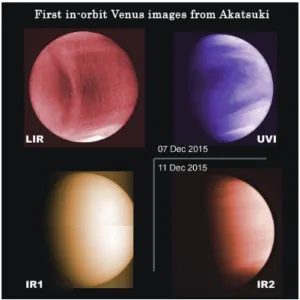
1. LIR discovered a large bow-shaped feature in the thermal map at the cloud top of Venus (Figure 2, images taken on 7 December 2015). The feature was observed until December 11 and appeared to rotate with the same speed as the surface (~1.6 m/s), rather than at the speed of the background atmospheric super-rotation (~100 m/s).
2. UVI imaged Venus at 283 nm in the SO
2absorption band and 365 nm in the unknown absorber band (Figure 2). We are investigating the interrelation of dynamics and chemistry in the upper atmosphere by comparing these images.
3. IR1 visualized the surface topography of Venus, as imaged at 1.01 μm on the night-side of the disk (Figure 2). De- tails of Aphrodite (3 to 5 km elevation) were captured. IR1 also captured small-scale structures in the cloud layer, which are clues to the cloud formation process.
4. IR2 acquired impressive 2.26 μm images of the night-side disk of Venus, in which waves and turbulences of various scales were visualized (Figure 3). On the day-side disk, 2.02 μm images of reflected sunlight indicated the co- existence of super-rotating cloud features and topographically fixed features.
5. RS obtained vertical profiles of the atmospheric temperature by a radio occultation technique (Figure 4). The profiles show significant temporal and spatial variation, the cause of which will be studied by combining RS and camera data.
Figure 3 Impressive view of
the night-side of Venus imaged with IR2 (25 March 2016). Two images (1.735 and 2.26 μm) were high-pass filtered and combined to produce this false color image.
Figure 4 Example result of the
radio occultation experiment. The vertical profile of atmos pheric temperature is acquired for the entrance and exit of the spacecraft, indicating latitudinal variations of atmospheric tem perature.
Figure 1 Four attitude control thrusters (23 N) on
the top panel of spacecraft were used in VOI-R1 on December 7, 2015.
Figure 2 First in-orbit Venus images from the four
on-board cameras (LIR, UVI, and IR1 on December
7, and IR2 on December 11 after the sensor had
cooled).
X-ray astronomy satellite Hitomi (ASTRO-H) was launched at 17:45:00 on Feb. 17, 2016 (JST), and separation from the rocket and opening of the solar array wings were verified. Results of the orbital calculation also con- firmed that the satellite was injected into the intended orbit. (JAXA press release, Feb. 17–18, 2016) The soft x-ray detector (SXS) was cooled and initial functions such as the extension of the extended optical bench (EOB)
were verified as planned after the launch, thus confirming the expected performance for creating scientific achievements.
However, an operational abnormality was detected during the verification phase for initial functions on March 26, and radio signal from the satellite could not be received. As a result of a JAXA-wide effort to identify the problem, understand the state of the satellite, and do everything to recover the satellite functions, we were able to determine the mechanism that triggered the “attitude abnormality” from a
“normal state of the satellite” and led to the “separation o f bodies“; it was concluded that functional recovery of the satellite could not be expected, and therefore, efforts should concentrate on investigating the cause (JAXA press release, April 28, 2016).
Earth swing-by of Hayabusa2
[Asteroid Explorer “Hayabusa2”]
On 3 December 2015, just one year after launch, Hayabusa2 returned and performed its Earth swing-by. An Earth swing-by, also known as an Earth gravity assist, is a technique for changing the speed and direction of spacecraft by using the Earth's gravitational force. The increase in speed of Hayabusa2 from the Earth swing-by is equivalent to the total acceleration of the ion engine for one year.
Precise orbit determination is crucial for performing the Earth swing-by.
Hayabusa2 is the first JAXA spacecraft to be equipped with full delta differ- ential one-way range (DDOR) capability. This technology enables
us to determine the orbit of the spacecraft 10 times more precisely than by the conventional range-Doppler method. This DDOR technology was demonstrated before the Earth swing-by.
When Hayabusa2 approached the Earth and Moon, observa- tions were carried out by the onboard instruments. For example, the optical navigation camera, wide-angle (ONC-W) took images of the Earth during approach (Figure 1). The telescopic optical navigation camera (ONC-T) took color images of Antarctica and the surrounding region (Figure 2). The thermal infrared imager (TIR) took thermal images of the Earth (Figure 3), and the near-infrared spectrometer (NIRS3) obtained spectral data from the Earth and Moon. These data will serve as references for future observations of the asteroid Ryugu. In addition, an
optical link experiment was performed with the LIDAR laser altimeter. LIDAR on Hayabusa2 detected laser light from a satellite laser ranging ground station at a distance of 6.7 million km.
After the Earth swing-by, long-term ion engine operation was used from March to May 2016, putting Hayabusa2 on the planned trajectory toward Ryugu. We are looking forward to arriving at Ryugu in 2018 and gathering exciting data.
Launch of Hitomi and Achievements by the soft
X-ray spectrometer (SXS) onboard X-ray astronomy satellite Hitomi (ASTRO-H)
[X-ray astronomy “HITOMI” (ASTRO-H)]
2
3
H-ⅡA rocket 30 launch
ASTRO-H after separation
Figure 1 Images of the Earth taken byONC-W as Hayabusa2 was approach ing the Earth swing-by.
Figure 2 Image of the
southern hemisphere of Earth taken by ONC-T just after the Earth swing-by.
Figure 3 Image of the
southern hemisphere of
Earth taken by TIR arou-
nd the same time as the
image in Figure 2.
• Adiabatic demagnetization refrigerator (ADR) was first excited on Feb. 22; the detecter temperature reached 50 mK. The ADR was recycled approx. once every 2 days and maintained at 50 mK up to March 26.
• From the temperature difference between the helium tank and phase separator, the evapo- ration rate of helium was estimated to be approx. 35 μg/s, and heat input into helium was estimated at approx. 730 μW (nominal design value is 750 μW).
• Taking the gradual degradation of the mechanical-refrigerator performance and the amount of helium filled in pre-launch opera- tion into account, liquid helium lifetime was estimated to be 4.2 years (requirement is >
3 years, nominal design value is 3.5 years).
• An energy resolution equivalent to that of the ground tests (4.9 eV half width half maxi- mum at 5.9 keV) was confirmed, and the fine structure of emission lines that could not be resolved by the energy resolution of past instruments (~120 eV FWHM) was directly observed successfully for the first time.
• From the results, line-of-sight velocity dispersion of high-temperature plasma at the central region of the galaxy cluster was determined to be 164± 12 km/s. This dis- covery indicates for the first time that kinetic energy does not contribute significantly to the dynamic equilibrium of the plasma in galaxy clusters (paper being published early July).
35 pixel image by the SXS onboard Hitomi
• Superimposed over the X-ray image by the U.S. satellite Chandra. Both show X-ray intensity in pseudo-color.
• SXS field of view covering the Perseus cluster core region extending by 60 kilo persec
• Pixel on the top-lefti not used.
Time history of the cooling system in orbit
Observation results of Perseus cluster of galaxies (critical phase, initial verification phase)
Changes in operating power
Helium tank temp.
Joule-Thomson Refrigerator
double stage Stirling-Cycle refrigerator
Phase separator temp.
Intermittent temp. rise is due to the excitation of the adiabatic demagnetization refrigerator
X-ray detection temp.
ADR 2nd stage temp.
(Absolute temp. (K)Absolute temp. (K)Absolute temp. (K)Absolute temp. (K) 0.1
1
0.05
Time (Universal) YYYY-MM-DD
X-ray spectrum obtained with the SXS onboard ASTRO-H (Hitomi)
The best quality spectrum before Hitomi (with Suzaku satellite) Closeup view of
emission from 24- times ionized iron X-ray Energy (eV)
X-ray Energy (keV)
X-ray flux (counts/bin [=2 ev])
X-ray flux (counts/second/keV)
data/ model
Note: the gate valve at the X-ray entrance on SXS
was closed. The X-ray below 3 keV is attenuated by
the beryllium window on the gate valve.
SUZAKU satellite reveals the average chemical
composition of our Universe on the largest scales to be the same as that of our Sun
[X-ray Astronomy “SUZAKU” (ASTRO-EⅡ)]
4
All the chemical elements that are heavier than carbon, like the oxygen we breathe and the silicon that makes up the sand on the beach, were produced inside stars through nuclear fusion and released by stellar explosions called supernovae. By measuring the chemical composition of the Universe, scientists are trying reconstruct the history of how, when, and where each of the chemical elements vital for the evolution of life were produced.
Generally, there are two ways that a supernova explosion can happen, and the proportions of chemical elements that are produced depend on the supernova type. Lighter elements, like oxygen and magnesium, originate mainly from the explosions of massive stars, more than ten times the size of our Sun, at the end of their lifetimes.
These are known as core-collapse supernovae. Smaller stars usually end their life cycles as white dwarves, a small fraction of which can explode as a thermonuclear or type Ia supernova if they accrete matter from a companion star, causing the white dwarf to become unstable to the pull of its own gravity. Heavier atoms, like iron and nickel, mostly come from this latter type of supernova. To produce the chemical composition of our Solar System, for instance, we need roughly one thermonuclear supernova for every five core-collapse supernova explosions. JAXA research fellow Aurora Simionescu wanted to find out whether the average chemical composition of the Universe was similar to that of our Solar System, or whether our local neighborhood was a special place.
Perhaps counterintuitively, the answer to this question is best found not by looking at the stars themselves, but by looking at intergalactic space. This is because most of the normal matter in the universe, and thus also most of the metals, are currently not contained in stars, and are in a hot, diffuse gas that fills the space between galaxies. The gas is so hot that it radiates X-ray light. The brightest X-rays come from so-
called clusters of galaxies, the places in the Universe where galaxies are packed closest together.
“I’ve found this idea fascinating ever since the first year of my PhD: X-raying the chemical content of our Universe”, says Simionescu. But back then, almost 10 years ago, it was hard to obtain reliable measurements of the metal abun- dances, except for in the very densest, brightest parts of the intergalactic medium, due to a lack of X-ray photons and high background noise. So, we could only probe the chemical composition of the central part of a galaxy cluster, only one-thousandth of the typical volume.
JAXA’s SUZAKU X-ray satellite dedicated a large amount of its observation time to addressing this problem, collect- ing data over many weeks. The first such deep observations, targeting the brightest system, the Perseus Cluster, al- lowed remarkably detailed measurements of the iron abundance in the intra-cluster medium on large scales. However, information about chemical elements predominantly produced by core-collapse supernovae was still missing.
For these measurements, observations of a galaxy cluster with a lower average temperature were needed, where the emission from lighter elements would be stronger than in the Perseus Cluster. SUZAKU spent about two weeks looking at the Virgo Cluster, the nearest and second-brightest cluster in the X-ray sky, which has such a suitably low temperature. With this new data set, Simionescu and her colleagues at JAXA and Stanford University detected not just iron, but for the first time also magnesium, silicon, and sulfur all the way to the edge of the galaxy cluster. Their results are reported in a study published recently in the Astrophysical Journal.
“What we found was that the ratios between the abundances of iron, silicon, sulfur, and magnesium, are constant throughout the entire volume of the Virgo Cluster, and indeed roughly consistent with the composition of our own Sun and most of the stars in our Galaxy”, explains Dr. Norbert Werner from Stanford University, a co-author of the article.
Figure 1 Suzaku mapped iron, magnesium,
silicon and sulfur in four directions all across the Virgo galaxy cluster for the first time. The northern arm of the survey (top) extends as far as 5 million light-years from the cluster’
s centre. The dashed circle shows what as-
tronomers call the virial radius, the boundary
where gas from the surrounding large-scale
structure is just falling into the cluster. Some
prominent member galaxies of the cluster
are labeled as well. The background image
is part of the short-exposure all-sky X-ray
survey acquired by the German ROSAT satel-
lite. Credits: A. Simionescu (JAXA) and Hans
Boehringer (MPE)
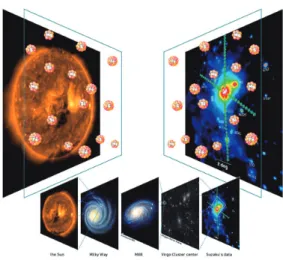
Galaxy clusters cover such a large volume that the content of each object is believed to be representative of the rest of the Universe. The new SUZAKU finding means that the chemical elements in the cosmos are very well mixed, with a chemical composition that remains the same from scales of the solar radius (hundreds of thousands of kilometers) to the size of a cluster of galaxies (several million light years).
Although there may still be a few special places in the Uni- verse that retain a different chemical make-up, on average, the bulk of the Universe has a very similar composition to our local neighborhood: the same raw soup of elements that is necessary for life like ours is found wherever you look.
“The SUZAKU satellite has opened a brand new window on the Universe and shown us that wherever you look, over vast scales, the mix of chemical elements is essentially the same” said Steven Allen, Professor of Physics at Stanford University and co-author of the study. “It’s a beautifully simple result, and another step in understanding how the Universe around us came to be.”
HINODE and IRIS reveal that magnetically driven resonance helps heat the Sun's atmosphere
5
An international research team from Japan, the US, and Europe combined high-resolution observations from the HINODE (SOLAR-B) mission and NASA's IRIS mission, together with state-of-the-art numerical simulations and modeling from the National Astronomical Observatory of Japan’s supercomputer. In the combined data, researchers detected and identified the observational signatures of resonant absorption, which is an important mechanism for the conversion of wave energy into heat in the solar corona. The result was published in The Astrophysical Journal in August 2015.
The solar corona consists of a hot gas at approxi- mately 1 million °C; the surface of the Sun is only 6000 °C.
The mechanism that maintains the high temperature of the corona is not known, and this is referred to as the coronal heating problem. It is one of the most intriguing mysteries in astronomy.
Resonant absorption is a process where two diffe- rent types of magnetically driven waves resonate, strengthening one of them. In particular, this research examined Alfvénic waves, which can propagate through a prominence (a filamentary structure of cool, dense gas floating in the corona). For the first time, researchers could directly observe resonant absorption between
transverse waves and torsional waves that produces a turbulent flow that heats the prominence. HINODE observed the transverse motion and IRIS observed the torsional motion (Figure 1).
These observations would not have been possible with HINODE alone, and thus joint observations from HINODE and IRIS were crucial in investigating the wave behaviors in detail. The study showed that it is possible to investigate the wave heating process observationally, and future research will contribute to solving the coronal heating problem.
Figure 1 (Top) Solar surface image from the NASA solar ob-
servation satellite SDO. (Bottom) Solar prominence captured by HINODE. The image shows that the prominence is a thin strand-like structure. Prominence vibration in the green re- gion was observed simultaneously by Hinode and IRIS and used to identify the wave dissipation. © NASA/JAXA/NAOJ
Figure 2 Suzaku reveals that the chemical composition,in terms of the relative abundances between Si, S, Mg,
and Fe, remains the same over a very broad range of
spatial scales: from the size of the Solar System (Pluto is
7.4 light-hours away) up to the entire volume of the Virgo
Cluster that is ten million light years across. The same
chemical make-up that allowed life to develop in our small
corner of the Universe is found, wherever you look.
New zodiacal emission model based on the AKARI all-sky survey data
[Infrared Astronomy “AKARI” (ASTRO-F)]
Understanding the space environment around Jupiter's magnetosphere
[Extreme Ultraviolet Spectroscope for Exospheric Dynamics
“HISAKI” (SPRINT-A)]
6
7
Based on the all-sky far-infrared image map by AKARI published in December 2014, a spatial distribution model was developed for the zodiacal emission, which is infrared radiation produced by dust in the solar system. The spatial resolution of AKARI is several times higher than for past
observations, and fine structures in the emission components were successfully reproduced.
Zodiacal emission is a major radiation source from the sky in the mid- to far-infrared wavelengths. The emission consists of a smooth component from the dust distributed over the solar-system and of fine structures from asteroidal dust bands and the circumsolar ring. These fine structures were discovered by the IRAS all-sky survey in 1983. However, IRAS's spatial resolution (3–5 arcmin in the far-infrared) and short observation period (10 months) prevented detailed modeling.
The new model based on the AKARI data with the higher spatial resolution (1.0–1.5 arcmin) and longer observation period (16 months) has improved the zodiacal emission model greatly and reproduced these fine structures accurately.
The revised zodiacal emission model is not only useful for studies of solar-system dust, but is also important for investigating galactic and extra-galactic infrared radiation.
Precise removal of the foreground strong component from zodiacal emission is crucial for detailed observations of the infrared radiation behind it. With the revised model, we can reduce the residual of the subtracted zodiacal emission to one tenth of the previous level; therefore, we will be able to obtain infrared observations that are more accurate.
The results have been published in Publications of Astro
nomical Society of Japan, Volume 68, article id. 35 (2016).
The X-ray aurora in the polar region of Jupiter is emitted by ions entering Jupiter’s atmosphere. The ions have energies three orders of magnitude greater than those of the plasma seen at the poles on Earth. The physical mechanism that creates such high-energy ions in Jupiter’s magnetosphere was unknown. Simultaneous observations by large X-ray telescopes (XMM-Newton, ESA and Chandra, NASA) and JAXA telescope HISAKI (SPRINT-A) were conducted to understand the emission mechanism of the Jovian polar X-ray aurora (Figure 1). Long-term continuous observations by HISAKI have allowed the solar wind dependence to be studies. The simultaneous observations show that the intensity of the X-ray aurora is correlated with the solar wind velocity, and that a process at the boundary layer of Jupiter’s magnetosphere results in the X-ray emissions. The results support the hypothesis that the boundary layer of the Jovian magnetosphere is a strong accelerator of energetic particles and advance our understanding of the generation of non-thermal plasma (Journal of Geophysical Research, paper accepted February 2016). Our understanding of Jovian magnetospheric dynamics will be developed further with new data from the NASA Jupiter explorer, JUNO. Joint observations with other space telescopes and JUNO are being planned.
Ecliptic latitude (°)
Ecliptic longitude (°)
Brightness (MJy/sr)
(Upper) Far-infrared all-sky infrared map by AKARI, currently available to the public. Parallel stripes near the center represent the zodiacal emission.
(Lower) Image after subtracting the zodiacal emis-
sion component model constructed in this study. The
background infrared radiation can be seen clearly.
Figure 1 (Left) X-ray aurora observed by
satellite Chandra. (Right) Origins of the X- ray aurora emission in the magnetosphere (red and blue crosses). The Jovian magne- tospheric boundary (red line) is also shown (Kimura et al., 2016). The origins of the X- ray aurora are close to the boundary layer.
The characteristics and the dependence on the solar wind velocity show that X-ray- emitting energetic ions are produced in the boundary layer.
All-electric propulsion refers to a spacecraft system where orbital transfer delta-v from the launch orbit to geo- stationary orbit (GEO) and delta-v for North–South station keeping (NSSK) both provided by electric propulsion. This system can drastically reduce the weight of a satellite, particularly the propellant weight for orbital transfer, which will reduce the cost per payload hugely. In typical cases, the cost per payload for an all-electric propulsion satellite is expected to be half of that of a conventional satellite based on chemical propulsion. The first all-electric propulsion sat- ellite bus, Boeing’s 702SP, flew successfully with an ion engine system, that features high specific impulse (Isp) and a corresponding high payload ratio. However, the drawback is the long trip time for orbital transfer, which typically takes half a year. To enable quick orbital transfer, a Hall thruster with a moderate Isp can provide a better system, which is why western companies are developing Hall thrusters. These thrusters depend on a selected Isp, but the high thrust- to-power ratio and low dry weight of Hall thrusters enable quick orbital transfer, possibly in less than three months if the optimum Isp is selected.
For quick orbital transfer from a launch orbit to GEO, a Hall thruster system with a higher thrust-to-power ratio is required. The most popular operational Isp range of Hall thrusters is 1500–2000 s, with a typical thrust-to-power ratio of 60 mN/kW. However, a thruster with a higher thrust-to-power ratio and a lower Isp will deliver spacecraft more quickly and efficiently because higher thrust, and hence higher acceleration, is possible. Vice versa, for NSSK, a higher Isp of 2500–3000 s is preferable to minimize propellant consumption for a typical geosynchronous satellite lifetime of 15–20 years. Based on these requirements, a Hall thruster capable of a high-thrust mode for quick orbital transfer and high-Isp operation for NSSK is ideal. We are focusing our research and development on bimodal Hall thrusters.
So far, breadboard models (BBM) of 2–4 kW and 6 kW Hall thrusters have been designed and tested by JAXA, IHI AEROSPACE, IHI, and Tokyo Metropolitan University. Low-power models, such as BBM1 (left in Figure 1), are intended to replace ion thrusters for NSSK, or main propulsion systems for small and medium class deep space explorers. In contrast, higher-power models, like BBM2 (right in Figure 1), will have both a high-thrust mode (up to 480 mN and 1300s or higher) for quick orbit raising from geostationary transfer orbit to geostationary earth orbit, and a high-Isp mode (120 mN and 2500s (goal)) for efficient NSSK operation after insertion into geostationary orbit. Several tests on BBM2 have been conducted at powers up
to 6.9 kW and a thrust value of up to 473 mN was obtained for a xenon mass flow rate of 30 mg/s. For a reduced flow rate and a higher acceleration voltage, an Isp of 2300s was obtained. Bimodal operation that can switch between high-thrust mode and high-Isp mode will create an ideal thruster system useful for geosynchronous satellites and space explora- tion.
(Asian Joint Conference on Propulsion and Power, March 2016).
Strengthening industry and mission competitiveness
[Hall thruster R&D] 8
Figure 1. Breadboard model thrusters (left) BBM1 operating at 2 kW
and (right) BBM2 operating at 6 kW.
A solid rocket motor cannot be verified with the flight motor itself; therefore, quality assurance has previously been performed with a radiation test that requires large facilities and multiple inspection processes. Quality assurance of a three-stage flight motor was conducted by using a new ultrasonic flaw detection method that could potentially replace conventional radiation tests.
Our ultrasonic test combines several new technologies for detect- ing flaws through poor transmission of ultrasonic waves. The new testing method no longer requires maintenance and renewal of large facilities and it reduces the testing time by two-thirds (Sym
posium on Advanced Materials and Nondestructive Measurement for the Establishment of a Safe and Secure Society, March 2016).
We are planning to apply this new quality assurance approach to all the second and third-stage motors in the Epsilon rocket.
Development of new inspection technology for the epsilon
flight motor
[Epsilon Rocket Research]
First measurement of the electron structure of molten boron with an electrostatic levitation furnace
9
Boron is a technologically important material because of its high hardness, low density, and high melting point. Some theoretical studies suggest that boron could acquire a metallic character on melting, similar to silicon and germanium. Although transport experiments on liquid boron have indicated the survival of semiconducting behavior, the question of whether liquid boron is a metal or not was controversial and unsolved because handling liquid boron is difficult due to its high melting temperature and its chemical reaction with crucibles.
The electronic properties of molten boron were measured by using an electrostatic levitation method (Figure 1), developed for microgravity experiments in space, combined with the third-generation synchrotron radiation facility SPring-8. The bonding characteristics of liquid boron at 2500 K were studied by high-resolution Compton scattering. Excellent agreement was found between the measurements and the corresponding Car-
Parrinello molecular dynamics simulations. In contrast to silicon, boron had a similar range of movement (itinerant range) in the liquid and the solid (Figure 2). This indicated that boron retains its semiconductor properties and does not become a metal, despite previous predictions.
Our results obtained will improve our understanding of the physical properties of molten boron, which could lead to the development of new materials.
10
Figure 1 Electrostatic levitation
furnace.
Figure 2 Experimental itinerant range of the valence electrons for (left)
boron and (right) silicon.
(Upper) Schematic view and (Lower) testing setup of ultrasonic tests for Epsilon flight moter
Transmission probe
Receiving probe
Transmission probe Flight motor
Receiving probe
Development of a reusable system with minimized fuel consumption [Reusable sounding-rocket research]
Achieving the fastest speed for high-speed telemetry transmission with a small satellite
Recently, Earth observation satellites have been able to take images with resolutions of several tens of centimeters.
However, there are technical difficulties in transmitting the image data to Earth stations, because available radio fre- quency bands for high-speed data downlinks are limited. Thus, developing communication technologies for high-speed data links under the constraints of the radio frequency bandwidth is important.
We have developed a frequency bandwidth-efficient 64APSK modulation technology for Earth observation satellites that is 1.5–2 times more efficient than conventional technologies. Together with Prof. Nakasuka’s group at the Univer- sity of Tokyo, we applied these technologies to the small satellite, HODOYOSHI #4, which has a mass of 64 kg. The 3.8 m antenna station at Sagamihara campus, Institute of Space and Astronautical Science (ISAS), Japan, received 505 Mbit/s data with 64APSK modulation and demodulated and decoded the data without error. This communication speed is the highest achieved for a small satellite.
Each state (symbol) can express 6 bit of information in 64APSK modulation (Figure 1). In this demonstration of 505 Mbit/s data transmission, only 125 MHz radio frequency bandwidth was of the full bandwidth allocation of 375MHz for the X band (8025–8400 MHz) Earth observation data link. It is possible to have three 125 MHz bands in the full band, with right-hand and left-hand circular polarization channels for each of the three bands. Over these six channels, Earth observation satellites could transfer as much as 3000 Mbit/s in the X band.
At present, several IT companies are proposing plans to launch hundreds of small satellites for Earth imaging or recording movies with short intervals. It is expected that these projects will face difficulties in transmitting large amounts of observation data over the limited radio frequency bandwidth. Our high-speed communication technology may contribute greatly to these new types of Earth observation mission.
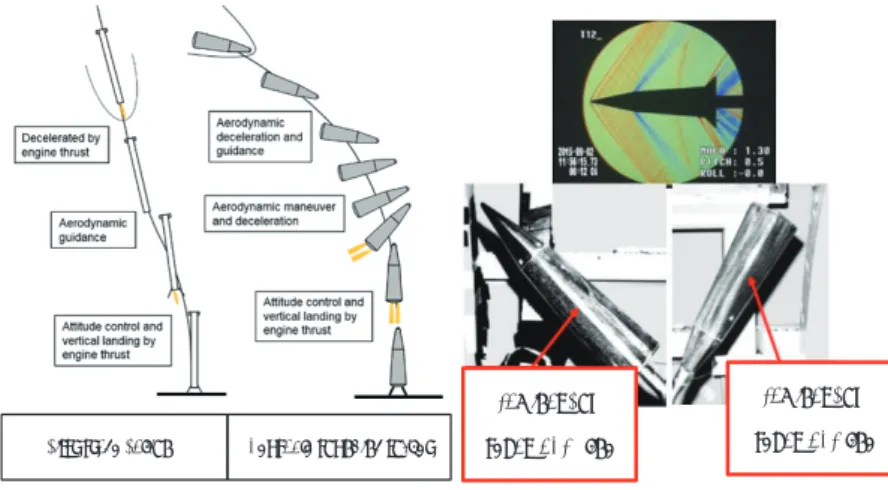
The rocket Falcon 9, developed by an American private company, consumes a large amount of propellant because it is decelerated and guided toward the land- ing point by using main engine thrust.
We designed a return landing approach that minimizes fuel consumption for de- veloping reusable sounding rockets (Fig- ure 1). The consumption of propellants during the return flight was compared with an optimized control simulation, and the results showed that fuel consumption can be minimized during returning flights by maximizing the use of aerodynamics to achieve sufficient deceleration (2015 Symposium for Space Flight Dynamics, December 2015).
11
12
Figure 1 Constellation plot of 64 APSK modulation signals from HODOYOSHI #4
satellite. Sixty-four APSK modulation signals from HODOYOSHI #4 satellite to the 3.8 m antenna Earth station, Sagamihara, ISAS, are plotted in the plane of in- phase axis and quadrature axis. The color scale shows the event frequency of ap- pearance, where red indicates more frequent events. The transmitted signals are decoded and recovered by error-correction codes
Figure 1 Deceleration of reusable sound-
ing rocket during return flight
Figure 2 Aerodynamic wind tunneltests
Reusable sounding rocket First-stage Falcon 9
Laminar flow separation line
Laminar flow separation line
Microgravity crystal growth of semiconductors on the Kibo module
In
xGa
1-xSb is an important material that has tunable properties in the infrared (IR) region and is suitable for IR- device applications. Because the quality of crystals depends on the growth conditions, the growth of alloy semicon- ductors can be examined better under microgravity conditions (μG) where convection is suppressed. In the present study, we investigated the dissolution and growth of In
xGa
1-xSb alloy semiconductors via a sandwiched structure of GaSb(seed)/InSb/GaSb(feed) under normal and μG conditions. In
xGa
1-xSb crystals were grown by using a gradient heating furnace on the Kibo module aboard the International Space Station under μG, and a similar experiment was conducted under terrestrial conditions (1G) by using the same growth method. The crystals were cut along the growth direction and their growth properties were studied. The In composition and growth rate of the crystals were calculated.
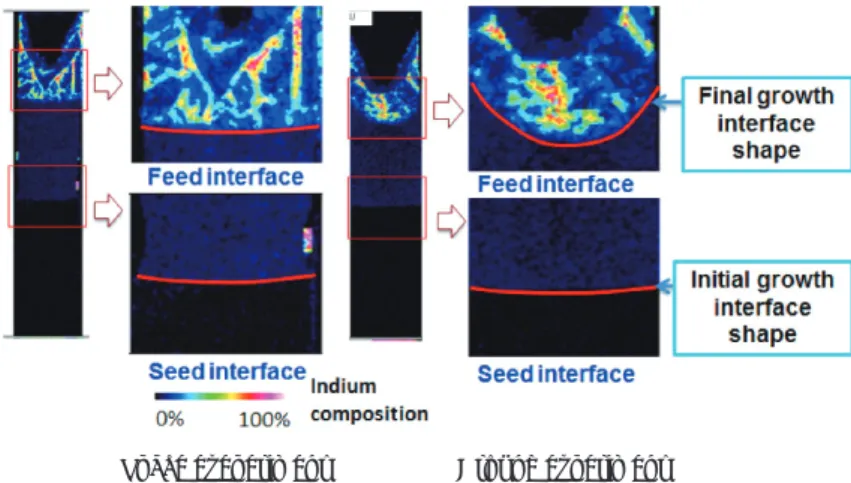
The μG results showed that large crystals may be produced at an accelerated growth rate if convection is damped during crystal growth. The acceleration of crystal growth cannot be explained by the conventional assumption that crystal growth speed decreases under μG because the materials are transported by diffusion alone. Compared with 1G (right in Figure 1), the composition of the crystals grown under gG was more uniform, leading to improved quality with fewer defects (left in Figure 1) and accelerated crystal growth. These findings provide valuable hints at new avenues of research that could spur the development of new growth technology for the production of high-quality bulk semiconductor crystals for IR elements, which is difficult in under 1G.
We propose the following explanation of the difference of the growth rates. Under μG, the solutes dissolved at the seed interface could not move to the feed interface owing to the absence of convection, and thus the solution at the seed interface became locally supersaturated. Therefore, the growth under μG started earlier than that under 1G.
Moreover, the dissolved solutes from the feed interface diffused quickly toward the seed interfaces because of the density gradient between the solute and solvent. Therefore, the growth rate was high under μG compared with 1G.
In contrast, convection was dominant under 1G, which reduced the solute accumulation near the seed interface. The seed dissolution stopped once the crystal started to grow from the seed interface. Thus, the initiation of the growth was delayed and the growth rate was low compared with μG.
Reference: Y. Inatomi et al., “Growth of In
xGa
1-xSb alloy semiconductor at the International Space Station (ISS) and comparison with terrestrial experiments”, npj Microgravity 1 (2015) 15011.
13
Figure 1 Electron probe microanalysis mapping of In distribution in (left) μG
and (right) 1G samples.
Space exeperiment Ground experiment
14
The origin of the main and internal modulation of the pulsating aurora (PsA) is revealed by the interactions be- tween the lower-band Chorus waves and plasma sheet electrons, based on simultaneous observations of precipitating electrons and auroral emissions in the magnetic footprint of the REIMEI satellite. (JAXA press release Sep 28, Journal of Geophysical Research Sep, 2015)
The PsA appears as irregular patches of luminosity with quasi-periodic (2–20 s or longer, main) temporal fluctuations. The lumi- nosity variations of the PsA are characterized by a series of rapid on-off switching caused by the intermittent precipitation of electrons with energies of several to tens of kiloelectron volts. In addition to quasi-periodic on-off switching, fast modulations embedded in the pulsation on-time, called quasi-3 Hz (internal) modulations, are observed.
The REIMEI satellite can observe the fine structures of auroral emissions and the corresponding precipitating auroral particles simultaneously. By using this unique feature, the REIMEI satellite has revealed the fine structure of the energy spectra of precipitat- ing electrons corresponding to the PsA, where each of main and internal modulations have their own components in the energy spectra, including energy-time dispersions (Figure 1).
Moreover, the stable precipitations around 1 keV are associated with the PsA.
Furthermore, we have reproduced these energy spectra with numerical simula- tions. In this simulation, Chorus waves (plasma waves) are generated around the geomagnetic equator and propagate along the geomagnetic field line, where ambient electrons are scattered when a resonance condition is fulfilled. Some of the scattered electrons precipitate into the ionosphere and excite auroral emissions. Figure 2 shows the measured and simulated spectra, which are similar. The fine structure of the precipitating electrons that cause PsA is a manifestation of Chorus frequency spectrum, namely the lower and upper Chorus waves. Thus, we have explained the generation mechanisms of the main and internal modulations of PsA.
REIMEI satellite reveals the origin of main and internal modulations of pulsating aurora
[Innovation Technology Demonstration Experiment “REIMEI” (INDEX)]
5s
Figure 1 (Upper panel) Precipitating electron energy spectra observed dur-
ing the pulsating aurora. (Bottom panel) Energy flux of 8 keV electrons.
Signatures of the main and internal modulations are clearly visible.
Figure 2 (Upper panel) Precipitating electron energy spectra observed dur-