Dairy Industry in Inner Mongolia Based on DEA Model
journal or
publication title
STUDIES OF REGIONAL POLICY
volume 23
number 4
page range 105‑115
year 2021‑03‑31
URL http://id.nii.ac.jp/1496/00001179/
Analysis on the Scale Management Efficiency of Dairy Industry in Inner Mongolia Based on DEA Model
ZHOU Hua
Abstract: Based on the data of China's dairy industry Yearbook, this paper uses the basic model CCR of data envelopment analysis to calculate the small-scale and medium-scale breeding efficiency of Inner Mongolia dairy industry, and uses the SYSC method to measure and analyze the relative efficiency. The results show that it is an effective way to improve the efficiency of breeding to concentrate the advantages in small-scale breeding and vigorously develop the income of main product output value, while in the medium-sized breeding, measures and Countermeasures to increase the output value of by-products are needed to increase the efficiency of breeding. The results of the SYSC method showed that the advantages of small-scale and medium-sized breeding patterns are difficult to give, and one side has more advantages than the other.
Keywords: Inner Mongolia dairy industry; scale breeding; breeding efficiency; CCR model;
SYSC method
Ⅰ
Introduction
As the upstream of dairy industry chain, dairy farmers play an indispensable role in the development of dairy industry. China's dairy industry has entered the stage of rapid development with high quality. Therefore, how to adapt to the development trend of China's dairy industry, achieve scientific and reasonable breeding scale, improve and increase the breeding efficiency has become the driving force to promote the high-quality development of China's dairy industry.
In recent years, China's dairy industry in the development of policies and measures continue to strengthen and improve the level of security, both the breeding scale of dairy farmers or the management form has undergone fundamental changes. In terms of the change of breeding
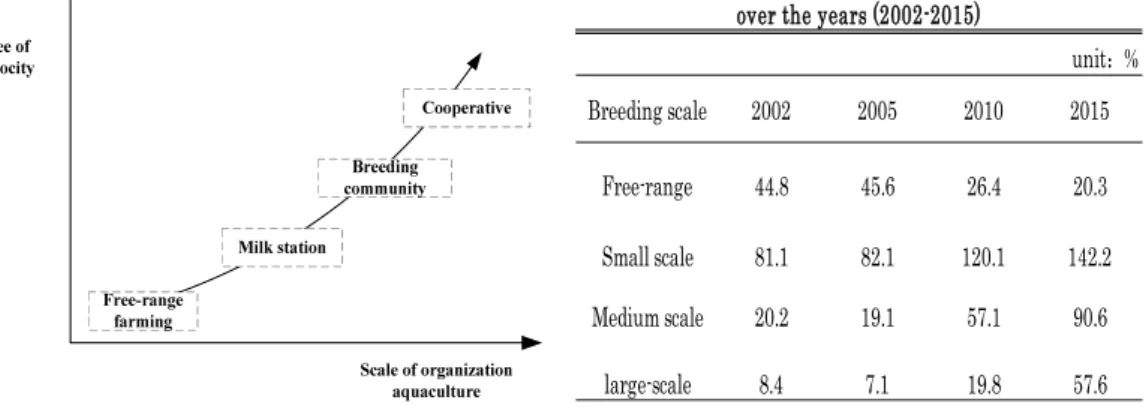
Based on the above changes, according to the statistics of China's dairy industry yearbook, dairy farming can be divided into four levels according to the breeding scale: free-range, small- scale, medium-sized, and large-scale breeding(as shown in Figure 1). As of 2015, after 15 years of rapid development, the proportion of breeding scale and level has changed significantly(as shown in Table 1). The characteristics of each level are as follows: free-range breeding decreased from 44.8% in 2002 to 20.1% in 2015, small-scale increased from 81.1% in 2002 to 142.2% in 2015, medium-sized increased from 20.2% in 2002 to 90.6% in 2015, and large-scale increased from 8.4% in 2002 to 57.6% in 2015. For example, the data show that except for the continuous decrease of free-range, the other three scale levels have shown a trend of increasing year by year. Among them, the growth rate of medium-sized enterprises in the past 13 years was 70.4%, that of small-scale enterprises was 61.1%, and that of large-scale enterprises was 49.2%.
From the view of the scale of breeding, the development of dairy industry in China is in line with the scale efficiency. In addition to the scale of breeding, the efficiency of breeding should not be ignored. In breeding activities, the main body of breeding will make the scale selection according to the breeding efficiency, thus affecting the overall development of breeding.
Therefore, how to improve the efficiency of breeding, choose a reasonable scale of breeding, and maximize the income of breeding has become the primary problem that dairy farmers need to
Figure 1 The development trend of scale breeding
Source: Created by the author based on the "China Dairy Statistics Yearbook (2017 Edition)".
solve.
Ⅱ
literature review
Based on a large number of research results, this paper sorts out two types of research closely
related to this paper. The first one discusses the relationship between the benefits of dairy farming and scale breeding, especially the relationship between technical efficiency, cost- effectiveness, production efficiency, and scale breeding.
Bai Yanfei (2014) and others measured and analyzed the production efficiency, pure technical efficiency, and scale efficiency decline of Beijing dairy farming professional cooperatives by using DEA method [1]. Hu Feng (2019) and others studied the technical efficiency of dairy farming, the actual role of input factors, and the effect of influencing factors of technical inefficiency by using the stochastic frontier model beyond logarithmic production function [2]. Wang Shangao (2019) and others calculated the environmental efficiency of different scale dairy farming based on SFA model [3]. Du Fenglian (2013) and others measured the economic efficiency, technical efficiency, and allocation efficiency of different raw milk production modes by using stochastic frontier analysis method [4]. Mei Mei (2019) and others analyzed the correlation between different influencing factors and net profit of dairy farming under different scales [5]. The other kind of literature which is closely related to this paper focuses on the improvement of breeding scale and efficiency. Scholars stressed that how to improve and improve the operating efficiency, choose the appropriate scale of breeding is more important. Wang Haichun (2015) and others believe that although the large-scale dairy cattle breeding and management level is higher, cow yield per unit area is higher, the milk price is better, and the overall economic benefit is better than that of the breeding community and the free-range farmers, but we can not blindly seek the big and fast, and moderate scale breeding according to local conditions is conducive to promoting the healthy and sustainable development of the dairy industry [6]. Wu Yunhua (2019) and others pointed out that the breeding scale has a significant positive effect on the technical efficiency, but the development and growth of the breeding scale should comprehensively consider various factors, and should not be greedy for large and fast, but should be moderately developed step by step [7].
Based on the important reference of the above scientific research results, the paper takes the different breeding scale of Inner Mongolia dairy industry as the breakthrough point, selects the small-scale and medium-sized scale which are developing rapidly among the current four breeding scales as the research object, analyzes how to improve the input or output of each breeding scale to realize its efficient breeding, and tries to find a breeding scale suitable for the sustainable development of Inner Mongolia dairy industry State.
Ⅲ
Theories, models and methodology
[8]Based on the above analysis of the efficiency of dairy breeding scale, to correctly measure the impact of multiple inputs and multiple outputs of each farming scale on the relative efficiency of the breeding scale, the data envelopment analysis method (DEA) used in this paper is dealing with multiple indicators It has unique advantages in terms of input and multi-indicator output and is appropriate and feasible. In the case of maintaining the current scale of breeding, the CCR model in DEA analysis method was used to determine the efficiency of each scale of breeding, to explore the improvement scheme. Besides, on this basis, the SYSC method, which is based on different systems to measure the efficiency, is used to identify the superior breeding scale among the two breeding scales, to establish the breeding scale suitable for the sustainable development of Inner Mongolia dairy industry.
(1) Efficiency measurement based on CCR model
CCR model is a research method developed by A.Charnes&W.W.Cooper&E.Rhodes to measure the relative efficiency of multi-input and multi-output business entities. It can be formulated according to the following steps.
In the above model, θ is the relative efficiency value of a certain breeding scale, and xo is the input amount of production resources of a certain scale of breeding scale,yo is the output of a certain breeding scale; X is the input of production resources of comparative breeding scale, and Y is the output of comparative breeding scale. Besides, μT is the variable weight of input production resources, and νT is the variable weight of output production resources.
If θ=1(xo、yo) The breeding scale is relatively efficient. That is,0≦θ≦1. Through this model, we can judge the relative efficiency of breeding scale with the same input and the same output.
In addition, by measuring the relative weight of variable μ or V, we can get whether to improve the input or output of each breeding scale, so as to improve the efficiency of aquaculture and determine the relevant improvement measures.
(2) Efficiency measurement in different systems
As shown in Figure 2, if the scale of HG is unilaterally superior to that of SG, the frontier is HG1 and HG2 lines, and the production set may be a convex set. However, as shown in Figure3, max θ=μT yo (1-1)
s.t νT xo=1 (1-2)
μT Y-νT X ≦0 (1-3)
μT≧0,νT≧0 (1-4)
in the case of no unilateral superiority between the two breeding scales, the frontiers of HG breeding scale are HG1, P, F, and HG2, while the frontier of SG is SG1, E, P, SG2. Therefore, SG, E, P, F, Hg2 lines are the frontiers of the two breeding scales, and the production set may not be a convex set. That is to say, the scale of HG adopts breeding operation, while the SG breeding scale adopts other breeding operation activities, while there is no breeding operation activity in the middle (on the EF line).
Combining the two types of farming scales, when the relative efficiency is determined by CCR model, the frontiers are the SG1, E, F, HG2 lines. Since the production activity between the E and F lines is possible, the production possibility set is convex. However, if there is no unilateral superiority between the two types of farming scales, the possible production set is not a convex set, and the efficiency value of the farming scale between the OE line and the OF line will not be correctly measured.
Therefore, it is appropriate and feasible to measure the relative efficiency values of different measurement systems in the case of two breeding scale forms. In the case of different systems, the method for determining the efficiency is formulated according to the study of Kaoru Tone (1993). In the following, the determination method is called SYSC method.
In the above model, θ is the relative efficiency value of a certain breeding scale, Xo is the input amount of production resources of a certain
breeding scale, yo is the output of a certain breeding scale; XA
is the input amount of production resources of breeding scale group A, YB is the output of breeding scale group B.
According to the measurement results of SYSC method, if the frontier is depicted as shown in Fig 2, it can be said that one breeding scale has unilateral advantages over another. However, if the frontier is as shown in Figure 3, it is impossible to have unilateral superiority in the two breeding scales.
(3) Data description
The data used in this paper is from China dairy Yearbook (2012-2017). Based on this data, small-scale and medium-sized dairy farms that are developing rapidly among the four breeding scales of Inner Mongolia dairy industry are selected to calculate the breeding efficiency.
In the use of SYSC method to determine the input of production resources, the production cost, labor cost, and land cost of each cow are used, while the output value is the total output value of each cow. In CCR model, the input of small-scale breeding production resources is the production cost, labor cost and land cost of small-scale dairy cattle in Inner Mongolia, while the output uses the main product output value and by-product output value of small-scale dairy cattle in Inner Mongolia; the input of medium-scale breeding production resources uses the production cost, labor cost and land cost of small-scale dairy cattle in Inner Mongolia Labor costs, land costs, and the output uses the average output value of main products and by-products of each cow in Inner Mongolia.
Ⅳ
Result Analysis
(1) Determination results based on CCR model
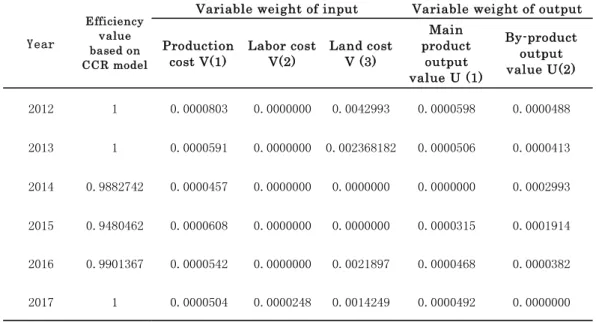
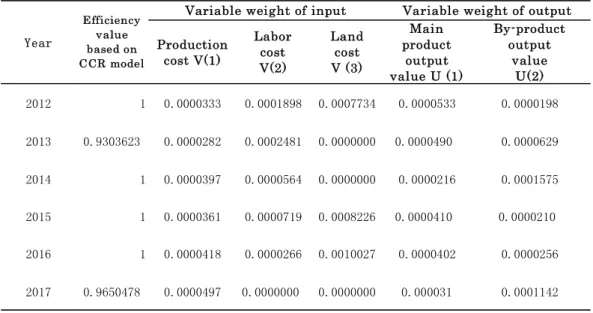
Based on CCR model, the relative efficiency values and variable weights of input and output for small-scale and medium-scale breeding are shown in Table 2 and Table 3.
It can be seen from Table 2 that in the input of inefficient small-scale breeding, the production cost is the largest variable weight. This means that compared with other input factors, the efficiency of breeding can be improved by reducing the production cost by 1 unit. In terms of
min θ (2-1)
s.t θ Xo≧λA XA+λB XB (2-2)
yo≦λA YA+λB YB (2-3)
LΖΑ≦eλA≦UZA (2-4)
LΖB≦eλB≦UZB (2-5)
ZA+ZB=1 (2-6)
λA≧0 λB≧0 (2-7)
ZA, ZB=0或1 (2-8)
L=0, U=∞ (2-9)
output, compared with the variable weight of by-product output value, the variable weight of the main product output value is more. From this, we can see that the concentration of advantages to increase the output value of the main products will more effectively improve breeding efficiency.
According to table 3, the variable weight of production cost is relatively large in 2017, while the variable weight of labor cost is relatively large in 2013. In terms of output, contrary to the above situation of small-scale breeding, the variable weight of the by-product output value is relatively large. Therefore, by expanding and increasing the output value of by-products, the breeding efficiency will be improved more effectively.
Table 2 Efficiency value and variable weight of small-scale dairy cattle breeding
(2) Determination results based on SYSC method
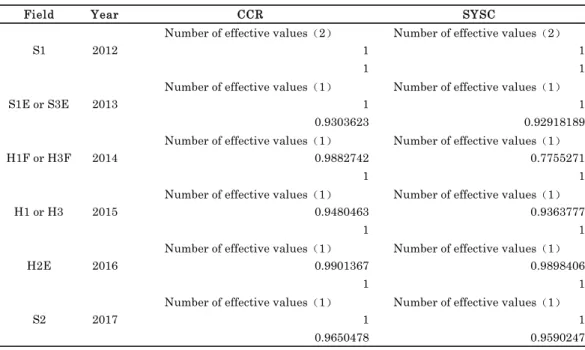
The results of relative efficiency determination by SYSC method are shown in Table 4.
According to figure3, in the CCR model, the efficiency values are measured according to their respective cultivation scale, and the frontiers of breeding scale are SG1,E, P, SG2 and HG1, P, F and HG2 lines respectively; while the efficiency values measured by SYSC method are SG1,E , P, F, Hg2 lines in Figure 3.
According to the results determined by SYSC method, the effective scale of dairy industry was small-scale breeding in three years (25.0%) in 2012,2013,2017, and four years (33.3%) in medium-sized breeding scale in 2012,2014,2015 and 2016. The average value of efficiency was 0.9502909 for medium-sized and 0.9813678 for medium-sized breeding.
Besides, the annual aquaculture of each field in Figure 3 is also shown in Table 4. The annual breeding between OE line and of line in Figure 3 is from 2013 to 2016, accounting for 66.7% of the total annual breeding. In other words, due to the difference between SYSC method and CCR model, the relative efficiency of 66.7% of annual breeding will change. Therefore, it is important to choose the measurement method or measurement model.
In Figure3, the OP line can be divided into left and right areas. In the left field, small-scale breeding has relative advantages, which is manifested as the effective value of small-scale breeding is 3, while the effective value of medium-scale breeding is 2; in the right-hand field, medium-scale breeding has relative advantages, specifically manifested as the effective value of
Table 3 Efficiency value and variable weight of Medium scale dairy cattle breeding
medium-sized breeding is 3 and the effective value of small-scale breeding is 2. Based on the above analysis results, it is difficult to conclude that one side's breeding scale form is superior to the other side's in small-scale and medium-scale aquaculture. This is consistent with the theoretical hypothesis.
Table 4 Annual breeding and efficiency value of different fields
Ⅴ
Conclusion
In view of the differences in aquaculture efficiency between different scales (small scale, medium scale), this paper analyzes how to improve the input or output of each scale of breeding to achieve its efficiency through CCR model. At the same time, SYSC method was used to identify the two types of breeding scale, trying to find a suitable breeding scale form for sustainable development of the dairy industry in Inner Mongolia. Through research and analysis, the following conclusions are drawn.
The results of CCR model show that it is an effective way to improve the efficiency of breeding
breeding efficiency more effectively. According to the results of relative efficiency measurement and analysis by using SYSC method, it is difficult to judge that the scale form of one side is more superior to that of the other side from the advantages of small-scale and medium-scale dairy farming. This is consistent with the prediction of theoretical analysis in Fig 3.
The conclusion of this paper has important implications for the development of small-scale and medium-scale dairy industry in Inner Mongolia in recent 10 years. At present, the development of the dairy industry in Inner Mongolia mainly depends on policies and resource factors. There are some problems, such as extensive production mode, imperfect industrial system, great pressure on resources and environment, weak ecological service function, limited innovation drive, and excessive dependence on traditional management mode for dairy industry growth, which makes the breeding efficiency of dairy industry scale breeding subject unable to be effectively exerted. With the further promotion of the national strategy of“ecological civilization construction”in Inner Mongolia, the strategic measures of high-quality development guided by ecological priority and green development are fundamentally changing the factor endowment structure and the transformation and upgrading of the industrial structure of the dairy industry.
The large-scale intensive breeding of the dairy industry has become the development trend of the dairy industry in the future, even in large-scale intensive breeding in the development stage of the mainstream status, the role of small and medium-sized breeding is still irreplaceable.
Based on the above conclusions, to realize the sustainable development of the dairy industry in Inner Mongolia, adhere to the national strategic orientation of ecological priority and green development. According to local conditions, should vigorously develop the ecological and economic scale breeding, which combines the small and medium-sized breeding pattern dominated by farmers and herdsmen,and the large-scale breeding form dominated by dairy enterprises.
(しゅう か・内モンゴル科技大学包頭師範学院経済管理学部講師)
Reference
[1] Wang Haichun, Qiao Guanghua, Liu Yuman. Analysis of technical economy and management problems of scale dairy farms in four provinces in Northwest China [J]. Economic research reference, 2015 (58): 41-51.
[2] Yu Dengfeng, Hu Zhifeng, Chinese Journal of animal husbandry efficiency: 2015, China.
[3] Wang Shangao, Xu Zhao. Analysis of environmental efficiency and its influencing factors of different scale dairy farming in China [J]. Chinese Journal of animal husbandry, 2018,54 (12): 132-139.
[4] Du Fenglian, Ma Huifeng, Fu Hongquan. Analysis on the technical efficiency of raw milk production of different models in China [J]. Agricultural modernization research, 2013,34 (04): 486-490.
[5] Wu Yunhua, Wang Hui, Dong Xiaoxia. Study on technical efficiency of different dairy cattle breeding modes based on FA model [J]. Shanghai Agricultural Journal, 2019, 35 (6): 135.140.
[6] Bai Yanfei, He Zhongwei, Wu Xiameng, Liu Fang. An analysis of the operational efficiency of Beijing dairy farming professional cooperatives based on DEA model [J]. Agricultural Outlook, 2014,10 (09): 37-42.
[7]A.Chanes, W.W.Cooper, E.Rhodes(1978): Measuring the efficiency of decision-making units, European Journal of
Operational Research. Vol.2, pp.429-444.
[8] Jin Changhao Analysis of Efficiency in Dairy Farms by DEA,Volume 34, Issue 3 (Volume 90) .
[9] Kaoru Kane, (1993): "measurement and improvement of managerial efficiency - by Envelope analysis method (DEA)", Japan Science and Technology Agency.