• 検索結果がありません。

福島県立医科大学 学術機関リポジトリ

N/A
N/A
Protected

Academic year: 2021

シェア "福島県立医科大学 学術機関リポジトリ"

Copied!
6
0
0

読み込み中.... (全文を見る)

全文

(1)

Fukushima Medical University

福島県立医科大学 学術機関リポジトリ

This document is downloaded at: 2021-11-07T23:42:51Z

Title Endoscopic ultrasound-guided fine needle aspiration for pancreatic cancer

Author(s)

Suzuki, Rei; Takagi, Tadayuki; Sugimoto, Mitsuru; Konno, Naoki; Sato, Yuki; Irie, Hiroki; Watanabe, Ko; Nakamura, Jun;

Takasumi, Mika; Hashimoto, Minami; Hikichi, Takuto; Ohira, Hiromasa

Citation Fukushima Journal of Medical Science. 64(3): 111-115

Issue Date 2018

URL http://ir.fmu.ac.jp/dspace/handle/123456789/706

Rights © 2018 The Fukushima Society of Medical Science

DOI 10.5387/fms.2018-14

Text Version publisher

(2)

[Review]

Endoscopic ultrasound

-

guided fine needle aspiration for pancreatic cancer

Rei Suzuki

1)

, Tadayuki Takagi

1)

, Mitsuru Sugimoto

1)

, Naoki Konno

1)

, Yuki Sato

1)

, Hiroki Irie

1)

, Ko Watanabe

2)

, Jun Nakamura

2)

, Mika Takasumi

1)

, Minami Hashimoto

2)

,

Takuto Hikichi

2)

and Hiromasa Ohira

1)

1)

Department of Gastroenterology, Fukushima Medical University School of Medicine,

2)

Department of Endoscopy, Fukushima Medical University Hospital

(Received July 25, 2018, accepted August 6, 2018)

Abstract

Since the development of endoscopic ultrasound

-

guided fine needle aspiration (EUS

-

FNA) in the early 1990s, its application has been extended to various diseases. For pancreatic cancer (PC), EUS

-

FNA can obtain specimens from the tumor itself with fewer complications than other meth- ods. EUS

-

FNA can also be more useful for TNM staging than other imaging modalities. Further- more, EUS

-

FNA can contribute to precision medicine by obtaining tissue for immunohistochemical or genetic studies from primary or metastatic sites of diseases. This paper will focus on the role of EUS

-

FNA in PC.

Key words : EUS

-

FNA, pancreatic cancer

Introduction

Pancreatic cancer (PC) is associated with a very poor prognosis, highlighted by the close parallel be- tween disease incidence and mortality

2)

. Five

-

year survival in patients with PC remains as low as 6% in the USA

3,4)

. EUS

-

FNA was established in the early 1990s and is now considered one of the standard procedures for PC diagnosis

1)

. Its applications have been widening from tissue sampling to disease stag- ing. This article presents a review of several re- cent developments in EUS

-

FNA in PC.

Diagnosis of PC using EUS

-

FNA

Our group previously reported the superiority of EUS

-

FNA to endoscopic retrograde pancreatogra- phy (ERP) in the diagnosis of PC without biliary stricture

5)

. In this study, we included 83 patients (EUS

-

FNA in 53 patients and ERP in 30 patients) and found that EUS

-

FNA showed sensitivity of 92.9% and accuracy of 94.3%, while ERP showed sensitivity of 33.3% and accuracy of 46.7%. With regard to complications, there was a significant dif-

ference (P<0.01) in the frequency of post

-

procedure pancreatitis between the EUS

-

FNA group and the ERP group (0%, 0/53 vs 33.3%, 10/30, respective- ly). Considering these advantages of EUS

-

FNA, EUS

-

FNA now plays an important role in the diag- nostic algorithm of PC

6)

.

Regarding the diagnostic yield of EUS

-

FNA for PCs, several retrospective and prospective studies have been published. These series show signifi- cant variability in the reported sensitivity and speci- ficity of EUS

-

FNA. To summarize available evi- dence on the diagnostic accuracy and safety of EUS

-

FNA for solid lesions of the pancreas, Hewitt et al.

conducted a meta

-

analysis that included 33 studies published between 1997 and 2009 with a total num- ber of 4984 patients

7)

. The pooled sensitivity for malignant cytology was 85% (95% confidence inter- val [CI], 84

-

86), and the pooled specificity was 98%

(95% CI, 97

-

99). Variables that appeared to affect diagnostic yield were prospective study design and multicenter study

7)

.

Another factor that can improve the diagnostic yield of EUS

-

FNA is the presence of an on

-

site cy- topathologist who can evaluate the quality and quan- Corresponding author : Rei Suzuki E

-

mail : [email protected]

https://www.jstage.jst.go.jp/browse/fms http://www.fmu.ac.jp/home/lib/F

-

igaku/

111

(3)

112 R. Suzuki et al.

tity of the obtained specimen (rapid on

-

site evalua- tion : ROSE)

8-10)

. ROSE is now considered a standard method for EUS

-

FNA because it not only improves the diagnostic value, but it also reduces the complication rate. However, some centers do not have this capability because of the cost and a lack of resources. Considering this challenging sit- uation, we conducted a prospective study to evaluate the optimal number of needle passes with a 25

-

gauge needle for solid pancreatic lesions (SPLs) without ROSE. This study was a preliminary study with 20 patients in each group (Group A : EUS

-

FNA with 4 needle passes, Group B : EUS

-

FNA with ROSE). We found that the sampling rate was high- er in Group B (20/20, 100%) than in Group A (19/20, 95%), but there was no significant difference be- tween them (P

-

value = 0.31). In Group A, sensi- tivity, specificity and accuracy were 100% among the 19 cases. In Group B, sensitivity was 94.1%, speci- ficity was 100%, and accuracy was 95%. There were also no significant differences between the groups. No complications were seen. Our study suggests that four needle passes using a 25

-

gauge needle may be sufficient for EUS

-

FNA of SPLs where onsite cytology is not available

11)

. Subse- quent studies with the same objectives have con- firmed our findings

12,13)

.

EUS

-

FNA for pancreatic cancer staging

Staging of PC is done according to the Ameri- can Join Committee of Cancer (AJCC) and the Union for International Cancer Control (UICC) Staging TNM classification, which describes tumor exten- sion (T) and lymph node (N) and distant metastases (M). Reported accuracies of T

-

staging by EUS range from 62

-

94%, and those of N

-

staging by EUS range from 50

-

86%. Additionally, EUS

-

FNA can contribute to accurate TNM staging on some special occasions

14-20)

.

1. Peritoneal tumor dissemination or malignant as- cites

Accurate diagnosis of peritoneal tumor dissemi- nation or malignant ascites in cancer patients is re- quired to select proper treatment options. Howev- er, it is occasionally difficult to detect or obtain a minute amount of ascites by conventional modali- ties. EUS can detect a minute or minimal amount of ascitic fluid that may be undetectable with other imaging modalities, including abdominal ultrasound (US), computed tomography (CT), and magnetic res- onance imaging (MRI). Moreover, EUS

-

guided ab-

dominal paracentesis (EUS

-

P) has the potential to play an important role for staging of cancer since the establishment of malignant ascites denotes a more advanced stage of cancer

21-23)

. Although EUS

-

P is a useful technique at times, we encountered technical difficulties during EUS

-

P, probably due to a weaker counteracting force from extramural objects and a lax gastrointestinal wall. We previously reported the usefulness of a spring

-

loaded needle device for EUS

-

P in 11 patients with known malignancies (6 PCs). Our results showed that EUS

-

P with an au- tomated spring

-

loaded needle device can be a useful technique to obtain a minute amount of ascitic fluid in cancer patients. Furthermore, EUS showed its ability to detect a scant amount of ascitic fluid that US and CT could not detect in 4 patients with pan- creatic ductal adenocarcinoma. In these patients, the average amount of aspirated fluid was only 2.6 mL. Two of them were diagnosed as malignant, and this result changed their management (Figure 1A

-

C)

24)

.

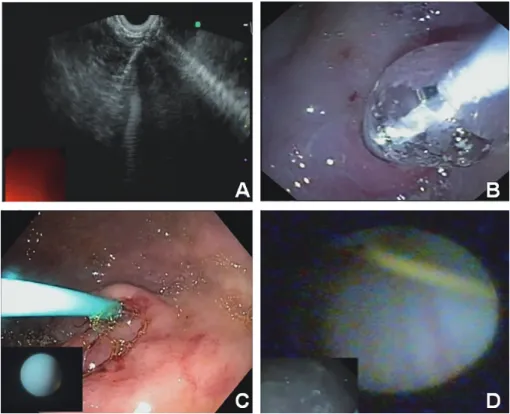
Another issue in staging is preoperative lapa- roscopy, which has been used in the staging of vari- ous types of cancers. Even though it has been proven to be more accurate for decisions of resect- ability than other cross

-

sectional imaging, a lack of validated studies and its complexity for this purpose (e.g., need for general anesthesia and an operating room) hinder its application in routine practice. To resolve this issue, we conducted an animal study that aimed to develop a new endoscopic procedure for exploration of the abdominal cavity. Our pilot study demonstrated the technical feasibility of EUS

-

assisted direct peritoneal visualization with a 10

-

Fr small

-

caliber scope in a swine model. As we hy- pothesized, a <1

-

cm stomach wall defect can be closed tightly with commercially available hemosta- sis clips without any special techniques (Figure 2A

-

D)

25)

.

2. Para

-

aortic lymph node metastasis

Para

-

aortic lymph node (PALN) metastasis is

classified as a distant metastasis and is regarded as

one of the unresectable factors. Recent reports

demonstrated that such PALN metastases were

found in more than 10% of surgical cases of

PC. However, because of the limited diagnostic

ability using conventional imaging modalities (eg, ul-

trasonography, multidetector

-

row CT [MDCT],

magnetic resonance imaging, EUS, and positron

emission tomography [PET]), PALN metastasis cur-

rently is not always evaluated before surgery. Ku-

rita et al. conducted a prospective study to compare

(4)

Fig. 1. Endoscopic ultrasound guided abdominal paracentesis. (A) An automated spring

-

loaded needle (NA

-

11J

-

KB, Olympus, Japan). (B) Computed tomography revealed minute amount of ascites along the right hepatic lobe (white arrow). (C) Endoscopic ultrasound guided abdominal paracentesis successfully obtained ascites (white arrowhead).

Fig. 2. Endoscopic technique of peritoneal visualization. (A) A stomach defect was created with an endoscopic ul-

trasound

-

guide fine needle aspiration technique. (B) The defect was dilated with balloon under fluoroscopic

guidance. (C) A small

-

caliber scope was inserted into the peritoneal cavity. (D) The peritoneum was visual-

ized.

(5)

114 R. Suzuki et al.

the diagnostic yield for PALN metastases between EUS

-

FNA and PET

-

CT

26)

. In their analysis, they found that preoperative EUS

-

FNA or PET/CT made a correct diagnosis in 20 (95.2%) and 12 (57.1%), re- spectively. EUS

-

FNA had higher sensitivity and specificity for the diagnosis of PALN metastases (sensitivity, 96.7% [29/30] ; 95% confidence inter- val, 82.2%

-

99.9% ; specificity, 100% [39/39] ; 95%

confidence interval, 91.0%

-

100%) than PET/CT.

Considering this result, they concluded that EUS

-

FNA should be part of the standard preoperative ex- amination for patients with PC.

EUS

-

FNA in precision medicine for pancreatic cancer

Precision medicine involves providing specific treatments for patients who have tumors with cer- tain types of bio

-

profiles. In the last three decades, precision medicine has developed dramatically and is now applied to many different cancers, including PC. Techniques for precision medicine range from ex vivo cancer models, immunohistochemistry (IHC), real time

-

PCR, and mutational analysis using next

-

generation sequencing (NGS).

Our groups previously reported the utility of chemo

-

sensitivity testing by using EUS

-

FNA sam- ples in patients with unresectable PC

27)

. This study included 34 patients, and chemo

-

sensitivity (treated/

control ratio : T/C ratio) was calculated as the quan- tity of adenosine triphosphate for a tumor treated with gemcitabine as a percentage of that for the con- trol. When the cut

-

off value of the T/C ratio was set at 74%, we could predict 180

-

day progression

-

free survival (PFS) with sensitivity and specificity of 71.4% and 91.3%, respectively.

Additionally, analyses of drug sensitivity

-

related gene profiles using samples obtained by EUS

-

FNA have been reported. Ashida et al. extracted mes- senger RNA from EUS

-

FNA samples and conducted cDNA array analysis

28)

. They found that dCK mRNA expression is a candidate indicator for GEM efficacy in unresectable PC. Quantitative mRNA measurements of deoxycytidine kinase using EUS

-

FNA samples are necessary for definitive conclu- sions. With a similar method, Eto et al. found that human equilibrative nucleoside transporter 1 and Notch3 mRNA expressions in EUS

-

FNA specimens were the key predictive biomarkers of GEM effect and GEM sensitivity in patients with unresectable PC

29)

.

Using NGS, an entire human genome can be sequenced within a single day. First, several stud-

ies have used this technique for the diagnosis of PC

30,31)

. Subsequently, in the era of precision medi- cine, its application has shifted from diagnosis to molecular profiling for potential targets for personal- ized anticancer therapy. Even though we still have many issues that limit the clinical application of pre- cision medicine to PC, EUS

-

FNA may play an im- portant role in precision medicine for PC in the fu- ture

32)

.

Conflict of Interest Disclosure

The authors declare no conflicts of interest as- sociated with this manuscript.

References

1. Wiersema MJ, Vilmann P, Giovannini M, et al. En- dosonography

-

guided fine

-

needle aspiration biopsy : diagnostic accuracy and complication as- sessment. Gastroenterology, 112 : 1087

-

1095, 1997.

2. Siegel R, Ma J, Zou Z, et al. Cancer statistics, 2014. CA Cancer J Clin, 64 : 9

-

29, 2014.

3. Gillen S, Schuster T, Meyer Zum Buschenfelde C, et al. Preoperative/neoadjuvant therapy in pan- creatic cancer : a systematic review and meta

-

analysis of response and resection percentages.

PLoS Med, 7 : e1000267, 2010.

4. Kamisawa T, Wood LD, Itoi T, et al. Pancreatic cancer. Lancet, 388 : 73

-

85, 2016.

5. Wakatsuki T, Irisawa A, Bhutani MS, et al. Com- parative study of diagnostic value of cytologic sam- pling by endoscopic ultrasonography

-

guided fine

-

needle aspiration and that by endoscopic retrograde pancreatography for the management of pancreatic mass without biliary stricture. J Gastroenterol Hepatol, 20 : 1707

-

1711, 2005.

6. Committee ASoP, Eloubeidi MA, Decker GA, et al.

The role of endoscopy in the evaluation and man- agement of patients with solid pancreatic neoplasia.

Gastrointest Endosc, 83 : 17

-

28, 2016.

7. Hewitt MJ, McPhail MJ, Possamai L, et al. EUS

-

guided FNA for diagnosis of solid pancreatic neoplasms : a meta

-

analysis. Gastrointest En- dosc, 75 : 319

-

331, 2012.

8. Eloubeidi MA, Tamhane A, Jhala N, et al. Agree- ment between rapid onsite and final cytologic in- terpretations of EUS

-

guided FNA specimens : im- plications for the endosonographer and patient management. Am J Gastroenterol, 101 : 2841

-

2847, 2006.

9. Schmidt RL, Witt BL, Lopez

-

Calderon LE, et al.

The influence of rapid onsite evaluation on the ad-

equacy rate of fine

-

needle aspiration cytology : a

(6)

systematic review and meta

-

analysis. Am J Clin Pathol, 139 : 300

-

308, 2013.

10. Hikichi T, Irisawa A, Bhutani MS, et al. Endo- scopic ultrasound

-

guided fine

-

needle aspiration of solid pancreatic masses with rapid on

-

site cytologi- cal evaluation by endosonographers without atten- dance of cytopathologists. J Gastroenterol, 44 : 322

-

328, 2009.

11. Suzuki R, Irisawa A, Bhutani MS, et al. Prospec- tive evaluation of the optimal number of 25

-

gauge needle passes for endoscopic ultrasound

-

guided fine

-

needle aspiration biopsy of solid pancreatic le- sions in the absence of an onsite cytopathologist.

Dig Endosc, 24 : 452

-

456, 2012.

12. Ge PS, Wani S, Watson RR, et al. Per

-

pass per- formance characteristics of endoscopic ultrasound

-

guided fine

-

needle aspiration of malignant solid pancreatic masses in a large multicenter cohort.

Pancreas, 47 : 296

-

301, 2018.

13. Uehara H, Sueyoshi H, Takada R, et al. Optimal number of needle passes in endoscopic ultrasound

-

guided fine needle aspiration for pancreatic lesions.

Pancreatology, 15 : 392

-

396, 2015.

14. Rosch T, Braig C, Gain T, et al. Staging of pancre- atic and ampullary carcinoma by endoscopic ultra- sonography. Comparison with conventional so- nography, computed tomography, and angiography.

Gastroenterology, 102 : 188

-

199, 1992.

15. Palazzo L, Roseau G, Gayet B, et al. Endoscopic ultrasonography in the diagnosis and staging of pancreatic adenocarcinoma. Results of a prospec- tive study with comparison to ultrasonography and CT scan. Endoscopy, 25 : 143

-

150, 1993.

16. Muller MF, Meyenberger C, Bertschinger P, et al.

Pancreatic tumors : evaluation with endoscopic US, CT, and MR imaging. Radiology, 190 : 745

-

751, 1994.

17. Gress FG, Hawes RH, Savides TJ, et al. Role of EUS in the preoperative staging of pancreatic cancer : a large single

-

center experience. Gas- trointest Endosc, 50 : 786

-

791, 1999.

18. Ahmad NA, Lewis JD, Siegelman ES, et al. Role of endoscopic ultrasound and magnetic resonance imaging in the preoperative staging of pancreatic adenocarcinoma. Am J Gastroenterol, 95 : 1926

-

1931, 2000.

19. Midwinter MJ, Beveridge CJ, Wilsdon JB, et al.

Correlation between spiral computed tomography, endoscopic ultrasonography and findings at opera- tion in pancreatic and ampullary tumours. Br J Surg, 86 : 189

-

193, 1999.

20. Shami VM, Mahajan A, Loch MM, et al. Compari- son between endoscopic ultrasound and magnetic resonance imaging for the staging of pancreatic

cancer. Pancreas, 40 : 567

-

570, 2011.

21. DeWitt J, LeBlanc J, McHenry L, et al. Endo- scopic ultrasound

-

guided fine

-

needle aspiration of ascites. Clin Gastroenterol Hepatol, 5 : 609

-

615, 2007.

22. Kaushik N, Khalid A, Brody D, et al. EUS

-

guided paracentesis for the diagnosis of malignant ascites.

Gastrointest Endosc, 64 : 908

-

913, 2006.

23. Nguyen PT, Chang KJ. EUS in the detection of ascites and EUS

-

guided paracentesis. Gastroin- test Endosc, 54 : 336

-

339, 2001.

24. Suzuki R, Irisawa A, Bhutani MS, et al. An auto- mated spring

-

loaded needle for endoscopic ultra- sound

-

guided abdominal paracentesis in cancer pa- tients. World J Gastrointest Endosc, 6 : 55

-

59, 2014.

25. Suzuki R, Bhutani MS, Shin D, et al. Endoscopic ultrasound

-

assisted direct peritoneal visualization with a small

-

caliber scope : A proof of concept study in a swine model. Endosc Ultrasound, 3 : 226

-

231, 2014.

26. Kurita A, Kodama Y, Nakamoto Y, et al. Impact of EUS

-

FNA for preoperative para

-

aortic lymph node staging in patients with pancreatobiliary cancer.

Gastrointest Endosc, 84 : 467

-

475 e461, 2016.

27. Wakatsuki T, Irisawa A, Terashima M, et al. ATP assay

-

guided chemosensitivity testing for gem- citabine with biopsy specimens obtained from un- resectable pancreatic cancer using endoscopic ul- trasonography

-

guided fine

-

needle aspiration. Int J Clin Oncol, 16 : 387

-

394, 2011.

28. Ashida R, Nakata B, Shigekawa M, et al. Gem- citabine sensitivity

-

related mRNA expression in endoscopic ultrasound

-

guided fine

-

needle aspira- tion biopsy of unresectable pancreatic cancer. J Exp Clin Cancer Res, 28 : 83, 2009.

29. Eto K, Kawakami H, Kuwatani M, et al. Human equilibrative nucleoside transporter 1 and Notch3 can predict gemcitabine effects in patients with un- resectable pancreatic cancer. Br J Cancer, 108 : 1488

-

1494, 2013.

30. Kameta E, Sugimori K, Kaneko T, et al. Diagnosis of pancreatic lesions collected by endoscopic ultra- sound

-

guided fine

-

needle aspiration using next

-

generation sequencing. Oncol Lett, 12 : 3875

-

3881, 2016.

31. de Biase D, Visani M, Baccarini P, et al. Next gen- eration sequencing improves the accuracy of KRAS mutation analysis in endoscopic ultrasound fine needle aspiration pancreatic lesions. PloS One, 9 : e87651, 2014.

32. Berry W, Lundy J, Croagh D, et al. Reviewing the

utility of EUS FNA to advance precision medicine

in pancreatic cancer. Cancers (Basel), 10 : 2018.

Fig. 2.  Endoscopic technique of peritoneal visualization.  (A)  A stomach defect was created with an endoscopic ul- ul-trasound - guide fine needle aspiration technique

参照

関連したドキュメント

It is suggested by our method that most of the quadratic algebras for all St¨ ackel equivalence classes of 3D second order quantum superintegrable systems on conformally flat

Next, we prove bounds for the dimensions of p-adic MLV-spaces in Section 3, assuming results in Section 4, and make a conjecture about a special element in the motivic Galois group

Transirico, “Second order elliptic equations in weighted Sobolev spaces on unbounded domains,” Rendiconti della Accademia Nazionale delle Scienze detta dei XL.. Memorie di

Then it follows immediately from a suitable version of “Hensel’s Lemma” [cf., e.g., the argument of [4], Lemma 2.1] that S may be obtained, as the notation suggests, as the m A

We provide an efficient formula for the colored Jones function of the simplest hyperbolic non-2-bridge knot, and using this formula, we provide numerical evidence for the

It is well known that in the cases covered by Theorem 1, the maximum permanent is achieved by a circulant.. Note also, by Theorem 4, that the conjecture holds for (m, 2) whenever m

The theme of this paper is the typical values that this parameter takes on a random graph on n vertices and edge probability equal to p.. The main tool we use is an

[r]