大臣
(全体7000人)
環境保護行政担当次官
環境計画・政策担当次官
環境振興基準担当次官
Unidad Coordinadora de Participación Social y TransparenciaUCAI
CECADESU
CAN(180名)
IMTA
PROFEPA(182名)
CONANP
CONAFOR
CONABIO
環境庁(176名)
生態系整備及び生態系保全 研究局(33名) 都市・地域・地球汚染研究局(27名) 環境政策・環境経済研究局 (36名)CENICA(80名)
大 気 質 行 政 ・ 排 出 登 録 汚染物質取引局5.SEMARNAT 内規
第
10 章 環境庁(INE)
第113条
都市・地域・地球汚染研究局は下記の権能を持つ。
I.
生態系及び環境サービスの経済的意義、または個別の汚染を起こす製
品・活動に関し分析・審査を行い、これを省・庁の検討に付す。
II.
省の管理ユニットや外局、その他連邦行政府のしかるべき部署と協議
の上、環境コストの内面化のための税制・金融・市場面での経済ツー
ルを設計・提案し、生産セクターの経済・環境的決定に結びつける。
III.
生態系、天然資源、環境サービスの環境経済評価方法の分析・設計・
適用を促進し、これを調整する。
IV.
省の管理ユニット及びしかるべき外局と協力して、環境基準の遵守の
決定に関与する経済要素、及びその効果に関する調査を実施する。
V.
適用可能な法規則に基づき、国内に於ける環境問題の解決や天然資源
の適切な管理を目的とした国外からの融資や国際機関・組織よりの供
与の獲得とその効率的な利用に関する判断基準を、省のしかるべき管
理ユニットに対し提示する。
VI.
環境政策が貧困世帯に与える影響に関する調査を実施し、社会開発省
を協力して環境上メリットを持つような貧困低減プログラムを立案す
る。
VII.
環境統計情報局及び国家統計地理院(INEGI)と協力して国家持続可能
性指標システムの開発に貢献する。
VIII.
大学、研究センター、その他の国内・国外の機関と共同で、生物・物
理システムと経済・社会プロセスの相互関係を分析的に再現するモデ
ルの構築、作成、運営を促進し、これに参加する。
IX.
エネルギー・セクター当局と共同し、将来の様々なエネルギー
/環境シ
ナリオ、燃料品質シナリオを評価するためのコンピューターモデル、
一般均衡モデルを評価し、使用する。
X.
省のその他の局と協力して、環境行政に関する政策、プログラム、基
準、ガイドライン、対策、判断基準、手順などの作成と実施に資する
都市・地域・セクター経済に関する応用研究ラインを提案し、これを
開発する。
XI.
大気質、有害廃棄物・有害物質の取り扱いと処理、及び気象変化に関
する研究の実施を通じて国際協力プロジェクト・国際協力活動に参加
する。 その際、国際事業調整ユニットの然るべき参加を得る。
XII.
温室効果ガスの減少、これによって起こる気象変化の我が国への影響、
及びこれに対する対応策の評価に関する調査を促進し、調整する。
XIII.
国立環境研究研修センター局と協力して、環境毒性及び個人暴露に関
する研究プロジェクトを提案し、これを評価する。
XIV.
環境優先性を確立する省の他部署を支援するため、比較リスク分析に
関する研究を実施する。
XV.
国立環境研究研修センター局と協力して、全国の大気質情報の体系で
ある全国大気質情報システムや、環境汚染・環境劣化に関するその他
のシステムやデータベースを設立する。
XVI.
国立環境研究研修センター局とともに、大気汚染及び有害物質・有害
廃棄物の取り扱いに関する研究プログラムの立案、実施に参加する。
XVII.
エミッション・ファクター及び活動パターンの更新のための調査を促
進し、これを調整する。
XVIII. 品質保証のデータベースやサブシステムの維持・改善を奨励し、これ
を調整する。
第
115 条
国家環境研究研修センター局(
CENICA)は下記の権能を持
つ。
I.
大気排出の減少、有害廃棄物の安全な取り扱い及び廃棄物の減量化に
関する技術革新の評価プログラムを設定し、これを調整する。
II.
大気汚染物質、化学物質、廃棄物のサンプリング及び分析を実施する
試験ラボが、連邦度量衡・規格化法に基づき、メキシコ公式規格に合
致しているか否かを評価することが必要とされる場合には、これらの
ラボの認証・承認のための評価委員会に参加する。 この際、
(環境天
然資源省)環境振興・基準次官がこの点に関し発行する判断基準やガ
イドラインを尊重する。
III. 省の当該管理ユニットに対し、大気モニタリングシステムの技術仕様、
設計ベース、操作プロトコル、データの取り扱い方を提案し、大気モ
ニタリングシステムの運営の評価と品質保証を行うとともに、全国各
州の大気汚染モニタリングシステムの設置を奨励し、調整し、監督す
る。
IV.
省の当該管理ユニットに対し、大気汚染と有害物質の取り扱い分野に
於ける応用研究ラインを提案する。 又、交通・都市開発の環境的管
理に関する政策、プログラム、基準、ガイドライン、対策、手順など
の立案及びその実施に貢献する。
V.
有害物質・有害活動総合行政局、及び大気質・排出登録・汚染物質移
転行政局と協力してメキシコ盆地首都圏環境委員会の環境モニタリン
グプロジェクトを実施する。
VI.
連邦行政府のその他の機関・部署や州政府・市町村当局と調整の上、
大気質の決定のための調査を指導し、その結果を普及させる。
VII.
外国の同様な研究所と協力関係を樹立し、法務・機関間協力ユニット
と共同して汚染予防・防止や有害廃棄物の取り扱いに関連したテーマ
の技術協力を促進する。
VIII.
都市・地域・地球汚染研究局と協力して、大気質行政に貢献するコン
ピューターモデルの応用・操作に参加する。
IX.
有害物質・有害活動総合行政局、大気質・排出登録・汚染物質移転行
政局、法務・機関間協力ユニット、国際関係調整部と協力して、大気
域や河川域の持続可能な管理や工業資材・工業廃棄物の保管・取り扱
いに関する国際フォーラムに省の代表として参加する。
X.
省の当該管理ユニットに対し、大気汚染物質の測定と同定のプロセス
に関する分析法の開発や管理手順、品質保証などを提案する。
XI.
大気汚染と個人暴露の評価に関する研究を実施する。
XII.
有害廃棄物の減量化や汚染土壌の回復に関する研究を実施する。
XIII.
都市・地域・地球汚染研究局と協力して、環境統計・情報局のガイド
ラインに従い、全国大気質情報システム及び汚染・環境劣化に関する
その他のデータシステム、データベースを開発し、使用する。
XIV.
全国レベルで大気中の汚染物質や土壌中の有害廃棄物の存在や量に関
するデータを作成し、科学的情報を提供・普及させる。
XV.
省の当該管理ユニットと協力して、メキシコの公共・民間・学術セク
ターの専門員に対し、大気汚染と固形廃棄物・有害廃棄物の取り扱い、
分析技術に関する技術科学的研修プログラムを組織する。
XVI.
大気汚染物質の分析及び測定機器の校正に関し、標準ラボとして機能
する。
XVII.
省の管理ユニットや外郭組織などが必要とする場合には、調査や研究、
技術評価プログラムへの参加、大気モニタリングシステムの監督や評
価を行って意見を発表し、技術報告書を作成する。
第
11 章
連邦環境保護検察庁
第
118条
連邦環境保護検察庁は長官を責任者とし、下記の権限を持つ。
XXXVI 環境庁(INE)国家環境研究研修センター局(CENICA)の意見を事
前に聴取した上で、度量衡・基準化連邦法の規定に従って認証を受け
た検査ユニットや認定機関が行う業務を承認・監督する。
DIRECCIÓN GENERAL DEL CENTRO NACIONAL DE INVESTIGACIÓN Y CAPACITACIÓN
AMBIENTAL
VICTOR J. GUTIERREZ AVEDOY
DIRECCIÓN DE INVESTIGACIÓN EN CONTAMINACIÓN ATMOSFÉRICA BEATRIZ CARDENAS GONZALEZ COORDINADOR ADMINISTRATIVO VICTOR M. CORONA NORIEGA DIRECCION DE INVESTIGACION EN RESIDUOS Y SITIOS CONTAMINADOS GUSTAVO SOLORZANO OCHOA
DIRECCION DE INVESTIGACIÓN EN MONITOREO ATMOSFÉRICO
Y CARACTERIZACIÓN ANALÍTICA DE CONTAMINANTES
ANA PATRICIA MARTÍNEZ BOLIVAR
SUBDIRECCION DE ANÁLISIS INTEGRAL DE
LA CONTAMINACIÓN ATMOSFERICA JULIA CERON BRETON
SUBDIRECCIÓN DE INV. EN CARACTERIZACIÓN DE CONTAMINANTES ATMOSFÉRICOS SALVADOR BLANCO JIMENEZ SUBDIRECCIÓN DE INVESTIGACIÓN SOBRE EL MANEJO INTEGRAL DE LOS RESIDUOS ANABELL ROSAS DOMINGUEZ SUBDIRECCION DE INVESTIGACIÓN EN SUELOS CONTAMINADOS Y SUSTANCIAS TOXICAS PERSISTENTES TANIA L. VOLKE SEPULVEDA SUBDIRECCION DE INVESTIGACION Y CARACTERIZACION ANALITICA DE CONTAMINANTES MA. TERESA ORTUÑO
ARZATE
SUBDIRECCION DE VALORACIÓN DE LA CONTAMINACIÓN DEL
AIRE JOSE ZARAGOZA AVILA
DEPTO. DE ESTUDIOS SOBRE TRANSPORTE E IMPACTO DE CONTAMINANTES ATMOSFERICOS CLAUDIA MARQUEZ ESTRADA DEPTO DE ESTUDIOS SOBRE EXPOSICION PERSONAL Y MICROAMBIENTAL J. FELIPE ANGELES GARCIA DEPTO. DE ESTUDIOS SOBRE CARACTERIZACIÓN DE CONTAMINANTES ATMOSFÉRICOS ROSA MA. BERNBABE
DEPTO. DE CARACTERIZACIÓN FÍSICO-QUÍMICA DE PARTÍCULAS FRANCISCO MANDUJANO DEPTO. DE ESTUDIOS SOBRE COMPUESTOS ORGÁNICOS VOLÁTILES
EMMA BUENO LOPEZ
DEPTO. DE TECNOLOGÍAS APLICADAS AL MANEJO, TRATAMIENTO Y DISPOSICIÓN DE RESIDUOS GUILLERMO ENCARNACIÓN A. DEPTO. DE INVESTIGACIÓN APLICADA EN RESIDUOS SERGIO FLORES MARTÍNEZ DEPTO. DE PROYECTOS REGIONALES Y EVALUACIÓN DE SUSTANCIAS TOXICAS PERSISTENTES EN SUELOS Y RESIDUOS VICTOR JOAQUIN ALVARADO DEPTO. DE INVESTIGACIÓN APLICADA A SUSTANCIAS TOXICAS PERSISTENTES ALEJANDRO DE LA ROSA DEPTO. DE INVESTIGACIÓN Y EVALUACIÓN DE SUELOS CONTAMINADOS JUAN ANTONIO VELASCO DEPTO. DE CARACTERIZACION DE CONTAMINANTES POR ESPECTROSCOPIA DE ABSORCION Y EMISION ATOMICA PAOLA SALGADO FIGUEROA DEPTO. DE CARACTERIZACION BASICA Y BIOTOXICIDAD DE CONTAMINANTES MERCEDES REYES DEPTO. DE INVESTIGACION INSTRUMENTAL DE COMPUESTOS ORGANICOS ANA MARIA MALDONADO C. DEPTO. DE ASEGURAMIENTO Y CONTROL DE CALIDAD ALBERTO TELLEZ GIRON
BRAVO DEPTO. DE
CARACTERIZACION DE RESIDUOS Y SUELOS
CONTAMINADOS MA. DEL CARMEN
GUTIERREZ
DIRECCION GENERAL DEL CENTRO NACIONAL
DE INVESTIGACION Y CAPACITACION
AMBIENTAL
DEPTO. DEL SISTEMA NACIONAL DE INFORMACIÓN DE CALIDAD DEL AIRE CARMEN A. SÁNCHEZ SOTO SUBDIRECCION DE APOYO TÉCNICO Y CAPACITACIÓN AMBIENTAL ALMA DELIA NAVA
MONTES DEPTO. DE VINCULACION CONCEPCION REYES MARTINEZ DEPTO. DE INSTRUMENTACIÓN DE PROGRAMAS INSTITUTCIONALES DIANA FLOR DEL PERAL
RODRIGUEZ DEPTO. DE EVALUACIÓN
DE EMISIONES DE FUENTES FIJAS
MOVILES ANGELICA PEÑA LUNA
DEPTO. DEMONITOREO ATOMOSFERICO OSCAR FENTANES
6-2 CENICA 職員一覧
1. 国立環境研究研修センター 局長 ビクトル グティエレス アベドイ
2. 大気汚染研究部 部長 ベアトリス カルデナス ゴンサレス
3. 廃棄物・汚染地研究部 部長 グスターボ ソロルサノ オチョア
4. 大気測定・汚染物質分析同定部 部長 パトリシア マルティネス ボリ
バル
5.
大気汚染総合分析副部長 フリア セロン ブレトン
6.
大気汚染物質移動・影響調査課長 クラウディア マルケス エストラダ
7.
個人暴露・微小環境調査課長 フェリーペ アンヘレス ガルシア
8.
大気汚染物質同定副部長 サルバドル ブランコ ヒメネス
9.
大気汚染物質同定調査課長 ロサ マリア ベルナベ
10. 粒子状物質物理化学同定課長 フランシスコ マンデュハノ
11. 揮発性有機化合物調査課長 エマ ブエノ ロペス
12. 廃棄物総合管理研究副部長 アナベル ロサス ドミンゲス
13. 廃棄物管理・処理・処分応用技術課長 ギジェルモ エンカルナシオン
A.
14. 廃棄物応用研究課長 セルヒオ フローレス マルティネス
15. 廃棄物汚染土壌同定課長 マリア デル カルメン グティエレス
16. 汚染土壌・高残留性有害物質研究副部長 タニア L ボルケ セプルベダ
17. 高残留性有害物質応用研究課長 アレハンドロ デラロサ
18. 汚染土壌研究評価課長 フアン アントニオ ベラスコ
19. 土壌・廃棄物中の高残留性有害物質地域プロジェクト・評価課長 ビクト
ル ホアキン アルバラード
20. 汚染物質研究・分析同定副部長 マリア テレサ オルテュニョ アルサ
テ
21. 原子吸光・原子放射分光計による汚染物質同定課長 パオラ サルガド
フィゲロア
22. 汚染物質基礎同定・生物学的毒性課長 メルセデス レイエス
23. 有機化合物計器研究 アナ マリア マルドナド C
24. 大気汚染監視副部長 ホセ サラゴサ アビラ
25. 大気観測課長 オスカル フォンタネス アリアガ
26. 固定・移動発生源排出評価課長 アンヘリカ ペニャ ルナ
27. 全国大気質情報システム課長 カルメン サンチェス ソト
28. 技術支援・環境研修副部長 アルマ デリア ナバ モンテス
29. 連携課長 コンセプシオン レイエス マルティネス
30. 機関プログラム実施課長 ディアナ フロレス レアル ロドリゲス
31. 品質保証・品質管理課長 アルベルト テイジェス ヒロン ブラボ
32. 管理コーディネーター ビクトル M コロナ ノリエガ
6-3 CENICA 取得認証一覧 =========================================== メキシコ認証機構(EMA)総裁 マヌエル フェルナンデス スアレス 殿 NMX-EC-025-INMC-2000 に基づき、国立環境研究研修センターに対し与えられた認証 NO. FRA-190-028702 の更新を当状をもって要請致します。 又、この更新には、添付書類に明記す る通り、基準NMX-EC-17025-IMNC-2000 に基づく認証を含めること、及び方法(メソッド)の 範囲拡大をも要請致します。 以上 敬具 マリア テレサ オルトウニョ アルサテ 汚染物質研究・分析同定副部長
添付文書 試験方法あるいは試験の技術手順の正式名称 基準名 又は/及び 使用する方法名 提案認証者 人数 1. 大気中の浮遊粒子状物質総量の濃度 NOM-PA-CCAM-002/93 8 2. 腐食性 電位計による廃棄物の PH 測定 EPA 9040 C 2002 6 3. 廃棄物中に存在する酸に溶解・非溶解の硫化物によ る反応性 EPA 9034 dic 1996 抽出 7 章、7.3.4.1 項 6 4. 廃棄物中のシアン化物による反応性 EPA 9014B dic 1996 抽 出 7章、SW846 6 5. 廃棄物の着火性 EPA 1010A-2002 閉ざされた カップ内での着火性 6
6. 水素化物発生器付き原子吸光によるヒ素 EPA 7061A ヒ素 jul 1992 3,4
7. 比色計による六価クロム EPA 7196A 六価クロム jul 1992 6 8. 原子吸光分光計による廃棄物・土壌中の金属 EPA 7000 B – 1998 ( 消 化 EPA 3015, 3051) 3,4
9. 水素化物発生によるセレニウム EPA 7741A セレニウム sep
1994 3,4 10. 亜揮発性有機化合物 クロルダーノ、o-クレゾール、m-クレゾール、p-クレ ゾール、2,4 ジニトロトルエン、エンドリン、ヘプタク ロロ及びそのエポキシ化物質、ヘクサクロロエタン、 リンデン、メトキシクロロ、ニトロベンゼン、ペンタ クロロフェノル、2,3,4,6 テトラクロロフェノール、ト クサフェノ、2,4,5 トリクロロフェノール、エーテル bis (2 エチルクロロ) 1,2 ジクロロベンゼン、1,4 ジクロロ ベンゼン、フェノール、ヘクサクロロベンゼン、ヘク サクロロ、1,3 プタジエン、アルファ BHC、ベータ BHC、 ガンマ BHC、アルドリン、アルファエンドサ ルファン、DDE、ジエルドリン、エンドリン、ベータ エンドサルファン、DDD、エンドリンアルデヒド、DDT EPA 8270D-98 ガスクロマト グラフ/マススペクトルスコー プによる亜揮発性有機化合物 dic 1996 1,2
11. 廃棄物中の除草剤(2,4 D 及び Silvex) EPA 8321A 高性能液体クロ
マトグラフによる溶剤抽出可 能非揮発性化合物 dic 1996
5, 10
12. 廃棄物、土壌、沈殿物中の金属 (Sb, As, Ba, Be, Ca, Cd, Cr, Co, Cu, Fe, Li, Sr, Ni, Hg, Mg, Mn, Mo, Ag, Pb, Se, Ti, Ta)
EPA 6010C-2000
原子放射分光器、ICP dic 1996
4
試験方法あるいは試験の技術手順の正式名称 基準名 又は/及び 使用する方法名 提案認証者 人数 フ/マススペクトロスコープに よ る 揮 発 性 有 機 化 合 物 dic 1996 14. 少量大気測定に関する重量分析 CENICA/PT-APF-01 少 量 大 気測定の際のフィルター調整 と重量測定 8 15. 土壌及び廃棄物の PH EPA 9045C-2002 土壌と廃棄 物のPh ene 95 6
16. 土壌及び沈殿物中の殺虫剤 EPA 8081A dec. 1996
ガスクロマトグラフによる有 機塩素殺虫剤 1,2 17. 土壌、沈殿物、大気中の亜揮発性有機化合物 (PAH 類、有機塩素殺虫剤、有機リン殺虫剤) EPA 8270D 1998 ガスクロマ トグラフ/マススペクトロスコ ープによる亜揮発性有機化合 物 1,2 18. 石油中の総炭化水素量(土壌及び沈殿物中の TPH) EPA 8015 D 2003 GC/FID に よる非ハロゲン化有機物 1,2 19. 廃棄物中のアニオン物質 (硝酸塩、亜硝酸塩、硫 酸塩、リン酸塩、塩化物) EPA 9056 A nov 2000 イオンクロマトグラフによる アニオン非有機物質同定 2 20. 廃棄物の有害性 NOM-AA-87-1995-SCFI
Daphnia magna stratus (甲 殻類)を使用した急性毒性試験 法 3,7 21. 大気中のアニオン物質 (硝酸塩、亜硝酸塩、塩化 物、硫酸塩) EPA 9056 nov 2000 クロマトグラフによるアニオ ン非有機物質の同定 2 試験方法拡大 22. 侵出 NOM-053-SEMARNAT 6 23. 有害廃棄物の反応性 NOM-052-SEMARNAT EPA 7 章 7.3.2.1 項 6 24. フィルターで捕獲される多芳香属炭化水素 EPA 8310 1996 5 25. 遺伝子組み替えトウモロコシの同定 CENICA 法(ポリメラーゼ連 鎖反応 PCR) 11 26. 大気中の揮発性有機物質の同定 EPA TO-14 1999 修正版 9
提案有資格者 氏名 役職 1. アナ マリア マルドナード コントレーラス 課長 2. ウゴ バレーラ ウエルタス 専門アナリスト 3. ルイス エクトル ガルシア ロメロ 上級技術員 4. パオラ サルガド サルガド 課長 5. マリア デル カルメン グティエレス シガレス 課長 6. メルセデス レイエス サンチェス 課長 7. イサベル ロメロ テラン 上級技術員 8. フランシスコ マンデュハノ 課長 9. エマ ナンシー ブエノ ロペス 課長 10. マリセラ パブロ サンティアゴ アナリスト 11. アルマ デリア ナバ モンテス 副部長
AIR QUALITY MONITORING
IN MEXICO
PRESENT AND FUTURE
February - 7 - 2005
メキシコの大気質モニタリング
現状と将来
このプレゼンテーションはメキシコに於ける大気質の測定のための活動とインフラの現状を知って
頂くためのものです。
又、全国大気モニタリング・プログラムの実施と全国大気質情報システムの設立に至るまでの計
画やその目標も説明されています。 全国大気モニタリング・プログラムと全国大気質情報シス
テムは、環境行政の政策設計の基本的ツールとなるべきものです。
7-1 SENICA大気汚染総合分析同定部部長による「メキシコの大気質モニタリングの
現状と展望」に関するプレゼンテーション
Information available of air monitoring systems
Air monitoring Systems in Mexico (including manual or automatic and goverment or private sector monitoring)
City State Automatic
Monitoring Stations
Manual Monitoring
Stations Mobile Equipment Obs. O3 CO SO2 NO2 PM 2.5 1 PM101 PM102 PST2
1 Aguascalientes Aguascalientes 2 2 2 2 3 3 2 3 Solo opera una EMA
2 Mexicali Baja California 4 4 4 4 6 4 6
3 Tecate Baja California 1 1 1 1 1 1
4 Tijuana Baja California 4 4 4 4 6 4 6
5 Torreon Oficial Coahuila 1 1 1 1 1 5 1 5 Peñoles 7 3 14 7 14
6 Manzanillo Oficial Colima 1 1 1 Installation needed CFE 3 3 1 3 3 3 3
7 Cd. Juárez Chihuahua 3 3 6 3 5 1
8 Ojinaga Chihuahua 3 Installation needed
9 ZMVM Distrito Federal 20 25 26 19 8 15 7 13 36 13 2
10 Durango Durango 2 1 2
11 Goméz Palacio Durango 1 1 1 1 1 1 1
12 Celaya Guanajuato 3 2 2 3 3 13 Irapuato Guanajuato 3 3 3 3 3 14 León Guanajuato 1 1 1 1 1 1 15 Salamanca Guanajuato 3 3 3 3 1 2 1 3 2 1 16 Atitalaquia Hidalgo 1 1 17 Atotonilco Hidalgo 1 1 18 Tepeji Hidalgo 1 2 2 19 Tlaxcoapan Hidalgo 1 1 20 Tula Hidalgo 1 1 1 1 1 1 1 Installation needed 21 ZMG Jalisco 8 8 8 8 8 8 22 ZMVT México 7 4 7 7 7 2 5 7 7 1
23 Cuernavaca Morelos 1 1 1 1 3 1 1 2 SPM Samplers are out of order
24 Ocuituco Morelos 1 1 1 1 1 1 1
25 ZMM Nuevo León 5 5 5 5 5 5 5 2
26 Puebla Puebla 4 4 4 4 4 4
27 Querétaro Querétaro 62 7 7 1
28 San Luis Potosí Of. San Luis Potosí 1 1 1 1 1 1 1 1 1 Temporaly out of order IMMSA San Luis Potosí 10 10 10 10
29 Agua Prieta (Mex. Cananéa) Sonora 1 1
Unión Fenosa 4 4 4 4 4 Temporaly out of order
30 Cananea (Minera María) Sonora 2 2
Mexicana de Cobre 1 1 Temporaly out of order
31 Cumpas (Molimex) Sonora 4 4 4 4
32 Hermosillo Of. Sonora 1 1 3 3 3 Installation needed for automatic equipment Unión Fenosa 3 3 3 3 3 3
33 Naco (Mex. Cananéa) Sonora 1 Temporaly out of order
34 Nacozari (Mexicana de Cobre) Sonora 6 1 6 1 Temporaly out of order manual samplers
35 Obregón Of. Sonora 1 1 Temporaly out of order manual samplers
ITSON 1 1 1
36 Villahermosa Of. Tabasco 1 1 1 1 1 1 1 Temporaly out of order automatic analizers Universidad ABJ 1 1 Installation needed
37 Cárdenas Tabasco 1 1
38 Comalcalco Tabasco 1 1
39 Altamira Tamaulipas 2 2
40 Mante Tamaulipas 2 2
41 Matamoros Tamaulipas 2 4 2 4 Temporaly out of order automatic analizers
42 Nvo. Laredo Tamaulipas 4 4
43 Reynosa Tamaulipas 4 4 44 Tampico Tamaulipas 1 1 45 Victoria Tamaulipas 2 2 46 Apizaco Tlaxcala 1 1 47 Calpulalpan Tlaxcala 1 1 48 Huamantla Tlaxcala 1 1 49 Panzacola Tlaxcala 1 1 1
50 Tlaxcala Tlaxcala 1 1 1 1 1 Installation needed for automatic equipment
51 Sta. Cruz Quilehtla Tlaxcala 1 1
52 Zacatecas Zacatecas 1 1* 1* 1* 2* Temporaly out of order 1 automatic method Private air monitoring system
2 manual method Air monitoring systems (temporaly out of order or installation is needed)
Pollutants
Automatic Systems of Air Monitoring in Operation in Mexico by Local Goverments
City State Automatic
Monitoring Stations
Manual Monitoring Stations
Mobile Equipment SINAICA
O3 CO SO2 NO2 PM101
PM 2.5 1
PM102
PST2
1 Aguascalientes Aguascalientes 2 2 2 2 3 3 2 (1 3 ) 3
2 Mexicali Baja California 4 4 3 4 12 3 (1 3
) 6
3 Tecate Baja California 1 1 1 1 1 1
4 Tijuana Baja California 4 4 2 4 4 1 6 6 3 (1 3 ) 6
5 Torreon Coahuila 1 1 1 1 1 5 1 5
6 Cd. Juárez Chihuahua 3 3 6 3 5 1
7 ZMVM Distrito Federal 20 25 26 19 15 8 7 13 36 13 2
8 Goméz Palacio Durango 1 1 1 1 1 1 1
9 Celaya Guanajuato 3 2 2 3 3 10 Irapuato Guanajuato 3 3 3 3 3 11 León Guanajuato 1 1 1 1 1 1 12 Salamanca Guanajuato 3 3 3 3 1 2 1 3 2 1 13 ZMG Jalisco 8 8 8 8 8 8 14 ZMVT México 7 4 7 7 7 2 5 7 7 1 15 Cuernavaca Morelos 1 1 1 1 3 (2 3 ) 1 1 16 Ocuituco Morelos 1 1 1 1 1 1 1 17 ZMM Nuevo León 5 5 5 5 5 5 5 2 18 Puebla Puebla 4 4 4 4 4 4 1 automatic method 2 manual method 3 Temporaly Out of Order
Pollutants
Air Monitoring Systems out of order in Mexico
O3 CO SO2 NOx PM10 PM10 PST
1 Aguascalientes Aguascalientes 1 1 1 1 Enable is needed
2 La Paz Baja California Sur 1 1 Installation is needed
3 Acuña Coahuila 4 Installation is needed
4 Monclova Coahuila 5 Enable is needed
5 Piedras Negras Coahuila 1 4 Installation is needed
6 Saltillo Coahuila 4 Enable is needed
7 Manzanillo Colima 1 1 1 Installation is needed
8 Chihuahua Chihuahua 5 2 Installation is needed
9 Acapulco Guerrero 1 Installation is needed
10 Tula Hidalgo 1 1 1 1 Installation is needed
11 Morelia Michoacán 1 1 1 1 Installation is needed
12 Tepic Nayarit 1 1 Installation is needed 4 Enable is needed
13 San Juan del Río Querétaro 1 1 2 Installation is needed
14 Culiacán Sinaloa 2 Enable is needed
15 San Luis Potosí San Luis Potosí 1 1 1 1 1 1 Enable is needed
16 Hermosillo Sonora 1 1 Installation is needed
17 Navojoa Sonora 1 Enable is needed
18 Nogales Sonora 1 Enable is needed
19 Obregón Sonora 1 Enable is needed
20 San Luis Río Colorado Sonora 1 Enable is needed
21 Villahermosa Tabasco 1 1 Installation is needed
22 Matamoros Tamaulipas 2 Enable is needed
23 Tlaxcala Tlaxcala 1 1 Installation is needed
24 Mérida Yucatán 2 Enable is needed
25 Zacatecas Zacatecas 1 1 1 1 2 Enable is needed Also included in "Air monitoring Systems in Mexico (including manual or automatic and goverment or private sector monitoring)" table
City State Automatic Manual Mobile Obs. Equipment
52
Manual and/ or automatic air
monitoring systems, including
government and private sector.
Some of them are temporally out
of service or installation is needed
18
air quality automatic
monitoring systems
operated by local
governments
25
air monitoring systems
out of order or whose
instruments
are not installed yet
前のスライドは、全国に設置されているネットワーク、測定所、測定装置を、その稼働状況、
物理的状況、管理状況から3つのカテゴリーに分けて示したものです。
• 第1の表には、公共セクター以外のセクターが持っているものを含め、自動、手動、その両
方を問わず、何らかのタイプの大気質測定装置が設置されている52の都市が示されていま
す。
• 第2の表は政府セクターが運営している自動モニタリングシステムのある都市を示したもの。
•第3は故障とか資金不足により設置ができないなど、何らかの理由で稼働していない測定
装置のある都市の表です。
Automatic air quality monitoring
systems in operation
Automatic Systems of Air Monitoring in Operation in Mexico by Local Goverments
City State Automatic
Monitoring Stations
Manual Monitoring
Stations
Mobile Equipment SINAICA
O3 CO SO2 NO2 PM101 PM 2.5 1 PM102 PST2
1 Aguascalientes Aguascalientes 2 2 2 2 3 3 2 (1 3 ) 3
2 Mexicali Baja California 4 4 3 4 12 3 (1 3 ) 6
3 Tecate Baja California 1 1 1 1 1 1
4 Tijuana Baja California 4 4 2 4 4 1 6 6 3 (1 3 ) 6
5 Torreon Coahuila 1 1 1 1 1 5 1 5
6 Cd. Juárez Chihuahua 3 3 6 3 5 1
7 ZMVM Distrito Federal 20 25 26 19 15 8 7 13 36 13 2
8 Goméz Palacio Durango 1 1 1 1 1 1 1
9 Celaya Guanajuato 3 2 2 3 3 10 Irapuato Guanajuato 3 3 3 3 3 11 León Guanajuato 1 1 1 1 1 1 12 Salamanca Guanajuato 3 3 3 3 1 2 1 3 2 1 13 ZMG Jalisco 8 8 8 8 8 8 14 ZMVT México 7 4 7 7 7 2 5 7 7 1 15 Cuernavaca Morelos 1 1 1 1 3 (2 3 ) 1 1 16 Ocuituco Morelos 1 1 1 1 1 1 1 17 ZMM Nuevo León 5 5 5 5 5 5 5 2 18 Puebla Puebla 4 4 4 4 4 4 1 automatic method 2 manual method 3 Temporaly Out of Order
Pollutants
Aguascalientes, Ags.
Mexicali, BC.
Tecate, BC.
Tijuana, BC.
Torreón, Coah.
Cd. Juaréz, Chih.
ZMVM
Gómez Palacio, Dur.
Celaya, Gto.
Irapuato, Gto.
León, Gto.
Salamanca, Gto.
ZMG
ZMVT
Cuernavaca, Mor.
Ocuituco, Mor.
ZMM
Puebla, Pue.
スライド
NO.5は、現在稼働している18都市の自動測定装置の詳細が示されてい
ます。 ここに含まれる情報は下記の通りです。
• 都市名と州名
• 各測定所で測定されているパラメーター
• 使用されている測定装置のタイプ
• 測定所のタイプと数
• SINAICAに接続しているか否か
• 移動測定装置を持っている都市
スライド
NO.7の地図は、18のネットワークの地理的位置を示す補完的情報です。
Current automatic air quality
monitoring systems
# # # # # # # # # # # # # # # ## # # # # # Ocuituco # Tijuana # Tecate # Mexicali # Ciudad Juárez # Monterrey # Goméz Palacio # Torreón # Guadalajara # Aguascalientes # Puebla # Ciudad de México # Cuernava # Toluca # Celaya # León # Irapuato # SalamancaMonitoring System in the Environment
Management Control Structure
Sampling
& Analysis
Environment Monitoring
Data
Evaluation
&
Analysis
Emission Inventory
Epidemiological
surveillance
Load Analysis
Law/Regulation
Control Measure Planning
Air Pollution
Control
and
Management
スライド
NO.8はプログラムの中で考えられている様々な要素がどのように構成され、どのように
相互に関連することによって、大気質の適切な管理が可能となるようなシステムが実現するか、
を示したものです。 (スキームは湯川博士から提供されたもの。)
• 大気汚染物質の測定と分析により、汚染物質の濃度に関するデータが作成され、それを確認・
評価した上で、補完的な情報を提供する他の環境評価・測定ツールと組み合わせる。 これらの
他のツールとは、エミッションインベントリー、疫学調査、基準や規則などで、これらを組み合わせ
て、大気政策の具体的な形である様々な汚染防止措置のオプションを考え、評価し、場合によっ
てはこれを改変する。
Monitoring in Air Control Activities
Monitoring Monitoring Evaluation Analysis Evaluation Analysis QA/QC QA/QC Data Base Data Base Equipment Maintenance Equipment Maintenance Monitoring Strategy Monitoring Strategy I n v e n t o r y Analysis I n v e n t o r y Analysis N e t w o r k D e s i g n Strategy N e t w o r k D e s i g n Strategy Data Distribution Data Distribution Utilization of M o n i t o r i n g Data Utilization of M o n i t o r i n g Data R e c e p t o r Analysis R e c e p t o r Analysis M o d e l Analysis M o d e l Analysis P o l l u t i o n Reduction Measure P o l l u t i o n Reduction Measure Implementation Evaluation Implementation Evaluation Data Treatment Validation Data Treatment Validation Epidemiological Surveillance
図
10は(湯川博士から提供されたもの)、スライドNO.8を補完する形で大気汚染防止活動の
中で大気質測定が果たす役割を示したものです。 この図には、測定活動自体を始める前に
考慮すべきいろいろな活動も示されています。 例えば、品質保証/品質管理計画、ネットワー
ク設計戦略、装置のメンテナンス・プログラムなどがこれに相当します。
又、データの取り扱いや検証
(validation)、データ分析、疫学調査の裏付けとかエミッション
インベントリーの調整のための使用など、その配布先や使用用途も設定されています。 加え
て、これらの間の相互関係が示され、こうした活動サイクルを完成させ、かつ、汚染軽減のため
の政策や措置を決定するために必要となる情報需要に常に答えられるような大気測定システ
ムであるためのフィードバックがされるようなシステムの評価が設定されています。
Monitoring Strategy, Where?
• In the 32 capital cities or metropolitan areas
• Manual and Automatic monitoring in cities with a
population of more than 1 million
• Manual and Automatic monitoring in cities with
real or potential air quality problems. Hot spots:
– Petrochemical complexes
– Industrial corridors
– National interest places: tourist areas
• TSP and PM10 sampling in cities with a
population of at least 0.5 million
全国レベルで大気モニタリング戦略を設定しようとする時、まず答えなければならない質問
は、どこに大気測定ネットワークを設置すべきか、と言う質問です。 この質問に答えるた
めには、幾つかの判断基準を多くの人と同意した上で決定しなければなりません。 このス
ライドは、これらの判断基準のいくつかを示しています。
• 各州の州政府所在地である32の都市、あるいはその都市圏に設置する、と言う政治的
判断基準
• 人口100万人以上の都市、と言う判断基準。 100万規模の大都市となると、大量のエ
ネルギーを様々なサービスの形で消費するため、環境の質に大きな影響を与える。
• 周辺に石油化学工業関連の施設・プラントや発電所がある都市。 及び大きな工業地
帯の一部を構成している都市。 こうした都市では、汚染により住民の健康に影響の出る
可能性があり、リスクを負っている。
• 観光地など、国家的関心のある場所。 これらの場所は、その状況を監視し、保護する
必要がある。
• 50万人以上の住民がある都市。 これらについても、サービスによるエネルギー消費を
考え、大気質の指標として
PSTとPM10の基礎的測定を実施する。
Monitoring Strategy, Which
parameters?
• 5 criteria pollutants and meteorological parameters
in metropolitan areas, national interest places and
cities with more than 1 million inhabitants
• 5 criteria pollutants, VOCs, POPs and
meteorological parameters in Hot spots:
– Petrochemical complexes
– Industrial corridors
• TSP and PM10 sampling in cities with at least 0.5
million inhabitants
大気質評価プログラムの実施のための戦略の一部として、測定対象となる汚染物質を選定しなけ
ればなりません。 その際には、一定の都市・集落が抱えている問題、あるいは都市・集落で今後
起こりそうな問題を考え、これを代表するような汚染物質を選定することが必要になります。
全ての大都市圏、観光名所のある都市、人口
100万以上の都市全てについて、5つの基準汚染
物質と汚染物質の挙動に関係する気象パラメーターの測定を地方ネットワーク・プログラムの中に
含めることを提案しました。
工業地帯、石油化学コンビナートや発電所、あるいはその両方に近い所にある都市は、これらの
施設が通常大気質に影響を及ぼす所から、特に重要な地区と考えられています。
人口50万人以上の都市は、少なくとも浮遊粒子状物質、
PST又はPM10の測定を行って、影響
の程度を設定する大気質指標を持つことが必要です。
Air monitoring stations, What Kind of ?
• URBAN
• SUBURBAN
(at least 2 in major cities)
• ROADSIDE
• INDUSTRIAL
• TRANSBOUNDARY (at
least 5 in the country)
具体的な目的に従った測定所のタイプについては、その測定所が設置される予定の場所
の環境に従って、カテゴリーに分けて考えるべきであることは明らかです。
完全に市街地にある測定所の情報は、周辺部・バックグラウンドの測定所のデータと比較
し、これによって補完されるべきものです。 又、都市部で発生する汚染物質が農村部あ
るいは天然の地域に運搬されるような場合、そうした汚染物質の挙動に関する情報も必
要になります。
他方、線的発生源、面的発生源の直接的な貢献度を推定するための測定所も必要と考え
られます。
更に考慮すべき要素は、使用する測定器のタイプです。 現在メキシコで使用されている
測定器の大部分は、自動のものも手動のものもアクティブ・タイプですが、特殊なモニタリ
ングについてはパッシブ・タイプの測定器の使用も普及されるべきでしょう。
前のスライドの地図は、全国各州の州政府所在地にモニタリング・プログラムが設定され、
機材も提供された場合、全国大気測定ネットワークと全国大気質情報システムのベースは
こうなる、と言うことを示したものです。
Strengthening of air quality monitoring
•
Monitoring Renovation Planning
1) Objectives of Measurement
- Regional Monitoring Station
- Federal Surveillance Center
2) Review of Present Monitoring Stations
- Workmanship and Performance
- Site and Monitoring Objectives. Classification of stations
3) Maintenance and Budget Planning. Enough availability of consumables and Spare Parts
for each network
•
Definition of Measured Value
1) One Hour Average
2) Daily Average. Effective Measuring Hours (20 hours)
3) Monthly Average. To be based on Hourly, not Daily
4) Yearly Average. To be based on Hourly, not Monthly, nor daily
•
Data Management/Validation
1) Definition of “Missing Value”
2) Definition of System Error
3) Review of Historical Statistical Value
4) Validation of Daily, Monthly and yearly Value
5) Storage of Hourly Value for Five to Ten years
Strengthening of air quality monitoring
•
QA/QC development
•
Assessment of local monitoring systems activities. Validation,
Evaluation, Analysis
•
Contents of Measuring Technology and Other Method
•
Maintenance and Budget Planning
•
Detailed Manual
•
Training Programs
•
Operation, calibration and maintenance
•
Data management, storage and analysis
•
Network design and evaluation of the representativeness of the sites
•
Transfer standard laboratory
•
Equip, operate and support a primary standard lab for air quality monitoring
前の2枚のスライドはメキシコに於ける大気測定を実際に強化するため、考慮すべき側面や
施策を示したものです。 モニタリングの立案の見直し、測定所に於ける測定の明白で具体
的な目的や、カバレッジ、代表制の設定に始まって、現在全国に存在する測定所の監査や
診断、適切な予算措置やスペアパーツ・消耗材の購入計画、汚染物質の発生源、その挙動
や分布を知ることができる連邦レベルの大気質監視センターの設置まで、様々な必要性が
あると考えられます。
指標やその適用を決定するための判断基準も考えなければなりません。 例えば一定
の単位時間内に有効と考えられるデータの数、異常値や矛盾する値を示す一連の「フラッ
グ」など、データ取り扱い上の判断基準も必要です。
又、質・量の点で適切なデータを生み出すための品質管理/品質保証プログラムへの
支援活動に含めるべき要素も示されています。
この点については、データの取り扱いや検証、他のテクノロジーに関する知識、オペレー
ションマニュアルに関する知識などの面について、地方ネットワークのオペレーターの指
導が重要であることが指摘されています。
最後に、全国的に大気測定機器に関するガイドラインを設定し、これを均質化するような
校正・基準移転ラボの重要性が強調されています。
QA/QC Regional Centres
4 Regional Laboratories
CENTER
CENICA
SOUTH
PACIFIC
地域センター
現在
CENICAが中央レベルで実施している活動を地域レベルで実施できる地域センターのア
イディアは、技術支援需要が高まって来ている現状を反映したものです。
今後数年間にできる限り多くの都市を含めようと言う、大気モニタリング全国プログラムの目的
から考えられる展望や、全国大気質情報システムの設定している目標から見て、
CENICAの
機能を分散させ、地域センターにこれらの機能を移転して、サービスをより効率的に実施する
努力が必要です。
•
Analysis of Site Measurement
•
Graphical Analysis for Hourly , Daily, Weekly, Seasonal Trend is a
“Must”
•
Yearly Trend Analysis
•
Review of Pollution Pattern Change between the Sites
•
Correlation Analysis between Pollutants
•
SPM,CO and NO2
•
VOC,NO2 and O3
•
With Meteorological Parameter
•
Correlation of Sites and Representativeness in the Region
•
Simulation Analysis
•
Application for Major Polluted Cities in conjunction with Integrated
Investigation on Regional Air Quality(Fortran Basis)
•
Detailed Site and Zoning Analysis for the Target Regions(Excel Basis)
•
Further step; Complex with Cluster Analysis
•
Analysis on Hourly value in Relation to Regional,
Social and Economic Activities
1)
Hourly Analysis on CO, NO2, SPM and O3
–
Weekly Analysis on Activity Characteristics
•
Analysis on Monthly Pollution Characteristics
•
In Relation to Meteorological Conditions
•
In Relation to Social and Customs
•
Analysis on Receptor Relationship
•
80% Catchments for Point Sources
•
Mobile Source for Highway, Federal way and State way
•
Surface emission from Commercial, Public Service and Living
DATA analysis
前の2枚のスライドは、データ分析に関するもので、大気モニタリングのデータをより効果的
に使用するため、明白なガイドラインや方針の設定を提案しています。
これらのガイドラインや方針によって、モニタリング・データを最も効率的に使用するための様々
な情報分析のレベルが設定され、測定努力が実際に住民の健康や生態系の保護に役立つ
対策に活かされるべきです。
次ぎのスライドでは大気モニタリングと関係付けて考えられるべき用途や活動が示されてい
ます。
Utilization of Monitoring DATA
•
Development of State wise Inventory Collection
•
Classification of Point Sources
•
Vehicular Inventory
•
Surface Emission
•
Inventory and Production
•
Historical Trend of Economic and Social Activities GD
Trend
•
Inventory and Production
•
Market price Index
•
Employment Rate, etc
•
Establishment of Inventory Collection System in the State
•
Annual Air Pollution Prevention Plan
•
Committee and Working Group
•
Sector wise Coordination by the State Air Pollution Dept
•
Periodical Integrated Air Monitoring & Investigation: with
Passive Sampler, Upper Layer Measurement, among others.
•
Integrated Analysis of Air Pollution Mechanism:
Relationship between Concentration and Source-Receptor,
Simulation Modeling,
•
Preparation of Air Pollution Prevention Measures: Short and
Long Term Strategy, Action Plan, Basis for Annual
Monitoring Plan
•
Annual Evaluation of Air Pollution Prevention Measure:
Evaluation of project, Monitoring Evaluation and Next Year
Planning.
•
Midterm Basis Renovation Plan for the System: Air
Pollution Prevention Measure, Monitoring Evaluation, Law
and Regulation, Enforcement System
Measures and Evaluation of Monitoring
Project
前のスライドでは、我々の大気測定プログラムを定期的に評価することが必要であるとさ
れているとともに、大気測定プログラムと他の調査・研究とを関連付ける必要性が提示され
ています。
最初から何枚目かのスライドの図にもあったように、大気測定は大気質管理が成功を収め
るのに必要な様々の対策に達するのに必要な一連の活動の一環を成しています。
National Air Quality Monitoring Program
“The Web Page”
AIR MONITORING NATIONAL INVENTORY
AIR MONITORING NATIONAL INVENTORY
(CURRENT OPERATIVE PERFORMANCE)
(CURRENT OPERATIVE PERFORMANCE)
Overview
Network design documents
Operation Standard Procedures (for automatic and
manual methods)
- Technical support (discussion groups)
- Annual audits program
TRANSFER STANDARDS AND CALIBRATION
TRANSFER STANDARDS AND CALIBRATION
LABORATORY
LABORATORY
O
verview
Instrumentation and capabilities
Annual Work Program
SINAICA
SINAICA
Overview
Data validation procedures
Manual & Automatic networks data
– Raw data
– Validated data
加えて、測定活動の普及・支援策の一つとして、現在開発中のいくつかのマニュアルのプ
ロトコルのガイドラインや校正・基準移転ラボに関する情報、
SINAICAへのコネクション
を設定したウェッブページを作成する可能性が検討されています。
このウェッブページには、各所のモニタリングネットワークの専門家が互いに支援や指導
を求めて連絡し合い、モニタリングに関する疑問や問題点を討議できるようなサイト、フォー
ラムを設けることもできるかもしれません。
QUALITY
COMPETITIVE SYSTEM
NEW MARKETS
EMISSIONS TRADING PROGRAMS
NEW POSSIBLE FINANCE SOURCES
FOR THE DESIGN AND IMPLEMENTATION OF THE NATIONAL AIR
QUALITY MONITORING PROGRAM, PNMA 2007 - 2010
こうして、我々が情報の品質を保証することが
¥できれば、排出交換などの新しい市場メカ
ニズムを実施することも可能となるでしょう。
我が国のモニタリングシステムを国際的に認知されたシステムとすることができれば、新し
い市場や新しい金融的なオプション/チャンスも開かれることでしょう。
7-2 大気モデリングに関する CENICA 側から提示された研修計画
DIRECCIÓN DE INVESTIGACIÓN EN MONITOREO Y CARACTERIZACIÓN DE CONTAMINANTES
ATMOSFÉRICOS
CENICA project for Air Quality Modeling
(working title) March 18, 2005
Claudia Márquez, Henry Wöhrnschimmel
1 Introduction... 198
1.1 Modeling in the framework of decision making... 198
1.2 Experience in Monitoring, Emission Inventory and Modeling in Mexico... 199
1.3 Objectives and goals ... 200
2 Methods... 201
2.1 Overview ... 201
2.2 Training and Workshops... 202
2.3 Additional Measurements ... 206
2.4 Formalize Expert-Government Interaction ... 206
2.5 Evaluation of Project Success ... 206
3 Expected Results... 207
3.1 Expected Products for March 2008... 207
3.2 Project Impact... 207
3.3 Expected Obstacles... 207
4 Annex ... 208
4.1 Proposed Budget... 208
4.1.1 Basic budget ... 208
4.1.2 Recommendations for the acquisition of equipment (prices in US$)... 210
4.2 List of Experts from the Center for Atmospheric Science of the UNAM ... 211
4.3 Some fundaments on modeling ... 212
4.3.1 Topics of Basic Meteorology ... 212
4.3.2 Model Types ... 212
CENICA Project for Air Quality Modeling
1 Introduction
On February 10, 2005, the Second Japanese Preparatory Study Team and the Mexi-can authorities signed the minutes of their meeting on the program of Strengthening Air Quality Monitoring in the United States of Mexico. The overall goal of this program is to make the Mexican society recognize the importance of air quality monitoring, and to strengthen the capacity of the local governments to provide and utilize reliable air qual-ity information for policy planning.
This project proposal is a contribution of the Mexican National Center for Environ-mental Research and Training (CENICA) to the Japanese Technical Cooperation, and aims at defining in more detail the activities agreed on under Output 3-2: “CENICA conducts studies on effective utilization of monitoring data through the use of models”, as part of output 3: “studies that complement existing air quality monitoring are carried out”. These studies are expected to provide additional information about air pollution formation mechanisms.
It has to be emphasized that this document is a first draft and that a revision and com-ments by the Japanese counterpart is kindly requested
1.1 Modeling in the framework of decision making
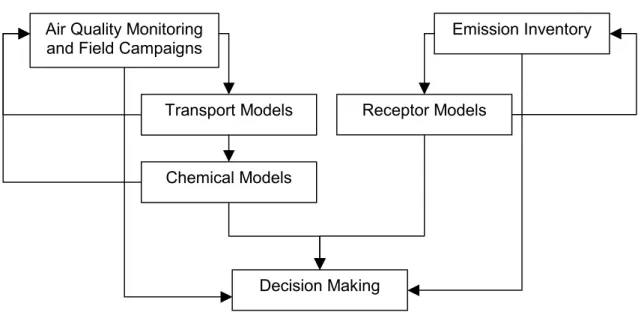
Air pollution models are used by scientists to interpret measurements of air pollutant concentrations, and by governments to support the decision making process in air quality management. Thus, models play a crucial role in the framework of science and air quality management. A representation of information flows between air pollution monitoring, modeling, and decision making is represented in Figure 1.1. Typical ques-tions that are addressed by air quality models are:
• What is the contribution of source A to the concentrations of pollutants at site B? • What is the most cost-effective strategy for reducing pollutant concentrations bellow
an air quality standard?
• What will be the effect on air quality of the addition or the reduction of a specific air pollutant emission flux?
• Where should one place a future source (industrial complex, freeway, etc.) to mini-mize its environmental impacts?
CENICA Project for Air Quality Modeling
Figure 1.1 Air pollution models in the context of decision making. Arrows indicate the flow of information.
1.2 Experience in Monitoring, Emission Inventory and Modeling in Mexico
As illustrated in Figure 1.1, air quality monitoring, emission inventories and modeling go hand in hand in providing decision makers with a base for environmentally sound deci-sions. This section describes the experience that exists in Mexico in these fields. Monitoring
At present, the National System of Air Quality Information (SINAICA) is reporting data in real time on its webpage (http//:sinaica.ine.gob.mx). Monitoring networks of different Mexican cities are included, as those of Mexico City, Guadalajara, Monterrey, Tijuana, Mexicali, Rosarito, Tecate, Salamanca, Puebla, Toluca, Ciudad Juárez and the air quality monitoring station of CENICA located in the southeast of Mexico City. This rich information is used primarily in a descriptive manner, so that there is a need for a pro-found analysis of the air quality network data from different states in the country. Such analysis may include correlations between long-term trends in pollutant concentrations to changes in emissions, or the mid-term response of air quality to actions to prevent or control air pollution such as those included in the air quality programs (PROAIRE’s). Understanding the causes of inter-annual variation in pollutant concentrations requires to distinguish different causes like changes in emissions and meteorological variability. With increasing complexity of the problem, the application of models becomes more necessary.
Measurements of the more specific non-criteria pollutants have been carried out by CENICA, for example PM2.5, volatile organic compounds, and the speciation of par-ticulate matter. Thanks to the first and second phase of the JICA project, CENICA is now becoming a leading research institution in the measurement of air pollution. Through the years, equipment and expertise provided by JICA experts has allowed the performance of projects that have not only generated scientific knowledge but also have been used in the decision making process to improve air quality in Mexico. How-ever, this information has remained mostly on a descriptive level, so that the use of models is a good option to obtain more benefit of the measurement data and expertise in ambient measurements. Therefore, the third phase of the JICA project intends to consolidate the research at CENICA also in applying air pollution simulation models on
Decision Making
Emission Inventory
Receptor Models Transport Models
Air Quality Monitoring and Field Campaigns
CENICA Project for Air Quality Modeling
monitoring data. Furthermore, capacitating CENICA staff is of high importance for con-sulting services that this institution is requested to offer to local and state governments throughout the country.
Emission Inventories
The development of an emission inventory for the Mexico City Metropolitan Area made it possible to quantify the emissions of sources within the Federal District, as well as the State of Mexico. Since 1989, efforts were done to know the volume and type of air pollutant that is produced by every source or sector. Thus, the major contributors were identified, to which priority should be given in emission control. The emission inventory for Mexico City is analyzed every two years.
The first national emission inventory, based on the year 1999, is currently being estab-lished, with the final version being expected for 2005 (see more detailed information on http://www.ine.gob.mx/dgicurg/calaire/lineas/download/info_inem.pdf). It will include emissions of nitrogen oxides, sulfur oxides, volatile organic compounds, carbon monoxide, suspended particles and ammonium from point sources, mobile, area and biogenic sources. Depending on data availability, the resolution will be on the scale of state and municipal.
Modeling
In Mexico there are some groups that model air pollution and meteorological conditions. The most important one is at the National University of Mexico (UNAM), composed of scientists from the Center of Atmospheric Science. They are currently working on dis-persion, meteorological and chemical models. In Annex 4.1, a short resume is included of the different members of this center. In addition, there is a group of people from vari-ous institutions and the Mexico City government, known as CAM (Comisión Ambiental Metropolitana), also working with meteorological models like the MM5 and MEMO. Some efforts have been done at the National Institute of Ecology (INE) with the photo-chemical model MCCM. Data from the different monitoring networks in Mexico have been used to feed various models. The networks are located in Mexico City (Molina & Molina, 2002), in Salamanca, Monterrey and other major urban centers in Mexico. However, there is not a real institutionalized scheme to make decisions on model-based information, in contrast to other countries where models constitute a fundamen-tal element in air quality management. The US-EPA is nowadays using models of sev-eral types in order to support decision making in air quality management. Examples are given on the EPA-website http://www.epa.gov/oar/oaqps/modeling.html. In Canada the same models are used. Also the European Environmental Agency recommends the use of specific models in its Guidance Report on preliminary assessment under EC air quality directives (http://reports.eea.eu.int/TEC11a/en/page011.html).
1.3 Objectives and goals
The proposed project is meant to close the gap between monitoring and decision mak-ing by the use of air pollution models. The principal objective of the project is the forma-tion of human resources in air quality model applicaforma-tion, in order use data from air qual-ity monitoring networks more efficiently, thus contributing to scientific understanding of air pollution and to environmentally sound decision making. Particular objectives are:
(1) Exchange knowledge between government staff and expert modelers on the in-formation needs of air quality management, and solutions that may offer the application of air quality models.
CENICA Project for Air Quality Modeling
(2) Commonly work out responses to specific problems in air quality management by means of applying air quality models on an expert level as well as screening level, thus building capacity within government staff to include air quality models as an element for decision making;
(3) Create a group with experts on modeling activities and government staff trained in model applications, to advise policy makers on how to consider model infor-mation in their decisions, on an institutional and regular.
2 Methods
2.1 Overview
The steps to meet the objectives described above are given in the following:
1a) Realize interviews with experts in air quality modeling and mesoscale circulations in order to prepare the training, to be imparted to government staff.
1b) Synthesize expert views in the framework of a workshop in order to work out the final definition of the training.
1c) Define dates and contents of the training.
1d) Select government staff (technical areas) for participating in the training on air quality models.
2) Impart practical training on the use of models for government staff (DG-CENICA, DG-ICURG, DG-GCA, RETC-SEMARNAT and staff from the three model cities). Workshops which are held after each training module.
3a) Prepare already available input data from Mexico City and the three model cities to be used in the air quality models during the training.
3b) Define necessary measurements to be carried out in order to complete the input data for the air quality models.
3c) Carry out additional measurement in Mexico City and the three model cities. 4) Formalize further collaboration between experts and government staff, which
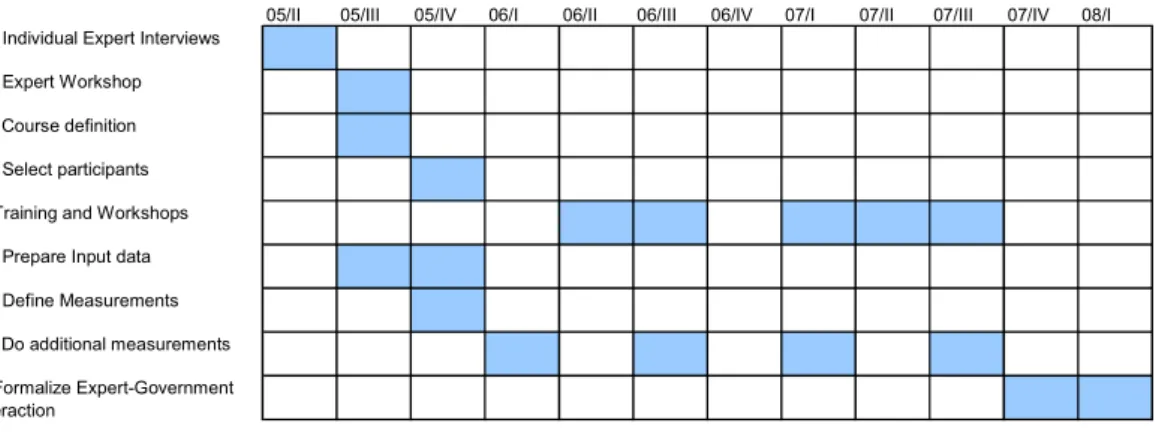
leads to an advisory board supporting federal and local governments in the inter-pretation of model results and the formulation of policies on air quality problems. A preliminary schedule of the activities to be conducted during the project is given in
Table 2.1. A description of each activity is provided in the following sections.
Table 2.1 Schedule of activities
05/II 05/III 05/IV 06/I 06/II 06/III 06/IV 07/I 07/II 07/III 07/IV 08/I
1a) Individual Expert Interviews 1b) Expert Workshop 1c) Course definition 1d) Select participants 2) Training and Workshops 3a) Prepare Input data 3b) Define Measurements 3c) Do additional measurements 4) Formalize Expert-Government Interaction