INVITED PAPER
Special Section on New/Next Generation Photonic Networking and Future NetworksFuture Service Adaptive Access / Aggregation Network Architecture
Hiroki IKEDA†a),Member, Hidetoshi TAKESHITA††,Student Member,andSatoru OKAMOTO††,Fellow
SUMMARY The emergence of new services in the cloud computing era has made smooth service migration an important issue in access net- works. However, different types of equipment are typically used for the different services due to differences in service requirements. This leads to an increase in not only capital expenditures but also operational expendi- tures. Here we propose using a service adaptive approach as a solution to this problem. We analyze the requirements of a future access network in terms of service, network, and node. We discuss available access network technologies including the passive optical network, single star network. Fi- nally, we present a future service adaptive access/aggregation network and its architecture along with a programmable optical line terminal and opti- cal network unit, discuss its benefit, and describe example services that it would support.
key words: optical access network, passive optical network, network ser- vice, network topology
1. Introduction
Fiber to the home (FTTH) service has grown rapidly over the last five years in Japan, and there are now almost 20 mil- lion subscribers [1]. The installation of fiber infrastructures for access networks in Japan is almost completed. The main FTTH providers offer Internet access service and video dis- tribution service. The Internet access service uses a passive optical network (PON) technology, such as Ethernet PON (E-PON) and Gigabit Ethernet PON (GE-PON), which are described in the Institute of Electrical and Electronics En- gineers (IEEE) 802.3ah Specification, Ethernet in the First Mile (EFM) [2], and broadband PON (BPON) and Gigabit- capable PON (GPON), which are described in the Interna- tional Telecommunications Union (ITU) G.984 Recommen- dation [3]. A PON, which is an attractive broadband tech- nology for the last mile, is a point-to-multipoint optical net- work that has no active elements between the optical line terminal (OLT) and the optical network units (ONUs). The advantages of using a PON as an access network include lower fiber deployment cost due to subscribers sharing a fiber line, a wider bandwidth, and lower maintenance cost for the fiber line. The video distribution service uses ra- dio frequency (RF) overlay technology as an alternative to providing a high-definition television (HDTV) video service
Manuscript received July 25, 2011.
Manuscript revised November 7, 2011.
†The author is with Central Research Laboratory, Hitachi Ltd., Kokubunji-shi, 185-8601 Japan.
††The authors are with the Department of Information and Com- puter Science, Faculty of Science and Technology, Keio University, Yokohama-shi, 223-8522 Japan.
a) E-mail: [email protected] DOI: 10.1587/transcom.E95.B.696
Fig. 1 Schematics of current network architectures including ATM, CATV, PON, and mobile backhaul.
over fiber lines [4]. This RF overlay technology enables a service operator to deliver video contents in the same format as a cable TV (CATV) or satellite provider. At the carrier’s local office, a video optical line terminal (V-OLT) is also required to transmit the video content using the 1550-nm wavelength. An optical amplifier boosts the optical video signals, and a wavelength-division multiplexer (WDM) mul- tiplexes the signal over the same fiber line.
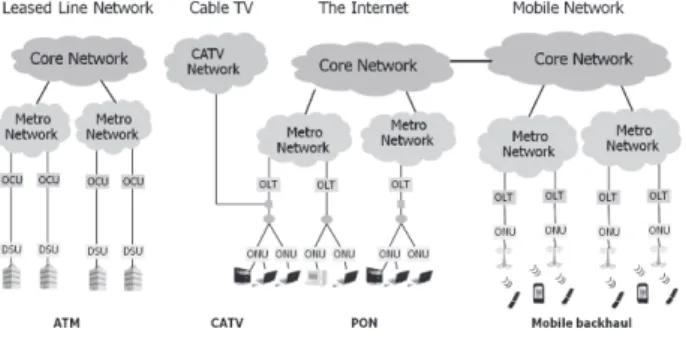
As shown in Fig. 1, a variety of access services are available to subscribers. The asynchronous transfer mode (ATM) is used to provide a unified transport function across services. Since ATM originated in the early 1990’s, ATM equipment is coming to the end of its life due to economi- cal, technical, and/or political reasons. The unified transport function is being shifted to Ethernet and the multi-protocol label switching (MPLS). Both of these technologies are widely used in carrier networks, such as Ethernet-based E- PON/GE-PON for internet access services, in carrier-grade Ethernet for leased line services, in MPLS virtual private networks (VPNs) for VPN services, and in MPLS traffic en- gineering for Internet protocol (IP) backbone services. The MPLS transport profile (MPLS-TP) has recently emerged as a transport technology alternative to ATM [5]. MPLS-TP offers a smooth migration path towards IP-based infrastruc- tures, where development is taking place. Moreover, carri- ers can implement MPLS-TP without having to take current ATM implementations off-line by using a pseudo wire tech- nology [6]–[8]. This is important to carriers from a prof- itability standpoint.
Another paradigm shift in transport technology is Eth- ernet, namely EFM. The idea of using Ethernet as the last- mile (or first-mile in the case of EFM) access technology Copyright c2012 The Institute of Electronics, Information and Communication Engineers
for providing new services to businesses and residences is quickly gaining popularity. For enterprise customers, the chance to do away with conventional E1/T1 access lines and the expensive IP routers that convert IP-over-Ethernet packets to and from IP over time-division multiplexing (TDM) — plus the order-of-magnitude increase in access speeds that Ethernet promises — combine for a very com- pelling solution. The corresponding opportunity for carriers extends beyond simplifying their networks to offering ad- ditional, Ethernet-based services such as toll bypass, voice conferencing, video conferencing, bandwidth-on-demand, and storage.
In mobile networks, the evolution towards long term evolution (LTE) and 4th generation (4G) supporting higher bandwidths for mobile data and video applications is forcing mobile backhauls to adapt to new requirements for access networks. To support these growing bandwidth demands cost efficiently, mobile backhauls are in a transition from synchronized TDM networks to asynchronous Ethernet net- works.
Timing has traditionally been delivered very accurately and reliably over TDM, but Ethernet-based networks do not have an inherent mechanism for providing highly accurate synchronization. There are several approaches to address- ing this challenge, with Precision Time Protocol (PTP) - IEEE 1588v2 [9] currently leading the way. The transmis- sion of clock information over an Ethernet network elimi- nates the need for alternative mechanisms, such as a global positioning system (GPS). The IEEE 1588v2 solution trans- mits dedicated timing packets, which flow along the same paths as the data packets, reducing the cost of synchroniza- tion and simplifying implementation. Since the number of cell sites will increase due to the need for a higher signal- to-noise ratio to support the increase in bandwidth delivered to customers, this cost reduction will be welcome news for operators.
A cloud computing service provider or an application service provider (ASP) providing, for example, a computer- aided design service or a medical/health care service re- quires a high-speed response time for its applications. To reduce the transmission delay time, ASPs attempt to place their data centers (DCs) as close as possible to users. For example, a DC might be placed on a floor in a building in an urban area. This type of DC is called a micro-DC to dis- tinguish it from the conventional giant DC. Micro-DCs are connected to the access network.
A smart grid for automated metering infrastructure (AMI) application also needs to meet different requirement.
For example, active demand response and emergency load management require higher reliability and lower latency as an integrated system than they do as stand-alone systems.
The services now emerging and growing include real- time enhanced reality, video-conferencing, on-line gaming, on-the-map positioning, and cloud storage. The number of these services is growing exponentially thanks to the latest generation of multimedia-ready devices like smart phones, tablet personal computers (PCs), personal digital assistants
(PDAs) and handheld game consoles. The increasing num- ber of services translates into an increase in the number of access sites. Therefore, capital expenditures (CapEx) and operational expenditures (OpEx) are increasing [10], [11].
To reduce the number of access sites, it is necessary to implement long reach access and to increase the number of users per site. Long-reach PON (LR-PON) technology, which supports the migration of metro networks and access networks into a long-reach access network, simplifies the network and reduces CapEx and OpEx [10], [11]. The ac- cess line topology for the Internet service and video distri- bution service using FTTH is passive double star (PDS), as shown in Fig. 1, which reduces cost. The leased line and mo- bile backhaul use a single star (SS) topology because of their different requirements such as various qualities of services (QoS), different transmission/transport frame, and different bandwidth guarantee.
The rest of the paper is organized as follows. In Sect. 2, detailed requirements for future access networks are dis- cussed. Section 3 provides current solution candidates for requirements. Section 4 describes our proposed service adaptive network architecture. Finally, Sect. 5 summarizes the key points.
2. Requirements for Future Access Networks
2.1 Service Requirements
Conventional access services including Internet access and video on demand have specific requirements and use a ded- icated network consisting of a core network, a metro net- work, and an access network that meets their requirements.
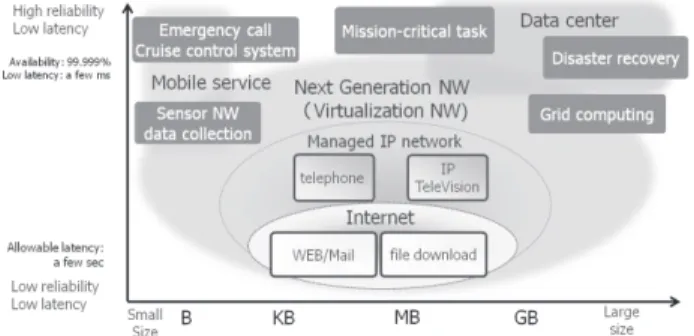
Future access networks should support both conventional and new services as shown in Fig. 2. New access services, such as micro-DC service, mobile backhaul service, leased line and machine-to-machine (M2M) service, need addi- tional requirements.
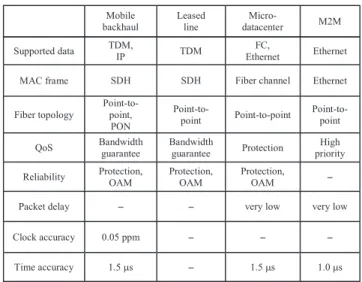
Table 1 summarizes the technical requirements for four types of service. A leased line service and a micro-DC ser- vice require high reliably and managed transmission. To en- hance the reliability, operation, administration, and mainte- nance (OAM) techniques and protection techniques should be implemented. Since legacy synchronous digital hier- archy (SDH) and ATM leased line service equipment are
Fig. 2 Application reliability as function of data size.
Table 1 Technical requirements for four types of new services.
now being replaced with MPLS-TP equipment, future ac- cess networks require high transmission quality and high availability, equivalent to those of MPLS-TP core transport networks.
A micro-DC network requires low latency and time synchronization. Fiber channel (FC) networks are currently used to connect servers and back-end storage systems in micro-DC environments. In addition, micro-DC network requires high reliability, meaning that it needs a protection mechanism.
A mobile backhaul service requires time synchroniza- tion across devices, high availability transmission (i.e., pro- tection), and time distribution to client devices. As de- scribed in Sect. 1, mobile backhauls are in a transition from synchronized TDM networks to asynchronous Ethernet net- works. Therefore, future access networks should support tree-like user and time distribution technologies, which is described in IEEE 1588v2 solution and synchronous Ether- net [12], to accommodate the growing number of users.
M2M is a new development in telecommunication en- vironments, and M2M services require low latency and high QoS. In an M2M service, a communication device is con- nected directly to a network without a user interface or user interaction. M2M services are expected to expand rapidly and to generate significant revenues for operators because the traffic carried will be considered valuable. Therefore fu- ture access networks should support QoS technology.
2.2 Network Requirements
Because the number of ONUs is increasing, it is necessary to implement long reach access and to increase the num- ber of users per site in order to reduce CapEx [11], power usage [13], and operational and management costs. CapEx and power usage reduction requires simplifying the network structure. An aggregation network has been introduced for aggregating the user traffic and/or service networks of each service into a single access/aggregation network [13]. Tech-
nologies supporting effective aggregation will be needed to accommodate ONUs in a wide area. Therefore, it is neces- sary to extend multipoint-to-point control (MPCP).
The peak transmission rate per user in an access net- work is at least 1 Gb/s, and the committed data rate is above 0.3 Gb/s [11]. However, a future access network requires a much greater access reach (up to 100 km) and a larger number of customers per fiber (e.g., 1024) [11] than cur- rent access network. The National Institute of Informa- tion and Communication Technologies (NICT) in Japan has started the AKARI Project [14] to develop a new genera- tion network (NWGN). In the AKARI project, a new ac- cess network architecture has been proposed that will sup- port NWGN requirements in 2015 to 2020 [15]. For the NWGN, 10-Gb/s for each user and QoS support for each service are required. Meeting these requirements requires several 10-Gb/s to Tb/s order transmission in one fiber and real-time packet buffer processing. Technologies support- ing high speed and long reach transmission will be needed to accommodate ONUs in a wide area. Therefore, it is nec- essary to extend access reach by using new access network technologies.
The topologies for access networks vary depending on the primary purpose of the network, so they are heteroge- neous. For instance, SS topologies, which can be considered a point-to-point link, are bandwidth inefficient and achieve low yield in terms of users served in comparison to active and passive double star (ADS/PDS) networks. However, since SS topologies serve a business niche, e.g., leased lines, SS and ADS/PDS topologies must be supported.
2.3 Node Requirements
As the processing speed of terminals increases, higher band- width connections are needed. Specialized equipment and optical fiber are thus been installed for each new service.
This makes the deployment and provisioning of new ser- vices a lengthy and costly process. The service migration of access networks can be made more cost effective by im- proving the availability of hardware and by avoiding dou- ble investment in the optical fiber infrastructure. To sim- plify operations, carriers are looking for ways to build ac- cess networks over a single infrastructure that will scale to meet these diverse services while maintaining security, ser- vice levels, and reliability.
A QoS is needed for M2M and leased line services. To meet the QoS requirements for a variety of services provided in different physical topologies, a new media access control (MAC) frame and multi-point control protocol (MPCP) are needed that can simultaneously handle Ethernet, MPLS, and FC frames while maintaining their QoS peculiarities. Mul- tiple service level agreements (SLAs) with different QoS re- quirements need to be considered. The QoS is also affecting the dynamic bandwidth assignment mechanism in the access networks as well as implementation of time synchronization in the backhaul networks.
In DC environments, FC over Ethernet technology will
Table 2 Requirements for future access/aggregation networks.
be used to share network links. A network-based time syn- chronization technology will be used underground, in of- fices, in factories, and in locations where GPS radio wave signals cannot reach or the cost of GPS receivers cannot be sustained to support business applications that require time synchronization. As M2M services require low latency as well, future access networks should support low latency and time synchronization technology.
2.4 Future Access Network Requirements
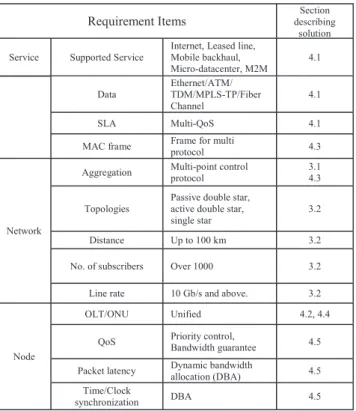
Table 2 summarizes the service, network, and node require- ments for future access/aggregation networks mentioned above. Future networks need to meet these requirements.
We will discuss solutions to these requirements in Sects. 3 and 4. The sections describing solutions are shown in Ta- ble 2.
3. Technology Trend for Access Network
In this section, we describe available technology trend and candidate solutions for some of the network requirements listed in Table 2. They include current and future optical access network technologies.
3.1 Current Optical Access Network Technologies A PON is a point-to-multipoint network consisting of an OLT and multiple ONUs in a tree topology. The OLT is located in the central office, connected to a metro area net- work or a backbone/core network. The ONUs are located
Fig. 3 IEEE and ITU-T TDMA-PON standardization road maps.
on subscribers’ premises.
Commercial PONs use time division multiple access (TDMA), which is cost effective for access networks. For the upstream TDMA, the ONUs share the upstream capac- ity and transmit data to the OLT. For the downstream TDM, the OLT broadcasts data to all ONUs, which share the down- stream capacity, and then the destination ONU extracts the data on basis of the PON link identifier (ID), such as the port ID of the GPON or the logical link ID of the GE-PON.
The logical connection between the OLT and each ONU is point-to-point.
TDMA-PON standards have been evolving under two different umbrella organizations, the ITU and the IEEE. The PON standardization road maps are both shown in Fig. 3.
Each organization has been presenting over the last decade different sets of recommendations and standards. However, they are now facing a technological challenge: TDMA- based systems have apparently reached a threshold in terms of cost vs. performance. Hence, new technologies are being proposed to maintain control of the cost of the electronics while maximizing the available optical bandwidth.
MPCP is defined to provide bandwidth assignment and auto discovery in IEEE 802.3ah [2]. The bandwidth assign- ment mechanism relies on grant and request message. The auto discovery is used to detect newly connected ONUs.
3.2 Future Optical Access/Metro Network Technologies 3.2.1 Network Topology Technologies
Here we discuss future network topology technologies that use current TDMA- and WDM-PONs.
a) ADS/PON approach
Since WDM-PONs assign one wavelength to each ONU, they meet service requirements from a technical per- spective. However, from the economic point of view, a WDM-PON is not cost effective because a user who does not require a large bandwidth still consumes the entire band- width.
One way to solve this problem is to share one wave- length among ONUs to provide a TDMA-PON and to use
the other wavelengths as WDM-PON [15]. With this ap- proach, a 10 to 20 km range can be covered.
b) SS approach
A WDM-PON basically assigns one wavelength to each user. With an SS approach, one wavelength is assigned to each service. This results in a flexible transmission rate and bandwidth for each user. This is because an SS approach provides a dedicated fiber for each user. If a user requests a shared access service, a PON is emulated in the OLT. The SS approach enables bandwidth to be shared in the optical domain by using optical couplers or in the electrical domain by using a layer two switch.
Miyazawa reported new architectures for optical access networks [15], but their cost effectiveness in comparison to a WDM-PON was not mentioned. Cost reduction with the SS approach is the most important factor in achieving the NWGN access network.
3.2.2 Network Architecture Technologies
Network architecture technologies include TDMA-PON, WDM-PON, optical orthogonal frequency division multiple access (OFDMA)-PON, optical code division multiplexing (OCDM)-PON, and coherent WDM-PON.
TDMA-PONs have been widely deployed because they contribute to cost-effective high-speed access systems.
However, a pure TDMA-PON is not sufficiently scalable in terms of reach, user count, and per-user data rate mainly due to the increased cost of the electronics beyond 10 Gb/s.
Several candidate technologies for future access networks are thus now being investigated. They include WDM- PON, OFDMA-PON, OCDM-PON, coherent WDM-PON, and hybrid systems combining two or more of these tech- nologies. Their benefits and drawbacks are briefly discussed below.
WDM-PON [16] reduces the number of fibers through the use of wavelength multiplexes, provides a guaranteed bandwidth for each user, has a long reach due to opti- cal amplification, and ensures security and privacy with wavelength per user. However, it creates ONU inven- tory and OAM complexities and is less cost-effective when ONU with colorless sources is used (widely tunable lasers, wavelength-seeded reflective semiconductor optical ampli- fier (SOA), etc.).
OFDMA-PON provides higher capacity with spectral efficiency using many narrow-band orthogonal subcarriers than TDMA-PONs and WDM-PONs, has a long reach with high linear dispersion tolerance, supports dynamic band- width allocation with subcarriers, and has a flexible modula- tion format (analog or digital) with orthogonal subcarriers.
To date, it has been demonstrated to support 40-Gb/s trans- mission over 20 km with a 1:32 optical split [17]. However, for the achievement of 100-Gb/s, 100-km transmission re- quires the development of an ultra-high-speed digital analog converter (DAC), an analog digital converter (ADC), and a high-performance digital signal processor (DSP).
OCDM-PON is based on the well-established spread
spectrum technique in microwave communications. It pro- vides data confidentiality and privacy by using a unique op- tical code, has low latency, provides a guaranteed bandwidth for each unique user code, and operates asynchronously [16]. However, OCDM-PONs are still too complex for prac- tical use as they require unconventional optical devices and inline optical dispersion compensation [16]. An OCDM- PON has been demonstrated to support full-duplex, asyn- chronous, 10-Gb/s transmission over 50 km [18].
A coherent WDM-PON has been field tested in a 2.5- Gb/s coherent link over 68 km [16]. They are still cost inef- fective due to the use of digital coherent receivers based on advanced DSP and the use of silicon photonics integration of the single ONU and OLT optical components.
To enable the access reach to be extended in a cost- effective manner, optical amplifiers are being developed.
Candidate devices are the erbium-doped fiber amplifier (EDFA), SOA, and distributed Raman amplifier (DRA) [16].
3.3 Time/Clock Synchronization Technologies
Time/clock synchronization is essential for reliable services at the different layers in networks, from the physical layer to the application layer. As mentioned in Sect. 1, although GPS technology can be used to distribute this information with a high level of accuracy, logistic and cost issues generally restrain network designers from using it widely. Instead, GPS signals are received at a node or server high in the net- work hierarchy, and the information extracted is distributed throughout the network. Table 3 summarizes the proper- ties of four commonly used time and clock synchronization technologies; the network time protocol (NTP), GPS, IEEE 1588, and the synchronous Ethernet.
With IEEE 1588v2, the slave clock on each network device is synchronized with the system grandmaster clock.
Traffic time-stamping is used to achieve the high accuracy synchronization needed to ensure the stability of the base station frequency and of the handovers in wireless networks.
The timestamps between the master and slave devices utilize specific PTP packets.
Synchronization is achieved using two procedures. The first procedure is to run the slave clock at the same fre- quency as the master clock. The second procedure is to
Table 3 Properties of commonly used time and frequency synchronization technologies.
run the slave clock at the same time of day as the mas- ter clock. IEEE1588-2008 [9] defines two clock types for network nodes: boundary clock (BC) and transparent clock (TC). A BC behaves as a master and a slave. It synchro- nizes the slave clock with the adjacent master clock via one port and synchronizes the other slave clocks via the other ports. A TC does not need to synchronize with an adjacent clock; instead, it measures the residence time of PTP event messages such as sync and delay requests.
One of the challenges when applying IEEE1588v2 to a PON is determining how to deliver IEEE1588v2 signaling.
An ad hoc group within the IEEE P1904.1 working group [20] addressed this challenge but was unable to make a de- termination because it exceeded the scope of its mandate due to the implementation dependency.
4. Future Network Architecture
In this section, we propose network solution for the require- ments shown in Table 2. We describe a future service adap- tive access/aggregation network and its architecture along with the OLT design. The protocol and services supported are also discussed. Service adaptive means that the proposed network accommodates various kinds of services with uni- fied architecture.
4.1 Future Service Adaptive Access/Aggregation Network (SAAN)
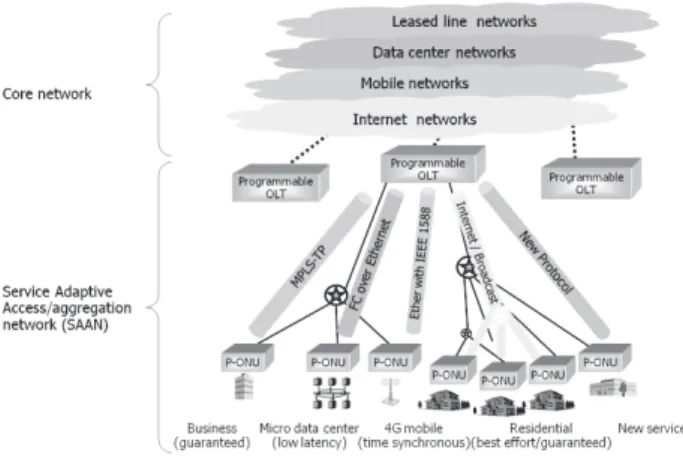
An overview of a future network, from the common core network to the proposed future access/aggregation net- works, is shown in Fig. 4. The core network is heteroge- neously composed of leased line networks, DC networks, mobile networks, and Internet backbone networks. Despite their differences, these networks have a feature in common that affects the design of the overall network: they are all highly bandwidth intensive. MPLS-TP is currently the lead- ing candidate for use as the common core network transport protocol.
The future access/aggregation network accommodates
Fig. 4 Future service adaptive access/aggregation network (SAAN).
all services by using adaptation technologies. Each of these service networks operates under different premises and within certain parameters, and the traffic they carry may have different data frames and types, protocols, and require- ments. The data frames include but are not limited to MPLS- TP, Ethernet, FC, IEEE 1588 (v1 and v2), and ATM. One approach to unifying services with different requirements on the same platform is to have them share the physical fiber network and hardware. Services can be unified not only in the physical layer, which consists of the basic hard- ware transmission technologies, but also in the data link layer, which provides the functional and procedural means to transfer data between network nodes.
To accommodate all services in the access network, an adaptation function is required. This function will be ap- plied to deeply service optimized access network technol- ogy. We propose a service adaptive access/aggregation net- work (SAAN). The SAAN provides an adaptation function for service accommodation and a traffic aggregation func- tion for traffic grooming. SAAN consists of a programmable (P-OLT), programmable ONUs (P-ONUs), and optical fiber with various topologies, including ADS, PDS, and SS, link- ing the core network with the end-users. The P-OLT is able to support a variety of services, meaning that the SAAN transparently conveys the traffic while maintaining the spe- cific features of each traffic type.
Using a programmable OLT and programmable ONUs has several benefits:
• Resource utilization is improved because virtual re- sources are reserved to meet service requirements as necessary.
• Service migration is smoother because virtual re- sources are configured for service deployment without installing additional equipment.
• Installation costs are reduced because the logical OLTs (L-OLTs) and logical ONUs (L-ONUs) can be config- ured remotely.
The P-OLT bridges the core network with the P-ONUs.
The ONUs must be reconfigurable so that they can support not only existing services but also new services. Further- more, they must be reconfigurable regardless of the topol- ogy (e.g., ADS, PDS, and SS). The wide variety of traffic types to be transmitted requires the development of a new MAC frame for the SAAN; this raises other technical is- sues regarding, for example, the discovery of new ONUs and the bandwidth allocation technology used to achieve low la- tency. In addition, legacy equipment compatibility must be considered and supported, both at the physical layer and at the management layer. The required technologies will be discussed in the following subsections.
4.2 OLT and ONU Architecture
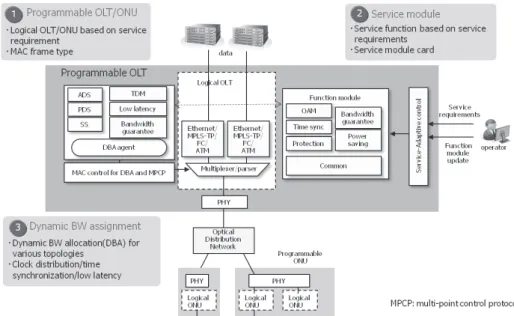
The basic logical architecture of a programmable OLT is shown in Fig. 5. An OLT must be able to provide different service modules and be able to operate the module speci-
Fig. 5 Architecture of SAAN with programmable OLT and ONUs.
fied by the system operator in a static or dynamic matter.
The services include OAM, protection, time synchroniza- tion, bandwidth guarantee, low latency, and even power sav- ing. The physical layer may operate using Ethernet, MPLS- TP, ATM, or FC on a common physical layer device (PHY).
Since current developments on PON systems in terms of available bandwidth are blurring the boundary between op- tical transport and traffic distribution at the access point, the SAAN must natively support such technologies if services and applications at the end point are to operate correctly.
Figure 6 shows how the programmable OLT and ONUs are configured in accordance with the topology of the optical distribution network (ODN), that is, on the basis of which topology is used: ADS, PDS, or SS (an active network, a passive network, or a point-to-point link). A dynamic band- width allocation (DBA) method that is suitable for the topol- ogy is selected.
Figure 7 shows the basic layered architecture of the SAAN. The adaptation layer between the service layer and MAC layer enables a variety of services to be provided. The service adaptation layer selects the most suitable MAC pro- tocol for each service to operate over the ODN. This layer stack can be implemented only in reconfigurable systems.
This physical layer implementation plays a key role in the SAAN. Because MAC is provided using TDM, WDM, OFDM, or OCDM, services can be allocated more effi- ciently by increasing the granularity at which the optical bandwidth is accessed.
4.3 Programmable OLT and ONU
The use of a programmable OLT and programmable ONUs enables various services to be provided by a single device, without installing additional equipment, as shown in Fig. 5.
The programmable OLT can configure multiple L-OLTs
Fig. 6 Configuration scenarios corresponding to (a) ADS, (b) PDS, and (c) SS topologies.
Fig. 7 Basic layered architecture between OLT and ONU.
within the one physical OLT. They are configured using software/firmware re-install or update. Each programmable
ONU can configure multiple L-ONUs within one physical ONU. Each L-ONU would be used for a different service.
For example, one L-ONU could accommodate an FTTH terminal and another could accommodate a femto base sta- tion. In practice, services such as FTTH that use a low-end type ONU would not need a programmable ONU function.
Therefore, the programmable OLT must be compatible with non-programmable ONUs.
The programmable OLT receives the required ODN topology and service requirement parameters from the net- work management system via the service adaptive function.
It then selects the most suitable type of DBA and the re- quired function modules. The L-OLT and L-ONU configure the data link function, thereby enabling a variety of service- dependent MAC frames to be capsulated in an SAAN frame for transport.
The programmability and reconfigurability of the OLT and ONU depend not on dedicated access to a physical medium but on the service layers of the system. The ben- efit for carriers is reduced installation time, which reduces operation expenses. The benefit for manufacturers is that they can produce a larger number of the same type of ONU even though they are to be used for different services, which reduces ONU cost. However the cost merit for pro- grammable technologies is important issues For example, the cost-effective development of programmable OLTs and ONUs is thus a major challenge.
4.4 MAC Frame and MPCP for SAAN
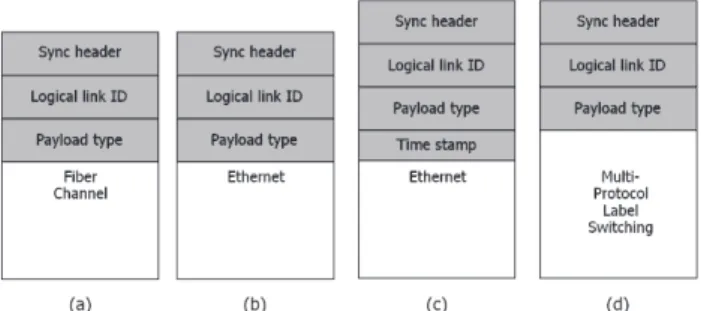
Various possible structures for the proposed MAC frame for the SAAN are shown in Fig. 8. The MAC frame can accom- modate various types of data frames (FC, Ethernet, MPLS- TP, etc.) and provide multi-level QoS service or even best- effort service. It can take various components, including a sync header, a logical link ID, a time stamp, and the payload type. The sync header is used to determine the timing of the clock synchronization. The logical link ID is used to con- nect between an L-OLT and an L-ONU. The payload type is used to specify the type of SAAN frame (data, OAM, etc.).
A new MPCP is required to coordinate virtual multipoint-to-point upstream traffic in any topology because a programmable ONU has multiple L-ONUs. In addition, in the ADS case shown in Fig. 6(a), an MPCP coordina-
Fig. 8 Examples structures for MAC frame: (a) FC frame, (b) Ethernet frame, (c) Ethernet frame with time stamp, (d) MPLS-TP packet.
tion mechanism with an optical switch (OSW) for upstream and downstream traffic is required because of the required switching scheduling of the OSW in the downstream and upstream directions.
An OAM function is required in the domain of an L- OLT/L-ONU although the discovery function of the PON system can be used as an alternative to the OAM function.
In this scenario, GATE/REPORT messages, which are MAC control frames in MPCP, are sent periodically between the L-OLT and the L-ONUs. They are used as alarm indica- tion signals, remote defect indications, continuity checks, fault detections, and loop back tests. Performance monitor- ing functions will hence be needed to monitor parameters directly derived from physical impairments, such as the bit error rate (BER), or generated by the network, such as la- tency and jitter. Performance monitoring plays a key role in detecting probable causes of changes in the QoS and, even- tually, in detecting the inducing sources. It is also impor- tant for service allocation. Performance monitoring will be implemented in various ways, including delay testing and insertion loss measurement.
4.5 Multi-QoS Support
Current PON technologies can provide bandwidth control and traffic prioritization. However, a new mechanism op- erating on top of the PON system must be implemented to support requests for low jitter and low-latency features.
These features are extremely important when implementing backhaul mobile solutions, in which synchronization plays a key role. For the proposed SAAN, the DBA module needs to be reengineered to enable coordination mechanisms to handle multiple QoS levels, such as the ones specified for MPLS-TP, ATM, and PON. It also needs to be able to co- ordinate with protocols operating at higher layers, such as IEEE 1588, to ensure proper operation of the network.
As can be seen Figs. 5 and 6, the DBA module has sev- eral functions:
• time slot assignment for each L-ONU (both upstream and downstream) to meet requirements for each ser- vice;
• coordination with function modules including time synchronization and protection modules;
• control of topology information (ADS, PDS, SS, etc.);
• andextraction of QoS information from incoming MAC frames.
An example of multi-QoS assignment to L-ONUs is shown in Fig. 9. For a low-latency TDM service (L-ONU
#1), a time slot can be assigned in a short cycle; but this consumes much bandwidth because of the high frame over- head. For a low-latency service (not TDM) (L-ONU #2), a time slot can be assigned to reduce latency. For a best- effort service (L-ONU #3), an unoccupied time slot can be assigned to consume as much unused bandwidth as possi- ble. Therefore, the development of a suitable DBA module
for SAAN is a major challenge.
4.6 SAAN Application Examples
The SAAN is an open architecture network characterized by the reconfigurability of its OLTs and ONUs, enabling it to adapt to different network scenarios and technical require- ments.
The programmable OLTs comprise a hardware side containing optical transmitters and receivers and a software reconfigurable set of functions and protocols. This indepen- dence between hardware and software not only has many technical benefits but also provides CapEx and OpEx reduc- tion. For example, the OLTs and ONUs can be reconfigured remotely instead of locally.
An example mobile backhaul application of SAAN is shown in Fig. 10(a). Since the access line topology is PDS, DBA with PDS is selected. The OAM and time synchro- nization function modules are selected on the basis of the requirements of the mobile backhaul.
The L-OLT transfers user data to the L-ONU cooperat- ing with QoS messages in MPLS-TP. The L-OLT transfers a time-stamped PTP frame to the L-ONU, and the L-ONU synchronizes its clock with that of the base station.
Fig. 9 Example multi-QoS assignment to L-ONUs.
Fig. 10 Example applications of SAAN: (a) mobile backhaul, (b) micro- DC.
A micro-DC application of SAAN is shown in Fig. 10(b). Since the access line topology is ADS, DBA with ADS is selected. A protection function module and a DBA module with low latency are selected on the basis of the re- quirements of the micro-DC. In micro-DC applications, ser- vice must be continued by using a protection function even if a failure occurs. Low latencies for user service requests are achieved by using DBA for the low-latency function block.
5. Conclusion
The requirements for a future access network were dis- cussed, and the proposed future SAAN and its architec- ture were described. The programmable OLT and the pro- grammable ONUs it uses were also described, and the re- quired technologies and services supported were discussed.
The SAAN can accommodate various services with different requirements and provided using different topolo- gies with sharing of network resources. Also discussed were the need for a new media access control frame and a new multi-point control protocol for the SAAN.
The SAAN provides several benefits. Virtual resources to meet service requirements are reserved as necessary, which improves resource utilization. Virtual resources are configured for service deployment without the need to in- stall additional equipment, resulting in smooth service mi- gration. The logical OLTs and logical ONUs can be config- ured remotely, which reduces installation costs.
Application examples were presented to demonstrate the potential use of the SAAN in practical situations. The function modules can be chosen and updated by software as necessary.
Acknowledgments
The authors thank Prof. Naoaki Yamanaka for his insightful
comments and stimulating suggestions.
References
[1] Ministry of Internal Affairs and Communications Japan, “The num- ber of broadband subscribers,” Dec. 2010.
[2] IEEE 802.3ah, “Ethernet in the First Mile,” June 2004.
[3] ITU-T Recommendation G.984, “Gigabit-capable passive optical networks (G-PON): General characteristics,” March 2003.
[4] H. Shinohara, “Broadband access in Japan: Rapidly growing FTTH market,” IEEE Commun. Mag., vol.43, no.9, pp.72–78, Sept. 2005.
[5] R. Winter, “The coming of age of MPLS,” IEEE Commun. Mag., vol.49, no.4, pp.78–81, April 2011.
[6] S. Bryant and P. Pate, ed., “Pseudo wire emulation edge-to-edge (PWE3) architecture,” IETF RFC3985, March 2005.
[7] L. Martini, J. Jayakumar, M. Bocci, N. El-Aawar, J. Brayley, and G. Koleyni, “Encapsulation methods for transport of asynchronous transfer mode (ATM) over MPLS networks,” IETF RFC4717, Dec.
2006.
[8] ITU-T Recommendation Y.1411, “ATM-MPLS network interwork- ing — Cell mode user plane interworking,” Feb. 2003.
[9] “1588-2008 IEEE standard for a precision clock synchronization protocol for networked measurement and control systems,” July 2008.
[10] H. Song, B. Kim, and B. Mukherjee, “Long-reach optical access net- works: A survey of research challenges, demonstrations, and band- width assignment mechanisms,” IEEE Commun. Surveys & Tutori- als, vol.12, no.1, pp.112–123, First Quarter 2010.
[11] D. Breuer, F. Geilhardt, R. H¨ulsermann, M. Kind, C. Lange, T.
Monath, and E. Weis, “Opportunities for next-generation optical ac- cess,” IEEE Commun. Mag., vol.49, no.2, pp.s16–s24, Feb. 2011.
[12] ITU-T Recommendation G.8262, “Timing characteristics of a syn- chronous Ethernet equipment slave clock,” July 2010.
[13] H. Takeshita, D. Ishii, S. Okamoto, E. Oki, and N. Yamanaka,
“Highly energy efficient Layer-3 network architecture based on ser- vice cloud and optical aggregation network,” IEICE Trans. Com- mun., vol.E94-B, no.4, pp.894–903, April 2011.
[14] “‘AKARI’ Architecture Design Project for New Generation Net- work,” http://akari-project.nict.go.jp/eng/index2.htm
[15] T. Miyazawa and H. Harai, “Optical access architecture designs based on WDM-direct toward new generation networks,” IEICE Trans. Commun., vol.E93-B, no.2, pp.236–245, Feb. 2010.
[16] E. Wong, “Current and next-generation broadband access technolo- gies,” OFC/NFOEC 2011, NMD1, Los Angeles, USA, March 2011.
[17] N. Cvijetic, N. Prasad, D. Quan, J. Howard, and T. Wang,
“Computationally-efficient DSP-based MIMO equalization for OSNR gains in 40 Gb/s OFDMA-PON,” OFC/NFOEC 2011, OTuK6, Los Angeles, USA, March 2011.
[18] N. Kataoka, N. Wada, X. Wang, G. Cincotti, and K. Kitayama,
“10 Gbps-Class, bandwidth-symmetric, OCDM-PON system using hybrid multi-port and SSFBG en/decoder,” ONDM 2010, 5-2, pp.1–
4, Kyoto, Japan, Feb. 2010.
[19] D.L. Mills, “Network time protocol (Version 3) specification, imple- mentation and analysis,” IETF RFC1305, March 1992.
[20] IEEE P1904.1 Working Group Standard for Service Inter- operability in Ethernet Passive Optical Networks (SIEPON), http://www.ieee1904.org/1/
Hiroki Ikeda received B.S., M.S. and Ph.D.
degrees in communication engineering from Osaka University in 1993, 1995 and 2009. From 1995 to 1999, he worked in Hitachi Ltd. Central Research Laboratory, studying optical transmis- sion systems. From 1999 to 2002, he worked in Hitachi America’s Network System Research Laboratory, studying optical cross-connect net- works. From 2003 to 2006, he worked at Hi- tachi (China) Research and Development Inc.
in Beijing, studying future optical access net- works. Since 2006, he has been working at Hitachi’s Central Research Laboratory, studying optical access network. He served as an editor on the IEICE’s technical committee on communication system (CS) from 2009 to 2011.
Hidetoshi Takeshita graduated from Shizu- oka University, Japan, where he received a B.E.
in electrical engineering. In 1974 he joined NEC Corporation, Tokyo, Japan, where he worked on the development of electronic switching sys- tems, digital switching systems, and the system engineering for fixed and mobile carriers. Since 2009, he has been investigating high-energy effi- cient network architectures. Since 2010, he has served as a research assistant for Global COE Program “High-Level Global Cooperation for Leading-edge Platform on Access Spaces” of the Ministry of Education, Culture, Sports, Science, and Technology, Japan. He is an IEEE student member.
Satoru Okamoto received B.E., M.E. and Ph.D. degrees in electronics engineering from Hokkaido University, Hokkaido, Japan, in 1986, 1988 and 1994. In 1988, he joined Nippon Tele- graph and Telephone Corporation (NTT), Japan, where he conducted research on ATM cross- connect system architectures, photonic switch- ing systems, and optical path network archi- tectures and participated in the development of GMPLS-controlled HIKARI router (“photonic MPLS router”) systems. He has led several GMPLS-related interoperability trials in Japan, such as the Photonic In- ternet Lab (PIL) and the Optical Internetworking Forum (OIF) Worldwide Interoperability Demo. Since 2006, he has been an associate professor at Keio University. He is a vice co-chair of the Interoperability Work- ing Group of the Kei-han-na Info-communication Open Laboratory. He is now promoting several research projects related to photonic networks.
He was the chair of the Technical Committee on Photonic Network (PN).
He received the Young Researchers’ Award in 1995 and the Achievement Award in 2000. He has also received the IEICE/IEEE HPSR2002 Outstand- ing Paper Award, the Certification of Appreciation ISOCORE and PIL in 2008, and the IEICE Communications Society Best Paper Award and IEEE ISAS2011 Best Paper Award in 2011. He is an associate editor of OSA Optics Express and was associate editor of IEICE Transactions. He is an IEEE Senior Member.