TRUNCATED BARSOTTI-TATE GROUP SCHEMES
YUICHIRO HOSHI OCTOBER 2008
Abstract. The purpose of the present paper is to show that mor- phisms between the generic fibers of truncated Barsotti-Tate group schemes over mixed characteristic complete discrete valuation rings with perfect residue fields extend in a “tame-blind” fashion — i.e., under a condition which is unaffected by passing to a tame exten- sion — to morphisms between the original truncated Barsotti-Tate group schemes. The “tame-blindness” of our extension result al- lows one to verify the analogue of a result of Tate for isogenies of Barsotti-Tate groups over the ring of integers of the p-adic com- pletion of the maximal tamely ramified extension field.
Contents
0. Introduction 1
1. Discriminants and cotangent spaces 7
2. Review of truncated p-adic Hodge theory 10
3. Proof of the main theorem 15
References 26
0. Introduction
The purpose of the present paper is to show that morphisms between the generic fibers of truncated Barsotti-Tate group schemes over mixed characteristic complete discrete valuation rings with perfect residue fields extend in a “tame-blind” fashion — i.e., under a condition which is unaffected by passing to a tame extension — to morphisms between the original truncated Barsotti-Tate group schemes.
Throughout this paper, let R be a complete discrete valuation ring, k the residue field of R, K the field of fractions of R, K an algebraic closure of K, ΓK def= Gal(K/K), and vp the valuation of K such that vp(p) = 1. Assume, moreover, thatK is of characteristic 0, andk is of characteristic p > 0 and perfect. Let eK be the absolute ramification index of K.
By a result of Tate obtained in [11], for (p-)Barsotti-Tate groups (i.e., p-divisible groups) G, H over R, every Zp[ΓK]-equivariant morphism
1
Tp(G)→Tp(H) ofp-adic Tate modules arises from a morphismG → H of Barsotti-Tate groups over R (cf. [11], Theorem 4). Now one can consider the question of whether or not such a result can be generalized to finite level, i.e., whether or not for finite flat commutative group schemesG,H overR, any morphismG⊗RK →H⊗RK of the generic fibers extends to a morphism G → H of the original group schemes over R. For instance, a result of Raynaud obtained in [9] yields an affirmative answer to this question ifeK < p−1 (cf. [9], Corollaire 3.3.6, 1). On the other hand, one verifies immediately that this extension question cannot be resolved in the affirmative without some further assumption. Indeed, let K be the finite extension field of the field Qp of p-adic rational numbers obtained by adjoining a primitive p- th root of unity to Qp, G the kernel µp of the endomorphism of the multiplicative group scheme Gm over R given by raising to the p-th power, and H the constant group scheme Z/(p) of order p over R.
Then it is easily verified that although there exists an isomorphism µp⊗RK →∼ Z/(p)⊗RK of group schemes overK, there isnonontrivial morphism of group schemes overR fromµp toZ/(p) ifp≥3.
In the present paper, we consider the following “Extension Problem”:
(Extension Problem) :Find a sufficient condition for a morphism between the generic fibers of finite flat com- mutative group schemes overR to extend to a morphism between the original group schemes over R.
In particular, in the present paper, we consider the following “Tame- blind Extension Problem”:
(Tame-blind Extension Problem) : Find a suffi- cient condition which depends only onvp(eK)for a mor- phism between the generic fibers of finite flat commu- tative group schemes over R to extend to a morphism between the original group schemes over R.
Our main result yields a solution to this “Tame-blind Extension Problem” in the case where the morphisms in question are morphisms of truncated Barsotti-Tate group schemes (cf. Theorem 3.4):
Theorem 0.1. LetG, H be truncated(p-)Barsotti-Tate group schemes over R, fK: G⊗RK → H ⊗RK a morphism of group schemes over K, n a natural number, and ²FonK def= 2 + vp(eK) (cf. the expression
“vp(DR/W(k))+1/(p−1)” in the statement of[2], Colloraire to Th´eor`eme 3). Assume that one of the following conditions is satisfied:
(i) The cokernel of the morphism G(K) → H(K) determined by fK is annihilated by pn, and 4²FonK +n ≤lv(H), where lv(H) is the level of H.
(ii) The kernel of the morphism G(K) →H(K) determined by fK is annihilated by pn, and 4²FonK +n≤lv(G), where lv(G) is the level of G.
Then the morphism fK extends uniquely to a morphism over R.
The following result follows immediately from Theorem 0.1 (cf. Corol- lary 3.6, (iii)):
Corollary 0.2. Let G, H be truncated Barsotti-Tate group schemes over R, and IsomR(G, H) (respectively, IsomK(G⊗RK, H⊗RK)) the set of isomorphisms of G (respectively, G⊗RK) with H (respectively, H⊗RK) overR (respectively, K). Then if 4²FonK ≤lv(G), lv(H), then the natural morphism
IsomR(G, H)−→IsomK(G⊗RK, H⊗RK) is bijective.
Note that a number of results related to the above “Extension Prob- lem” such as the result of Raynand referred to above have been obtained by various authors. Examples of such results are as follows:
LetG,H be finite flat commutative group schemes over R, and fK: G⊗RK → H⊗RK a morphism of group schemes over K. Then the following hold:
(B) Let²BonK be the smallest natural number which is≥logp(peK/(p− 1)). Then by a result of Bondarko obtained in [1], one can ver- ify that if there exists a morphism fK0 : G⊗R K → H ⊗RK of group schemes over K such that fK = p²BonK ◦fK0 , then the morphism fK extends to a morphism G → H of the original group schemes over R (cf. [1], Theorem A). That is to say, any morphism between the generic fibers of finite flat commutative group schemes overR extends to a morphism between the orig- inal group schemes after composition with the endomorphism given by multiplication by p²BonK .
(L) Lethbe a natural number. Then by a result of Liu obtained in [5], one can verify that there exists a natural number ²LiuK,h de- pending oneK andhsuch that ifGis a truncated Barsotti-Tate group scheme of height h, and fK =p²LiuK,h◦fK0 for a morphism fK0 : G⊗R K → H ⊗RK of group schemes over K, then the morphism fK extends to a morphism G → H of the original group schemes over R (cf. [5], Theorem 1.0.5).
Theorem 0.1 is weaker than the above two results (B) and (L) in the sense that the class of group schemes considered in Theorem 0.1 are strictly smaller than the class of group schemes considered in the above two results. On the other hand, Theorem 0.1 is stronger than the above two results in the sense that
whereas the invariants ²BonK and ²LiuK,h that appear in the above two results depend on eK, our invariant ²FonK de- pends only on vp(eK).
It seems to the author that one of the reasons why the conditions for extending the morphisms in question in (B) and (L) depend on eK (i.e., as eK/pvp(eK) grows, the conditions become more stringent) is as follows:
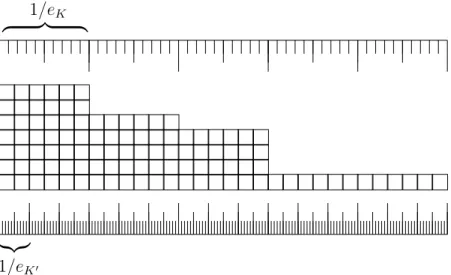
In the arguments of [1], [5], which appear to build on Tate’s original argument, one must measure various in- tegral structures by means of a “ruler graduated in units of size 1/eK”. Thus, as the size 1/eK of the units de- creases(i.e., aseK/pvp(eK) grows), it becomes more diffi- cult to control the extent to which the integral structures in question converge.
Figure 1: rulers graduated in units of sizes 1/eK, 1/eK0
z 1/e}|K {
|{z}
1/eK0
From this point of view, the argument established in the present paper is an argument that does not rely on the use of a “ruler graduated in units of size 1/eK”.
The “tame-blindness” of our extension result allows one to verify the analogue of the result of Tate referred to above for isogenies of Barsotti- Tate groups over the ring of integers of the p-adic completion of the maximal tamely ramified extension field (cf. Corollary 3.8). Note that this analogue does not follow from (B) and (L):
Corollary 0.3. Let Ktm (⊆ K) be the maximal tamely ramified ex- tension field of K, (Ktm)∧ (respectively, K)b the p-adic completion of Ktm (respectively, K), (Rtm)∧ the ring of integers of (Ktm)∧, and
Γ(Ktm)∧ def
= Gal(K/(Kb tm)∧). (Thus, by restricting elements of Γ(Ktm)∧
to the algebraic closure of (Ktm)∧ in K, one obtains a natural iso-b morphism of Γ(Ktm)∧ with the corresponding absolute Galois group of (Ktm)∧.) Let G and H be Barsotti-Tate groups over (Rtm)∧, Tp(G) (respectively, Tp(H)) the p-adic Tate module of G (respectively, H), and Isog(Rtm)∧(G,H) (respectively,IsogΓ(Ktm)∧(Tp(G), Tp(H))) the set of morphismsφof Barsotti-Tate groups over(Rtm)∧(respectively,Zp[Γ(Ktm)∧]- equivariant morphismsφ)fromG (respectively,Tp(G))toH(respectively, Tp(H))such thatφ induces an isomorphismTp(G)⊗ZpQp →∼ Tp(H)⊗Zp
Qp. Then the natural morphism
Isog(Rtm)∧(G,H)−→IsogΓ(Ktm)∧(Tp(G), Tp(H)) is bijective.
The present paper is organized as follows: In Section 1, we study the relationship between discriminants and cotangent spaces of finite flat group schemes. In Section 2, we review truncated p-adic Hodge theory for finite flat group schemes as established in [2] and prove lemmas needed later by means of this theory. In Section 3, we prove the main theorem and some corollaries which follow from the main theorem.
Acknowledgement
I would like to thank Professor Shinichi Mochizuki for suggesting the topic, and helpful discussions and comments.
This work was supported by Grant-in-Aid for Young Scientists (B) (20740010).
Notations and Terminologies
Numbers. The notationNwill be used to denote the set or (additive) monoid of nonnegative rational integers. The notation Z will be used to denote the set, group, or ring of rational integers. The notation Q will be used to denote the set, group, or field of rational numbers. The notation Q>0 will be used to denote the set or (additive) monoid of positive rational numbers. If l is a prime number, then the notation Zl (respectively, Ql) will be used to denote thel-adic completion of Z (respectively, Q).
Group schemes. In the present paper, by a finite flat group scheme over a scheme S we shall mean a commutative group scheme over S which is finite and flat over S, and by a finite flat subgroup scheme of a finite flat group scheme G over S we shall mean a closed subgroup scheme of G which is finite and flat overS.
LetGbe a finite flat group scheme over a connected schemeS. Then we shall refer to the rank of the locally free OS-module φ∗OG, where φ: G → S is the structure morphism of G, as the rank of G over S.
We shall denote by rankS(G) the rank ofG over S.
LetGbe a finite flat group scheme over a schemeS, andn a natural number. Then we shall denote by nG: G → G the endomorphism of G given by multiplication by n. Note that nG is amorphism of group schemes overS.
Let f: G → H be a morphism of finite flat group schemes over a scheme S. Then we shall denote by Ker(f) the group scheme over S obtained as the fiber product of f and the identity section of H. We shall refer to Ker(f) as thekernel of the morphism f. Note that since H is separated over S, the kernel Ker(f) is a closed subgroup scheme of G.
Let G be a finite flat group scheme over a scheme S, and H ⊆ G a finite flat subgroup scheme of G over S. Then a quotient of G by H, which is a finite flat group scheme over S, exists (cf. e.g., [8], Th´eor`eme 1, (iii)). We shall denote by G/H the quotient of G by H.
Note that we have a natural morphism of group schemes G → G/H over S which is finite and faithfully flat; moreover, the kernel of this morphism G→G/H coincides with H ⊆G.
LetG1,G2 be group schemes over a schemeS. Then we shall denote by
Homgp/S(G1, G2)
the set of morphisms of group schemes over S from G1 toG2.
LetG be a finite flat group scheme over a scheme S. Then we shall write GD the Cartier dual of G, i.e., the finite flat group scheme over S which represents the functor over S
T ÃHomgp/T(G×ST,Gm,T).
Note that for a morphism of finite flat group schemes f: G→H over S, it is easily verified that if f is faithfully flat, then the morphism of finite flat group schemes fD: HD → GD over S induced by f is a closed immersion; moreover, if f is a closed immersion, then the morphism fD: HD → GD is faithfully flat. Indeed, since GD, HD are finite and flat over S, it follows from [3], Corollaire 11.3.11, that by base-changing, we may assume that S is the spectrum of a field. On the other hand, since f is a closed immersion, it is verified that the morphism Γ(GD,OGD)→ Γ(HD,OHD) determined by fD is injective.
Thus, it follows from [12], Theorem in 14.1, that fD is faithfully flat.
Let
0−→G1 −→f1 G2 −→f2 G3 −→0
be a sequence consisting of finite flat group schemes over a scheme S.
Then we shall say that the above sequence is exact if f1 is a closed
immersion, and f2 determines an isomorphism G2/G1 →∼ G3. (In par- ticular,f2isfaithfully flat, and the kernel off2coincides withG1 ⊆G2.) Note that if the sequence of finite flat group schemes over S
0−→G1 −→f1 G2 −→f2 G3 −→0 is exact, then the sequence
0−→GD3 f
D
−→2 GD2 f
D
−→1 GD1 −→0 is also exact.
Let G be a group scheme over a scheme S, and M an OS-module.
Then we shall write t∗G(M)def= e∗GΩ1G/S⊗OSM, whereeG: S →Gis the identity section of G, and refer to t∗G(M) as the M-valued cotangent space of G; moreover, we shall write tG(M) def= HomOS(e∗GΩ1G/S,M) and refer to tG(M) as the M-valued tangent space of G.
1. Discriminants and cotangent spaces
In this Section , we study the relationship between discriminants and cotangent spaces of finite flat group schemes.
Throughout this paper, letR be a complete discrete valuation ring, k the residue field of R, K the field of fractions of R, K an algebraic closure of K, and vp the valuation of K such that vp(p) = 1. Assume, moreover, that K is of characteristic 0, and k is of characteristicp > 0 and perfect.
Definition 1.1. Let G be a finite flat group scheme over R.
(i) We shall denote by discR(G) ⊆ R the ideal of R obtained as the discriminant of the finite flat R-algebra Γ(G,OG) over R.
Moreover, we shall write DR(G)def= vp(discR(G)).
(ii) We shall writedGdef= dimk(t∗G(k)) and refer todGas the dimen- sion of G.
Lemma 1.2 (Finiteness of cotangent spaces). Let G be a finite flat group scheme over R. Then the R-module t∗G(R) is of finite length and generated by exactly dG elements.
Proof. The assertion that t∗G(R) is of finite length follows from the
´
etaleness of G ⊗R K over K; moreover, the assertion that t∗G(R) is generated by exactly dG elements follows from the definition of dimen-
sion. ¤
Definition 1.3.
(i) Let M be an R-module of finite length. Then if M 6= 0, then there exists a unique element
(a1,· · · , adimk(M⊗Rk))∈Q⊕>0dimk(M⊗Rk)
such that ai ≤ aj if i ≤ j, and, moreover, there exists an isomorphism
M '
dimkM(M⊗Rk) i=1
R/(pai). We shall write
LR(M)def= {a1,· · · , adimk(M⊗Rk)} ⊆Q>0
for M 6= 0, LR({0}) def= {0}, and |M|R def= P
a∈LR(M)a ∈ Q>0. Moreover, for an integer n, we shall write MR = n (respec- tively, MR ≤ n; respectively, MR < n; respectively, MR ≥ n;
respectively,MR > n) ifa=nfor anya∈LR(M) (respectively, max(LR(M))≤n; respectively, max(LR(M))< n; respectively, min(LR(M))≥n; respectively, min(LR(M))> n).
Note that it is immediate that ifM 6= 0, thenvp(lengthR(M)) =
|M|R.
(ii) Let G be a finite flat group scheme over R. Then it follows from Lemma 1.2 that t∗G(R) is of finite length. We shall write L(t∗G)def= LR(t∗G(R)) and|t∗G|def= |t∗G(R)|R. Moreover, for an inte- ger n, we shall write t∗G =n (respectively, t∗G ≤n; respectively, t∗G < n; respectively,t∗G ≥n; respectively,t∗G> n) ift∗G(R)
R=n (respectively, t∗G(R)
R ≤ n; respectively, t∗G(R)
R < n; respec- tively, t∗G(R)
R≥n; respectively, t∗G(R)
R> n).
Proposition 1.4 (Discriminants and cotangent spaces). Let G be a finite flat group scheme over R. Then the following hold:
DR(G) (= (vp(discR(G))) = rankR(G)· |t∗G|.
Proof. By the transitivity of discriminant, we may assume without loss of generality that Gisconnected. Then it follows from [6], Lemma 6.1, that there exists an isomorphism of R-algebras
Γ(G,OG)'R[t1,· · · , tdG]/(Φ1,· · · ,ΦdG),
where theti’s are indeterminates, and (Φ1,· · · ,ΦdG) is a regularR[t1,· · · , tdG]- sequence. Thus, it follows from [7], Theorem 25.2, that there exists a
natural exact sequence of R[t1,· · · , tdG]-modules (Φ1,· · · ,ΦdG)−→d
dG
M
i=1
Γ(G,OG)·dti −→Ω1G/R−→0.
Therefore, the assertion follows from [6], Corollary A. 13, together with
the definition of t∗G(R). ¤
Lemma 1.5 (Isomorphisms of finite flat group schemes). Let G, H be finite flat group schemes over R, and f: G→ H a morphism of
group schemes over R. Then f is an isomorphism if and only if the following two conditions are satisfied:
(i) The morphism G⊗RK →H⊗RK over K induced by f is an isomorphism.
(ii) |t∗H| ≤ |t∗G|.
Proof. By the definition of discriminant, we have thatDR(G)≤DR(H).
Thus, this follows immediately from Proposition 1.4. ¤ Lemma 1.6 (Exactness of sequences of cotangent spaces). If a sequence of finite flat group schemes over R
0−→G1 −→G2 −→G3 −→0 is exact, then the sequences of R-modules
0−→t∗G3(R)−→tG∗2(R)−→t∗G1(R)−→0 ; 0−→tG1(K/R)−→tG2(K/R)−→tG3(K/R)−→0
are also exact. In particular, for a morphism of finite flat group schemes f: G → H over R, if f is a closed immersion (respectively, faith- fully flat morphism), then the morphism t∗H(R) → t∗G(R) induced by f is surjective (respectively, injective), and the morphism tG(K/R)→ tH(K/R) induced by f is injective (respectively, surjective).
Proof. To prove Lemma 1.6, it is immediate that it is enough to show that the sequence
0−→t∗G3(R)−→tG∗2(R)−→t∗G1(R)−→0 is exact.
By the transitivity of discriminant, together with Proposition 1.4, we obtain that
DR(G2) = rankR(G2)·|t∗G
2|= rankR(G1)·DR(G3)+rankR(G3)·DR(G1)
= rankR(G2)·(|tG∗1|+|t∗G3|) ; thus, we obtain that|t∗G
2|=|t∗G
1|+|t∗G
3|. On the other hand, by defini- tion, the exact sequence of group schemes appearing in the statement of Lemma 1.6 induces an exact sequence of R-modules
t∗G
3(R)−→t∗G
2(R)−→t∗G
1(R)−→0. Therefore, by the above equality |t∗G
2| = |t∗G
1|+|t∗G
3|, the first arrow t∗G
3(R)→t∗G
2(R) is injective. This completes the proof of the assertion
that the sequence in question is exact. ¤
2. Review of truncated p-adic Hodge theory
In this Section, we review truncated p-adic Hodge theory for finite flat group schemes as established in [2] and prove lemmas needed later by means of this theory.
We maintain the notation of the preceding Section. Moreover, let R be the ring of integers of K, ΓK def= Gal(K/K), and Ωdef= Ω1
R/R. Definition 2.1.
(i) Let S be a connected scheme. Then we shall say that a finite flat group schemeG overS is a p-group schemeif its rank over S is a power ofp.
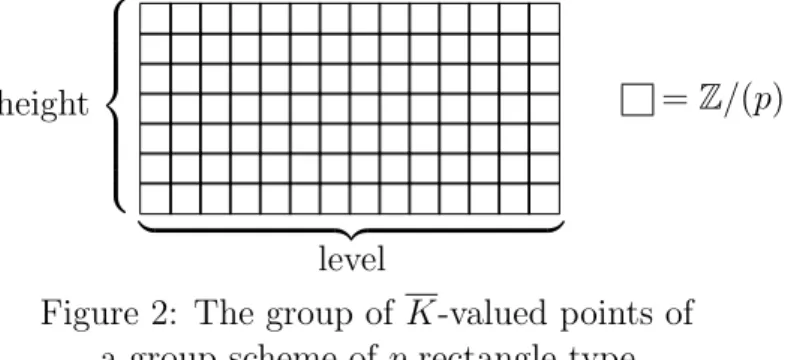
(ii) Let n, h be natural numbers. Then we shall say that a finite flat group schemeGoverRisof p-rectangle-type of leveln with height h if G(K) is isomorphic to L
hZ/(pn) as an abstract finite group (cf. Figure 2). Moreover, we shall denote by lv(G) the level of G, and by ht(G) the height of G.
Figure 2: The group of K-valued points of a group scheme of p-rectangle-type
=Z/(p) height
level
| {z }
Remark 2.2.
(i) Any connected finite flat group schemes over R are p-group schemes.
(ii) IfGis ofp-rectangle-type, then the Cartier dualGD ofGis also of p-rectangle-type. Moreover, lv(G) = lv(GD) and ht(G) = ht(GD).
The following lemma follows immediately from definition, together with Lemma 1.2:
Lemma 2.3 (Bound for the lengths of cotangent spaces). Let G be a finite flat group scheme over R of p-rectangle-type. Then t∗G ≤ lv(G). In particular, |t∗G| ≤dG·lv(G).
Definition 2.4. We shall write ²FonK def= 2 +vp(eK), where eK is the absolute ramification index of K.
Note that since as is well-known that
vp(DR/W(k))≤1−(1/eK) +vp(eK),
where W(k)⊆R is the ring of Witt vectors with coefficients in k, and DR/W(k) ⊆ R is the different of the extension R/W(k) (cf. e.g., [10], Chapter III, Remarks following Proposition 13), we obtain that
vp(DR/W(k)) + 1/(p−1)≤²FonK .
The following proposition follows from [2], Corollaire to Th´eor`eme 3, together with [2], Th´eor`eme 10:
Proposition 2.5 (Existence of functorial morphisms). Let G be a p-group scheme over R. Then there exists a functorial morphism of R[ΓK]-modules
φG: G(K)⊗ZpR −→t∗GD(R)⊕tG(Ω),
where the kernel and cokernel are annihilated by p²FonK ; moreover, there exists a natural isomorphism of R[ΓK]-modules
(K/a)(1)−→∼ Ω, where
adef= {a∈K | −vp(DR/W(k))−1/(p−1)≤vp(a)} ⊆K .
Lemma 2.6 (Bound for the orders of kernels and cokernels).
Let G, H be p-group schemes over R, f: G→H a morphism of group schemes over R, and n a natural numbers. Then the following hold:
(i) If the kernel of the morphism G(K) → H(K) induced by f is annihilated by pn, then the cokernel (respectively, kernel)of the morphism
t∗H(R)−→t∗G(R) (respectively, t∗GD(R)−→t∗HD(R)) induced by f is annihilated by p²FonK +n.
(ii) If the cokernel of the morphismG(K)→H(K) induced by f is annihilated by pn, then the kernel(respectively, cokernel)of the morphism
t∗H(R)−→t∗G(R) (respectively, t∗GD(R)−→t∗HD(R)) induced by f is annihilated by p²FonK +n.
Proof. First, we prove assertion (i). Now we have a commutative dia- gram:
HD(K)⊗ZpR viaf
−−−−→D GD(K)⊗ZpR
φHD
y yφGD t∗H(R)⊕tHD(Ω) −−−−→
viafD
t∗G(R)⊕tGD(Ω).
Since the cokernel of the top horizontal arrow (respectively, right-hand vertical arrow) is annihilated by pn (respectively, p²FonK ), the respective cokernels of the morphisms
t∗H(R)−→t∗G(R) ; tHD(Ω)−→tGD(Ω)
determined by f are annihilated by p²FonK +n. Thus, the kernel of the morphismt∗GD(R)→t∗HD(R) determined byf is annihilated byp²FonK +n. This completes the proof of assertion (i). Moreover, by taking “(−)D”,
assertion (ii) follows from assertion (i). ¤
Lemma 2.7 (Orders of generators of cotangent spaces). Let G be a finite flat group scheme of p-rectangle-type of level > 2²FonK over R, and a ∈ L(t∗G) (cf. Definition 1.3, (ii)). Then 0 ≤ a ≤ ²FonK or lv(G)−²FonK ≤a≤lv(G) (cf. Figure 3).
Figure 3: t∗G(R)
=R/(p) z }| {
z }| {
| {z }
²FonK
²FonK
lv(G) dG
· · · · ·
Proof. If t∗G ≤ ²FonK , then the assertion is immediate; thus, we may assume that p²FonK ·t∗G(R) 6= 0. By the definition of L(t∗G), to prove Lemma 2.7, it is immediate that it is enough to show that
p²FonK ·t∗G(R)
R≥lv(G)−2²FonK (cf. Definition 1.3, (i)); thus, we prove this assertion.
Since the kernel and cokernel of the morphism
φGD: AG def= GD(R)⊗ZpR−→TG def= t∗G(R)⊕tGD(Ω)
are annihilated by p²FonK , the composite AG φ→GD TG ³ p²FonK · TG is surjective, and the natural surjection AG ³ p2²FonK ·AG (6= 0, since 2²FonK <lv(G)) factors through this composite AGφ→GD TG ³p²FonK ·TG, i.e., we obtain a sequence of surjections:
AG−→p²FonK ·TG−→p2²FonK ·AG(6= 0).
Therefore, by the definition of the term “of p-rectangle-type”, it is easily verified that p²FonK ·t∗G(R)
R ≥ lv(G)−2²FonK . This completes the
proof of Lemma 2.7. ¤
Definition 2.8. Let G be a finite flat group scheme over R, M a module, and n a natural number.
(i) We shall write
d◦G def= dimk((p²FonK ·t∗G(R))⊗Rk) (≤dG) (cf. Figure 4).
Figure 4: d◦G
=R/(p) z }| {
z }| {
| {z }
²FonK
²FonK
lv(G) dG
· · · · ·
¢¢
¢¢
¢¢
¢®
d◦G
Note that it follows from the proof of Lemma 2.7 that ifGis of p-rectangle-type of level>2²FonK , then d◦G+d◦GD = ht(G).
(ii) Then we shall say that x ∈ M is n-primitive if the following condition is satisfied:
pnx= 0 and x6∈p·M.
Note that for an R-module M of finite length, M has no n-primitive element if and only if M = 0 or MR> n+ 1.
Remark 2.9. For a finite flat group scheme G of p-rectangle-type of level > 2²FonK over R which is not ´etale, the following conditions are equivalent:
(i) t∗G > ²FonK .
(ii) t∗G ≥lv(G)−²FonK . (iii) d◦G =dG.
(iv) t∗G(R) has no (²FonK −1)-primitive element.
Indeed, the assertion that (i) is equivalent to (ii) (respectively, (iii);
respectively, (iv)) follows from Lemma 2.7 (respectively, Lemma 2.7;
respectively, the definition of (²FonK −1)-primitive element).
Lemma 2.10 (Facts concerning modified dimensions). Let G, H be finite flat group schemes of p-rectangle-type over R, f: G → H a morphism of group schemes over R, andn a natural number. Then the following hold:
(i) If the kernel of the morphism G(K)→H(K) is annihilated by pn, and3²FonK +n ≤lv(G), lv(H), thend◦G ≤d◦H andd◦GD ≤d◦HD. (ii) If the cokernel of the morphismG(K)→H(K)is annihilated by pn, and 3²FonK +n≤lv(G), lv(H), thend◦H ≤d◦G andd◦HD ≤d◦G.
Proof. First, we prove assertion (i). LetLdef= min{lv(G),lv(H)}. Then it follows from Lemma 2.6 that the respective cokernels of the mor- phisms
(p²FonK ·t∗H(R))⊗RR/(pL−2²FonK )−→(p²FonK ·t∗G(R))⊗RR/(pL−2²FonK ) ; (p²FonK ·tHD(K/R))⊗RR/(pL−2²FonK )−→(p²FonK ·tGD(K/R))⊗RR/(pL−2²FonK ) induced by f are annihilated by p²FonK +n; moreover, it follows from Lemma 2.7 that (p²FonK ·t∗G(R))⊗R R/(pL−2²FonK ) (respectively, (p²FonK · t∗H(R))⊗RR/(pL−2²FonK ); respectively, (p²KFon·tGD(K/R))⊗RR/(pL−2²FonK );
respectively, (p²FonK ·tHD(K/R))⊗RR/(pL−2²FonK )) is a freeR/(pL−2²FonK )- module of rank d◦G (respectively, d◦H; respectively, d◦GD; respectively, d◦HD). Therefore, since ²FonK +n ≤ L−2²FonK , we obtain that d◦G ≤ d◦H and d◦GD ≤ d◦HD. This completes the proof of assertion (i). Moreover, by taking “(−)D”, assertion (ii) follows from assertion (i). ¤ Lemma 2.11 (Freeness of cotangent spaces of certain group schemes). Let G be a finite flat group scheme of p-rectangle-type over R. Then if dG+dGD = ht(G), then t∗G(R) is free over R/(plv(G)).
Proof. To prove Lemma 2.11, it is immediate that it is enough to show that |t∗G| = lv(G)·dG, i.e., it is enough to show that DR(G) = plv(G)·ht(G)lv(G)·dG by Proposition 1.4. Now it follows from Propo- sition 1.4; Lemma 2.3 that DR(G) ≤ plv(G)·ht(G)lv(G) · dG. More- over, again by Proposition 1.4; Lemma 2.3, we obtain that DR(GD)≤ plv(G)·ht(G)lv(G)·dGD. On the other hand, it follows from [9], Proposition 9 in Appendice, that DR(G) +DR(GD) = rankR(G)·vp(rankR(G)) = plv(G)·ht(G)lv(G)·ht(G). Thus, since dG+dGD = ht(G), we obtain that
DR(G) = plv(G)·ht(G)lv(G)·dG. ¤
Lemma 2.12(Isomorphisms of group schemes ofp-rectangle-type).
LetG, Hbe finite flat group schemes ofp-rectangle-type of level≥3²FonK overR, and f: G→H a morphism of group schemes over R. Assume thatt∗G(R)is free overR/(plv(G)), andt∗H > ²FonK . Thenf is an isomor-
phism if and only if the morphism G⊗RK →H⊗RK overK induced by f is an isomorphism.
Proof. The “only if” part of the assertion is immediate; thus, we prove the “if” part of the assertion. Since the morphism G⊗RK → H⊗R
K over K induced by f is an isomorphism, we obtain that lv(G) = lv(H) and dG = dH (cf. Remark 2.9; Lemma 2.10). Thus, it follows from Lemma 2.3 that |t∗H| ≤ lv(G) ·dG. On the other hand, since
|t∗G|= lv(G)·dG, we obtain that |t∗H| ≤ |t∗G|. Therefore, it follows from
Lemma 1.5 that f is an isomorphism. ¤
Finally, we review the notion oftruncated Barsotti-Tate group schemes.
Definition 2.13 (cf. e.g., [4], D´efinition 1.1). Let S be a connected scheme. Then we shall say that a finite flat group scheme G over S is truncated(p-)Barsotti-Tate(of level≥2) if there exist natural numbers n and h such that the following condition is satisfied:
n ≥ 2 and G is of rank pnh. Moreover, for any natural number m ≤ n, the morphism G → Im(pmG), where Im(pmG) is the scheme-theoretic image of pmG, determined bypmG isfaithfully flat(thus, Ker(pmG) isflatoverS), and the finite flat group scheme Ker(pmG) over S is of rank pmh.
For a truncated Barsotti-Tate group schemeGoverS, and a natural number m, we shall write G[pm]def= Ker(pmG).
Remark 2.14.
(i) Any truncated Barsotti-Tate group schemes are ofp-rectangle- type.
(ii) IfG is truncated Barsotti-Tate, then the Cartier dualGD of G is also truncated Barsotti-Tate.
Lemma 2.15 (Freeness of cotangent spaces of truncated Bar- sotti-Tate group schemes). LetGbe a truncated Barsotti-Tate group schemes overR. ThendG+dGD = lv(G). In particular, by Lemma 2.11, t∗G(R) is free over R/(plv(G)).
Proof. This follows from a similar argument to the argument used in
the proof of [11], Proposition 3. ¤
Remark 2.16. The assertion that t∗G(R) is free over R/(plv(G)) can be also proven by means of [2], Proposition 10, together with Proposi- tion 2.17 below.
Proposition 2.17 (Existence of certain Barsotti-Tate groups).
Let G be a truncated Barsotti-Tate group scheme over R. Then there exists a Barsotti-Tate group G over R such that G is isomorphic to Ker(plv(G): G → G).
Proof. This follows from [4], Th´eor`eme 4.4, (e). ¤ 3. Proof of the main theorem
In this Section, we prove the main theorem, i.e., Theorem 3.4 below.
We maintain the notation of the preceding Section.
Lemma 3.1 (Split injections of R-modules). Let M, N be R- modules of finite length, f: M →N a morphism of R-modules, and m a natural number. Then the following hold:
(i) If M andN are free over R/(pm), and the morphismM⊗Rk → N ⊗Rk induced by f is injective, then f is injective, and the image of f is a direct summand of N.