RIMS-1733
On the colored Jones polynomials
of ribbon links, boundary links and Brunnian links
By
Sakie SUZUKI
November 2011
R ESEARCH I NSTITUTE FOR M ATHEMATICAL S CIENCES
On the colored Jones polynomials of ribbon links, boundary links and Brunnian links
Sakie Suzuki
∗November 27, 2011
Abstract
Habiro gave principal ideals of Z[q, q−1] in which certain linear combinations of the colored Jones polynomials of algebraically-split links take values. The author proved that the same linear combinations for ribbon links, boundary links and Brunnian links are contained in smaller ideals ofZ[q, q−1] generated by several elements. In this paper, we prove that these ideals also are principal, each generated by a product of cyclotomic polynomials.
1 Introduction
After the discovery of the Jones polynomial, Reshetikhin and Turaev [7] defined an invariant of framed links whose components are colored by finite dimensional represen- tations of a ribbon Hopf algebra. Thecolored Jones polynomial can be defined as the Reshetikhin-Turaev invariant of links whose components are colored by finite dimen- sional representations of the quantized enveloping algebraUh(sl2).
We are interested in the relationship between algebraic properties of the colored Jones polynomial andtopological properties of links.
In this paper, we consider the following three types of links.
A link is called aribbon link if it bounds the image of an immersion from a disjoint union of disks intoS3with only ribbon singularities.
Ann-component linkL=L1∪· · ·∪Lnis called aboundary linkif it bounds a disjoint union ofnSeifert surfacesF1, . . . , Fn inS3 such thatLi boundsFi fori= 1, . . . , n.
A linkLis called aBrunnian link if every proper sublink ofLis trivial.
In [4], Habiro used certain linear combinations JL; ˜P′
l1,...,P˜ln′ , l1, . . . , ln ≥ 0, of the colored Jones polynomials of a link L to construct the unified Witten-Reshetikhin- Turaev invariants for integral homology spheres. He proved that JL; ˜P′
l1,...,P˜′
ln
for an algebraically-split, 0-framed linkL is contained in a certain principal ideal ofZ[q, q−1] (Theorem 2.1). This result was improved by the present author [8, 9, 10, 11] in the
∗Research Institute for Mathematical Sciences, Kyoto University, Kyoto, 606-8502, Japan. E-mail address:[email protected]
special case of ribbon links, boundary links (Theorem 2.2) and Brunnian links (Theorem 2.4) by using idealsIl1, . . . , Iln ofZ[q, q−1], where Theorem 2.2 for boundary links had been conjectured by Habiro [4]. Here, in [8], we gave an alternative proof of the fact that the Jones polynomial of ann-component ribbon link is divisible by the Jones polynomial of the n-component trivial link, which was proved first by Eisermann [1]. The results in [4, 8, 9, 10, 11] are proved by using theuniversalsl2 invariant of bottom tangles(cf.
[3, 4]), which has the universality property for the colored Jones polynomial of links.
In this paper, we prove that the ideal Il, l ≥0, is a principal ideal generated by a product of cyclotomic polynomials (Theorem 3.1), and rewrite Theorems 2.1, 2.2 and 2.4 by using these generators (Proposition 3.3).
2 Results for the colored Jones polynomial
In this section, we recall results in [4, 9, 10, 11] for the colored Jones polynomial. For the definition of the quantized enveloping algebra Uh(sl2), see, e.g., [6, 4, 9]. We set q= exph.
For m≥1, let Vmdenote the m-dimensional irreducible representation ofUh(sl2).
LetRdenote the representation ring ofUh(sl2) overQ(q12), i.e.,Ris theQ(q12)-algebra R= Span
Q(q12){Vm |m≥1}
with the multiplication induced by the tensor product. It is well known that R = Q(q12)[V2].
Habiro [4] studied the following elements inR P˜l′= q12l
{l}q!
l−1
∏
i=0
(V2−qi+12 −q−i−12),
forl≥0,which are used in an important technical step in his construction of the unified Witten-Reshetikhin-Turaev invariants for integral homology spheres.
For the definition of the colored Jones polynomialJL;X1,...,Xn ofLwithith compo- nentLi colored byXi∈ R, see, e.g., [5, 4, 9].
Set
{i}q =qi−1, {i}q,n={i}q{i−1}q· · · {i−n+ 1}q, {n}q! ={n}q,n, fori∈Z, n≥0.
Habiro [4] proved the following.
Theorem 2.1 (Habiro [4]). Let L be an n-component, algebraically-split link with 0- framing. We have
JL; ˜P′
l1,...,P˜ln′ ∈ {2lmax+ 1}q,lmax+1
{1}q
Z[q, q−1], (1)
forl1, . . . , ln ≥0, wherelmax= max(l1. . . , ln).
Set
fl,k={l−k}q!{k}q!,
for 0≤k≤l. Forl≥0, letIl be the ideal ofZ[q, q−1] generated byfl,0, . . . , fl,l. In [9, 10], we proved the following.
Theorem 2.2 ([9, 10]). Let L be an n-component ribbon or boundary link with 0- framing. Forl1, . . . , ln≥0, we have
JL; ˜P′
l1,...,P˜ln′ ∈ {2lmax+ 1}q,lmax+1
{1}q
∏
1≤i≤n,i̸=iM
Ili, (2)
wherelmax= max(l1, . . . , ln)andiM is an integer such thatliM =lmax.
Remark 2.3. Theorem 2.2 for boundary links had been conjectured by Habiro [4].
In [11], we prove the following.
Theorem 2.4([11]). LetL be an n-component Brunnian link withn≥3. We have JL; ˜P′
l1,...,P˜′
ln ∈ {2lmax+ 1}q,lmax+1
{1}q{lmin}q!
∏
1≤i≤n,i̸=iM,im
Ili, (3)
for l1, . . . , ln ≥ 0, where lmax = max(l1, . . . , ln), lmin = min(l1, . . . , ln) and iM, im, iM ̸=im, are integers such thatliM =lmax,lim =lmin, respectively.
Let us compare Theorems 2.1, 2.2 and 2.4. Forl1, . . . , ln ≥0, letZa(l1,...,ln),Zr,b(l1,...,ln) andZBr(l1,...,ln)denote the ideals ofZ[q, q−1] at the right hand sides of (1), (2) and (3), respectively, i.e., we set
Za(l1,...,ln)= {2lmax+ 1}q,lmax+1
{1}q Z[q, q−1], Zr,b(l1,...,ln)= {2lmax+ 1}q,lmax+1
{1}q
∏
1≤i≤n,i̸=iM
Ili,
ZBr(l1,...,ln)= {2lmax+ 1}q,lmax+1
{1}q{lmin}q!
∏
1≤i≤n,i̸=iM,im
Ili.
Forl1, . . . , ln≥0, we have
Zr,b(l1,...,ln)⊂Za(l1,...,ln), Zr,b(l1,...,ln)⊂ZBr(l1,...,ln), since we have
Zr,b(l1,...,ln)=( ∏
1≤i≤n,i̸=iM
Ili)
·Za(l1,...,ln),
=(
{lmin}q!Ilmin)
·ZBr(l1,...,ln).
On the other hand, there are no inclusion which satisfies for alll1, . . . , ln≥0 between Za(l1,...,ln) and ZBr(l1,...,ln) . For example, we have Za(2,2,2,2) ̸⊂ZBr(2,2,2,2) and ZBr(2,2,2,2) ̸⊂
Za(2,2,2,2) since
Za(2,2,2,2)= {5}q,3
{1}q Z[q, q−1]
= (q−1)2(q+ 1)(q2+q+ 1)(q2+ 1)(q4+q3+q2+q1+ 1)Z[q, q−1], ZBr(2,2,2,2)= {5}q,3
{1}q{2}q!{1}4qZ[q, q−1]
= (q−1)4(q2+q+ 1)(q2+ 1)(q4+q3+q2+q1+ 1)Z[q, q−1].
Since a Brunnian link withn≥3 components is algebraically-split with 0-framing, we have the following refinement of Theorem 2.4.
Theorem 2.5. Let Lbe an n-component Brunnian link withn≥3. We have JL; ˜P′
l1,...,P˜ln′ ∈Za(l1,...,ln)∩ZBr(l1,...,ln), forl1, . . . , ln ≥0.
3 Main result for the ideal I
lIn this section, we state the main result of this paper.
Forl≥0, recall the generatorsfl,0, . . . , fl,l of the ideal Il. Set gl=GCD(fl,0, . . . , fl,l).
It is clear that Il ⊂ glZ[q, q−1]. The opposite inclusion follows if and only if Il is principal. Since Z[q, q−1] is not a principal ideal domain, it had been a problem ifIl
is principal or not. The main result in this paper (Theorem 3.1) is thatIl is principal, where we determineglexplicitly. The proof is in Section 4.
Form≥1, let Φm=∏
d|m(qd−1)µ(md)∈Z[q] denote themth cyclotomic polynomial, where∏
d|mdenotes the product over all positive divisors dofm, and µis the M¨obius function. Forr∈Q, we denote by⌊r⌋the largest integer smaller than or equal tor.
Theorem 3.1. Forl≥0, the idealIl is the principal ideal generated bygl. Moreover, we have
gl= ∏
m≥1
Φtml,m, (4)
where
tl,m=
{⌊l+1m ⌋ −1 for1≤m≤l,
0 forl < m.
Here is a table oftl,m for 1≤m≤4, 0≤l≤16.
m\l 0 1 2 3 4 5 6 7 8 9 10 11 12 13 14 15 16
1 0 1 2 3 4 5 6 7 8 9 10 11 12 13 14 15 16
2 0 0 0 1 1 2 2 3 3 4 4 5 5 6 6 7 7
3 0 0 0 0 0 1 1 1 2 2 2 3 3 3 4 4 4
4 0 0 0 0 0 0 0 1 1 1 1 2 2 2 2 3 3
Remark 3.2. In [11], Theorem 3.1 is used in the proof of Theorem 2.4.
Theorem 3.1 implies that the idealsZr,b(l1,...,ln)andZBr(l1,...,ln)are principal. Moreover, we can write a generator of each principal idealZa(l1,...,ln),Zr,b(l1,...,ln)andZBr(l1,...,ln)as a product of cyclotomic polynomials as follows.
Proposition 3.3. Forl1, . . . , ln ≥0, the idealsZa(l1,...,ln), Zr,b(l1,...,ln) andZBr(l1,...,ln) are principal. Moreover, we have
Za(l1,...,ln)= ∏
m≥1
Φ⌊
2lmax +1
m ⌋−⌊lmax−1m ⌋−⌊m1⌋
m Z[q, q−1],
Zr,b(l1,...,ln)= ∏
1≤m≤2lmax+1
Φ⌊
2lmax +1
m ⌋−⌊lmax−m 1⌋−⌊m1⌋+∑
1≤i≤n,i̸=iMtli,m
m Z[q, q−1],
ZBr(l1,...,ln)= ∏
1≤m≤2lmax+1
Φ⌊
2lmax +1
m ⌋−⌊lmax−1m ⌋−⌊m1⌋−⌊lminm ⌋+∑
1≤i≤n,i̸=iM ,imtli,m
m Z[q, q−1].
Proof. The assertion forZa(l1,...,ln)follows from {l}q,i= ∏
m≥1
Φ⌊mml⌋−⌊l−im⌋, (5)
for 0≤i≤l. The assertion for Zr,b(l1,...,ln) and ZBr(l1,...,ln) follows from (5) and Theorem 3.1.
Corollary 3.4. Forl1, . . . , ln≥0, we have Za(l1,...,ln)∩ZBr(l1,...,ln)= ∏
m≥1
Φ⌊
2lmax +1
m ⌋−⌊lmax−1m ⌋−⌊m1⌋+max(0,∑
1≤i≤n,i̸=iM ,imtli,m−⌊lminm ⌋)
m Z[q, q−1].
Example 3.5. Let L be an n-component algebraically-split link with 0-framing. By Theorem 2.1 and Proposition 3.3, we have
JL; ˜P′
1,...,P˜1′ ∈Φ1Φ2Φ3Z[q, q−1], JL; ˜P′
2,...,P˜2′ ∈Φ21Φ2Φ3Φ4Φ5Z[q, q−1], JL; ˜P′
3,...,P˜3′ ∈Φ31Φ22Φ3Φ4Φ5Φ6Φ7Z[q, q−1].
...
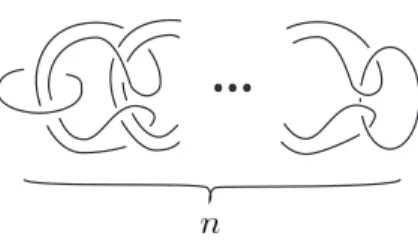
Figure 1: Milnor’s linkMn
Let Lbe an n-component Brunnian link withn≥3. By Theorem 2.5 and Corollary 3.4, we have
JL; ˜P′
1,...,P˜1′ ∈Φ1n−2Φ2Φ3Z[q, q−1], JL; ˜P′
2,...,P˜2′ ∈Φ2(n1 −2)Φ2Φ3Φ4Φ5Z[q, q−1], JL; ˜P′
3,...,P˜3′ ∈Φ3(n1 −2)Φ2n−1Φ3Φ4Φ5Φ6Φ7Z[q, q−1].
Let Lbe an n-component ribbon or boundary link with0-framing. By Theorem 2.2 and Proposition 3.3, we have
JL; ˜P′
1,...,P˜1′ ∈Φ1nΦ2Φ3Z[q, q−1], JL; ˜P′
2,...,P˜2′ ∈Φ2n1 Φ2Φ3Φ4Φ5Z[q, q−1], JL; ˜P′
3,...,P˜3′ ∈Φ3n1 Φn+12 Φ3Φ4Φ5Φ6Φ7Z[q, q−1].
Example 3.6. Forn≥3, let Mn be Milnor’sn-component Brunnian link depicted in Figure 1. Note thatM3 is the Borromean rings. We have
JM
n; ˜P1′,...,P˜1′ = (−1)nq−2n+4Φn1−2Φ2n−2Φ3Φn4−3,
which we will prove in a forthcoming paper [12]. This implies that Theorem 2.4 is best possible for the divisibility by Φ1 and Φ3 of JL; ˜P′
1,...,P˜1′ with L Brunnian. By Theorem 2.2, this also implies that eachMn is not ribbon or boundary.
4 Proof of Theorem 3.1
We prove Theorem 3.1.
For a1, . . . , am ∈ Z[q, q−1], let (a1, . . . , am) denote the ideal in Z[q, q−1] generated bya1, . . . , am∈Z[q, q−1].
Forl≥0, recall thatIl= (fl,0, fl,1, . . . , fl,l) withfl,i={l−i}q!{i}q! for 0≤i≤l.
For 0≤k≤l, we have
(fl,0, fl,1, . . . , fl,k) ={l−k}q!(hl,k,0, hl,k,1, . . . , hl,k,k) with
hl,k,i=fl,i/{l−k}q!
={l−i}q,k−i{i}q!,
for 1≤i≤k.
Set
Il,k= (hl,k,0, hl,k,1, . . . , hl,k,k), gl,k=GCD(hl,k,0, hl,k,1, . . . , hl,k,k).
Note thatIl,l=Il andgl,l=gl.
In what follows, for a ∈ Z[q, q−1]\ {0} and m ≥ 1, let dm(a) denote the largest integerisuch thata∈ΦimZ[q, q−1]. For 0≤k≤l, we can write
gl,k= ∏
m≥1
Φdmm(gl,k), since eachhl,k,iis a product of cyclotomic polynomials.
Lemma 4.1. For0≤k≤l, we have dm(gl,k) =
{⌊l+1m ⌋ −1− ⌊lm−k⌋ for1≤m≤k,
0 fork < m.
Proof. We have
dm(gl,k) = min{dm
(hl,k,i
)|0≤i≤k}
= min{dm
({l−i}q,k−i{i}q!)
|0≤i≤k}
= min{⌊l−i
m ⌋ − ⌊l−k m ⌋+⌊i
m⌋|0≤i≤k}
= min{⌊l−i m ⌋+⌊ i
m⌋|0≤i≤k} − ⌊l−k m ⌋. Ifk < m, then we havedm(gl,k) = 0 sincedm
(hl,k,k) =dm
({k}q!) = 0.
Let 1≤m≤k. Since we have
⌊l−(i+am)
m ⌋+⌊i+am
m ⌋=⌊l−i m ⌋+⌊i
m⌋, for 0≤i≤kanda∈Z, we have
min{⌊l−i m ⌋+⌊i
m⌋|0≤i≤k}= min{⌊l−i m ⌋+⌊i
m⌋|0≤i≤m−1}.
Here, for 0≤i≤m−1, we have⌊mi⌋= 0 and⌊l−mi⌋takes the minimum withi=m−1.
Thus we have
min{⌊l−i m ⌋+⌊i
m⌋|0≤i≤m−1}=⌊l−(m−1)
m ⌋
=⌊l+ 1 m ⌋ −1.
This implies
dm(gl,k) =⌊l+ 1
m ⌋ −1− ⌊l−k m ⌋. Hence we have the assertion.
Note that we have the latter part (4) of Theorem 3.1 as follows.
Corollary 4.2. Forl≥0, we have
gl=gl,l = ∏
m≥1
Φtml,m.
From now, we prove the following generalization of Theorem 3.1.
Proposition 4.3. For0≤k≤l, the idealIl,k is the principal ideal generated bygl,k. For 1≤k≤l, set
˜
gl,k=gl,k/gl,k−1. We have
˜
gl,k= ∏
1≤m≤k
Φ⌊
l+1
m ⌋−1−⌊l−km ⌋−(
⌊l+1m ⌋−1−⌊l−k+1m ⌋)
m
= ∏
1≤m≤k
Φ⌊ml−k+1m ⌋−⌊l−km ⌋
= ∏
m|l−k+1 1≤m≤k
Φm.
We use the following technical lemma.
Lemma 4.4. For1≤k≤l, we have
({l−k+ 1}q,{k}q{k−1}q!
gl,k−1 ) = (˜gl,k).
(Note thatgl,k−1=GCD({l}q,k−1,{l−1}q,k−2{1}q, . . . ,{k−1}q!) divides{k−1}q!.) Proof of Proposition 4.3 by assuming Lemma 4.4 . We use induction on k. For k= 0, clearly we have
Il,0= (gl,0) = ({l}q!).
Fork≥1, we have
Il,k= (hl,k,0, hl,k,1, . . . , hl,k,k)
= ({l}q,k,{l−1}q,k−1{1}q, . . . ,{l−k+ 1}q{k−1}q!,{k}q!)
=(
{l−k+ 1}q({l}q,k−1,{l−1}q,k−2{1}q, . . . ,{k−1}q!),{k}q!)
= ({l−k+ 1}qgl,k−1,{k}q!)
=gl,k−1({l−k+ 1}q,{k}q{k−1}q! gl,k−1 )
= (gl,k−1g˜l,k)
= (gl,k),
where the second equality is given by
hl,k,0={l−k+ 1}q· {l−i}q,k−i−1{i}q,
for 0≤i≤k−1, and the third equality is given by the assumption of the induction.
Hence we have the assertion.
In what follows, we prove Lemma 4.4. We use the following two lemmas, which are well-known.
Lemma 4.5 (cf. Habiro [2, Lemma 4.1]). For a, b ≥ 0, the following conditions are equivalent.
(i) (Φa,Φb) =Z[q, q−1]
(ii) ab ̸=pi for any prime number p≥0 andi∈Z
Lemma 4.6. Let a1, . . . , am, b1, . . . , bn ∈Z[q, q−1]such that (ai, bj) =Z[q, q−1]for all 1≤i≤m,1≤j≤n. We have
(a1a2· · ·am, b1b2· · ·bn) =Z[q, q−1].
Proof of Lemma 4.4. It is enough to prove the following two equalities.
GCD({l−k+ 1}q,{k}q{k−1}q! gl,k−1
) = ˜gl,k, (6)
({l−k+ 1}q/˜gl,k,{k}q
{k−1}q! gl,k−1
/˜gl,k) =Z[q, q−1], (7) for 1≤k≤l.
First, we prove (6). Recall that
˜
gl,k= ∏
m|l−k+1 1≤m≤k
Φm. (8)
Since{l−k+ 1}q=∏
m|l−k+1Φm anddm({k}q{k−1}q!
gl,k−1 ) = 0 form > k, it is enough to check
dm({k}q
{k−1}q! gl,k−1
)≥1, form|l−k+ 1, 1≤m≤k. Indeed, we have
dm({k}q) = {
1 form|k,
0 form̸ |k, (9)
dm({k−1}q! gl,k−1 ) =
{
0 form|k,
1 form̸ |k. (10)
Here, (9) is clear and (10) follows from dm({k−1}q!
gl,k−1
) =⌊k−1
m ⌋ −tl,k−1,m
=⌊k−1
m ⌋ − ⌊l+ 1
m ⌋+ 1 +⌊l−k+ 1
m ⌋
=⌊pm+r−1
m ⌋ − ⌊(p+p′)m+r
m ⌋+ 1 +⌊p′m m ⌋
=⌊r−1 m ⌋+ 1
= {
0 forr= 0,
1 for 1≤r≤m−1,
where, we writek=mp+r andl−k+ 1 =mp′ withp, p′≥1 and 0≤r≤m−1.
We prove (7). By Lemmas 4.5 and 4.6, it is enough to prove that there are no pair of integersm, n≥1 such that
• mn =pi for a primepandi∈Z,
• dm({l−k+ 1}q/˜gl,k)≥1, and
• dn({k}q{k−1}q!
gl,k−1 /˜gl,k)≥1.
Note that
{l−k+ 1}q/˜gl,k= ∏
m|l−k+1 m>k
Φm.
Letm|l−k+ 1, m > k. Recall that forn > k, we havedn({k}q{k−1}q!
gl,k−1 ) = 0. Assume that 1 ≤n ≤ k and n|m, which implies n|l−k+ 1. The conditions 1 ≤ n ≤k and n|l−k+ 1 implydn(˜gl,k−1) = 1 by (8). By (9) and (10), we havedn({k}q{k−1}q!
gl,k−1 ) = 1.
Thus we havedn({k}q{k−1}q!
gl,k−1 /g˜l,k) = 0, which completes the proof.
Acknowledgments. This work was partially supported by JSPS Research Fellowships for Young Scientists. The author is deeply grateful to Professor Kazuo Habiro and Professor Tomotada Ohtsuki for helpful advice and encouragement.
References
[1] M. Eisermann, The Jones polynomial of ribbon links. Geom. Topol. 13 (2009), no. 2, 623–660.
[2] K. Habiro, Cyclotomic completions of polynomial rings. Publ. Res. Inst. Math. Sci.
40(2004), no. 4, 1127–1146.
[3] K. Habiro, Bottom tangles and universal invariants. Alg. Geom. Topol. 6(2006), 1113–1214.
[4] K. Habiro, A unified Witten-Reshetikhin-Turaev invariants for integral homology spheres. Invent. Math.171(2008), no. 1, 1–81.
[5] V. F. R. Jones, Hecke algebra representations of braid groups and link polynomials.
Ann. Math. (2)126(1987), 335–388.
[6] C. Kassel, Quantum groups. Graduate Texts in Mathematics,155, Springer-Verlag, New York, 1995.
[7] N. Y. Reshetikhin, V. G. Turaev, Ribbon graphs and their invariants derived from quantum groups. Comm. Math. Phys.127(1990), no. 1, 1–26.
[8] S. Suzuki, Master’s thesis. Kyoto university, 2009.
[9] S. Suzuki, On the universalsl2 invariant of ribbon bottom tangles. Algebr. Geom.
Topol.10(2010), no. 2, 1027–1061.
[10] S. Suzuki, On the universal sl2 invariant of boundary bottom tangles.
arXiv:1103.2204.
[11] S. Suzuki, On the universalsl2 invariant of Brunnian bottom tangles. In prepara- tion.
[12] S. Suzuki, In preparation.