
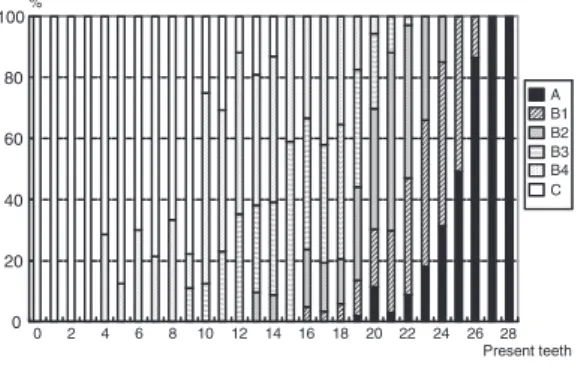
IRUCAA@TDC : Relationship between Eichner Index and number of present teeth.
5
0
0
全文
(2) Bull Tokyo Dent Coll (2012) 53(1): 37–40. Short Communication. Relationship between Eichner Index and Number of Present Teeth Koichi Yoshino, Ikuo Kikukawa*, Yasushi Yoda**, Hidehiko Watanabe***, Kakuhiro Fukai****, Naoki Sugihara and Takashi Matsukubo. Department of Epidemiology and Public Health, Tokyo Dental College, 1-2-2 Masago, Mihama-ku, Chiba 261-8502, Japan * Kikukawa Dental Clinic, 2-8-21-3F Shakujii, Nerima-ku, Tokyo 177-0041, Japan ** Yoda Dental Clinic, 1-2-12 Yushima, Bunkyo-ku, Tokyo 113-0034, Japan *** Department of Adult Restorative Dentistry, University of Nebraska Medical Center, College of Dentistry, 40th and Holdrege Sts., Lincoln, Nebraska 68583-0750, USA **** Fukai Institute of Health Science, 3-86 Hikonari, Misato, Saitama 341-0003, Japan Received 13 May, 2011/Accepted for publication 16 November, 2011. Abstract The aim of this study was to determine the percentage of participants in each of the six Eichner Index groups by number of present teeth (PT). The data were obtained from a periodontal disease examination carried out under a health promotion law in a city located northeast of Tokyo, Japan, in 2005. Data from a total of 1,549 (524 male and 1,025 female) 60-year-old participants were analyzed in this study. Number of occlusal supports was counted by analyzing dental charts. The Eichner Index was used to group the participants into six groups based on distribution of occlusal support teeth. The percentage of patients in Group A with 24 PT was 31.4%; none in Group A had fewer than 19 PT. The percentage in Groups A, B1, and B2 with between 20 and 28 PT was above 50%; the number of participants in these groups with fewer than 20 PT decreased rapidly. Those with fewer than 16 PT were almost found in Groups B3, B4 and C. Only a few patients in Group C had between 10 and 14 PT; those with fewer than 9 PT were only found in Groups B4 or C. Based on these results, the Eichner Index category of a given participant can be estimated from number of PT. Key words:. Eichner Index — Present teeth — Adults. Introduction. developed a new system for classification of partial edentulous arches. The Eichner Index is based on occlusal contact between naturally existing teeth in the premolar and molar regions. These regions are divided into four supporting zones, two in the molar and two in the premolar regions. A patient is classified as belonging to one of six groups based on the presence or absence of intermaxillary tooth contact in these four zones. After that, Eichner2) classified partial edentulous arches. The Survey of Dental Diseases in Japan14), while providing important data on oral health status, includes none on occlusal status. In our previous study22) investigating the relationship between occlusal support and number of present teeth (PT), we demonstrated that number of PT allowed estimation of number of occlusal supports. More than five decades ago, Eichner3) 37.
(3) 38. Yoshino K et al.. by the Eichner Index once again, showing that this classification provided a standard for degree of mortality of the dentition and that it was suitable for application to studies on morbidity statistics. Many studies have used the Eichner Index or a modified version thereof 1,5–9,11,13,18,19,21). Concerning the relationship between the Eichner Index and number of PT, Österberg and Landt et al.16) suggested a strong corre lation between Eichner Index classification and number of teeth. Although the mean number of PT by the Eichner Index has been reported16,17), to our knowledge, no studies have investigated the percentage of participants in each Eichner Index category by number of PT. Our hypothesis was that percentage of par ticipants in each group would change rapidly with tooth loss, due to the tendency for tooth loss to begin from the posterior region. The aim of this study was to determine the percentage of participants in each of the six Eichner Index groups by number of PT. Determining the relationship between Eichner Index classification and number of PT would allow estimation of occlusal status from number of PT and number of PT from Eichner Index classification. This would enable researchers to use data and reports which do not include occlusal status. Conversely, number of PT could be estimated from research reporting only Eichner Index data.. Methods Data were collected from a periodontal disease examination conducted in a city located northeast of Tokyo, Japan, in 2005. This examination targeted people aged 40, 50, and 60 years, and was based on a municipal health promotion law. Data obtained from 1,549 60-year-olds (524 male and 1,025 female) were analyzed in this study. This age was selected as tooth loss increases rapidly from around the age of 60 years in Japan14). Number of PT was obtained from the individual dental charts. Completely and partially erupted permanent teeth were defined as “present teeth” (i.e., existing teeth) in this study. Supernu-. Table 1 Classification by Eichner Index. Eichner . Index. A . Example from typical patient’s dentition 7 6 5 4 3 2 1 1 2 3 4 5 6 7 7 6 5 4 3 2 1 1 2 3 4 5 6 7 7 6 5 4 3 2 1 1 2 3 4 5 6 7 7 4 3 2 1 1 2 3 4 5 6 7 7 4 3 2 1 1 2 3 4 6 7 6 5 4 3 2 1 1 2 3 4 5 6 7 . 7 6 5 4 3 2 1 1 2 3 4 5 6 7 B1 5 4 3 2 1 1 2 3 4 5 6 7 . B2 5 4 3 2 1 1 2 3 4 5 7 6 5 4 3 2 1 1 2 3 4 5 6 7 . 7 6 5 4 3 2 1 1 2 3 4 5 6 7 B3 3 2 1 1 2 3 4 . 7 6 5 4 3 2 1 1 2 3 4 5 6 7 B4 3 2 1 1 2 3 . C . — 7 6 5 4 3 2 1 1 2 3 4 5 6 7 — —. merary teeth, third molars, pontics of bridge prostheses, and implant-supported superstructures were not counted as PT. Number and distribution of occlusal supports were determined by analyzing dental records. Any opposing pair of maxillary and mandibular teeth with the same tooth number was counted as one occlusal support. We used the Eichner Index2,3) to classify the patients into six groups based on distribution of occlusal support teeth (Table 1). The Eichner Index is based on the presence or absence of occlusal contact in each of the premolar and molar regions, which are called supporting zones. A maximum of four supporting zones can exist, each of which must have at least one tooth in contact with an antagonist in order to be counted. In this study, the participants were divided into six groups as follows: A (four supporting zones), B1 (three supporting zones), B2 (two supporting zones), B3 (one supporting zone), B4 (anterior tooth contact but no supporting zones), and C (no occlusal contact among the few remaining teeth).. Results The percentage of participants in each of the six Eichner Index groups by number.
(4) Eichner Index by Number of PT 100. %. 80. A B1 B2 B3 B4 C. 60 40 20 0. 0. 2. 4. 6. 8. 10. 12. 14. 16. 18. 20. 22. 24. 26 28 Present teeth. Fig. 1 Percentage of participants in each of Eichner Index category by number of PT. n=1,549, 60-year-olds.. of PT is shown in Fig. 1. The percentage in Group A decreased with decrease in number of PT. In Group A, patients with 24 PT occupied 31.4%; none in Group A had fewer than 19 PT. Over 50% of patients in Groups A, B1, and B2 had between 20 and 28 PT; the number of patients with fewer than 20 PT in these groups decreased rapidly, however. Those with fewer than 16 PT were found almost in Groups B3, B4 and C. Only a few participants with between 10 and 14 PT were found in Group C; those with fewer than 9 PT were only found in Groups B4 or C.. Discussion Rules concerning how to count occlusal supports remain to be well established. In fact, although the term “occlusal supports” is frequently used, there is still no consensus on its definition. For example, Österberg et al.15) used a modified Eichner classification which included contact with and between artificial teeth in bridges and dentures in addition to contact between natural teeth. Lachmann et al.10) investigated dentition including implantsupported segments. In this study, we analyzed patient dental records. Number of occlusal supports may also be influenced by malocclusion, but this is rare enough to be ignored in this case due to the large sample size. In this study, a direct relationship was observed between number of PT and Eichner Index classification. This result is consistent. 39. with that of Österberg and Landt16), in which mean number of PT decreased as Eichner Index classification moved from Group A to C. The Survey of Dental Diseases in Japan in 200514) and our previous study22) showed a certain sequence of tooth loss — first molars were the first teeth to be lost, followed by mandibular second molars, maxillary second molars and then maxillary first molars in people around 60 years of age. This tendency has a strong impact on the direct relationship between number of PT and Eichner Index classification. The relationships between Eichner Index classification and masticatory efficiency (assessed as comminution efficiency)6–9,11,13,18,21), masti catory ability (self-reported)6,11,18,21), and bite force6,8,11,18,21) has been reported. Of course, a precise evaluation of occlusal function cannot be obtained from number of PT. However, the results of this study show that a patient must maintain 20 PT or more in order to have at least two occlusal support zones. In Japan, the 8020 campaign, which encourages the elderly to retain at least 20 teeth until the age of 80, has been in place since 198912). The WHO stated in 1992 that throughout life, the retention of a functional, aesthetic, natural dentition of 20 teeth, without pros theses, should be the treatment goal for oral health20). However, in this study, 70% of subjects with 20 PT did not have more than two occlusal support zones. Of course, 20 teeth is a good target for oral health instruction, but the relationship between occlusal support (as measured by the Eichner Index) and masticatory efficiency6,7,11) must also be considered. In this study, 5% of those with 20 PT only had anterior occlusal contact, and 20% only had occlusal contact in one posterior zone in addition to anterior contact. Therefore, even for patients with 20 PT, dental professionals may need to consider prosthodontic treatment options in some cases. The results of the present study also show that there will be only anterior support, if any at all, when number of PT is lower than 9. Fukai et al.4) reported on the mortality of a cohort of community-residing older people..
(5) 40. Yoshino K et al.. That study indicated that, above the age of 80 years, participants with fewer than 10 functional teeth showed a significantly higher rate of overall mortality than those with 10 PT or more. The results of this present study provide the means to estimate the approximate Eichner Index classification of a patient from number of PT. References 1) Capurso U (1990) Dental occlusion and temporomandibular involvement in rheumatic pathology. Minerva Stomatol 39:327–335. 2) Eichner K (1990) Renewed examination of the group classification of partially edentulous arches by Eichner and application advices for studies on morbidity statistics. Stomatol DDR 40:321–325. 3) Eichner K (1955) Über eine gruppeneinteilung der lückengebisse für der prothetik. Dtsch Zahnarztl Z 10:1831–1834. (in German) 4) Fukai K, Takiguchi T, Ando Y, Aoyama H, Miyakawa Y, Ito G, Inoue M, Sasaki H (2007) Functional tooth number and 15-year mortality in a cohort of community-residing older people. Geriatr Gerontol Int 7:341–347. 5) Haase G, Eichner K (1979) Determination and position of the masticatory surface complex and clinically necessary corrections (with special regard to Fehr’s calotte articulation). Dtsch Zahnarztl Z 34:582–590. (in German) 6) Ikebe K, Hazeyama T, Iwase K, Sajima H, Gonda T, Maeda Y, Nokubi T (2008) Association of symptomless TMJ sounds with occlusal force and masticatory performance in older adults. J Oral Rehabil 35:317–323. 7) Ikebe K, Matsuda K, Morii K, Furuya-Yoshinaka M, Nokubi T, Renner RP (2006) Association of masticatory performance with age, posterior occlusal contacts, occlusal force, and salivary flow in older adults. Int J Prosthodont 19: 475–481. 8) Ikebe K, Morii K, Matsuda K, Nokubi T (2007) Discrepancy between satisfaction with masti cation, food acceptability, and masticatory performance in older adults. Int J Prosthodont 20:161–167. 9) Kikutani T, Tamura F, Nishiwaki K, Kodama M, Suda M, Fukui T, Takahashi N, Yoshida M, Akagawa Y, Kimura M (2009) Oral motor function and masticatory performance in the community-dwelling elderly. Odontology 97: 38–42. 10) Lachmann S, Engel E, Axmann D, Weber H (2004) Radiographic study of changes in the mandibular condyle after implant prostho. dontic rehabilitation. Int J Prosthodont 17: 565–570. 11) Miura H, Araki Y, Hirai T, Isogai E, Hirose K, Umenai T (1998) Evaluation of chewing activity in the elderly person. J Oral Rehabil 25:190–193. 12) Miyatake K (1992) 8020 movement. J Jpn Dent Assoc 45:15–24. (in Japanese) 13) Ono T, Kohda H, Hori K, Nokubi T (2007) Masticatory performance in postmaxillectomy patients with edentulous maxillae fitted with obturator prostheses. Int J Prosthodont 20: 145–150. 14) Oral Health Association (2007) The Statistical Analysis Committee on the Survey of Dental Diseases. Comprehensive Guide to the Survey of Dental Diseases 2005, Oral Health Association, Tokyo. (in Japanese) 15) Österberg T, Hedegård B, Säter G (1983) Variation in dental health in 70-year old men and women in Göteborg, Sweden. Swed Dent J 7:29–48. 16) Österberg T, Landt H (1976) Index för bettstatus för epidemiologiska studier och kliniskt bruk. Tandlaekartidningen 68:1216– 1223. (in Swedish) 17) Österberg T, Mellström D, Sundh V (1990) Dental health and functional ageing. Community Dent Oral Epidemiol 18:313–318. 18) Österberg T, Tsuga K, Rothenberg E, Carlsson GE, Steen B (2001) Masticatory ability in 80-yearold subjects and its relation to intake of energy, nutrients and food items. Gerodontology 19: 95–101. 19) Sato H, Österberg T, Ahlqwist M, Carlsson GE, Gröndahl HG, Rubinstein B (1996) Association between radiographic findings in the mandibular condyle and temporomandibular dysfunction in an elderly population. Acta Odontol Scand 54:384–390. 20) World Health Organisation (1992) Recent advances in oral health. WHO Technical Report Series. No.826, pp.16–17, WHO, Geneva. 21) Yamashita S, Sakai S, Hatch JP, Rugh JD (2000) Relationship between oral function and occlusal support in denture wearers. J Oral Rehabil 27:881–886. 22) Yoshino K, Watanabe H, Fukai K, Sugihara N, Matsukubo T (2011) Number of occlusal units estimated from number of present teeth. Bull Tokyo Dent Coll 52:155–158. Reprint requests to: Dr. Koichi Yoshino Department of Epidemiology and Public Health, Tokyo Dental College, 1-2-2 Masago, Mihama-ku, Chiba 261-8502, Japan Tel: +81-43-270-3746 Fax: +81-43-270-3748 E-mail: [email protected].
(6)
図

関連したドキュメント
In this section we will show that in the case of a generic quadric the variety G(n, Q) is 2-incompressible, and also will formulate the conjecture describing the canonical dimension
In previous work [11], the author shows that in the general case of functions f : G → N between arbitrary finite groups G and N , bundle and graph equivalence have a common source
We prove that the spread of shape operator is a conformal invariant for any submanifold in a Riemannian manifold.. Then, we prove that, for a compact submanifold of a
The approach based on the strangeness index includes un- determined solution components but requires a number of constant rank conditions, whereas the approach based on
2 Similarity between number theory and knot theory 4 3 Iwasawa invariants of cyclic covers of link exteriors 4.. 4 Profinite
A line bundle as in the right hand side of the definition of Cliff(X ) is said to contribute to the Clifford index and, among them, those L with Cliff(L) = Cliff(X) are said to
Related to this, we examine the modular theory for positive projections from a von Neumann algebra onto a Jordan image of another von Neumann alge- bra, and use such projections
[25] Nahas, J.; Ponce, G.; On the persistence properties of solutions of nonlinear dispersive equa- tions in weighted Sobolev spaces, Harmonic analysis and nonlinear
