JAIST Repository
https://dspace.jaist.ac.jp/
Title 緊急時の意思決定に対する自己認識を促進する学習プ
ラットフォームに関する研究
Author(s) Chaianun, Damrongrat Citation
Issue Date 2018‑03
Type Thesis or Dissertation Text version ETD
URL http://hdl.handle.net/10119/15315 Rights
Description Supervisor:池田 満, 知識科学研究科, 博士
A Learning Platform for Cultivating Learner’s Self-Awareness on Human
Decision-making in an Emergency Situation
Chaianun DAMRONGRAT
Japan Advanced Institute of Science and Technology
Doctoral Dissertation
A Learning Platform for Cultivating Learner’s Self-Awareness on Human
Decision-making in an Emergency Situation
Chaianun DAMRONGRAT
Supervisor: Professor Mitsuru Ikeda School of Knowledge Science
Japan Advanced Institute of Science and Technology
March 2018
ABSTRACT
Self-awareness is an important skill that each individual needs in daily life. It is even more important in a critical situation. However, it is difficult to be aware of one’s own thinking process. A person may have useful knowledge for a certain situation; however, they may fail to apply it to solve a problem they encounter. For example, people may know that competing with others for a single exit immediately causes the evacuation flow to become clogged. However, many of them may still behave improperly and emotionally when they confront the actual situation. One of the possible reasons is that ordinary people may not have many opportunities to realize how their decision-making affects their behaviour. Unlike the emergency services, such as the police, fire fighters, and rescue teams who have been trained to cope with emergency situations, ordinary people tend to behave inappropriately. It is therefore important for people to be able to apply the right knowledge to a situation and to improve their self-awareness of their thinking process.
However, self-awareness is very difficult to cultivate, because mental processes are implicit and vague.
With regard to learning about self-awareness, authors believe that surprise caused by self-awareness could be a good activator for learning. We are not aware of how we can think or behave to cope with a situation and we often believe that we can think appropriately, although there may be not any evidence of this. If we can observe our thinking process and realize that the result of our thinking is not reasonable, we will be “surprised” to find that we are not good at thinking and then we will be motivated to cultivate our self-awareness of our thinking process.
The role of surprise is a trigger that makes learners have a deeper realization of their own thinking process. This dissertation has two objectives: 1) to motivate learners to cultivate self-awareness of their thinking process in an emergency, and 2) to propose a learning platform using surprise as a trigger for learning.
The proposed learning platform consists of three phases. 1) The Anticipating Phase: its objective is to let learners collect information in a learning environment, interpret it in terms of parameters, analyse information and make a prediction of the behaviours of agents in the microworld. These activities would allow the learners to present their current thinking process. 2) The Evaluation Phase: the objective of this phase is to let the learners evaluate their prediction results and observe the outcomes generated by a simulation system. The learners can compare the two results to find out which are similar or different. 3) The Self-monitoring Phase: if the comparison results from Phase 2 are different, it implies that the thinking process of the learners and the simulation’s mechanism are different. The learners might feel surprised at this and they would then like to know what caused the different results. In this way, the learners start to monitor their own thinking process. They can modify the simulation’s parameters to test their hypothesis. Thus, the awareness of their thinking process has begun. Our research hypothesis is that surprise will be a good learning trigger to deepen self-awareness of a person’s thinking process and will cause them to reflect on their own behaviour if they are ever in an actual emergency situation.
Keywords: self-awareness, emotion-based decision-making model, microworld, surprise, learning platform
ACKNOWLEDGEMENTS
Firstly, I would like to express my truthful thanks to my supervisor, Professor Mitsuru Ikeda, for everything I have received since the first day in Ikeda lab until now. There are many things I have got from sensei; research experience, thinking process, chances, Japanese cultural knowledge and many more. Thank you very much.
Secondly, I would like to thank my colleagues in National Electronics and Computer Technology Center (NECTEC, Thailand) especially Dr. Thepchai Supnithi who suggested me to submit an application to JAIST; Dr. Chai Wutiwiwatchai and Dr. Alisa Kongthon who allowed me the great chance to study abroad.
Thirdly, friends at Japan Advanced Institute of Science and Technology (JAIST), faculty members, Japanese sensei. Thank to Oat, Nee, Jo, Ouan, Yeepun, P’Noom, Nam, Waan, Ryo, Ikue, Steve, and many people that have shared good and bad memories with me. I cannot list you all here.
Fourthly, all respondents who kindly participated in to the experimentation. They were busy at that time, but still shared their precious time for this research. I am really appreciated.
Last but not the least, I would like to thank to my family who always support and believe in me. Thank you very much.
TABLE OF CONTENT
ABSTRACT ... i
ACKNOWLEDGEMENTS ... ii
LIST OF FIGURES ... vii
LIST OF TABLES ... xii
INTRODUCTION ... 1
CHAPTER 1 1.1. Research motivation ... 3
1.1.1. An unexpected situation can motivate awareness ... 3
1.1.2. An unexpected situation can enhance cognition ... 4
1.2. Research objectives ... 4
1.3. Research plan ... 5
1.3.1. To use an indoor fire emergency as learning scenarios ... 6
1.3.2. To provide a learning platform aiming to let surprise occurred ... 7
1.3.3. To expect learners being motivated to become more aware of their thinking processes ... 8
1.4. Significance and originality of the study ... 9
1.5. Dissertation overview ... 10
LITERATURE REVIEW ... 12
CHAPTER 2 2.1. Self-awareness and learning ... 12
2.2. Surprise and learning ... 13
2.3. Emotion and decision-making ... 13
2.4. Human behavior under emergency ... 15
2.5. Simulated emergency and decision-making implementation ... 15
2.6. Modeling of human behavior ... 16
2.7. Conclusion and discussion ... 17
RESEARCH METHODOLOGY ... 18
CHAPTER 3 3.1. Designing of the experiment ... 19
3.1.1. Analyzing necessary components for design an experiment ... 19
3.1.2. Designing a learning platform using surprise as a learning trigger ... 20
3.1.3. Designing an experimentation ... 21
3.2. Designing of learning materials ... 22
3.2.1. Learning materials in pre-learning ... 22
3.3. Designing of questionnaires ... 25
3.4. Conclusion and discussion ... 28
MICROWORLD ... 29
CHAPTER 4 4.1. Introduction ... 29
4.2. Role of Microworld in the learning aspect ... 29
4.3. Category of Microworld ... 30
4.3.1. Traditional Microworld ... 30
4.3.2. Half-Baked Microworld ... 31
4.4. Limitation of the existing Microworlds ... 31
4.5. Soft-Half-Baked Microworld ... 32
4.6. Conclusion and discussion ... 34
DESIGN OF THE RATIONAL-EMOTIONAL DECISION-MAKING CHAPTER 5 MODEL 36 5.1. Introduction ... 37
5.2. What is the rational-emotional decision-making model (RED model)? ... 38
5.3. Objective of RED model ... 40
5.3.1. Objective 1: To allow the designed simulated phenomenon to occur ... 40
5.3.2. Objective 2: To represent simulated behaviors of helping others and escaping to the nearest exit of and simulated agent ... 41
5.4. Role of the RED model from learning aspect ... 41
5.5. Design of the RED model ... 43
5.6. Decision-making rules ... 47
5.7. Summary ... 48
CORRESPONDENCE OF THE RED MODEL TO THE SOFT-HALF- CHAPTER 6 BAKED MICROWORLD AND ITS DECISION-MAKING RULES ... 49
6.1. Correspondence between the RED model and the soft-half-baked microworld ... 50
6.2. Correspondence between RED model and decision-making rules ... 51
6.2.1. Making goal ... 52
6.2.2. Collecting information ... 54
6.2.3. Making criteria ... 55
6.2.4. Making alternative ... 58
6.2.5. Predicting outcomes for each alternative ... 59
6.2.6. Selecting the best alternative ... 62
6.3. Summary ... 69
LEARNING MATERIAL ... 71
CHAPTER 7 7.1. Objective of the designed learning materials ... 74
7.2. Scopes and concerns of the designed learning course ... 75
7.2.2. Why does the indoor fire emergency is selected as the learning scenarios ... 77
7.2.3. The trial use case is conducted in Thai language ... 78
7.2.4. How to implement and measure the surprise to happen ... 78
7.3. Content of the learning materials ... 79
7.3.1. The learning materials in pre-learning phase ... 80
7.3.2. Explanation of using the simulation ... 84
7.3.3. Questionnaire and its intention ... 91
7.4. Summary ... 94
TRIAL USE CASE OF THE DESIGNED LEARNING COURSE ... 96
CHAPTER 8 8.1. Target of respondents ... 96
8.2. Experiment setting ... 97
8.3. Expected learning results ... 97
8.4. Result of trial use case ... 101
8.4.1. Example reports the learners could observe ... 101
8.4.2. Result from questionnaire ... 103
8.5. Conclusion and discussion ... 126
8.5.1. Discussion: evidence of the surprise is occurred in the trial use case ... 127
8.5.2. Discussion: evidence of being motivated to realize own thought in the trial use case 128 8.5.3. Discussion: differentiation a rational thinking and an emotional thinking .. 130
8.5.4. Discussion: Limitations ... 131
CONCLUSION AND DISCUSSION ... 135
CHAPTER 9 9.1. Conclusion ... 135
9.2. Significance of research outputs ... 137
9.2.1. Original research ... 137
9.2.2. Impact on the knowledge science community ... 138
9.2.3. Impact on the academic community ... 138
9.3. Limitation and future work ... 138
9.4. Discussion ... 139
LIST OF PUBLICATIONS ... 142
REFERENCES ... 143
APPENDIX A. DECISION-MAKING RULES ... 147
LIST OF FIGURES
Figure 1-1Knowledge-to-action gaps. A person has knowledge (solid-oval A) to solve a problem in a certain situation. He is expected to perform expected action 1 (solid-oval B) to handle that situation. However, with too much emotion (dash-oval C), that person perform actual action 1 (dash-oval D) instead. The knowledge-to-action gaps is the difference
between expected action 1 and actual action 1 ... 2 Figure 1-2 Gaining self-awareness ability (dot-oval E) to reduce the knowledge-to-action gaps caused by too much emotion (dash-oval C). With awareness, a person can apply his knowledge while balancing it with his emotion. As a result, the person performs actual action 2 (dot-oval F.) ... 3 Figure 3-1 Outline of research methodology ... 18 Figure 3-2 Outline of the proposed learning plat form using surprise as its learning trigger for motivating self-awareness ... 20 Figure 3-3 the learning material to allow learners to understand stand how important of self- awareness. The content of this news is a son noticed his mom got an electric shock, he tried to help her but both of them were dead ... 23 Figure 3-4 Learning materials to allow learners to understand how important of self-
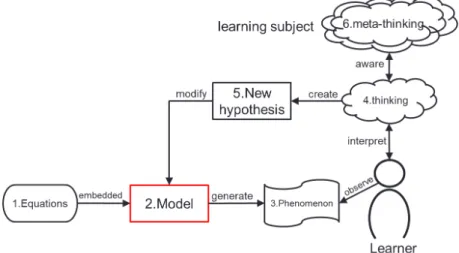
awareness. The content of this news is a young cameraman felt guilty that the did not help an old man escaping Tsunami on 3/11. He filmed the event instead. ... 23 Figure 3-5 Demonstration's interface to allow learners to understand how the simulation work ... 24 Figure 3-6 The experiment version's interface. There are obstacles and more types of agent25 Figure 3-7 The outline of the experimentation process. ... 28 Figure 4-1 In Traditional- and Half-Baked Microworld, the learning subject is the equations which the learner is expected to understand. Thus, the model is required a well-defined equations or rules. ... 32 Figure 4-2 In Soft-Half-Baked Microworld, the learning subject is meta-thinking. Thus, the learners are expected to aware their own thinking process, not the equations embedded into the model. ... 33 Figure 5-1 This figure presents a general concept of the soft-half-baked microworld. It
consists of modules. The RED model is represented as module no.2 with a red colored rectangle. Decision-making rules, module no.1, are embedded in the RED model to generate a simulated specific phenomenon, module no.3. A learner is expected to be aware of their thought, module no. 6, by comparing its own thoughts in module no. 4, and results of the simulated phenomenon are observed in module no. 3. A new idea might occur while the learner compares their thoughts with the simulated results. The learner may test their hypothesis, module no. 5, by modifying the simulation parameters and repeating the simulation to observe how the newly simulated results should be evaluated the test if the hypothesis make sense or not. ... 38
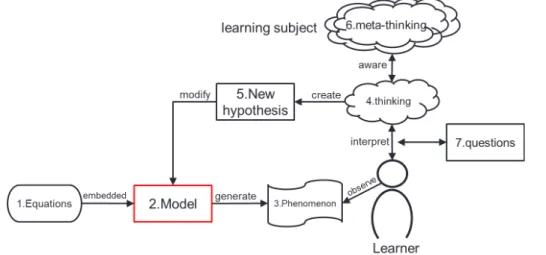
Figure 5-2 From learning point of view, the role of the RED model, presented as module no.2 with red colored rectangle, is to provide chances for learners to realize their own thought.
Learners can obverse the simulated phenomenon, module no.3, generated by the RED model, and compare the simulated results with their predictions. Prediction results, especially the different one, are expected to cause the learners to feel surprised and curious to find out reasons that make the differences happen. They may question themselves about their thought, module no.4. They may even try to modify simulation parameters to test their new hypothesis if they need, module no.5. We carefully prepare questionnaires to guide the learners to
question their own thought, module no. 7. As a result, learners are motivated to realize their own thought, module no.6. ... 42 Figure 5-3 The RED model consists of 6 submodules for making a decision. Without emotion, it can be considered as a rational decision-making model. However, emotion could take place and cause impact to any submodule. As a result, the decision becomes an emotional decision- making. ... 44 Figure 6-1 Overview of the solf-half-baked microworld shows relation between the RED model (no.2) and other modules. The soft-half-baked microworld is divided into front-end and back-end. The front-end is user interface that a learner can interact with. The back-end unit consists of the RED model (no.2) and a set of decision-making rules (no.1) designed following the RED model’s concept. The back-end unit is hidden from the learner. However, the learner may guess how the mechanism of the RED model and its decision-making rules work through observing the simulated phenomenon (no.3.) The RED model works together with its decision-making rules to make the soft-half-baked microworld a specific designed learning environment for the learner. ... 49 Figure 6-2 The RED model consists of 6 main modules: making goal, collecting information, making criteria, making alternative, prediction outcomes of alternatives, and selecting the best alternative, respectively. Without emotion, this model can be considered as rational decision-making model. However, emotion could be engage to any module, and cause an emotional decision-making. ... 51 Figure 6-3 Overview of selecting the best alternative module. This module is divided into three processes. First, assess risk acceptation (no.1 in the figure.) This process performs risk acceptation for each alternative from a considering agent’s point of view. It assesses risk estimations from the previous module. Second, categorizing and ranking each alternative (no.2 in the figure.) This process categorizes each alternative into one of four categories: top candidate, candidate, ignored candidate, and the rest. Third, selecting the best alternative (all processes in the dash-rectangle in the figure.) there are four sub-processes to handle cases that have multiple candidate alternatives remained. Briefly description is to use the agent’s intention to select the best alternative. If there still are multiple alternatives remained, select the least distance to an exit or a handicapped responding to escaping or helping intention, respectively. If there still are multiple alternative remained, random one of them as the best alternative. ... 63 Figure 7-1 A concept of the learning platform using surprise to motivate learners to be aware of their thought. There are three phases: anticipating, evaluating and self-monitoring phases (presented with blue-colored as no.1-3), respectively. A learner observes a given
phenomenon (a) and use its current knowledge to predict its expected outcomes (b.) The learner explicitly expresses its predicted opinion (c.) The learning platform has a scaffolder which plays a role for giving alternative opinion to the learner. This scaffolder can be a person or a system. In this research, the scaffolder is a simulation system created by
following concepts of the soft-half-baked microworld mentioned in chapter 5. The simulation
system provides alternative opinions to the learner. The learner compares its own opinions with the alternative opinions. Comparison results, especially the different ones, are expected to cause the learner feel surprise (d.) The difference can imply that the learner’s thought is different to the simulation’s mechanism. The learner reflects the comparison results to itself (e.) The learner may try to figure out what causes the different comparison to happen. As a result, the learner is expected to be better aware of its thinking process. ... 72 Figure 7-2 A news is about an emergency of electric shock. There was a woman who was collapsed by electrical shoeck. Her son found her and attempted to bring her out. However, both of them were dead by the electrical shock. ... 81 Figure 7-3 This news is about incident of tsunami in Tōhoku area, Japan (2011.) The story is about a cameraman felt guilty because he did not help an old man escape to a safe place. He took a video instead. However, a son of the old man came to meet him with gratitude for the video he took. The son said it was good for him to not help his father, otherwise he may not survive too. ... 82 Figure 7-4 The overview of the learning course. It is divided into six steps. The first two steps, 1 and 2, represent as the pre-learning phase. Step no.3 and 4 represent the main-learning phase. Finally, the step no.5 and 6 represent the post-learning phase. ... 84 Figure 7-5 A floor plan's layout of a building which is used in the learning course. There are 21 rooms, 2 exits. Applying with the graph-based theory, it can be represented as 22 nodes and 27 edges in a graph. Each node in the graph is represented as a black square dot. Each node dominates its own area representing in colors. The red-rectangle are exits. The white colored rectangles represent doors or passages connecting between two areas. ... 85 Figure 7-6 Example situation that an agent tends to help a handicapped. The counter of helping intention factor, factor no.3 in Table 7-3, is increasing whenever there is an agent have an intention to help a handicapped. If the agent can reach to the handicapped, the counter of accessible help is increased (factor no.4.) Moreover, if the agent and the handicapped manage to escape to an exit successfully, the counter of success escaping is increased (no.5.) On the other hand, if the agent cannot reach to the handicapped, the counter of failed access is increased (no.6). If the agent can reach to the handicapped (no.4), but they are failed for escaping (no.7), the counter of failed escaping is increased. ... 87 Figure 7-7 Simple UI presents the display of the live simulation that a learner can observe.
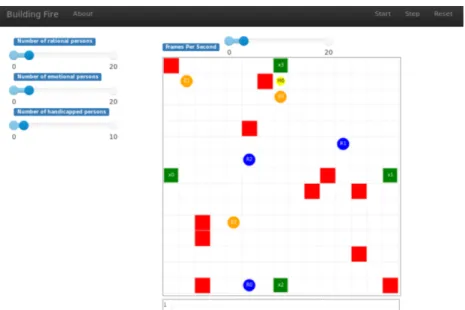
Parts a and b, red colored rectangles, are allowed a learner to interact with. Part a. is a controller for running the simulation. It can control start/stop running, run step-by-step, and reset the simulation. Part b. is parameter settings. In this simple UI shows only number of each type of agent. Part c., green-colored rectangle, presents the movement of components in the simulation. The rectangles represent structures and incidents such as exits and fires.
While the circles represent simulated agents. The red, green and brown colored rectangles present the fire, exit, and burnt exit, respectively. The burnt exit is the exit that covered with fire. It is broken and cannot be used for escape anymore. The blue, orange and yellow colored circles represent the rational, emotional, and handicapped agents, respectively. Part d., light blue colored rectangle, presents the live report about number of survivors, deaths, and other factors presented in Table 7-4. In the actual UI, the live reports is presented beneath part c. 88 Figure 7-8 UI of the actual simulation that the learners use in the learning course. There are four parts the same as the simple UI in Figure 7-7. However, part b. and part c are different.
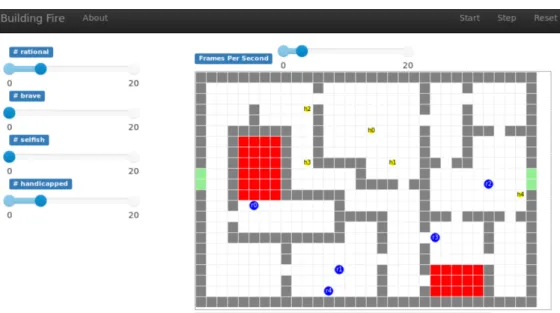
The parameters in part b are number of rational, brave, selfish and handicapped agents.
Moreover, another parameter named “emotional boost” is added. This parameter is as a switch to turn on or turn off (default is turn off.) If it is turn on, all agents are affected by
emotions more than usual. For the part d, the map is larger and there are walls too. The map represents the layout in Figure 7-5. The wall is represented by gray colored rectangle. Agents are represented as circles the same as Figure 7-7; however, the colors are a bit different. The rational, brave, selfish, and handicapped agents are blue, orange, light-blue, and yellow colors, respectively. ... 89 Figure 7-9 Example average results of the fifty runs. The information generated from the simulation. They are seven concerning factors that are asked the learners to make their predictions. This information can be plot as graphs to present the learners as depicted in Figure 7-10. ... 90 Figure 7-10 Example graphs which are results of the batch run. Figure a., on the left side, presents comparative average values of seven concerning factors among different types of agents: rational, brave, selfish, and handicapped agents. Figure b, on the right side, is an example information of the rational agent. The graph presents relation between
helpling_intention (x-axis) and failed_escaping (y-axis.) The graph is presented in hex-bin format. The darker color means the more frequency that happened in the simulations. For example, the darkest color in this figure is a value around coordinate (5,0). It means there are 8 times (the darkest color) out of 50 runs that the rational agent have 5 time of
helping_intention, and there are 0 time of failed_escaping that they are failed to help the handicapped. ... 90 Figure 7-11 Overview of the questionnaires that are used for both the main-learning and the post-learning phases. The questionnaires are divided into four parts. Part A, B and C are belonged to the main-learning phase. They aim to collect general information (part A and B) and guide the learners to make predictions and give the reasons that make them answer as they did. Part D is belonged to the post-learning phase. It aims to guiding the learners to question their thought and be aware of their thinking processes. ... 91 Figure 8-1 The overview of the questionnaires. The questionnaires are divided into four parts.
The first three parts, A, B, and C, are belonged to the main-learning phase, while part D is belonged to the post-learning phase. Part A, B and C aim to guide the learners carefully think to express their predictions and reasons supporting the predictions. Part D aims to guide the learners to gradually question themselves about their thinking process and motivate them to be aware of their thought. ... 101 Figure 8-2 Example of a report that each learner can observe. This resport is results
corresponding to simple scenario Predition 01 described in Table 3-2. This case is a scenario that there are 5 rational, and 5 handicapped in the scenario. ... 102 Figure 8-3 Example of a report that each learner can observe. This report is results
corresponding to mixture-of-agent scenario Prediction 02 described in Table 3-3. This case is a scenario that there are 5 agents for each agnet type. ... 103 Figure 8-4 Gender of respondents: blue color is male, red color is female ... 103 Figure 8-5 Age of respondents ... 104 Figure 8-6 Monitor learner's mind that which agent type tend to have "helping intention".
Blue, Red and Orange color are High, Medium and Low, respectively. ... 105 Figure 8-7 Monitoring learner's mind that which agent type tend to have "escaping intention" . Blue, Red, Orange colors are High, Medium and Low, respectively ... 106 Figure 8-8 Prediction results of which agent type would have the highest numbers of
survivors. R, B and S are Rational, Brave and Selfish, respectively ... 108
Figure 8-9 Prediction of which agent type would support the handicapped to have the highest rate. R, B and S are Rational, Brave and Selfish, respectively ... 110 Figure 8-10 Prediction of which agent type would have helping intention the most. R, B, S are Rational, Brave and Selfish, respectively. ... 111 Figure 8-11 Prediction of which agent type would be able to reach to handicapped person the most. R, B, S are Rational, Brave and Selfish, respectively ... 113 Figure 8-12 Prediction of which agent type would be able to take the handicapped to exit successfully. R, B, S are Rational, Brave and Selfish, respectively ... 114 Figure 8-13 Prediction of which agent type would be failed to reach to Handicapped the most.
R, B, S are Rational, Brave and Selfish, respectively. ... 116 Figure 8-14 Prediction of how does increasing number of agents would change the survival rate and Red color are decreaing and increasing, respectively. Purple, Green and Orange color are no impact, depend on situation, and the same rate (from other option) ... 117 Figure 8-15 Results of comparison between predicted outcomes and simulated outcomes. Y- axis, from top to bottom, represents question no.5, 7, 9, 11, 13, 15 and 17, respectively. X- asis is number of learners. ... 119 Figure 8-16 Which comparison that the learner feels questionable the most. Y-axis, from top- to bottom, represents question no. 5, 7, 9, 11, 13 and 17, respectively. ... 122 Figure 8-17 what is the feeling toward questionable questions no.22 ... 123 Figure 8-18 does the feeling in question no.24 motivate the learners to think about their thinkingprocess or not. Blue color is yes. Red and orange colors could represent the same meaning, no. ... 124 Figure 8-24 Outline of the learning activities which are divided into six steps. They are used in this trial use case for conduct the learning course. ... 125 Figure 8-25 This graph presents which learning steps that the learners consider it to stimulate them to think about their own thinking process the most. The prediction and reasoning step, no.3 and no.6, are the most votes ... 126 Figure 8-26 proportion between the learners who said they are motivated to realize of their thought and the learner who think the reasoning step stimulate them to realize their thought the most. The learner who selected the reasoning step as stimulating them the most are 40%
of ones who said they are motivated to realize their thought. ... 126
LIST OF TABLES
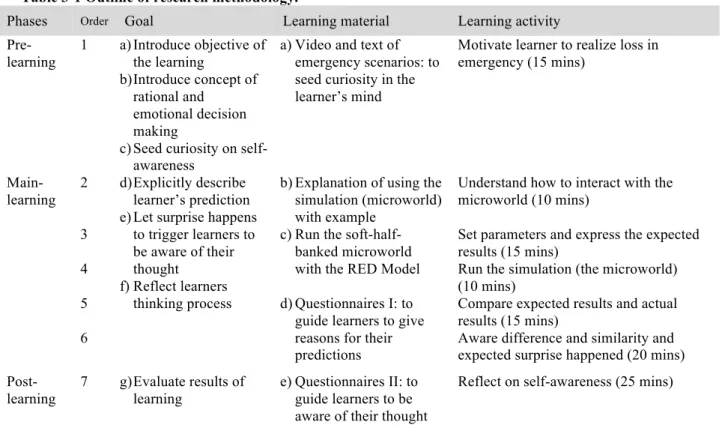
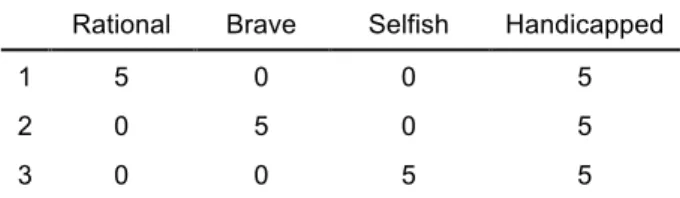
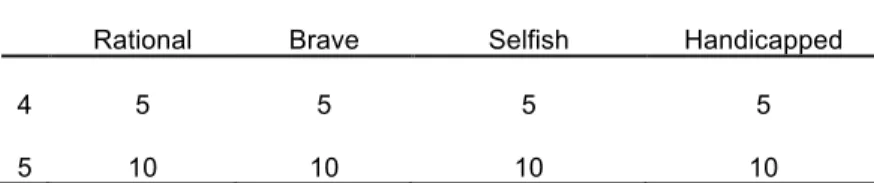
Table 3-1 Outline of research methodology. ... 21 Table 3-2 Tasks Prediction 01 which aim to make the scenario simple. Handicapped agents stay with another agent type foe each time. ... 26 Table 3-3 Tasks Prediction 02 which aim to make the scenario a bit more complex. All types of agent are in the map. ... 27 Table 4-1 Aspects' comparison of Traditional-, Half-Baked- and Soft-Half-Baked
Microworld ... 34 Table 5-1 Example of fact bases. The first statement shows that if the distance to the nearest fire is infinity, then it means there is no fire on that path. If the distance is a valid value, then there is fire in that path. ... 47 Table 5-2 Example of risk estimation for helping others in the predicting outputs for each alternative module of the RED model. ... 48 Table 6-1 Each simulated agent has its own personality tentative behavior based on its
intention. There are two types of intention: escaping or helping intention. The intention will be used as a decision factor if there are multiple alternatives for the agent to make a decision.
This table shows a default ratio to assign the intention for each agent type. ... 53 Table 6-2 Example of raw information that is used in the simulation. The information no.1 is considered as person information, while the rests are considered as perceived information that each agent can perceive from its surrounding. The information no.1 presents the agent type of the considering agent. No.2 present what alternative paths are available for considering. No. 3, 4 and 5 present the shortest distance to the nearest fire, exit and handicapped agent,
respectively. ... 54 Table 6-3 Chance that an agent interprets perceived information incorrectly is caused by emotion. Rational agent is assigned the chance to incorrectly interpret information as 5-10%, while emotional agent is assigned as 10-15%, respectively. ... 55 Table 6-4 Conceptual criteria that use for the RED model. There are seven criteria for this research. Some criteria are used in other modules. For example, criteria no. 4,5 and 6, which are risk estimations, these criteria are used in module no.5 for predicting outcomes for each alternative. ... 56 Table 6-5 Some decision-making rules defining of "similar distance". They represent
criterion no.1, accepted conditional distance, in Table 6-4. Different agent types have different similar distance values. Rational, brave, and selfish agents have their similar distance as 2, 3 and 1 for considering distance between a targeted handicapped and fire, respectively. ... 57 Table 6-6 Some decision-making rules representing criteria no.2 and 3, possibility for
escaping and helping in Table 6-4. These possibilities aims to distance of the fire. If the fire is further than the nearest exit, or the considering handicapped agent, then it is possible for
Table 6-7 Chance that an agent may discard the alternative by emotions. The rational agent is considered as ones who have better control their emotion. They have a lower chance to discard their alternatives. While the emotional agent, brave and selfish agents, are considered as ones who are not be aware to control their emotions. They have a higher chance to discard their alternative. The rational and emotional agents have 5-10% and 10-15% chance to
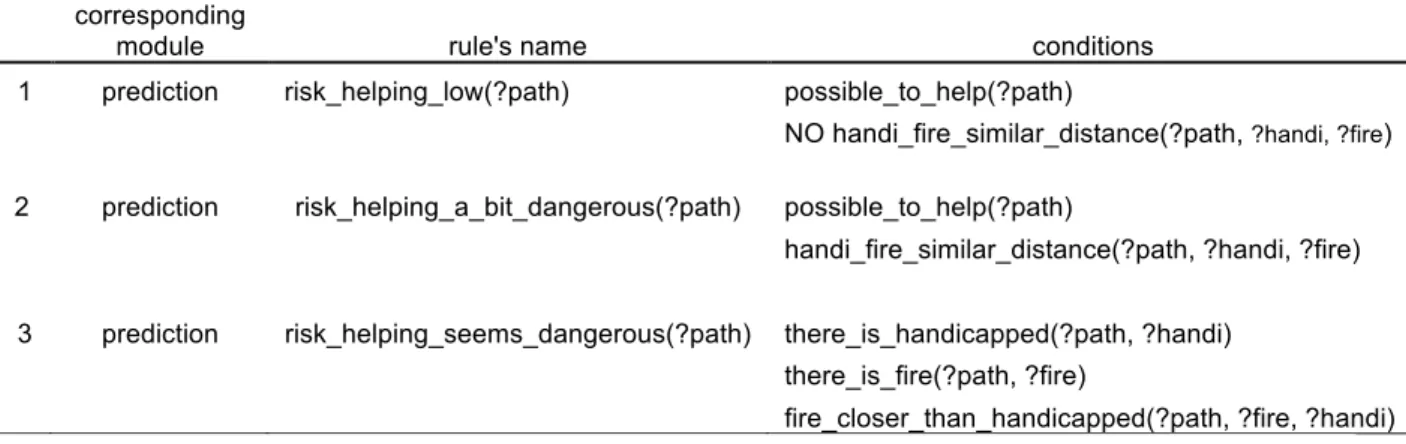
discard their alternatives, respectively. ... 58 Table 6-8 Example rules for estimating helping risk. The helping risk is considered as low if the distance to a handicapped and distance to a fire are far away. The helping risk is
considered as a little dangerous if the distance between the handicapped and the fire are similar. The helping risk is considered as seem dangerous if the distance to the fire is closer than the distance to the handicapped. However, different agent types have concept of similar distance differently. Thus, they may estimate the risk in the same situation differently. ... 60 Table 6-9 Example rules for estimating escaping risk. The escaping risk is considered as low if the distance to an exit and distance to a fire are far away. The escaping risk is considered as a bit dangerous if the distance between the exit and the fire are similar. The escaping risk is considered as seems dangerous if the distance to the fire is closer than the distance to the exit.
However, different agent types have concept of similar distance differently. Thus, thy may estimate the risk in the same situation differently. ... 61 Table 6-10 Example rules for estimating helping effort. The helping effort is considered as no effort if the handicapped agent is located closer than the exit. As a result, the helper agent is just go to the handicapped agent’s location and bring along to the exit without extra effort.
The helping effort is considered as a little effort if the handicapped is located further than the exit. However, their distance is within the range that is considered as similar distance. As a result, the helper agent takes a little extra effort for helping. The helping effort is considered as big effort if the handicapped agent is further away to the exit. The distance is further than the range that is considered as similar distance. As a result, the helper agent is required a big effort for helping this handicapped agent. ... 62 Table 6-11 Example rules for rational agent for accepting the escaping risk and helping risk.
For the escaping risk (rule no.1), the rational agent could accept the escaping risk if and only if the escaping risk estimation is low. On the other hand, the rational agent could accept the helping risk (rule no.2) if two conditions are reached. First, the helping risk, that concerns relation between distance to the fire and the handicapped, is low. Second, the effort for
helping have to be no effort or take a little effort. ... 64 Table 6-12 Summarized conditions for every agent types to accept the escaping risk. The rational and selfish agents would accept the escaping risk when the escaping risk estimation is low. On the other hand, the brave agent is willing to handle a bit dangerous situation. The brave agent would accept the escaping risk when the escaping risk estimation within the range between low and a little dangerous. ... 65 Table 6-13 Summarized conditions for every agent types to accept helping risk. There are two conditions to be concerned. First condition is the helping risk estimation. Second is the helping effort estimation. The rational agent would accept the risk if the first condition is low and the second condition, effort for helping, is between low and little dangerous. The selfish agent would accept the helping risk if the both conditions are at its low level. On the other hand, the brave agent would accept the helping risk with two cases. The first case, if the first condition is low, the fire is far away to the handicapped, the brave agent will not mind to help the handicapped. As a result, they can accept all level of effort. The second case is if the helping risk is at little dangerous, the fire is further than the handicapped, but not too far. In
this situation, if the effort is between no effort to little effort, the brave agent can accept the risk. ... 66 Table 6-14 Rules for categorizing alternative in to categories. There are four categories: top candidate path, candidate path, ignored candidate, and the rest candidate categories. For the top candidate path category, this category represents alternative paths that are accepted for both escaping and helping risk estimations. For the second category, the candidate path, this category represents alternative paths that are accepted only either the escaping or helping risk estimations. For the third category, the ignored candidate path, this category represents too dangerous or useless candidate paths. Too dangerous path means a path that there is a fire right next to current location. Useless path means a path that there is neither any exit for escaping, nor handicapped for helping. For the forth category, the rest candidate path, this category represents the leftover of the top candidate path, candidate path, and ignored candidate path categories. These categories are ranked from the most to the least preferable as the top candidate path, the candidate path, the rest candidate path, and the ignored
candidate path categories, respectively. ... 67 Table 6-15 Criteria for an agent to select its best alternative when there are multiple
alternatives. If the agent has escaping intention, the criterion is to select the alternative that has the least distance to exit. On the other hand, if the agent has helping intention, the
criterion is to select the alternative that has the least distance to the handicapped. ... 69 Table 7-1 Overview of the learning course. It is divided into three phases: pre-learning, main- learning and post-learning phases. The pre-learning phase aims to shape the mutual
understanding of the scenarios of emergency we used in this research, and seed the curiosity about their behaviors if they were in the emergency themselves. The main-learning phase aims to let the learners explicitly express their prediction toward the given phenomenon.
Questionnaires are used to guide the learners to think deeper. The post-learning aims to motivate learners to realize of their thinking process. A set of questionnaires are carefully selected to guide learners to question their thought. ... 73 Table 7-2 There are seven factors that are required the learners to make their predictions. The factor no1 and 2 is number survivors and deaths representing number of agents that
successful and failed to escape to an exit, respectively. The rest factors, no.3-7, are better to be described with Figure 7-6 ... 86 Figure 7-6 Example situation that an agent tends to help a handicapped. The counter of helping intention factor, factor no.3 in Table 7-3, is increasing whenever there is an agent have an intention to help a handicapped. If the agent can reach to the handicapped, the counter of accessible help is increased (factor no.4.) Moreover, if the agent and the handicapped manage to escape to an exit successfully, the counter of success escaping is increased (no.5.) On the other hand, if the agent cannot reach to the handicapped, the counter of failed access is increased (no.6). If the agent can reach to the handicapped (no.4), but they are failed for escaping (no.7), the counter of failed escaping is increased. ... 87 Figure 7-7 Simple UI presents the display of the live simulation that a learner can observe.
Parts a and b, red colored rectangles, are allowed a learner to interact with. Part a. is a controller for running the simulation. It can control start/stop running, run step-by-step, and reset the simulation. Part b. is parameter settings. In this simple UI shows only number of each type of agent. Part c., green-colored rectangle, presents the movement of components in the simulation. The rectangles represent structures and incidents such as exits and fires.
While the circles represent simulated agents. The red, green and brown colored rectangles present the fire, exit, and burnt exit, respectively. The burnt exit is the exit that covered with
fire. It is broken and cannot be used for escape anymore. The blue, orange and yellow colored circles represent the rational, emotional, and handicapped agents, respectively. Part d., light blue colored rectangle, presents the live report about number of survivors, deaths, and other factors presented in Table 7-4. In the actual UI, the live reports is presented beneath part c. 88 Table 7-5 Default options for questions no.23. The question asks learner that what kind the feeling they have when they are curious to know the reasons that cause the different
comparison results between their predictions and simulated results, and is it acceptable or not.
... 94 Table 8-1 Overview of the whole processes in this learning course. There are three phases: 1) pre-learning phase, 2) main-learning phase, and 3) post-learning phase. The purpose of the pre-learning phase is to describe overview of learning tasks and describe the simulated emergency scenarios to the learners. The purpose of the main-learning phase is to let the learners make their predictions of the simulation. The purpose of the post-learning phase is to evaluate whether the learners are motivated to be aware of their thought. ... 98 Table 8-2 Setting for the simple scenarios. Learners are requested to set number of each type of agent as showed in the table and make their predictions from question no.5 to no.10. Each situation there are only two types of agent at a time. ... 107 Table 8-3 Setting for the complex scenarios. Learners are requested to set number of each type of agent as showed in the table and make their predictions from question no.11 to no.18.
These scenarios consist of all types of agnet. ... 112
INTRODUCTION CHAPTER 1
Self-awareness is an important skill that an individual requires in daily life. It is even more important in a critical situation since it may imply the difference between life or death.
However, it is difficult to realize the nature of one’s own thinking process without help. It is true that people may have knowledge which is useful for a certain situation; however, they may fail to apply the knowledge to solve the problem they are encountering. For example, people may know that competing with others trying to exit at the same time clogs up the evacuating flow (Fahy R. F., 1997; Kobes M. a., 2010); closing doors and windows in a building during a fire evacuation are a good method for stopping a fire from spreading (Kobes M. a., 2010; Hasofer, 2006). However, many people may still behave improperly and emotionally when they confront an actual situation. There is a term to describe this phenomenon which is known as “knowledge-to-action gap (Tanaka, 2015).” To reduce the knowledge-to-action gap, it is important for people to be aware of how they think or behave, and try to lessen mistakes caused by these gaps.
One of the possible reasons for the knowledge-to-action gap is that ordinary people may not have many opportunities to understand their decision-making process, and how their decisions affect their behaviour. Unlike the emergency services, such as the police, fire fighters, and rescue teams who have been trained to cope with emergency situations, ordinary people tend to behave inappropriately in such situations. In this research, we make the assumption that emotion can affect decision-making and behaviour. Figure 1-1 presents concepts showing that people may have important knowledge (solid-oval A), for a certain situation. Based on this knowledge, a person is expected to perform an expected action 1 (solid-oval B.) However, with too much emotion in the emergency (dash-oval C), the emotion causes a person to behave emotionally as actual action 1 (dash-oval D.) The knowledge-to-action gaps in this figure is the difference between expected action 1 (solid- oval B), and actual action 1 (dash-oval D).
Figure 1-1Knowledge-to-action gaps. A person has knowledge (solid-oval A) to solve a problem in a certain situation. He is expected to perform expected action 1 (solid-oval B) to handle that situation.
However, with too much emotion (dash-oval C), that person perform actual action 1 (dash-oval D) instead.
The knowledge-to-action gaps is the difference between expected action 1 and actual action 1
We hypothesize that awareness can be used to balance the emotion. We use the term
“balance” since emotion does not always imply to cause inappropriate performance. For example, in an indoor fire emergency, we often hear that evacuees may be stronger than usual in moving obstacles or carrying heavy objects during their escape. If a person can balance their emotion so that it does not reach an extreme level, they can balance their decision- making by taking into account what is a rational response and also what is an appropriate level of emotion. Thus, their actions which are the result of their decision-making process may not lead them into a dangerous situation.
Figure 1-2 shows the research hypothesis of how gaining the self-awareness ability could reduce the knowledge-to-action gaps caused by too much emotion. From the figure, suppose that a person has knowledge (solid-oval A) to solve a specific problem. With this knowledge, he is expected to perform expected action 1 (solid-oval B) to handle that situation. However, with too much emotion (long-dash oval C), that person emotionally perform an actual action 1 (long-dash oval D) instead. Our hypothesis is to gain self-awareness (short-dash oval E) for making that person to have better controlling his emotion. As a result, the person may perform an actual action 2 (short-dash oval F.) The actual action 2 is more similar to the expected action 1 (solid oval B) than the emotional actual action 1 (long-dash oval D) which influenced by emotions. As a result, the figure shows the idea of how self-awareness less the knowledge-to-action gaps.
It is important for people to be able to apply the right knowledge for the situation and also to improve their self-awareness which is part of the thinking process. However, self- awareness is very difficult to cultivate, because mental processes are implicit and vague.
Thus, our objective is to cultivate self-awareness in order to lessen the knowledge-to-action gaps.
Figure 1-2 Gaining self-awareness ability (dot-oval E) to reduce the knowledge-to-action gaps caused by too much emotion (dash-oval C). With awareness, a person can apply his knowledge while balancing it with his emotion. As a result, the person performs actual action 2 (dot-oval F.)
1.1. Research motivation
This research aims to reduce the knowledge-to-action gaps. Our belief is that by increasing self-awareness these gaps will be reduced if we are aware of our thoughts and if we do not let too much emotion affect the decision-making process. This research makes the hypothesis that surprise could be a good trigger to increase self-awareness. The definition of surprise in this research is a representation of difference between expectations and reality (Casti, 1994; Lorini, 2007). Based on this definition, there are two personal reasons to support this hypothesis and to enable this research to be conducted: 1) an unexpected situation can cause us to be more aware of what we are doing and to help us use the right knowledge when we encounter a particular problem, and 2) an unexpected situation can enhance cognition which is closely related to self-awareness.
1.1.1. An unexpected situation can motivate awareness
The author’s mother experienced an indoor fire when she was young. That indoor fire incident could be considered as a negative surprise for her. As a result of this experience she is very aware of the risk of fire, even if there is nothing to be worried about. She is always ready to face an unexpected fire incident. Unlike the emergency services such as fire fighters, those people have been trained repeatedly to make them to be aware to cope with the emergency fire situation. Moreover, there are stories of people or animals that they have lesion learns from their unexpected failure experiences. These experiences can make people aware of possible risks and how to respond to similar situations effectively. They may even
repeatedly imagine a particular problem, and try different ways to solve the problem in their mind. As a result, they may have a better idea of how to find the best solution to cope such a problem in advance.
If the stories mentioned above are considered as negative surprises, positive surprises could motivate people to be aware of their thinking processes as well. Such an awareness of our thinking processes is not only limited to only solving problems. People can learn and improve themselves every day. For example, people may feel impressed by being treated nicely by others unexpectedly as, for example, when a person is cheered up and encouraged when they feel depressed. Consequently, that person may become more aware of the power of speech. Thus, that person may be more careful about how they use words and try to encourage others to share their experience.
1.1.2. An unexpected situation can enhance cognition
This reason is based on a common phenomenon which is people have difficulty to recognize the common matters. For example, how many people can recognize what they ate for breakfast a week ago? How did it taste? However, many people may be able to recognize the taste of a particular dish that surprised them a long time ago. Another example is if you are walking along the street. Suddenly, a car honks its horn at you. This will make you remember this day for some time. Biological and medical studies show that this phenomenon is caused by the adrenaline hormone. It affects to our memory (FRANCISCO, 2013; William J. Cromie, 2004).
Cognition may not be directly related to self-awareness; however, it is related to improving self-awareness. If we define self-awareness as conscious knowledge of oneself or comparing our self-current status with our internal values (Duval, 1973), cognition is the important capability of retrieving information or knowledge for comparison. Without cognitive ability, we would be less able to be aware of ourselves since we would lower our ability to retrieve information or knowledge for the purpose of evaluation.
1.2. Research objectives
Based on the research question ‘how to motivate self-awareness’, this research makes the hypothesis that surprise could be a good activator to realize one’s self-awareness. Individuals are often not aware how they will be able to cope with a particular situation and they often believe they can think appropriately without having any evidence for this. If individuals can observe their thinking process they will realize that the results of their thinking are not always
reasonable; they will be surprised to discover that they are not good at thinking and then they will be motivated to cultivate their self-awareness of their thinking processes.
To evaluate the hypothesis, this research has set the following objectives:
1) To motivate learners to cultivate self-awareness of their thinking process in an emergency situation.
2) To propose a learning platform that uses surprise as a learning trigger for learners to be aware of their thinking processes.
As mentioned earlier, our hypothesis is that when individuals observe their thinking processes they may discover that the results of their thinking are not reasonable, then they will be surprised and motivated to develop a greater awareness of their thinking processes.
The proposed learning platform provides a simulated emergency phenomenon. The phenomenon is a simulation of a human being in an emergency. There are four types of agent: rational, emotionally brave, emotionally selfish, and handicapped agents. Different types of agent behave differently based on the decision-making process. Learners are requested to make a prediction based on their reasons for their expected results of the phenomenon. This process will lead the learners to express their thoughts explicitly. After making their predictions, they run the simulation and observe the simulated results. Thus, learners can make a comparison between their predictions and the simulated results. Both similar and different comparisons will make learners rethink their thinking processes, especially when the comparison shows a difference. In this learning environment, learners will hopefully be motivated to become more aware of their thinking processes.
1.3. Research plan
The research proposes a learning platform using surprise as a learning trigger to motivate learners to be aware of their thinking process. In this research, the surprise is defined as a representation of the difference between expectations and reality (Casti, 1994; Lorini, 2007).
The learning platform provides a set of learning scenarios to represent a simulated version of a certain phenomenon. In this research, the simulated phenomenon is human behaviors in an emergency. This research is limited to consider only two types of behavior as cited in Pan X.’s studies (Pan X. , 2006; Pan X. a., 2007). The behaviors are 1) escaping to the nearest exit or 2) helping others before escaping. However, the simulated phenomenon is designed to achieve our learning purpose. It aims to motivate learners to be aware of their thinking processes. The simulated phenomenon is designed with limited and controlled factors. It does
not represent actual human behaviors in an emergency which is much more complex than this simplified simulated behaviors.
1.3.1. To use an indoor fire emergency as learning scenarios
An indoor fire emergency is selected over other natural emergencies: earthquakes, tsunamis, floods or other manmade emergencies: wars, car crashes, since an indoor fire shares mutual understanding more than others. People live and pursue their daily activities in buildings such as living at houses or apartments, working at office buildings and shopping at department stores more than ever since the massive development of cities. It is a global phenomenon. People may not have direct experience of an indoor fire emergency; however, most can imagine what an indoor fire would be like. Unlike other emergencies or disasters, people in some areas may not have experienced earthquakes, tsunamis or wars for generations. They may know those emergencies’ definition; however, it is hard for them to imagine the exact circumstances of such emergencies. As a result, an indoor fire emergency was selected as our learning scenarios since learners are able to imagine how they would cope with such situation. On the other hand, earthquakes, tsunamis or wars are not suitable for our learning scenarios since the gap between knowing the actual situation and our experience is too large.
In an indoor fire emergency, we can assume that evacuees want to escape through an exit to find a safe place as soon as possible. However, many behaviors could occur in such a situation. For example, altruism, competitive, and leading-following behaviors (Pan X. a., 2007). Helping others could be considered as a form of altruistic behavior. This type of behavior is selected since it can represent a critical situation in which we have to make a decision to help others or to escape. This kind of situation is not limited to indoor fire emergencies, but also occurs in daily life. Moreover, it is simple enough to understand the feeling of preferring to help others who need help. This preference for helping others can be defined as a factor in the simulation. The helper goes to one who need help, then both of them escape together. Learners will be able to accept this concept easily. Other types of behaviors such as competitive behavior or leading-following behavior are more complex than helping behavior. Learners may have diverse opinions of competitive activities. For example, what would be the outcome of competition: fighting, running away, or leading-following behavior.
Therefore, helping behavior is a better option since learners are more likely to have a mutual understanding of the learning phenomenon.
Other behaviors might be considered for motivating learners’ to be aware of their thinking processes. For example, most people know that we should lower our head to avoid smoke while escaping from a fire in a building. However, this kind of behavior relies largely on our senses of smell and vision. Without those senses it is difficult to conduct a learning scenario to motivate the learners’ awareness.
1.3.2. To provide a learning platform aiming to let surprise occurred
As mentioned previously, the objective of this research is to propose a learning platform using surprise to motivate learners’ self-awareness of their thinking processes. The learning platform uses simulation to provide learning scenarios. The learning scenarios for this research are helping or escaping behavior by simulated agents in an indoor fire emergency.
Learners are requested to predict and observe behaviors of three types of simulated agent: 1) a rational agent, 2) an emotionally brave agent, and 3) an emotionally selfish agent. The rational agent represents those who balance their emotions of preferring to help others or to escape. In other words, a rational agent is considered as an ordinary person and is used as a reference for other emotional agents. An emotionally brave agent represents a person who confident and optimistic. They may accept a bit more risk than a rational agent. An emotionally selfish agent represents a person who is more concerned about their personal safeness. They would help others only if they consider the situation is safe. However, they carefully estimate risks more than the other types of agent. The learning scenarios represent phenomenon for which all types of agent have the same knowledge of how to solve the problem: to help others or to escape. However, with different abilities to control their emotions, they let their emotions affect their decision-making processes differently. Since each type of agent has different criteria to make a decision, as a result, they behave differently even if they are in the same situation. However, the agent’s decision-making process does not represent how an actual human being make a decision. These decision- making processes on the part of the agent are designed to allow different types of behavior to occur in order to achieve our learning purpose.
Learners are given an overview of the scenarios such as how many members there are for each type of agent. They are requested to predict the simulated outcomes and to explicitly describe the reasons for the prediction they made. Examples of prediction outcomes are:
which type of agent attempts to help others the most, which has the highest number of successful escape, and so on. In this process, learners play a role as a simulated agent in the given scenarios. For example, if they imagine themselves as a rational agent and what
decision would they make. On the other hand, if they are an emotional agent, brave or selfish agent, what decision would they make and what reasons do they give for their predictions.
This process is designed to reflect their thinking processes.
Once the learners have made their predictions, they run the simulation and observe the simulated results. The learners are requested to compare their predictions with the simulated results. These comparisons may be similar or different. It is expected that the difference in the results between expectations and reality will surprise the learners. As a result of such surprises and carefully selected questions designed for guiding learners to be curious about why their predictions and simulated results are different, learners are expected to be motivated to questions their thinking processes by themselves. They can modify the simulation parameters to test their hypotheses and try to answer questions in their minds. As a result, they are expected to be motivated to realize on their thinking processes and ask themselves why they made the predictions as they did. More information is presented in chapter 3, methodology, and in chapter 7, learning material.
1.3.3. To expect learners being motivated to become more aware of their thinking processes The expectation of this research is to provide a situation which leads learners to be motivated to realize on their thinking processes. It is not expected that every learner can fully and clearly realize how they thought or be able to explicitly describe their own thinking model. Our goal is to change learners’ thinking status from not realize of their thought, to be curious and start making question on their thinking process by themselves.
Considering on our motivation of reducing knowledge-to-action gaps, the knowledge-to- action gaps means people may have knowledge to solve a problem, but they may fail to apply it to solve the problem when they are in the actual situation. This research assumes that too much emotion may affect one’s decision-making process. For example, extreme emotional thinking may lead to a dangerous situation if a person fails to apply their knowledge to solve the problem.
Why does the failure happen? It could be because they are not aware, or they ignore their knowledge of how a certain action may lead to some situation. Why are they not aware of this? It is possible that they lack the self-awareness ability, or emotion may take place at the time they have to make a decision. The research selects learning phenomenon representing rational-emotional decisions/behaviors in an emergency situation. Learners observe the simulated agents which have a rational- emotional decision-making process, then reflect on
how they would react themselves. As a result, they are expected to be motivated to increase their own self-awareness.
The correspondence between our designed learning scenarios and knowledge-to-action gaps are as follows: first is the corresponding of the knowledge. In this research, it is the perception of the learner toward being a rational, brave or selfish person, respectively. They can imagine that they have different degree of self-awareness which will allow their emotions to control their decision-making processes. For example, if the learner is a selfish agent, they may imagine that fear can control their decision-making process. As a result, they prioritize their safety-safeness first. Second, the corresponding of action, the learner makes a set of prediction results according to the given scenarios. The predictions could be considered as actions based on their perceptions toward different types of agent. Third, the corresponding of the gaps, as presented in Figure 1-1, the expected action (solid-oval B in Figure 1-1) represents the rational agent’s behavior in the learner’s mind. On the other hand, the behaviors of emotionally brave or emotionally selfish agents represent how emotions take control of the decision-making process (dash-oval B in the Figure 1-1.) As a result, learners can imagine the knowledge-to-action gaps between rational and emotional behaviors by themselves. With the comparison between their predictions and simulated results, they are expected to be motivated to realize of their own thinking process.
For example, if a learner believes that a brave person is one who tends to help others if possible, then typically, in that learner’s mind, the more brave persons there are in the scenario, the more survivors there will be. If this learner expects more survivors in the actual emergency, this learner may emotionally take action to help or even ask others to cooperate with him/her to help those ones who need it. However, in some of our case studies, the results are not in accord with the learner’s prediction. The greater the intention to help does not always result in a higher number of survivors. Thus, the learners are motivated to question their thinking processes to try to find out the possible reasons for themselves. As a result, the learners can find the reasons for this different comparison result and be considered as be motivated.
1.4. Significance and originality of the study
To achieve the objectives mentioned above, this research prepared simulated emergency scenarios for helping learners to cultivate their self-awareness. The scenarios involve a mixture of agents, who are rational and emotional, trying to escape a simulated emergency situation to reach a safe place. Learners try to describe their thoughts explicitly as predicted
results, and then compare the actual simulated outcomes with their predictions. The comparisons will develop learners’ awareness of their thinking processes. There are three major novelties in this research.
1) A novel learning platform: This learning platform uses surprise as a learning trigger for cultivating self-awareness. It encourages learners to question their thoughts. As a result, they will be motivated to develop a greater awareness of their thinking processes.
2) A Rational Emotional Decision-making model (RED model): The model describes how emotion has an impact on the decision-making process. It is used to represent how rational and emotional agents make decisions in given scenarios. However, its mechanism is hidden from learners since the objective is to cultivate self-awareness, not to judge its correctness. More detail of this model is presented in chapters 5 and 6.
3) A soft-half-baked microworld: this provides a simulated environment which is designed to follow a theoretical concept of a microworld. Its innovative points are described in chapter 4.
1.5. Dissertation overview
This dissertation will be divided into eight chapters. The chapters of this dissertation are presented as follows:
Chapter 2 describes the literature related to the research. The literature is reviewed according to various aspects: psychology, pedagogy, sociology, emergency behavior and computer science. The content will be described in terms of the relationship between self- awareness and learning, surprise and learning, emotion and decision-making, human behavior in an emergency, human behavior modeling, and software library packages for implementing the simulation system of this research.
Chapter 3 discusses the research methodology. The aim of this chapter is to propose a learning platform using surprise as a learning trigger for motivating self-awareness. It starts with analyzing the necessary components for the proposed learning platform and then explains the design of the learning platform itself and the design of the experimentation of the research. The learning platform is divided into three phases: the anticipating phase, the evaluating phase, and the self-monitoring phase. Then the design of learning materials is described. The context will give learners a better understanding of the learning tasks of the experiment they are going to be involved with. Finally, the design of the questionnaires is discussed.