CONFUSION
AND UNITY IN HANDLING OF HEAT MOTION AND $FLUID$ MOTION IN THE $19TH$ CENTURY流体数理古典理論研究所増田茂
SHIGERU MASUDA
RESEARCHWORKSHOPONCLASSICALFLUIDDYNAMICS,
EX.LONG-TERMRESEARCHER, INSTITUTE OFMATHEMATICAL SCIENCES, KYOTO UNIV.
ABSTRACT.
We discuss the confusion and unity in handling of heat motion and fluid motion in the 19th century, explaining the theoretical background. These two theoriesorthemes arestudied
byFourier at the first timeand lastedin theacademicactivities inaccompanywith the arrival of continuum. Thesetwo theories orthemesarestudied by Fourierat the first and and the last academicactivity in the arrivalof continuum. The otherstudyonthecommunicationofheat
between two bodiesproblemha.$s$been researchedbyPr\’evost 1792 [29],whichprecedesFourier’s
manuscript 1807[11].
The hydrodynamistslikeNavier, Poisson, Cauchyareproposethewaveequationsin the
elas-ticity,andthe last twohydrodynamistsproposesthetotalequationsin unityonthecontinuum.
Fromtheviewpoint of mathematicsonthecontinuum,wepickupPoisson’s direct method for definiteintegral in regarding to theproblemsbetween realand imaginary, that is the life-work
theme Euler and Laplace also struggled to solve it.
We point outthisproblem basedon thethen continuum concept, whichis the bridgepoint
over classical mechanics intoclassical quantummechanics like Boltzmann, and moreover into
newquantum mechanics like Schr\"odinger. Throughthis wide range aspossible, welike to at-tentionto mathematicalaspectofFourier and his surrondings, in the viewpointofunity ofheat and fluidonthecontinuum,
Our motivation in this paper istoconsiderthe confusion and unityonthe continuum from both thepositiveand negativemathematicalviewpoints.
1. INTRODICTION 1,2,3 How does the
wave
occur? Newton1686
[22] shows his principle on the wave motionin the water pressure.
Thepressure doesn’tpropagate bythe fluid of the secondarylinearstrait, except for the particle of adjacent fluid. If the adjacent particles $a,$$b,$ $c,$$d,$$e$ propagate
in the straight line, press from $a$ to $e$ ; the particle $e$ progresses separately into
the obliquepoints$f$ and$g$, and without sustainedpressure,and moreover, to the
particles $h$ and $k;m$
as
it is fixed in another direction, it presses forthe particleinto propping up ; the unsustained pressuregoes separately into the particles $l$
and $m$, and
as
this way, it follows successively andlimitlessly. thus it willoccur
so
many time, inaccurately, to the particlein the indirect adjacency. Q.E.D. [22, pp.354-5] (trans. from Latin, mine.)Date: 2015/01/07.
1Translationfrom Latin/French/Germaninto Englishmine, except forBoltzmann.
$2_{To}$establishatime lineofthese contributor,welistfor easy referencethe
year of their birth and death:
New-ton (1643-1727), Euler(1707-83), $d^{)}Alembert(1717-83)$, Lagrange(1736-1813), Laplace(1749-1827), Fourier(1768-1830), Poisson(1781-1840), Cauchy(1789-1857), Dirichlet(1805-59), Riemann(1826-66), Boltzmann(1844-1906), Hilbert(1862-1943), $Schr\ddot{\circ}dinger(1887-1961)$.
$3_{We}$use $(\Downarrow$$)$ meansourremark not original, whenwewant to avoid theconfusions betweenouropinionand
What is the fluid? According to today’s diffinition, it is called the fluid is
a
limitlesslyfree
continuum. Where does continuumcome
fromin the historical view?2. THE ORIGIN OF EIGENVALUE PROBLEM
Euler
1748
[6] says the height ofthe vibrating cord is calculated by the linear, first-orderedexpression
as
follows :$y= \alpha\sin\frac{\pi x}{a}+\beta\sin\frac{2\pi x}{a}+\gamma\sin\frac{3\pi x}{a}+\cdots$ (1)
Lagrange
1759
[13] descrivesas
the introductional expressionof the trigonometric series by $P_{\nu}$and $Q_{\nu}$
as
follows :$P_{\nu} \equiv Y_{1}\sin\frac{v\varpi}{2m}+Y_{2}\sin\frac{2\nu\varpi}{2m}+Y_{3}\sin\frac{3\nu\varpi}{2m}+\cdots+Y_{m-1}\sin\frac{(m-1)v\varpi}{2m}$ (2)
where, $Q_{v}$ has the
same
linear, flrst-ordered combination with coefficients $V_{1},$ $V_{2},$ $\cdot\cdot$ insteadof $Y_{1},$ $Y_{2},$ $\cdots$
.
The indicies of$P$ and $Q$ show simply the valeurparticuloeres (eigenvalues) of$\nu$ which $($the valeur $particuloe\backslash res)$ belong to them ($P_{\nu}$ and $Q_{\nu\rangle}$ respectively). [13, pp.79-80]
(trans. mine.) Remark. Lagrange’s $\varpi$ is equal to $\pi$
.
In (1),we
can see
incase we
assume
$a=2m$and $\alpha,$ $\beta,$ $\gamma,$ $\cdots$
are
equal to $Y_{1},$ $Y_{2},$ $Y_{3},$ $\cdot\cdot$, then $x=\nu$ in Lagrange’s $P_{\nu}$ in (2)or
$Q_{v}$ reffering to valeur$particuloere\backslash$ (eigenvalue), namely (1) $=(2)$
.
3. THE HEAT AND FLUID THEORIES IN THE $19TH$ CENTURY
3.1.
The theory of heatcommunication
in the Pr\’evost’s essay.Pr\’evost [29] discuss thecommunication of heat between two corps in earlier than Fourier, who corresponds with Pr\’evost, according to Grattan-Guiness [11, p.23].
Hisprinciples
are as
follows: allthe corps radiate the heat without relation to thetemperature.The heat equilibrium is induced with the equal quantity of heat by the heat communication. These principles becomesharedwith Fourier successively. (cf. Table 1.)
3.2.
The outline of thesituations
surroundingFourier.
About the situations around Fourier,
we can
summarizeas
follows :1. Fourier’s manuscript 1807, whichhad been unknown for us until 1972, I. Grattan-Guinness
[11] discovered it. Fourier’s paper 1812 based
on
the manuscriptwas
prized by the academyofFrance. We consider that Fourier, in hishfe workof the heat theory, begins withthe communi-cation theory, and he devoted inestablishing this theme
as
the priority.2.
Owing to the arrival of continuum theory, many mathematical physical worksare
intro-duced, such
as
that Fourier and Poisson struggle to deduce the trigonometricseries in the heattheoryandheat diffusionequations. Inthe curent of formularizing process of the fluid dynamics, Navier, Poisson, Cauchyand Stokesstruggle todeduce thewaveequations and theNavier-Stokes
equations. Ofcource, there
are
manyproceding researches before these topics, however, for1
of space,we
must pick upat least, the essentials suchas
following contents :3.
Fourier [9] combines heat theorywith the Euler’s equationsofincompressiblefluiddynam-ics and proposes theequationof heat motion influid in 1820, however, this
paper
was
publishedin
1833
after13 years,
itwas
after 3 years since Fourier passed away. Fourierseems
to have beendoutfulto publish it inlife.4. After Fourier’s commnunication theory, the gas theorists like Maxwell, Kirchhoff,
Boltz-mann
[2] study the transport equations with the concept of collision and transport of themolecules in
mass.
In both principles,we
see
almostsame
relation between the Fourier’scom-munication and transport of heat molecules and the Boltzmann’s collision and transport of gas molecules.
TABLE 1. The four books
on
physic$(\succ$mathematical theories of heatand remarked
on
the necessity of careful handling to the diversion from real to imaginary,es-pecially, to Fourier explicitly. To Euler and Laplace, Poisson
owes
many knowledge, and buildsup his principle ofintegral, consulting Lagrange, Lacroix, Legendre, etc. On the other hand, Poisson feels incompatibility with Laplace’s ‘passage’,
on
which Laplace had issueda
paper in 1809, entitled : On the ‘reciprocal’ passage ofresults between real and imaginary. in1782-3.
6. To these passages, Poisson proposed the direct, double integral in 1811, 13, 15, 20 and
23. Theone analytic method of Poisson 1811 is using the round braket, contrary to the Euler’s integra11781. The multiple integralitself
was
discussed and practical byLaplacein 1782, about20 yearsbefore, when Poisson applied it to his analysis in
1806.
7.
As a contemporary, Fourier is madea
victim by Poisson. To Fourier’s main work: Theanalyticaltheory
of
heatin 1822, and to the relatingpapers, Poisson points the diversion apply-ingthewhat-Poisson-called-it ‘algebraic’ theoremof De Guaor
themethod of cascades by Roll, to transcendentalequation. Moreover, about theircontrarieties, Darboux, the editor of $(E$uvres
de Fourier, evaluates
on
the correctness of Poisson’s reasoningsin 1888. Drichlet also mentionsabout Fourier’s method
as
a
sort of singularityof
passage from the finite to the infinite.3.3. The preliminary discources
on
Fourier from the Nota to I.Grattan-Guinness.3.3.1. The Fourier’s Oeuvres edited by G. Darboux.
The preliminary discource byFourier, edited by G. Barboux, says in 1820:
G. Darboux says in his first edition in 1888 : The works relating to the heat
Science, inDec. 21,
1807.
his first publicationisunknown forus:
we
don’t knowexcept for
an
extract of 4 pages of BSP in1808
; Itwas
read bythe Committee, however, maybe withdrawn by Fourier during1810.
TheCommitteeof Academy,held in 1811, decided the following judgment : “‘
Make clear the mathematical
theory
on
the propagationofheat,and compare thistheorywith theexact result ofexperiments.” (trans. mine.) 43.3.2. The Fourier 1822 by A. Rreeman and The Fourier
1807
edited by I. Grattan-Guinness.In 1878, A. Freeman published the first English translated Fourier’s second version, of which the preliminary is completely the
same
as
G. Darboux
1888, tenyears
laterthan A.
Reeman. In 1972, I.Grattan-Guinness
discovered the manuscript1807.
He pays attentionsto the Avertissment in the second edition by G. Darboux
as
abovewe
mention. Weare
thankful toGrattan-Guinnessfor the showingone
oftheparagraph of$1\cdot 136$ (Des temp\’eraturesfinales et de la courbe qui les pr\’esente. ), and its belonging $figure^{5}$ of the Fourier’s Manuscript
1807, Tkorie de lapropagation de la chaleur, edited and commentedby Grattan-Guinness [11, p.371-2].
flg.1 An exponentialdecay ofdiffusion in Fourier’s Manuscript 1807
4. THE THEORETICAL CONTRARIETIES TO FOURIER 4.1. Lagrange and Fourier
on
the trigonometric series.Riemann studies the history of research
on
Fourier series up to then (Geschichte der Fruge\"uberdie Darstellbarkeit einerwillk\"uhrlichgegebenen Function durcheine triigonometrtscheReihe,
[30, pp.4-17].) Wecite
one
paragraphof his interesting description fromtheviewofmathematicalhistory
as
follows :$(\Leftarrow$$)$ When Fourier submitted his first work to the Academy
franqaise6
(21,Dec., 1807)
on
theheat,representing acompletely arbitrary (graphically), givenfunctions with the trigonometric series, at first, gray-haired
Lagrange7
irritates so much, however, refuses flatly. The paper is callednow
being belonged tothe Arcive of the Parisian Academy frangaise. (id. According to Mr. Professor
Dirichlet’s oralpresentation.) Therefore, after Poissoninspectscarefully through
the
paper,8
promptlyargues that in thepaper of Lagrange, there isa
paragraphon
the vibration of string, where Fourier may have discovered the descriptivemethod.9 To refuse this defect of the statement telling clearly
on
the rivalryrelation between Fourier and Poisson,
we
would like to back to the Lagrange’s$4_{(\Downarrow)}$
About theextract,sameasabovefootnote. Lagrangewasa member oftheCommittee ofjudgementand poses against Fourier’s paper 1807. cf [30]. G.Darboux lists as follows : Lagrange, Laplace, Malus, Ha\"ue and Legendre. [4, p.vii].
$5_{This}$figure istheFourier’soriginal. [11, p.370]. In th$s$figure,onthe$x$axis,therearethe numbers 1, 2, 3, 4
$6(\Downarrow)$i.e. French Academy.
$7(\Downarrow)$ Lagrangewasthenseventy-oneyears old.
8id. 9id.
papers,
so
wecan
reach the event in the Academy nothing have been clear yet. [30, p.10] (trans. mine.)Riemann cites exactly the Flrench original
as
follows :$(\Leftarrow$$)$ In fact,
a
paragraph cited by Poisson is the expression :$y=2 \int Y\sin X\pi dX\sin x\pi+2\int Y\sin 2X\pi dX\sin 2x\pi+\cdots+2\int Y\sin nX\pi dX\sin nx\pi$, (3)
So, If$x=X$, then $y=Y$, and $Y$ is the ordinate confronting to the abscissa
X. Thisformuladoesn’t coincide withtheFourier’s $series^{1\fbox{Error::0x0000}}$
; there is sufficiently the capability of
some
mistake; however, it is only a simple outlook, because Lagrangeuses
$\int dx$as
the integral symbol. Today, it is to be used by $\sum\Delta X.$When we inspect through his papers, it is beyond believable that he expresses
a
completely arbitrary function by series expansion with infinite sins. [30, pp.10-11] (trans. mine.)Lagrange had stated (3) in his paper of the motion of sound in
1762-65.
[14, p.553]4.2. The trials to seek the mathematical rigours on heat theories.
Poisson [23] traces Fourier’s work of heat theory, from the another point of view. Poisson emphasizes, in the head paragraph of his paper, that although he totally takes the different
approaches to formulate the heat differential equations or to solove the various problems
or
to deducethesolutions fromthem, the resultsby Poissonare
coincident withFourier’s. Poisson[23] considers the proving on the convergence of series of periodic quantities by Lagrange and Fourier
as
themanner
lacking the exactitude and vigorousness, and wants to make up to it. Poisson proposes the different and complex type of heat equationwith Fourier’s. For example,we
assume
that interior ray extends to sensible distance, which forces of heat may affect thephenomena, the terms of series between before and after should be differente.
We remark that Fourier’s integral problems
are
handled in the scope on the infinite solid in Fourier 1822 [8]. We must pay attention to that these considerations have beencapable on thecontinuumtheory.
Poincar\’e 1895 [26] proves the existence of the function satisfying the Dirichlet condition :
$Thk_{0oe}’me$
.
Siune
fonction
$f(x)$satisfait
\‘a la condition de Dirichlet dans l’intervalle$(-\pi, \pi)$, elle pourra \^etre repr\’esent\’ee dans ce m\^eme intervalle par une s\^erie de Fourier,
c’est-\‘a-dire que l’on
aura:
$\pi f(x)=\frac{1}{2}\int_{-\pi}^{\pi}f(x)dx+\sum\cos mx\int_{-\pi}^{\pi}f(x)\cos mxdx+\sum\sin mx\int_{-\pi}^{\pi}f(x)\sin mxdx$
[26, p.57,
\S 38]
(cf. Table 1.)5.
CONFUSIONS
AND UNIFY ON CONTINUUM THEORYThe hysico-mathematicians are must construct at first the physical structure, then allpies the mathematical concept on it. The former is necessary to fit with the actual phenomena.
Arago
1829
[1] seeks to separate these items toNavier1829
[21] in the current ofdispute with Poisson andArago. This iscomes
fromthe wordwhat-Navier-called l’une sur l’autre,hefails to explain exactly it, and sincethen, histheories and the equationsare
neglected up to the top of20th century. We consider thatthe confusions and unify
are as
follows :$\bullet$
Poisson and Fourier discuss onthe handling of De Gua’s theory into the transcendental equations. Without clearexplanation, Fourier passed away in
1830.
$10_{(\Downarrow)}$Thismeanstwo interpretations : one means
theseries by Fourier, the other today’s conventionally used
nomenclature : ‘the Fourier series’. Judging from Riemann’s youngdays, in 1867, this maymeanthe former. In generally, the trigonometric series is used then.
$\bullet$ On the att.
$-$tion and replusion ofmolecule, Navier depends
on
Fourier’s principle ofheat molecule. Thethenhysico-mathematicians had little evaluated Navier untilthetop
of20thcentury. For formulationofheat motionin thefluid, Fourier cites not Navier’s fluid equations, but Euler’s fluid equations.
$\bullet$ Thehydrodynamistslike Navier, Poisson, Cauchy
are
propose the
wave
equations in the elasticity, andthelast two hydrodynamistsproposes thetotal equations in unityon
the continuum.$\bullet$ On the formulation ofheat
motion in the fluid, Fourier hadsubmitted thispaper,
how-ever, until his death, he has not published it, in which he
seems
to aim the unity of hydro- and thermodynamics, however, hehas
givenup it.5.1. A comment on continuum by Duhamel.
Duhamel 1829 [5] points out the theory of continuum fromthe viewpoint of scientific history.
$(\Leftarrow$$)$ The forces against the separation of composition of corps whether rigid
or
solid,are
zero or
doesn’t exist in the statewe
discuss. It doesn’t start tooccur
itonly whenwe
dare to separate it,or
alternate the distance betweenthemolecules. Namely, if
we
represent this forces by integral, when forceturns intozero,
even
after the alternation of the molecular distance, say, if the body issepareting, it
means
that the body doesn’t resist at all against the separation,this is unthinkable
so.
(J4-2)We will talk about the fact that
as
thesame
way in 1821, when Mr. Navier proposes the molecular activities and regards the bodyas
the countinuum, Mr. Poisson alsohas gotten thesame
idea.This method inspecting the molecular actions
are
originally used inthestudyofcapillary phenomena by Mr. Laplace. Mr. Navier has gotten afterward the
nice idea to deduce the theory of elastic solid ; however, all the researchers and physic$(\succ$mathematicians have supposed the molecules adjoining corps, and
Poisson is the first of coincidence with calculations withthe physical structures.
(J5-1)
Inadditionto,althoughthehypothesesof continuumtheoryhave beenactually
so
inexact, however, have played big roles in thescience, Intheroles, have played, the theories by M. Laplace have welcomed by theresearchers. This observationon
the molecular activities, in the bulk ofspecial problems, above all, in the continuum theory, it has the very countless merits to have to sweep out the allspecial hypotheses. (J5-2) [5, p.99] (trans. mine.)
5.2. Attraction and repulsion.
Here, we show
one
of Fourier’s contexts which Navier dependson
and esteemsas
the authority ofhysicGmathematicians.($\Leftarrow$) $\eta 54$
.
The equilibrewhichkeeps in the interior ofasolidmass
between therepulsive
force
dueto heat and the molecular attractionisstable ; namely, whichrestablish by iiself, when it troubles by
an
accidentalcause.
If the moleculesare
places in thedistancewhich is convenient to the equilibre, and ifan
exteriorforce make this distance withoutthe temperaturechanges bytheheat,the effect of attraction begins surpass it and makes the molecules at the initial position,
after a multitude ofoscilation which becomes
more
andmore
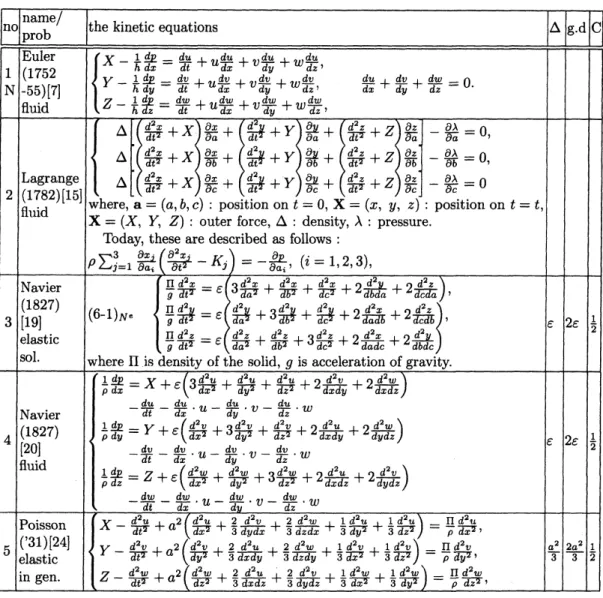
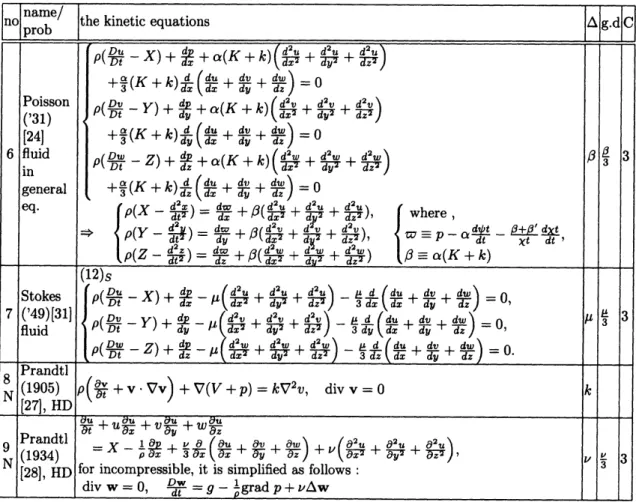
insensible. ATABLE 2. The kinetic equations of the hydrodynamics until the “Navier-Stokes
equations”
were
fixed. $(HD$ : hydrodynamics, $N$ : non-linear, g.d: grad.div,$C$ : $\frac{\Delta}{gr.dv}$ inelastic or fluid. $\Delta$
: tensor coefficient of the main axis in Laplacian.)
molecules ; this is the origin of sonic or flexible vibration of corps and ofall the effect of elasticity. [8, pp.31-2] (trans. mine.)
6. FOURIER’S HEAT EQUATION OF MOTION IN FLUID
Fourier esteems Euler’s fluid dynamic equations, saying in the prefaceof “The analysis of the heatmotion in the fluid We cite Fourier’s English translated paper
as
follows :Tosolve this,
we
mustconsider,a
givenspace interior ofmass, for example, by the volume ofa
rectangular prism composed ofsix sides, of which the positionis given. We investigate all the successive alterations which the quality of heat
contained in the space of prism obeys. This quantity alternates instantly and constantly, and becomes very different by the two things. One is the property, the molecules of fluid have, to communicate their heat with sufficiently near molecules, whenthe temperatures
are
not equal.The question is reduced into to calculate separately : the heat receiving from the space of prism due to the communication and the heat receiving from the
TABLE3. (Continuedfrom Table2.) Thekineticequationsof thehydrodynamics
untilthe “Navier-Stokes equations”’ were fixed.
space due to the motion of molecules.
We know the analyticexpressionofcommunicated heat, and the first point of the question is plainly cleared. Therest is the calculation oftransported heat : it depend
on
only the velocity ofmolecules and the directionwhich they take in their motion. [9, pp.507-514.]. (trans. mine.)Fourier combines heat theorywith the Euler’s equation ofincompressiblefluid dynamics and proposes the equation of heat motion in fluid in 1820, however, this paper
was
published in1833
after13
years, itwas
after3
years since Fourierpassed away. Fourierseems
to have beendoutful to publish it in life. Here, $\epsilon$ is the variable density and $\theta$ is the variable
temperature of
the molecule respectively. $K$ : properconductance of mass, $C$ : the constant of specificheat, $h$
: the constant determining dilatation, $e$ : density at$\theta=0.$
$\{\begin{array}{l}\frac{\frac{1}{\epsilon 1}}{\epsilon}dR\overline{d}y^{+\frac{}{}+\alpha\frac{}{}+\beta\frac{}{}+\gamma\frac{}{}-Y=0}\overline{d}xd_{R+\frac{d\alpha}{d\beta dtdt}+\alpha\frac{d\alpha}{d\beta d\alpha dx}+\beta\frac{d\alpha}{dd_{\oint_{dy}}}+\gamma\frac{d\alpha}{d\beta dzdz}-X=0},\frac{1}{\epsilon}\neq^{d_{z}}+\frac{d\gamma}{dt}+\alpha\frac{d\gamma}{d\alpha}+\beta\frac{d\gamma}{dy}+\gamma\frac{d\gamma}{dz}-Z=0.\frac{d\epsilon}{dt}+\frac{d}{dx}(\epsilon\alpha)+\frac{d}{dy}(\epsilon\beta)+\frac{d}{dz}(\epsilon\gamma)=0, \epsilon=e(1+h\theta) .\frac{d\theta}{dt}=_{\sigma}^{K}(\frac{d^{2}}{dx}\theta r+\frac{d^{2}}{d}yv^{\theta^{2}\theta}+\frac{d}{d}z\nabla)-[\frac{d}{dx}(\alpha\theta)+\tau_{y}d(\beta\theta)+\frac{d}{dz}(\gamma\theta)].\end{array}$
where, $\alpha,$ $\beta,$ $\gamma,$ $p,$ $\epsilon,$
$\theta$
are
the function of$x,$ $y,$ $z,$ $t.$ $X,$ $Y,$ $Z$
are
the outer forces. Wethink, Fourier
seems
to feelan inferiority complex to the fluiddynamics by Euler and he divers7.
PoISSON’S PARADIGM OF UNIVERSAL TRUTH ON THE DEFINITE INTEGRALPoisson mentions the universality of the method tosolvethe differential equations.
Pois-son attacks the definite integral by Euler and Laplace, and Fourier’s analytical theoryof heat, and manages to construct universal truthin the paradigms.
Oneof the paradigms is made by Euler and Laplace. LaplacesucceedstoEulerandstatesthe passage from real to imaginary
or
reciprocal passage between two, whichwe
mention inbelow.Theother contradictory problem is Fourier’sapplication of DeGua. The diversionisFourier’s
essential tool for the analytical theory ofheat.
Dirichlet callsthese passages
a
sort ofsingularityof
passagefrom thefinite to the infinite. cf. Chapter 1. We think that Poisson’s strategy is to destruct both paradigms and make his ownparadigm to establish the univarsal truth between mathematics and physics.
8. La valeur particuli\‘ere AND THE EIGENVALUE
We confirm the identityofvaleurparticuliere with theeigenvalue. We would payattention to the historical fact that it has been develloped for the linear differential equation on the heat
deffusion, or the trigonometric serirsin the analysis including string
or
sonic oscillation and the process redefined by Hilbert in1904.
$\bullet$ We think the eigenvalue is translated from la valeurparticuliere into
German word der
Eigenwert bythe Hilbert
1904
and isexpatiated by Courant-Hilbert 1924 [3]. The wordeigenfunction is combinedcorresponding to the word : eigenvalue.
$\bullet$ In the bibliographies ofthe earlier centuries, forexample, Lagrange 1759, Fourier 1822,
Poisson 1823, 1835, Cauchy 1823, Sturm 1836, Liouville 1836, Poincar\’e 1895, et al. use
la valeur $particuloeoe\backslash$
.
Sturm and Liouville owe to Poisson’s preceding works of nowso-called Sturm-Liouville type differential equation ofthe second order.
$\bullet$ In the first English translation of Fourier’s main work [8], Freeman 1878 [10] uses ‘the
particular value’ toall the
over
43 original words in thisbook.$\bullet$ Wilkinson
1952
uses
eigenvalue without using the other English word : proper valueor
particular value in recognition ofits nomenclature of eigenvalue.
$\bullet$ Today’s Frenchword: la valeur propre, used byChatelin 1988, et al., maybe reimported
from German Eigenwert after Wilkinson’sEnglish word eigenvalue.
$\bullet$ The then French usage of la
fonction
$particuloere\backslash /le$ espace particuliere correspondingto the eigenfunction /eigenspace /eigenvector aren’t distinct in these days, however,
the correspondency between the eigenvalue and the function isvisible, for example, such
as
theexpressionin Poisson [25]or
Sturm [33] or theexpression in Liouville [16], in spiteof the factthat its usage aren’t so distinct as after Hilbert.
$\bullet$ On the other hand, the word valeurcaract\‘eristique aren’t used
as
the eigenvalue.$\bullet$ At last, we
can
recognize Euler 1748 onthe cord vibrationas
one of the origin ofeigen-value problem. It isbecause the two equations (1) and (2)
are
thesame.
9. THE CARRIED-OVER TO THE NEXT CENTURY UNIFYING THE LEGACIES IN THE $19TH$ C.
In 1878, ten years earlier than G. Darboux, A. Reeman [10] published the first English translated Fourier’s second version 1822. To this work, Lord Kelvin (William Thomson)
con-tributestoimport the Fourier’stheoryintothe Englandacademic society. 11 The microscopical
description of hydromechanics equations are followed by the description of equations of gas
theory by Maxwell, Kirchhoff and Boltzmann. Above all, in 1872, Boltzmann formulated the
Boltzmann equations. After Stokes’ linear equations, the equations ofgas theories were de-duced by Maxwell in 1865, Kirchhoff in 1868 and Boltzmann in 1872. They contributed to
formulate the fluid equations and to fix the Navier-Stokes equations, when Prandtl stated the today’s formulation in using thenomenclature
as
the “so-called Navier-Stokesequations” in 1905, in whichPrandtl included the three terms of nonlinear and two hnear terms with the ratio of
two
coefficients
a.s
3:
1, whicharose
fromPoisson
in 1831,Saint-Venant
in 1843, andStokes
in1845.
$Rom$ Fourier’s equation ofheat, Boltzmann’s gas transport equation is deduced. (cf.Table2, 3).
10.
CONCLUSIONS1. We consider our problem
as
the totality among the definite integral, the trigonometric series, etc.,for
Poisson’s objection to Fourier is relating the universal andfundamental
problem of analytics,
as
we
show Poisson’s analytical/mathematical thoughtor
sight inthe Chapter 7, etc. Infact, Poisson’s work-span
covers
them.2. Pr\’evost’s precedingworks
are
cited and transferred to theFourier’s communication the-ory of heat, and Pr\’evost guides Fourie tothe primary academic theme.3. Boltzmann’s concept ofcollision and transport with entropy andprobability
are
treatedas
the classical quantummechanics. In this sense, Fourier’s communication theory and the equation of motion in the fluid standon
the communication point between theclassical
mechanics andnew
quantum mechanics by Schr\"odinger.4. Owing to the arrival of continuum,
we
are
able to discuss the solution of the problemon
the continuous space of mathematics. As Duhamel says, at first, Poisson performsit with the concept of mathematically infinite continuity. This allows
us
to discuss,without depending
on
the microscopic-description, by the vectorially description, likeSaint-Venant, Stokes.
5. Although the confusion of knowledges
on
continuum, the unity in the mathematicsare
gained, however, the applicabilities of the uniteor
general equationsare
then not yet defined, whichcomes
from themisunderstandingsinterphysico-mathematics, suchas
theidentity of fluid andelasticity, or, fluid and heat.
6. Sturm-Liouville type differential equations ofheat diffusion problems [16, 32]
are
rede-fined byHilbert [12] using the second orderdifferentialoperator$\mathcal{L}$and
as
the EigenWert problem translating from the traditionally used nomenclature la valeurparticuli\‘ere.7.
About the describability of the trigonometric series ofan
arbitrary function, nobody succeeds in it including Fourier, himself. Up tothe middle ofor
after the 20th century,these collaborations
are
continued, finally in 1966, by Carleson proved in $L^{2}$, and in
1968, by Hunt in $L^{p}.$
REFERENCES
[1] D.F.J. Arago, Note du R\’edacteur, Annales de chimie et dephysique, 39(1829), 107-110. (This is following withNavier[21], 99-107).
[2] L. Boltzmann, Vorlesungen \"uber Gastheone, vonDr. LudwigBoltzmannProfessor der Theoretischen Physik an der Universit\"at Wien. Verlagvon Johann AmbrosiusBarth, Leipzig, 1895, 1923. Lectures ongas theory, 1895,translatedby Stephen G.Brush, Dover, 1964.
[3] R. Courant, D. Hilbert,Methoden Mathematischen Physih Band 1,2, Springer, 1924.
$arrow$ http:$//gdz$.sub.uni-goettingen.de/dms/load/toc/?PPN$=PPN3RCauchy8067226X$
(We can see, also Methods ofMathematical Physics, first Englush edition T}unslated and Remsedfrom the
German Original, Vol. 1, 2. WileyClassics Edition, 1989.)
[4] G. Darboux, (Euvres de Fourier. Publi\’eespar les soins de M.Gaston Darboux, Tome Premier, Paris, 1888,
Tome Second, Paris, 1890.
[5] J.M.C.Duhamel, (Book review)M\’emoiresurl’\’Equilibreet leMouvement desCorps \’elastiques;par M.Poisson,
Bulletin des sciences math\’ematiques, astromatiques, physiques et chimiques, 11(1829), 98-111. (The title
number: No.35.)
[6] L.Euler, Sur la vibration descordes,M\’emoiresdel’Acad\’emiedes Sciences deBerlin,4(1748), 69-85. Leonhardi Euleri Opera Omnia, Series II, vol.10, 63-77. $arrow The$ Euler Archives, berlin-brandenburgischeACADEMIE
DERWISSENSCHAFTEN,Berlin
[7] L.Euler, Sectio secunda deprincipiiamotusfluidorum, E.396. (1752-1755),Acta AcademiaeImperialis
Scien-tiarum Petropolitensis, $0(1756-1757)$, $271-311(1761)$
.
Leonhardi Euleri OperaOmnia. Edited byC.?YuesdellIII: CommentationesMechanicae. Volumenposterius, $2-13(1955)$ 1-72, 73-153. (Latin)
[8] J.-B.-J. Fourier, Th\’eorze analytique de la chaleur. Deusoeme
\’Edition,
Paris, 1822. (This is available by[9] J.-B.-J. Fourier, M\’emoire d’Analysesurlemouvement de la chaleurdans les Fluides,pp.507-514, Extrait des notes manuscntes conserv\’eesparl’auteur,pp.515-530 M\’emoiresdel’Acad\’emieroyaledesSiences, 12(1833),
507-530. (Lu: $4/sept/1820$. $)arrow http:$//gaIlica.bnf.fr/ark: $/12148/bpt6k3227s/f620$ (Darboux$2[^{?}], pp.593- 614)$
[10] A.Freeman, Theanalyticaltheoryofheatby Joseph Fourier, (Translatedin English, withNotes),Cambridge Univ. Press, 1878.
[11] I. Grattan-Guinness, Joseph Founer 1768-1830, MIT., 1972.
[12] D. Hilbert, David Hilbert GesammelteAbhandlungen, Springer-Verlag, 1970.
[13] J.L. Lagrange, Recherchessur la Nature et la Propagation du Son, Miscellanea Taurinensia, 1(1759),39-148. Oeuvres de Lagrange$1(1867-92)$, 39-150 $arrow http$://gallica.bnf.fr/ark:$/12148/bpt6k2155691/f89$
[14] J.L. Lagrange, Solution de diff\’erentsprobl\‘emes de calcul int\’egral, MiscellaneaTaurinensiaIII, $1(1762-65)$
.
Oeuvres deLagrange $1(1867-92)$, 471-668 $arrow http$://gallica.bnf.fr/ark:$/12148/bpt6k2155691/f89$
[15] J.L.Lagrange, M\’ecanique analitique, Paris, 1788. (Quatri\‘eme \’edition d’apr\‘es laTroisi\‘eme \’edition de 1833 publi\‘ee par M. Bertrand, JosephLouis de Lagrange, Oeuvres, publi\‘ees par lessoins deJ.-A. Serret et
Gas-ton Darboux, 11/12, (Vol.11 : 1888, Vo1.12 : 1889), GeorgOlms Verlag, Hildesheim.New York, 1973. ) (
J.Bertarnd remarks the differences between the editions. )
[16] J. Liouville, M\’emoire sur le d\’eveloppement des fonctions ou parties de fonctions en s\’eries dont les
divers termes sont assujettis \‘a satisfaire \‘a une m\^eme \’equation diff\’erentielle du second order con-tenant un param\’etre vanable, J. Math. Pures Appl., 1(1836). 253-265. (Lu : $30/nov/1835.$ ) $arrow$
http://gallica.bnf.$h/ark:/12148/bpt6kl6380x/f259$
[17] S. Masuda, Historicaldevelopment ofclassicalfluid dynamics, Scholars’ Press, 2014.
[18] S. Masuda, Histomcal development ofdassicalphysico-mathematics, Scholars’ Press, 2014.
[19] C.L.M.H. Navier, M\’emoire sur les lois de l \’equilibre et du mouvement des corps solides \’elastiques,
M\’emoires de l’Acad\’emie des Sience de l’Institute de France, 7(1827), 375-393. (Lu: $14/mai/1821.$ ) $arrow$
http://gallica.bnf.$fr/ark:/12148/bpt6k32227$, 375-393.
[20] C.L.M.H. Navier, M\’emoire sur les lois du mouvement des fluides, M\’emoires de l’Acad\’emie desSience de
l’Institute deFrance, 6(1827), 389-440. (Lu: $18/mar/1822$
.
$)arrow http$://gallica.bnf.fr/ark:$/12148/bpt6k322lx,$ 389-440.[21] C.L.M.H. Navier, Lettre de M.Namer\‘a M. Arago,Annales de chimie et dephysique, 39(1829), 99-107.(This is followedbyNote d R\’edacteur, 107-110.)
[22] Sir I. Newton, Philosophiae Naturalis Prencipia Mathematica, London, 1687
http: //gallica.bnf.$fr/ark:/12148/bpt6k3363w$
[23] S.D. Poisson, M\’emoire surla $Distr\iota$bution de la Chaleurdans les Corps solides, J. \’Ecole RoyalePolytech.,
Cahier 19, 12(1823), 1-144. (Lu: $31/d\acute{e}c/1821.$ ) $arrow http$://gallica.bnf.fr/ark:$/12148/bpt6k433675h$
[24] S.D.Poisson, M\’emoiresur les\’equations g\’en\’erales del’\’equilibreetdumouvementdes corpssolides\’elastiques
etdes fluides, (1829), J. \’Ecole Royale Polytech., 13(1831), 1-174. (Lu: $12/oct/1829$. $)$
[25] S.D. Poisson, Th\’eome math\’ematique de lachaleur, Bachelier P\’ereet Fils, Paris, 1835. $arrow http://www.e-$
rara.ch/doi/10.3931/e-rara-16666
[26] E. Poincar\’e, Th\’eome analytique de lapropagation de la chaleur. Legons profess\’ees pendant le premier se-mentre 189S,l894, GeorgesCarr\’e, Paris. $arrow http$://gallica.bnf.$fr/ark:/12148/bpt6k5500702f$
[27] L.Prandtl,\"UberFl\"ussigkeitsbewegung beisehrkleinerReibung, in III.InternationalerMathematiker-Kongress in Heidelbergvom 8.bis13.August1904. Verhundlungen,A. Krazer(ed.)184-91, Leibzig, 1905. Also: Ludwig Prandtl, Gesammelte Abhundlungen zurMecchanik, Hydro-und Aerodynamik, vols 3(1961),G\"ottingen. vo12,
575-584. (read 1904.)
[28] L. Prandtl, Rundamentals ofhydro-and aeromechanics, McGrawhill, 1934. (Based onlecturesofL.Prandtl
(1929) byO.G.Tietjens, translated toEnglishbyL.Rosenhead. 1934. )
[29] P. Pr\’evost, Recherches physico-m\’ecaniques sur la cheleur, Paris, 1792. $arrow$
http://www.e-rara.ch/doi/10.3931/e-rara-4785
[30] B. Riemann, Ueber die Darstellbarkeit einerFunction durch eine $tr^{v}\iota$gonometmsche Reihe, G\"ottingen
State-Univ. 1867. 1-47.
[31] G.G.Stokes, Onthe theones ofthe internalfrection of fluidsinmotion, andofthe equilibreum andmotionof
elastic solids, 1849, (read 1845), (Fromthe Transactions ofthe Cambredge Philosophical Society Vol.VIII.
p.287),Johnson Reprint Corporation, NewYork andLondon, 1966.
[32] C.Sturm, M\’emoiresur les\’Equationsdiff\’erentielles lineairesduscondordre, J. Math.Pures Appl., 1(1836). 106-186.( Lu: 28/sep/l833. ) $arrow$http://gallica.bnf.fr/ark:$/12148/bpt6kl6380x/fll2$
[33] C.Sturm,M\’emoiresuruneclassd’\’Equations\‘a differencespartielles, J. Math. Pures Appl.,1(1836).373-458.
$arrow http:$//gallica.bnf.$fr/ark:/12148/bpt6kl6380x/f381$

![figure is the Fourier’s original. [11, p.370]. In th $s$ figure, on the $x$ axis, there are the numbers 1, 2, 3, 4](https://thumb-ap.123doks.com/thumbv2/123deta/5955017.1055623/4.892.295.625.470.557/figure-fourier-s-original-th-figure-axis-numbers.webp)