JAIST Repository
https://dspace.jaist.ac.jp/
Title 動的認識論理のラベル付きシークエント計算の研究
Author(s) 野村, 尚新
Citation
Issue Date 2016‑03
Type Thesis or Dissertation Text version ETD
URL http://hdl.handle.net/10119/13517 Rights
Description Supervisor:東条 敏, 情報科学研究科, 博士
Doctoral Dissertation
Labelled Sequent Calculi for
Dynamic Epistemic Logics
Shoshin Nomura
Supervisor: Satoshi Tojo
School of Information Science
Japan Advanced Institute of Science and Technology
(Degree conferment March 2016)
Abstract
Dynamic Epistemic Logic (DEL) is a field of modern epistemic logic that aims at for- mally expressing the change of human knowledge through modifying Kripke models which represent the state of agents’ knowledge. For example, if an agent called John does not know if it will rain tomorrow and he gets information from a weather fore- cast on TV which informs that it will rain tomorrow, then he is now not ignorant of the condition of tomorrow’s weather (i.e., his knowledge-state was changed by the information on TV). This is a typical example of public announcement (public infor- mation), andPublic Announcement Logic(PAL) by Plaza (1989) can formally express such a situation regarding the knowledge-change of agents. PAL became the basis of other DELs and we also started to investigate labelled sequent calculus from PAL. In addition to public announcements, information is not always shared among all agents (it is not always public) and it is totally possible to imagine that some information is for only a single agent (private announcement) or for a specific group of agents. PAL can cope with only public announcement (information), butLogic of Epistemic Actions and Knowledge(EAK) by Baltag et al. (1989) is a logic for the formal expression of such information flows which are more delicate than public announcements. EAK is a generalized and developed version of PAL and our second target is this epistemic logic. On the other hand, the term knowledge has philosophically profound meanings, and historically, the notion of knowledge contains evidence or verification to justify one’s belief. Intuitionistic epistemic logics are candidates which express knowledge in a strict sense. Based on the intuitionistic modal logic IK by Fischer Servi (1984) and Simpson (1994),Intuitionistic PAL(IntPAL)—an intuitionistic version of PAL—
is proposed by Ma et al. (2014), and this enables us to express the change of knowledge defined in a strict sense.
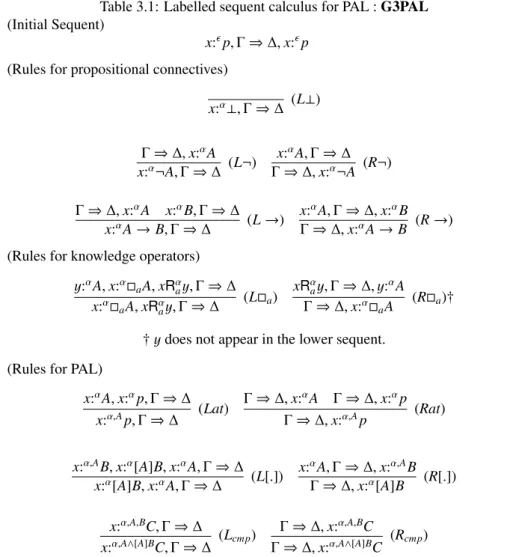
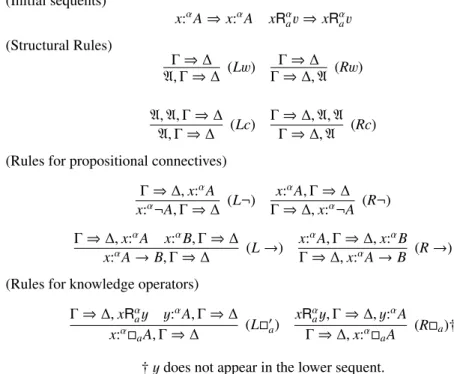
In this thesis, we provide three different cut-free labelled sequent calculi for PAL, EAK and IntPAL respectively. First, we investigate an existing labelled sequent cal- culus for PAL and this investigation becomes an important foundation for the three labelled sequent calculi of ours with respect to the soundness theorems, the complete- ness theorems and the cut-elimination theorems for other labelled systems. A labelled sequent calculusG3PALfor PAL is provided by Maffezioli and Negri (2011), but it in fact lacks inference rules for deriving an axiom of the Hilbert-system of PAL. So, we provide our revised calculusGPAL, and all the formulas derivable by Hilbert-system of PAL are also derivable inGPALtogether with the cut rule. We also establish the cut elimination theorem. Moreover, we show the soundness of our calculus for Kripke se- mantics with the notion of surviveness of possible worlds in a restricted domain. Then we provide a direct proof of the semantic completeness of GPAL for the link-cutting semantics of PAL.
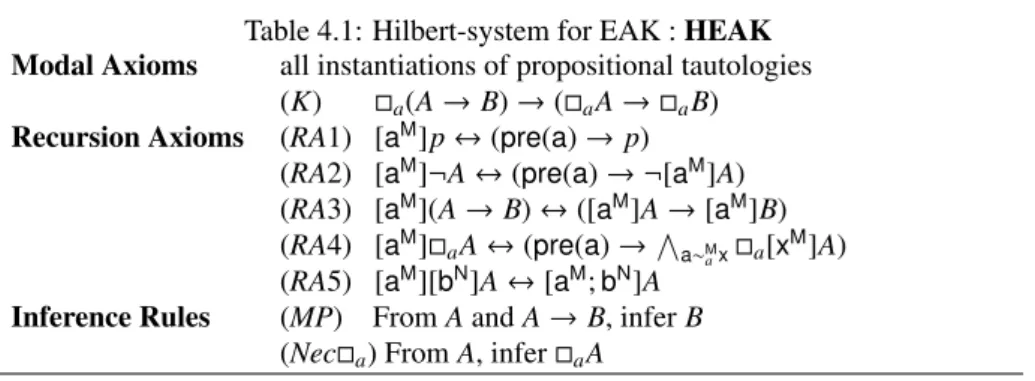
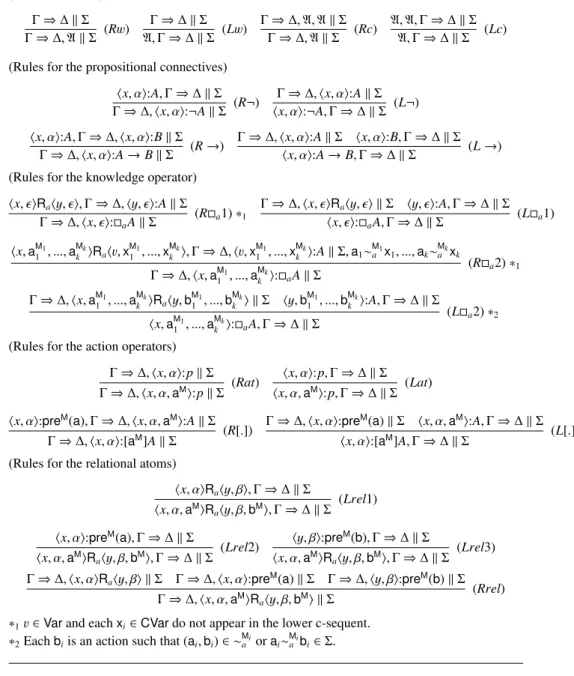
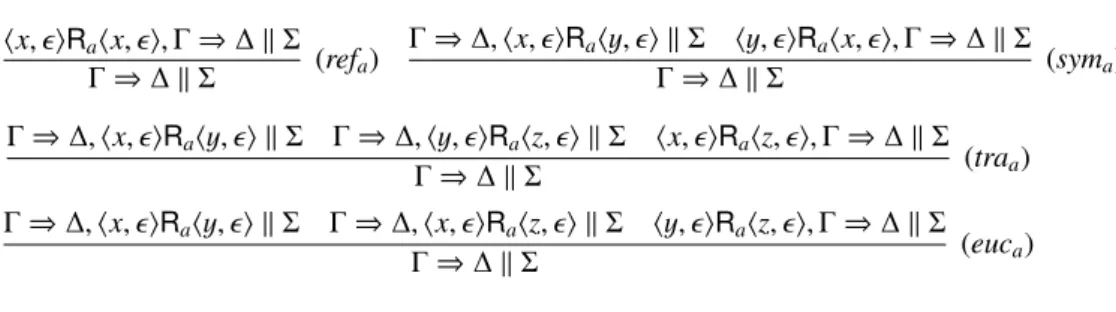
Secondly, we move onto EAK based on the study of labelled sequent calculus for PAL. We also provide a cut-free labelled sequent calculus (GEAK) on the background of existing studies of the Hilbert-system (we call itHEAK) and labelled calculi for PAL. Similar to the previous procedure, we first show that all the formulas derivable by the Hilbert-system of EAK are also derivable inGEAKwith the cut rule, and we show
that the cut rule is eliminable inGEAK. Then we showGEAKis sound for Kripke semantics. After demonstrating that soundness, we derive the semantic completeness ofGIntPALas a corollary of these theorems
Thirdly and lastly, we introduce a labelled sequent calculusGIntPALfor IntPAL.
Following the same manner of the construction of a labelled sequent calculus as the pre- vious two, we show that all theorems of the Hilbert-system of IntPAL are also derivable inGIntPALwith the cut rule. Then we prove the cut-eliminability ofGIntPALand also its soundness for birelational Kripke semantics, and so its completeness for the semantics.
Keywords— Dynamic Epistemic Logic, Public Announcement Logic, Intuitionistic Public Announcement Logic, Logic of Epistemic Actions and Knowledge, Labelled Sequent Calculus, Admissibility of Cut, Validity of Sequents
Contents
1 Introduction 6
1.1 Epistemic Logic and belief-revision . . . 6
1.2 Dynamic Epistemic Logic (DEL) . . . 7
1.3 Sequent calculi for modal logics . . . 8
1.4 Proof-theoretic studies for DELs . . . 10
1.5 Contribution . . . 12
2 Preliminaries 14 2.1 Multi-modal logic (ML) . . . 14
2.1.1 LanguageLMLand Kripke semantics . . . 14
2.1.2 Hilbert-systemHKof Multi-modal logic . . . 16
2.1.3 Labelled sequent calculusG3K . . . 19
2.1.4 Multi-agent epistemic logic . . . 22
2.2 Public Announcement Logic (PAL) . . . 23
2.2.1 LanguageLPALand Kripke semantics . . . 23
2.2.2 Examples of knowledge-change in PAL . . . 24
2.2.3 Hilbert-systemHPALof PAL . . . 27
2.3 Logic of Epistemic Actions and Knowledge (EAK) . . . 29
2.3.1 LanguageLEAKand Kripke semantics . . . 29
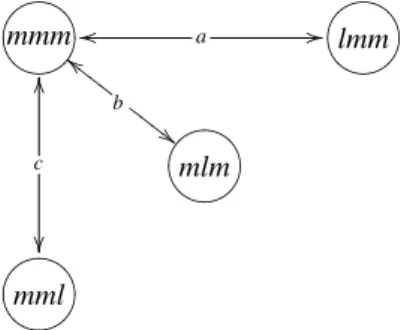
2.3.2 Examples of knowledge-change in EAK . . . 31
2.3.3 Hilbert-systemHEAKof EAK . . . 32
3 Labelled sequent calculus for PAL 34 3.1 Sequent calculus for PAL . . . 35
3.1.1 G3PAL . . . 35
3.1.2 Problems ofG3PAL . . . 36
3.2 Revised calculusGPAL. . . 39
3.2.1 GPAL. . . 40
3.2.2 All theorems ofHPALare derivable inGPAL+ . . . 44
3.2.3 Cut Elimination ofGPAL+. . . 47
3.3 Soundness ofGPAL . . . 56
3.4 Completeness ofGPALfor Link-cutting semantics . . . 61
3.5 Extensions of PAL fromKtoS5 . . . 68
4 Labelled sequent calculus for EAK 75
4.1 Labelled sequent calculusGEAK . . . 76
4.2 Cut elimination ofGEAK+ . . . 79
4.3 All derivable formulas inHEAKare derivable inGEAK+ . . . 87
4.4 Soundness ofGEAK . . . 91
4.5 Extensions of EAK fromKtoS5. . . 97
5 Intuitionistic Public Announcement Logic (IntPAL) 102 5.1 LanguageLIntPALand birelational Kripke Semantics . . . 103
5.2 Examples of knowledge-change in IntPAL . . . 105
5.3 Hilbert-systemHIntPALof IntHPAL . . . 105
5.4 Labelled sequent calculusGIntPAL . . . 106
5.5 All theorems ofHIntPALare derivable inGIntPAL+ . . . 107
5.6 Cut Elimination ofGIntPAL+ . . . 115
5.7 Soundness ofGIntPAL. . . 123
6 Conclusion 130 6.1 Summary of contributions . . . 130
6.2 Future directions . . . 131
A Implementations for Dynamic Epistemic Logics 132 A.1 Semantic tools for DELs . . . 132
A.1.1 Implementation for PAL . . . 132
A.1.2 Kripke semantics . . . 133
A.1.3 Implementation for EAK . . . 136
A.2 Automated theorem prover for DELs :Kripkenstein . . . 146
A.2.1 GPALofKripkenstein . . . 146
A.2.2 Core functions for automated theorem proving . . . 152
List of Tables
2.1 Frame properties . . . 15
2.2 Hilbert-system for ML:HK. . . 16
2.3 Labelled sequent calculus for ML :G3K. . . 20
2.4 Rules of G3-system for frame properties . . . 20
2.5 Hilbert-system for PAL :HPAL . . . 27
2.6 Hilbert-system for EAK :HEAK. . . 32
3.1 Labelled sequent calculus for PAL :G3PAL . . . 37
3.2 Revised labelled sequent calculus for PAL:GPAL. . . 42
3.3 Rules for frame properties . . . 70
4.1 Hilbert-system for EAK :HEAK. . . 75
4.2 Labelled sequent calculus for EAK :GEAK . . . 78
4.3 Rules for frame properties . . . 98
5.1 Hilbert-system for IntPAL :HIntPAL . . . 106
5.2 Labelled sequent calculus for IntPAL :GIntPAL . . . 108
A.1 Labelled sequent calculus forKripkenstein:GPAL′ . . . 147
List of Notations
Acronyms
ML Multi-modal Logic
PAL Public Announcement Logic
EAK Logic of Epistemic Actions and Knowledge IntPAL Intuitionistic PAL
Set theoretic notations
x∈X the membership relation ofxandX ∅ the emptyset X⊆Y Xis a subset ofY P(X) the power set ofX
X∪Y the union ofXandY R◦Q the composition ofRandQ X∩Y the intersection ofXandY idX the identity relation onX X×Y the Cartesian product ofXandY N the set of all natural numbers X\Y the relative complementXofY
Common notations
a,b, ...∈Agt agents Ra,Rb, ... accessibility relations
p,q, ...∈Prop propositional atoms F,F′, ... Kripke frames
A,B, ...∈ L formulas M,M′, ... Kripke models
x, y, ...∈Var variables F,F′, ... classes of Kripke frames
w, v, ... worlds M,M′, ... classes of Kripke models
W,W′, ... sets of worlds
Notations for PAL and IntPAL
α, β, ... finite lists of formulas xRαay relational atom
x:αA labelled formula A,B, ... labelled expressions
Notations for EAK
a,b, ...∈Act actions α, β, ... finite lists of
x,y, ...∈CVar⊆Act meta-variables for actions pointed action models
S,S′, ... finite sets of actions ⟨x, α⟩:A labelled formula
∼a,∼b, ... action relations ⟨x, α⟩Ra⟨y, β⟩ relational atom
M,N, ... action models A,B, ... labelled expressions
aM,bN, ...∈PAct pointed action models
Acknowledgement
This thesis would not be possible without the devoted support of my supervisors, Satoshi Tojo and Katsuhiko Sano. Their enthusiastic guidance enabled me to enter the field of knowledge-revision and modal logic and to realize the aim of my research in the Ph.D. program, and they taught me what a researcher should be. I wish, in particular, to thank assistant Prof. Sano for teaching modal logic from the basics and considering the essential parts, such as an adequate validity for a labelled sequent for DELs and the application of Simpson’s lifting lemma in the proof of IntPAL’s sound- ness. We used this information in our papers which became the basis of this thesis. I would like to thank my supervisor of minor research, Hiroakira Ono. He gives a valu- able opportunity to develop and discuss the idea regarding the third paper of Dynamic Epistemic Logic, and I had unforgettable and fun times with him. I am immensely indebted to members of my Ph.D. defense, Makoto Kanazawa, Ryo Kashima, Hajime Ishihara and Norbert Preining. Their critical insight and suggestions improve my thesis and help to enhance my understanding of logic. I also thank Prof. Kanazawa for not only the defense but giving us valuable advice of the link-cutting semantics in the first paper of ours. I wish to thank to Hiroaki Suzuki, Shinya Hirose and Takafumi Kodama for supporting my coding, Sean Arn for helping to edit English documents, and all the other members of Tojo laboratory for encouraging me in the Ph.D. program. Without their help, this thesis would not be completed.
Chapter 1
Introduction
The prelude to this thesis is modal logics. In the late 50s to the early 60s, Kripke [46, 47] providedKripke semanticsto modal logic.1 This semantics provides an adequate interpretation for a formal expression of ‘necessarily’ and ‘possibly.’ In modal logic,
‘it is possible thatA,’ may be expressed by formula□A, and in Kripke semantics, it is intuitively interpreted as ‘for all possible worlds which are accessible from a specific world,Aholds.’ This semantics gives both formal and intuitive understandings to the once mysterious notion of modality. Since then, the field of modal logic has flourished and deepened studies of several kinds of modalities, such as temporal modalities [70], deontic modalities [43], doxastic modalities [36] and epistemic modalities. We are, in this thesis, concerned with epistemic logic which handles the last modalities, epistemic modalities.
1.1 Epistemic Logic and belief-revision
Epistemic logic is a logic which aims at formalizing knowledge, and has been devel- oped by several logicians and philosophers, e.g., von Wright [86] and Hintikka [35].
The initial motivation for the study of this logic was to contribute to the field of philo- sophical epistemology since the concept of the formalization of knowledge (or belief) through formal languages suits the spirit of analytic philosophy in the early 20th cen- tury where Anglo-American philosophers discussed the reasonable measure for mod- ern philosophy and aimed for expulsion of traditional metaphysics. Although episte- mology in analytic philosophy gradually strengthened academic relationship with other natural sciences such as neuroscience and biology and left the formalization with modal logic, another movement of formalization of knowledge and belief was, instead, started in a different area, computer science. In the 80s, since the performance of computers became much more powerful than before, the study of artificial intelligence blossomed, and several works were submitted; for example, non-monotonic logics (default logic
1At the same period, similar semantics independently was given by Kanger [39], Hinttika [35], Mon- tague [55] and Prior [70], and a closely related study had already been given by Jonsson and Tarski [37, 38]
about ten years ago (see more detail in [32, 74]).
by Reiter [72], circumscription by McCarthy [52]) and belief-revision by Levi [48]
and Gärdenfors and Makinson [29]. This area is called belief-revision (knowledge- revision). However, another tradition of formalization of knowledge, epistemic logic, was not popular in that field.
1.2 Dynamic Epistemic Logic (DEL)
In the last century, there were two movements of formalizing knowledge—philosophical epistemology and belief-revision— but these two had not deeply connected with each other. From the 90s, the movement of knowledge-revision (belief-revision) became conspicuous in epistemic logic. Specifically,Public Announcement Logic (PAL) by Plaza [68] andLogic of Epistemic Actions and Knowledge(EAK) by Baltag et al. [8]
(elaborated in several papers, e.g., [8, 31, 81, 83])2are outstanding studies, and they formed the field of Dynamic Epistemic Logic (DEL). Today, a number of followers have developed and refined this area for a formalization of knowledge, and have been specializing DEL to apply it to artificial intelligence, epistemology in philosophy, the- oretical economics, formalizing law, and so on.
Public Announcement Logic Public Announcement Logic (PAL) was first presented by Plaza [68], and it has been the basis of Dynamic Epistemic Logic. PAL is a logic for formally expressing changes of human knowledge. When we obtain some infor- mation through communication with others, our state of knowledge may change. For example, if ‘John does not know whether it will rain tomorrow or not’ is true and he gets information from the weather forecast which says that ‘it will not rain tomorrow,’
then the state of John’s knowledge changes, so ‘John knows that it will not rain to- morrow’ becomes true. While a Kripke model of the standard epistemic logic stands for the state of knowledge, the standard epistemic logic does not have any syntax for properly expressing changes of the state of knowledge. PAL was introduced for the pur- pose of dealing with the flexibility of human knowledge, and the change of knowledge formally realized by the announcement operator which can restrict possible worlds of Kripke semantics. A formula [A]Bof PAL reads ‘after an announcement ofA,Bholds.’
Logic of Epistemic Actions and Knowledge (EAK) Another foundation of the field of DEL is Logic of Epistemic Actions and Knowledge (EAK) provided by [8]. EAK is a developed version of PAL; as the name PAL shows, it deals mainly with ‘public an- nouncements,’ by which every agent shares the same information; however, the state of knowledge may be changed not only by public announcements but also announcements to a specific group in a community. A typical example is ‘private announcements,’
in which someone communicates something to only a single person (e.g., a personal letter). An extension of PAL, EAK is a logic which can express not only public an- nouncements, but more delicate and complicated flows of information such as private
2The original EAK by [8] has reformed and improved until today, and this is sometimes called by different names, e.g.,Dynamic Epistemic Logic(in a narrow sense) andAction Model Logic[83]. In fact, we basically follow the definitions of this logic introduced in [83] from the next chapter, but we employ the original name by [8].
announcement, and such a factor that causes a change of knowledge state is called an action(or event) as a whole. Technically, the notion of actionais defined with the action model which is almost the same as the Kripke model with a finite domain. In- terestingly or oddly, an action model differs from a Kripke model and belongs to the syntax field of EAK. A formula [a]Bof EAK reads ‘after an actionaoccurs,Bholds.’
1.3 Sequent calculi for modal logics
Sequent calculus is another principal of this thesis. We mainly refer to the survey paper of Negri [56] and Bednarska and Indrzejczak [9] for this section regarding se- quent calculi of modal logics. Sequent calculus for propositional logic LK was given by Gentzen [30], and it has also applied to the proof theory of modal logics, and the reader can find sequent calculi for the modal logics K, T, S4, and S5 in the introduction of Ono [66]. The simple and standard sequent calculus for modal logic K includes the following additional inference rule to the sequent calculus LK for classical proposi- tional logic,
Γ⇒A
□Γ⇒□A (□) .
Modal logics T, S4 and S5 include other additional rules respectively, and cut-elimination theorems of sequent calculi for some systems (in particularly S4) are established by Ohnishi and Matsumoto [62]. Also contraction-free calculi (called a G3-system, and we will see it in Section 2.1.3) for some systems are constructed respectively by Troel- stra and Schwichtenberg [80]. However, in fact, the sequent calculus for modal logic S5 is problematic since Ohnishi and Matsumoto [63] also showed that the cut-elimination does not hold in this standard sequent calculus for S5. This crucial failure in S5 led several studies of the sequent calculus for modal logic. In this movement in the 70s and 80s, Mints [54] and Sato [75, 76] independently provided a cut-free calculus for S5, but they are fairly complicated and contain the problem with the subformula property.
Shvarts [77] provided a cut-free sequent calculus for modal logic K45 and also showed that formulaAis derivable in modal logic S5 iff□Ais derivable in modal logic K45;
so it can be said that he gave an indirect solution of cut elimination of S5. In the same paper [77], he also provided a cut-free system for KD45. Moreover, many other re- searchers attempted to construct an adequate cut-free sequent calculus for modal logics including S5. For example, display calculus [10], nested sequent calculus [40, 79, 14], hypersequent calculus [69, 5], labelled sequent calculus and so on. In the following, we briefly introduce one of such new systems called labelled sequent calculus.
Labelled sequent calculus An original idea of labelled sequent calculus can be found in Kanger [39], where a sequent for S5 consists of formulas with natural num- bers and this formula is calledspotted formula Am(m∈N)3. Modern labelled sequent calculus was explained in Negri and Plato [58] introduces a special syntactic object (it enriches the syntax) calledlabelled formula. The basic idea underlying this calculus
3The author is grateful to Hiroakira Ono who lent him Kanger’s precious original reference [39] and told the origin of labelled formula.
is to internalize notations of the standard semantics of modal logic (Kripke semantics) into the enriched syntax. In other words, this enriched syntax includes a label con- sisting of variablexwhich corresponding to possible worldwin Kripke semantics. A labelled formulax:Awhich is a formulaAwith label xcorresponds to a satisfaction relationM,f(x)⊩ AwhereMis a Kripke model and f is a function which assigns a world to a variable. Moreover, this calculus includes another special syntaxxRycalled arelational atom(wherex, yare labels). As one can imagine, the relational atom cor- responds to accessibility relation f(x)R f(y) in Kripke semantics where f is the func- tion as above. By importing special notations corresponding to semantic notations, inference rules of labelled sequent calculus are directly obtained from the definition of satisfaction relation. For example, given a Kripke modelM=(W,R,V), the definition
M, w⊩ □Aiff wRvimpliesM, v⊩ □Afor allv∈W.
Since labelled sequent calculus has syntactic notations corresponding semantic nota- tions, labelled formulax:□A(corresponding toM,f(x) |=A) can be intuitively inter- preted as an implication ofxRy→y:Afor ally(corresponding tof(x)R f(y) impliesM,f(y)⊩ A); therefore, in such a labelled system, inference rules can be easily extracted from the definition of satisfaction relation in Kripke semantics. Let us look at inference rules for□operator:
xRy,Γ⇒y:□A,∆ Γ⇒x:□A,∆ (R□) whereydoes not appear in the lower sequent, and
y:A,x:□A,xRy,Γ⇒∆ x:□A,xRy,Γ⇒∆ (L□)
.
As you can see, these rules are obtained from the idea thatx:□Ais an implication of xRy→y:Afor ally.
Moreover, labelled sequent calculus can internalize frame properties such as reflex- ivity, symmetricity, transitiveness etc. quite easily as well. Assume we have a labelled calculus for modal logic K, and we can obtain a calculus for modal logic T by adding the following inference rules into the set of inference rules of it:
xRx,Γ⇒∆ Γ⇒∆ (ref)
.
This calculus which enriches syntax and has syntactic notations corresponding to se- mantic notations can construct inference rules relating with frame properties and add them straightforwardly. Because of that, the construction of this type of calculus starts from K and then afterwards expand it to T, S4, S5 etc. by adding such inference rules.
We also follow this method. In other words, we will construct our labelled calculi based on modal logic K at first in the following sections.
Cut elimination for S5, which was the primary interest of new version of sequent calculus for modal logics, holds of course, and a contraction free calculus can also be constructed in this system for S5. The more specific and formal definition of this calculus will be given in the next section.
1.4 Proof-theoretic studies for DELs
Let us move onto the topic of proof-theoretic formalizations of DELs such as PAL and EAK. For each of the two DELs, there exists the Hilbert-system (c.f. [8, 68]) which is sound and complete with respect to Kripke semantics (we will discuss them in Chapter 2). Based on the Hilbert-systems, several proof-theoretic studies for PAL and EAK have been appeared. We discuss such related works below other than a labelled sequent calculus for PAL which will be introduced in Chapter 3 in detail.
Labelled tableaux method for PAL A tableaux method for PAL is introduced in Balbiani el al. [7]. Its calculation is carried out witha labelled formula x:αA4 where αis a finite list of formulas of PAL, x ∈ Var(Var is a set of variables) and Ais a formula of PAL. The labelled formula of this method is the same as that of labelled sequent calculus, it corresponds to the definition of the satisfaction relation in PAL’s Kripke semantics, and it intuitively reads that after the sequence of announcements α, formulaAstill holds at world x. Added to that, this method included the ternary relationΣ⊆Agt×Var×Var(Agtis a set of agents, and we denote the triple (a,x, y) by xRay) which represents the accessibility relation. The below is two examples, (K) and ([.]), of the inference rules of this calculus which are for the box (knowledge) operator and the announcement operator:
x:B1,B2,...,Bn□aA,Σ
(K)
ttiiiiiiiiiiiiiiiiiiii
xxpppppppppppp
((P
PP PP PP PP PP PP P
++X
XX XX XX XX XX XX XX XX XX XX XX XX XX . . .
y:ϵ¬B1,Σ y:ϵB1,Σ . . . y:ϵB1,Σ y:ϵB1,Σ
y:B1¬B2,Σ y:B1,...,Bn−2Bn−1,Σ y:B1,...,Bn−2Bn−1,Σ y:B1,...,Bn−1¬Bn,Σ y:B1,...,Bn−1Bn,Σ wherexRay∈Σ.
x:α[A]B,Σ
([.])
ssgggggggggggg
++W
WW WW WW WW WW WW
x:α¬A,Σ x:αA,Σ
x:α,AB,Σ .
4The notation of labelled formula differs from the original paper [7]; however, since the labelled formula here also has the same type as that of a labelled sequent calculus in this thesis, we unify different notations of labelled formula intox:αA.
Further, a different tableaux method is given by Ma et al. [50] which is sound and complete for a non-normal modal logic characterized by neighborhood models, and this method does not include a syntactic expression of accessibility relation which differs from above. This system also contains a labelled formula like the one above, but they explicitly include the following labelled formula: x:α×.This semantically means that a world corresponding toxdoes notsurviveafter the sequence of public announcementsα. To be specific, possible worlds in Kripke semantics can be restricted by an announcement, and this suggests that some worlds can be eliminated and the others survive. The notation×in the labelled formula is a sign of a world which does not survive. The idea of survival is also used in the semantics of labelled sequent calculi in this thesis (see Sections 3.3 and 3.4). The following is examples of the inference rules (□∩a) and ([.]):
x:α□aA x:β¬□aB
(□∩a)
tthhhhhhhhh WWWWWWWWWW++
y:αA y:α×
y:β¬B y:β¬B ,
x:α[A]B
([.])
uujjjjjjjjj
**T
TT TT TT TT
x:α¬A x:α,AB
Labelled tableaux method for EAK Tableau method for EAK is introduced by Aucher et al. [3], and Aucher and Schwarzentruber [4] in the context of the study regarding computational complexity of EAK. This method also containsa labelled for- mulalike the tableaux methods for PAL. A labelled formula has the following form, x:αAwherex∈N,αis a finite list ofactionsof EAK andAis a formula of EAK, and it intuitively reads that after the sequence of actionsα, formulaAstill holds at worldx.
Moreover, this system includes a syntactic notationxRayof an accessibility relation as the initial example of tableau method for PAL (and sequent calculi in this thesis).x:α✓ means that list of actions isexecutablein the world corresponding tox, andx:α⊗means that listαof actions isnotexecutable in the world corresponding tox. The meaning of executable is that the precondintions ofxwhich belong to actions in the list hold. The reader may notice that this method resembles the tableaux method for PAL from the following examples of the inference rules (□a) and ([.]):
x:a1,a2,...,an□aA,Σ xRay
(□a)
rrfffffffffff XXXXXXXXXXX,,
y:b1,b2,...,bn✓ y:b1,b2,...,bn⊗
y:b1,b2,...,bnA ,
x:α[a]A
[.]
uujjjjjjjj
**T
TT TT TT TT
x:α,a⊗ x:α,a✓
x:α,aA ,
where everybiis a state which is accessible fromai.
Display calculus for EAK Display calculus was first introduced in Belnap [10].
This calculus consists of an enriched syntax and introduces new structural connec- tives(,). While the above labelled systems are semantic-dependent systems (a labelled formula correspond to the semantic notion, the satisfaction relation), display calculus is a semantic-independent system. A sequentX ⇒ Y is a pair ofX andY which are structuresconsisting of formulas and structure constants using the structural connec- tives. An outstanding feature of display calculi is a general cut-elimination theorem which for all display calculi satisfying eight syntactic conditions.
This powerful proof-theoretic framework is widely applied to several logics includ- ing EAK. Display calculus for EAK is given by Greco et al. [33]. It also provides an enriched syntactics than the normal version of EAK, in which all logical operations have adjoints. This calculus is sound and complete for semantics called the final coal- gebra semantic (c.f. [1, 18]). The reason to employ such a non-standard semantics is that the standard Kripke semantics may not provide a natural interpretation to the ex- tended logical operators such as [·] and ⟨·⟩ which are adjoint to [·] and⟨·⟩(the action operator and the dual of this) respectively, but the final coalgebra semantics can do this.
The following is an example of inference rule of this calculus:
A⇒ {a}X A⇒[a]X ([a]R)
,
whereais an action and{a}is a structural connective associated with [a] and⟨a⟩.5
1.5 Contribution
We mainly focused on the proof theories of PAL and EAK, which became the basis of the flourishing field of epistemic logic, and constructed cut-free labelled sequent calculi for them based on existing Hilbert-style proof systems. Specifically, in PAL, our labelled sequent calculus was closely related with the study of Maffezioli and Ne- gri [51], where a labelled sequent calculus for PAL was constructed, but Balbiani et al. [6] suggested that this system is not semantically complete for Kripke semantics.
We specified this problem and revised it to be a complete calculus. We also focused on the soundness of a labelled sequent calculus for PAL where the usual definition for the validity of a sequent was not adequate, which has not been suggested by previous works, and we provided a different and more suitable definition for it. Then, we in- vestigated the completeness theorem for our calculus. In PAL, the Kripke model can be restricted by an announcement, i.e., some possible world(s) where a contradiction occurs that can be deleted, and this causes a difficulty for a direct proof of the com- pleteness theorem. Therefore, for the proof, we also found that a different but suitable Kripke semantics was required, which we called ‘link-cutting semantics,’ where only the accessibility relation can be restricted by an announcement. Also, our calculus was founded on modal logic K, the most basic modal logic, as a starting point of the con- struction of our calculus, but the extensions from K to other modal logics were also
5In addition to related works mentioned above, a nested sequent calculus for EAK is provided by Dyck- hoffand Sadrzadeh [24], but the syntax underlying their system varies from the normal syntax of EAK, so we do not refer to it in detail.
given by providing additional inference rules corresponding to frame properties. The extension to modal logic S5 is particularly significant since S5 is the usual basis of epistemic logic. In EAK, there exists a calculus by [33] is complete for an unusual semantics, the final coalgebra semantics. In this thesis, we, based on the argument of the labelled sequent calculus for PAL, constructed a labelled sequent calculus for EAK that was semantically complete for thestandardKripke semantics. Since EAK is a generalization of PAL, a number of methods for the construction of a labelled sequent calculus for PAL could be applicable to the construction of a calculus for EAK; how- ever, we particularly pay attention to how to deal with the composition of accessibility relations and action relations in a syntactic way. The treatment of these relations was the core of our calculus for EAK and they differentiate it from [3]. We also provide extensions from modal logic K to other modal logics, including S5, as in the case of PAL. Moreover, recently, Intuitionistic PAL (IntPAL) was proposed by Ma et al. [49], and we provided a cut-free labelled sequent calculus for it. The construction of the cal- culus also follows a similar method to that of PAL; however, since IntPAL employs a bi-relational Kripke semantics, which is one of the standard semantics for intuitionistic modal logics, we face a different difficulty from the deletion of world(s). We settle the problem by making use of Simpson’s solution [78]. Intuitionistic epistemic logic has a philosophically profound meaning as it can be regarded to provide a strict sense of knowledge, which is justified by evidence for knowledge. We expect that our cut-free calculus is valuable to give concrete evidence. There is an underlying paper on each of three labelled sequent calculi. Studies of three sequent calculi for PAL, EAK and IntPAL are based on the author’s paper [61], [60] and [59] respectively.
The outline of this thesis is as follows: Chapter 2 provides technical preliminaries of basic multi-modal logics and labelled sequent calculi for multi-modal logics, se- mantics and their applications for PAL, and those of EAK; Chapter 3 introduces our first calculus, which is for PAL, and shows the cut-elimination theorem, as well as the soundness and completeness results; and Chapter 4 introduces our second calculus, which is for EAK and shows the same results as above. Chapter 5 provides the language and bi- relational Kripke semantics of IntPAL, and then introduces our third calculus, in which we also show the results of the cut-elimination, soundness and completeness.
Chapter 2
Preliminaries
2.1 Multi-modal logic (ML)
Let us get started with Multi-modal Logic (ML for short), the foundation of epistemic logics and dynamic epistemic logics. ML contains a finite setMod= {□,□′,□′′, . . .}
of modal operators (modalities) is added to classical propositional logic. In fact, the ordinary (multi-agent) epistemic logic is no different from (multi-) modal logic S5 (in Section 2.1.4) but only modalities are interpreted as states of knowledge. In this section, we mainly refer to [11, 17]. Section 2.1.1 gives the language and Kripke semantics of ML, while Section 2.1.2 and Section 2.1.3 introduce two different proof systems and their basic results respectively.
2.1.1 Language L
MLand Kripke semantics
LetProp ={p,q,r, . . .}be a countably infinite set of propositional atoms andMod= {□,□′,□′′, . . .}a nonempty finite set of modalities. Then the setLML={A,B,C, . . .}of formulas of ML is inductively defined by BNF as follows (p∈Prop,□∈Mod):
A::=p| ¬A|(A→A)|□A.
Definition 2.1.1. LetA,Bbe any formulas inLMLandpbe any propositional atom in Prop. Then ordinary logical connectives are defined as follows:
A∧B:=¬(A→ ¬B), A∨B:=¬A→B,
⊥:=p∧ ¬p, ♢A:=¬□¬A, A↔B:=(A→ B)∧(B→A), ⊤:=⊥ → ⊥,
∧{A1, ...,An}:=A1∧ · · · ∧An, ∧
∅:=⊤.
Kripke Semantics Let us consider Kripke semantics. A (Kripke) frameis a pair F=(W,(R□)□∈Mod) whereW is a non-emptyset of elements, called (possible)worlds, and eachR□⊆W×W is a binary relation onW, called anaccessibility relation. We call a pairM= (F,V) a (Kripke)modelifFis a frame andV : Prop → P(W) is a valuation functionwhich assigns a subset ofWto a propositional atom. Given a model
M,w∈ D(M) andA ∈ LML, we define thesatisfaction relationM, w⊩Aas follows (□∈Mod):
M, w⊩p iff w∈V(p), M, w⊩¬A iff M, w⊮A,
M, w⊩A→B iff M, w⊩AimpliesM, w⊩B,
M, w⊩ □A iff for allv∈W :wR□vimpliesM, v⊩A.
The setW of worlds in a modelMis also called thedomainofM, denoted byD(M).
We write a class of frames byFetc. and a class of models byMetc.
Definition 2.1.2(Validity). LetAbe any formula inLML.
(i) A formulaAisvalid on a modelM(notation:M⊩A) ifM, w⊩Aholds for any w∈ D(M).
(ii) A formulaAisvalid on a frameF=(W,(R□)□∈Mod) (notation:F⊩A) if (F,V)⊩ Aholds for any valuationV.
(ii) A formulaAisvalid onM(notation: M⊩A) ifM⊩Aholds for any modelM in a class of modelsM.
(iv) A formulaAisvalid onF(notation:F⊩A) ifF⊩Aholds for any frameFin a classFof frames.
Frame definability We consider here the correspondence between a formula and a condition of frames. Then we define the basic concept of modal logic underlying in this thesis.
Definition 2.1.3(Definability). LetAbe a formula inLMLandFa class of frames. We say thatA definesFifF∈FiffF⊩Afor allF.
Here are five widely known formulas each of which is given a traditional name such as T□,B□,4□,5□andD□(□∈Mod) as follows:
T□:=□p→p, 4□:=□p→□□p, D□:=□p→♢p.
B□:=p→□♢p, 5□:=♢p→□♢p,
In addition to that, we introduce other five well-known names of conditions on acces- sibility relations (R□)□∈Modin a frame. These conditions are shown in Table 2.1.
Table 2.1: Frame properties R□isreflexive wR□wfor allw∈W
R□issymmetric wR□vimpliesvR□wfor allw, v∈W
R□istransitive wR□vandvR□uimplywR□ufor allw, v,u∈W R□isEuclidean wR□vandwR□uimplyvR□ufor allw, v,u∈W R□isserial wR□vfor allw∈Wfor somev∈W
When we say a list (R□)□∈Mod of accessibility relations is reflexive, every accessi- bility relationR□in the list is reflexive. Then we can show the following proposition.
Proposition 2.1.1. LetFbe a frame andR□be any accessibility relation inF. Then the following hold:
F⊩T□ iff R□isreflexive, F⊩5□ iff R□isEuclidean, F⊩B□ iff R□issymmetric, F⊩D□ iff R□isserial.
F⊩4□ iff R□istransitive,
As a result of Proposition 2.1.1, formulasT□,B□,4□,5□ andD□ (□ ∈ Mod) define classes of frames which satisfy the corresponding frame property respectively, e.g.,T□ defines the class ofR□-reflexive frames. In what follows, we use the following set:
FrameAxiom:={T□,B□,4□,5□,D□|□∈Mod}.
Definition 2.1.4. LetΣbe a subset ofFrameAxiom. Then we writeFΣ to mean the class of frames which is defined by∧Σ. Further, let us also define the class MΣ of models byMΣ:={(F,V)|F∈FΣandVis a valuationVonF}.
2.1.2 Hilbert-system HK of Multi-modal logic
We will introduce two proof systems: Hilbert-system in this section and labelled se- quent calculus in the next section. Hilbert-systemHKis given in Table 2.2, where axiom (K) and inference rule (Nec) are added to the Hilbert-system of classical propo- sitional logic. When we add one or more formulas inFrameAxiomas additional axiom
Table 2.2: Hilbert-system for ML:HK
Modal axiom scheme (Taut) all instantiations of propositional tautologies (K) □(A→ B)→(□A→□B) (□∈Mod) Inference rules (MP) FromAandA→B, inferB
(Nec) FromA, infer□A(□∈Mod)
schemes (each of which can define a class of frame) to the set of axiom scheme ofHK, we obtain Hilbert-systems other thanHKas follows.
Definition 2.1.5(Extensions ofHK). LetΣbe a subset ofFrameAxiom. When each element ofΣis added to HK as an axiom scheme by replacing p with an arbitrary formulaA,the extension ofHKis the resulting Hilbert-systemHKΣ.
For example, if the set{T□,B□′}are added toHK, we obtain Hilbert-systemHK{T□B□′}. Hilbert-systems with some particular combinations of axiom schemes are given names.
HT:=HK{T□|□∈Mod}, HS5:=HK{T□,5□|□∈Mod}, HB:=HK{T□,B□|□∈Mod}, HD:=HK{D□|□∈Mod}. HS4:=HK{T□,4□|□∈Mod},
Definition 2.1.6 (Derivation of HKΣ). Let HKΣ (where Σ ⊆ FrameAxiom) be a Hilbert-system. AderivationinHKΣconsists of a sequence of formulas each of which is an instance of an axiom or is the result of applying an inference rule to formula(s) that occur earlier. IfAis the last formula in a derivation, thenAisderivable, and we write⊢HKΣ A. Given a subsetΓ∪ {A}ofLML,A is derivable fromΓinHKΣif there is a finite subsetΓ′ofΓsuch that⊢HKΣ∧Γ′→A, and we writeΓ⊢HKΣA.
Additionally, whenAis not derivable in a proof systemHKΣ(whereΣ⊆FrameAxiom), we write⊬HKΣ A. Finally, we define basic MLs. For anyΣ ⊆ FrameAxiom, modal logicKΣis the set of all derivable formulas inHKΣ. Some modal logics are also given special names in some particular combinations of axiom schemes.
K:=K∅, S4:=K{T□,4□|□∈Mod}, T:=K{T□|□∈Mod}, S5:=K{T□,5□|□∈Mod}, B:=K{T□,B□|□∈Mod}, D:=K{D□|□∈Mod}.
Soundness and Completeness The soundness and completeness theorems are in- tegral parts of a proof system, and the completeness of HKis especially important through this thesis since the semantic completeness theorems of DELs depend on the completeness ofHK(we will see it in the next section).
Theorem 2.1.1(Soundness ofHKΣ). LetΣbe a subset ofFrameAxiom. If⊢HKΣ A, thenMΣ⊩A, for any formulaA∈ LML.
We briefly look at a proof of the completeness theorem ofHKΣwith a similar argument in [11, Section 4.3].
Definition 2.1.7(MaximalKΣ-consistent set). LetΓ⊆ LML. ThenΓisKΣ-consistent if⊥is not derivable fromΓ(Γ ⊬HKΣ ⊥). Γismaximalif A ∈ Γor¬A ∈ Γ for any A∈ LML. Γis amaximallyKΣ-consistent set(aKΣ-MCS for short) ifΓis maximal andKΣ-consistent.
Lemma 2.1.1(Lindenbaum). Every KΣ-consistent set of formulas is a subset of a KΣ-MCS.
Lemma 2.1.2. IfΓis aKΣ-MCS, then
(i) Γ⊢HKΣAimpliesA∈Γ(Deductively closed), (ii) A∈Γiff¬A<Γ,
(iii) A→B∈ΓiffA∈ΓimpliesB∈Γ,
(iv) if□A<Γ, then{¬A} ∪ {B|□B∈Γ}isKΣ-consistent.
Definition 2.1.8(Canonical model). The canonical modelMKΣ=(WKΣ,(RK□Σ)□∈Mod,VKΣ) is defined as follows:
WKΣ = {Γ|Γis aKΣ-MCS},
ΓRK□Σ∆ iff {A|□A∈Γ} ⊆∆ (□∈Mod), VKΣ(p) = {Γ∈WKΣ|p∈Γ}.
Lemma 2.1.3(Truth lemma). For any formulaA ∈ LMLand anyKΣ-MCSΓ,A ∈Γ iffMKΣ,Γ⊩A.
Lemma 2.1.4. LetMKΣ =(WKΣ,(R□KΣ)□∈Mod,VKΣ}be the canonical model for modal logicKΣ. Then the following hold:
(i) if⊢HKΣ□A→Afor all formulasA, thenRK□Σis reflexive,
(ii) if⊢HKΣA→□♢Afor all formulasA, thenRK□Σis symmetric, (iii) if⊢HKΣ□A→□□Afor all formulasA, thenRK□Σis transitive, (iv) if⊢HKΣ♢A→□♢Afor all formulasA, thenRK□Σis Euclidean,
(v) if⊢HKΣ□A→♢Afor all formulasA, thenRK□Σis serial.
Theorem 2.1.2(Completeness ofHKΣ). LetΣbe a subset ofFrameAxiom. IfMΣ⊩ A, then⊢HKΣ A, for any formulaA∈ LML.
Proof. Fix any A ∈ LML. We show the contraposition i.e., if⊬HKΣ A, thenAis not valid. Suppose⊬HKΣAwhich is equivalent to{¬A}⊬HKΣ⊥. So,{¬A}isKΣ-consistent.
By Lemma 2.1.1, there is aKΣ-MCS∆such that{¬A} ⊆∆. By Lemma 2.1.2 (Truth lemma),MKΣ,Γ⊩¬A.By Lemma 2.1.3, the canonical modelMKΣsatisfies the corre- sponding frame property(ies). Therefore, we obtainMKΣ,Γ⊮ Aas desired. □ Decidability and Finite model property We add one more basic property of MLs i.e., decidability. To establish the notion of decidability, we need to mention the finite model property.
Definition 2.1.9(Finite model property). LetΣbe a subset ofFrameAxiom. KΣhas thefinite model propertyiffeach non-theorem of KΣis false in some finite model in MΣ.
Definition 2.1.10(Decidability). A systemKΣof modal logic isdecidableif there is an effective method1 for deciding of any formula whether or not it is a theorem of the system.
The following is a well-known result of modal logics.
Theorem 2.1.3. Modal logicsK,T,B,S4,S5andDhave the finite model property.
Its proof is conducted by the standard filteration-method (c.f. [17, Theorem 5.21] and [65, Section 5] for uni-modal logic).2
Theorem 2.1.4. A system of modal logicKΣis decidable ifKΣhas the finite model property.
1In [19], a method (procedure) M is said to be effective (or mechanical) if (1) M is set out in terms of a finite number of exact instructions (each instruction being expressed by means of a finite number of symbols); (2) M will, if carried out without error, produce the desired result in a finite number of steps; (3) M can (in practice or in principle) be carried out by a human being unaided by any machinery save paper and pencil; (4) M demands no insight or ingenuity on the part of the human being carrying it out.
2A different approach for the finite model property of multi-modal logics is by the fusion of modal logics in [12, Chapter 15]. For any modal logicsX1andX2where they have disjoint modal operators□1, ...,□nand
□n+1, ...,□n+mrespectively, thefusionX1⊗X2ofX1andX2is the smallest multi-modal logic containing
□1, ...,□n,□n+1, ...,□n+m. Then the following [12, Theorem 4 in Chapter 15] holds: if bothX1andX2are modal logics having the finite model property, then their fusionX1⊗X2has the finite model property as well. LetY1andY2be modal logics containing□and□′(□,□′∈Modand□,□′) respectively. Since they are uni-modal logics, the finite model property holds respectively. Then by the above theorem, the fusion Y1⊗Y2has the finite model property. By doing the same step finite times, we obtain that a multi-modal logic containing a finite number of modalities□1,□2, ...,□n∈Modhas the property, since an arbitrary multi-modal logic is equal to a fusionY1⊗ · · · ⊗Yn.
Proof(Outline). AssumeKΣhas the finite model property. Let us consider an effective method for deciding of any formulaAwhether it is a theorem of the system. We call such a method for decidingAis a theorema positive test, and call such a method for decidingAis a non-theorema negative test. By assumption,KΣclearly has a finite number of axioms, so there is a positive test.
Next, a negative test is given as follows. IfM has a finite domain, there is an effective method to check whether an arbitrary formula X is valid atM. Let us call such a methodδ. Besides, we have an effective method to permutate all finite models, and let us call itγ. By the methods of δand γ, we have a complete enumeration M1,M2, ...∈MΣof finite models in each of which∧Σis valid (the validity is checked byδ). If Ais a non-theorem ofKΣ, thenAis false in someMk ∈ MΣ. To find such a modelMk, the falsity ofAis checked atMiby the method ofδ, and ifAis false at the model, then it is a countermodel ofA, elseAis checked by the next modelMi+1. Starting from this procedure fromi = 1, a countermodelMkof Acan be found in a finite step, and therefore, we obtain the way to check whetherAis a theorem or not can
be checked by alternating these tests. □
Corollary 2.1.1. Multi-modal logicsK,T,B,S4,S5andDare decidable.
2.1.3 Labelled sequent calculus G3K
We introduce in this section one of the most uniform approaches for sequent calculus for ML,labelled sequent calculusG3Kby Negri and von Plato [57]. and Negri [56].
G3Kis a basic G3-style sequent calculus for modal logicK, where each formula has a label corresponding to a world of a domain in Kripke semantics. In fact, the la- belled sequent calculus can be regarded as a formalized version of this Kripke seman- tics. We note that a G3-style sequent calculus (or G3-system) is a sequent calculus that does not have any structural rules, and outstanding features ofG3Kare that all inference rules are height-preserving invertible and that the contraction rules are ad- missible3. The specific introduction of the G3-system itself can be found in Troelstra and Schwichtenberg [80] and Negri and von Plato [57], and in this section we follow [57]’s introduction.
Let Var = {x, y,z, . . .} be a countably infinite set of variables. Then, given any x, y ∈ Var and any formula A, we say x:A is a labelled formula, and say xR□y is arelational atomfor any modality □ ∈ Mod. Intuitively, the labelled formula x:A corresponds to ‘M,x⊩A.’ We also use the term,labelled expressionsto indicate that they are either labelled formulas or relational atoms, and we denote them byA,B, etc.
Asequent Γ ⇒ ∆is a pair of finite multi-sets of labelled expressions. The set of inference rules ofG3Kis given in Table 2.3. Hereinafter, for any sequentΓ ⇒ ∆, if Γ⇒ ∆is derivable inG3K, we write⊢G3K Γ⇒ ∆. We call labelled expressionAin the lowersequent at each inference ruleprincipalifAis not in eitherΓor∆.
3The definitions of the height-preserving invertibility and admissibility will be soon given in this section.
We would like to remark a short history of the G3-system. According to von Plato [85], Ketonen [42]
obtained the invertibility of inference rules for classical propositional logic (CL), and Curry [20] showed theheight-preservinginvertibility of them. Moreover, the height-preserving admissibility of the contraction rules (G3-system for CL) was given by Dragalin [22]. Subsequently, Troelstra and Schwichtenberg [80] gave a G3-system in the intuitionistic single suceedent calculus.
Table 2.3: Labelled sequent calculus for ML :G3K (Initial Sequent)
x:p,Γ⇒∆,x:p xR□y,Γ⇒∆,xR□y (Rules for propositional connectives)
Γ⇒∆,x:A
x:¬A,Γ⇒∆ (L¬) x:A,Γ⇒∆ Γ⇒∆,x:¬A (R¬) Γ⇒∆,x:A x:B,Γ⇒∆
x:A→B,Γ⇒∆ (L→) x:A,Γ⇒∆,x:B Γ⇒∆,x:A→B (R→)
x:⊥,Γ⇒∆ (L⊥) (Rules for modal operators)
y:A,x:□A,xR□y,Γ⇒∆
x:□A,xR□y,Γ⇒∆ (L□) xR□y,Γ⇒∆, y:A Γ⇒∆,x:□A (R□)†
†ydoes not appear in the lower sequent.
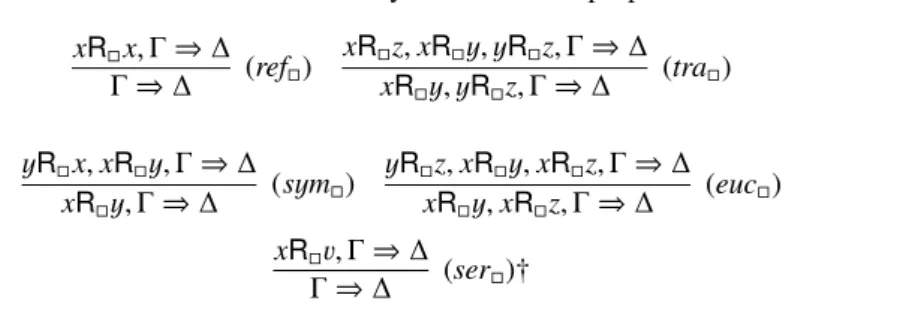
Extensions of G3K Similar to the situation ofHK, extensions ofG3Kare obtained by adding toG3Kone or more of the following rules shown in Table 2.4, which also correspond to the frame properties. Let∗ be a function such that FrameAxiom → {(ref□),(sym□),(tra□),(euc□),(ser□)|□∈Agt}, and defined as follows:
T□∗:=(ref□), B□∗:=(sym□), 4□∗:=(tra□), 5□∗:=(euc□), D□∗:=(ser□).
LetΣbe a subset ofFrameAxiomthenΣ∗is defined to be the set{X∗|X∈Σ}. Definition 2.1.11(Extensions ofG3K). LetΣbe a subset of FrameAxiom. A G3- systemG3KΣ∗is an extension ofG3K, when each element ofΣ∗is added toG3Kas
Table 2.4: Rules of G3-system for frame properties xR□x,Γ⇒∆
Γ⇒∆ (ref□) xR□z,xR□y, yR□z,Γ⇒∆ xR□y, yR□z,Γ⇒∆ (tra□) yR□x,xR□y,Γ⇒∆
xR□y,Γ⇒∆ (sym□) yR□z,xR□y,xR□z,Γ⇒∆ xR□y,xR□z,Γ⇒∆ (euc□) xR□v,Γ⇒∆
Γ⇒∆ (ser□)†
†vdoes not appear in the lowersequent.
an inference rule.
G3-systems with some particular combinations of inference rules are given names.
G3T:=G3K{(ref□)|□∈Mod}, G3B:=G3K{(sym□)|□∈Mod}, G3S4:=G3K{(ref□),(tra□)|□∈Mod}, G3S5:=G3K{(ref□),(euc□)|□∈Mod}, G3D:=G3K{(ser□)|□∈Mod}.
Features of G3KΣ∗ LetG3KΣ∗ be an arbitrary extension ofG3K. We introduce some definitions and outstanding features ofG3KΣ∗. Each extension has properties of G3-system such as the height-preserving invertibility of inference rules and the admis- sibility of the contraction rules and cut-admissibility as well as the completeness for the corresponding Kripke semantics.
Definition 2.1.12(Derivation ofG3KΣ∗). LetΣbe a subset ofFrameAxiom. Aderiva- tionof sequentΓ⇒ ∆inG3KΣ∗is a tree of sequents satisfying the following condi- tions:
(1) The uppermost sequent of the tree is an initial sequent or a conclusion of (L⊥).
(2) Every sequent in the tree except the uppermost sequent(s) is a lowersequent of an inference rule ofG3K.
(3) The lowest sequent isΓ⇒∆.
Given a sequentΓ⇒∆, it isderivable inG3KΣ∗and we write⊢G3KΣ∗ Γ⇒∆if there is a derivation of the sequent. The height of the derivation ofΓ⇒∆is the maximum length of branches of the derivation, and we write⊢nG3KΣ∗ Γ⇒∆to be explicit on the meaning of⊢G3KΣ∗ Γ⇒∆at derivation heightn.
Definition 2.1.13(Admissible). LetΣbe a subset ofFrameAxiom. A rule isadmissible if, whenever the premise(s) of the rule is derivable inG3KΣ∗, the conclusion of the rule is derivable inG3KΣ∗. A rule is height-preserving admissible if, whenever the premise(s) of the rule is derivable inG3KΣ∗with the derivation height at mostn, the conclusion of the rule is derivable inG3KΣ∗with the derivation height at mostn.
Definition 2.1.14(Invertible). LetΣbe a subset of FrameAxiom. A rule is height- preserving invertibleinG3KΣ∗ if, whenever the conclusion of the rule is derivable with the derivation height at mostn, premise(s) of the rule is also derivable with the derivation height at mostn.
Proposition 2.1.2. LetΣbe a subset ofFrameAxiom. All the inference rules ofG3KΣ∗ are height-preserving invertible.
Proposition 2.1.3. The following structural rules are height-preserving admissible:
Γ⇒∆
A,Γ⇒∆ (Lw), Γ⇒∆
Γ⇒∆,A (Rw), A,A,Γ⇒∆
A,Γ⇒∆ (Lc), Γ⇒∆,A,A Γ⇒∆,A (Rc).
Theorem 2.1.5. LetΣbe a subset ofFrameAxiom. The following rule (Cut) is admis- sible inG3KΣ∗,
Γ⇒∆,x:A x:A,Γ′⇒∆′ Γ,Γ′⇒∆,∆′ (Cut), where labelled formulax:Ain (Cut) is called acut expression.
Now, we move onto the part of the soundness theorem ofG3KΣ∗. For the theorem, we extend Kripke semantics to cover the labelled expressions. Given any modelM, we say that f :Var→ D(M) is anassignment.
Definition 2.1.15. LetMbe a model and f :Var→ D(M) an assignment:
M,f ⊩x:A iff M,f(x)⊩A, M,f ⊩xR□y iff (f(x),f(y))∈R□. Definition 2.1.16(Validity for sequents). LetΓ⇒∆be any sequent.
• Γ⇒ ∆isvalid ona modelMif for all assignments f :Var→ D(M) such that M,f ⊩Afor allA∈Γ, there existsB∈∆such thatM,f ⊩B.
• Γ⇒∆isvalid ona classMof frames ifΓ⇒∆is valid onMfor allMin a class Mof models.
Let us recall Definition 2.1.4 by which the classMΣof models is defined byMΣ := {(F,V)|F∈FΣandVis a valuationVonF}. The following results of soundness and completeness are shown in Negri and von Plato [58, Theorem 11.27, Theorem 11.28].
Theorem 2.1.6(Soundness and completeness ofG3KΣ∗).LetΣbe a subset ofFrameAxiom.
Γ⇒∆is valid onMΣ iff⊢G3KΣ∗Γ⇒∆.
Combining Theorem 2.1.1 and Theorem 2.1.2 and Theorem 2.1.6, we have the follow- ing.
Corollary 2.1.2. LetΣbe a subset ofFrameAxiomandAa formula ofLML. Then the following are equivalent:
(i) MΣ⊩A, (ii) ⊢HKΣ A, (iii) ⊢G3KΣ∗⇒x:A.
2.1.4 Multi-agent epistemic logic
Multi-agent epistemic logic is basically the same as Multi-modal LogicS5where a finiteset Agt of agents a,b,c, ... are given as an index set of modal operators, and so the setModof modal operators is defined by {□a | a ∈ Agt}and also a list of accessibility relations in a model is given with the index set of agents as (Ra)a∈Agt.4 It is
4In epistemic logics, operator□ais sometimes written asKaby the initial of “Know.”