Japan Advanced Institute of Science and Technology
JAIST Repository
https://dspace.jaist.ac.jp/
Title デザイン教育の改善に向けた工芸職人の創造的認知の
研究
Author(s) Deny, Willy Junaidy Citation
Issue Date 2014‑09
Type Thesis or Dissertation Text version ETD
URL http://hdl.handle.net/10119/12297 Rights
Description Supervisor:永井 由佳里, 知識科学研究科, 博士
Doctoral Dissertation
Investigating the Creative Cognition of Craftsmen for the Improvement of Design Education
Deny Willy Junaidy
Supervisor: Professor Yukari Nagai School of Knowledge Science
Japan Advanced Institute of Science and Technology
September, 2014
To my parents, my wife, and my daughter
i
Abstract
Keywords:
Creative Cognition, Cognitive Fixedness, Traditional Craftsman, Design Education and Training, Knowledge Contributor.
This study aims to reveal potential aspects of barrier in creativity (i.e., cognitive fixedness) in people who possess traditional/conservative viewpoints. We investigate the characteristic of craftsman’s conceptual ideation process, namely, beliefs in prior knowledge, be it tradition, habit (belief in form, belief in perfection; belief in manner). Thorough knowledge about beliefs allow for the retention of prior knowledge without harm. Without sufficient knowledge to the beliefs, any attempt to introduce unconventional ways of thinking would encounter difficulty. Our goal is to provide resource for the development of design education delivery (a nationwide governmental Human Resource Development/HRD program that operates in developing countries) for traditional craftsmen to produce more desirable product.
For having basic understanding of craftsmen’s beliefs in conceptual ideation process, we first focus at the origin of state of mind in which an object or situation are perceived in familiar way. We observe the creative learning process of children in traditional craft villages that internalised and deeply rooted in action and attitudes. This portrays how cognitive fixedness in conservative viewpoint is formed in childhood. We observe parent-child co-creative play experience and concluded that stronger role-taking behavior facilitates children’s development of formative skills (i.e., craftsmanship) which seems to give apprentice-like experience, while independence leads to more exploratory thinking (i.e., creativity). This likely has been fostered since childhood stage that shapes Indonesian children in the craft villages become inter-dependence and maintain consistently the rigid practice of craftsmanship as a consistent belief.
As we understand the origin of cognitive fixedness of traditional craftsmen, furthermore we investigated the cognitive fixedness from the associative concepts of craftsmen and designers (design trainers) as they conceptualize their ideas at the early stage of idea generation. To capture associative concepts that occur at in-depth cognitive levels of imagination we conducted a think-aloud protocol.
We employed a concept network analysis based on the associative concept dictionary to extract verbalized thoughts. We request, both the craftsmen and design trainers to imagine designing a fruit bowl. When imagine designing a fruit bowl, craftsmen’s associative concept placed greater focus on product appearance and technical aspects, such as operation (i.e., replace, reduce, etc.) and shape (i.e., waist, body, etc.). In contrast, design trainers’ associative concepts paid greater attention to the presence of issues related to surroundings, such as scene (silverware, norm, etc.) and appeal (fresh, dish, etc.). This study demonstrated that design trainers tended to use more remotely associated concepts (polysemous words) that have greater probability of achieving unconventional ways of thinking. While, traditional craftsmen tended to use more closely associated concepts that represent a narrow commitment to a particular issues they familiar with (cognitive fixedness in technical and object property).
To overcome craftsmen’s closely associated concepts (cognitive fixedness) we conducted a design experiment for traditional wooden sandal craftsmen to create a new design of traditional wooden sandal. We observed two stages of idea generation, at the first stage, craftsmen were challenged to generate their conservative ideas at extreme level. Furthermore, conceptual sketches and frequently
ii
verbalized thoughts related to unfamiliarity or skepticism were examined by design trainers. In all likelihood, the unfamiliar stimuli “painful,” “broken,” and “upside-down” were result of extreme level of cognitive fixedness. At the second stage, craftsmen redeveloped and were pushed to utilize this unfamiliar stimuli. The experiment demonstrated that the ability to capture and utilize unfamiliar stimuli during a challenge of extreme levels of cognitive fixedness might lead to unconventional idea, for example, an up-side down wooden sandal. We realized that craftsmen’s unfamiliar stimuli that generated at extreme level of cognitive fixedness (i.e., broken shape, painful shape, upside-down shape) are remotely associated concepts that potential for unconventional ideas. This shows that in the state of extreme of cognitive fixedness, craftsmen unconsciously encounter dialectical belief, a state where their conservatism became less rigid. This means they are not just thinking of object properties and technical terms but also thinking more abstract and surroundings issues (appeal or scene).
To avoid narrow or closely associated concepts and produce more intrinsic experiences that access remotely associated concepts at the in-depth cognitive level, craftsmen must experience the dialectical belief in familiar way. Dialectical belief is a criticism phase where one begins to doubt his/her premature commitment (cognitive fixedness); consequently, the individual may become curious about different belief systems. The improved method to challenge traditional craftsman to generate their conservative ideas at extreme level is able to overcome cognitive fixedness. However, traditional craftsman’s cognitive resource that has been fostered since childhood is apparently dependent.
Therefore, we proposed an embedded design training program within a tourism-based craft workshop- like setting. The visitors, consumers are the knowledge contributors that co-create in design activity with the craftsmen. Challenges are result from the presence of knowledge contributors that brings episodic recreational behavior, i.e., stylistic, mood and curiousity. Ultimately, the knowledge contributors will constantly challenge cognitive fixedness to access remotely associated concepts.
iii
Acknowledgements
It would not have been possible to write this doctoral thesis without the help and support of the kind people around me, to only some of whom it is possible to give particular mention here. Above all, I would like to gratefully and sincerely thank Professor Yukari Nagai for her guidance, insightful knowledge and challenge. She encouraged me to not only grow as a researcher but also as a leading researcher and an independent thinker. I would like to thank Associate Professor Takaya Yuizono who under took to act as my sub-supervisor for his wisdom and knowledge. My deepest heartfelt appreciation goes to my minor research theme supervisor, Professor Yoshiteru Nakamori for his guidance and valuable suggestion.
I owe sincere and earnest thankfulness to Professor Jake Kaner whose advice and insight was invaluable to me during my stay as a Visiting Research Fellow at the Furniture Research Group, Buckinghamshire New University, UK. I also wish to express my thanks to Professor Florin Ioras for his assistance and guidance.
I would like to express the deepest appreciation to all master craftsmen in Indonesia and UK, children and parents in Indonesia and Japan for taking time as participants and their generous support to this research.
I am particularly grateful for invaluable assistance and insight given by Professor Toshiharu Taura and Assistant Professor Georgi V. Georgiev at Kobe University.
I am truly indebted and thankful to all members of the examination committee who evaluated my Ph.D. dissertation. To the names of main theme advisor Professor Yukari Nagai, main theme sub- advisor Associate Professor Takaya Yuizono, Professor Youji Kohda, Professor Tsutomu Fujinami of Japan Advanced Institute of Science and Technology and external examiner Professor Takamitsu Tanaka (Iwate University) that gave me constructive comments and warm encouragement.
I would also like to thank all of the members of the Creative Research Group and Design Research Laboratory member of Japan Advanced Institute of Science and Technology. Professor Saboru Ogata, Assistant Professor Junya Morita, Mr. Shunpei Taniguchi, Mr. Shintaro Mori, Mr. Toru Yoshida, Mrs.
Yasuko Nakata and everyone for their support and patience.
It is a pleasure to acknowledge with gratitude to the Directorate General of Higher Education of the Republic Indonesia (DIKTI) 2010 for awarding the financial support. I have also greatly benefited from the Japan Advanced Institute of Science and Technology and NEC Foundation for all the financial assistances.
Special thanks to all my colleagues at Interior Design Study Program, Faculty of Art and Design, and all senior colleagues at Institute Technology Bandung for all the great support. I owe a very important debt to Assistant Professor Muhammad Ihsan, and design trainers team from Institute of Technology Bandung, the official staffs of Industry office at Tasikmalaya Region, Indonesia for their generous support.
I am indebted to the Indonesian colleagues and families at JAIST that have been supporting me when I encounter many difficulties, Assistant Professor Khoirul Anwar, Ade Irawan, Didin Wahyudin, Muhammad Reza Kahar.
Finally, and most importantly, I would like to thank my wife Lina Marliani and my daughter Nidewi Aruman for their personal support and great patience at all times. My mother, my father who has already been gone for two years, mother-in law, brothers and sisters that have given me their unequivocal support throughout, for which my mere expression of thanks likewise does not suffice.
iv
Table of Contents
Abstract ... i
Acknowledgements ... iii
List of Figures ... vii
List of Tables ... ix
Chapter 1 ... 1
Introduction ... 1
1.1 Governmental HRD Progam: Design and Creativity Training ... 1
1.2 Problem Statement ... 2
1.3 Terminologies ... 2
1.4 Originality ... 3
1.5 Research Objective ... 5
1.6 Contribution of this Study ... 5
1.7 Organization of this Study ... 5
Chapter 2 ... 9
Related Works ... 9
2.1 Traditional Crafts ... 9
2.2 Nationwide Governmental HRD Program: Design Training ... 11
2.2.1 Craftsman and design trainer ... 14
2.3 Problems and Development Issues of Traditional Craft ... 15
2.4 Issues in Creative Cognition ... 18
2.4.1 Creativity enhancement ... 19
2.4.2 Cognitive fixedness ... 20
2.4.3 Situated creativity ... 20
2.4.4 Co-creation through knowledge contributor ... 22
2.5 Conceptual Ideation Process of A Craftsman ... 23
2.6 Method to Capture Conceptualization Process ... 23
2.7 Summary ... 24
Chapter 3 ... 26
The Origin of Cognitive Fixedness of Traditional Craftsmen ... 26
3.1 Model of Traditional Teaching of Master-Apprentice ... 26
3.1.1 Traditional crafts villages ... 27
3.1.2 The influence of cultural and spirituality ... 28
3.1.3 Parent-child relationship in Javanese cultural context ... 28
3.1.4 Master-apprentice relation ... 28
3. 2 Model of Traditional Teaching of master-apprentice ... 31
3.2.1 Parent-child role in master-apprentice relation ... 31
3.2.2 Cognitive resources development in traditional teaching ... 31
3.3 Research Aim ... 32
3.4 Study Design ... 32
v
3.4.1 Method ... 32
3.4.2 Participants ... 33
3.4.3 Procedure ... 33
3.4.4 Definition and types of communication ... 33
3.5 Formative-Skill ... 34
3.5.1 Experiments in Indonesia ... 34
3.5.2 Experiments in Japan ... 36
3.5.3 Object and activity evaluation in Experiment A and C ... 37
3.6 Communication Network Analysis ... 38
3.7 Craftsman’s Cognitive Fixedness Development in Childhood ... 41
3.8 Findings... 43
Chapter 4 ... 44
The Gaps of Cognitive Fixedness at In-depth Cognitive Levels ... 44
4.1 Cognitive Aspects of Creativity ... 45
4.1.1 Early stage of idea generation ... 45
4.1.2 Surface and in-depth cognitive levels ... 45
4.1.3 Associative concept network analysis ... 46
4.2 Research Aim ... 47
4.3 Research Method ... 47
4.3.1 Participants ... 47
4.3.2 Procedure ... 47
4.4 Analysis of In-Depth Cognitive Levels at The Early Stage of Idea Generation ... 48
4.4.1 Craftsmen’s associative concept network ... 50
4.4.2 Designers’ associative concept network ... 51
4.5 Comparison of the Associated Concepts ... 52
4.5.1 Identification of the characteristics of associative concepts ... 53
4.5.2 Analysis of semantic relationships ... 54
4.6 Cognitive Fixedness at In-depth Cognitive Levels of Traditional Craftsman... 56
4.7 Findings... 57
Chapter 5 ... 59
Overcoming Cognitive Fixedness ... 59
5.1 An Experiment to Challenge Conservatism to Extreme Levels ... 59
5.2 Research Aim ... 60
5.3 Research Method ... 60
5.3.1 Participants ... 60
5.3.2 Procedure ... 61
5.4 Analysis on Overcoming Cognitive Fixedness ... 61
5.4.1 The first stage of idea generation ... 61
5.4.2 The second stage of idea generation ... 62
5.4.3 Evaluation of the experiment ... 62
5.5 Findings... 65
vi
Chapter 6 ... 68
Discussion for the Improvement Model of Design Training ... 68
6.1 Evaluation of Overcoming Cognitive Fixedness ... 68
6.1.1 The cognitive fixedness shaped in childhood ... 68
6.1.2 Cognitive fixedness of traditional craftsman ... 68
6.1.3 The empowered cognitive fixedness... 69
6.2 Contributors in Co-Creation Educational Activity ... 70
6.2.1 Knowledge contributors ... 70
6.3 A New Model of Design Training ... 71
6.4 A Design Training to Overcome Cognitive Fixedness with Knowledge Contributors ... 73
6.4.1 Dialectical-belief feature in the improved model of design training ... 75
Chapter 7 ... 77
Conclusion ... 77
7.1 Contribution ... 78
7.2 Future Research ... 79
Bibliography ... 81
Publications ... 88
Appendix ... 90
vii
List of Figures
Figure 1.1: The framework of this research ... 4
Figure 1.2: Organization of this study ... 6
Figure 2.1: Examples of four different craft categories ... 10
Figure 2.2: Market segmentation of crafts (Suzuki, 2005) ... 10
Figure 2.3: Scheme of Nationalwide Indonesian Governmenttal HRD Program ... 11
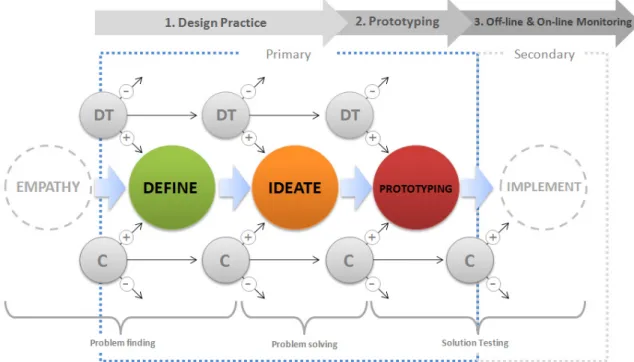
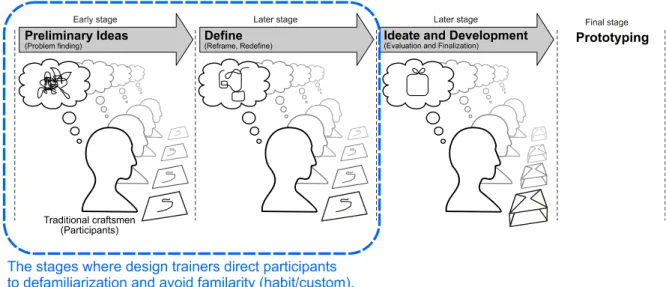
Figure 2.4: Typical design thinking process that delivered by design trainer to the craftsman in a design training program (modified from Didactic Design Thinking Process Model (Plattner et al. 2009). ... 12
Figure 2.5: A design training for bamboo craftsmen in Situbeet, City of Tasikmalaya, West Java, Indonesia. Annual program of the office of Industry, PPK-IPM (Author, 2007)... 13
Figure 2.6: A design training for bamboo craftsmen in Parakan Honje, region of Tasikmalaya, West Java, Indonesia. Annual program of the office of Industry, PPK-IPM (Author, 2007)... 13
Figure 2.7: A design training for rattan furniture makers and craftsmen in Cirebon, West Java, Indonesia. Annual program of the office of Industry (Author, 2009) ... 14
Figure 2.8: Identified problems at producers level (Suzuki, 2005) ... 15
Figure 2.9: Identified problems at institution level (Suzuki, 2005) ... 16
Figure 2.10: Craftsmen are treated as design students ... 17
Figure 2.11: Recognized of premature commitment of individual with traditional viewpoint at the idea generation process... 17
Figure 2.12: The spaces of creativity and possible designs (Adapted form Gero, 2002) ... 21
Figure 2.13: Topography of design research from Postma, 2012 (adaptation from Sanders, 2008)... 22
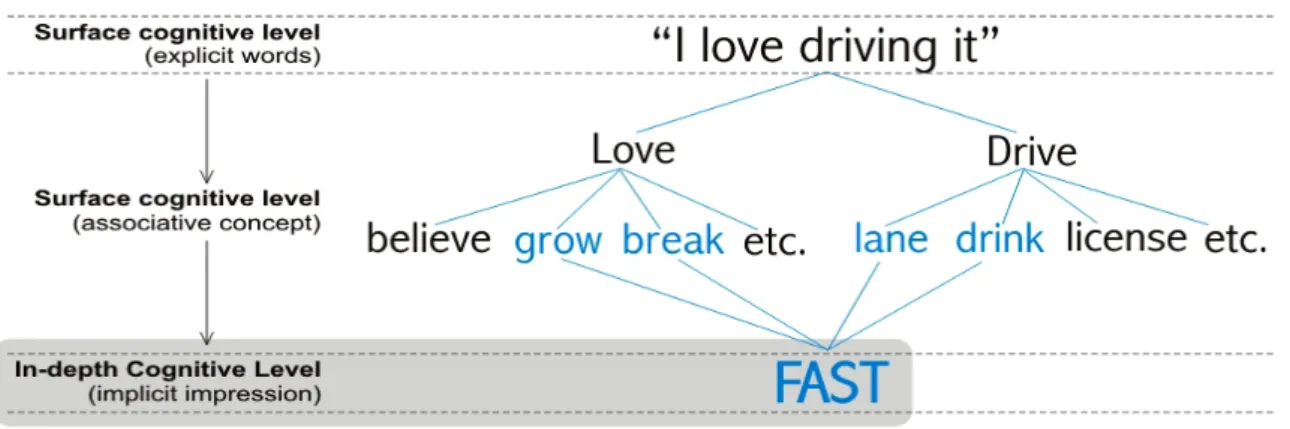
Figure 2.14: Capturing the in-depth cognitive level using an Associative Concept Dictionary .... 24
Figure 3.1: Local wood carving village in Ubud, Bali (left); wooden furniture and sculpture village in Jepara, central Java (right)... 27
Figure 3.2: Figure 3.2: An old picture of a master and an apprentice were making traditional Indonesian Kris dagger (circa 1940s). Source: van Duuren, D. A. (1996). De kris: een aardse benadering van een kosmisch symbool. Koninlijk Instituut voor de Tropen, Tropenmuseum... 29
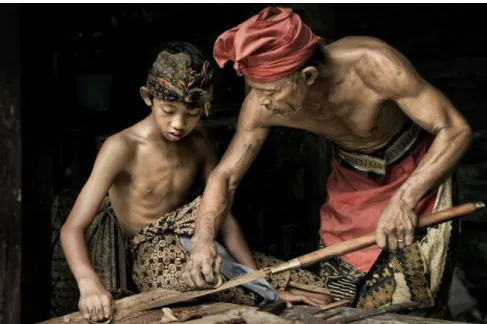
Figure 3.3: A picture of the present time of a master (The Pande) and a young apprentice are making a traditional Balinese spear (circa 2000s)... 29
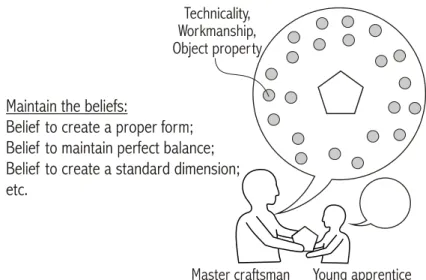
Figure 3.4: A typical knowledge transfer from master craftsman to young apprentice ... 31
Figure 3.5: Experiment A. Making a Japanese ceramic whistle (陶笛) ... 34
Figure 3.6: Experiment B. Making a musical instrument that produces three tones ... 35
Figure 3.7: Experiment C. Making a musical instrument that produces sound as a result of the player’s body action ... 35
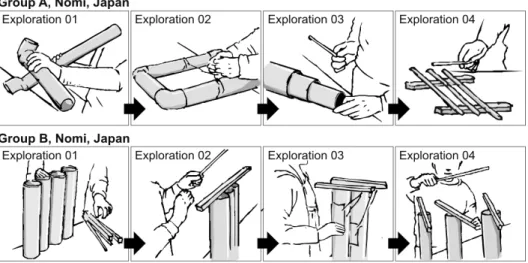
Figure 3.8: Experiment A. Making a Japanese ceramic whistle (陶笛) ... 36
Figure 3.9: Experiment B. Making a musical instrument that produces three tones ... 36
Figure 3.10: Experiment C. Making a musical instrument that produces sound as a result of the player’s body action ... 37 Figure 3.11a: Parent-child communication networks in Experiment B (Red arc
viii
represents cross-communication of OtherParent-OtherChild (P(x)-C(y)
or vice versa)) ... 38
Figure 3.11b: Parent-child communication networks in Experiment C (Red arc represents cross-communication of OtherParent-OtherChild (P(x)-C(y) or vice versa) ... 39
Figure 3.12: More systematical and exploratory thinking to resolve the given task performed by Japanese children (Experiment B. Making a three-tone musical instrument) ... 42
Figure 3.13: Properties of OtherParent-OtherChild cross-communication in co-creating value and creative play ... 42
Figure 4.1: Capturing in-depth cognitive levels by the use of the associative concept dictionary ... 46
Figure 4.2: Research framework: Identification of the different characteristics of in-depth cognitive levels ... 47
Figure 4.3: Craftsmen’s and designers’ associative concept networks (prior to simplification) .. 49
Figure 4.4: Craftsmen’s associative concept networks ... 51
Figure 4.5: Designers’ associative concept networks ... 52
Figure 4.6: Overlay of Craftsmen’s and designers’ associative concept networks ... 53
Figure 4.7: Semantic relationship map ... 55
Figure 4.8: Craftsmen’s and designers’ imaginative approaches ... 55
Figure 5.1: Research framework: design training experiment ... 60
Figure 5.2: Extreme conservatism in idea generation ... 62
Figure 5.3: Design Experiments ... 63
Figure 5.4: Transformation that occurred during 2nd later stage of idea generation ... 63
Figure 5.5: The conflict that exists between fundamental comprehension (cognitive fixedness) and unfamiliar stimuli contained in extreme levels of cognitive fixedness... 64
Figure 5.6: Design trainer-craftsman’s inter-domain knowledge transfer require more contributors to successfully creating shared value ... 64
Figure 5.7: Before and after ... 65
Figure 5.8: The comparison between previous model and the proposed improved design training... 66
Figure 5.9: The evidence of the succes of the program ... 67
Figure 5.10: Recent coming products of the post-training that showing more radical of product development done by the craftsmen ... 67
Figure 6.1: Traditional craftsmen’s transformations during idea generation ... 69
Figure 6.2: Co-creation model for group of craftsmen with stagnancy in product development (Adapted from Cognitive Modelling of Creative Knowledge Work; Candy, 1999)) ... 71
Figure 6.3: A model of co-creation educational activity for traditional craftsmen ... 73
Figure 6.4: The two phases in concept generation (Taura & Nagai, 2012) ... 74
Figure 6.5: Dialectical belief in conceptualization that challenge cognitive fixedness to extreme level ... 75
ix
List of Tables
Table 3.1: Experiment A. Making a Japanese ceramic whistle ... 37
Table 3.2: Experiment C. Making a body-action musical instrument ... 37
Table 3.3: ODC scores representing gregariousness behavior ... 40
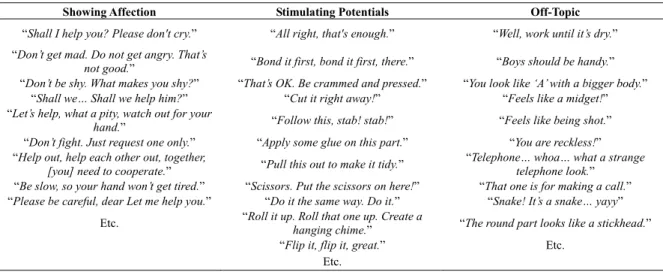
Table 3.4a: Parent-child utterances in cross-communication in Experiments B and C (Indonesia) ... 40
Table 3.4b: Parent-child utterances during cross-communication in Experiments B and C (Japan) ... 40
Table 3.5: Cross-communication utterances (OtherParent-OtherChild and vice versa) ... 41
Table 4.1: Sorted verbalized thoughts (shown in part and in alphabetical order) ... 48
Table 4.2: T-test: Two-Sample Assuming Unequal Variances ... 50
Table 4.3: Distribution of Craftsmen’s ODC scores ... 50
Table 4.4: Distribution of Designers’ ODC scores ... 51
Table 4.5: Generated associative words following reduction ... 52
Table 4.6: Identified characteristics of associative concepts ... 54
Table 4.7: Rotated factor matrix ... 54
Table 4.8: Corresponding factor name ... 54
1
Chapter 1 Introduction
1.1 Governmental HRD Progam: Design and Creativity Training
To achieve a strong national industry, many developing countries, including Indonesian government have begun to focus on rural industry development because of its potential for new job creation and to maintain national and cultural identities. The government have begun to implement technical assistance programs (a nationwide governmental HRD program that operates in developing countries) in order to produce more desirable product) such as design training to improve traditional craftsmen’s creativity levels. Government policies related to the future development of local craft industries are stated as follows:
Indonesian Presidential Decree No. 6 Year 2007: Fast Growth of Real Sector Policy and Micro Business Development.
Ministry of Industry Regulation No. 78/IND/PER/10/2007: the Increase of Small and Medium Development Industry Effectively through One Village One Product – OVOP.
Indonesian Presidential Decree No.28 Year 2008 about the National Industrial Policy.
Crafts sector is a subsector within the Creative Industry category; it is divided broadly over 14 industry categories including advertising, fashion, design, music, etc. In terms of 2010 GDP, fashion industry has contributed 63.3% and followed by crafts sector at 33.2%. The sector is made up of thousands of SMEs at an estimated 6.74% of total companies in Indonesia. The creative industries has also contributed 9% of export value in 2010 [122]. This shows the importance of crafts sector in Indonesian economy. Over the past two decades, technical assistance programs (i.e design training) featured as routine strategic program. At some point, it becomes a joint inter-ministerial program, involving the Ministry of Industry, Ministry of Tourism and Creative Economy, Ministry of Cooperatives and Small and Medium Enterprises.
Design trainers involved at such program often reported that design training delivery encounters difficulties when the craftsmen are introduced to design process. Most of the craftsmen (participants) feel awkward and unfamiliar with design process that introduced. In fact, this is understandable, individual such as traditional craftsmen who reside in developing country are not literate in design, although they possess artistic skills. Design education is a recent phenomenon that follows the traditions of Western models; it is a rational method for identifying and solving design problems. Few studies have focused on curriculum design for craftspeople; in fact, the generic assumption is that
2
education needs to solve major problem, which is to meet market demand. Understanding the market involves providing information about the gap between users’ affective preferences and needs; it is directed toward finding the goal of product design through the problem-driven phase. However, conceptualizing new ideas for products cannot be obtained simply by understanding the market; this process is a phase stemming from an inspiration or inner sense [1]. This study explores latent aspects of in-depth levels of cognition in design creativity, more specifically in conservative conceptualization which has never been explored.
To clarify the standing point of this study, two main issues are discussed. First, understanding current issues on problems of development of traditional craft. We overview the nationwide governmental HRD Progam: design and creativity training. Second, we review the effectiveness of the transfer of knowledge of design training delivery to the traditional craftsman. We emphasize on the investigation on cognitive aspect of creativity of craftspeople who hold strong beliefs or with conservative viewpoint.
1.2 Problem Statement
Very limited attention is given to examine the conceptual process of individual with conservative viewpoint or individual who hold strong belief of customs (i.e., traditional craftsman). An individual like a craftsperson is often recognized for his/her traditional viewpoints that may be structured by prior knowledge and typical features contained in familiar categories known as cognitive fixedness.
Therefore, a design training program delivered to traditional craftsman that attempt to introduce unconventional ways of thinking would encounter difficulty. The conceptual design process conceptual design process that introduced is taken for granted from conventional design method in design school. The problem is the lack of understanding of the design trainer about the underlying forms of cognitive fixedness of the traditional craftsman, which essential to facilitate an appropriate design training delivery that fits craftsman’s conservative viewpoint.
1.3 Terminologies
We used the following terminologies in this paper:
Creative cognition covers processes and mechanisms that play an important part in many endeavors of human activity that incorporate creative activity. Creative cognition known as cognitive mechanisms combine experiments with existing work in cognitive psychology to provide the cognitive structures that contribute to creative thinking. Creative cognition studies cover concept, formation, categorization, memory retrieval, and problem solving [2].
Cognitive Fixedness is most often demonstrated through functional fixedness, which is defined as the inability to think about something (typically an object) as having any other function outside of its intended use [121]. In design area, it is known as design fixation a commitment to a particular set of unchangeable decisions created by old ways of thinking and responding [7, 10].
Design Training consists of a nationwide governmental HRD program that operates in developing countries. It provides in-studio type design and creativity training for traditional craft craftsmen. The aim of design training is to enhance Craftsmen’s creativity and improve the quality of products.
A Craftsman (hereafter referred to as ‘Craftsman’) is a traditional master craftsperson who resides in a developing country. He or she may possess limited formal education. However, he or she has acquired special craftsman skills and gained expertise in his or her local village’s
3
traditional crafts that have been passed down from one generation to another.
A Design Trainer (hereafter referred to as ‘Designer’) is an industrial or architectural design graduate who possesses work experience as an instructor in a design training program aimed at the promotion of traditional crafts.
Associative Concept Network Analysis (CNA) CNA is a method of identifying inexplicit associative layer of the free verbalizations expressed. Such associative layer that underpin many free verbalizations. All free verbalizations are examined for words from which they are typically associated by menas of concept dictionary. Construction of concept network associative pairs are added to a network structure on the basis of the number of outgoing connections [3].
An Associative Concept is a representation of an individual’s expression. It is a stimulus that can lead to another associative meaning. It is comprised of six sub-types: connotative, collocative, social, affective, reflected, and thematic [4]. The conceptual network depicts human memory as an associative system, in which a single idea can contain multiple meanings (i.e., it is polysemous). A concept network employs a computational model to reproduce observable aspects of expressions associated with an individual’s mental state. It is a suitable tool for associative analysis that can be used to explore latent links that exist among concepts.
The Concept Dictionary utilized in conceptual networks originated at the University of South Florida Free Association Norms database (USF-FAN). It consists of free associations, rhymes, and a word fragment norms database. It is the largest database of free associations ever collected in the United States [5, 6].
1.4 Originality
Most studies in the field of creativity have focused on the role of stimulus freedom that leads to creative solutions rather than barriers. These studies have designated the conservative viewpoint and its cognitive fixedness as an undeniable mastermind of mental constructs that can impede our ability to develop creative ideas. Cognitive fixedness is a perceptual barrier created by old ways of thinking and responding [7, 8]. To date, a small number of studies attempt to identify and mitigate barriers in creativity, (i.e., cognitive fixedness or design fixation), and almost no attention has been given to examine the potentials hidden in barriers [9, 10, 11, 12]. Therefore, we will study the conservative viewpoint that has long been regarded as a perceptual barrier that tends to inhibit craftsman’s mental set. Current conventional design education curricula strictly avoids perceptual barriers, however it is necessary to acknowledging the potentials of conservative viewpoint to be accommodated as a feature in design education curriculums, mainly for traditional craftsman.
We recognized that conventional design education is incompatible with the mindset of traditional craftsman who tend to hold strong and genuine beliefs. Thus, we create a model of design education delivery that fits craftsman’s conservative viewpoint. To facilitate development of this model, we investigate knowledge acquisition of the conservative conceptualization. This feature utilizes craftsman’s prior knowledge at extreme level to further experience dialectical-beliefs of unfamiliar values, at the same time allowing for the retention of prior knowledge without harm. The originality of this study lied on utilization of the potentials hidden in barriers (cognitive fixedness or design fixation) during transfer of knowledge of design training delivery to the traditional craftsman who hold strong beliefs or with conservative viewpoint (see, Fig. 1.1).
4
Figure11:Theframeworkofthisresearch
5
1.5 Research Objective
This study aims to reveal potential aspects of barrier in creativity (cognitive fixedness) in people who possess traditional/conservative viewpoint (crafsman). We investigate how to overcome craftsman’s cognitive fixedness in the conceptual ideation process. Our goal is to provide appropriate resource for the development of design education delivery for traditional craftsmen to produce more desirable product. We conduct two experiments of capturing and overcoming cognitive fixedness during conceptualization process. The first experiment is investigating the difference associative concepts of the in-depth cognitive levels at the early stage of idea generation of design trainers and traditional craftsmen. The first experiment demonstrate the characteristic of the cognitive fixedness. The second experiment is to overcome cognitive fixedness with case study of a design experiment to create new design of traditional wooden sandal.
1.6 Contribution of this Study
The contribution of this study is an improved model of design training for traditional craftsman to overcome their cognitive fixedness. This will be useful to improve creativity and design education delivery for people who possess conservatism in order to produce more desirable product. One of the government strategic program is the design and creativity training delivery to the craftspeople—a nationwide governmental HRD program. For the long-term impact, this improvement will foster rural economic growth in line with the effort of government in developing countries to develop rural craft industries. Contribution of this study to Knowledge Science is a knowledge creation of a new co- creation design education for people with conservative/traditional viewpoint (i.e., traditional craftsman) with involvement of knowledge contributors.
1.7 Organization of this Study
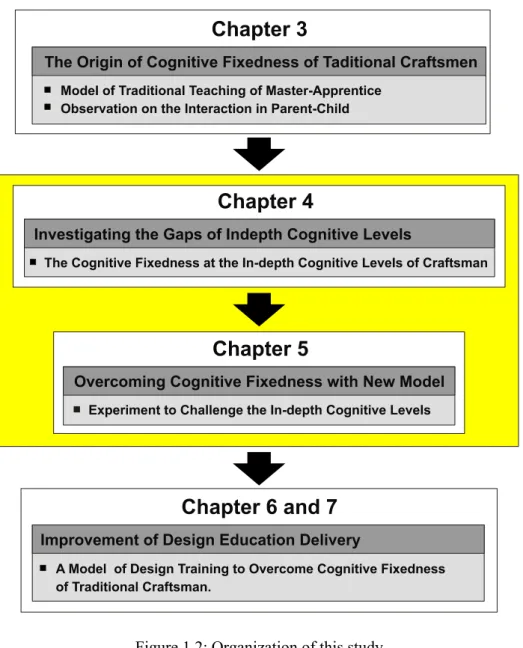
In order to reveal potential aspects of barrier in creativity (cognitive fixedness) in people who possess traditional/conservative viewpoints and to study more effective design training delivery, this study is divided into four parts, where the second and third part is the main study as shown in Figure 1.1. The first part contains a chapter (Chapter 3) focused on the origin of cognitive fixedness. We observe the creative learning process of children in traditional craft villages that internalised and deeply rooted in action and attitudes. On the second part of this study (Chapter 4) we investigate the cognitive fixedness from the associative concepts at the in-depth cognitive levels of craftsmen and designers (design trainers) as they conceptualize their ideas. On the third part (Chapter 5), to overcome craftsmen’s cognitive fixedness we conduct a design experiment of creating new design of traditional wooden sandal. We challenge their conservative ideas at extreme level and utilize the obtained unfamiliar stimuli from the previous challenge. On the last part (Chapter 6 and 7) we discuss the improved model of design training that overcoming craftsman’s cognitive fixedness and propose a co-creation design training as an event embedded within a tourism-based craft workshop-like setting that benefited from knowledge contributors. The organization of this study is as follow:
6
Figure 1.2: Organization of this study
Chapter 3 – Understanding the origin of cognitive fixedness by observing the creative learning process of children in traditional craft villages that internalised and deeply rooted in action and attitudes.
For having basic understanding of craftsmen’s beliefs in conceptual ideation process we focus on the origin of state of mind in which an object or situation are perceived in familiar way. We observe the creative learning process of children in traditional craft villages that internalised and deeply rooted in action and attitudes. This portrays how cognitive fixedness in conservative viewpoint is formed in childhood. This study shows, the strong role-taking behavior of Indonesian parents appeared to reinforce intimacy in an apprentice-like, co-creative play experience to help the children gain formative skills. We concluded that the stronger the spoiling behavior (i.e., strong role-taking behavior), the greater the parent’s contentment is in acting as a loving parent and satisfying the child’s expectation for dependency. Over time, role- taking behavior facilitates children’s development of formative skills (e.g., craftsmanship) which seems to give apprentice-like experience, while independence leads to more exploratory thinking (i.e., creativity). This likely has been fostered since childhood stage that shapes
7
Indonesian children in craft villages become inter-dependence and maintain consistently the rigid practice of craftsmanship as a consistent belief (cognitive fixedness).
Chapter 4 – Investigating the gaps of in-depth cognitive levels by focusing cognitive fixedness from the associative concepts of craftsmen and designers (design trainers) as they conceptualize their ideas at the early stage of idea generation.
We investigated the cognitive fixedness from the associative concepts of craftsmen and designers (design trainers) as they conceptualize their ideas at the early stage of idea generation. To capture associative concepts that occur at in-depth cognitive levels of imagination we conducted a think-aloud protocol. We employed a concept network analysis based on the associative concept dictionary to extract verbalized thoughts. We request, both the craftsmen and design trainers to imagine designing a fruit bowl. When imagine designing a fruit bowl, craftsmen’s associative concept placed greater focus on product appearance and technical aspects, such as operation (i.e., replace, reduce, etc.) and shape (i.e., waist, body, etc.). In contrast, design trainers’ associative concepts paid greater attention to the presence of issues related to surroundings, such as scene (silverware, norm, etc.) and appeal (fresh, dish, etc.).
This study demonstrated that design trainers tended to use more remotely associated concepts (polysemous words) that have greater probability of achieving unconventional ways of thinking. While, traditional craftsmen tended to use more closely associated concepts that represent a narrow commitment to a particular issues they familiar with (cognitive fixedness in technical and object property).
Chapter 5 – Overcoming craftsmen’s cognitive fixedness with a design experiment to challenge craftsman’s conservative ideas at extreme level and utilize the obtained unfamiliar stimuli from the previous challenge.
To overcome craftsmen’s closely associated concepts (cognitive fixedness). We conducted a design experiment for traditional wooden sandal craftsmen to create a new design of traditional wooden sandal. We observed two stages of idea generation, at the first stage, craftsmen were challenged to generate their conservative ideas at extreme level. Furthermore, conceptual sketches and frequently verbalized thoughts related to unfamiliarity or skepticism were examined by design trainers. In all likelihood, the unfamiliar stimuli “painful,” “broken,” and
“upside-down” were result of extreme level of cognitive fixedness. At the second stage, craftsmen redeveloped and were pushed to utilize this unfamiliar stimuli. The experiment demonstrated that the ability to capture and utilize unfamiliar stimuli during a challenge of extreme levels of cognitive fixedness might lead to unconventional idea, for example, an up- side down wooden sandal. We realized that craftsmen’s unfamiliar stimuli that generated at extreme level of cognitive fixedness (i.e., broken shape, painful shape, upside-down shape) are the remotely associated concepts that potential for unconventional ideas.
In Chapter 6 – Discussion on the improved model of design training that overcoming craftsman’s cognitive fixedness and propose a co-creation design training.
To avoid narrow or closely associated concepts and produce more intrinsic experiences that access remotely associated concepts at the in-depth cognitive level, craftsmen must experience the dialectical belief in a familiar way. Dialectical belief is a criticism phase where one begins to doubt his/her premature commitment (cognitive fixedness); consequently, the individual may become curious about different belief systems. The improved method to challenge traditional craftsman to generate their conservative ideas at extreme level is able to overcome cognitive fixedness. However, traditional craftsman’s cognitive resource that has been fostered since childhood is apparently dependent. Therefore, we proposed an embedded design training
8
program within a tourism-based craft workshop-like setting. The visitors, consumers are the knowledge contributors that co-create in design activity with the craftsmen. Challenges are result from the presence of knowledge contributors that brings episodic recreational behavior, i.e., stylistic, mood and curiousity. Ultimately, the knowledge contributors will constantly challenge cognitive fixedness to access remotely associated concepts.
In Chapter 7 – Conclusion
We claim that cognitive fixedness of individual who possess conservative viewpoint (i.e.
craftsman) can be overcame with an improved model of design training program that challenge craftsman’s conservative ideas at extreme level and utilize the obtained unfamiliar stimuli from the previous challenge. Furthermore, we propose a co-creation design education involving knowledge contributors (i.e consumers, visitors).
9
Chapter 2
Related Works
Besides artisanal wood-carving skills, Indonesia is also known for its outstanding array of traditional crafts ranging from potteries, to Batic fabric, etc. In addition, Indonesia’s forest land that comprises 60 % of the country’s land area makes it the third largest area of tropical rainforest in the world, which potentially provides strategic competitiveness allowing for a strong craft industry. However, due to over three and a half centuries of Dutch occupation and strong influence of the colonial era no indigenous traditions developed. With little innovation in local industry the local people are accustomed to only copying or modifying. Rural craft industries in Indonesia have strong historical backgrounds and at the same time encounter the problems to sustain the business. In the case of Indonesia, with its high level of woodworking skills being above average remains pointless as the ability for innovation and product development still remains a major obstacle.
2.1 Traditional Crafts
Suzuki (2005) an expert in regional development clasifies four different craft types, their category and attributes are as follow (see, Figure 2.1 & 2.2):
Fine art crafts which is produced by master/artist. The entire production process is usually self- contained. Fine art craft masters tend to work by themselves to complete the entire production process. Some examples are ceramics and earthenware produced in artist studio and sell at exclusive gallery.
Traditional crafts or often called folkcrafts, these traditional crafts are humble piece of work that maintained traditional elements without replacement of the original raw materials and of production technologies. These crafts were produced by minority tribal groups in rural villages and in remote mountainous areas and sold in traditional market at nearby town.
Innovative Handicrafts are modified traditional handicraft with improvement in design. The modification applies either on the production technology, shape or materials to meet the dynamic market demand. The innovative handicrafts producers mostly have well inherited traditional skills or sometimes a graduate product design start up.
Manufactured crafts are all intensive machine-made crafts produced by machine and do not require skilled craftspersons. The production facilities exist in urban areas and the production mechanism is identical with that of other industrial products. Daily use tablewares such as typical lacquer ceramics are the example.
10
Figure 2.1: Examples of four different craft categories (All images are copyrighted and property of their respective owners)
Figure 2.2: Market segmentation of crafts (Suzuki, 2005)
According Yanagi (1989) and Suzuki (2005), fine art crafts are highly specialized and individually inspired ‘high’ art which represent the wealthy people. Manufactured crafts require capital investment as a crucial development factor, and more importantly, those industries do not contribute significantly to the job creation in rural. Innovative handicraft exist only at spesific region of Indonesia, where some expatriats build their business in certain city with tourist destination, for example, Bali city and Yogyakarta city. Therefore, Traditional craft or Folk craft, which still maintain local resources and crucial to rural economic development activities is the focus of our study.
b. Traditional craft or folkcraft a. Fine art craft
d. Manufactured craft c. Innovative handicraft
11
2.2 Nationwide Governmental HRD Program: Design Training
To achieve a strong national industry, many developing countries including Indonesian government have begun to focus on rural industry development because of its potential for new job creation and to maintain national and cultural identities. The government have begun to implement technical assistance programs (a nationwide governmental HRD program) in order to produce more desirable products) such as design training to improve traditional craftsmen’s creativity levels. The scheme of the official program are as follows (see, Figure 2.3):
Figure 2.3: Scheme of Nationalwide Indonesian Governmental HRD Program.
To deliver technical assistance to the craftspeople in rural industry, the government, donors or private sector assign a team of design professional or design trainers. The assignment is based on the designated program, for example, to deliver a design training in rural textile craft village, a textile design graduate or textile designer will be comissioned. An industrial design or interior design graduate with their speciality in bamboo or natural material will be assigned to deliver a design training program to bamboo craftspeople. Most of the programs are arranged in a half or one year program scheme, as a package of various trainings. This training package addresses on capacity building and technical assistance with following activities, i.e., product development, packaging design, management and marketing. Government, donors or private sectors will setup the program by considering the blue print of the local regional development. This means the craftspeople in targeted rural area are addressed by purpose. The selection of targeted craft village is based on the economic development planning of the local region including to increase human resource capacity.
Design Training (a nationwide governmental HRD program) is an event to introduce design and creativity practice. The activity mainly concerns of product development widely operated in rural crafts industries in Indonesia. It provides in-studio type design and creativity training for traditional craftsmen with aims to improve design or product quality. At a basic level, creativity and design
12
training hopes to introduce widely known the design method. During training class, craftsmen receive an introduction to Design Principles (e.g. balance, proportion, and so on). Craftsmen are also engaged Creativity in Icebreakers. They then participate in design exercises and develop prototypes. A typical design training program may takes five to seven days.
Idea generation is an essential step in the design thinking process. It involves the interplay between cognitive and affective skills that leads to the resolution of recognized difficulties. It also involves iteration, a cyclical process of idea generation, evaluation, and design improvement to gather and filter information during the stage of generating and evaluating possible solutions. The general steps of design thinking introduced commonly in a design training are listed below (see, Figure 2.4):
1. Early stage of idea generation: during which participants finding problems.
2. Later stage of idea generation: during which participants reframe and redefine.
3. Later stage of idea generation: during which participants develop and finalize the idea.
4. Final stage: during which participants realize the ideas concretely.
One session of a design training normally comprised of 5-7 days (8h/day), the curriculum is structured of three major sessions:
- The Design Principles (balance, proportion, etc.).
- Creativity Icebreaker games/exercises for habituation.
b. Second session of design practice: Preliminary ideas, developing ideas and evaluation.
a. First session of theory:
c. Third session of design practice (prototyping): Foam modeling, mock-up and finishing system.
Figure 2.4: Typical design thinking process that delivered by design trainer to the craftsman in design training program (modified from Didactic Design Thinking Process Model (Plattner et al. 2009)).
Followings are some examples of design training conducted in rural craft industries in Indonesia (see, Figure, 2.5; 2.6; and 2.7).
13
Figure 2.5: A design training for bamboo craftsmen in Situbeet, City of Tasikmalaya, West Java, Indonesia. Annual program of the office of Industry, year 2007, PPK-IPM (Author, 2007).
Figure 2.6: A design training for bamboo craftsmen in Parakan Honje, region of Tasikmalaya, West Java, Indonesia. Annual program of the office of Industry, year 2007, PPK-IPM (Author, 2007).
Problem finding Problem reframing Development Prototyping
Problem finding Problem reframing Development Prototyping
14
Figure 2.7: A design training for rattan furniture makers and craftsmen in Cirebon, West Java, Indonesia. Annual program of the office of Industry, year 2009 (Author, 2009)
2.2.1 Craftsman and design trainer
In Indonesia, a rural master craftsman is a traditional master craftsperson who resides in a rural area.
He or she has acquired special craft skills and gained expertise in his or her vernacular traditional crafts that have been passed down from one generation to another often through an apprenticeship system. Yanagi Soetsu a Japanese craftsman and philosopher asserts a true craft is a non-individually- inspired ‘high’ art, which is widely known as folk craft, used in people’s everyday lives, unpretentious, pure and simple created by craftsman, to distinguish it with the craft artist [13, 14]. Pye (1965) provides an improved definition of craftsmanship as ‘workmanship of risk,’ where risk represents a piece of work which could be unexpectedly defective during the working process, can be a result of any tools, such as chisel, hammer; or a result of improper treatment, where this risk can be advantegous, unique or even failure [15]. This means either techniques or processes are considered conservative, however, it exceptionally offers unconventional process to be present. Despite a presumption that a craftsman thinks in a conventional manner he or she is often aware of being unconventional.
During a design training, there are two parties involved, one party as the participant and the other party as the trainer, the definitions are as follow:
A Craftsman or a Master Craftsman (hereafter referred to as ‘Craftsman’) is a traditional master craftsperson who resides in a developing country. He or she may possess limited formal education. However, he or she has acquired special craftsman skills and gained expertise in his or her local village’s traditional crafts that have been passed down from one generation to another.
In some countries they are awarded as as National living treasure.
A Design Trainer (hereafter referred to as ‘Designer’) is an industrial or architectural design graduate who possesses work experience as an instructor in a design training program aimed at the promotion of traditional crafts.
Problem finding Problem reframing Development Prototyping
15
2.3 Problems and Development Issues of Traditional Craft
Suzuki (2005), an expert in regional development has reported on problems and development issues for craftsman’s craft promotion [16]. Many parties engaged in local craft development process have identified number of problems of the implementation of the program. The problems varies from lack of promotional policies, supporting istitutions, low craft quality, poor managerial skills, business access also lack of capable development designers, etc.
Problems and development of traditional craft are divided as problems at policy level, problems at institution level, and problems at craft producers level. Those problems comprised of technical issues such as lack of support facilities focusing on HRD, lack of awareness for traditional values and future potential, also lack of challenging mind (see, Figure 2.8 and 2.9). As generally known, most of the traditional craftsman fail to develop new and innovative ideas because there is no challenge and they lack of creativity. Due to their conservative nature, this makes difficult to develop new ideas with their own initiatives. Suzuki (2005) points out that:
“Design development is often understood as a means to develop crafts to meet the consumers’ needs which covers only exterior appearance.” Again, he underlines that
“Design improvement covers wider aspects including the living environment and culture indigenous to the crafts. Interestingly, the notion to interpret living environment and culture indigenous to be valued in design improvement is missing among policy makers and often among designers in developing countries.”
Figure 2.8: Identified problems at producers level (Suzuki, 2005).
16
Figure 2.9: Identified problems at institution level (Suzuki, 2005).
However, apart of the ability to interpret indigenous value, more importantly there are absolute gaps in the design thinking process during the idea generation stage can occur between traditional craftsman and designers. Previous research suggests that design trainers failed when they attempted to introduce an unconventional design domain to inspire traditional craftsman to develop unconventional ideas [17]. This may have occurred because of differences in the nature of creative cognition that influences the respective designers’ and craftsman’ design thinking processes. This leaves a fundamental question that, is there any concrete guideline or study reference describing the nature of the creative cognition of traditional craftsman available for design trainers to use as material during training? Design education is a recent phenomenon that follows the tradition of Western model; it is a rational method for identifying and solving design problems, there is lack of studies have focused on creativity enhancement of people that hold strong beliefs and conservative viewpoint as craftspeople (see, Figure 2.10).
Scholars of modern studies of craftsmanship recognize a crucial point that craftsmanship is a mastery of doing and making involving beliefs and conservatism. These aspects in many studies of craftsmanship is frequently discussed as a representation of technical processes and skills. Sennett (2008) argues that a craftsman is a know-how of “mind,” “hand,” between ideation and practical execution, which represents the special human condition of being engaged. To date this statement is the most pertinent definition which reflects the craftsman’s conceptual ideation process [18].
Conceptual ideation is generating and developing new ideas where an idea is understood as a basic element of thought that can be either visual, concrete, or abstract [19]. The ideation state defines one’s current location in the design space where one gets deeper insight, discovery and conflicts. It is generally known that traditional people think in a conventional manner. Gero (2011) affirms that conventional ways of thinking is when one is trapped at a general fixation and premature commitment. A premature commitment refers when someone appears trapped to a particular set of design decisions that they familiar with [10]. With a high level of mastery, an individual like a craftsperson is often recognized for his/her traditional viewpoints that may be structured by prior knowledge and typical features contained in familiar categories [2]. The recent study of Nagai et al.
(2013) demonstrated that the craftsmen’s conceptualisation at the early stage of idea generation
17
experiences a fixation that disables them to explore the abstract realm which normally occurs at the early stage of idea generation. This explains that the craftsman’s conceptualisation seen at the early stage has evidently occured at the later stage, as a proof of experiencing fixation [12].
We recognize that conventional design education is incompatible with the mindset of traditional craftsman who tends to hold strong beliefs (see, Figure 2.10). Craftsmen’s conceptualization at the early stage of idea generation experiences a fixation that disable them to explore more abstract realm which normally occurs at the early stage of idea generation. With a high level of mastery, an individual like a craftsperson is often recognized for his/her traditional viewpoints that may be structured by prior knowledge and typical features contained in familiar categories (see, Figure 2.11) [2, 12]. Thus, to facilitate the development of design education delivery that fits craftsman’s conservative viewpoint. It is important to investigate the typical mindsets that affect creative cognition during conceptualization. With sufficient understanding of the thought process during conceptualization we can manage the mindsets in order to stimulate positive creative cognition.
Figure 2.10: Craftsmen are treated as design students
Figure 2.11: Recognized of premature commitment of individual with traditional viewpoint at the idea generation process
18
2.4 Issues in Creative Cognition
Creativity is a very difficult subject in which to be precise. Some creativity researchers describe creativity is “living things moving in a field.” Engagement is highly necessary to understand “living things moving in a field.” One can observes “living things” by video or photo, however, the “living things” are no longer “moving in a field.” Such approach is totally reducing all of the facts. Another approach known as research, a reliable process of describing accuracy of the “things”, but it missed to describe the natural movement. By moving along with "the living things" is a good way to deeper engage and learn the nature. When we record and describe this "living things," however we can not be accurate since we detach from the true experience. Another method is to raise "living things" and observe them, this experience may discover a complete experience, when the "living things" exhibit their wild instincts, and our control is an apriori and unfair manner in doing an observation. The most appropriate approach is design research approaches in a laboratory setting, a demonstrative experiment. It must shows the “living things” animatedly running about the field; the subjects and experimenter need to be enthusiastic and passionate, but then again, the research objectivity is questionable, such enthusiastic and passion might be unfair in the judgement [20]. These difficulties have push researchers to find more appropriate methodology to reveal the cognitive structures and processes that are involved in creative thinking and cognition.
In general, cognition is considered a major factor in the creative process [21]. Most of the conceptualization of creativity in the design process is based on exploration of the cognitive aspects of creativity [22]. Extensive studies have been conducted to capture the cognitive levels of creativity used during the design process. These studies attempted to understand users’ affective preferences, such as taste, and the feelings they may experience that can result in successful impressions of products [23, 3].
Creative cognition covers processes and mechanisms that play an important part in many endeavors of human activity that incorporate creative activity. Finke, Ward and Smith (1992) who first coined the term creative cognition, to affirm the boundary of an area of study within cognitive science that focus on the creative processes. Creative cognition known as cognitive mechanisms combines experiments with existing work in cognitive psychology to provide the first cognitive structures that contribute to creative thinking. Creative cognition studies cover concept, formation, categorization, memory retrieval, and problem solving [2]. It has been studied in the past by various researchers, followings are few majors different labels [24]:
Making the Familiar Strange
Gordon and his colleagues (1961) explicate the concept of “trust things that are alien, and alienate things that are trusted.” Making the familiar strange is defamiliarisation to have new resources we can use to think with and to go about changing our behavior. It is a juxtapose the target problem or object with a completely unrelated object or situation [25].
Displacement of Concepts
Schön (1963) explains how new ideas may result from new ways of seeing new things in the manner of the old. For example, in order to get a new insight about a concept, it needs to be displaced, that is, put in the context of other unrelated concepts [26].
Bisociation
Koestler (1964) coined this term to illustrate the combinatorial nature of creativity to distinguish the type of metaphoric thinking that leads to the acts of great creativity from familiar associative thinking. As such, means to join unrelated, often conflicting, information in a new way [27].
19 Lateral Thinking
Edward de Bono (1971) contrasted vertical thinking with lateral thinking. It is a new concept by looking at the logical (vertical) thinking carries a chosen idea forward, the sideways (lateral) thinking provokes fresh ideas or changes the frame of reference. [28].
Estrangement
Rodari (1996) proposed many practical methods that stimulate imagination and creativity in children through random juxtaposition of concepts. One mechanism he emphasizes is to consciously block the evocation of familiarity and try to view an object as if it is a strange object you are seeing for the first time [9].
Conceptual Blending.
Fauconnier and Turner (2008) analyzed how people combine perceptual, experiential and conceptual aspects of different concepts subconsciously to generate new insights. Conceptual blending is a deep cognitive activity that "makes new meanings out of old” [30] for example:
Design idea for an art knife by combining two concepts—broken glass and chocolate segments [31].
The cognitive capacity to behave creatively is a normative characteristic of humans. One’s cognitive capacity is greatly influenced by their attributes, such as culture, beliefs, and insights. At some point, this attributes is regarded as an advantage or even barrier. This study seeks to advance our understanding of barrier in creativity through precise characterization of the cognitive processes that lead to creative enhancement. Only a limited number of studies have explored the creative cognition that occurs during design process at the very early stage of idea generation, a stage associated with a greater diversity of ideas [32].
2.4.1 Creativity enhancement
There is an increasing trend of research on creativity, more spesifically research on the creative process, which is likely to continue as a major design research area. Design and creativity is relatively a new subject in science, for years design and creativity reserch borrows theories from cognitive science and psychology. However, design creativity is a developed research area that has potential to contribute to the foundations to our cognitive understanding. Therefore, it is a challenge for the design creativity research community to unveiling the true nature of creative processes in design. Over the last fifty years of research on creativity is partly found to be speculative [33]. Besides, there are gaps between the amount of studies on creativity and the relevance in terms of transfer into practice [34].
Therefore, a concrete and empirical evidence in the occurence of creative cognition will be valuable for the practice of design education, particularly for inclusive design education.
The implementation of technical assistance programs in developing countries (e.g., design training) to improve craftsmen’s skills and creativity levels has been implemeted for over decade.
Apparently, such programs were unsuccessful at introducing an unconventional design domain to inspire craftsmen to develop progressive ideas [16]. Differences in the nature of creative cognition, which influence craftsmen’s design thinking processes, may have contributed to program failure. A conventional mindset was evident from gaps associated with in-depth cognitive levels of craftsmen and designers during the early stages of concept generation [17].
20
2.4.2 Cognitive fixedness
Numerous published studies have described how stereotypical or conventional thought may lead to decreased creativity [35, 36, 37, 8]. To date, most creativity studies have focused on stimuli, rather than barriers [7, 9, 10, 11]. Limited attention has been given to exploration of potential hidden in barriers [12]. Current conventional design education curricula avoid perceptual barriers; thus, traditional craftsmen appear trapped by a general fixation and commitment to a particular set of unchangeable design decisions [10]. Therefore, the cognitive fixedness will be investigated in this study because it has been regarded as a perceptual barrier to be accommodated as a feature in design education curriculums for craftsmen.
2.4.3 Situated creativity
Besides the importance of empowering cognitive fixedness, a circumstance or situation that facilitate cognitive fixedness to thrive is also never been studied almost entirely. A classic study from Schon (1999) about reflective practice as a process of learning through ‘reflection in action’ and ‘reflection on action’ experience is a significant gateway to understand the cognition behind the process of thinking [38]. The study on reflective practice indicates how a ‘situation’ becomes a fundamental factor that affect the process of human’s cognition. The two terms ‘reflection in action’ and
‘reflection on action’ has lead to understanding in capturing experience, skill or knowledge. However, again, the approach to explain to the notion of cognitive experience is still speculative.
Csikszentmihalyi (1988, 1990) suggests a system view where three dimensions of interaction within the creativity process: a domain that provide information to the person, a person who does the act of variation which seemingly may or may not be selected by the field, and the last, a field that incorporates the variation into the domain. His study suggests a condition of co-development as an agency element [39, 40].
Gero (2002) describes designing is an activity during which designers perform actions in order to change the environment. Their reflection in/on their own practice will allow them interpreting the results of their actions, they hold control to manipulate the environment. This experience is defined as of a recursive process, an “interaction of making and seeing” [41, 42] (See Figure 2.12). This circumstance is a unique situation with rich of unconscious and unexpected possibility in interpreting issues. A dialectical beliefs within one’s fixed original experience is being challenged and receives advantage through each situated creativity to be presented. A ‘situated’ provide access to a dialectical mental state which known as a constructive memory. As Gero stated:
“The main idea of constructive memory is that memory, instead of being laid down and fixed at the time of the original experience, must be newly constructed every time there needs to be a memory. ...Each memory, after being constructed, is added to the experience and thus becomes part of the situation, which affects the kinds of further memories that can be constructed.”
21
Figure 2.12: The spaces of creativity and possible designs (Adapted from Gero, 2002).
Further, Sosa (2003) present a model called design situation (DS) as an alternative methodological basis of a model of situated creativity [43]. He stressed that:
“Design Situation model (DS) takes place within the situated interaction of individuals in a social environment trascending its conventional characterization as purely a cognitive process. It was claimed as an experimentation with the causal relation between change processes of design behavior at the individual and the collective levels of a society.”
From above studies, a situated creativity is a meaningful agency to affect cognitive processess of design behavior, and the point is how technically we utilize it in the context collective levels of a society. Design trainers have confirmed about difficulty encounter when conduct a design training.
Participants do not realize their premature commitment and cognitive fixedness, therefore, a situated creativity will plays important role to facilitate the process. To overcome these challenges some design methods is widely used, i.e., participatory design, collaborative design, co-design (See Figure 2.6). A relatively new branch of user-centered design approaches is Empathic design to helps designers to build creative understanding of users and their everyday lives [44, 45, 46, 47, 48, 49].
The empathic design approach is a handy tool at the early stages of new product development, when product concepts developed [45]. However, as many user-centered design approaches, i.e., participatory design, collaborative design or emphatic design which successfully embedded within an industrial organization, nevertheless emphasize aspects of product opportunities rather than the cognitive aspect. (see, Figure 2.13).