JAIST Repository
https://dspace.jaist.ac.jp/
Title ソフトウェアーキテクチャ設計に関する研究
Author(s) 岸, 知二
Citation
Issue Date 2002‑06
Type Thesis or Dissertation Text version author
URL http://hdl.handle.net/10119/931 Rights
Description Supervisor:片山 卓也, 情報科学研究科, 博士
Studies on Software Architectural Design
by
Tomoji KISHI
submitted to
Japan Advanced Institute of Science and Technology in partial fulfillment of the requirements
for the degree of Doctor of Philosophy
Supervisor: Professor Takuya Katayama
School of Information Science
Japan Advanced Institute of Science and Technology
June 30, 2002
Copyright c ° 2002 by Tomoji Kishi
Abstract
In this paper, we discuss software architectural design methods, especially that in the early phase of software development to find out the design direction for the software.
In architectural design, we examine fundamental software structure considering the requirements on potential software that will be developed on the architecture, in terms of functionalities and quality attributes. Besides, as architecture imposes constraints on following software design, we have to determine the most appropriate design direction, in the early phase, based on information in hand at that time. In this paper, we examine an architectural design method, considering these characteristics.
We make a case study on actual architectural design to clarify that we need to examine the followings in architectural design; the applicability of architectural design alternatives to requirements, relative preferences among applicable candidates, and, in product-line architectural design, the tradeoffs between the appropriateness of architectural candidates to the product-line as a whole and the appropriateness to each member of the product-line.
Then we develop the conceptual framework on architectural design, in which we clarify the relationship among various concepts related to software architecture and architectural design.
Based on the above observations, we propose a concrete architectural design method.
This method provides the method to analyze requirements utilizing factors that determine quality attributes, separate requirements based on aspect-oriented concepts, categorize requirements for applicability examination, determine preferences using decision-making techniques, and examine tradeoffs for product-line architectural design. We evaluate the techniques based on an actual case of architectural design.
The contributions of the paper are to clarify the conceptual framework of architectural design, and to propose a concrete architectural design method based on it. Furthermore, as the method explicitly handles the criteria, reasons, and the result of design decision, it makes design objective, and helps us to trace the reasoning of the design decision.
Acknowledgments
The authors would like to thank Professor Takuya Katayama for continuous supports and suggestions to the research. We also thank Professor Koichiro Ochimizu, for his com- ments on the research, especially application of AHP method toward architectural design.
Dr. Toshiaki Aoki and members of Katayama laboratory give us helpful comments and support to the research. This research is motivated by ITS on-board system architecture projects. We appreciate every member participated in the projects. We would like to express our gratitude to Ms. Natsuko Noda for intensive discussion on the research.
Contents
Abstract i
Acknowledgments ii
1 Introduction 1
1.1 Software Architectural Design . . . 1
1.1.1 Background . . . 1
1.1.2 Architectural Design . . . 2
1.2 The Problem . . . 2
1.3 Overview of the Solution . . . 4
2 Related Works 7 2.1 Software Architecture and Views . . . 7
2.2 Architectural Descriptions . . . 8
2.3 Design Method . . . 8
2.4 Architectural Design . . . 9
2.5 Product-line Architecture . . . 10
3 Architectural Design 11 3.1 Software Architecture . . . 11
3.1.1 Software Structure . . . 11
3.1.2 Software Structure and Software Architecture . . . 12
3.1.3 Assumed Scenario and Product-line . . . 13
3.2 Architectural Design . . . 13
3.2.1 Definition of Architectural Design . . . 13
3.2.2 Types of Architectural Design . . . 14
3.3 Analysis of the Problem . . . 17
3.3.1 Overview of the Project . . . 17
3.3.2 Observation from the Project . . . 17
3.3.3 Observation on Product-line Scoping . . . 20
3.4 Modeling Framework . . . 20
3.4.1 Model for Software Structure . . . 20
3.4.2 How to Represent Requirements on Quality Attributes . . . 22
4 Design Techniques 25 4.1 Overviews . . . 25
4.1.1 Applicability and Preference . . . 25
4.1.2 Tradeoffs between Individual Optimal and Whole Optimal . . . 26
4.1.3 Overview of Architectural Design . . . 26
4.2 Aspect-Oriented Analysis [25, 27] . . . 27
4.2.1 Designing Architecture Considering Quality Attributes . . . 27
4.2.2 Problems . . . 28
4.2.3 Overview of the Approach . . . 28
4.2.4 Factors and Aspects . . . 28
4.2.5 Analysis Method . . . 29
4.2.6 Example . . . 30
4.2.7 Application of the Method . . . 32
4.3 Identifying Category of Requirements [28] . . . 33
4.3.1 Category of Requirements . . . 33
4.3.2 Identifying Category of Requirements . . . 33
4.3.3 Analyzing Commonalities and Differences . . . 35
4.3.4 Applying the Techniques to Architectural Design . . . 36
4.3.5 The Meaning of Category of Requirements . . . 38
4.3.6 Impact of Infrastructure towards Quality Attributes . . . 38
4.3.7 Category of Requirements and Infrastructure [27] . . . 40
4.4 Decision-Making in Architectural Design [26, 29] . . . 41
4.4.1 Architectural Design as Decision-Making Problem . . . 41
4.4.2 Decision-Making Framework . . . 42
4.4.3 Analytic Hierarchy Process (AHP) . . . 42
4.4.4 Applying AHP to Architectural Design . . . 43
4.5 Determining Product-line Scoping [29] . . . 47
4.5.1 Issues in Product-line Scoping . . . 47
4.5.2 Requirements on Product and Product-lines . . . 48
4.5.3 Design Policy . . . 49
4.5.4 Applying Decision-Making Framework . . . 49
5 Design Method 51 5.1 Design Policy . . . 51
5.1.1 Relationship among Three Types of Architectural Design . . . 51
5.1.2 Basic Design Procedure . . . 51
5.2 Simple Architectural Design for a Single Product . . . 52
5.3 Product-line Architectural Design . . . 55
5.4 Product-line Scoping . . . 57
6 Case Study 63 6.1 ITS On-board System as Product-line Architectural Design . . . 63
6.2 ITS On-board System as Product-line Scoping . . . 67
7 Evaluation and Discussion 72 7.1 Evaluation of the Case Study . . . 72
7.1.1 Size . . . 72
7.1.2 Cost . . . 72
7.1.3 Resolution . . . 73
7.2 Applicability of the Method . . . 73
7.2.1 Model for Software Structure . . . 73
7.2.2 Granularity and Abstraction Level . . . 74
7.2.3 Types of Quality Attributes . . . 74
7.3 Comparison with other Techniques . . . 74
7.3.1 Evaluation Techniques . . . 74
7.3.2 Scoring Techniques . . . 75
7.3.3 Decision-Making in Architectural Design . . . 76
7.3.4 Examples of Existing Techniques . . . 76
8 Conclusion 78 References 80 Publications 84 A Conceptual Framework of Architectural Design 85 A.1 Package Structure . . . 85
A.2 Package: Ran’s Framework . . . 86
A.3 Package: Software Architecture . . . 88
A.4 Package: Product-line . . . 89
A.5 Package: Architectural Design . . . 90
A.6 Package: Product-line Scoping . . . 91
B An Example of AHP Calculation 92
List of Figures
1.1 Example of Architectural Design for a Single Product . . . 2
1.2 Example of Product-line Architectural Design . . . 3
1.3 Example of Product-line Scoping . . . 3
1.4 Architectural Design . . . 4
1.5 Overview of the Architectural Design Method . . . 6
3.1 Ran’s Conceptual Framework — Revised . . . 11
3.2 Conceptual Framework for Software Architecture . . . 12
3.3 Variations of Software Architectural Design . . . 14
3.4 Architectural Design for a Single Product . . . 15
3.5 Product-line Architectural Design . . . 16
3.6 Product-line Scoping . . . 16
3.7 Two Extreme Situations in Product-line Scoping . . . 20
3.8 Modeling Framework for Software Structure . . . 21
4.1 Conceptual Model for Applicability and Preference . . . 25
4.2 Conceptual Model for Tradeoffs . . . 26
4.3 Overview of the Architectural Design Method (Revised) . . . 26
4.4 Relationship between Requirements and Factors . . . 29
4.5 Separate Aspects . . . 30
4.6 AOA Example: Logical Structure of Map Information . . . 31
4.7 Partial Ordering based on the Category of Requirements . . . 38
4.8 Infra Example: Logical Structure of Information Terminal . . . 39
4.9 Infra Example: Physical Format of CD-ROM A . . . 39
4.10 Infra Example: Proper Architecture for CD-ROM A . . . 39
4.11 Infra Example: Physical Format of CD-ROM B . . . 40
4.12 Infra Example: Proper Architecture for CD-ROM B . . . 40
4.13 Decision Making Framework . . . 42
4.14 An Example of AHP Scheme . . . 43
4.15 AHP Example: Portfolio (by Quality Attributes) . . . 45
4.16 AHP Example: Portfolio (by Types of Quality Attributes) . . . 46
4.17 AHP Example: Portfolio (by Stakeholders) . . . 46
4.18 Framework of Applying AHP to Architectural Design . . . 46
4.19 Example of Product-line Scoping . . . 47
4.20 SCP Example: Description of Sequentially and Co-existence . . . 49
5.1 Basic Design Procedure . . . 52
5.2 AD Example: Evolution Scenario . . . 53
5.3 PLS Example: Relations among Products . . . 58
5.4 PLS Example: Portfolio of Each Scope . . . 62
6.1 Casestudy 2: Relationship among Products . . . 69
6.2 Casestudy 2: Portfolio of Scopes . . . 70
A.1 Package Structure . . . 85
A.2 Package: Ran’s Framework . . . 86
A.3 Package: Software Architecture . . . 88
A.4 Package: Product-line . . . 89
A.5 Package: Architectural Design . . . 90
A.6 Package: Product-line Scoping . . . 91
List of Tables
3.1 Three Types of Architectural Design . . . 15
3.2 Overviews of Architectural Selection for ITS Project . . . 19
3.3 Quality Attributes and their Representation . . . 23
4.1 AOA Example: Requirements on Quality Attributes . . . 31
4.2 AOA Example: Factors for Each Quality Attributes . . . 32
4.3 AOA Example: Results of Characterization . . . 32
4.4 AOA Example: Separated Aspects (Performance) . . . 32
4.5 AOA Example: Separated Aspects (Size) . . . 33
4.6 COR Example: Variation of Requirements on Quality Attributes . . . 34
4.7 COR Example: Candidates of Architectural Techniques . . . 34
4.8 COR Example: Identifed Categories of Requirements . . . 34
4.9 COR Example: Requirements on Products . . . 35
4.10 COR Example: Category of Requirements from Performance . . . 35
4.11 COR Example: Category of Requirements from Size . . . 36
4.12 COR Example: Commonalities and Differences . . . 36
4.13 COR Example: Applicability Matrix . . . 36
4.14 Infra Example: Requirements on Products . . . 40
4.15 Infra Example: Category of Requirements . . . 41
4.16 Infra Example: Applicability Matrix . . . 41
4.17 Infra Example: Category of Infrastructure . . . 41
4.18 AHP Example: Comparison among Criteria and Obtained Weights . . . . 44
4.19 AHP Example: Comparison among Options and Obtained Weights . . . . 44
4.20 AHP Example: Final Weights of Options . . . 44
4.21 Example of Description of Product-line Scoping . . . 48
5.1 AD Example: Requirements on Products . . . 53
5.2 AD Example: Architectural Candidates . . . 53
5.3 AD Example: Category of Requirements (Performance) . . . 54
5.4 AD Example: Category of Requirements (Size) . . . 54
5.5 AD Example: Analyzing Commonality and Differences . . . 54
5.6 AD Example: Applicability Matrix . . . 54
5.7 AD Example: Weights Obtained by AHP . . . 55
5.8 PLA Example: Products in Product-line . . . 55
5.9 PLA Example: Requirements on Products . . . 56
5.10 PLA Example: Category of Requirements (Performance) . . . 56
5.11 PLA Example: Category of Requirements (Size) . . . 56
5.12 PLA Example: Examine Applicability . . . 57
5.13 PLA Example: Applicability Matrix . . . 57
5.14 PLA Example: Preference of Architectural Candidates . . . 57
5.15 PLS Example: Given Set of Products . . . 58
5.16 PLS Example: Requirements on Products . . . 58
5.17 PLS Example: Requirements on Product-line . . . 59
5.18 PLS Example: Architectural Candidates . . . 59
5.19 PLS Example: Preference of Architectural Candidates . . . 60
5.20 PLS Example: Category of Requirements (Performance) . . . 60
5.21 PLS Example: Category of Requirements (Size) . . . 60
5.22 PLS Example: Examine Applicability . . . 61
5.23 PLS Example: Applicability Matrix . . . 61
5.24 PLS Example: Candidate of Scope . . . 61
5.25 PLS Example: Weight of Whole Optimal and Individual Optimal . . . 62
6.1 Casestudy 1: Quality Attributes to be Examined . . . 63
6.2 Casestudy 1: Requirements on Each Sub Services (Vehicle) . . . 64
6.3 Casestudy 1: Requirements on Each Sub Services (Roadside) . . . 65
6.4 Casestudy 1: Architectural Candidates for C1-03 . . . 65
6.5 Casestudy 1: Categories of Requirements (Vehicle) . . . 65
6.6 Casestudy 1: Categories of Requirements (Roadside) . . . 65
6.7 Casestudy 1: Analyzing Commonalities and Differences (Vehicle) . . . 66
6.8 Casestudy 1: Analyzing Commonalities and Differences (Roadside) . . . . 66
6.9 Casestudy 1: Applicability Matrix (Vehicle) . . . 66
6.10 Casestudy 1: Applicability Matrix (Roadside) . . . 66
6.11 Casestudy 1: Result of Architecture Selection (Vehicle) . . . 67
6.12 Casestudy 1: Result of Architecture Selection (Roadside) . . . 67
6.13 Casestudy 2: Products . . . 68
6.14 Casestudy 2: Quality Attributes to be Examined . . . 68
6.15 Casestudy 2: Requirements on Products . . . 68
6.16 Casestudy 2: Requirements on Product-lines . . . 69
6.17 Casestudy 2: Architectural Candidate . . . 69
6.18 Casestudy 2: Preference of Architectural Candidate . . . 70
6.19 Casestudy 2: Applicability Matrix . . . 70
6.20 Casestudy 2: Candidate of Scope . . . 70
6.21 Casestudy 2: Weight of the Whole Optimal and Individual Optimal . . . . 71
7.1 Quantitative Comparison of Cost . . . 73
B.1 Numbers Used for Pair-wise Comparison . . . 92
B.2 Comparison among Criteria . . . 92
B.3 Preference among Criteria . . . 93
B.4 Comparison among Candidates in Terms of Performance . . . 93
B.5 Comparison among Candidates in Terms of Size . . . 93
B.6 Preference among Candidates . . . 93
Chapter 1 Introduction
1.1 Software Architectural Design
1.1.1 Background
Software architecture is the fundamental software structure that is composed on the infras- tructure of software. Software architectural design is the design of software architecture for target software, and is also quite important for the following reasons;
• Software architecture determines the characteristics of the software based on the architecture. For example, run-time architecture of software is the structure of components provided by the run-time infrastructure, such as threads and resources, and has an impact on run-time quality attributes such as performance and run- time memory size. Development-time architecture of software is the structure of components provided by the development-time infrastructure, such as programming language constructors, and has an impact on development-time quality attributes such as extensibility and reusability.
Therefore we have to design software architecture so as to satisfy the requirements on quality attributes related to the structure, considering the characteristics of the infrastructure.
• Software architecture has a strong impact on the software development. As software architecture is the fundamental structure, many design decisions depend on the software architecture. If we change the software architecture, that causes serious impact on these design decisions. In this sense, software architectural design affects succeeding software development.
Therefore, we have to analyze the nature of software, its evolution, product families and development style and design software architecture so as to be steady; otherwise, software development may become quite expensive.
• It is required to make software architectural decisions open. When we want different software to communicate and collaborate with each other, we have to make these software share the same architectural assumptions. For example, software compo- nents for Web-computing systems have to share the same architectural assumptions, such as responsibilities of each component, rules of communications, error-handling policies, so as to collaborate correctly.
Therefore, when we develop software, we have to explicitly define the architecture and the assumptions behind that in order to make the architecture open.
1.1.2 Architectural Design
The term ”software architecture” gives the impression that it means important software structure that is the basis of entire structure and governs other software structure. How- ever, it is difficult to distinguish architectural design from ordinary software design by
’importance’, because it is a quite objective notion.
In this paper, we try to clarify software architectural issues by focusing on the re- quirements on software. Namely, in architectural design, we are to examine not only the requirements on current product but also potential requirements on the product. For example, if we are to design software architecture that will be steady throughout the software evolution, we have to examine potential requirements on the software. Similarly, if we are to develop software spirally, we have to examine development scenarios and ex- amine the requirement on the software in each iteration to make software architecture to be the basis of the development.
In actual software development, we encounter many situations in which we have to consider architectural issues. In our research, we have categorized the situations into the followings:
• Designing architecture for a single product. Here we design software architecture for a product considering the evolution of the software, such as customization and version-up (Figure 1.1).
P1
A
P2 P3
target product
assumed evolution customize version up
Figure 1.1: Example of Architectural Design for a Single Product
• Designing product-line architecture for a family of products. Here we develop soft- ware architecture that will be shared by products in the family (Figure 1.2).
• Examining the scope of product-line architecture, i.e. to determine the set of prod- ucts that share the same architecture. Here we decide how we divide the set of products into sub groups each of which shares the same architecture (Figure1.3).
1.2 The Problem
As mentioned above, software architecture is quite important and we have to carefully design software architecture so as to make software have required characteristics and make
P1 P2 P3 product-line
A
Figure 1.2: Example of Product-line Architectural Design
P1 P2 P3
product family
A1 A2
Product-line 1 Product-line 2
Figure 1.3: Example of Product-line Scoping
software development efficient. However, compared with ordinary software design field, research on software architectural design is not enough and many problems have to be solved.
Though software architectural design has commonalities with ordinary software design, there exist unique characteristics to software architectural design. The followings are typical characteristics for software architecture:
• In software architectural design, we have to examine requirements on functionalities and that on quality attributes. For functionalities, there are some techniques to de- sign software architecture, such as analyzing hot/frozen spots from functionalities, and design software architecture based on the analysis. Similarly, we have to exam- ine requirements on quality attributes so as to design software architecture to be the platform of the software that fulfills the requirement of quality attributes. However, we do not have any systematic architectural design method to handle requirements on quality attributes.
• As software architecture is the fundamental software structure and become the basis of the succeeding software design decisions, we have to design software architecture in the early phase of software development. Therefore we cannot check the appro- priateness of the design by developing software actually. Far from that, we do not have enough information to do so. This implies that software architectural design necessarily has the decision-making aspect and the risk-management aspect.
• We need a systematic way to make decisions in architectural design. Architectural design has to be done in the early phase of software development, and we have to make many design decisions based on information we can obtain at that time.
As software architectural decisions are important, we want to make architectural decisions systematically. We also want to make our decision traceable. However, so far, we do not have such a decision-making framework for architectural design.
The objective of the study is to find out a practical method for software architectural design, that reflects the characteristics mentioned above. Here ’practical’ means that we can apply the method to real problems. In order to apply the method to real problems, the method has to have the following characteristics:
• We can apply the method to actual size of the problem. Even though experts may be able to design systems by their own ways, systematic methods are still important especially when we design a large and important system, because it is dangerous to design a large system depending upon personal skills. In such a case, it is also required to design the system in an objective way because we have to claim the appropriateness of the design to many stakeholders.
• We can apply the method in a reasonable cost. The method does not use any design technique that requires lots of cost, compared with existing way.
• The method has enough ’resolution’ for architectural design. In architectural de- sign, we have to examine multiple alternatives to select most suitable one. The method has to distinguish these alternatives and select suitable one depending on the requirements and design policy.
1.3 Overview of the Solution
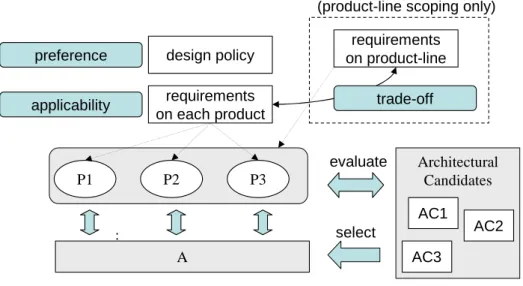
In this paper, we define architectural design as selecting most appropriate architecture from multiple options, in terms of requirements and design policy. Figure 1.4 shows an image of software architectural design.
Architectural Candidates
… select
evaluate
P1 P2 P3
A
requirements on each product
requirements on product-line design policy
applicability preference
AC1 AC2
AC3 trade-off
(product-line scoping only)
Figure 1.4: Architectural Design
In the figure, we are trying to select architecture from architectural candidates. We have requirements on each product both on functionalities and quality attributes. We also
have design policy, in which we define the importance of quality attributes. For example, we may want to make development cost as low as possible, or we may want to make product as reliable as possible. When we examine the product-line scoping, we also have requirements on product-lines, in which we define how we want to develop product-lines.
For example, we want to develop the high-end product first, and then release the standard model as first as possible, and so on. In order to select an architecture from candidates, we have to evaluate each architectural candidate, in terms of these requirements and design policy.
In order to examine the architectural design method, we make case study on an actual architectural design project to examine the nature of software architectural design. Based on the observation, we find it important to focus on the followings in architectural design;
• Applicability: If we can attain the requirement on a product based on an architec- ture, we say that the architecture is applicable in terms of the requirement on the product. In general, when we design architecture, we examine multiple products that will be developed on the architecture. Therefore, we have to select architecture that will be applicable in terms of requirements on corresponding products.
• Preference: There may be multiple applicable architectural candidates. However, these applicable candidates generally have different characteristics; for example, one is good for performance and one is good for cost, and so on. In architectural design, we define design policy in which we determine the importance or weight of each quality attribute, and we select the best one form candidates based on the design policy.
• Tradeoffs: In product-line scoping, we have to consider tradeoffs between benefit for development of each product and benefit for product-lines as a whole. For example, if we are to have a single architecture shared by every product, that is good for development cost, because we only develop a single architecture. On the other hand, If we develop architecture for each product, that is good for each product, however it will be expensive to develop multiple architectures. We have to examine this kind of tradeoffs.
Architectural design is to select architecture considering applicability, preference and tradeoffs. In other words, in architectural design, we have to decide the ordering among architectural candidates in terms of these three concepts.
Figure 1.5 shows the overview of the architectural design technique proposed in this paper. This technique consists of three major parts:
• Examine applicability: Here, we use two techniques; aspect-oriented analysis, and identifying categories of requirements. Aspect-oriented analysis is a technique to separate requirements on each quality attribute from the original requirement. Uti- lizing this technique, we identify categories of requirements, in which we not only find out applicable candidates, but also identify which one could fulfill widest spec- trum of requirements.
• Examine preference: We utilize decision-making techniques to decide the preference in terms of design policy.
Examine applicability
Examine preference
Examine trade-offs
- Aspect-Oriented Analysis - Category of requirements
- Decision-making framework
-Requirement on product-lines
(product-line scoping only)
Figure 1.5: Overview of the Architectural Design Method
• Examine tradeoffs: Utilizing the result of previous steps, examine the tradeoff among options. This step is especially important if we design multiple architectures for a product family.
Chapter 2
Related Works
2.1 Software Architecture and Views
Though there are many definitions of software architecture [4, 10, 14, 19, 39, 40, 44] and no single definition is accepted widely, we could say that most of them claim the followings:
• Software architecture refers to the fundamental software structure.
• Software architecture has a strong impact on the characteristics or quality attributes of the software developed on the architecture.
• Software structure governs the entire software design. Once software architecture is determined, it is difficult to change the decision, because many succeeding designs depend on the architecture.
• We can categorize software architecture into relatively independent views. Though there proposed different categorization and views, they have similarity [31, 40, 45].
In this paper, we adopt Ran’s definition of software structure and views [40], however, we have adopted the different terminologies.
Some definitions say that software architecture is not only the software structure but also design principle, policy and guidelines. Though these definitions are quite important as these concepts govern the software architectural design, these definitions are little abstract and vague. On the contrast, we just focus on the software structural issues in this paper. Furthermore, in this research, we regard the software architecture as the basis for multiple software products. This makes software architectural design clearer.
We categorize the situation in which we have to design the software structure for multiple products into two. One is designing a single product considering its evolution (modification and version up). In this case, we consider the possible variations of re- quirements on the products. However, the focus of the design is the target product. The other is designing the architecture for product-lines. In this case, we also design software structure considering multiple requirements. However, in this case, our focus is on the multiple products. If the architecture is good for a product, but it would be not good for other products. We have to examine whether or not the architecture is good for each product in product-line, and maximize the total benefit.
2.2 Architectural Descriptions
There are two different approaches for architectural descriptions. One is to prepare special language for architectural description. Typically, such languages, usually called Architec- ture Description Language (ADL) [1, 9, 34, 35, 43], have mathematical background to enable mathematical treatment, or have execution semantics to enable simulation. An- other approach is to utilize modeling language based on relatively loose formalism, such as Unified Modeling Language (UML) to enable semi-formal description for human commu- nication or simple tool manipulation such as code generation [16, 18, 31]. In this paper, we adopt UML to describe software structure.
ADL is good for analyzing known characteristics that can be modeled on the mathe- matical foundation. For example, it is good to analyze the performance of the software using the performance model. However, relationship between software architecture and quality attributes is not well understood, and the application of ADL is limited. Espe- cially, in the early phase of software architecture, we have to assess wide spectrum of quality attributes based on limited information. In such a case ADL approach is not appropriate.
Semi-formal languages such as UML [38] can be used in wider situation. As these languages are weak, we can not use them for strict analysis or simulation. However, it could be used to model variety of concepts in a uniform manner. As our focus is making the appropriate architectural decision considering wide and variety of aspects related to software quality attributes, these semi-formal languages are more appropriate.
UML is good for describing the static aspects (information or data) and dynamic aspects (functions and timing). However, we do not have good way to describe require- ments on quality attributes using UML. In this paper, we attach these requirements to the modeling components such as class and collaborations. It is not enough in terms of modeling purpose, but it is one of the most common practice adopted in the actual software projects.
2.3 Design Method
As software architecture is the fundamental structure and is the basis of the software design, it is expensive to change the software architecture. That is the main reason why we have to carefully design software architecture.
Most software design methods treat software architectural issues. One of the main is- sues in treating software architectural issues is development-time quality attributes such as reusability and extensibility. In early 70’s, they already argued about the module strength and coupling. We can say that major methods such as structured-method and object- oriented method focus on finding good module structure. However, in these software design method, software structure and software architecture is not clearly distinguished.
In real-time structure method proposed by Hatley [17], they treat architectural issues as assignment of functions to components connected by communication path.
Designing the reusable assets such as framework and components requires more ex- plicit focus on software architectural issues. In these design, we do not focus on just a single product, but potential products that will be developed on the reusable assets.
In framework design, we are to find hot-spots and frozen-spots in order to design the architecture that can manage the variation of potential products.
In order to develop software and software architecture, it is not enough to design from functional aspects. We have to consider the aspects related to quality attributes.
However, as we have mentioned, relationship between software architecture and quality attributes is not well understood. However, there are some researches and practices that are to handle quality attributes. For example, in engineering fields, there are researches that treat quality attributes such as performance [15, 17, 42]. Buhr proposes a method in which they analyze coarse-grained dynamic structure using use-case map [6].
In this paper, we focus on architectural design by examining requirements of multiple products that will be developed on the target architecture. We examine these require- ments, especially requirements on quality attributes and find out appropriate design direc- tions. We do not focus on analyzing strict relationship between architecture and quality attributes, but are to clarify the general framework of software architectural design.
2.4 Architectural Design
In actual software development, there are typically two stages where we design software architecture. One is the actual structural design, in which we examine every techni- cal detail and decide the concrete design. In this phase, we have to clarify everything, specification and design, and make architecture clearly designed.
The other is in the early stage of the software development in which we find out the design directions of the software. In this phase, we do not examine every thing, but focus on the significant issues that have to be determined in the early phase. The global architectural style and the basic architectural techniques are examples of issues that have to be decided in this phase. Unless we make any decision on these issues, we cannot design software any further. In these early phase, we may not have enough information for architectural design, however we have to make decision on architecture anyhow. In this paper, we focus on this type of architectural design.
Software design is a creative activity, but we do not always create new design. In soft- ware architectural design, we could point out three typical types of architectural design.
• Create new architecture based on the requirements. Structured method based on functional decomposition is one of the way to develop software structure from the requirements.
• Develop architecture based on the pattern. As same as the design pattern [12], there are approaches to define catalogues of architectural styles, to solve problems in architectural design [7, 30, 36, 44]. It is important to understand the characteristics for architectural styles and utilize them in actual architecture, as it is expensive to actually check the characteristics of architectural styles by ourselves.
• Select the architecture that is most appropriate for the requirements from architec- tural candidates. In the architectural design, it is common to find design directions from multiple options.
In this paper, we focus on the third case, select architecture from multiple options. In selecting architecture, we have to evaluate each architecture in terms of requirements, and decide most appropriate one. Therefore, evaluation techniques are one of the main focus [21, 22]. Though some similar works are categorized into architectural evaluation field,
in this paper, we categorize our research into design field, as our objective is to select an appropriate architecture anyhow.
There are another methods that focus on the problem specific to architectural design [30, 8], and we also have to consider these aspects when we design architecture in actual project.
2.5 Product-line Architecture
Product-line architecture is architecture that is shared by members of a product-line.
When we are to develop product-lines efficiently, it is important to develop product-line architecture and set up reusable assets based on the architecture. Usually, product-line architecture means, not only architecture itself, but also systems of strategic reuse based on shared architecture [4, 4, 46, 48]. Therefore, non-technical issues such as project man- agement, cost estimation, and risk management are indispensable for product-line archi- tecture. However, in this paper, we focus on technical issues of product-line architectural design.
When we develop product families, we may divide products in the product family into multiple product-lines. Though products in the same product family have some commonalities, it is dangerous to share a single architecture by every member of product family. As product family is determined by many factors such as business issues, technical issues, development- side issues, we have to carefully examine the products and determine the product-lines. This activity is normally referred as software scoping [11, 46], and in usual, it is not considered to be the design activity but business activity to define the product-lines and their development activity. However, in this paper, we just focus on the technical aspect of the software scoping, and categorize the activity in the software architectural design.
Chapter 3
Architectural Design
3.1 Software Architecture
3.1.1 Software Structure
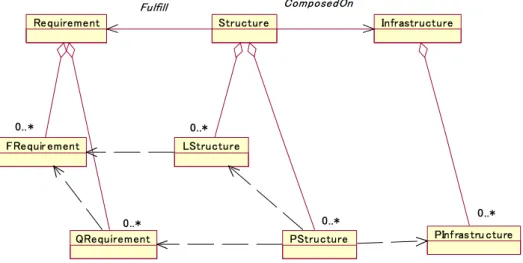
As the basis of our research, we adopt the conceptual framework for software structure proposed by Ran [40]. Though this framework well explains the nature of software struc- ture and the relationship between software structure and quality attributes, it does not explicitly capture the differences between architecture and software structure. In order to extend the framework, we have slightly changed the terminology. Figure 3.1 shows the framework.
!"
#$%'&
(*)+-,).0/ 13254
# $6%0&7
Figure 3.1: Ran’s Conceptual Framework — Revised The following is the summary of the framework1:
• Software structure (Structure) is composed on the infrastructure of software, and is designed so as to fulfill requirements. Requirement is categorized into requirement on function (FRequirement) and requirement on quality attributes (QRequirement).
1In the diagram, we use contracted form for each name due to the space reason. In this case, ’structure’
is a concatenate form, and in the text we use ’software structure’.
• Software structure is categorized into logical structure (LStructure) and physical structure (PStructure). Logical structure is a special software structure that is con- structed on the conceptual components. On the other hand, physical structure is constructed on the physical infrastructure (Pinfrastructure). There are multi- ple physical structures dependent on the physical infrastructure, such as run-time structure and development-time structure. Each structure is designed to fulfill corre- sponding requirement on quality attribute (QRequirements). For example, run-time structure is designed so as to fulfill requirement on run-time quality attribute such as performance and run-time memory size.
• Logical structure represents the important notions in the target domain, and re- lationship among them. In the ordinary development method, functionalities are represented in this model. Physical structure reflects the logical structure and has to attain corresponding requirement on quality attributes.
3.1.2 Software Structure and Software Architecture
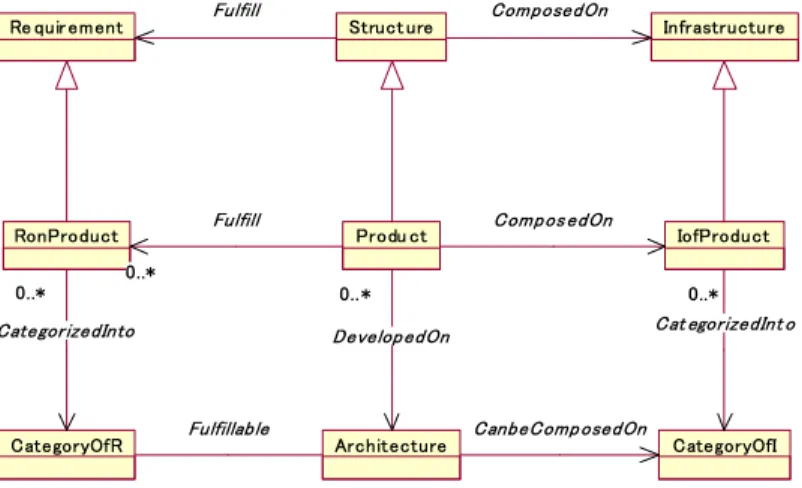
We extend the Ran’s framework so as to explicitly capture the nature of software ar- chitecture. As changes of architecturally significant decisions have a serious impact on succeeding design decisions, we are to design software architecture to be steady through- out software development and evolution. In other word, software architecture has to be the platform of potential software that is assumed to be developed on it. Figure 3.2 shows the conceptual framework for software architecture.
!
"$#%&'#(*)+,-
./0*12*3$ 456! ./0 12*3$
7 8) " 7-8 )"/#%9&$#(*)+,- :1;!1<
=>>?
=>>?
" 7@)A#BC )+D- @#
1;!1<
=>>?
=>>?
" 7@)AE#FBC )+D- @#
;1<
=>>?
=>>?
G )H )#&I)+,-
=>>?
=>>?
"/#%&I#()+,-
Figure 3.2: Conceptual Framework for Software Architecture The followings are the overview of the framework.
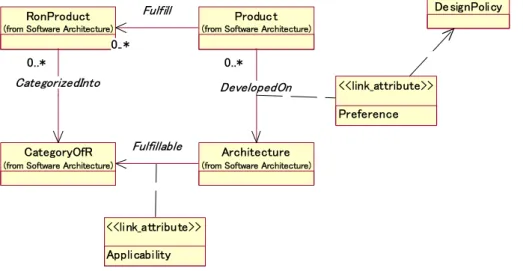
• Product is constructed on the infrastructure of the product (IofProduct), and is de- signed to fulfill requirement on the product (RonProduct). This is the same relation- ship among requirement, software structure (Structure) and infrastructure defined in Ran’s framework.
• Architectureis the platform of potential products. Here, ”potential products” means products that are assumed to be developed on the architecture. In other words, they are products included in the scope of the design.
• As architecture should be the basis for potential products, each product is devel- oped on the architecture and has to fulfill the requirements on the product. If we have a single architecture shared by multiple products, the architecture should fulfill the range of requirements on every product. We call the requirement on ar- chitecture that should be the basis of multiple products as category of requirements (CategoryOfR). We will explain the idea in 4.3 in detail.
• Infrastructure may change during the evolution or we have to port products onto other infrastructure. We introduce the notion category of infrastructure (Category- OfI), as same as the requirement case.
3.1.3 Assumed Scenario and Product-line
As we explained in 1.1.2, when we design software architecture, we have to examine the requirements on software that will be developed on the architecture. In other words, when we design software architecture, we have to have any information about potential products that will be developed on the architecture. We call these potential requirements as assumed scenario. An assumed scenario is a set of requirements that are considered to be required on software that will be developed on the architecture.
Though it is difficult to identify potential requirements, we try to identify them in actual software development. For example, when we try to develop software spirally, we assume the development scenario in which we decide the items to be developed and the order of development. The development scenario may change, if we encounter problems or if the situation of development is changed. However, we have to assume the scenario to make the strategic development plan. Similarly, when we develop systems, we examine the possible enhancement of the system or change of requirements, in order to handle such expected changes.
When we develop product-lines, we have to assume scenario more clearly. We have to make plan for develop product-line, in which we define what kind of products are included in product-family, what characteristics each product has, and how we develop these prod- ucts. Without this kind of assumption, we cannot expect the strategic development based on the reuse technology.
3.2 Architectural Design
3.2.1 Definition of Architectural Design
Architectural design is the process in which we find out the structure of components provided by the infrastructures so as to fulfill requirements. In this paper, we define architectural design as the process in which we select most appropriate architecture from architectural candidates in terms of requirements on potential products and design policy.
We explain the intention of the definition.
• In architectural design, it is common to make a list of possible architectural candi- dates and select most appropriate one from the list. This definition assumes such a situation. This process is one of the typical ways of design, especially when we are to insist the appropriateness of the design decision. On the other hand, it is a little
”heavy” process if we have to make a list of candidates for every design decision.
• As we explained in 1.1.2, potential products are products in assumed develop- ment/evolution scenario, or planned product-lines.
• Appropriate architecture usually means that selected architecture satisfies require- ments. However, in actual development, it sometimes happens that we cannot fulfill requirements by any architectural candidates. That happens because we cannot say that there is no architecture that satisfies requirements until we actually enumerate candidates and assess the characteristics of them. Therefore, we do not exclude such a situation, and in this situation appropriateness is judged by the design policy.
• ”Design policy” gives the rules to determine the preference among candidates.
Though there may be variety of ways to define ”design policy”, in this paper, we define design policy by the preferences among quality attributes. For example, as- sume that we have two architectural candidates; one is good for performance and the other is good for cost. If these candidates satisfy requirements, we cannot de- termine which one in most appropriate. However, if design policy says that cost in the most important quality attribute, we can select one.
3.2.2 Types of Architectural Design
As we discussed in 1.1.2, we will examine three types of architectural design.
!"# $
&%'&(
)**+ )**+
,".-$/102!3.$456-0
'&(
)**+ )**+
78$9$0;:.$4<16 )**+
)**+
; !
number of products
number of architecture
Figure 3.3: Variations of Software Architectural Design
Figure 3.3 shows a part of the conceptual framework shown in Figure 3.2. When we design software architecture, we examine target products that will be developed on the architecture, and ”number of products” means the number of the target products. In developing product families, we may design a single architecture for the products in the family, or we may divide products into subsets in which they share the same architecture.
”Number of architecture” refers to the number of architecture to be designed. Usually 1
≤ ”number of architecture” ≤ ”number of products” holds. We will explain three types of architectural design shown in Table 3.1.
• Architectural Design: Designing architecture of a product. Here we design software architecture for a product considering the evolution of the software. In this case, requirements include not only requirements on target product but also assumed scenario for the product (Figure 3.4).
Table 3.1: Three Types of Architectural Design number of number of architecture products
Architectural design for 1 1
a single product
Product-line architectural 1 N design
Product-line scoping M N
Figure 3.4: Architectural Design for a Single Product
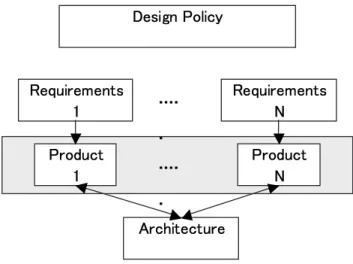
• Product-Line Architectural Design: Designing product-line architecture for a family of products. Here we develop software architecture that will be shared by products in the family. In this case, requirements include requirements on each product in the family, and every product shares the same architecture (Figure 3.5).
!
"
!
Figure 3.5: Product-line Architectural Design
• Product-Line Scoping: Examining the scope of product-line architecture, i.e. to determine the set of products that share the same architecture. Here we decide how we divide the set of products into sub groups each of which shares the same archi- tecture. In this case, requirements include not only requirements on each product but also requirements on scoping (Figure 3.6).
!
"
#$
"
#
%
&
Figure 3.6: Product-line Scoping
Usually, product-line scoping is not called architectural design. However, we assume this is one of the types of architectural design, as this involves quite similar technical issues as architectural design.
3.3 Analysis of the Problem
3.3.1 Overview of the Project
In order to evaluate the technique, we pick up the actual architectural design project, which designed architecture for on-board (in vehicle) systems for ITS (Intelligent Trans- port Systems) and make observation on the characteristics of architectural design. We also apply our technique to the same problem to demonstrate the applicability of the technique to actual problem.
This project, ”Study on ITS on-board system architecture”, was completed in 1997 by Association of Electronic Technology for Automobile Traffic and Driving (JSK), in which they investigated the required services and important technologies in the field, and examined the higher-level architecture for on-board system [2].
In the system architecture (SA), they defined 45 sub-services (correspondent to prod- uct in our technique), such as route guidance, assistance for economic driving, provision- ing of road traffic control, and so on. They analyzed 45 sub-services to identify necessary information and functions using object-oriented analysis. For each function, they enu- merated candidates of architecture to realize the function, and qualitatively compared candidates in terms of quality attributes. After that, for each sub-service, they checked every function required for the sub-service, and selected the proper candidate considering the requirements on the sub-service and the characteristics of candidates.
Though ITS are not pure software systems but systems that are realized by software and hardware utilizing communication technology, the differences are not so important in the early stage of architectural design. Firstly, in many systems, we start analysis before dividing the system into software part, hardware part, and human activities. Secondly, when we think of many software systems, most of them are not pure software systems.
For example, when we design web application, we have to think of networking issues;
when we design an embedded system, we have to consider the hardware configuration.
Thirdly, this ITS project have adopted software methodologies, object-oriented method, to the system architectural design, and the basic scheme of the design is almost the same.
The reasons we have picked up this project for the evaluation are the followings; 1) as this project was a large joint project among experts of services, system architects, and specialists of each technologies, the result of the architecture design is considerably reliable, 2) as they have left the reason of architectural selection and basic materials as reports, it is relatively easy to trace their reasoning based on the written documents.
In 3.3.2, we will overview the project and observe the characteristics of architectural design.
3.3.2 Observation from the Project
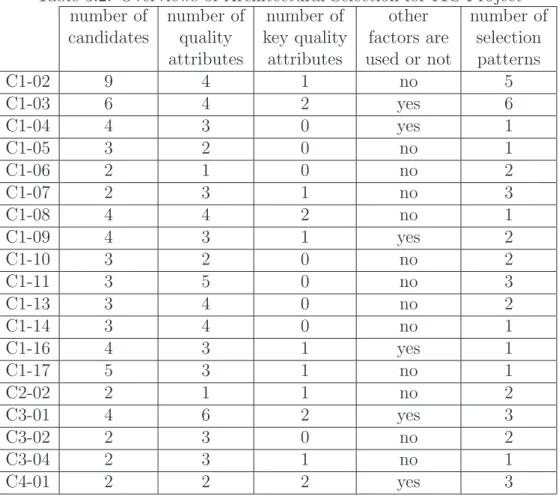
Though there are hundreds of functions used by 45 sub-services, there are important functions that they call ”common functions”, which are shared by more than two sub- services. We focus on these common functions, because they are related to commonalities between requirements. Among them, we have picked up 21 important functions, because for these functions, there left enough information in the report. The followings are the observations from analyzing the architectural selection for these 21 functions:
• Though they have considered dozens of quality attributes when they characterize
architectural candidates, they use restricted number of quality attributes for each architectural selection.
• Among these quality attributes, some quality attributes are used to judge the appli- cability (namely, they reject some candidates because the candidates cannot fulfill the requirements on this quality attributes). Other quality attributes are used for relative comparison between candidates to select a ”better” candidate among appli- cable candidates. We call the former as ”key quality attribute” in this paper.
• If they cannot select a candidate from key quality attributes, they select a candidate based on the relative comparison. In some case they have examined the character- istics of the sub-service not only from quality attributes but also from knowledge about the sub-services.
Based on the above observation, we have examined how architectural selection has done for these 21 sub-services. Table 3.2 shows the followings: number of candidates for the sub-services, number of quality attributes they used in architectural selection, number of key quality attributes, whether or not factors other than quality attributes are used, and the number of selection patterns, i.e. how many types of reasoning exist. For example, consider that a function F is used by three sub-services S1, S2 and S3, and for S1 and S2 they select candidate (a) as it is good for cost, and for S3 they select candidate (b) as it is high performance, we say the number of selection patterns are two. Even if two sub-services select the same candidate, we say that they are different selection patterns, if the reason is different. In Table 3.2, id such as C1-02 is the id used in the project. This table has 19 functions, as two functions have only one candidate and we ignore them.
Based on the observation and the results summarized in Table 3.2, we consider the followings about the applicability of our techniques:
• In this project, 11 sub-services out of 19 have key quality attributes and we can identify two or more categories for them. 4 out of 11 have two key quality attributes.
This means that in architectural selection it is important to judge the applicability of candidates in terms of requirements.
• If there are no key quality attributes, all candidate fulfill the requirements. In this case, they select an architecture using some technique to decide the relative preference. (In this project, they use scoring method).
• Many of the architectural selection (13 out of 19) can be done just using quality attributes. This means that in architectural selection, in many cases, requirements on quality attributes have enough information for architectural selection.
• Many of the architectural selection (12 out of 19) have more than two selection patterns. It becomes difficult to clarify the reason of architectural selection, if the number of the patterns becomes large. In our technique, we can hierarchically (step-wisely) select the architecture that makes the reasoning clearer.
As shown above, we can observe that in architectural selection, it is important to determine ”applicability” and ”relative preference” for architectural candidates.
Table 3.2: Overviews of Architectural Selection for ITS Project number of number of number of other number of candidates quality key quality factors are selection
attributes attributes used or not patterns
C1-02 9 4 1 no 5
C1-03 6 4 2 yes 6
C1-04 4 3 0 yes 1
C1-05 3 2 0 no 1
C1-06 2 1 0 no 2
C1-07 2 3 1 no 3
C1-08 4 4 2 no 1
C1-09 4 3 1 yes 2
C1-10 3 2 0 no 2
C1-11 3 5 0 no 3
C1-13 3 4 0 no 2
C1-14 3 4 0 no 1
C1-16 4 3 1 yes 1
C1-17 5 3 1 no 1
C2-02 2 1 1 no 2
C3-01 4 6 2 yes 3
C3-02 2 3 0 no 2
C3-04 2 3 1 no 1
C4-01 2 2 2 yes 3
3.3.3 Observation on Product-line Scoping
In examining product-line scoping, we have to consider different aspects from that of single product architectural design and product-line architectural design.
P1 P2 P3 P1 P2 P3
A
(a) (b)
A1 A2 A3
Figure 3.7: Two Extreme Situations in Product-line Scoping Figure 3.7 shows two extreme situations in product-line scoping.
• In (a), every product shares the same architecture, and we can expect to reduce the total development cost as we develop a single architecture for every product.
However, it may not be good for the characteristics of each product, as it is difficult to provide a single architecture that is best for every products.
• In (b), each product has its own architecture. In this case we could develop special- ized architecture for each product to realize the best characteristics. However, it is expensive and bad for the total development cost.
As observed above, in product-line scoping, we have to examine not only the charac- teristics of each product but also the characteristics of total development, such as devel- opment cost and reuse ratio. These two characteristics are tend to conflict each other, and in such a case, we have to examine the tradeoffs between these two.
3.4 Modeling Framework
3.4.1 Model for Software Structure
In this section, we explain the modeling framework for software structure used in the paper. Though the design method proposed in the paper does not tightly combined with the modeling framework below, it is incorrect to insist that the method is free from modeling method because there are variety of modeling techniques for software structure.
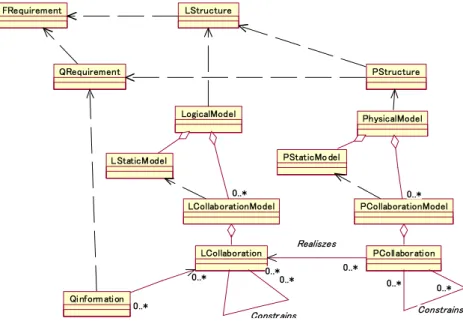
Our modeling framework is one of common frameworks based on UML. Figure 3.8 shows the framework.
• Logical structure (LStructure) and physical structure (PStructure) in the concep- tual framework (Figure 3.1) are modeled as logical model and physical model re- spectively. These two models are corresponding to analysis model and design model in ordinary methodology.
"!#
$""#%!#
&!"#
'"( "
)*##"+ %!#
,--. ,--.
0/1"2""#%!#
)*##"+
,--. ,--.
,--. ,--.
,--.
3*4576"89:";5<6 ,--.
)'##"+ !#
,--. ,--.
)'##"+" "
,--. ,--.
,--.
3*45'6"89=:;5<6 ,--.
,--.
,--.
,--.
,--.
>0?:"@;6A? 6
Figure 3.8: Modeling Framework for Software Structure
• Logical model consists of logical static model (LStaticModel) and logical collabo- ration model (LCollaborationModel). Logical static model is described by means of class diagram of UML, and logical collaboration model is described by means of collaboration diagram of UML. Physical model also consists of physical static model (PStaticModel) and physical collaboration model (PCollaborationModel).
• Logical model is obtained by analyzing the requirements on function. In logical static model, there defined conceptual elements that are used in logical collabo- ration model. In logical collaboration model, there described interactions among components and roles played by them, typically for specific aspects of software be- havior. In UML, there are two types of collaboration model, one is at specification level and the other is at instance level, and we believe both of them are useful for our purpose.
• As we have explained in 3.1.1, there are multiple physical structures dependent on the different infrastructures. Corresponding to these multiple physical infrastruc- tures, we can define multiple physical models that describe different structures, such as run-time structure and development-time structure.
• We do not model requirements on quality attributes straightforwardly. We describe requirements on quality attributes as added information to logical model; attached information to components in logical static model or logical collaboration in logical collaboration model. We will explain this further in 3.4.2
• Logical collaboration model and physical collaboration model consist of logical col- laborations and physical collaborations respectively. If physical structure satisfies the requirements on products, there must be physical collaborations corresponding to logical collaboration that satisfies both requirements on function and require- ments on quality attributes.
3.4.2 How to Represent Requirements on Quality Attributes
Though our modeling framework is almost as same as modeling framework adopted by typical object-oriented method, the way to express requirements on quality attributes is slightly extended. In this section, we explain how to represent variety of requirements on quality attributes in this modeling framework.
• As we are interested in the quality attributes that relate to software architecture, we categorize quality attributes by means of types of software architecture that deter- mines the quality attributes. Namely, we categorize quality attributes into run-time quality attributes, development-time quality attributes, deployment-time quality at- tributes, and so on. Based on the category, we attach each requirement on quality attributes to corresponding software structure model. For example, requirements on run-time quality attributes are attached to run-time structure model, requirements on development-time quality attributes are attached to development-time structure, and so on.
• When we attach requirements to software structure, as explained above, we attach the requirements to most appropriate modeling components. Typically, require- ments are attached on static components modeled in logical static model or dynamic collaborations modeled in logical collaboration model. As both components and col- laborations can be defined hierarchically, we can attach requirements at arbitrary level.
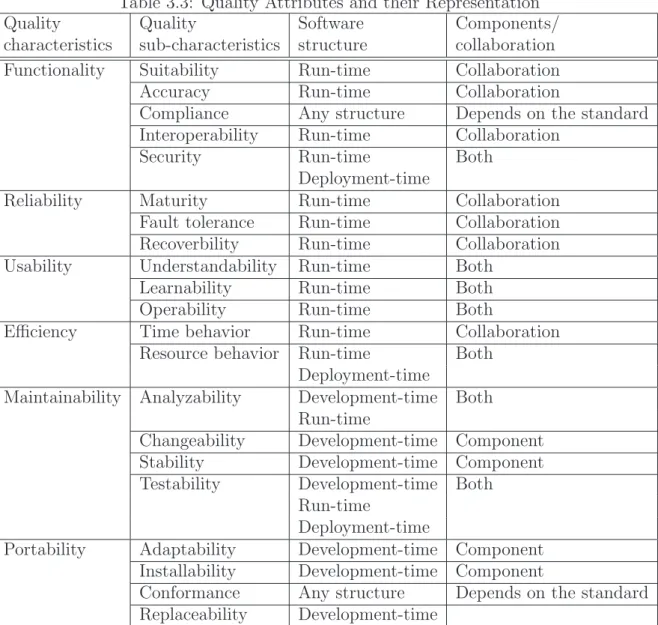
The way how to attach the requirements on quality attributes to proper components or collaborations is context dependent, i.e. we have to analyze the required quality attributes and judge most appropriate target. Table 3.3 shows some examples of quality attributes picked up from ISO 9126, and typical examples how to represent the requirements. We do not insist that all the quality attributes described here have strong relationship with software structure, but we show the table to clarify how to represent requirements on quality attributes. Basically, if the quality attribute is about static characteristics of components, it is attached to the components. If it is about functions, it is attached to the collaborations representing the functions.
In order to clarify our intention, we explain some quality attributes described in the table.
• Functionality: Suitability is about the quality of design, and can be attached to collaborations at design level. Interoperability typically relates data format and is about run-time component structure.
• Reliability: Typically this quality is about set of services (functions), and can be attached to collaborations that include the functions.
• Usability: Typically this attribute is about human interface or human operation and this relates to run-times static / dynamic structure because that affects user operation.
• Efficiency: Time behavior relates to run-time collaboration. Resource behavior relates to run-time collaboration (run time resource) or run-time / development- time components structure (static resource).
Table 3.3: Quality Attributes and their Representation
Quality Quality Software Components/
characteristics sub-characteristics structure collaboration Functionality Suitability Run-time Collaboration
Accuracy Run-time Collaboration
Compliance Any structure Depends on the standard Interoperability Run-time Collaboration
Security Run-time Both
Deployment-time
Reliability Maturity Run-time Collaboration
Fault tolerance Run-time Collaboration Recoverbility Run-time Collaboration Usability Understandability Run-time Both
Learnability Run-time Both
Operability Run-time Both
Efficiency Time behavior Run-time Collaboration Resource behavior Run-time Both
Deployment-time
Maintainability Analyzability Development-time Both Run-time
Changeability Development-time Component Stability Development-time Component Testability Development-time Both
Run-time
Deployment-time
Portability Adaptability Development-time Component Installability Development-time Component
Conformance Any structure Depends on the standard Replaceability Development-time
• Maintainability: Analyzability relates to how easy to understand the dynamic be- havior of software. Changeability and stability relate to development time static structure. Testability depends on both structure.
• Portability: Basically relates to development-time component structure.