Japan Advanced Institute of Science and Technology
JAIST Repository
https://dspace.jaist.ac.jp/
Title
ビスイミノアセナフテン構造を有する材料の合成と電
気化学エネルギーデバイスへの応用
Author(s)
Patnaik, Sai Gourang
CitationIssue Date
2018‑09
Type
Thesis or Dissertation
Text versionETD
URL
http://hdl.handle.net/10119/15536
RightsDescription
Supervisor:松見 紀佳, マテリアルサイエンス研究科
, 博士
氏 名
PATNAIK, Sai Gourang学 位 の 種 類
学 位 記 番 号 学 位 授 与 年 月 日
博士(マテリアルサイエンス)
博材第
457号 平成
30年
9月
21日
論 文 題 目
Synthesis of Bisiminoacenaphthene (BIAN) Based Materials and Their Applications to Electrochemical Energy Devices論 文 審 査 委 員 主査
松見紀佳(北陸先端科学技術大学院大学 先端科学技術研究科 教授)大島義文(同 教授)
長尾祐樹(同 准教授)
谷池俊明(同 准教授)
獨古薫(横浜国立大学大学院工学研究院 教授)
論文の内容の要旨
Chapter 1: Background
The current thesis is focused on compounds of the family bis(aryl)acenaphthenediimine (Ar-BIAN) (Figure 1). They have long been employed as ligands for transition metals and their metal complexes have been utilized as catalysts in wide spectrum of reactions.
However only recently the rich redox chemistry of Ar-BIAN based compounds have been evaluated. These compounds are
characterized by high chemical stability and have wide scope for functionalization owing to the availability of suitable precursors.
And more importantly, they have the inherent ability to act as electron sponge in a reversible manner.
Feudskin and coworkers have shown that these group of ligands can easily
take up to four electrons from reactive
metals like Na/Li and form corresponding complexes, which can also disproportionate to come back to their original state. This ability to stabilize various reactive metals in redox active manner can thus
N N R
R
Figure 1. Bis(aryl)acenaphthenequinonediimine
Figure 2. Graphical abstract of current research
have interesting applications in energy storage devices. By utilizing these group of materials on electrode surface, their electron reservoir property can help in providing better interfacial characteristics, especially when the interface is a dynamic one. Hence, in an effort to capitalize on these unexplored but potential properties of these group of materials, we synthesis various functional materials with end applications in Li-ion and Li-air based energy devices. (Figure 2)
Chapter 2: BIAN based polymer binder
First line of research was focused on designing BIAN based binder materials for Li-ion batteries (LiB’s). The application of band gap engineered binders can have great effect on the ultimate device performance, even though binder constitute only a small fraction of the gravimetric weight of the electrode. Our results showed that, use of BIAN based functional diamine polymer binder leads to
performance improvement resulting from an enhanced SEI.
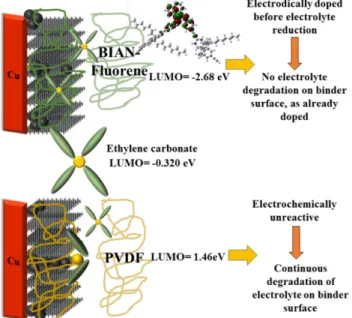
Bis-imino-acenaphthequinone (BIAN)-Fluorene copolymer (π conjugated polymer bearing BIAN and fluorene units) binder (Figure 3) was designed, synthesised and adopted for preparation of graphite electrode laminate in lithium-ion batteries. Density functional theory calculations using Gaussian 09 showed that the polymer had
Lowest unoccupied molecular orbitals (LUMO) levels lower than that of the LUMO of carbonate based electrolytes and hence would undergo reduction before the reduction of the electrolyte components.
This in turn would reduce irreversible electrolyte reduction on binder surface (Figure 4). More importantly, the resultant SEI derived from the reduced conjugated polymer will be more robust compared to conventional electrolyte reduction derived SEI. Compared to the traditional PVDF
Figure 3. Functional components of BIAN-Fluorene biunder
Figure 4. Graphical abstract of functioning of the novel polymer binder
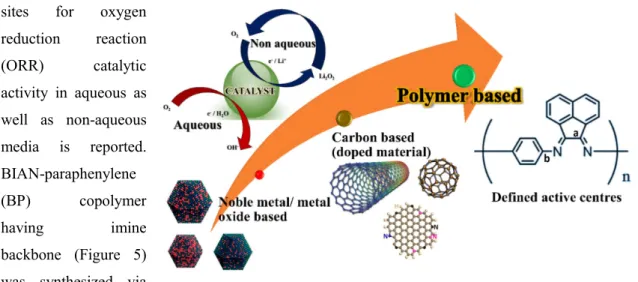
Figure 5. Schematic showing evolution of ORR catalysts and current polymeric binder, the electrode with BIAN-Fluorene binder exhibited significantly enhanced electrochemical performance in terms of rate capability, specific capacity and cycling behavior. At a rate of 1C, the electrode with BIAN-Fluorene binder exhibited more than 250 mAhg-1 capacity after 100 cycles while the electrode based on PVDF binder only delivered 165 mAhg-1. The significant improvement of cycling performance was due to the improvement of adherence of the electrode laminate to the current collector and improved interface. Electrochemical impedance spectroscopy (EIS) and dynamic electrochemical impedance spectroscopy (DEIS) studies showed the formation of an improved interface with BIAN-Fluorene based binder.
Chapter 3: BIAN based polymeric electrocatalyst
The second application was to use BIAN based materials as electrocatalyst for Oxygen reduction reaction (ORR) in fuel cells and Li-air batteries. We could design active site defined polymeric electrocatalyst for ORR, for the first time. The performance of the catalyst was in par with other metal free ORR catalysts and with much higher stability than conventional Pt/Vulcan based electrocatalysts. The further development of this kind of active site defined polymeric electrocatalayst and their corresponding metal coordinated analogues will thus be a big leap in transition from random high energy consuming annealed carbon based electrocatalysts to defined materials under ambient conditions.
Design, synthesis and performance evaluation of functional polymer material with defined active sites for oxygen
reduction reaction (ORR) catalytic activity in aqueous as well as non-aqueous media is reported.
BIAN-paraphenylene
(BP) copolymer having imine backbone (Figure 5)
was synthesized via
solution based
polycondensation. The as synthesized polymer itself showed considerable ORR activity, comparable to that of other reported metal free heteroatom doped carbon materials. The composites of the polymer with graphene oxide (GO) sheets (GO/BP) were also synthesized under moderate temperature conditions (4000C) with the polymer remaining intact. The composites showed further
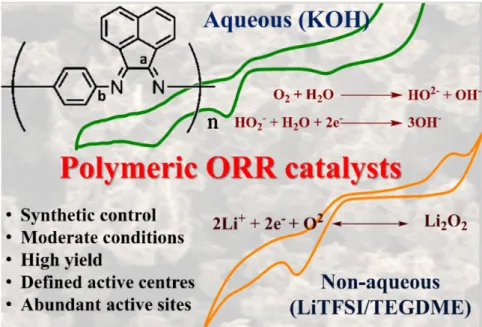
enhanced electrochemical activity owing to the synergistic effect of GO and active site defined polymer material. We also tried to evaluate the nature and basis of catalytic activity on polymer surface by different techniques. The cyclic voltammograms showed two distinct ORR peaks, indicating two different active sites. This was also in agreement with Mulliken charge distribution analysis from Density functional theory (DFT) studies, which showed the presence of
two different carbons next to nitrogen having different electropositive nature. More interestingly, the polymer itself and its composites with GO showed excellent stability for ORR in non-aqueous medium and ether based solvents with dissolved lithium salts. ORR in non-aqueous solvents being the pre-requisite for utilization in Li-air batteries, the polymeric catalyst material is thus a promising alternative to conventional catalysts for ORR (Figure 6). Also, the polymer itself can be used as an ORR active binder for electrode slurry preparation, thereby enhancing catalyst performance.
Chapter 4: BIAN based functional additive for high voltage cathodes
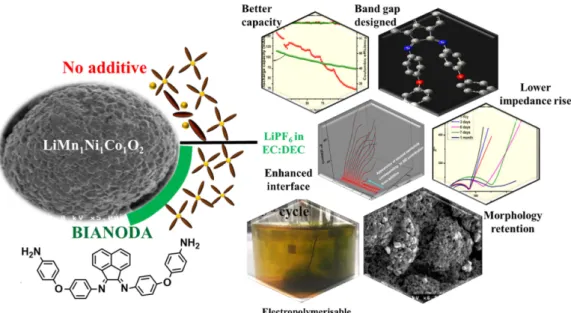
Inspired with these results, we further designed BIAN based band gap engineered additives for performance and storage enhancement of high voltage cathodes for LIB’s (Figure 7). The results were quite promising, giving very good cycling stability and capacity retention upon storage. We also performed XPS studies to understand the surface evolution during cycling at high voltage and found that, BIAN based additive reduces irreversible electrolyte oxidation on electrode surface as compared to the case without any additives.
Figure 6. Graphical summary of BIAN based ORR active polymer activity
Keywords: Bisiminoacenaphthene, binders, Li-ion batteries, oxygen reduction reaction, electrocatalysts, high voltage cathodes, electropolymerisation
論文審査の結果の要旨
本論文においては、ビスイミノアセナフテンキノンを活用した各種高分子材料/機能性物質を 合成し、それらをリチウムイオン2次電池用グラファイト負極バインダー、酸素還元反応用電気 化学触媒、リチウムイオン2次電池正極用添加剤として活用し、いずれも好ましい特性を有する ことが見出された。
まず、ビスイミノアセナフテンキノン構造を主鎖に有するn型π-共役系高分子をSonogashira カップリング重合により合成し、数平均分子量40000 程度のポリマーが得られた。この高分子 は集電体(銅箔)への吸着に有利なアルファジイミン配位子やグラファイトとの混合に有利な複 素芳香環、スラリー溶液への溶解性を与える側鎖アルキル基などをし、バインダー材料として好 ましい構造を有している。また、電子不足型の n 型共役系高分子であることにより負極の環境 で還元ドープされ導電性を発現できると期待された。本材料は電解液であるエチレンカーボネー ト(EC)よりもLUMOが低く、ECの還元分解に先んじてポリマーが還元ドープされることに より厚いSEI(固体電解質界面)の生成を妨げ、相乗的に電池の内部抵抗を低減させた。結果と してLi/電解液/C型ハーフセルの放電容量はPVDFを負極バインダーとした場合と比較して1.5 倍に増大した。
次に、ビスイミノアセナフテンキノン構造を有する n 型共役系高分子を金属を含有しない酸 素還元反応用電気化学触媒として活用した。有機材料の焼成により作製される構造が不明瞭なヘ
Figure 7. Graphical summary of BIANODA based functional additives for high voltage th d
テロ元素ドープグラフェン系と異なり、合成高分子をグラフェンオキシドと比較的低温(400oC) でアニーリングすることで明瞭な活性点を有する電気化学触媒を作製した。本系は非金属系酸素 還元反応触媒として極めて高い活性を示しつつ、市販のPt/C系と比較して大幅に優れた電気化 学耐久性を示した。
また、5V級の高電圧電池系への応用が期待されているMNCカソード(LiMn1/3Ni1/3Co1/3O2) 用添加剤をBIAN骨格を活用しつつ設計した。本化合物(BIANODA)は両端にアニリン構造を有 するためECよりもHOMOが高く、カソードの環境でECの酸化分解に先んじて酸化重合する と考えられる。ECの分解に伴う厚いSEI膜の形成を妨げつつ導電性のポリアニリン構造を形成 し界面抵抗を低減すると期待された。加えてBIANはシッフ塩基であるため、LiPF6の分解によ り生成するHFをトラップすることができ、結果として電池の内部抵抗を低減しつつカソード材 料の長期安定性、電池の充放電サイクルの安定性を向上させた。
以上のように、ユニークな特性を有しつつこれまで電池材料として活用されてこなかった BIANを負極バインダー、酸素還元反応電気化学触媒、正極用添加剤として活用することにより、
エネルギーデバイスの特性向上に新たな戦略を与えることができることが見出され、学術的にも 博士学位に値すると認めた。