Elasticity . . .弾力性とは
• … allows us to analyze supply and demand
with greater precision.
• … is a measure of how much buyers and sellers
respond to changes in market conditions
• 定義:弾力性は供給と需要の変動を正確
• 定義:弾力性は供給と需要の変動を正確
に分析する方法であり、市場において売
り手と買い手は価格変化にどれだけ反応
するかを測定する尺度である。
THE ELASTICITY OF DEMAND 需要の弾力性
• The price elasticity of demand is a measure of how much the quantity demanded of a good responds to a change in the price of that good. When we talk about
elasticity, that responsiveness is always measured in percentage terms. Specifically, the price elasticity of percentage terms. Specifically, the price elasticity of demand is the percentage change in quantity
demanded due to a percentage change in the price.
定義:需要の価格弾力性はある商品の価格
の変化により需要の量はどれだけ変化する
かを測る尺度である。百分率で表示する。
The Price Elasticity of Demand and Its Determinants
需要の価格弾力性とその決定要因
• Availability of Close Substitutes
密接な代替財の有無
• Necessities versus Luxuries
非需品と贅沢品
非需品と贅沢品
• Definition of the Market
市場の定義(競争市場か、代替財の多少など)
• Time Horizon
The Price Elasticity of Demand and Its Determinants
需要の価格弾力性とその決定要因
• Demand tends to be more elastic:
需要はもっと弾力的、
• the larger the number of close substitutes.代替品は 多ければ
多ければ
• if the good is a luxury.贅沢品であれば
• the more narrowly defined the market. 市場の定 義は狭い場合は
Computing the Price Elasticity of Demand
需要の価格弾力性を計算してみよう
• The price elasticity of demand is computed as the percentage change in the quantity demanded divided by the percentage change in price. 需要の価格弾力性は需要量変化の百分率割る価格変化の 百分率。 需要量変化率(%) 需要量変化率(%) 需要の価格弾力性= ----------- 価格変化率(%)
Price elasticity of demand =
Percentage change in quantity demanded
Computing the Price Elasticity of Demand
需要の価格弾力性を計算してみよう
• Example: If the price of an ice cream cone increases from $2.00 to $2.20 and the amount you buy falls from 10 to 8 cones, then your elasticity of demand would be calculated as:
• 例:アイスクリームの価格は2ドルから2.2ドルまで上昇したら、 消費量は10個から8個まで減少した。 需要の価格弾力性の計算は以下のとおり。 ( ) ( . . ) . 10 8 10 100 2 20 2 00 2 00 100 20% 10% 2
Price elasticity of demand = Percentage change in quantity demanded Percentage change in price
The Midpoint Method: A Better Way to Calculate Percentage Changes and Elasticities
中間点方法:より正確的に弾力性を測る
• The midpoint formula is preferable when
calculating the price elasticity of demand
because it gives the same answer regardless of
the direction of the price change.
the direction of the price change.
2 1 2 1
2 1 2 1
( ) /[( ) / 2]
Price elasticity of demand =
( ) /[( ) / 2]
Q Q Q Q
P P P P
The Midpoint Method: A Better Way to Calculate Percentage Changes and Elasticities
中間点方法:より正確的に弾力性を測る
• Example: If the price of an ice cream cone
increases from $2.00 to $2.20 and the amount
you buy falls from 10 to 8 cones, then your
elasticity of demand, using the midpoint
elasticity of demand, using the midpoint
formula, would be calculated as:
(10 8) 22% (10 8)/ 2 2.32 (2.20 2.00) 9.5% (2.00 2.20)/ 2
The Variety of Demand Curves
さまざまな需要曲線
• Inelastic Demand
非弾力的
• Quantity demanded does not respond strongly to price changes. Price elasticity of demand is less than one.
• 需要の量は価格の変化に反応なし。需要の弾力 • 需要の量は価格の変化に反応なし。需要の弾力
性は1より小さい。E<1
• Elastic Demand
弾力的
• Quantity demanded responds strongly to changes in price. Price elasticity of demand is greater than one. • 需要の量は価格の変化に反応が大きい。需要の
Computing the Price Elasticity of Demand 価格弾力性の計算例 $5 5.00)/2 (4.00 5.00) (4.00 50)/2 (100 50) (100 ED Price
Demand is price elastic.
4 Demand Quantity 100 0 50 3 percent 22 percent 67
The Variety of Demand Curves
さまざまな需要曲線
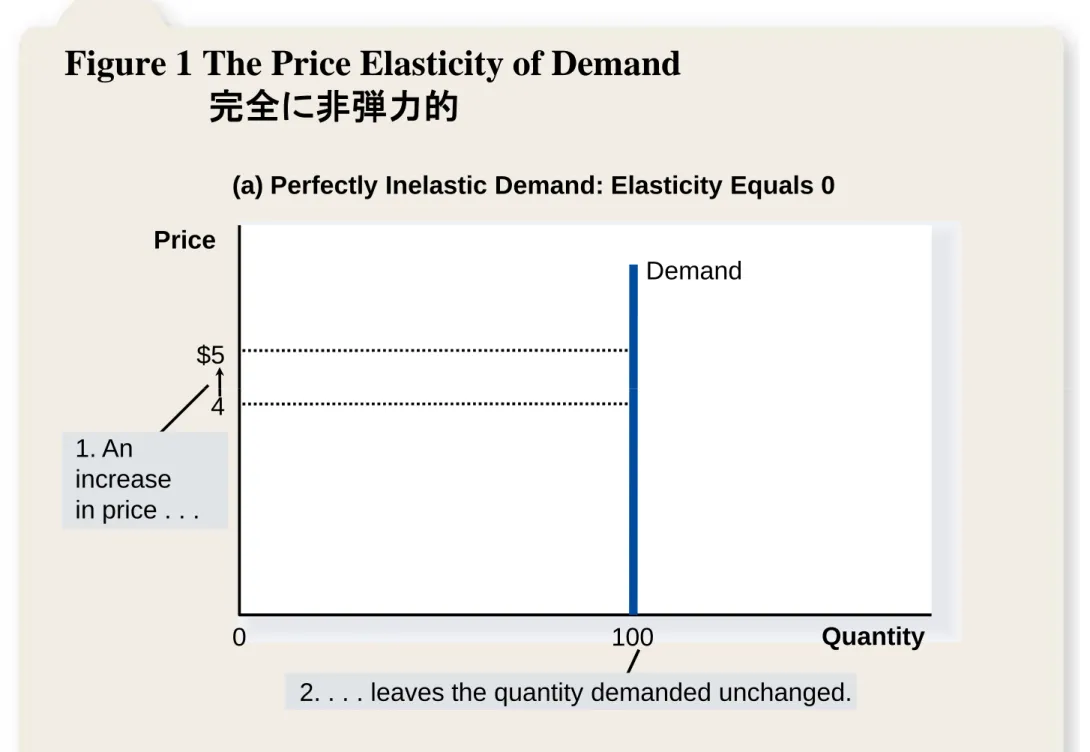
• Perfectly Inelastic
完全非弾力的
• Quantity demanded does not respond to price changes. 需要の量は完全に価格の変化に反応なし。
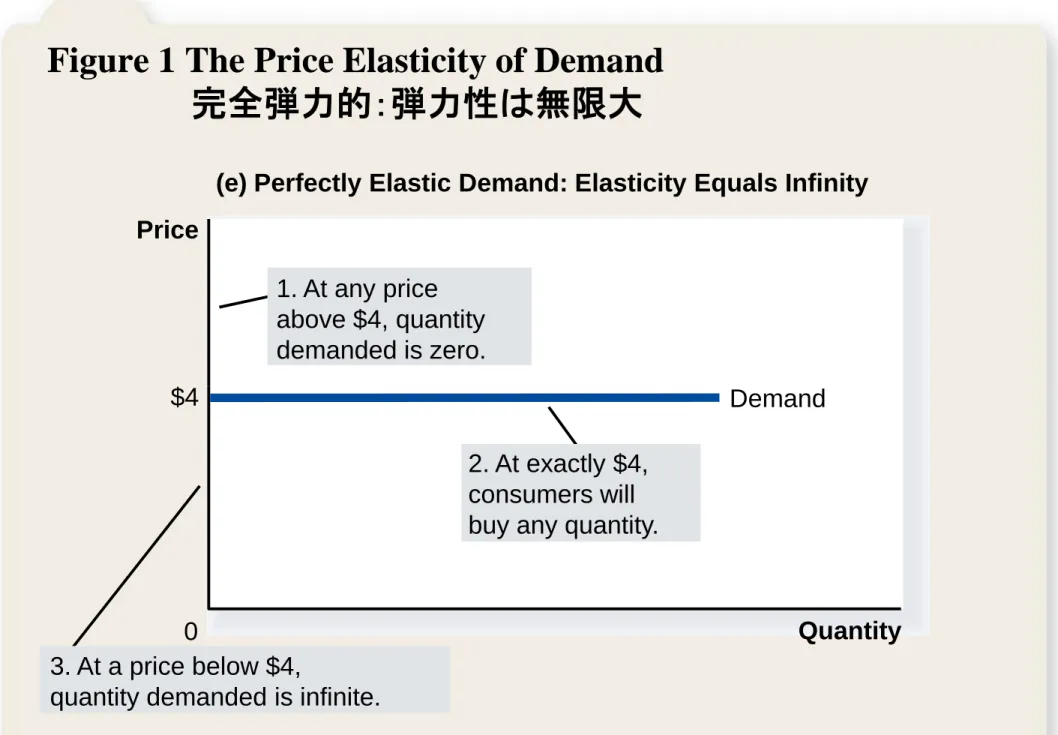
• Perfectly Elastic
完全弾力的
• Quantity demanded changes infinitely with any change in price. 需要の量は価格の変化に無限に反応。
• Unit Elastic
単位弾力的
• Quantity demanded changes by the same percentage as the price.
The Variety of Demand Curves
さまざまな需要曲線
• Because the price elasticity of demand
measures how much quantity demanded
responds to the price, it is closely related to the
slope of the demand curve.
slope of the demand curve.
• But it is not the same thing as the slope!
• 需要の価格弾力性は需要曲線の傾きと似て
いるが、同じものではない。
Figure 1 The Price Elasticity of Demand
完全に非弾力的
(a) Perfectly Inelastic Demand: Elasticity Equals 0
$5 Demand Price 4 Quantity 100 0 1. An increase in price . . .
Figure 1 The Price Elasticity of Demand
非弾力的:弾力性は1より小さい
(b) Inelastic Demand: Elasticity Is Less Than 1
$5 Price Quantity 0 90 Demand 1. A 22% increase in price . . .
2. . . . leads to an 11% decrease in quantity demanded. 4
Figure 1 The Price Elasticity of Demand
単位弾力的:弾力性は1
(c) Unit Elastic Demand: Elasticity Equals 1 Price
$5
2. . . . leads to a 22% decrease in quantity demanded.
Quantity 4 100 0 80 1. A 22% increase in price . . . Demand
Figure 1 The Price Elasticity of Demand
弾力的:弾力性は1より大きい
(d) Elastic Demand: Elasticity Is Greater Than 1
Demand 4 Price $5 Demand Quantity 4 100 0 50 1. A 22% increase in price . . .
Figure 1 The Price Elasticity of Demand
完全弾力的:弾力性は無限大
(e) Perfectly Elastic Demand: Elasticity Equals Infinity Price $4 Demand 1. At any price above $4, quantity demanded is zero. Quantity 0 $4 Demand 2. At exactly $4, consumers will buy any quantity.
3. At a price below $4,
Total Revenue and the Price Elasticity of
Demand 総収入と需要の弾力性
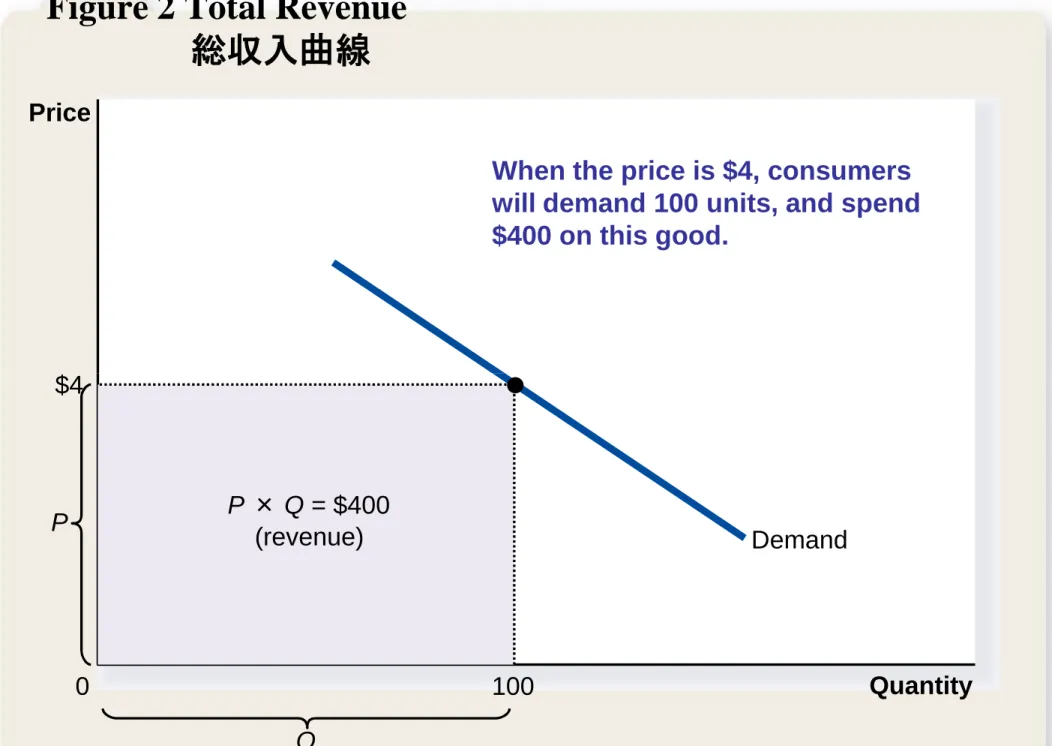
• Total revenue is the amount paid by buyers and received by sellers of a good.
• Computed as the price of the good times the quantity sold.
• 総収入は商品の価格かける販売量。 • 総収入は商品の価格かける販売量。
Figure 2 Total Revenue
総収入曲線
Price
$4
When the price is $4, consumers will demand 100 units, and spend $400 on this good. Demand Quantity P 0 P × Q = $400 (revenue) $4 100
Elasticity and Total Revenue along a Linear Demand Curve
線形需要曲線における総収入と弾力性
• With an inelastic demand curve, an increase in
price leads to a decrease in quantity that is
proportionately smaller. Thus, total revenue
increases.
Figure 3 How Total Revenue Changes When Price Changes: Inelastic Demand
価格変化の場合は総収入はどのように変化するか:非弾力的
Price Price
An Increase in price from $1 to $3 …
… leads to an Increase in total revenue from $100 to $240 Demand Quantity 0 Revenue = $100 Quantity 0 Revenue = $240 Demand $1 100 $3 80
Elasticity and Total Revenue along a Linear Demand Curve
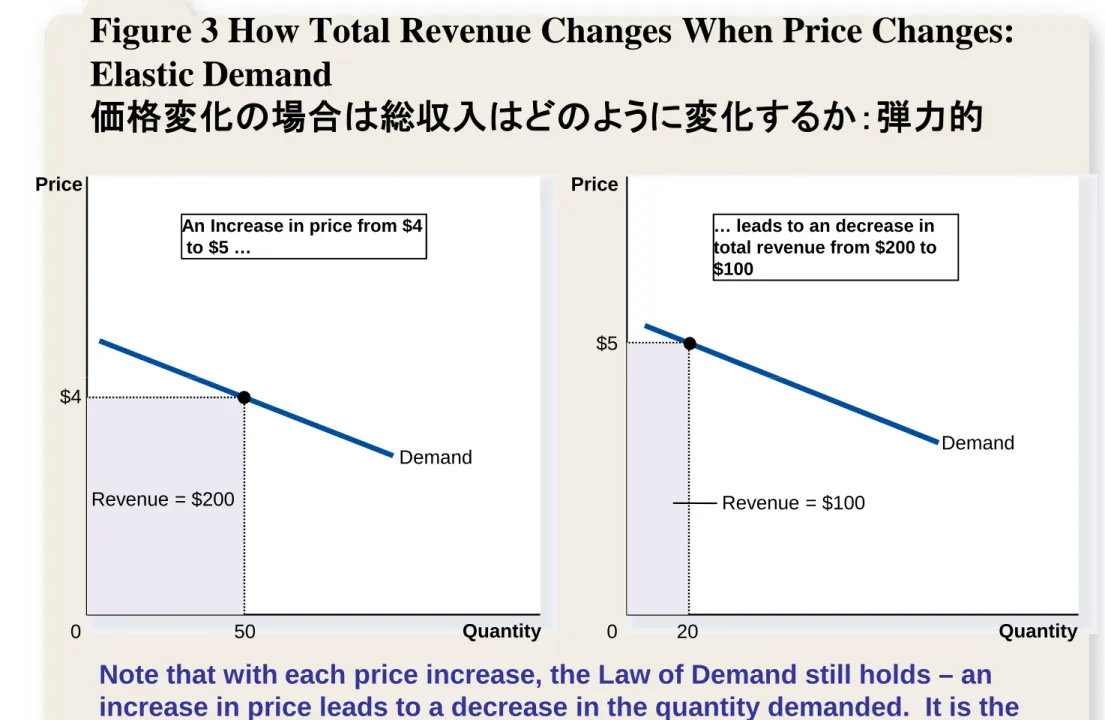
• With an elastic demand curve, an increase in
the price leads to a decrease in quantity
demanded that is proportionately larger. Thus,
total revenue decreases.
total revenue decreases.
Figure 3 How Total Revenue Changes When Price Changes: Elastic Demand
価格変化の場合は総収入はどのように変化するか:弾力的
Price Price
$5
An Increase in price from $4 to $5 …
… leads to an decrease in total revenue from $200 to $100 Demand Quantity 0 Revenue = $200 $4 50 Demand Quantity 0 Revenue = $100 20
Note that with each price increase, the Law of Demand still holds – an increase in price leads to a decrease in the quantity demanded. It is the
Elasticity of a Linear Demand Curve
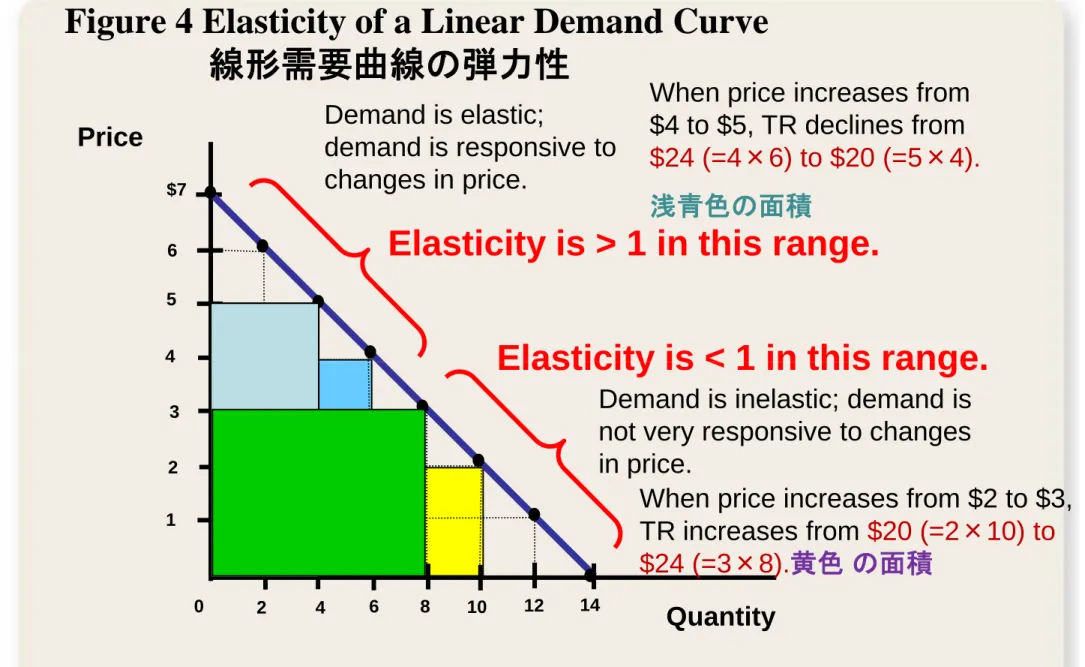
4 5 6 $7 Demand is elastic; demand is responsive to changes in price.
When price increases from $4 to $5, TR declines from $24 (=4×6) to $20 (=5×4).
浅青色の面積
Elasticity is > 1 in this range.
Elasticity is < 1 in this range.
Price
Figure 4 Elasticity of a Linear Demand Curve
線形需要曲線の弾力性
0 2 4 6 8 10 12 14
2 1 4
3 Demand is inelastic; demand is
not very responsive to changes in price.
When price increases from $2 to $3, TR increases from $20 (=2×10) to $24 (=3×8).黄色 の面積
Elasticity is < 1 in this range.
Other Demand Elasticities
そのたの弾力性
• Income Elasticity of Demand 所得の弾力性
• Income elasticity of demand measures how much the quantity demanded of a good responds to a change in consumers’ income.
• It is computed as the percentage change in the quantity demanded divided by the percentage change in income.
Other Demand Elasticities
その他の弾力性
• Computing Income Elasticity 所得弾力性の計算
Remember, all elasticities are measured by dividing one percentage change by another.
Other Demand Elasticities
その他の弾力性
• Income Elasticity 所得の弾力性
• Types of Goods 商品の種類 • Normal Goods 正常財 • Inferior Goods 劣等財• Higher income raises the quantity demanded for
normal goods but lowers the quantity demanded for inferior goods.
トレンド:
所得は向上すると、正常財への需要
Other Demand Elasticities
その他の弾力性
• Income Elasticity 所得の弾力性
• Goods consumers regard as necessities tend to be income inelastic 非需品の所得弾力性は小さい
• Examples include food, fuel, clothing, utilities, and
medical services. 例:食料、石油、衣服、光熱費、医療 medical services. 例:食料、石油、衣服、光熱費、医療 サービス。
• Goods consumers regard as luxuries tend to be
income elastic. 贅沢品の所得弾力性は大きい。
• Examples include sports cars, furs, and expensive foods. • 例:スポーツカー、革製品、高い食品
Other Demand Elasticities
その他の弾力性
• Cross-price elasticity of demand
需要の交差弾力性
• A measure of how much the quantity demanded of one good responds to a change in the price of another good, computed as the percentage change in quantity demanded of the first good divided by the percentage change in the price of the good divided by the percentage change in the price of the second good
THE ELASTICITY OF SUPPLY
供給の弾力性
•
Price elasticity of supply
is a measure of how
much the quantity supplied of a good responds
to a change in the price of that good.
• Price elasticity of supply is the percentage
• Price elasticity of supply is the percentage
change in quantity supplied resulting from a
percentage change in price.
• 供給の弾力性とは、価格の変化に供給量の
変化率を量る尺度である。同じく百分率で表
示する。
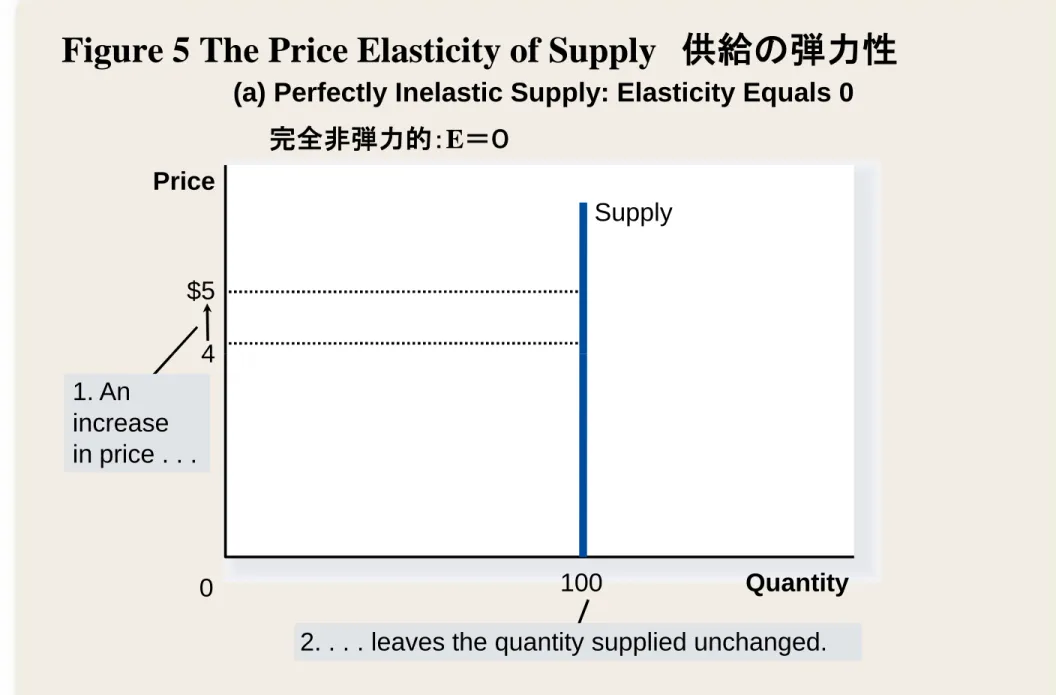
Figure 5 The Price Elasticity of Supply 供給の弾力性
(a) Perfectly Inelastic Supply: Elasticity Equals 0
完全非弾力的:E=0 $5 4 Supply Price 4 Quantity 100 0 1. An increase in price . . .
Figure 5 The Price Elasticity of Supply 供給の弾力性
(b) Inelastic Supply: Elasticity Is Less Than 1
完全非弾力的:E<1 $5 4 Price Supply 110 100 4 Quantity 0 1. A 22% increase in price . . .
Figure 5 The Price Elasticity of Supply 供給の弾力性
(c) Unit Elastic Supply: Elasticity Equals 1
単位弾力性:E=1
$5 4
Price
Supply
(If SUPPLY is unit
125 100
4
Quantity
0
2. . . . leads to a 22% increase in quantity supplied. 1. A 22%
increase in price . . .
(If SUPPLY is unit
elastic and linear, it will begin at the origin.)
Figure 5 The Price Elasticity of Supply 供給の弾力性
(d) Elastic Supply: Elasticity Is Greater Than 1
弾力性>1 Price 4 $5 Supply Quantity 0 1. A 22% increase in price . . .
2. . . . leads to a 67% increase in quantity supplied. 4
Figure 5 The Price Elasticity of Supply 供給の弾力性
(e) Perfectly Elastic Supply: Elasticity Equals Infinity
完全弾力的:無限大 Price 1. At any price above $4, quantity supplied is infinite. Quantity 0 $4 Supply 3. At a price below $4, quantity supplied is zero.
2. At exactly $4, producers will
The Price Elasticity of Supply and Its
Determinants 供給の弾力性とその決定要因
• Ability of sellers to change the amount of the
good they produce.売り手の商品の量の変化
能力に依存する。
• Beach-front land is inelastic. ビーチに面する土地 • Beach-front land is inelastic. ビーチに面する土地
は非弾力的。
• Books, cars, or manufactured goods are elastic. 本 、車、工業製品は弾力的。
• Time period 時間の推移
• Supply is more elastic in the long run. • 長期的に供給は弾力的。
Computing the Price Elasticity of Supply
需要の弾力性を測る
• The price elasticity of supply is computed as
the percentage change in the quantity supplied
divided by the percentage change in price.
需要の変化率(%) • 需要の弾力性= ー---------
価格の変化率(%)
Price elasticity of supply =
Percentage change in quantity supplied
THREE APPLICATIONS OF SUPPLY, DEMAND, AND ELASTICITY 供給、需要および弾力性の応用
• Can good news for farming be bad news for farmers? よい収穫は農家に対して悪いのか。
• What happens to wheat farmers and the market for wheat when university agronomists discover a new wheat when university agronomists discover a new wheat hybrid that is more productive than existing varieties?
大学の農学者はより生産的小麦の雑種を開
発した場合は、小麦農家に何かの変化が引
き起こるのか。
Can Good News for Farming Be Bad News for Farmers?
よい収穫は農家に対して悪いのか
• Examine whether the supply or demand curve shifts. 供給曲線と需要曲線の変化を検証しよう。
• Determine the direction of the shift of the curve. それは各曲線の方向を決めるのだ。
• Use the supply-and-demand diagram to see how the market equilibrium changes.
供給表と需要表を利用してその変化を見てみ
Figure 7 An Increase in Supply in the Market for Wheat 小麦市場において生産量の増加:小麦価格の下落 Price of Wheat S1 S2 2. . . . leads to a large fall in price . . .
1. When demand is inelastic, an increase in supply . . .
$3
Quantity of Wheat
0
3. . . . and a proportionately smaller increase in quantity sold. As a result,
Demand 2
110 100
Compute the Price Elasticity of Demand When There Is a Change in Supply 供給の変化により需要の価格弾力性を計算してみよ ED 100 110 100 110 2 3 00 2 00 3 00 2 00 2 ( ) / . . ( . . ) / 0 095 0 4 0 24 . . . Demand is inelastic. 需要は非弾力的
Why Did OPEC Fail to Keep the Price of Oil High? なぜ石油輸出機構は石油価格の向上を維持できないのか
• Supply and Demand can behave differently in the short run
and the long run 供給と需要の短期的反応と長期的反応
は異なる。
• In the short run, both supply and demand for oil are
relatively inelastic 短期的に石油の供給と需要は非弾力
的であるが、 的であるが、
• But in the long run, both are elastic 長期的に両方とも弾
力的である。
• Production outside of OPEC OPEC以外の国の石油生産 • More conservation by consumers 消費者の石油在庫の
増加
Does Drug Interdiction Increase or Decrease Drug-Related Crime?
麻薬禁止法は麻薬からみ犯罪を減少できるか
• Drug interdiction impacts sellers rather than buyers. 麻薬禁止は買いてより売り手を制限する
• Demand is unchanged. Equilibrium price rises although quantity falls.
麻薬の需要は変わらない。そして、麻薬量の減少 麻薬の需要は変わらない。そして、麻薬量の減少
にも関わらず均衡価格が上昇。
• Drug education impacts the buyers rather than sellers. 麻薬使用の教育は買い手より売り手に効果がある
• Demand is shifted. Equilibrium price and quantity are lowered.
Price of Drugs Price of Drugs
Drug Interdiction 麻薬禁止 Drug Education 麻薬使用の教育
S2
S1 S1
It is amazing how
Figure 9 Policies to Reduce the Use of Illegal Drugs
不法麻薬使用減少の政策効果
Quantity of Drugs Quantity of Drugs D2
D1 D1
The demand for illegal drugs is inelastic. Interdiction shifts the supply,
while education shifts the demand. In each case, the change in price is the same. But in one market the price goes up.
The changes in quantities (and TR) are
It is amazing how useful knowledge of elasticities can be!
Summary
• Price elasticity of demand measures how much the quantity demanded responds to changes in the price.
• Price elasticity of demand is calculated as the percentage change in quantity demanded divided by the percentage change in price.
– If a demand curve is elastic, total revenue falls when the price rises.
price rises.
– If it is inelastic, total revenue rises as the price rises.
• 需要の価格弾力性はある商品の価格の変化
により需要の量はどれだけ変化するかを測る
尺度である。百分率で表示する。
• 普段は、商品の需要量は価格の変動に逆変
動する。
Summary
• The income elasticity of demand measures how much the quantity demanded responds to changes in
consumers’ income.
• The cross-price elasticity of demand measures how much the quantity demanded of one good responds to the price of another good.
the price of another good.
• The price elasticity of supply measures how much the quantity supplied responds to changes in the price.
供給の弾力性とは、価格の変化に供給量の変化率を 量る尺度である。同じく百分率で表示する。
Summary
• In most markets, supply is more elastic in the long run than in the short run.
• 多くの場合は、供給量は短期より長期的に弾力的。
• The price elasticity of supply is calculated as the
percentage change in quantity supplied divided by the percentage change in quantity supplied divided by the percentage change in price.
• The tools of supply and demand can be applied in many different types of markets.