西 南 交 通 大 学 学 报
第 54 卷 第 5 期2019 年 10 月
JOURNAL OF SOUTHWEST JIAOTONG UNIVERSITY
Vol. 54 No. 5 Oct. 2019
ISSN -0258-2724 DOI:10.35741/issn.0258-2724.54.5.4
Research article
A
M
ATHEMATICAL
M
ODEL OF
R
EAL
T
IME
C
OMMUNICATION
P
ROCESS IN THE
T
ELECOMMUNICATION
N
ETWORK
C
HANNEL
通信网络信道中实时通信过程的数学模型
Lina Yahya Kadhim Al Zurfi, Israa Amer Dahham, Maytham Khudhair AbbasUniversity of Al-Qadisiyah,
Al Najaf, Iraq, [email protected], [email protected], [email protected]
Abstract
A mathematical model of the process of real time traffic transmission in the packet-switched telecommunications network channel is based on the exponential distribution of the moments of initial communication and the duration of real-time flow transmission. The use of the proposed model allows for the investigation of the results of the simulation the process of dynamically changing the traffic intensity in real time of the channel of a packet-switched telecommunications network.
Keywords: Real Time, Telecommunication, Multimedia Traffic, Flow Traffic, Real Time Traffic.
摘要 分组交换电信网络信道中实时流量传输过程的数学模型基于初始通信时刻的指数分布和实时流传输的 持续时间。 所提出的模型的使用允许研究模拟结果,即动态改变分组交换电信网络的信道的业务强度的过 程。
关键词: 实时,电信,多媒体流量,流量流量,实时流量。
I.
I
NTRODUCTIONMultimedia traffic is generated in modern telecommunications networks with packet switching during the sending of voice messages and video flows. This type of traffic is often called flow traffic or real-time traffic [1], [2], [3].
II.
W
RITING AP
LANTo ensure a good quality connection of flow traffic, it is necessary to minimize the delay and dispersion of packets that are possible with effective control over real-time flows in telecommunication networks in limited network resources [4].
A. Word-Processing Software
In the process of developing methods for real-time flows control in telecommunication
networks, it is advisable to use mathematical models that simulate the process of dynamically changing the traffic intensity in real time in a network channel.
Therefore, the crucial task is a scientific one: developing a model for creating adequate models that simulate the change in traffic intensity in real time in the channel of a telecommunications network with packet-switching.
The purpose of this article is to describe, with the help of mathematical simulation, the correct flow values that are taken into account in the scale of traffic intensity in real time in the channel of the telecommunications network.
Therefore, it is proved that the density of the time interval distribution between the moments of the transmission beginning of the real-time flows, and also the density of the duration distribution of
Al Zurfi et al. / Journal of Southwest Jiaotong University/ Vol.54 No.5 Oct. 2019 2
their transmission, satisfy the requirements of the exponential law.
III.
F
ORMULATION OF THET
ASK Let’s establish the following concepts:1) Size: the capacity of the channel through which should be transmitted real-time traffic.
2) A set of real-time flows Ω = {ωi}, where i = is the flow number, which should be transmitted through the channel.
3) Set Λ = {λi}, where λi is the required value
of intensity for flow transmitting ω1;
4) Set X1 = {x1}, where x1 is the the time
value corresponding to the beginning moment of transmitting the flow ω1;
5) Interval of modeling time .
It is necessary to determine the values of traffic intensity in real time in the channel of the telecommunication network at each current time.
Assumptions:
1) The time interval between the following moments of the beginning of the transmission of real-time flows in the channel is a random variable S, which is distributed according to the exponential law and is characterized by an average distribution ;
IV.
C
HARACTERISTICS OFR
EAL-T
IMEF
LOWST
RANSMITTED BY AT
ELECOMMUNICATIONSN
ETWORKC
HANNELTo simulate the real-time flows transmitted by such a channel, it is necessary to prove the distribution laws and characteristics of the random variables S (the time interval between the moments of the transmission beginnings of real-time flows in this channel) and T (the duration of the real-time flows in this channel). Within the framework of queuing theory, we propose models that adequately describe the function of the switching unit of telephone channels, which receive the flow of requests for connection establishment [5], [6], [7]. The most common models with respect to receiving calls in such a system and their services assume that the density of the time interval distribution between receiving calls, as well as the density of the distribution of their service duration, is an exponential law.
The practical significance of these models is that the values of the main characteristics of the queuing system, calculated on the basis of the models mentioned above, will be seamlessly coordinated with the results of the corresponding
measurements in the actual functioning networks with commutation channels.
There is an obvious analogy between the two processes: first, call service in a traditional telephone communication system, and second, real-time flow transmission in a telecommunications network with switching packages. The undoubted similarity between these processes lies in the fact that the moments of their beginning and ending are initiated exclusively by users and are associated only with their subjective needs, not with technological features of information transmitted in a particular network.
2) The duration of flow transmission in real time in the channel is a random value of T, described by the exponential distribution law and the mean distribution .
V.
M
ODELD
EVELOPMENTThe task of obtaining values that are, in the current time situation, located by the magnitude of the intensity of real-time traffic in the TNSP channel, leads us to determine the size of L(t), i.e., the total intensity of the real-time flows transmitted over a channel at a given time.
When determining the value of L (t), it must be taken into account that the total intensity of the flows simultaneously transmitted through the channel cannot exceed the capacity of this channel. Flow transmission at any one time is possible only if the following conditions are obeyed:
, (1)
where mi(t) is the the value of the total
intensity of real-time flows that must be transmitted on the TNSP channel at time moment t.
The value of mi(t) can be calculated by the
following expression:
(2)
where li(t) is the required value of the intensity
for transmitting the flow ωi at time moment t.
3
Having determined by eq. 2 the set {mi(t)}, it is
possible to find the required value of L(t), satisfying condition (1) as the highest value of the total intensity of the real-time flows, which is required for transmission through the telecommunication network channel at time moment t:
. In eq. 2, the values of li(t) are unknown. If, at
time moment t, it is required to transmit the flow ωi, the required value of the intensity of its
transfer at this moment of time will correspond to the given value λi, otherwise it will be equal to
zero:
(3) where xi is the moment time value required to
start transmitting the flow ωi; τi is the required
value of the duration for transmitting the flow ωi.
According to the assumptions, it is known that the random variable T is distributed by the exponential law. Therefore, the distribution density of the required transmission duration from the set Ω can be represented as a function:
.
To obtain the values of any random variable, special functions are used during the simulation, which, as a rule, generate values of a random variable having a uniform distribution in the range from 0 to 1. In reality, such functions generate not random but pseudo-random numbers sufficiently close to them. Having a sequence of uniformly distributed random numbers {Un}, where n = , it is possible to calculate the values of random numbers {Yn} with an exponential
distribution and an average value of α by the expression [8]:
.
Therefore, using a calibration that generates uniformly distributed values of the random numbers {Ui}, we can obtain the values {τi} of the
random variable T:
. (4)
In eq. 3, the unknown is the set of values X =
{xi}. The elements of this set can be found
sequentially using the expression:
(5) where si-1 is the size of the interval between
time moments xi-1 and xi.
As an example, Figure 1 shows the moments of the beginning of the real-time flow transmitting, the intervals between them, and the transmission times of these flows through the channel of the telecommunications network.
To solve the problem, it is necessary to obtain a set of values {si}. It is known that the
distribution density of a random variable S, corresponding to an exponential law, looks like this:
.
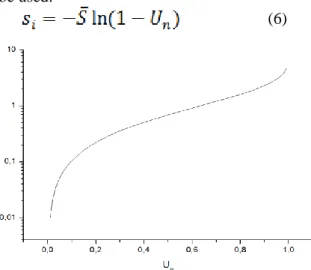
Therefore, to determine the values of {si} of a
random variable S, the following expression can be used:
(6)
VI.
D
ISCUSSION ANDC
ONCLUSION From the above example, it is clear that the mathematical model of the real-time traffic transmitting process in the telecommunications network channel includes the following steps:1. Input of initial data. The value of the size C is entered, the set of values Λ = {λi}, X1 = {x1},
value ty are given.
2. Configuring applications for real-time flow transmission in a channel. At this stage, the numbers {Uij} are generated and the sequential
calculation of the si values according to eq. 6, xi
according to eq. 5, and τi is calculated in
accordance with eq. 4. As a result, for each transmission of flow ωi the values are determined
for the time moments xi, when it is required to
start the transmission and the required transmission duration τi.
3. Obtaining the required values of the intensity of real time flows transmission through the network channel at the current time moment t. Figure 2. General view of the function –ln (1-Un).
Al Zurfi et al. / Journal of Southwest Jiaotong University/ Vol.54 No.5 Oct. 2019 4
At this stage, by using eq. 3, the values of li(t) are
calculated.
4. Calculation of the values of the total intensity of real-time flows, which should be transmitted over the network channel at time moment t. The essence of this stage is the obtaining, by using eq. 2, the values of mi(t).
5. Determination of the total intensity of the transmitted real-time flows in the network channel at the current time moment t. The condition (1) satisfaction should be verified. If the given condition is fulfilled, the value of the L(t) size, which was initially zero, is updated. By default, condition (1) corresponds to a situation where, due to the congestion limitation of the channel, the application for transferring flow ωi, received
at time t, will receive a rejection.
Steps 3-5 are cyclically repeated to obtain the resulting L (t) values for each time moment t.
Thus, a mathematical model of the process of transmitting real-time traffic in a telecommunications network channel is based on the analogy between call processes in a traditional telephone communication system and real-time stream transmission in a telecommunications network with switching packets, which can be assumed that the density of the distribution of the time interval between the start of transmission real-time streams, as well as the distribution density of the duration of their transmission, satisfies the requirements of the exponential law.
The application of this model allows simulating, using various software tools, the process of dynamically changing traffic intensity in real time in the channel of a packet-switched telecommunications network.