Equational Tree
Automata:
Towards
Automated
Verification
of
Network Protocols
*Hitoshi Ohsaki and Toshinori Takai
NationalInstitute of Advanced Industrial Science and Technology (AIST)
Nakoji 3-11-46, Amagasaki 661-0974, Japan
{ohsaki,takai}@ni.aist.go.jp
Abstract. An extension oftree automataframework,calledequational
treeautomata,is presented. Thistheoryis useful to deal with unification
modulo equational rewriting. In the manuscript, we demonstrate how
equational tree automata
can
be applied to several realistic unificationexamples, e.g. including asecurity problem of network protocols.
1
Equational
Tree
Languages
Unification modulo equational theory is acentral topic in automated
reason-ing. Tree automata
are
the powerful technique for handling unification modulorewriting [2]. On theother hand, tomodel
some
networksecurity problems likeDiffie-Hellman key exchange algorithm, rewrite rules and equations (e.g. $\mathrm{a}\mathrm{s}\mathrm{s}(\succ$
ciativity and commutativity axioms) have to be separately dealt with in the
underlying theory, but it
causes
the situationwhere the standardtree automatatechnique is useless. In
our
recent papers $[5, 7]$, we have proposedan
extensionoftreeautomata, whichiscalled equational treeautomata. Thisframework
sub-sumes
Petrinets (Example 1). Inapractical example, equational tree automatacan be used to verifyasecurityproblemofDiffie-Hellman protocol (Example 2).
We start this section withbasicsof tree automataand theequational
exten-sion.Atree automaton (TA forshort) $A$isdefined bythe4-tuple ($\mathcal{F},$$Q$,Qfin,$\Delta$):
each of those components is asignature$T$ (afiniteset of function symbols with
fixedarities), afinite set $Q$ofstates(specialconstantswith$F\cap Q=\emptyset$),asubset
$Q_{fin}$ of $Q$consistingofs0- alled
final
states and afinite set aoftransitionrulesin the following form:
$-f(p_{1}, \ldots,p_{n})arrow t$
for
some
$f\in \mathcal{F}$witharity(/) $=n$ and$p_{1}$,$\ldots$ :$p_{n}\in Q$.
The right-hand side$t$ is aterm consisting of$f$ and state symbols. Afunction symbol $f$ in the right-hand
side must be the
same
as one
inthe
le$\mathrm{f}\mathrm{t}$-hand
side.Each of$F_{\mathrm{A}}$
and
$h$ consists ofsome
binary functionsymbolsof thesignature$\mathcal{F}$
.
Theintersectionof$F_{\mathrm{A}}$and$h$is denoted by$F_{\mathrm{A}\mathrm{C}}$.
Asetofassociativityaxioms$f(f(x, y),z)$ $\approx f(x, f(y, z))$ for all $f\in F_{\mathrm{A}}$ is denoted by $\mathrm{A}(F_{\mathrm{A}})$
.
Likewise, asetof commutativity axioms $f(x, y)\approx f(y, x)$ for all $f\in Fc$ is $\mathrm{C}(F\mathrm{c})$
.
Theunion ofof$\mathrm{A}(\mathcal{F}_{\mathrm{A}\mathrm{C}})$ and $\mathrm{C}(\mathcal{F}_{\mathrm{A}\mathrm{C}})$ is represented by $\mathrm{A}\mathrm{C}(F_{\mathrm{A}\mathrm{C}})$
.
If unnecessary to beexplicit, $\star$Thispaperis amodifiedversion ofthe authors’ UNIF2002 paper [6]
数理解析研究所講究録 1318 巻 2003 年 48-52
we
write $\mathrm{A}$, $\mathrm{C}$ and $\mathrm{A}\mathrm{C}$, respectively. An equational tree automaton (ETA forshort) $A/\mathcal{E}$ isthe combination ofaTA $A$ and aset $\mathcal{E}$ of equations
over
thesamesignature $F$
.
An ETA $A/\mathcal{E}$ is called-regular ifthe right-hand side$t$ is asingle state $q$,
-monotone if the right-hand side $t$ is asingle state $q$
or
aterm $f(q_{1}, \ldots, q_{n})$for every transition rule $f(p_{1}, \ldots,p_{n})arrow t$ in A. Equational tree automata de
fined in [4, 5, 7]
are
in the above monotone case.Aterm $t$ in TiJF) is accepted by $\mathrm{A}/\mathrm{S}$ if$tarrow^{*}qA/\mathcal{E}$ for
same
$q\in Q_{fin}$.
The setoftermsaccepted by$\mathrm{A}/\mathrm{S}$ is
denoted
by $\mathcal{L}(A/\mathcal{E})$.
Atree
language (TL forshort)$L$
over
$T$ issome
subset of$\mathcal{T}(F)$. A
$\mathrm{T}\mathrm{L}L$ is $\mathcal{E}$-recognizable if there exists $A/\mathcal{E}$such that $L=\mathcal{L}(A/\mathcal{E})$
.
Similarly, $L$ is called $\mathcal{E}$ monotone $\mathrm{S}$-regular if$A/\mathcal{E}$ ismonotone (regular). If$L$is$\mathcal{E}$-recognizable with$\mathcal{E}=\emptyset$,
we
say$L$ is recognizable.Likewise,
we
say $L$ is monotone (regular) if$L$ is $\emptyset$ monotone ($\emptyset$-regular).We
say$A/\mathcal{E}$ is a $\mathrm{C}$-TA(A-TA, AC-TA) if$\mathcal{E}=\mathrm{C}$ ($\mathcal{E}=\mathrm{A}$, $\mathcal{E}=\mathrm{A}\mathrm{C}$, respectively).
Lemma 1. Ever$\eta$ $\mathrm{C}$-recognizable tree language is regular.
Proof.
We suppose atree language is recognizable with a $\mathrm{C}$-TA $A/\mathrm{C}$, where$A=$ $(F, Q, Q_{fin}, \Delta)$
.
Define $B=(F, Q, Q_{ffin}, \Delta’)$ with $\Delta’=\{f(p_{1}, \ldots,\mathrm{p}\mathrm{n})arrow q|$ $f(q_{\mathrm{l}}.., q_{n})\mathrm{n}\mathrm{i}\mathrm{t}arrow r\in\Delta$ such that $f(p_{1},p_{n})\sim \mathrm{c}f(q_{1},.., q_{n})\mathrm{r}\mathrm{T}\mathrm{A}\mathrm{r}\mathrm{s}$ and$rarrow*A/\mathrm{C}q$
}
$\square$
.
Then it
can
be proved that the regular TA $B$ recognizes$L(A/\mathrm{C})$.Lemma
2. The following language hierarchy holdsif
$\mathcal{E}=\mathrm{A}$:
$\mathcal{E}$ regular
$TL\subsetneq \mathcal{E}$ monotone $TL\subsetneq \mathcal{E}$-recognizable $TL$
However, the classes
of
regular $TL$ and$\mathcal{E}$-recognizable $TL$are
incomparable.Proof.
The first inclusion relation is proved in [7]. For thesecond inclusion,we
suppose $F=F_{0}\cup\{\mathrm{f}\}$ with$F_{\mathrm{A}}=\{\mathrm{f}\}$
.
Here$F_{0}$ denotes asetofconstant symbols.Then, a(word) language $W$ over $F_{0}$ is context-sensitive if and only if
an
A-monotone TL is mairnd for $W$
.
A $\mathrm{T}\mathrm{L}L$ is called maxi mal for alanguage $W$if for all terms $t$ in $\mathcal{T}(F)$, leaf(t) $\in W$ ifand only if $t\in L$
.
Similarly, it holdsthatalanguage $W$isrecursively enumerable if and only if
an
A-recognizable TLis maximal for $W$
.
It is known that recursively enumerable languages strictlyinclude context-sensitive languages. The difference of the classes of regular TL
and $\mathcal{E}$-recognizable TL
are
proved by taking the TL$L_{1}=$ $\mathrm{f}(\mathrm{f}(\mathrm{a},\mathrm{a}),$$\mathrm{a})\}$ under
the assumption of$F_{\mathrm{A}}=\{\mathrm{f}\}$
.
The $\mathrm{T}\mathrm{L}L_{1}$ is regular (as it is finite), but it notrecognizable with A-TA,because an A-TAwhich accepts$\mathrm{f}(\mathrm{f}(\mathrm{a}, \mathrm{a})$,a) also accepts
$\mathrm{f}(\mathrm{a},\mathrm{f}(\mathrm{a}, \mathrm{a}))$
.
On the other hand,we
take the $\mathrm{T}\mathrm{L}L_{2}=\{t||t|_{\mathrm{a}}=|t|_{\mathrm{b}}\}$over
thesignature $\mathcal{F}=\{\mathrm{f}, \mathrm{a}, \mathrm{b}\}$, where arity(f) $=2$ and $\mathrm{a}$,
$\mathrm{b}$
are
constant symbols. $\mathrm{I}\mathrm{f}\square$$F_{\mathrm{A}}=\{\mathrm{f}\}$ then $L$ is A-regular (Lemma8, [5]), but is not regular.
Remark 1. We know the
same
hierarchy holds also for$\mathcal{E}=\mathrm{A}\mathrm{C}$, except$\mathcal{E}$ monotone TL
(; $\mathcal{E}$-recognizable $\mathrm{T}\mathrm{L}$
.
The above relation remains
as an
open questionFig. 1. APetri net example: $P$
2AC-Tree Automata
for
Unification Problems
In this sectionwe discuss the applications of equational tree automata, in
par-ticular $\mathrm{A}\mathrm{C}$-tree automata, for unification problems. Our examples rely
on
thefollowing decidability result.
Theorem 1(Reachablepropertyproblem). Given agroundAC-TRS$\mathcal{R}/\mathrm{A}\mathrm{C}$
and tree languages $L_{1}$,$L_{2}$ over$F$ with $\mathcal{F}_{\mathrm{A}\mathrm{C}}$
.
If
$L_{1}$ and $L_{2}$ are AC-recognizabletree languages, it is decidable whether there eist
some
$s$ in $L_{1}$ and$t$ in $L_{2}$ suchthat $sarrow^{*}t\mathcal{R}/\mathrm{A}\mathrm{C}$
’ $i.e$
.
$(arrow^{*})\mathcal{R}/\mathrm{A}\mathrm{C}[L_{1}]\cap L_{2}\neq\emptyset$ is a computable question.Proof.
For asingleton $\mathcal{F}_{\mathrm{A}\mathrm{C}}$, the proof proceeds in the way of Lemma 4in [5].To extend $\mathcal{F}_{\mathrm{A}\mathrm{C}}$ by allowing to have arbitrary many
$\mathrm{A}\mathrm{C}$-symbols,
we
apply thesimilar argument of Section 3in [5]. $\square$
Example 1. Petri nets
are
known to be aspecial class of groundAC-TRSs.
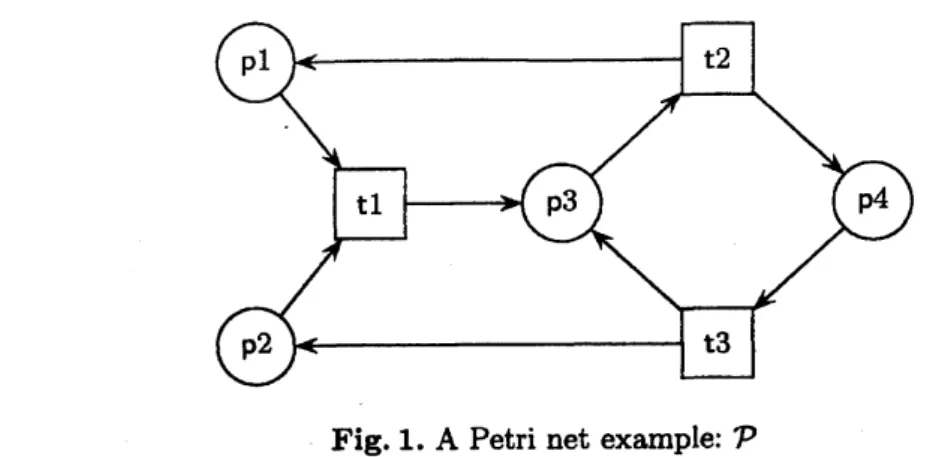
APetri net is atriple $(P,T, W)$, where $P$ is afinite set of places, $T$ is afinite set
oftransitions and $W$ is aweight-function $(P\mathrm{x}T)\cup(T\cross P)arrow \mathrm{N}$
.
Forinstance,the Petri net $P$ illustrated in Fig. 1has $W$ with $W(\mathrm{p}1,\mathrm{t}1)=1$, $W(\mathrm{p}2,\mathrm{t}1)=1$,
$W(\mathrm{p}3,\mathrm{t}2)=1$, $W(\mathrm{p}4,\mathrm{t}3)=1$, $W(\mathrm{t}1, \mathrm{p}3)=1$, $W(\mathrm{t}2, \mathrm{p}1)=1$, $W(\mathrm{t}2, \mathrm{p}4)=1$, $W(\mathrm{t}3, \mathrm{p}2)=1$, $W(\mathrm{t}3, \mathrm{p}3)=1$
.
In the figure, placesare
denoted by circles, andtransitions are squares. The value of $W$ determines the weight of directed
arcs
between places and transitions. Then,the
associated
groundAC-TRS
$(\mathrm{T}, \mathcal{R}/\mathrm{A}\mathrm{C})$isdefined by$F$$=\{+\}\cup\{\epsilon, \mathrm{p}1, \ldots, \mathrm{p}4\}$,$F_{\mathrm{A}\mathrm{C}}=\{+\}$and$R$$=\{\mathrm{p}\mathrm{l}+\mathrm{p}2arrow \mathrm{p}3$, $\mathrm{p}3arrow$ $\mathrm{p}\mathrm{l}+\mathrm{p}4$, $\mathrm{p}4arrow \mathrm{p}2+\mathrm{p}3\}\cup\{\epsilon+\mathrm{p}iarrow \mathrm{p}i, \mathrm{p}iarrow \mathrm{p}i+\epsilon|1\leq i\leq 4\}$
.
Inthissetting, astateofaPetri net (thenumberof tokens
on
eachplace) isencodedbyamultisetof place symbols. The empty multiset is represented by $\epsilon$
.
Giventwo sets Li,$L_{2}$ ofstates of$P$
.
According to Theorem 1, it isdecidablewhetherthere existstates$m_{1}\in L_{1}$ and$m_{2}\in L_{2}$ suchthat $m_{1}arrow^{*}m_{2}\mathcal{P}$’provided
$L_{1}$,$L_{2}$
are
leaf-languages of$\mathrm{A}\mathrm{C}$-recognizable tree languages over $\mathcal{F}$.
The binaryrelation$-_{\mathrm{P}}^{*}$ isthereflexivetransitive closure ofone-steptransition relation. This
decidability property generalizes the result of Mayr [3]
$\mathrm{O}A$
$N$,$k(A)\circ N$
$’\sim$
$\underline{k(B)\circ N}$ $\mathrm{O}B$
$\underline{E(k(A)\circ k(B)\mathrm{o}N,M)}$
Fig.2. Diffie Hellman key exchange algorithm
Using the above property, for instance,
we
can
solve coverability problem,which is aquestion ofwhether there exists $m_{3}$ such that $m_{1}-_{\mathcal{P}}^{*}7713$ and $m_{2}\subseteq$
$m_{3}$
.
Actually, it is verified by solving the following question, which isdecidable:
$\exists\sigma?$
.
$t_{1}arrow^{*}\mathcal{R}/\mathrm{A}\mathrm{C}t_{2}+x\sigma$
.
Here$t_{1},t_{2}$ areterms
over
$F$ suchthat $1\mathrm{e}\mathrm{a}\mathrm{f}(t_{1})=m_{1}$ and leaf(ti) $=m_{2}$.
Example 2. We consider asimple network protocol. The protocol illustrated in
Fig. 2iscalledDiffie Hellman key exchange algorithm (e.g., Section22.1, [8]). In
the protocol, aprincipal $A$ chooses aprimenumber $N$ and sends to $B$ together
with
an
integer $k(A)\circ N$that is generated witharandom number$k(A)$.
Here wesupposethat nobody else
can
guess$k(A)$ from$k(A)\circ N$.
Then $B$returns$k(B)\circ N$to $A$
.
By assuming $\circ$ to be associative and commutative, $k(A)\circ k(B)\circ N$ canbe used
as
acommon
secret key for $A$ and $B$.
It enables $A$ to send only $B$a
secret message $M$ encrypted withthis key. Asecurity problem for this protocol
is whether or not
someone
else can retrieve asecret message $M$ by listening onthe channel.
In term rewriting, the axiom ofencryptionand decryptionandthe property of
keysarespecified by the $\mathrm{A}\mathrm{C}$-rewrite system $\mathcal{R}=\{D(x, E(x, y))arrow y\}$ and $\mathrm{A}\mathrm{C}=$
$\{x\circ y\approx \mathrm{y}\circ \mathrm{x}, (x\circ y)\circ z\approx x\circ(y\circ z)\}$
.
Onthe otherhand,aprincipal$C$wiretappingthe channel can obtain $N$, $k(A)\circ N$, $k(B)\circ N$ and $E(k(A)ok(B)\circ N, M)$.
Moreover, $C$ is supposed to have personal data $C$, $k(C)$ and to be able to use
function symbols $D$,$E,$$\circ$. So $C$’s knowledge is the set $L$ of terms constructible
from these components. Then, the security problem is verified by solving the
following unification problem: $\exists\sigma^{7}$
.
$x\sigmaarrow \mathcal{R}/\mathrm{A}\mathrm{C}*M$ for
some
$x\sigma\in L$.
In thissetting, $(arrow^{*})\mathcal{R}/\mathrm{A}\mathrm{C}[L]$ isan$\mathrm{A}\mathrm{C}$-monotone tree language. One should notice
that in order to compute $(arrow^{*})\mathcal{R}/\mathrm{A}\mathrm{C}[L]$ by using amodified algorithm ofKaji et
il. [2], intersection-ernptiness problem for $\mathrm{A}\mathrm{C}$-monotone tree languages must be
decidable. Obviously amembership problem $M\in(arrow^{*})\mathcal{R}/\mathrm{A}\mathrm{C}[L]$ is decidable.
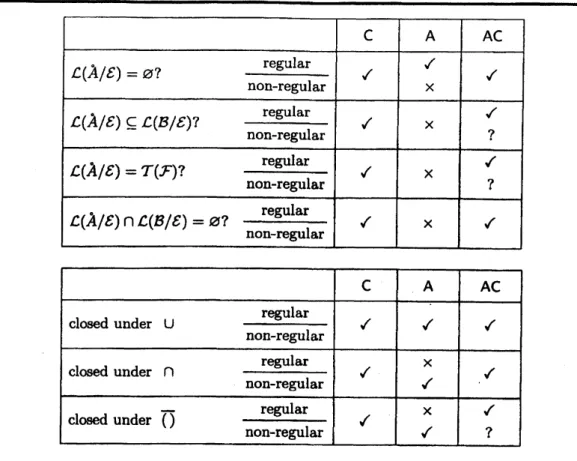
Decidability results and closure properties for equational tree languages
are
summarized in Fig.3. In the figure, the check mark $\sqrt$ means “positive” and the
cross
$\mathrm{x}$ is “negativ\"e. The question mark ?means
“open”. If thesame
resultholds inboth regular and non-regular cases, it is represented by asingle mark
in alarge column
$\mathrm{c}$ A AC $\mathcal{L}(A^{\mathrm{Q}}/\mathcal{E})=\emptyset$? $\frac{\mathrm{r}\mathrm{e}\mathrm{g}\mathrm{u}1\mathrm{a}\mathrm{r}}{\mathrm{n}\mathrm{o}\mathrm{n}- \mathrm{r}\mathrm{e}\mathrm{g}\mathrm{u}1\mathrm{a}\mathrm{r}}$ $\sqrt$ $\mathrm{v}’$ ’ $\mathrm{x}$ $\sqrt$
$L(\dot{A}/\mathcal{E})\subseteq L(B/\mathcal{E})$? $\frac{\mathrm{r}\mathrm{e}\mathrm{g}\mathrm{u}1\mathrm{a}\mathrm{r}}{\mathrm{n}\mathrm{o}\mathrm{n}- \mathrm{r}\mathrm{e}\mathrm{g}\mathrm{u}1\mathrm{a}\mathrm{r}}$ $\sqrt{}’$ $\mathrm{x}$
’ ?
$\mathcal{L}(\dot{A}/\mathcal{E})=\mathcal{T}(F)$? $\frac{\mathrm{r}\mathrm{e}\mathrm{g}\mathrm{u}1\mathrm{a}\mathrm{r}}{\mathrm{n}\mathrm{o}\mathrm{n}- \mathrm{r}\mathrm{e}\mathrm{g}\mathrm{u}1\mathrm{a}\mathrm{r}}$ $\sqrt{}’$ $\mathrm{x}$
$\sqrt$
$7$
$\rho/\dot{A}$ ’$p\backslash \cap\prime\prime/\beta\backslash -\prime 2’$?
$\underline{\mathrm{r}\mathrm{e}\mathrm{g}\mathrm{u}\mathrm{l}\mathrm{a}\mathrm{r}}$
’ $\backslash d$ /
$\sim\iota-/\cdot/|$ $’\sim\backslash \cdot/\cdot/-\infty$$\iota$
$\overline{\mathrm{n}\mathrm{o}\mathrm{n}}$
$\mathrm{V}$ $\wedge$ $\mathrm{v}$
$\mathrm{C}$ A
AC closed under $\cup$ $\frac{\mathrm{r}\mathrm{e}\mathrm{g}\mathrm{u}1\mathrm{a}\mathrm{r}}{\mathrm{n}\mathrm{o}\mathrm{n}- \mathrm{r}\mathrm{e}\mathrm{g}\mathrm{u}1\mathrm{a}\mathrm{r}}$ $\sqrt$ $\sqrt$ ’
closed under $\cap$ $\frac{\mathrm{r}\mathrm{e}\mathrm{g}\mathrm{u}1\mathrm{a}\mathrm{r}}{\mathrm{n}\mathrm{o}\mathrm{n}- \mathrm{r}\mathrm{e}\mathrm{g}\mathrm{u}1\mathrm{a}\mathrm{r}}$ $\sqrt$
$\mathrm{x}$
$\sqrt$
$\sqrt$
$-1_{\wedge B\Delta r}1,\prime \mathrm{r}A-\mathrm{r}$ $\overline{t\backslash }$
$\underline{\mathrm{r}\mathrm{e}\mathrm{g}\mathrm{u}\mathrm{l}\mathrm{a}\mathrm{r}}$ / $\mathrm{x}$ $\sqrt$ $.1-\mathrm{u}$ ulluDl 1$J$ $\overline{\mathrm{n}\mathrm{o}\mathrm{n}}$ $\vee$ $\sqrt$ ?
Fig.3. Decidability results and closureproperties
–
References
1. H.Comon, M. Dauchet, R. Gilleron, F. Jacquemard, D. Lugiez, S.Tison, and
M. Tommasi: Roe Automata Techniques and Applications, 2002. Draft available
on http:$//\mathrm{m}\mathrm{w}$.grappa.univ-lille3.$\mathrm{f}\mathrm{r}/\mathrm{t}\mathrm{a}\mathrm{t}\mathrm{a}/$
2. Y.Kaji, T. Fujiwara and T.Kasami: Solving a
Unification
Problem underCon-strained Substitutions Using TreeAutomata, JSC 23, pp. 79-117, 1997.
3. E.W.Mayr: An Algorithm
for
the General Petri Net Reachability Problem, SIAMJ. Comput 13(3), pp. $441\triangleleft 60$,1984.
4. H.Ohsaki, H. Seki, and T. Takai: Recognizing Boolean Closed A-Tree Languages
with Membership Conditional Rewriting Mechanism, Proc. of 14th RTA, 2003. To
appear in LNCS.
5. H. Ohsaki and T.Takai: Reachability and Closure Properties
of
Equational TaeLanguages, Proc. of13th RTA, LNCS 2378, pp. 114-128, 2002.
6. H. Ohsaki and T. Takai: A I}ee Automata Theory
for Unification
ModuloEqua-tional R ewriting, Proc. of16th UNIF, 2002.
7. H. Ohsaki: Beyond Regularity:Equational 2}eeAutomata
for
AssociativeandCom-mutative Theories, Proc. of 15th CSL, LNCS 2142, pp. 539-553, 2001.
8. B.Schneier: Applied Cryptography: Protocols, Algorithms, andSource Code in C,
Second Edition, John Wiley& Sons, 1996