A
mathematical model
of
fracture
phenomena
on
a
spring-block system
Masato
Kimura*,
Hirofumi
Notsu**,
*) Institute ofMathematics for Industry, Kyushu University, [email protected]
**) Waseda Institute for Advanced Study, Waseda University, [email protected]
Abstract
We propose acrackpropagation modelonaspring-block system usinganideaof
phasefield model forthedamage of springs. We consideradiscrete model of elastic
bodyusingascalarortensor-valued spring-block system, and studyitspropertiesin
detail. Our fracture modelis constructedonthe spring-block system. It isdescribed
in a mathematicallyclearway and the unique existence and regularity ofa solution
are proved.
1 Introduction
For crack propagation and fracture phenomena,
a
number of engineering-orientedsimu-lation algorithms, such as extended finite element method ($X$-FEM) [2], discrete element
method (DEM) [3, 7], particle discretization scheme (PDS-FEM) [4, 5] etc., are widely
used in engineering computing. On the other hand, from a viewpoint of mathematical
analysis, it is difficult to provesome mathematical properties of the engineering-oriented
models such
as
unique existence and energy estimates, since theyare
often not describedin sufficiently mathematical ways. In this research, we construct a mathematical
frame-work for a phase field model of materia$I$ damage ona spring-block system. The obtained
model is described inamathematically clear way and admits
some
mathematicalanalysis.The outline of this paper is
as
follows. In Section 2, we construct scalar andtensor-valued spring-block systems, which corresponds to anti-plane displacement and linear
elasticity problems, respectively. Their mathematical properties such
as
solvability ofa
boundary valueproblemonthe spring-block system
are
shown. InSection3, we propose amathematicalmodelof fracturedynamicsorcrackpropagationonthe spring-block system
by introducing a damage variable in Problem 3.3 and 3.4. We represent the fracture by
giving damage to the spring constant and cutting thespring accordingto the damage. In
Theorems 3.5, 3.6 and 3.7, we prove unique existence and regularity of
a
local solutionand existence ofa global solution.
2 Spring-block system
2.1 Block division
Let $n\in \mathbb{N}$ andlet $\Omega$ be abounded domain in$\mathbb{R}^{n}$ with aLipschitz boundary $\Gamma$. The outer
unit normal vector on $\Gamma$ is denoted by $\nu\in \mathbb{R}^{n}$. We
norm
of$L^{2}(\Omega)$as
$(u, v)_{0}:= \int_{\Omega}u(x)v(x)dx, \Vert u\Vert_{0}:=\sqrt{(u,u)_{0}},$
where $u,$$v$ are realvalued functions in $L^{2}(\Omega)$.
We divide $\Omega$ into $N$ subblocks $\mathcal{D}=\{D_{1}\}_{i=1}^{N}$
.
We suppose that each block $D_{i}$ is a nonempty connected open set in $\mathbb{R}^{n}$ and the conditions:$\overline{\Omega}=\bigcup_{i=1}^{N}\overline{D_{i}}, D_{i}\cap D_{j}=\emptyset(i\neq j)$
.
If$n\geq 2$,
we
additionallysuppose that $D_{i}$ hasa
Lipschitz boundary, and denote the outer unit normal vector on $\partial D_{i}$ by $\nu^{i}\in \mathbb{R}^{n}$.
The $n$-dimensional volume of $D_{i}$ is denoted by$|D_{i}|$
.
In this paper, for simplicity,we
call $\mathcal{D}=\{D_{i}\}_{i=1}^{N}$ ablock division of$\Omega$ and
assume
the above conditions.
We introduce the followingnotation for adjacent blocks in a block division $\mathcal{D}.$
$D_{ij}:=\overline{D_{i}}\cap\overline{D_{j}} (i, j=1, \ldots, N, i\neq j)$, $d_{ij}:=\mathcal{H}^{n-1}(D_{ij}) , (i, j=1, \ldots, N, i\neq j)$,
$\Lambda_{i} :=\{j ; d_{ij}>0\} (i=1, \cdots, N)$, (2.1)
$\Lambda:=\{(i,j);1\leq i<j\leq N, d_{ij}>0\},$
$\Sigma:=\bigcup_{(i,j)\in\Lambda}D_{ij},$
where $\mathcal{H}^{n-1}$ is the $n-1$ dimensional Hausdorff
measure.
In particular, for $(i,j)\in\Lambda$, theblocks $D_{i}$ and $D_{j}$
are
adjacent and $d_{ij}$ becomes$d_{ij}=\{\begin{array}{ll}1 (n=1)length of D_{ij} (n=2)area of D_{ij} (n=3) .\end{array}$
We define function
spaces
of piecewise constanton
$D_{i}$ and $D_{ij}$as
follows. $\chi_{i}(x):=\{\begin{array}{l}1 (x\in D_{i})0 (x\in\Omega\backslash D_{i})\end{array}$ $(i=1, \ldots, N)$$\chi_{ij}(x):=\{\begin{array}{l}1 (x\in D_{ij})0 (x\in\Sigma\backslash D_{ij})\end{array}$ $((i,j)\in\Lambda)$
$V( \mathcal{D}):=\{v\in L^{\infty}(\Omega);v=\sum_{i=1}^{N}v_{i}\chi_{i}, v_{i}\in \mathbb{R}\}$
In thefollowin$g$ sections, we consider scalaror vector valued displacement field which
belongs to $V(\mathcal{D})$, and virtual springs between adjacent blocks with a damage variable
$z\in W(\mathcal{D})$.
In most of boundary value problems of linear elasticity,
we
have to set a Dirichletboundary condition in a part of the boundary. Correspondingto the Dirichlet boundary
condition, we suppose that
$J=(J_{0}, J_{1}) , J_{0}\cup J_{1}=\{1, \ldots, N\}) J_{0}\cap J_{1}=\emptyset,J_{0}\neq\emptyset, J_{1}\neq\emptyset,$
and supposethat the balance offorces isconsidered at $D_{i}$ for$i\in J_{0}$ andthedisplacement of $D_{i}$ for $i\in J_{1}$ is a priori given. The displacement space $V(\mathcal{D})$ is a direct sum of the following subspaces:
$V_{l}( \mathcal{D});=\{v\in V(\mathcal{D});v=\sum_{i\in J_{l}}v_{i}\chi_{i}, v_{i}\in \mathbb{R}\} (l=0,1)$
.
2.2 Scalar spring constant model
For ablockdivision$\mathcal{D}$ of$\Omega$, a
scalar valued spring-block system is constructed as follows.
We consider $u= \sum_{i=1}^{N}u_{i}\chi_{i}\in V(\mathcal{D})$ and call $u_{i}\in \mathbb{R}$a displacement oftheblock $D_{i}.$ Inthe
case
$n=1$ or2,our
spring-block system has aphysical interpretationas
follows.In the space $\mathbb{R}^{n+1}=\mathbb{R}^{n}\cross \mathbb{R}$ with
a
coordinate $(x, y)\in \mathbb{R}^{n}\cross \mathbb{R}$, in equilibrium, then-dimensional object$\Omega$ is locatedonthe hyperplane of
$y=0$, namelyon the line $(n=1)$
or
onthe plane $(n=2)$. Undersome$bo$dy andboundary forces, weassume that thedivided
block $D_{i}$ moves only into
$y$-direction of the displacement $u_{i}\in \mathbb{R}.$
For a fixed $i$, the block $D_{j}$ is adjacent to $D_{i}$ if$j\in\Lambda_{i}$. We consider a virtual spring
between $D_{i}$ and $D_{j}$, and suppose that it has a spring constant $\kappa_{ij}>0$, and suppose that the force acting
on
$D_{i}$ from $D_{j}$ is givenas
$\kappa_{ij}(u_{j}-u_{i})\in \mathbb{R}$.
This representsa
sort oftheHook’s law. From the action-reaction law, $\kappa_{ij}$ should satisfy the condition:
$\kappa_{ij}=\kappa_{ji}\geq 0 ((i,j)\in\Lambda)$.
We define $\kappa:=\sum_{(i,j)\in\Lambda}\kappa_{ij}\chi_{ij}\in W(\mathcal{D})$. In this paper, under the aboveconditions, we call
$(\mathcal{D}, \kappa)$ a scalar spring-block system, and call
$(\mathcal{D}, \kappa, J)$ a scalar spring-block system with
Dirichlet boundary.
We consider the following problem.
Problem 2.1. Let $(\mathcal{D}, \kappa, J)$ be a scalar spring-block system with Dirichlet boundary in $\mathbb{R}^{n}$. Foragiven body
force
$f= \sum f_{i}\chi_{i}\in V_{0}(\mathcal{D})$ with$F_{i}$ $:=f_{i}|D_{i}|$ and a given displacement$g= \sum g_{i}\chi_{i}\in V_{1}(\mathcal{D})$,
find
a displacement$u= \sum u_{i}\chi_{i}\in V(\mathcal{D})$ such that$\{\begin{array}{ll}\sum_{j\in\Lambda_{i}}\kappa_{ij}(u_{j}-u_{i})+F_{i}=0 (i\in J_{0}) ,u_{i}=g_{i} (i\in J_{1}) .\end{array}$ (2.2)
The first equation of (2.2) represents the balance of force acting on the block $D_{i}$
$(i\in J_{0})$, and the second
one
represents the essential boundary condition ofWe introduce the following symmetric
bilinear form
and seminorm:$(u, v)_{\kappa} := \sum_{(i,j)\in\Lambda}\kappa_{ij}(u_{j}-u_{i})(v_{j}-v_{i}) (u, v\in V(\mathcal{D}))$ , (2.3)
$|v|_{\kappa}:=\sqrt{(v,v)_{\kappa}} (v\in V(\mathcal{D}))$
.
For Problem 2.1,
we
consider the following elastic energy of the springs with the outerforce and
an
affine space for the Dirichlet boundary condition:$E(v) := \frac{1}{2}|v|_{\kappa}^{2}-(f, v)_{0} (v\in V(\mathcal{D}))$,
$V(\mathcal{D},g):=\{v\in V(\mathcal{D});v-g\in V_{0}(\mathcal{D})\} (g\in V_{1}(\mathcal{D}))$
.
Then we have the following discrete analogue of the formula of integration by parts.
Lemma 2.2 (summationby parts). Fora scalar spring-block system$(\mathcal{D}, \kappa)$, the equality:
$(u, v)_{\kappa}= \sum_{i=1}^{N}v_{i}(\sum_{\in\Lambda_{1}}\kappa_{ij}(u_{i}-u_{j}))$
holds
for
all$u,v\in V(\mathcal{D})$.
Proof.
From (2.3), we have$(u, v)_{\kappa}= \sum_{(i,j)\in\Lambda}\kappa_{ij}(u_{j}-u_{i})(v_{j}-v_{i})$
$= \sum_{(i,j)\in\Lambda}\kappa_{ij}(u_{j}-u_{i})v_{j}+\sum_{(i,j)\in\Lambda}\kappa_{ij}(u_{i}-u_{j})v_{i}$
$= \sum_{(j,1)\in\Lambda}\kappa_{ij}(u_{i}-u_{j})v_{i}+\sum_{(i,j)\in\Lambda}\kappa_{ij}(u_{i}-u_{j})v_{i}$
$= \sum_{i=1}^{N}v_{i}(\sum_{\in\Lambda_{*}}\kappa_{ij}(u_{i}-u_{j}))$ .
$\square$
Using the summation by parts,
we
can
derivea
weakform of Problem 2.1.Proposition 2.3. Problem 2.1 is equivalent to the problem: Find$u\in V(\mathcal{D},g)$ such that
$(u,w)_{\kappa}=(f, w)_{0} (^{\forall}w\in V_{0}(\mathcal{D}))$. (2.4)
Proof.
For arbitrary $w\in V_{0}(\mathcal{D})$, we have theequality:$(f, w)_{0}= \sum_{i\in J_{0}}F_{i}w_{i}$. (2.5)
From Lemma 2.2,
we
havefor any $u\in V(\mathcal{D})$
.
If $u\in V(\mathcal{D}, g)$ is a solution of Problem 2.1, the right hand sides of (2.5) and (2.6) are equal and (2.4) follows. Conversely, if$u\in V(\mathcal{D}, g)$ satisfies (2.4), the left hand sides of (2.5) and (2.6)are
equal and (2.2) follows, since $w_{i}\in \mathbb{R}$ is arbitrary for$i\in J_{0}.$ $\square$
Conceming the solvability of Problem 2.1, we introduce some non-degenerate condi-tionsof the spring constant $\kappa$. We define
$c_{0}=c_{0}( \mathcal{D}, \kappa, J):=\inf_{v\in V_{0}(\mathcal{D}),\Vert v\Vert 0\neq 0}\frac{|v|_{\kappa}}{||v||_{0}}\geq 0.$
Definition 2.4. Let $(\mathcal{D}, \kappa, J)$ be
a
scalar spring-block system with Dirichlet boundary. 1. $(\mathcal{D}, \kappa, J)$ is called positively connectedifthe following condition is satisfied:$v\in V_{0}(\mathcal{D})$ and
$\sum_{\kappa_{ij}>0}|v_{j}-v_{i}|=0$, iff$v=0\in V(\mathcal{D})$. (2.7)
2. $(\mathcal{D}, \kappa, J)$ is called regular if$c_{0}(\mathcal{D}, \kappa, J)>0.$
The condition (2.7)
means
that all the blocks $D_{i}(i\in J_{0})$ is connected toa
Dirichletboundary block $D_{j}(j\in J_{1})$ by a chain of springs of positive $\kappa_{ij}>0$. We also remark
that, if $(\mathcal{D}, \kappa, J)$ is regular, then the inequality
$\Vert v\Vert_{0}\leq c_{0}^{-1}|v|_{\kappa} (v\in V_{0}(\mathcal{D}))$ (2.8)
holds.
Proposition 2.5. For a scalar spring-block system with Dirichlet boundary $(\mathcal{D}, \kappa, J)$, it
is regular
if
and onlyif
it ispositively connected.Proof.
We first remarkthat, since $V_{0}(\mathcal{D})$ is finite dimensional, it is not difficult to showexistence of $\overline{v}\in V_{0}(\mathcal{D})$ which satisfies $\Vert\overline{v}\Vert_{0}=1$ and $|\overline{v}|_{\kappa}=c_{0}.$
We suppose that $(\mathcal{D}, \kappa, J)$ is positively connected. If it is not regular, there exists
$\overline{v}\in V_{0}(\mathcal{D})$ such that $\Vert\overline{v}\Vert_{0}=1$ and $|\overline{v}|_{\kappa}=c_{0}=0$. But this contradicts the assumption
that $(\mathcal{D}, \kappa, J)$ is positively connected. Hence $(\mathcal{D}, \kappa, J)$ is regular.
Next,
we
suppose that $(\mathcal{D}, \kappa, J)$ is regular. If $v\in V_{0}(\mathcal{D})$ satisfies the condition $\sum_{\kappa_{ij}>0}|v_{j}-v_{i}|=0$, then $|v|_{\kappa}=0$ holds and $v=0\in V(\mathcal{D})$ follows from the inequality$\Vert v\Vert_{0}\leq c_{0}^{-1}|v|_{\kappa}=0$. Hence $(\mathcal{D}, \kappa, J)$ is positively connected. $\square$
Lemma 2.6.
If
$u$ isa
solutionof
Problem 2.1, then the following equality holds:$E(v)-E(u)= \frac{1}{2}|v-u|_{\kappa}^{2} (v\in V(\mathcal{D}, g))$.
Proof.
For $v\in V(\mathcal{D}, g)$, we set $w:=v-u\in V_{0}(\mathcal{D})$. $\mathbb{R}om$ Proposition 2.3, we obtain $E(v)-E(u)= \frac{1}{2}|v|_{\kappa}^{2}-\frac{1}{2}|u|_{\kappa}^{2}-(f, v-u)_{0}=\frac{1}{2}(v+u, v-u)_{\kappa}-(f, w)_{0}$$= \frac{1}{2}(v+u, w)_{\kappa}-(u, w)_{\kappa}=\frac{1}{2}(v-u, w)_{\kappa}=\frac{1}{2}|v-u|_{\kappa}^{2}.$
Theorem
2.7.
Let $(\mathcal{D}, \kappa, J)$ bea
regularscalarspring-block system with Diri chletbound-ary. Then there exists a uniquesolution$u\in V(\mathcal{D})$ to Problem2.1. Moreover, the solution
$u$ is a unique minimizer
of
$E(v)$ in $V(\mathcal{D}, g)$:$u= \arg\min_{v\in V(\mathcal{D},g)}E(v)$, (2.9)
and it
satisfies
the following estimatesfor
all$v\in V(\mathcal{D}, g)$:$|u|_{\kappa} \leq|v|_{\kappa}+\frac{\Vert f\Vert_{0}}{c_{0}}$, (2.10)
$\Vert u\Vert_{0}\leq\Vert v\Vert_{0}+\frac{2|v|_{\kappa}}{c_{0}}+\frac{\Vert f\Vert_{0}}{c_{0}^{2}}$
.
(2.11)Proof.
For$u\in V(\mathcal{D},g)$,we
set $\tilde{u}:=u-g\in V_{0}(\mathcal{D})$. From Proposition 2.3, Problem 2.1 isequivalent to
$(\tilde{u}, w)_{\kappa}=l(w) (^{\forall}w\in V_{0}(\mathcal{D}))$, (2.12)
where $l$is
a
linear functionalon
$V_{0}(\mathcal{D})$ defined by$l(w)$ $:=(f, w)_{0}-(g, w)_{\kappa}$.
Since $(\mathcal{D}, \kappa, J)$ is regular, $c_{0}=c_{0}(\mathcal{D}, \kappa, J)>0$ and the bilinear form $(\cdot, \cdot)_{\kappa}$ is coercive on $V_{0}(\mathcal{D})$, namely,$(w, w)_{\kappa}\geq d\Vert w\Vert_{0}^{2} (w\in V_{0}(\mathcal{D}))$ .
Rom the Lax-Milgram theorem, there uniquelyexists $\tilde{u}$which satisfies (2.12). Hence, the
unique existenceofthe solution $u$of Problem 2.1 is obtained.
From Lemma2.6, thesolution $u$becomes
a
minimizerofthe energy$E$among$V(\mathcal{D},g)$.Conversely, if$u\in V(\mathcal{D}, g)$ is a minimizerof $E$ among $V(\mathcal{D}, g)$, taking the first variation
of the energy, for arbitrary$w\in V_{0}(\mathcal{D})$,
we
obtain$0= \frac{d}{d\epsilon}E(u+\epsilon w)|_{\epsilon=0}=(u, w)_{\kappa}-(f, w)_{0}.$
Hence, $u$ is
a
solution of (2.4).From Proposition 2.3, the solution $u$ is decomposed
as
$u=u^{1}+u^{2}$, where$u^{1}\in V_{0}(\mathcal{D})$ s.t. $(u^{1}, v)_{\kappa}=(f, v)_{0}$ $(v\in V_{0}(\mathcal{D}))$, (2.13)
$u^{2}\in V(\mathcal{D},g)$ s.t. $(u^{2}, v)_{\kappa}=0$ $(v\in V_{0}(\mathcal{D}))$
.
(2.14)From (2.13),
we
have$|u^{1}|_{\kappa}^{2}=(f, u^{1})_{0}\leq\Vert f\Vert_{0}\Vert u^{1}\Vert_{0}\leqc_{0}^{-1}\Vert f\Vert_{0}|u^{1}|_{\kappa}.$
Hence, we obtain
$|u^{1}|_{\kappa}\leq c_{0}^{-1}\Vert f\Vert_{0}$. (2.15)
On the other hand, since $u^{2}$ is
a
unique minimizer of $E(v)$ among $v\in V(\mathcal{D},g)$ with$f=0$, we obtain
The inequality (2.10) follows from (2.15) and (2.16). Theestimate (2.11) is alsoobtained
as follows:
$\Vert u\Vert_{0}\leq\Vert v\Vert_{0}+\Vert v-u\Vert_{0}\leq\Vert v\Vert_{0}+c_{0}^{-1}|v-u|_{\kappa}$
$\leq\Vert v\Vert_{0}+c_{0}^{-1}(|v|_{\kappa}+|u|_{\kappa})\leq\Vert v\Vert_{0}+c_{0}^{-1}(2|v|_{\kappa}+c_{0}^{-1}\Vert f\Vert_{0})$
.
$\square$
2.3 tensor-valued spring constant model
In asimilar way to the scalar spring constant model, we construct atensor-valuedspring
constant model in this section.
For a block division $\mathcal{D}$ of $\Omega$ in $\mathbb{R}^{n}$, We consider
a
vector valueddisplacement $u=$
$\sum_{i=1}^{N}u_{i}\chi_{i}\in V(\mathcal{D})^{n}$, where $u_{i}\in \mathbb{R}^{n}$ is acolumn vector and
$V( \mathcal{D})^{n}:=\{v\in L^{\infty}(\Omega;\mathbb{R}^{n});v=\sum_{i=1}^{N}v_{i}\chi_{i}, v_{i}\in \mathbb{R}^{n}\}.$
For $(i,j)\in\Lambda$,We consideravirtual spring between the adjacent blocks$D_{i}$ and$D_{j}$ with tensor-valued spring constant $K_{ij}\in \mathbb{R}_{sym}^{n\cross n}$, where $\mathbb{R}_{sym}^{n\cross n}$ denotes aspace of real symmetric
matrices of size $n$. We suppose the condition:
$K_{ij}=K_{ji}\geq O ((i,j)\in\Lambda)$,
where $K_{ij}\geq O$ means that $K_{ij}$ is nonnegative definite. If$K_{ij}\in \mathbb{R}_{sym}^{n\cross n}$ is positive definite,
we
denote it by $K_{ij}>O$. We also define$K:= \sum_{(i,j)\in\Lambda}K_{ij}\chi_{ij}\in W(\mathcal{D})^{n\cross n}.$
Under the above conditions, we call $(\mathcal{D}, K)$ a tensor-valued spring-block system, and call
$(\mathcal{D}, K, J)$ a tensor-valued spring-block system with Dirichlet boundary.
We consider the followingproblem.
Problem 2.8. Let$(\mathcal{D}, K, J)$ be a tensor-valued spring-block system with $Dim$chlet
bound-ary in $\mathbb{R}^{n}$. For a given body
force
$f= \sum f_{i}\chi_{i}\in V_{0}(\mathcal{D})^{n}$ with $F_{i}$ $:=|D_{i}|f_{i}\in \mathbb{R}^{n}$ and agiven displacement$g= \sum g_{i}\chi_{i}\in V_{1}(\mathcal{D})^{n}$,
find
a
displacement $u= \sum u_{i}\chi_{i}\in V(\mathcal{D})^{n}$ suchthat
$A$
$\{\begin{array}{ll}\sum_{j\in\Lambda_{i}}K_{ij}(u_{j}-u_{i})+F_{i}=0 (i\in J_{0}) ,u_{i}=g_{i} (i\in J_{1}) .\end{array}$ (2.17)
We introduce the following symmetric bilinear form and seminorm:
$(u, v)_{K}:= \sum_{(i,j)\in\Lambda}\{K_{i_{J}’}(u_{j}-u_{i})\}\cdot(v_{j}-v_{i}) (u, v\in V(\mathcal{D})^{n})$,
For Problem 2.8,
we
consider the following elasticenergy
of the springs with the outer force andan
affine space for the Dirichlet boundary condition:$E(v):= \frac{1}{2}|v|_{K}^{2}-(f, v)_{0} (v\in V(\mathcal{D})^{n})$,
$V^{n}(\mathcal{D}, g):=\{v\in V(\mathcal{D})^{n};v-g\in V_{0}(\mathcal{D})^{n}\} (g\in V_{1}(\mathcal{D})^{n})$
.
Thesummation by parts formula is valid
even
for the tensor-valued model.Lemma 2.9 (summation by parts). For
a
tensor-valued spring-block system $(\mathcal{D}, K)$, theequality:
$(u, v)_{K}= \sum_{i=1}^{N}v_{i}\cdot(\sum_{\in\Lambda_{1}}K_{ij}(u_{i}-u_{j}))$
holds
for
all $u,$$v\in V(\mathcal{D})^{n}.$Proposition 2.10. Problem 2.8 is equivalent to the problem: Find $u\in V^{n}(\mathcal{D}, g)$ such
that
$(u, w)_{K}=(f, w)_{0} (^{\forall}w\in V_{0}(\mathcal{D})^{n})$.
Conceming the solvability of Problem 2.8,
we
introducesome
non-degeneratecondi-tions of the spring constant $K$. We define
$c_{O}=c_{0}( \mathcal{D}, K, J):=\inf_{v\in V_{0}(\mathcal{D})^{n},\Vert v\Vert0\neq 0}\frac{|v|_{K}}{||v||_{0}}\geq 0.$
Definition 2.11. Let $(\mathcal{D}, K, J)$ be
a
tensor-valued spring-block system with Dirichletboundary.
1. $(\mathcal{D}, K, J)$ is called positively connectedif the following condition is satisfied: $v\in V_{0}(\mathcal{D})$ and
$\sum_{K_{ij}>O}|v_{j}-v_{i}|=0$, iff
$v=0\in V(\mathcal{D})$. (2.18)
2. $(\mathcal{D}, K, J)$ is called regular if$c_{0}(\mathcal{D}, K, J)>0.$
Thecondition (2.18)
means
that all the blocks $D_{i}(i\in J_{0})$ is connected toa
Dirichletboundary block $D_{j}(j\in J_{1})$ by a chain of springs ofpositive definite $K_{ij}>O$. We also
remark that, if $(\mathcal{D}, K, J)$ is regular, then the inequahty
$\Vert v\Vert_{0}\leq c_{0}^{-1}|v|_{K} (v\in V_{0}(\mathcal{D})^{n})$ (2.19)
holds.
Proposition2.12. Fora tensor-valuedspring-blocksystemwithDirichletboundary$(\mathcal{D}, K, J)$,
Proof.
We suppose that $(\mathcal{D}, K, J)$ is positively connected. Ifit is not regular, there exists$\overline{v}\in V_{0}(\mathcal{D})^{n}$ such that $\Vert\overline{v}\Vert_{0}=1$ and $|\overline{v}|_{K}=c_{0}=0$. But this contradicts the assumption that $(\mathcal{D}, K, J)$ is positively connected. Hence $(\mathcal{D}, K, J)$ is regular. $\square$
In contrast with the scalar spring-block system, a regular tensor-valued spring-block
system is not necessarily positively connected.
Lemma 2.13.
If
$u$ is a solutionof
Problem 2.8, then thefollowing equality holds: $E(v)-E(u)= \frac{1}{2}|v-u|_{K}^{2} (v\in V^{n}(\mathcal{D}, g))$.Theorem 2.14. Let $(\mathcal{D}, K, J)$ be a regular tensor-valuedspring-blocksystem with
Dirich-let boundary. Then there exists a unique solution$u\in V(\mathcal{D})^{n}$ to Problem 2.8. Moreover,
the solution $u$ is a unique minimizer
of
$E(v)$ in $V^{n}(\mathcal{D}, g)$:$u= \arg\min_{v\in V^{n}(\mathcal{D},g)}E(v)$, (2.20)
andit
satisfies
thefollowing estimatesfor
all$v\in V^{n}(\mathcal{D}, g)$;$|u|_{K}\leq|v|_{K}+\underline{\Vert f\Vert_{0}},$
$c_{0}$
$\Vert u\Vert_{0}\leq\Vert v\Vert_{0}+\frac{2|v|_{K}}{c_{0}}+\frac{\Vert f\Vert_{0}}{c_{0}^{2}}.$
We omit proofsof Lemma 2.9, Proposition 2.10, Lemma2.13 and Theorem 2.14, since.
they
are
shown in similar arguments to the scalar spring constant model.3 Phase field model of fracture
3.1 Damage variable and phase field model
We construct a mathematical model of fracture on the scalar or tensor-valued spring
constant model by introducing
a
damage variable. We represent the fracture or crackpropagation by giving damage to the spring constant and cutting the spring according to
the given damage.
For $(i,j)\in\Lambda$, the damage of the spring between the adjacent blocks $D_{i}$ and $D_{j}$ is
assumed to be represented by $z_{ij}(t)\in[0,1]$ at time $t$. We set $z_{ij}=0$ if a spring is
nondamaged, and set $z_{ij}=1$ if it is completely broken. We also allow that $z_{ij}$ takes an
intermediate value in $(0,1)$ if the spring is slightly damaged. We define
$z(t)= \sum_{(i,j)\in\Lambda}z_{ij}(t)\chi_{ij}\in W(\mathcal{D})$,
variables:
$Z:= \{\zeta=\sum_{(i,j)\in\Lambda}\zeta_{ij}\chi_{ij}\in W(\mathcal{D}), \zeta_{ij}\in[0,1]\},$
$Z_{t}:=\{\zeta\in Z;v\in V_{0}(\mathcal{D})$and
$\sum_{\zeta_{1j}\neq 1}|v_{j}-v_{i}|=0$, iff
$v=0\in V(\mathcal{D})\},$
$\mathcal{Z}_{1}:=\{\zeta\in Z;\zeta_{ij}\in[0,1)\}.$
If $z(t)\in Z_{0}$, it
means
that each block $D_{i}$ of $i\in J_{0}$ is connected witha
block $D_{j}$ ofDirichlet boundary $(j\in J_{1})$ by
some
springs whichare
not completely bloken. We alsoremark that $Z_{1}\subset \mathcal{Z}_{0}.$
For
a
given scalar spring constant $\kappa=\sum_{(i,j)\in\Lambda}\kappa_{ij}\chi_{ij}$, the damaged spring constant $\tilde{\kappa}(t)=\sum_{(i,j)\in\Lambda}\tilde{\kappa}_{ij}(t)\chi_{ij}$ is defined by$\tilde{\kappa}_{ij}(t):=\eta(z_{ij}(t))\kappa_{ij} ((i,j)\in\Lambda)$ ,
where $\eta$ is a given function which satisfies the conditions:
$\eta\in C^{0}([0, \infty))\cap C^{2}([0,1))$, $\eta(0)=1,$ $\eta’(s)<0(0\leq s<1)$, $\eta(s)=0(s\geq 1)$
.
In
case
ofa
tensor-valued spring-block system,we
define the damaged spring constant$\tilde{K}(t)=\sum_{(t,j)\in\Lambda}\tilde{K}_{ij}(t)\chi_{\tau j}$ is defined by
$\tilde{K}_{ij}(t).:=\eta(z_{ij}(t))K_{ij} ((i,j)\in\Lambda)$.
Forthe damaged spring-blocksystems,
we
have the following propositions.Proposition 3.1. Let $(\mathcal{D}, \kappa, J)$ be a scalarspring-block system with Dirichlet boundary. For a damage variable$z\in Z$, we
define
a damaged spring constant$\tilde{\kappa}=\sum_{(i,j)\in\Lambda}\tilde{\kappa}_{ij}\chi_{ij}$ by$\tilde{\kappa}_{ij}:=\eta(z_{ij})\kappa_{ij}.$
1. We suppose that $(\mathcal{D}, \kappa, J)$ is regular. Then $(\mathcal{D},\tilde{\kappa}, J)$ is regular
if
$z\in Z_{1}.$2. We suppose that $\kappa_{ij}>0$
for
all $(i,j)\in\Lambda$.
Then $(\mathcal{D},\tilde{\kappa}, J)$ is regularif
and onlyif
$z\in a.$Proof.
For the first statement, we set$z^{*}:= \max z_{ij}(i,j)\in\Lambda<1.$
Then
we
have$\eta(z_{ij})\geq\eta(z^{*})>0$ for all $(i,j)\in\Lambda$. For $v\in V_{0}(\mathcal{D})$, since$|v|_{\tilde{\kappa}}^{2}= \sum_{(i,j)\in\Lambda}\eta(z_{ij})\kappa_{1j}(v_{j}-v_{i})^{2}\geq\eta(z^{*})|v|_{K}^{2}\geq\eta(z^{*})c_{0}(\mathcal{D}, \kappa, J)^{2}\Vert v\Vert_{0}^{2},$
$(\mathcal{D},\tilde{\kappa}, J)$is regular. The second statement is also shownbyvirtue of Proposition 2.5, since $(\mathcal{D},\tilde{\kappa}, J)$ is positively connected if and only if$z\in \mathcal{Z}_{0}.$ $\square$
Proposition 3.2. Let $(\mathcal{D}, K, J)$ be a tensor-valued spring-block system with Dirichlet
boundary. For a damage variable $z\in \mathcal{Z}$, we
define
a damaged spring constant $\tilde{K}=$$\sum_{(i,j)\in\Lambda}\tilde{K}_{ij}\chi_{ij}$ by$\tilde{K}_{ij}:=\eta(z_{ij})K_{ij}.$
1. We suppose $(\mathcal{D}, K, J)$ is regular. Then $(\mathcal{D},\tilde{K}, J)$ is regular
if
$z\in \mathcal{Z}_{1}.$2. We suppose that $K_{ij}>0$
for
all $(i, j)\in\Lambda$. Then $(\mathcal{D},\tilde{K}, J)$ is regularif
$z\in \mathcal{Z}_{0}.$ We can provethis proposition in thesame manner
of the proof of Proposition 3.1.We define
$\varphi(s):=\{\begin{array}{ll}-\frac{1}{2}\eta’(s) (0\leq s<1)0 (s\geq 1)\end{array}$
A typical choice of$\eta$ and $\varphi$ is
$\eta(s)=((1-s)_{+})^{2}, \varphi(s)=(1-s)_{+},$
where $(a)_{+}= \max(0, a)$. This $\eta$ belongs to $C^{1}([0, \infty))\cap W^{2,\infty}(0, \infty)$. Anotherexampleis
$\eta(s)=(1-s)_{+},$ $\varphi(s)=\{\begin{array}{l}\frac{1}{2} (0\leq s<1)0 (s\geq 1)\end{array}$
Wesuppose that thecrack propagation speedis slowand thequasi-stationary state for
the displacement field $u(t)\in V(\mathcal{D})$ is approximately valid during fracture progress. For
each time $t$, We consider the force balance equations
with the modified spring constant.
For the damagevariable $z(t)$, weconsider the following model:
$\alpha\frac{dz_{ij}}{dt}=\varphi(z_{ij})(Q_{ij}-\gamma_{ij})_{+} ((i,j)\in\Lambda)$,
(3.1) where
$Q_{ij}(t):=\kappa_{ij}(u_{j}(t)-u_{i}(t))^{2}$, or $Q_{ij}(t):=\{K_{ij}(u_{j}(t)-u_{i}(t))\}\cdot(u_{j}(t)-u_{i}(t))$ (3.2)
representsthe magnitude of the strainenergy between $D_{i}$ and $D_{j}$ in
case
of the scalaror
tensor-valued case, respectively. The given constant $\gamma_{ij}>0$ corresponds to
a
strength ofthe spring. The parameter $\alpha>0$ stands for a time constant oftime relaxation effect. In
our model (3.1), the damage variable $z_{ij}$ tends to 1 if the strain energy $Q_{ij}$ exceeds the
given threshold $\gamma_{ij}$, however $z_{ij}$ does not change if$Q_{ij}\leq\gamma_{ij}.$
In a usual elastic material, a crack
once
appeared in the material does not heal byitself. We also suppose this non-repair condition of the crack in
our
model. By virtue ofthe form $\alpha_{dt}^{\underline{d}z}\Delta^{i}=(\cdot)_{+}$, the damage variable is
non-decreasing in $t$, which represents the
non-repair condition.
We consider the following conditions for the $bo$dy force, the boundary displacement
and the initial damage. For $l\in\{0,1,2\}$, we suppose
$f= \sum f_{i}\chi_{i}\in C^{l}([0, \infty), V_{0}(\mathcal{D}))$ , $g= \sum g_{i}\chi_{i}\in C^{l}([0, \infty), V_{1}(\mathcal{D}))$, $z^{0}\in \mathcal{Z}$, (3.3)
where, in the
case
of tensor-valued spring-block system, we suppose $f_{i}(t)\in V_{0}(\mathcal{D})^{n}$ and $g_{i}(t)\in V_{1}(\mathcal{D})^{n}$. Hence,we
consider the following problems.Problem 3.3. Let $(\mathcal{D}, \kappa, J)$ be
a
scalar spring-block system unth Dirichlet boundary in $\mathbb{R}^{n}$.
For given$f,$$g$ and$z^{0}$ with the condition(3.3),
find
a displacement$u(t)= \sum u_{i}(t)\chi_{i}\in$$V(\mathcal{D})$
for
$a.e.$ $t\in[O, T)$ anda damage variable$z\in C^{0}([0, T), \mathcal{Z})$ urith$\frac{dz}{dt}\in L^{1}(0, T;W(\mathcal{D}))$for
some
$T\in(0, \infty]$ such that$\{\begin{array}{ll}\sum_{j\in\Lambda_{:}}\tilde{\kappa}_{ij}(t)(u_{j}(t)-u_{i}(t))+F_{i}(t)=0 (i\in J_{0}, t\in[0, T)) ,u_{i}(t)=g_{i}(t) (i\in J_{1}, t\in[0, T)) ,\alpha\frac{dz_{1j}}{dt}(t)=\varphi(z_{ij}(t))(Q_{ij}(t)-\gamma_{ij})_{+} ((i,j)\in\Lambda, a.e.t\in[O, T)) ,z_{1j}(0)=z_{1j}^{0} ((i,j)\in\Lambda) ,\end{array}$ (3.4)
where $F_{i}(t)$ $:=|D_{i}|f_{i}(t)$
for
$i=1,$$\cdots,$$N.$Problem 3.4. Let$(\mathcal{D}, K, J)$ be a tensor-valued spring-block system with Dirichlet
bound-ary in $\mathbb{R}^{n}$. For given $f,$
$g$ and $z^{0}$ with the condition (3.3),
find
a displacement $u(t)=$ $\sum u_{i}(t)\chi_{i}\in V(\mathcal{D})^{n}$for
$a.e.$ $t\in[0, T)$ and a damage variable $z\in C^{0}([0, T), Z)$ with $\frac{dz}{dt}\in L^{1}(0, T;W(\mathcal{D}))$for
some $T\in(O, \infty]$ such that$\{\begin{array}{ll}\sum_{j\in\Lambda_{1}}\tilde{K}_{ij}(t)(u_{j}(t)-u_{i}(t))+F_{i}(t)=0 (i\in J_{0}, t\in[0, T)) ,u_{i}(t)=g_{i}(t) (i\in J_{1}, t\in[0, T)) ,\alpha\frac{dz_{1j}}{dt}(t)=\varphi(z_{ij}(t))(Q_{ij}(t)-\gamma_{ij})_{+} ((i,j)\in\Lambda, a.e.t\in[O, T)) ,z_{ij}(0)=z_{ij}^{0} ((i,j)\in\Lambda) ,\end{array}$
where $F_{i}(t)$ $:=|D_{i}|f_{i}(t)$
for
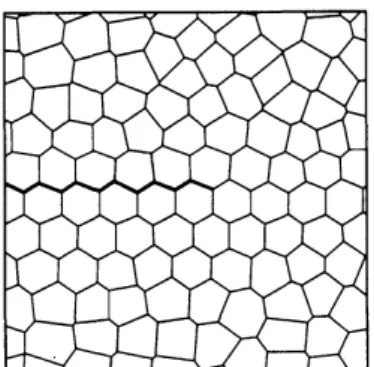
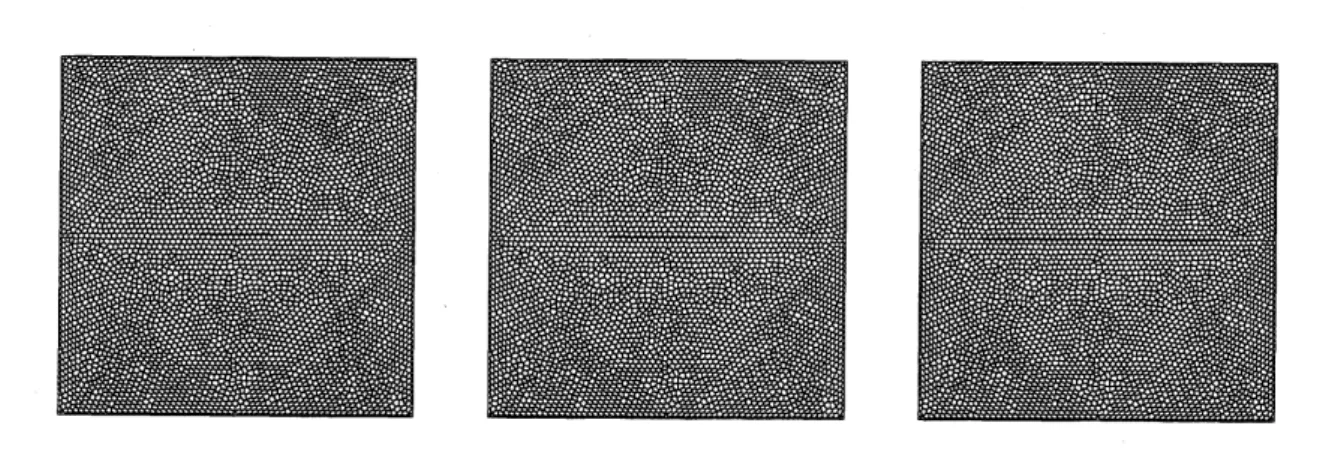
$i=1,$$\cdots,$$N.$A numerical example of
a
simulation of Problem 3.4 is shown in Figure 3, where wegive
a
crack opening load toan
initially cracked plate. If $z_{ij}(t)\geq 1-\epsilon$ for $smal\underline{l\epsilon}>\underline{0,}$the spring between the blocks $D_{i}$ and $D_{j}$ is almost broken and
we
consider $D_{ij}=D_{i}\cap D_{j}$is a part of the crack and bold it in the figures. $A$ close view of a crack tip is shown in
Figure 2. In Figure 3,
we
can observethat a straight crack propagates in time.Figure3: Exampleofcrack propagation on a tensor-valued spring constant model: Initial
configuration (left), Final configuration (right).
3.2 Solvability and regularity
Since the initial value problem (3.4) may have asingularity, weconsider $W^{1,1}$-solution in
Problem 3.3instead of the standard$C^{1}$-solution. Actually, (3.4) is consideredas asystem
of ODEs of $\{z_{ij}(t)\}_{(i,j)\in\Lambda}$, and a singularity may exist at $z_{ij}=1$ or if the coefficient
matrix of the linear system of the displacement field $\{u_{i}\}_{i\in J_{0}}$ is singular. We state our
mathematical results in the following three theorems in
case
of the scalar spring-blocksystem. We, however, remark that these theorems
are
valideven
for Problem 3.4.Theorem 3.5. We suppose the condition (3.3) with $l=0$.
If
$(\mathcal{D},\tilde{\kappa}(0), J)$ is regular, then there exist$T_{0}\in(0, \infty)$ and a solution $(u(t), z(t))$for
$0\leq t\leq T_{0}$ to Problem 3.3, and thesolution is unique in the time interval $[0, T_{0}]$. It also
satisfies
that $u\in C^{0}([0, T_{0}], V(\mathcal{D}))$and $z\in C^{1}([0, T_{0}], \mathcal{Z})$, and that $(\mathcal{D},\tilde{\kappa}(t), J)$ is regular
for
$t\in[0, T_{0}]$. Furthermore,if
$l=1$, then $u\in C^{1}([0, T_{0}], V(\mathcal{D}))$ and $z\in W^{2,\infty}(0, T_{0};\mathcal{Z})$ hold.
If
$l=2$ , then $u\in$$W^{2,\infty}(0, T_{0};V(\mathcal{D}))$ holds.
Proof.
Since $(\mathcal{D},\tilde{\kappa}(0), J)$ is regular, from Theorem 2.7, $u(O)$ is uniquely determined fromthe linear system of the first two equations of (3.4). From the Cramer’s formula, $u(O)$ is
represented in the form:
$u_{k}(0)= \frac{p_{k}(\tilde{\kappa}(0),f(0),g(0))}{p_{0}(\tilde{\kappa}(0))} (k=1, \ldots, N)$, (3.5)
where$p_{0}$ is the determinant given as a polynomial of $\tilde{\kappa}_{ij}(0)$ and $p_{k}$ is also a polynomial of $\tilde{\kappa}_{ij}(0),$ $f_{i}(0)$ and $g_{i}(0)$.
We define
$\Lambda^{*}:=\{(i,j)\in\Lambda;0\leq z_{ij}^{0}<1\},$
$\mathcal{Z}^{*}:=\{\zeta\in \mathcal{Z};\zeta_{ij}=1 ((i,j)\in\Lambda\backslash\Lambda^{*})\}.$
For $\zeta\in Z^{*}$ and $t\geq 0$,
we
define$\overline{\kappa}(\zeta):=\sum_{(i,j)\in\Lambda}\eta(\zeta_{ij})\kappa_{ij}\chi_{ij}\in W(\mathcal{D})$,
$\overline{u}_{k}(\zeta, t):=\frac{p_{k}(\overline{\kappa}(\zeta),f(t),g(t))}{p_{0}(\overline{\kappa}(\zeta))} (k=1, \ldots, N)$, $\overline{Q}_{ij}(\zeta, t) :=\kappa_{ij}(\overline{u}_{j}(\zeta, t)-\overline{u}_{i}(\zeta, t))^{2} ((i,j)\in\Lambda)$,
and we consider the following system ofODEs of$z_{ij}(t)$ for $(i,j)\in\Lambda^{*}.$
$\{\begin{array}{ll}\alpha\frac{dz_{ij}}{dt}(t)=\varphi(z_{ij}(t))(\overline{Q}_{ij}(z(t), t)-\gamma_{ij})_{+} ((i,j)\in\Lambda^{*}, t\geq 0) ,z_{ij}(0)=z_{ij}^{0} ((i,j)\in\Lambda^{*}) ,z_{ij}(t)=1 ((i,j)\in\Lambda\backslash \Lambda^{*}) .\end{array}$ (3.6)
From thestandardtheoryof$ODE$, sinceoursystem (3.6) satisfies theLipschitz condition,
it follows that there exists
a
unique local solution $z\in C^{1}([0, T_{0}], Z^{*})$, withsome
$T_{0}>0.$Without loss of generality,
we can
assume
that $z_{ij}(t)\in[0,1)$ for all $(i,j)\in\Lambda^{*}$ and $t\in[O, T_{0}]$.
We set$u(t)$ $:=\overline{u}(z(t), t)$.
Then$(u(t), z(t))$is becomesa
solutionofProblem3.3.It is clear that this is
a
unique solution of Problem 3.3 in the time interval $[0, T_{0}].$Moreover, since $p_{0}(\tilde{\kappa}(t))=p_{0}(\overline{\kappa}(z(t)))\neq 0$, it follows that $(\mathcal{D},\tilde{\kappa}(t), J)$ is regular
for $t\in[0, T_{0}]$. Under the above conditions, it also follows that $\tilde{\kappa}_{ij}\in C^{1}([0, T_{0}])$ and
$\varphi oz_{ij}\in C^{1}([0,T_{0}])$
.
In particular, ffom (3.5), $u\in C^{0}([0,T_{0}], V(\mathcal{D}))$ follows.If (3.3) holds for $l=1$, from (3.5), we obtain that $u\in C^{1}([0, T_{0}], V(\mathcal{D}))$ and that $\frac{dz}{dt}\in W^{1,\infty}(0,T_{0};W(\mathcal{D}))$. We ako have $z\in W^{2,\infty}(0, T_{0};W(\mathcal{D}))$ and $\tilde{\kappa}_{ij}\in W^{2,\infty}(0, T_{0})$
.
If (3.3) holds for $l=(2, u\in W^{2,\infty}(0, T_{0};V(\mathcal{D}))$ holds from (3.5). $\square$
By replacing $\kappa_{ij}=1$ and $z_{ij}^{0}=1$ in
case
of $\kappa_{ij}=0$, we canassume
that all springconstant $\kappa_{ij}$ is positive without loss of generahty. For a damage variable $z(t)(0\leq t<$
$T\leq\infty)$,
we
define$J(i,t)$ $:=\{k\in\{1, \cdots, N\};v_{k}=0$, if$v\in V(\mathcal{D})$ and $\sum_{z_{ij}(t)<1}|v_{j}-v_{i}|=0\},$
for $i=1,$$\cdots,$$N$, where $k\in J(i, t)$
means
that the block $D_{k}$ is connected bya
chain ofpositive spring constants with the block $D_{i}$
.
We call $J(i, t)$an
index set of connectedblocks to $D_{i}.$
Let $I(t)$ be thenumber of completely broken springs, namely,
$I(t):=\#\{(i,j)\in\Lambda;z_{ij}(t)=1\}.$
Thereexists $0=t_{0}<t_{1}<\cdots<t_{q}=T$such that
$I(t_{0})<I(t_{1})<\cdots<I(t_{q-1})$, $I(t)=I(t_{m-1})$ $(t\in[t_{m-1}, t_{m}), m=1, \cdots, q)$
.
Then we also have
Forfixed $m=1,$$\cdots,$$q$, in each time interval $[t_{m-1}, t_{m}),$$\mathcal{D}$ is divided into subblock system
$\mathcal{D}^{1},$
$\cdots,$$\mathcal{D}^{p}(\neq\emptyset)$, where $\mathcal{D}^{k}$ depends on
$m$ and
$\mathcal{D}=\bigcup_{k=1}^{p}\mathcal{D}^{k}, i_{k}:=\min\{j;D_{j}\in \mathcal{D}^{k}\}, \mathcal{D}^{k}=\{D_{i}\}_{i\in J(i_{k},t_{m-1})}.$
Theorem 3.6. Under the condition (3.3) with $l=0$, we suppose that there exists a
solution $(u(t), z(t))(0\leq t<T\leq\infty)$
of
Problem 3.3, anddefine
$0=t_{0}<t_{1}<\cdots<t_{q}=$$T$ with the condition (3.7). Then the solution
satisfies
the followingproperties.1. The damage$var\dot{v}ablez(t)$ is unique in the interval$[0, T)$, and$z\in C^{1}([t_{m-1}, t_{m}), W(\mathcal{D}))$
for
$m=1,$ $\cdots,$$q.$2. There exists$\tilde{u}(t)$ with$\tilde{u}\in C^{0}([t_{m-1}, t_{m}), V(\mathcal{D}))$
for
$m=1,$$\cdots,$$q$ such that$(\tilde{u}(t), z(t))$ $\dot{u}$ a solution
of
Problem 3.3.3. Suppose that $z_{ij}(t)\in[0,1)$
for
$0\leq t<t_{m}$. Then the quantity $Q_{ij}(t)$for
$t\in[0, t_{m})$is uniquely determined and $Q_{ij}\in C^{0}([0, t_{m}))$.
Proof.
For fixed$m=1,$$\cdots,$$q$, in each interval $[t_{m}-1, t_{m})$, we consider reduced problems in each connected spring blocksystem$\mathcal{D}^{k}(k=1, \cdots,p)$. We define$\tilde{J}_{1}^{k}$$:=J(i_{k}, t_{m-1})\cap J_{1},$
and set
$J^{k}=(J_{0}^{k}, J_{1}^{k})$, $J_{0}^{k}:=J(i_{k}, t_{m-1})\backslash J_{1}^{k},$ $J_{1}^{k}:=\{\begin{array}{ll}\tilde{J}_{1}^{k} if \tilde{J}_{1}^{k}\neq\emptyset\{i_{k}\} if \tilde{J}_{1}^{k}=\emptyset\end{array}$
Then $(\mathcal{D}^{k},\tilde{\kappa}(t), J^{k})$ becomes regular spring-block system with
Dirichlet boundary for $t\in$
$[t_{m-1}, t_{m})$. Then we cansolve (3.4) in each$\mathcal{D}^{k}$
with the initial condition $z(t_{m-1})$ for $z$ and
Dirichlet boundary condition:
$g_{i}^{k}(t)=\{\begin{array}{ll}g_{i}(t) if \tilde{J}_{1}^{k}\neq\emptyset 0 if \tilde{J}_{1}^{k}=\emptyset\end{array}$ $(i\in J_{1}^{k})$.
We define
$\tilde{u}_{i}(t):=\{\begin{array}{ll}u_{i}(t) if \tilde{J}_{1}^{k}\neq\emptyset u_{i}(t)-u_{i_{k}}(t) if \tilde{J}_{1}^{k}=\emptyset\end{array}$ $(D_{i}\in \mathcal{D}^{k}, t\in[t_{m-1}, t_{m}))$
.
Then it is easy to show that $(\tilde{u}(t), z(t))$ is
a
solution of each regular sub-spring-blocksystem. From Theorem 3.5, the solution is unique and itsatisfies$\tilde{u}\in C^{0}([t_{m-1}, t_{m}), V(\mathcal{D}))$ and $z\in C^{1}([t_{m-1}, t_{m}), W(\mathcal{D}))$.
We also remark that $z(t)$ isglobally unique, since$z(t_{m})= \lim_{tarrow t_{m}-0}z(t)$ always exists
due to the monotonicity of $z_{ij}(t)$ and we can extend $z(t)$ uniquely in the next interval
$[t_{m}, t_{m+1})$
.
If $(u(t), z(t))$ and $(\tilde{u}(t),\tilde{z}(t))$
are
both solutions ofProblem 3.3, from the uniqueness of $z(t)$, we have $\tilde{z}(t)=z(t)$. Then, for fixed $t,$ $u(t)-\tilde{u}(t)$ becomes a solution of forcebalance equations with $f\equiv 0$ and $g\equiv 0$. Hence, we have $u_{j}(t)-\tilde{u}_{j}(t)=u_{i}(t)-\tilde{u}_{i}(t)$ if $j\in\Lambda(i, t)$. It holds that $u_{j}(t)-u_{i}(t)=\tilde{u}_{j}(t)-\tilde{u}_{i}(t)$ if$z_{ij}(t)\in[0,1)$, and the third claim
Theorem
3.7.
We suppose that $f\equiv 0,$ $g\in C^{0}([0, \infty), V_{1}(\mathcal{D}))$ and $z^{0}\in Z$.
Then thereexists aglobal solution $(u(t), z(t))$ to Problem
3.3
in $0\leq t<\infty.$Proof.
We suppose that $\kappa_{ij}>0$ for all $(i,j)\in\Lambda$ without loss of generality. Similarly to the proof of Theorem 3.6,we
can
constructa
solution $(u(t), z(t))$ and $0=t_{0}<t_{1}<\cdots<$$t_{q}=\infty$ by solving each reduced problem in $\mathcal{D}^{k}$ with the initial condition at $t=t_{m-1}.$
We remark that,
even
if $\tilde{J}_{1}^{k}=\emptyset,$ $u_{i}(t)=0$ for $D_{i}\in \mathcal{D}^{k}$ satisfies (3.4) since $f\equiv 0$, and$z_{ij}(t)=z_{ij}(t_{m-1})$ for $t\geq t_{m-1}$ if$J(i,t_{m-1})\cap J(j, t)\cap J_{1}=\emptyset.$ $\square$
4 Conclusion
In this paper,
we
proposeda
mathematical model of fracture ofan
elastic material. Thedeformation oftheelastic body is approximated by
a
spring-block system andthe crack isrepresented by adamage variable defined
on
each springs. We remark that this researchis based
on
the idea of [6], and thata
dynamic problem in similar settingisstudied in [1].Due to the page limitation,
we
could not describesome
further results suchas an
energy
decay property,a
uniform estimate oftheenergy, an
estimate of crack lengthandmore
numerical examples. We also could not discuss about the consistency ofthe scalaror
tensor-valued spring constant model with the linear elasticity problem. They will bediscussed in
our
forthcoming papers.References
[1] K. Abe and M. Kimura,
Vibmtion-fracture
modelfor
one
dimensional spntng-masssystem. (preprint, submitted)
[2] T. Belytschko and T. Black, Elastic cmck growth in
finite
elements with minimalremeshing. Int. J. Numer. Meth. Eng., Vol.45, No.5 (1999), 601-620.
[3] F. Camborde, C. Mariotti and F. V. Donz\’e, Numerical study
of
rock and Concretebehaviour by discrete element modelling. Computersand Geotechnics, Vol.27 (2000),
225-247.
[4] H. Chen, L. Wijerathne, M. Hori and T. Ichimura, Stability
of
dynamicgrowthof
twoanti-symmetric cracks using
PDS-FEM.
Joumalof Japan Society of Civil Engineers,Ser. A2 (Apphed Mechamics (AM)), Vol. 68, Issue 1, (2012),
10-17.
[5] M. Hori, K. Oguni and H. Sakaguchi, Proposal
of
FEM implemented with particlediscretization
for
analysisof failure
phenomena. J. Mech. Phys. Sohds, Vol.53, No.3(2006), 681-703.
[6] M. Kimura and T. Takaishi, Phase
field
modelsfor
cmck propagation. Theoreticaland Apphed Mechanics Japan, Vol.59 (2011), 85-90.