A Pincer
Randomization
Method
for
Valuing
American Options
北海道大学・経済学研究科 木村 俊一 (Toshikazu Kimura)
北海道大学・経済学研究科 鈴木健勝 (Takeyoshi Suzuki)
Graduate School of Economics and Business Administration
Hokkaido University
1
Introduction
Variety has
come
to the options market nowadays since Black&
Scholes (1973) and Merton (1973)published the seminal paper. In particular, the valuation of American options (i.e., optionswhich can
be exercised before the pre-specified date)writtenon dividend-payingassetsis animportant issue in the
market due to that they have amuch broader range of applications. Many academics and practitioners
have attempted to resolve the value of American option analytically since McKean (1965) and Merton
(1973) formulated theoptionvalueas afreeboundary problem. However there havebeen
no closed-form
formula and analytical solutions. The difficulties in such pricing options originate from the possibility
ofearlyexercise and the early exercise boundary not known priorimust be determined
as a
part ofthesolution. Researchers have also made further efforts toward developments of numerical approximation
methods for pricingAmericanoptions.
A brand-new approximation is the randomization method proposed by Carr (1998), which is based
on an American option with a random maturity. The random maturity follows the $n$-stage Erlangian
distribution with mean equal to the pre-specified maturity. Although the idea is easy to understand,
the probability density function (pdf) of Erlangian distribution is not suitable for obtaining a sim ple
formulaforthen-thapproximation. Actually, Carr’sformulafor then-th approximation oftheAm erican
put value is given by
a
recursion ofcom
plex triple sums. To improve this shortcoming, an alternativerandomization method hasbeen recently developedby Kimura (2004), which used an order statistic$\mathrm{f}_{\mathrm{o}\mathrm{I}}$
therandom maturity. The order statistic alsoplays akey role in our newrandomization method in this
thesis,andhencethe details ofhismethodwill be specifiedlater. Kimura.i,, approximationnot only hasa
much simpler expressionthanCarr’s one, butalsoits numerical resultshave almost the
same
accuracy asCarr’s. However,com putationalresults sometimes behave unstablyunderacertain condition. Improving
this inadequacy is a principal goal ofour randomization method, which wecall a pincer randomization.
The primal focus of this thesis ison theAmerican put option because the call
case
canbe analyzed byput-callsymmetryrelations
The rest of this thesis is organized as follows: In Section 2, we provide
some
prelim inaries for theanalysis. Section 3 provides
an
idea of the pincer randomization method. To examine the accuracy ofour
method, numerical comparisonswith other approximationsare
shown in Section 4. Finally, we givea conclusion and
some
comments on future researchin Section 5.2
Preliminalies
2.1
Basic Framework
Assume that the stock price isa risk-neutralized process governedby thestochastic differentialequation
$\frac{dS_{\mathrm{f}}}{s_{t}}=(r-\delta)dt+\sigma dW_{t}$, (2.1)
where $W\equiv\{W_{t} : t\in[0, T]\}$ is a standard Brownian motion process
on
a filtered probability space$(\Omega, (F_{t})_{t\geq 0},\mathrm{P})$ where $(F_{t})_{t\geq 0}$ is the natural filtration corresponding to $W$ andthe probability
measure
$\mathrm{P}$ is chosen so that the stock has
mean
rate ofreturn$r$. Here, $r$ isthe risk-freerate ofinterest,$\delta$ is the
dividend rate, and a is thevolatility coefficient of the asset price.
We define the value of American put option with maturity date $T$ and exercise price $K_{\}}$ which
is expressed as $C(S_{t}, t)$ through this article, satisfies the Black and Scholes (1973) partial differential
equation (PDE)
subject totheboundary conditions
$\lim_{S\downarrow 0}P(S, t)=0$, (2.3)
$\lim_{S\uparrow B_{t}}P(S, t)=K-B_{t}$, (2.4)
$\lim_{S\uparrow B_{t}}\frac{\partial P(S,t)}{\partial S}=-1$, (2.5)
and the terminalcondition
$P(S_{T}, T)=(K-S_{T})^{+}$
.
(2.6)Equation(2.4)is usually called the “valuematching”conditionandEquation(2.5)isthe “smoothpasting”
condition. These conditions guarantee that premature exercise strategy on the early exercise boundary
$B_{t}$ will beoptimal.
2.2
Randomization Methods
2.2.1 Carr’s randomization
Carr’s randomization method consists of thefollowing three steps:
1. Randomize the maturity $T$ by an exponentially distributed random variable $\tilde{T}$
with mean $\mathrm{E}[\tilde{T}]=$ $\lambda^{-1}=T$in order to value the so-called Canadian option.
2. Extend the result to the
case
that $\tilde{T}$is distributed as the $n$-stage Erlangian distribution with the
same mean $\mathrm{E}[\tilde{T}]$$=\lambda^{-1}=T$.
3. Takethe limit ofthe randomizedoptionvalue by letting$narrow\infty$toobtaintheunderlyingAmerican
option value
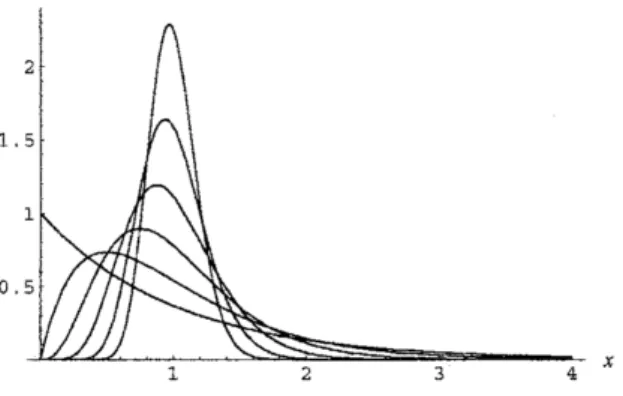
Figure 1 illustrates the $n$-stage Erlangiandistribution converges to Dirac’s delta function concentrated
at the mean $\lambda^{-1}=T$.
$x$
Figure 1: $n$-stage Erlangian probabilitydensity functions$(n =1,2, 4, 8, 16, 32)$
Let$g_{n}^{*}(T)$ $=\mathrm{E}[g(\tilde{T})]$ foracontinuous fimction
$g$. Then,
we
have$g_{n}^{*}(T)= \int_{0}^{\infty}g(t)\frac{(nt/T)^{n-1}}{(n-1)!}\frac{n}{T}e^{-nt/T}dt$, (2.7)
for whichwe obtain
$\lim_{narrow\infty}g_{n}^{\mathrm{x}}(T)=g(T)$ (2.8)
2.2.2 Kimura’s randomization
Insteadof the$n$-stage Erlangiandistribution, Kimura(2004)used
an
order static for the randommaturity.In much the sameway as in Carr’s randomization,his method consists ofthe following three steps:
1. Randomize the maturity $T$ by an exponentially distributed random variable$\overline{T}$
with mean $\mathrm{E}[\tilde{T}]$
$=$
$\lambda^{-1}=T$ in order to valuethe Canadianoption.
2. Extend the result to the case that $\tilde{T}$
is distributed as an order statistic whth the same mean
$\mathrm{E}[\tilde{T}]=\lambda^{-1}=T$
.
3. Take the limit of the randomized option value by letting n,m $arrow\infty$ to obtain the underlying
American optionvalue.
Let $X_{1)}$.
.
’$X_{n+m}$ be independent and exponentially distributed random variables with parameter
$\alpha$
$(>0)$, and let $X_{(i)}$ denote the i-th smallest of these random variables $(\mathrm{i}=1, , . , n+m)$. Thle pdfof
$X_{(7l+1)}$ is givenby
$f(t)= \frac{(n+m)!}{n!(m-1)!}(1-e^{-\alpha t})^{n}\alpha\epsilon^{-m\alpha t}$, $t$$\geq 0$. (2.9)
The mean and variance of$X_{(\uparrow 1+1)}$ are given by
$\mathrm{E}[X_{(\mathrm{n}+1)}]=\frac{1}{\alpha}\sum_{\mathrm{i}=0}^{rx}\frac{1}{m+\mathrm{i}}$, $\mathrm{V}[X_{\langle n+1)}]=\frac{1}{\alpha^{2}}\sum_{i=0}^{n}\frac{1}{(rn+\iota)^{2}}$. (210)
In add ition, the modal value of$X_{(7b+1)}$ is given by
NI$[X(7\downarrow+1)]\equiv \mathrm{a}\mathrm{r}\mathrm{g}\mathrm{n}t$lax$f(t)= \frac{1}{cx}\log\frac{n+m}{m}$. (2.11)
1
0
$X$ $X$
(a) mean rnatching $\mathrm{E}[X_{\{n+1)}]=1$ (b) mode$\Pi 1\mathrm{a}\mathrm{t}\mathrm{c}\mathrm{h}\mathrm{i}_{\mathrm{I}\mathrm{l}}\mathrm{g}$. $\mathrm{M}|X(n+1)]=1$
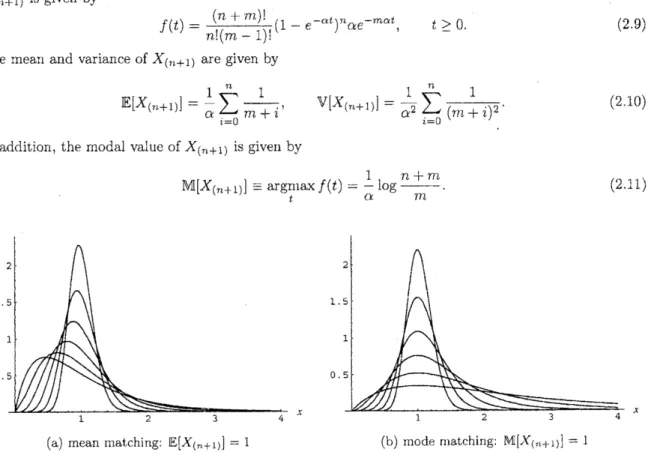
Figure 2: Probability densityfunctions ofthe order statistic $(n=m=1, 2,4, 8, 16, 32)$
Figure $2(\mathrm{a})$ and $2(\mathrm{b})$ show theconvergence of the pdfas $n(=m)arrow\infty$
.
There is not all that muchdifference between these figures and they converge to Dime’s delta function concentrated at the mean
$\mathrm{E}[X_{(7\iota+1\}}]=1$. By setting either $\mathrm{E}[X_{(n+1)}]=T$or$\mathrm{N}\#[X_{(\tau\iota+1)}|--T,$ $X_{(n+1)}$ canbe another candidate for
the random maturity$\tilde{T}$
, because $1\mathrm{i}\ln_{\mathit{7}1,marrow\infty}\mathrm{V}[X(n+1)]-\wedge 0$
.
Kimura (2004) adopted the mode-m atching NI[X(n+l)]=T in his randomization for $\mathrm{c}\mathrm{o}$ mputational
convenience,because thereisnosignificantdifferencebetweenthe twomatchings. For the mode-matching,
a can be determined by
$\alpha=\frac{1}{T}$ltog$\frac{n+m}{m}$. (2.12)
For acontinuous function $g(t)(t\geq 07$,let $g_{\iota}^{*},,n\iota$ $\equiv g_{l,7n}^{*},(T)$
$=\mathrm{E}[g(\tilde{T})]$, $\mathrm{t}\}_{1}\mathrm{e}\mathrm{n}$
forwhich we have
iim $g_{n,m}^{*}(T)=g(T)$
.
(2.14)$n,r’\iotaarrow\infty$
Proposition 1 (Kimura) The sequence
$(g_{r\iota,m}^{*})_{r\iota,\tau n\geq 1}$ satisfiesthe recursion
$\{$
$g_{0,m}^{*}=I_{0}^{\infty}$rnae$-mc\iota tg(t)dt$
$g_{n,m}^{*}= \frac{n+m}{n}g_{n-1,m}^{*}-\frac{m}{n}g_{n-1,m+1}^{*}$, $n\geq 1$
.
(2.15)
Let $L^{*}(m\alpha)$ denote arootof the equation for the eaxly exercise boundary of Canadian options. The
$7\mathrm{V}$-th randomized approximation $g_{N,N}^{*}\equiv\beta_{N}\approx B_{t}(N\geq 1)$ can be obtained by the algorithm named
OS-Random.
The algorithm also
can
be applied to computing the option value $F(t, S)$ by assuming that we havea functional programforcomputing$P^{*}(m\alpha, S)$ for a setofthe parameters $\{t, S, K,T, r, \delta, \sigma\}$
.
2.3
Canadian Options
Therandomization methods are based on the valueofCanadian option whosematurity is exponentially
distributed to introduce not only Carr’s randomization but aiso the alternativeoneproposed byKimura
(2004).
Proposition 2 (Kimura) The value of the European-style Canadian put optionis given by
$p^{*}(\lambda, S)=\{$ $\xi(S)+\frac{\lambda}{\lambda+r}K-\frac{\lambda}{\lambda+\delta}S$, $S<K$ $\eta(S)$, $S\geq K$, (2.16) where $\xi(S)=\frac{1}{\theta_{+}-\theta_{-}}\frac{\lambda}{\lambda+\delta}(1-\frac{r-\delta}{\lambda+r}\theta_{-})K(\frac{S}{K})^{\theta_{+}}$ , $S<K$ $\eta(S)=\frac{1}{\theta_{+}-\theta_{-}}\frac{\lambda}{\lambda+\delta}(1-\frac{r-\delta}{\lambda+r}\theta_{+})K(\frac{S}{K})^{\theta_{-}}$, $S\geq K$, (2.17)
and the parameters $\theta\pm$
are
tworoots of the follow ing quadraticequation$\frac{1}{2}\sigma^{2}\theta^{2}+$$(r- \delta -\frac{1}{?}.\sigma^{2})\theta-(\lambda+r)=0$, (2.18)
$\mathrm{i}.e.$,
$\theta_{\pm}=\frac{1}{\sigma^{\underline{9}}}\{-(r-\delta-\frac{1}{2}\sigma^{2})\pm\sqrt{\langle r-\delta-\frac{1}{2}\sigma^{2})^{2}+2\sigma^{2}(\lambda+r)}\}$
.
(2.19)Proposition 3 (Kimura) For $L^{*}\leq K$, the value of the American-style Canadian put option is given
by $P^{*}(\lambda, S)=\{$ $K-\mathit{3}$, $S\leq L^{*}$ (2.20) $p^{*}(\lambda, S)+e^{*}(\lambda, S)$, $S>L^{*}$, where
3
A
Pincer
Randomization Method
Kimura’s randomization method is notonly much simpler than Carr’s one, but also as accurate as Carr’s
one; however themethodshows unstable behaviors near the expiryundercertain conditions. Thereasons
for the unstabilityareconsidered as
(i) the algorithmis sensitive to theprecision of the root $L^{*}$.
(ii) the$(n, m)$-thapproximation$g_{n,m}^{*}$ cannot appropriately satisfies the value matching conditionin the
recursiveprocedure.
In this section, we propose a new randomization scheme named a pincer randomization (PR) method
to
overcome
those difficulties. The PR method is based on a pair of lower and upper bounds for atrue value (say TRUE), and then TRUE is sandwiched in between the bounds. This methods reflect
some fundamental properties ofthe option Greek Theta and the order statistic. It is generally known
that Theta indicates the ratioof thechange in an American putoptionprice to the decrease in time to
expiration, so that the shorter theremaining time to expiration, theoption value ischeaper.
Remark 1 Note that the relation of apair oflower and upper bounds inverts if and only if the Theta
is negativeunder deep-in-the-money.
3.1
Lower and upper bounds
for
the option
value
Assume that thematurity $T$ is arandom variable $\tilde{T}$
distributed
as
the order statistic$X(n+1)$ with mean$\mathrm{E}[\tilde{T}]=T$, as in the OS-Random algorithm. From Figure $2(\mathrm{a})$ andthe Theta property of Americanput
options that the
mean-m
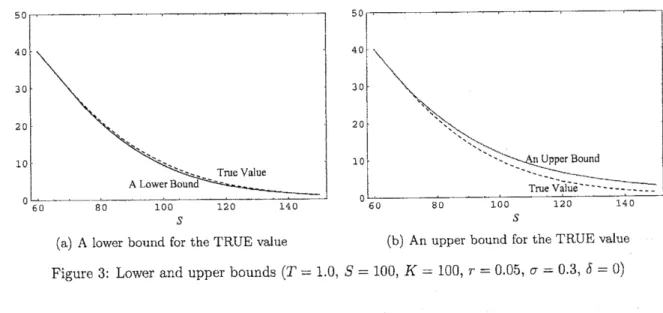
atchingapproximation for the option value always underestimates the truevaluewhen $n$,$m$ is not large enough, giving a lower bound. Note that mean-matching approximation for the
earlyexerciseboundary providesthe upper bound. Figure $3(\mathrm{a})$ shows that the lower bound $\mathrm{i}_{\mathrm{b}}$ atight one
over
the true value derivedby theCRR binom ialmethod with $n=$ 1000.In the
same manner
as the mean-matching case, Figure $2(\mathrm{b})$ and theTheta property shows that themode-matching approximation always overestimates the true valuewhen$n$,$m$is small, $\mathrm{i}.e.$, it isanupper
bound For the early exercise boundary, the mode-matching approximation providesthe lower bound
Figure $3(\mathrm{b})$ shows that the upper bound is less tight than the lowerbound, whereTRUE values
are
alsocomputed by the CRR binomial methodwith$n$ $=$ 1000.
50
(a) A lower bound for theTRUEvalue (b) An upperbound for theTRUEvalue
Figure 3: Lowerand upperbounds $(T=1.0, S=100, K=100, r=0.05, \sigma=0.3, \delta=0)$
3.2
Interpolating
lower and
upper
bounds
Figure 4illustrates arelationship betweenthe lower and upperbounds for the early exercise boundary.
This figure shows that thetheTRUEvalue is appropriatelysandwichedinbetween thebounds, and that
Figure 4: Lower and upper bounds for theearly exercise boundary ($K=100$,$r=0.05$, a $=0.3$, $\delta=0$)
option value, the TRUE value is appropriately sandwiched in between the bounds, and the lower bound
is agood approximation for theTRUE
one.
From Figure 3, themean
matching providesmore
accurateapproxim ations for the option value. Prom these observations, we employ the two methods below for
valuingAmerican put options.
.
Arithmetic Average:$P_{A}\langle t$,$S_{t}$) $= \frac{L(t,S_{t})+U(t,S_{t})}{2}$ (3.1)
where $L(t, S_{t})$ and $U(t, S_{t})$ are the lower and upper bound for the option va$\mathrm{l}\mathrm{u}\mathrm{e}$, respectively.
.
Geometric Average:$I_{G}^{\supset}(t, S_{\mathrm{t}})=\sqrt{L(t,S_{t})\mathrm{x}U(t,S_{t})}$ (3.2)
As described above, the upper bound of the earlyexercise boundary and the lower bound of the option
value
are
good approximationsfor theTRUEvalues. Hence,wealso add the lower-boundapproximationfor theoption value in comparisons.
0 0
0 -0
(a) $N=3$, 4,$!\mathrm{J}\ulcorner$ (b) $N=6$,7, 8
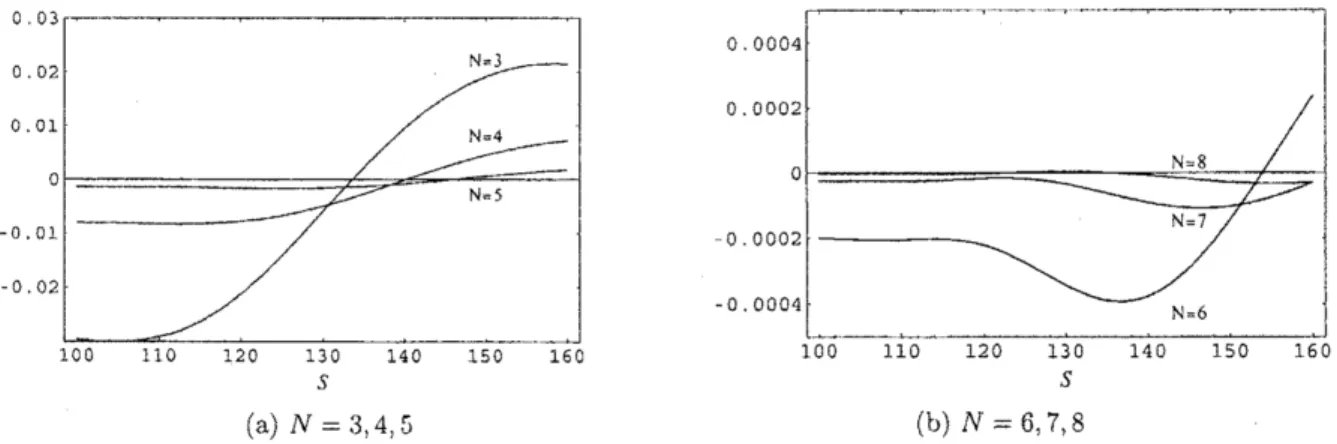
Figure 5: Relative percentage
errors
of the approxim ations for the vanilla European put value $p(0, S)$$\langle$$T=1.\mathrm{O}$, $K=1\mathrm{O}\mathrm{O}$, $r=0.05$, a $=0.3$, $\delta=0.05$)
To determine the level 1V of the approximation,
we
make a comparison between $p(t, S)$ and its PRapproxim ation. Obviously, the exact values of $p(t, S)$
can
be computed by the Black-Scholes formula$(2,2)$, Figure 5 illustrates the relative percentage
errors
of approximations for$p(0, S)$as
functions of$S$.The approximations become better as $N$ increases and wehavesufficient accuracy for$N\geq 6$
.
Hence, we4
Computational
Results
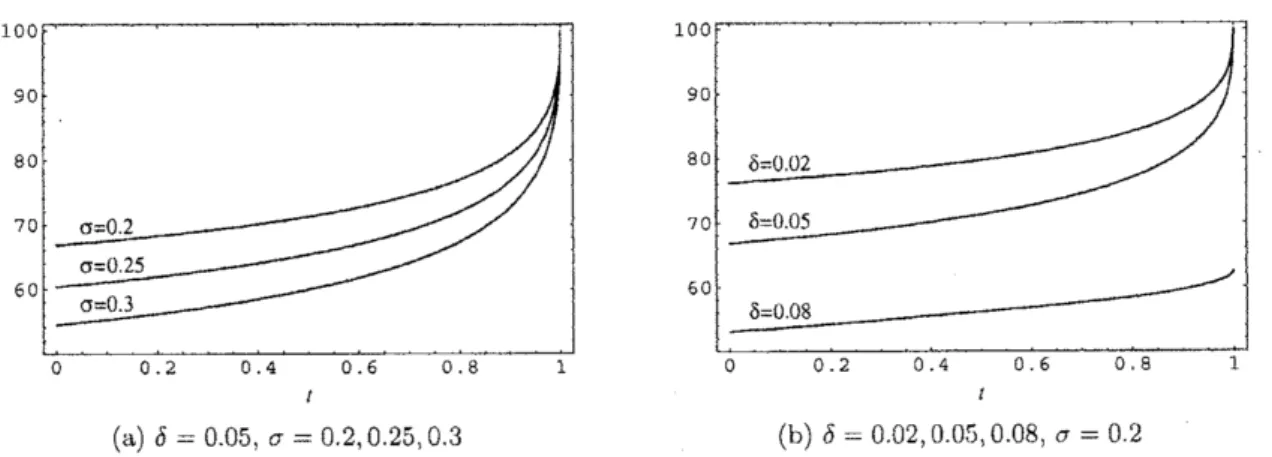
Figure $6(\mathrm{a})(6(\mathrm{b}))$ shows
some
relations between theearlyexerciseboundaryand the volatiliry (dividendrate). Also, Figure $7(\mathrm{a})(7(\mathrm{b}))$ shows
som
ne relations between the option values and the volatility(ma-turity). In order to check the performance of the PR method in detail, we
com
npare them with otherapproximations for particular
cases
quoted from numerical experiments in AitSahlia and Carr (1997).Tables 1 and 2 summarize these results, in which we compute three approximation by the PR method
withboththe arithmeticandgeometricaverages and the lower-bound approximationnam ed LB-Rondorn.
We employ the arithmetic average of the 1000- and lOOl-steps binomial value
as
a bench mark of theTRUE value. For the methods of OS-Random, Carr, and Geske
&
Johnson, ‘.N-pts” in these tablesdenote the numberofstepsofthe$N$-point Richardsonextrapolation. For the finite-difference results, the
parameters $N$ and $M$ denote the numbersof time and state steps, respectively. SeeAitSahlia and Carr
(1997) for details oftheir experiments.
$t$
(a) $\delta=0.05$, $\sigma=0.2$,0.05,0.3 (b) $\delta=0$02,$00_{\iota}^{r_{\mathrm{J}}}$, 0.05, $\sigma$ $=02$
Figure 6: Earlyexercise boundaries ofput options $(K=1\mathrm{O}\mathrm{O}, T=1.\mathrm{O}, r=0.05)$
(a) T$=1.()$, a $=0$2,0.3,$().4$ (b) T$=0.05$,10, 1.0,$\sigma=02$
Figure 7: Valuesofput options $(K=1\mathrm{O}\mathrm{O}, t=0, r=0.05, \delta=0.02)$
The PR methodperforms very well and competes with OS-Random and Carr’s randomization, In
addition,the PRmethod succeeds in the waythatmodificationofOS-Randomthatalwaysunderestimates
the TRUE value, because the PR method provides not only much
more
accurate approximations forvaluing put options but also better approximation than OS-Randomn In addition,
we see
from thesefigures that thePR method is
more
accurate than LBA and LUBA, which are also thelower-bound andthe lower-and-upper-bounds approximations, respectively.
Table 1 shows the impacts of the initial stock price $S$. The PR method $\mathrm{w}\mathrm{i}\mathrm{t}\mathrm{h}_{1}$ both of arithmetic
and geometric average becomes accurate as $S$ increases, because the early exercise prem iu1n relatively
that thePR method canvalue European option valuesas accurate astheBlack-Scholes formula and that
wecan decomposeAmerican option value into the early exercise premium plus Europeanoption value.
Table 2 demonstrates that remaining time impacts on the option values. The PR method with
both arithmetic and geometricaverages becomesaccurate as the remaining time becomes long. Forthis
tendency, we
can
give thesameprospect fromTable 1. Inaddition, fromTables 1and2,we
can see thatthe PR method with arithmetic average is accurate enough and is greater than theonewith geometric
average. Clearly, this reflects the fact that $P_{A}(t, S_{t})\geq P_{G}(t, S_{t})$for all $(t, St)$.
From the observations in Figures 3 and 4, it
was
considered that the lower-bound approximationsfor the option values would perform well. However, we see from Tables 1 and 2 that the lower-bound
approxim ations are less accurate than other approximations. We alsosee from othernumerical
experi-ments that the randomization method with
mean
matchingperforms well ifandonlyifdividendis zeroforwhich the root $L^{*}$ canbecompiited via
$L^{*}=K( \frac{r(\theta_{+}-1)}{\lambda})\frac{1}{\mathit{0}_{+}}$ (4.1)
without using Newton’s method. These observations wouldimply that the accuracy of the lower-bound
(or mean-matching) approximation is highlysensitive to thecomputational accuracy oftheroot $L^{*}$
.
5
Conclusion
The previous randomization methods have crucial problems such
as
(i) difficulty of implementation forCarr’s one and (ii) unstable behavior
near
expiry for Kimura’sone.
To rectify these faults at the sametime,wehaveemployed an interpolationapproximationusing apair oflowerandtipperboundsobtained
byKimura’s randomization method. The ideais based onthe Theta property of American put options.
Our new method, thePR method,refines Kimura’sone, removing another fault ofunderestimation.
The PR method generates accurate approximations when theinitial stockprice is intheout-of-money
or the remaining time to maturity is long. It is straightforward to interpret these properties frorn the
fact that American option value can decomposed into the early exercise premium and the associated
Europeanoption value,the latter of which constitutes agreater portion of the wholevalue. However , the
PRmethod still haveatendency of underestimation from the true value, whichneeds a further revision
of the randomization.
Mathematically,theessentialof randomization canbe interpretedas
an
inversionofLaplaceor
Fouriertransforms.
Thisinterpretationenablesus
to apPly the random izationmethodsincluding the PRmethodto valuing other options, $e.g.$, exoticor path-dependent options such asAsian, lookback, barrier options
and
so on.
This isafuture theme of extensive research. Another extensionof the randomizationmethodis the
case
that the stock return jumps accidentally, that is, the stock price process follows not theBrownian motion butajum $\mathrm{p}$-diffusionprocess suchas Levyprocesses. This remainsasfuturework, too.
References
[1] AitSahlia, $\mathrm{F}_{\}}$.and Carr, P., 1997, “American Options: A Comparison of Numerical
$\mathrm{M}\mathrm{e}\mathrm{t}\mathrm{h}\mathrm{o}\mathrm{d}_{\mathrm{S}},$
)’
Nu-merical MethodsinFinance,L C.G. RogersandD. Talay (eds.), CambridgeUniversity Press, 67-87.
$\lfloor\lceil 2]$ Black, F., and M. Scholes, 1973, “The Pricing of Options and Corporate Liabilities,” Journal
of
Political Economy, 81, 637-659.
[3] Carr, P., 1997) “Randomization and the American Put,” Review
of
FinancialStudies, 11, 597-626.[4] Cox, J.C.,
S.A.
Rossand M. Rubinstein, 1979, “option Pricing; ASimplified Approach,” Joumalof
Financial Economics, 7 229-264,
[5] Kimura, T., 2004, “Alternative Randomization for Valuing American Options,” The 2004 Daiwa
InternationalWorkshop on Financial Engineering, Kyoto, Japan.
[6] McKean, H.P., Jr., 1965, “Appendix: A Free Boundary Problem for the Heating Function Arising
from aProblem in Mathematical Economics,” IndustrialManagement Review, 6,
32-39.
[7] Merton, R., 1973, “Theoryof Rational OptionPricing,” Bell Journal
of
Economics andManagement$\mathrm{T}\mathrm{a}\cdot\frac{\mathrm{b}1\mathrm{e}1.\mathrm{A}\mathrm{c}\mathrm{o}\mathrm{m}\mathrm{a}\mathrm{r}\mathrm{i}\mathrm{s}\mathrm{o}\mathrm{n}}{\mathrm{M}\mathrm{e}\mathrm{t}\mathrm{h}\mathrm{o}\mathrm{d}}$of approximationsfor$P(0,S)S=\mathrm{S}0(T=3,K=100,r=0.06, \sigma=0.4,\delta=0.02)S=90S=100S=110S=120$
Binomial 29.2601 24.8023 21.1294 18.0849 15.5428
PRmethod (Arithmetic Ave.) 28,8392 24.4533 20,8489 17.8681 15.3892
PR method (Geometric Ave.) 28.8373 24.4501 20.8445 17.8624 15.3823
LB-Random 28.5135 24.0614 20.4092 17.3971 14.9005
OS-Random (8-Pts) 28.7998 24.4246 20.7891 17.7971 15.2995
Carr (3-pts)
29.2323
24.7692 21.0835 18.0369 15.4873Geske and Johnson
31.0305
26.1543 22.1114 18.7646 15.9911Quadratic
29.4377
25.0614
21.4484 18.4418 15,9239LBA 29.2105 24.7669 21.1039 18.0635 15.5252
LUB A 29.2540 24.7989 21.1306 18.0860 15.5437
Bunch and Johnson
29.938225.1566
21.3092 18.1558 15.5755Huang et al. 29.7147 25.0136 21.2121 18.1173 15.5729
$\underline{\mathrm{F}\mathrm{i}\mathrm{n}\mathrm{i}\mathrm{t}\mathrm{e}\mathrm{D}\mathrm{i}\mathrm{f}\mathrm{f}\mathrm{e}\mathrm{l}\mathrm{e}\mathrm{n}\mathrm{c}\mathrm{e}(N=200,\lambda f=300)}$
29.058424.4744
20.633014.5535
14.5535$\frac{\mathrm{T}\mathrm{a}\mathrm{b}1\mathrm{e}2\cdot \mathrm{A}\mathrm{c}\mathrm{o}\mathrm{m}\mathrm{p}\mathrm{a}\mathrm{r}\mathrm{i}\mathrm{s}\mathrm{o}\mathrm{n}\mathrm{o}\mathrm{f}\mathrm{a}\mathrm{p}\mathrm{p}\mathrm{r}\mathrm{o}\mathrm{x}\mathrm{i}\mathrm{m}\mathrm{a}\mathrm{t}\mathrm{i}\mathrm{o}\mathrm{n}\mathrm{s}\mathrm{f}\mathrm{o}\mathrm{r}P(0,100)(K.=100,r=0.06,\sigma=0.4,\delta=0.02)}{\mathrm{M}\mathrm{e}\mathrm{t}\mathrm{h}\mathrm{o}\mathrm{d}T=0.5T=10T=1.5T=2.0T=2.5}$
Binomial
$\overline{10.2741}$
13.877416.3682
18.284019.8349
PR method (Arithmetic Ave.)
10.3057
13.839216.2596
18.110919.6045
PR method (Geom etric Ave.)
10.3016
13.8345
16.2547 $[perp] 8\prec.1061$ 19.5998LB-Random
10.0157
13.4765 15.858617.6884
19.1702
OS-Random (8-pts) 10.1802 13.7083 16.1399 18.0090 19.5321
Carr (3-pts) 10.2759 13.8670
16.3469
18.2533 19.7960Geske and Johnson 10.3159 14.0553 16.7200 18.8388 20.5970
Quadratic 10.2728 13.9142
16.4627
18.4476 20.0743LBA 10.2697 13.8G79 16.3545
18.4476
19.8134LUBA 10.2750 13.8796 16.3712 18.2869 19.8371
Bunch and Johnson 10.2679 13.8904 16.4070 18.3487
19.9434
Huang et al. 10.2813