Recent trends in Asian integration and
Japanese participation
著者
Kagami Mitsuhiro
権利
Copyrights 日本貿易振興機構(ジェトロ)アジア
経済研究所 / Institute of Developing
Economies, Japan External Trade Organization
(IDE-JETRO) http://www.ide.go.jp
journal or
publication title
IDE Discussion Paper
volume
255
year
2010-09
INSTITUTE OF DEVELOPING ECONOMIES
IDE Discussion Papers are preliminary materials circulated to stimulate discussions and critical comments
Keywords: AEC, AFTA, ACFTA (ASEAN-China Free Trade Area), AKFTA (ASEAN- Korea
Free Trade Area), AJCEP (ASEAN-Japan Comprehensive Economic Partnership), AANZFTA (ASEAN-Australia New Zealand Free Trade Area), AIFTA (ASEAN-India Free Trade Area), ASEAN + 3, ASEAN + 6, spaghetti bowl effect
JEL classification: F15
IDE DISCUSSION PAPER No. 255
Recent Trends in Asian Integration and
Japanese Participation
Mitsuhiro KAGAMI*
September 2010
April 20XX
Abstract
In East Asia, de facto integration is taking place because Free Trade Agreements (FTAs) and Economic Partnership Agreements (EPAs) are flourishing in the region. ASEAN aims to form an ASEAN Economic Community (AEC) by 2015 with the completion of the ASEAN Free Trade Area (AFTA). Surrounding countries have been competing with each other to forge FTAs or EPAs with ASEAN, including China, Japan, Korea, Australia and New Zealand, and India. As a result, ASEAN has become a trading hub in East Asia. Bilateral FTAs/EPAs are also partly in place among 16 countries (ASEAN + 6). These economic ties in trade, services and investment are accelerating this region’s development as the world’s largest production base and biggest consumption market, helping to turn around the global recession in the aftermath of the so-called Lehman Shock. However, some problems also need to be pointed out in the East Asian integration such as the spaghetti bowl effect, severe competition, labor issues, environmental destruction and power struggles.
* President, Bangkok Research Center, IDE-JETRO. The author would like to express gratitude for the support provided during his stay in Bangkok by the National Research Council of Thailand, with special thanks to Ms. Pannee Panyawattanaporn, Chief of the Foreign Research Management Section, Office of International Affairs.
The Institute of Developing Economies (IDE) is a semigovernmental, nonpartisan, nonprofit research institute, founded in 1958. The Institute merged with the Japan External Trade Organization (JETRO) on July 1, 1998. The Institute conducts basic and comprehensive studies on economic and related affairs in all developing countries and regions, including Asia, the Middle East, Africa, Latin America, Oceania, and Eastern Europe.
The views expressed in this publication are those of the author(s). Publication does not imply endorsement by the Institute of Developing Economies of any of the views expressed within.
INSTITUTE OF DEVELOPING ECONOMIES (IDE), JETRO 3-2-2, WAKABA,MIHAMA-KU,CHIBA-SHI
CHIBA 261-8545, JAPAN
©2010 by Institute of Developing Economies, JETRO
No part of this publication may be reproduced without the prior permission of the IDE-JETRO.
1
RECENT TRENDS IN ASIAN INTEGRATION AND JAPANESE
PARTICIPATION
INTRODUCTION
The world is changing in terms of production and consumption. In the past, advanced countries manufactured final goods and exported them to developing countries. Today, we are witnessing a transformation. Asia’s developing economies such as China, the Association of Southeast Asian Nations (ASEAN) and India have become factories to the world and, at the same time, a huge consumption market. This change is being accelerated by the so-called Lehman Shock, the European financial crisis as relates to Greece, and Japan’s faltering brought on by political uncertainty. Meanwhile, Asian countries including economies in Oceania are seeking FTAs and making integration efforts, resulting in rapid trade liberalization among them. The first section of this paper narrates the changing world supply and demand in final and intermediate goods. The second section explains the process of trade liberalization and the integration efforts in Asia. Third is Japan’s participation in such movements. A conclusion follows.
1. THE WORLD’S FACTORY AND THE LARGEST CONSUMPTION MARKET
If we classify trade goods into materials, foods and beverages, intermediate
_____________
Paper presented to the IV International CELAO Conference held at Guadalajara, Mexico, on November 22-24, 2010, organized by the Latin American Study Council of Asia and Oceania (CELAO) and the University of Guadalajara.
2
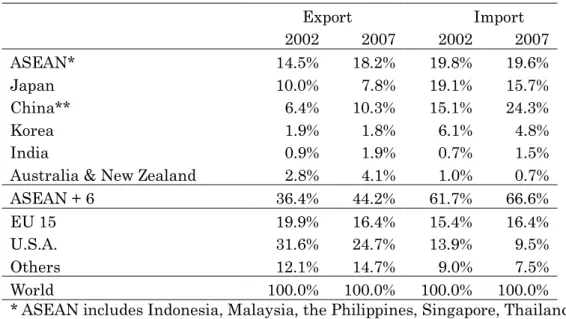
goods, and final goods, a striking result can be found in terms of a shift of the production base in the world. Advanced countries’ shares of final goods exports declined between 2002 and 2007 (see TABLE 1). Japan’s share decreased from 10.0% to 7.8%, the EU15’s from 19.9% to 16.4%, and that of the U.S.A. from 31.6% to 24.7%. On the other hand, China’s share (including Hong Kong and Macau) increased from 6.4% to 10.3%, that of the ASEAN (Indonesia, Malaysia, the Philippines, Singapore, Thailand and Vietnam) rose from 14.5% to 18.2%, and India’s climbed from 0.9% to 1.9% in the same period. Thus, the share of advanced countries (U.S.A., EU 15 and Japan) decreased from 61.5% to 48.9% while that of Asian developing countries (China, ASEAN and India) increased from 21.8% to 30.4% between 2002 and 2007.
TABLE 1: COUNTRY SHARE OF FINAL GOODS TRADE Export Import 2002 2007 2002 2007 ASEAN* 14.5% 18.2% 19.8% 19.6% Japan 10.0% 7.8% 19.1% 15.7% China** 6.4% 10.3% 15.1% 24.3% Korea 1.9% 1.8% 6.1% 4.8% India 0.9% 1.9% 0.7% 1.5% Australia & New Zealand 2.8% 4.1% 1.0% 0.7% ASEAN + 6 36.4% 44.2% 61.7% 66.6% EU 15 19.9% 16.4% 15.4% 16.4% U.S.A. 31.6% 24.7% 13.9% 9.5% Others 12.1% 14.7% 9.0% 7.5% World 100.0% 100.0% 100.0% 100.0% * ASEAN includes Indonesia, Malaysia, the Philippines, Singapore, Thailand
and Vietnam.
** China includes Hong Kong and Macau. Source: UN COMTRADE
This trend can also be observed in the trade of intermediate goods, which are necessary in order to produce final goods. Japan’s import share of intermediate goods
3
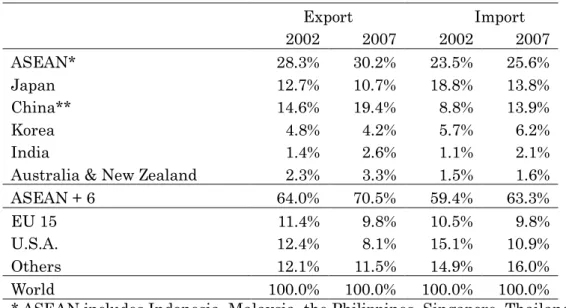
shrank from 18.8% in 2002 to 13.8% in 2007 (see TABLE 2). The shares of the U.S.A. and EU 15 also diminished from 15.1% to 10.9% and from 10.5% to 9.8%, respectively. China’s share, however, expanded from 8.8% to 13.9%, that of ASEAN broadened from 23.5% to 25.6% and India’s increased from 1.1% to 2.1%. In sum, the share of the advanced countries (U.S.A., EU 15 and Japan) shrank from 44.4% to 34.5% while that of the Asian developing countries (China, ASEAN and India) enlarged from 33.4% to 41.6% in the same period.
As for the supply side of intermediate goods, the export shares of Japan, EU 15 and the U.S.A. all decreased, falling from 12.7% to 10.7%, 11.4% to 9.8% and 12.4% to 8.1%, respectively. On the contrary, the shares of China, ASEAN and India enlarged from 14.6% to 19.4%, 28.3% to 30.2% and 1.4% to 2.6%, respectively. In short, the decline for advanced countries was from 36.5% to 28.6% and the increase for Asian developing countries was from 44.3% to 52.2%. In fact, today more than half of intermediate goods are produced in Asian developing countries. These results indicate that the world’s production base is really shifting to Asia.
Another fact that might seem surprising is the shift taking place in world demand and consumer markets. From the demand side for final goods, it is notable that import markets are also changing (see TABLE 1 again). Japan’s share of final goods imports declined from 19.1% in 2002 to 15.7% in 2007, while that of the U.S.A. dropped from 13.9% to 9.5% in the same period. Only the share of EU 15 increased, rising slightly from 15.4% to 16.4%. China’s share, on the contrary, surprisingly increased from 15.1% to 24.3%. India changed from 0.7% to 1.5% and ASEAN from 19.8% to 19.6%. The result is that the share of advanced countries as consumers has declined from 48.4% to 41.6%, while that of Asian developing countries has greatly
4
augmented from 35.6% to 45.4%, exceeding the advanced countries. This crucial shift is taking place in global trade and world markets, and it will continue considering the huge populations of China and India and the emergence of the middle class in these Asian countries.
TABLE 2: COUNTRY SHARE OF INTERMEDIATE GOODS TRADE Export Import 2002 2007 2002 2007 ASEAN* 28.3% 30.2% 23.5% 25.6% Japan 12.7% 10.7% 18.8% 13.8% China** 14.6% 19.4% 8.8% 13.9% Korea 4.8% 4.2% 5.7% 6.2% India 1.4% 2.6% 1.1% 2.1% Australia & New Zealand 2.3% 3.3% 1.5% 1.6% ASEAN + 6 64.0% 70.5% 59.4% 63.3% EU 15 11.4% 9.8% 10.5% 9.8% U.S.A. 12.4% 8.1% 15.1% 10.9% Others 12.1% 11.5% 14.9% 16.0% World 100.0% 100.0% 100.0% 100.0% * ASEAN includes Indonesia, Malaysia, the Philippines, Singapore, Thailand
and Vietnam.
** China includes Hong Kong and Macau. Source: UN COMTRADE
2. LIBERALIZATION OF TRADE AND INVESTMENT AND INTEGRATION IN EAST ASIA
2.1 ASEAN
ASEAN, or the Association of Southeast Asian Nations, was established in 1967 with five countries (Indonesia, Malaysia, the Philippines, Singapore and Thailand), initially to fight against the infiltration of communism. The group changed from a political one to a more economic association and Brunei (Darussalam) joined in 1984.
5
Then in the 1990s, the Mekong River basin countries became members of ASEAN: Vietnam in 1995, Myanmar and Lao PDR in 1997, and Cambodia in 1999.
Back in 1992, ASEAN members decided to form a free trade area in 15 years based on the Singapore Declaration, resolving to call it the ASEAN Free Trade Area (AFTA). This agreement went into effect in 1993, with the intention at first to phase out tariffs in the region by 2008.
AFTA is not a customs union with a common tariff on imports. For goods produced within the ASEAN region, ASEAN members are to apply a tariff rate of 0 to 5 percent (the latecomer ASEAN members of Vietnam, Myanmar, Lao PDR and Cambodia were given a prolonged period to implement rate reductions). This is known as the Common Effective Preferential Tariff (CEPT) system. Generally, goods originating within the region should include at least 40 percent local ASEAN content. Other “AFTA Plus” activities such as the elimination of non-tariff barriers, harmonization of tariff codes and development of common product certification standards were also initiated. In addition, services trade is to be liberalized (ASEAN Framework Agreement in Services, 1995). In 2003, the tariff reduction process was accelerated and ASEAN members agreed to set tariff rates on virtually all imports at zero by 2010 for the forerunner members of the association and by 2015 for the four latecomer members. The CEPT system has since increased ASEAN’s intra-regional trade enormously.
The integration goals of ASEAN were first presented in 1997 under “ASEAN Vision 2020.” The aim was to integrate the ASEAN Economic Community (AEC), ASEAN Security Community (ASC), and ASEAN Socio-Cultural Community (ASCC). This was endorsed at the Bali ASEAN Summit in 2003 (Bali Concord II). Especially, an
6
AEC is to be created by 2015, and the Cebu Declaration that was signed in 2007 affirms a commitment to accelerate the establishment of an integrated ASEAN community in view of the favorable progress of AFTA. The “ASEAN Economic Community Blueprint” showing the ambitions for an AEC was presented in November 2007 at the ASEAN Singapore Summit.
The “Blueprint” (see TABLE 3) consists of four pillars: (1) single market and production base, (2) competitive economic region, (3) equitable economic development, and (4) integration into the global economy. The first pillar involves liberalizing the region in terms of goods and services trade (or full achievement of CEPT-AFTA), and as a result, transforming the region into the world’s production factory as well as a single market. The second pillar establishes a more competitive atmosphere by promoting a competition policy, consumer protection, intellectual property rights, infrastructure development, tax reform and e-commerce. The third pillar is for reducing the development gap between forerunner and latecomer countries in ASEAN. Catch-up programs of the so-called CLMV countries or Cambodia, Lao PDR, Myanmar and Vietnam are designed in line with small and medium enterprise developments and the Initiative for ASEAN Integration. The forth pillar aims for ASEAN to be smoothly integrated into the world economy, such as through synergy effects of the FTAs, and for the region to participate in the global supply chain.
The “Blueprint” lays out a strategic schedule for each policy step to advance the AEC from 2008 to 2015 as planned by the ASEAN Secretariat. Also in 2007, the ASEAN Singapore Summit agreed on an “ASEAN Charter” for regulating secretarial procedures, chairmanship, resident ambassadorship, dispute settlements, establishment of a human rights organization, and other important rules for member countries.
TABLE 3: ASEAN ECONOMIC COMMUNITY BLUEPRINT Strategic Schedule
1. Single Market and Production Base 2. Competitive Economic Region 3. Equitable Economic Development 4. Integration into the Global Economy
Source: ASEAN Secretariat.
Liberalisation:
Tariff and NTB elimination
Free flow of goods
Facilitation:
Customs integration;
Standards and technical barriers to trade
Free flow of services
Free flow of investment
Free flow of capital
Coherent approach towards external economic relations
Common FTA regional approaches and synergy with bilateral FTAs; Common approaches to international treaties
Initiative for ASEAN Integration (IAI)
IAI programs; ASEAN self- help programs
Competition policy
Fair Trade; Network of competition authorities Consumer protection Establishment of consumer protection mechanism; Network of consumer protection agencies Intellectual property rights Process modernization Copyright acknow- ledgement notification Alliance and network-- ing of enforcement agencies
Taxation
Network of bilateral agreements on avoid- ance of double taxation
Infrastructure development Transport; Information infrastructure; Energy; Infrastructure financing E-commerce
ASEAN framework for harmonized legal infra- structure for e-contract and dispute resolution
SME development
Accelerate the pace of SME deve- lopment;
Enhance the com- petitiveess, Strengthen the resi- lience and increase the contribution of ASEAN SMEs
Free flow of skilled labor
Priority integration sectors
Sectoral approach to focus its limited resources on rapid and deep integration in critical areas
Liberalisation
Full market access & national treatment; Substantially remove all restrictions on trade in services
Facilitation
MRAs on professional services; Professional exchange
Liberalisation
All industries/ services incidental to these industries to ASEAN investors
Facilitation
Transparency; Streamlined procedures; Avoidance of double taxation; and Joint promotion
Liberalisation
Relax capital control measures on intra-ASEAN portfolio investment
Facilitation
Exchange information; Studies on impact; and Enhance withholding tax structure;
Liberalisation
Remove discrimination on employment
Facilitation
Harmonization of standards in education and training; MRA on vocational training
Food, agriculture and forestry
Enhance trade and long term competitiveness of ASEAN food, agriculture and forestry products;
Promote cooperation with international, regional organizations and private sectors Enhanced participation in global supply networks
Higher regional value added;
Productivity and R&D; Commercialization & marketing best practices
KEY TO ASEAN ECONOMIC COMMUNITY BY 2015
Political will;
Coordination and resource
mobilization;
Implementation arrangements; Capacity building and
institutional strengthening; and
Public and private sector
8
2.2 ASEAN as a Trade and Investment Hub
Considering the rapid growth potential, formidable liberalization progress, and large population of approximately 600 million in the ASEAN 10 countries, surrounding nations could not ignore the region’s economic capability as a trade partner. China moved first, then Japan, South Korea (Korea hereafter), Australia and New Zealand, and India. That means ASEAN has become a trade hub of Asia. The real reason behind this is discriminatory treatment in tariffs. Consider, for example, that Korea has an FTA with ASEAN but Japan does not. By using such FTA, a Korean factory in Thailand can import LCD panels from Korea without paying tariffs and export the finished TVs to other ASEAN countries also without paying tariffs by using AFTA. On the other hand, a Japanese factory in Thailand has to pay tariffs for its import of LCD panels from Japan. As a result, Japan loses price competitiveness in the ASEAN market against Korea. Thus, neighboring countries have entered into FTAs with ASEAN in order to obtain advantages from these networks.
2.2.1 China
It is amazing that China entered into an agreement with ASEAN on well-designed comprehensive economic tie-up plans in 2002, just one year after it joined the WTO in 2001. This was called the “Framework Agreement on Comprehensive Economic Cooperation between the Association of Southeast Asian Nations and the People’s Republic of China.” The “Framework” outlined agreements to be reached in trade liberalization within 10 years regarding goods, services and investment, as well as agreements in certain aspects of economic cooperation. Furthermore, prior to the start of tariff reductions, it was agreed to implement an Early
9
Harvest Program to accelerate integration of trade on certain primary products. Included in the program were such products as live animals, meat and edible meat offal, fish, dairy products, other animal products, live trees, edible vegetables, and edible fruits and nuts. The timeframes and speed of tariff reduction and elimination depended on the product categories. The program was supposed to be finished by 2006.
The ASEAN-China FTA on goods was agreed by both parties in 2004 and went into effect in July 2005. An ASEAN-China FTA on services was agreed in 2007 and became effective in July 2007. An investment agreement between ASEAN and China was signed in 2009 and entered into force in January 2010. Thus, the ASEAN-China Free Trade Area (ACFTA) was fully achieved. ACFTA covers about 1.9 billion people and US$6,000 billion in terms of GDP, making it the largest free trade area in the world. Tariff reductions are to drop to zero for approximately 7,000 products, or 93% of tradable goods, in 2010 for the forerunner ASEAN countries. For the four latecomer ASEAN countries, zero tariffs are to be applied by 2015.
The influence of the ACFTA is immeasurable. China can enjoy tropical primary products, mineral products, natural gas (from Myanmar) and high-tech parts and components from ASEAN, while ASEAN can benefit from cheap consumer products and heavy industry products from China. Chinese investment in ASEAN will increase due to the commercial and cultural ties through overseas Chinese living in the region. Moreover, the Chinese Yuan will penetrate into ASEAN as a trading currency.
2.2.2. Japan, Korea, Australia & New Zealand, and India
Japan followed China in 2003, signing a “Framework for Comprehensive Economic Partnership between the Association of Southeast Asian Nations and Japan.”
10
Also called the ASEAN-Japan Comprehensive Economic Partnership (AJCEP), this agreement is comprehensive and includes trade liberalization packages on goods and services, investment and economic cooperation. All participants had signed AJCEP by the end of 2008. As of August 2010, all ASEAN member countries except Indonesia had ratified it in their own legislatures and AJCEP became effective.
Japan immediately liberalized 90% of trade goods with zero tariffs, and within 10 years will have done so on 93%. Meanwhile, the ASEAN 6 countries (Brunei, Indonesia, Malaysia, the Philippines, Singapore and Thailand) will carry out immediate eliminations or phase-out reductions on 90% within 10 years. Vietnam promises tariff elimination of up to 90% within 15 years, while the CLM countries are targeting up to 85% within 18 years.
Korea followed Japan with respect to ASEAN negotiations. A framework agreement similar to that of China and Japan was signed by both parties in 2005 (“Framework Agreement on Comprehensive Economic Cooperation among the Governments of the Member Countries of the Association of Southeast Asian Nations and the Republic of Korea”). With that as a basis, an agreement on trade in goods was signed by Korea and ASEAN member countries except Thailand in 2006. In 2007, an agreement on trade in services was signed, also with the exception of Thailand. Thailand joined on both goods and services in February 2009. The agreement on investment among all ASEAN countries and Korea was signed at Jeju-Do, Korea, in June 2009, accordingly satisfying all framework promises. The ASEAN-Korea Free Trade Area (AKFTA) on trade in goods became effective in July 2007, and it stipulates the elimination of tariffs on virtually all items by 2012 among forerunner ASEAN countries and Korea. The AKFTA on trade in services went into force in May 2009.
11
Australia and New Zealand had the same idea in regard to an FTA. In 2004 at Vientiane, they committed to the “Joint Declaration of the Leaders at the ASEAN-Australia and New Zealand Commemorative Summit.” In this declaration, the commencement of negotiations on an ASEAN-Australia and New Zealand Free Trade Area (AANZFTA) was announced. Finally, the AANZFTA was signed among related countries in 2009 as the “Agreement Establishing the ASEAN-Australia New Zealand Free Trade Area” at the Economic Ministers Meeting in Cha-am, Thailand. The AANZFTA is more comprehensive than the AJCEP because it covers trade in goods, services (including financial and telecommunication), electronic commerce, investment, economic cooperation, and intellectual property rights, among other areas. It is also a region-to-region agreement. This is also the first FTA that Australia and New Zealand have jointly negotiated with another region, ASEAN in this case.
The AANZFTA entered into force January 1, 2010 for eight countries (Brunei, Malaysia, Myanmar, the Philippines, Singapore, Vietnam, Australia and New Zealand). It became effective for Thailand on March 12, 2010. The remaining three countries of Cambodia, Indonesia and Lao PDR are expected to ratify it within 2010.
Regarding India, the impetus first came from the ASEAN-India Summit at Phnom Penh in 2002, in which an “ASEAN-India Regional Trade and Investment Area (RTIA)” was announced as a long-term objective. Then the “Framework Agreement on Comprehensive Economic Cooperation between ASEAN and India” followed in 2003. This agreement indicated the start of negotiations toward establishing an ASEAN-India Free Trade Area (AIFTA) in terms of trade in goods and services, investment, and economic cooperation. The agreement also included an Early Harvest Program of 26 items between 2004 and 2007. (Due to a difference of opinion on Rules of Origin, the
12 program could not be implemented.)
Liberalization of trade in goods was first agreed between ASEAN and India in 2009 as the “Agreement on Trade in Goods under the Framework Agreement on Comprehensive Economic Cooperation between the Association of Southeast Asian Nations and the Republic of India.” Other issues such as trade in services and investment in AIFTA were carried over to subsequent negotiations, with August 2010 as the target for conclusion. Currently, an AIFTA on trade in goods with respect to India, Malaysia, Singapore and Thailand has come into force as of January 1, 2010.
3. JAPAN’S PARTICIPATION
Japan took both bilateral and integration approaches for its trade and investment policies. For a bilateral approach, Japan negotiates FTAs or Economic Partnership Agreements (EPAs) with individual countries. The other approach involves Japan taking the initiative to achieve economic integration with multiple countries such as ASEAN + 3 (China, Korea and Japan), ASEAN + 6 (Australia, China, India, Korea, New Zealand and Japan), and the Asia-Pacific Economic Cooperation (APEC).
3.1 Bilateral EPAs
Japan’s agreements are wider than FTAs because they cover not only trade in goods and services but also skilled-labor movements, government procurement, intellectual property, safeguard measures, dispute settlement, investment, and economic cooperation. That is why Japan prefers the term EPAs to FTAs. Japan, at present, has 11 signed EPAs, five others under negotiation and one more for which research has started. The 11 EPAs are with Singapore, Mexico, Malaysia, Chile, Thailand, Indonesia, Brunei,
13
TABLE 4 JAPAN: EPAs ALREADY ENTERED INTO FORCE COUNTRY OR REGION SIGNED IN EFFECTIVE FROM NOTES
Singapore January 2002 November 30, 2002 Amendments in 07 and 08 Mexico September 2004 April 1, 2005 Some tariff quota added
in 07. Malaysia December 2005 July 13, 2006
Chile March 2007 September 3, 2007
Thailand April 2007 November 1, 2007 Indonesia August 2007 July 1, 2008
Brunei June 2007 July 31, 2008
ASEAN All finished in
April 2008
Japan, Singapore, Lao PDR, Vietnam and Myanmar: Dec. 1, 08; Brunei: Jan. 1, 09; Malaysia: Feb. 1, 09; Thailand: Jun. 1, 09; Cambodia: Dec. 1, 09; and the Philippines: Jul. 1, 10.
Indonesia not yet ratified.
Philippines September 2006 December 11, 2008 Switzerland February 2009 September 1, 2009 Vietnam December 2008 October 1, 2009
14
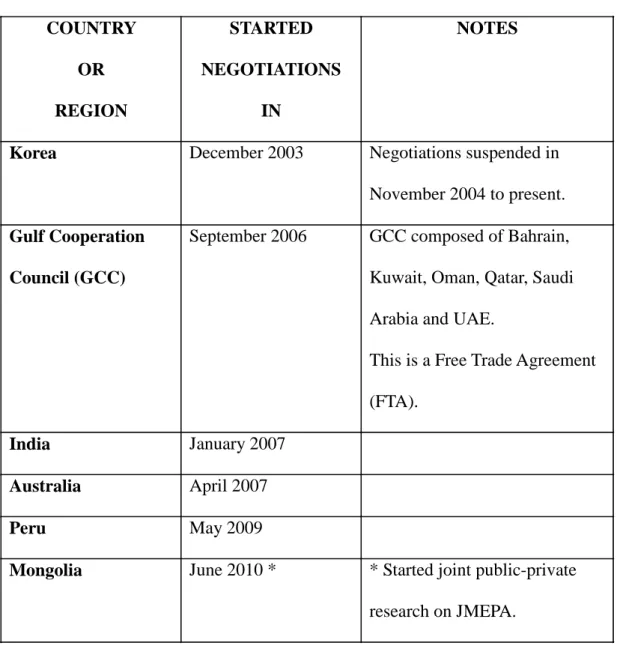
TABLE 5 JAPAN: EPAs UNDER NEGOTIATION COUNTRY OR REGION STARTED NEGOTIATIONS IN NOTES
Korea December 2003 Negotiations suspended in
November 2004 to present.
Gulf Cooperation Council (GCC)
September 2006 GCC composed of Bahrain,
Kuwait, Oman, Qatar, Saudi
Arabia and UAE.
This is a Free Trade Agreement
(FTA).
India January 2007
Australia April 2007
Peru May 2009
Mongolia June 2010 * * Started joint public-private
research on JMEPA.
Source: Ministry of Foreign Affairs.
ASEAN, the Philippines, Switzerland and Vietnam (see TABLE 4). The five being negotiated are with Korea; the Gulf Cooperation Council (GCC) that consists of the Kingdom of Bahrain, the State of Kuwait, the Sultanate of Oman, the State of Qatar, the Kingdom of Saudi Arabia and the United Arab Emirates (UAE); India; Australia and Peru. In addition, Japan and Mongolia started joint public-private research on an EPA in June 2010 (see TABLE 5).
15
Korea is also very active in engaging in bilateral FTAs with other countries/regions. It now has five FTAs in effect, these being with Chile, Singapore, ASEAN, India, and the European Free Trade Association (EFTA). Korea has concluded FTA negotiations with the U.S.A. and the EU, and is in negotiations with eight countries/regions: Canada, Mexico, Australia, New Zealand, Peru, Colombia, Turkey and the GCC. Furthermore, seven countries/regions are considering forming FTAs: Japan, China, China-Japan, Russia, Israel, the Southern African Customs Union (SACU), and MERCOSUR or the Southern Common Market made up of Argentina, Brazil, Paraguay and Uruguay.
3.2 Integration Efforts
The Asian financial crisis of 1997-98 made policy coordination and alignment necessary among Asian countries. ASEAN invited China, Japan and Korea to organize the first ASEAN + 3 Summit at Kuala Lumpur in 1997. One of the achievements from this effort was the Chiang Mai Initiative (CMI) financial scheme created between 1999 and 2000. The ASEAN + 3 Summit in 2004 agreed to organize an East Asian Summit (ASEAN + 6). The first East Asian Summit (EAS) was held at Kuala Lumpur in December 2005. The 16 EAS participants were the ASEAN 10 countries, Australia, China, India, Japan, Korea and New Zealand. The Kuala Lumpur Declaration of the Summit first mentioned that the EAS countries would offer a base to “promote community building in this region.”
Japan took the initiative under the Liberal Democratic Party (the third Koizumi, Abe, Fukuda and Aso cabinets between 2006 and 2009) to be the architect of an East Asian Community. The East Asian Initiative by the Japanese Government (mainly
16
formulated by the Ministry of Economy, Trade and Industry) consists of two parts: liberalization and integration through a Comprehensive Economic Partnership for East Asia (CEPEA) and policy research and capacity building through an Economic Research Institute for ASEAN and East Asia (ERIA). The Initiative was proposed to the EAS in January 2007. The establishment of ERIA, a new international research organization, was approved at the Singapore EAS in November 2007 and the institute was set up in Jakarta in June 2008 with the full financial support of the Government of Japan. The Government of Indonesia then endorsed ERIA as an international organization in December 2008.
ERIA has two objectives: first for policy research and recommendation of the research results to ministerial meetings or summits (EAS), and second on capacity-building programs for policy makers, especially in the newest ASEAN member countries (CLMV). The research activities of ERIA in 2009 covered 10 projects that are deeply related to three critical issues: integration, development gaps and sustainable development. One of the eye-catching projects is the Comprehensive Asian Development Plan (CADP) in cooperation with the Asian Development Bank (ADB) and the ASEAN Secretariat. It aims for a comprehensive East Asian economic plan that would accelerate the region’s development and market expansion, as an engine of growth for strengthening the world economy that has been severely damaged by the Lehman Shock and the financial crisis in Greece. CADP provides a grand design for economic infrastructure and industrial spatial distribution, and also includes model simulation analyses on the economic effects of planned large network corridor constructions.
17
countries and training courses such as the six-month course for CLMV bureaucrats provided by the IDE Advanced School (IDEAS) in Japan.
Using these instruments, Japan strongly supports such economic integration as the ASEAN Economic Community by 2015 and the East Asian Community (ASEAN + 6) in the future.
CONCLUDING REMARKS
East Asia is becoming the world’s largest production center and consumption market. ASEAN will soon transform into an economic community called the AEC. Moreover, ASEAN has been developing into a trade and investment hub in East Asia, as Australia, China, India, Japan, Korea and New Zealand have completed FTAs/EPAs with the region. ASEAN itself has concluded FTAs among its members in the form of AFTA. This signifies that the region is becoming the largest and freest trade area in the world. Therefore, intra-regional trade and investment will enormously increase (see FIGURE A).
However, some problems are also arising, as follows: (1) Spaghetti bowl effect
Regarding the ASEAN 10 countries, they have AFTA among them and now they enjoy FTAs/EPAs with China, Japan, Korea, Australia and New Zealand, and India. Moreover, these surrounding countries have bilateral FTAs/EPAs with some ASEAN countries. For example, Japan has bilateral EPAs with Brunei, Indonesia, Malaysia, the Philippines, Singapore, Thailand and Vietnam (see also Figure A). Korea maintains a bilateral FTA with Singapore; China and India also with Singapore; Australia with Singapore and Thailand; and New Zealand with Malaysia, Singapore and Thailand. (In
18
FIGURE A: ASEAN AS A TRADE HUB
Source: Author’s drawing.
FTA FTA
FTA EPA
Bilateral EPAs:
Brunei, Indonesia, Malaysia, Philippines, Singapore, Thailand and Vietnam FTA CER CHINA KOREA JAPAN NEW ZEALAND AUSTRALIA INDIA ASEAN10 AFTA
addition, six countries are also arranging FTAs/EPAs among themselves. For instance, Japan is negotiating bilateral EPAs with Korea, India and Australia, while China completed its FTA with New Zealand and is negotiating an FTA with Australia.) There is a tremendous confusion about which FTAs/EPAs will apply. Even customs officers do not know which tariff rate should apply for a specific product and which Rules of Origin are relevant, as so many agreements are replicated without doing so in an integrated manner. This is called the “spaghetti bowl effect.”
19 (2) Mega-competition in industry
ASEAN is becoming a major trade and investment hub. With respect to manufacturing industries, this represents an attractive opportunity for surrounding nations to invest in one of the ASEAN countries to manufacture products and then export them to other countries in the area. For instance, a Chinese electronics company can invest in Thailand to make finished products. Theoretically, this Sino-Thai factory can manufacture these products by importing parts and components from China with zero tariffs using the ACFTA, and also by importing other parts and components from ASEAN countries without tariffs using AFTA. The factory can then export the finished products to, for example, India without paying that country’s tariffs by using AIFTA. Australia, India, Japan, Korea and New Zealand can operate in the same manner of using ASEAN as a production base.
This means, however, that competition becomes very severe among them. In particular, ASEAN countries have to compete with these surrounding countries. They have to search for their own suitable manufacturing sectors or some production processes that have comparative advantages. The result will be the replacement, reallocation, repositioning, geographical realignment and reorganization of industry. In other words, vertical as well as horizontal division of labor takes place in the region as a whole. And, an era of mega-competition arrives. Special attention, in this context, should be given to the latecomer ASEAN countries, meaning the CLMV countries.
(3) Agriculture
The same thing will happen in agriculture. It is said that small but low-cost agricultural countries can gain in a fully liberalized world by exporting their agricultural
20
products. However, this is not necessarily so, as such countries sometimes face the inability to supply constantly and in large volumes with prompt delivery. Instead, Australian or New Zealand agricultural products may dominate in the region. Notwithstanding, of course, that FTAs/EPAs can permit the inclusion of exceptions to tariff elimination for sensitive categories such as agricultural products. Still, the reallocation of agriculture is inevitable, and new types of agriculture will appear such as contract farming across borders.
(4) Labor and migration issues
If an income gap exists, people will illegally migrate to seek higher income. It is said, for example, that Thailand has more than 2 million illegally migrated laborers from neighboring countries. Liberalization may cause the income gap among countries to expand. Programs such as the Initiative for ASEAN Integration in the AEC “Blueprint” are necessary for narrowing the income gap between forerunner and latecomer ASEAN countries. At the same time, programs for the re-training and re-education of unskilled laborers are in dire need.
(5) Political and border disputes
There are several concerns about political issues in regard to achieving smooth integration. Myanmar’s military government will have a general election this year (November 7, 2010) but there is great worry that it will not be done democratically. There are also border disputes, such as those between Thailand and Cambodia on the Preah Vihear Temple, between China and Vietnam on the Paracel Islands, and also among surrounding countries regarding the Spratly Islands. Even so, it is highly
21
expected that these issues will not hinder integration process such as the AEC.
(6) Environmental destruction
As seen from the experiences of advanced industrialized countries, environmental destruction is inescapable when development accelerates. Japan, for example, was notorious for the so-called “Minamata disease” caused by water pollution in the 1950s and 1960s. This was brought on by a chemical company’s dumping of mercury into Minamata Bay. If economic growth accelerates, air and water pollution, land contamination, and soil erosion will also increase in the region. “Green economies” are needed to help free the environment from destruction. East Asia is proud of its natural beauty and rich tourism resources, including the fact that it is home to the 10th longest river in the world, the Mekong. We should protect our natural resources and promote suitable usage of this waterway.
(7) Participation of U.S.A. and Russia in EAS
The ASEAN Foreign Ministers Meeting held in Hanoi on July 20, 2010, agreed that ASEAN would invite the U.S.A. and Russia to become members of the East Asian Summit (New EAS or ASEAN + 8), possibly by 2011. The main reason for this decision could be security issues. In particular, ASEAN is concerned over expansion of the Chinese Navy in the South China Sea and the Indian Ocean. It was also likely that the new Japanese government under the Democratic Party will keep the U.S.A. at a distance. It is said that Russia has wanted to be a member of the EAS since its establishment. The participation of the two big powers would completely change the balance in the region.
22
examples such as the North American Free Trade Agreement (NAFTA) in the North American region and MERCOSUR in South America. China seems to be promoting the idea of ASEAN + 3 and, as has been explained previously in this paper, Japan wants ASEAN + 6. (The Hatoyama cabinet mentioned an “East Asian Community” but the intended meaning was probably ASEAN + 3. The Kan’s approach to this issue has not yet been clear). At the least, the participation of two big powers will affect Japanese and Chinese initiatives to form an integrated community within East Asia.
23
REFERENCES
Mitsuhiro Kagami, Policy Recommendations of the ERIA Study Project (FY2007), BRC Discussion Paper Series No. 1, Bangkok Research Center, IDE-JETRO, 2008.
Mitsuhiro Kagami (ed.), Economic Relations of China, Japan and Korea with the Mekong River Basin Countries, BRC Research Report No. 3, Bangkok Research Center,
IDE-JETRO, 2010 or see http://www.ide.go.jp/English/Publish/Download/Brc/index.html http://www.asensec.org/4920htm http://www.mofa.go.jp/policy/economy/fta/index.html http://www.mofat.go.kr/english/econtrade/fta/issues/index2.jsp http://english.mofcom.gov.cn/aarticle/newsrelease/significantnews/201003/2010030681 2606.html http://www.commerce.nic.in/trade/international_ta.asp?id=2&trade=i http://www.dfat.gov.au/trade/ftas.html http://www.mfat.govt.nz/Trade-and-Economic-Relations/Trade-Agreements/index.php