Approaches to Economic Progress of Rural
Fisheries in the Developing Countries
著者
IWAKIRI Shigero
journal or
publication title
鹿児島大学水産学部紀要=Memoirs of Faculty of
Fisheries Kagoshima University
volume
23
page range
81-103
別言語のタイトル
発展途上国における村落漁業の経済的前進について
Mem. Fac. Fish., Kagoshima Univ. Vol. 23 pp. 81~103 (1974)
Approaches to Economic Progress of Rural Fisheries
in the Developing Countries.
Shigero Iwakiri*
Abstract
It seems difficult to achieve the planning of regional development in inshore fishing
area, by reason of imperfect methodology in the field of fisheries economics. According to the state of affairs our study should be devided into two parts.
Some economic ideas for the planning of rural fisheries development are described fran kly in the first part, and in the latter part, a certain system of fisheries production or fish marketing in the inshore communities are analyzed concretely, as a result of actual survey
in the Riau Archipelago.
The first par; Basic points of view on fisheries resources exploitation in the
developing countries.
A. Introduction
The objects of this report are not regarding on fisheries resource itself, but on the relationship between resource and mankind, that is the basic and principal problem with regard to the industrial development of living or new fisheries re s o u r c e s .
Although recently fisheries-economics has considerably made clear the ecologi
cal analysis of living resources, the subject of the study are limited in scope in the theoritical description of resources-conservation and optimum utilization, on
the assumption that the fixed quantity of resources and a certain standard of
fishing technique.
But in the case of unexploited sea, so many unknown factors of resources and so many kinds of fishing gears, that the state of affairs are variable and unpre cedented.
These are the reason why we cannot apply resource-economics to our study in this report and I should like to talk about industrial development of fisheries re
s o u r c e s .
When we talk about industrial development of fisheries resources, it refers to
extracting valuable commodities from biological resources, and the judgement or
decision on marketing values of the resources depend upon the economic situa
tion of each country or society. That is to say, that the type and scale of re
source-exploitation should be determined according to the economic policy of each country.
82 Mem. Fac. Fish., Kasoshima Univ. Vol. 23 (1974)
B.
Target of resources exploitation in the aspects of economic development policy
It goes without saying that, after finding new fisheries resources, considerable
national finance or private investment should be required for the purpose of ex
ploitation and utilization of the resources, therefore, establishment of industrial
target of fisheries-development must be asked at the beginning.
On the target of fisheries development we usually hear as follows : "Promotion
of self supply of animal proteinic food by fisheries product." or "Increasing of
common wealth of nation through fisheries development". These targets are not
industrial explanation but only political and abstract slogan.
The first reasonable target of fisheries-development is how to improve the liv
ing condition of several millions fishermen, who dwelling all around inshore area,
and as a result it should be done with the progress of domestic marketing of
fisheies products.
Obtaining foreign currency as second target, belong to the difference rule of economy from the first target, because one is concerned with production structure
and the other with marketing system.
C. Different types of fisheries management and economic scale in the fisheries devel
opment by reason of resources classification
At the general meeting of Economic Commission for Asia and the Far East in 1973, delegate of FAO explained on the result of green revolution which has been
main program for agricultural development in this area, as follows, "as the re
sult of this policy, unbulance of income between big scalefarmer and small
scale-farmer has gradually enlarged".
This is the important point to be taken care of the fisheries development in future, because this is the problems who and how can take charge of fishery develop ment.
General speaking, the categories of the fishery development should be classified by the condition of:
1. kind and f ertilitiy of the resources;
2. location of the fishing grounds;
3. market of the fishery products.
Inshore fishery because of the limited fishery resources must be operated by small scale fishermen, on the other hand offshore fishery resources should be exploited by the big scale enterprise.
D. Problems on the economic development of the fishing community
Although the fishing gear in the fishing community have kept small scale and low productivity, complicated composition of traditional fishing gear had kept a certain harmony with fisheries resources. It means that fishermen had conserved the resour
Iwakiri : Rural Fisheries in the Developing Countries 83
supported by the resources. This harmony had been continued not only by the
pasive fishing gear but also mutual control of operation in the fishing community.
As a result of the above mentioned we can understand two points:
1. In order to increase productivity or fishing efficiency by introducing new fish
ing gear, over-catching has to be avoided;
2. New inshore resource should be approached and exploited by each unit of com
munities.
The main obstruction on promoting of inshore fisheries communities, are old and
local religion, traditional custom and powerful of fish brokers or middlemen,
it seems very difficult to exclude the obstruction either by education or laws.
In order to provide productive function of community there are two course we
can consider: the easy course is to change dominator-class into the enterprise
with the financial aids; the second course is difficult, but it is important, to grew
up the economic character of the community with joint labour and joint property,
into production cooperative society.
E. Problems on the introduction of enterprise scale fishing
Usually a new and big enterprise will be set up through the cooperation of
foreign governmental credit or foreign private investment for the purpose of
developing the offshore or deep sea resources. In such a case, as a matter of
course, product and revenue should be shared according to the type of capital, and
the result will be very different.
Therefore, we have to point-out the importance
of fund programing and business management.
The next problem of resource exploitation in a big scale enterprise are as fol
lows : even if, fishing gears or boats will achieve modernization, it is difficult to
get success of the development with out enough equipment and facilities of rel
ative industry, infrastructure and replenish factory.
The last problem is marketing.
Mass production of enterprise scale of fishery
will premise large scale demand and international trade.
Therefore, marketing
will depend upon the difference of purchasing power or storage capacity and trans
portation capacity in each country, not only for the advanced countries but also
the developing countries.
This is the reason why to be consider about relation
ship between cost and price on one hand, or price and demand on the other.
F. Socio-economic role of the national fishery regulation to avoid a conflict on fishery among different subsectors of fishing industry
Japan has excelent achievement on regulation of domestic fisheries operation and
the adjustment and control of inshore fishing grounds, but had also made many
trouble in the international relation in fisheries. Therefore, we can apply many
things from Japanese history of these experiences. First, in this stage there are
few domestic regulation on fishing ground in the developing countries. When some
84 Mem. Fac. Fish., Kagoshima Univ. Vol. 23 (1974)
adjustment in order to protect local fishermen right, against the expansion of other
side, and to conserve the resource from excessive competition.
Second, geographically the major part of sea is surrounded by many countries.
Therefore, there must be an international regulation on exploiting the offshore
of resource for the purpose of equal utilization and optimum production. It should
be necessity of some kind of committee for the establishment of neutral regula
tion in countries-concerned.
G. Fish marketing and price formation
Fish marketing is also basic problem for fishery development because almost
all of the fishery products are not for self-consumption but for marketing.
In
actual condition in the developing countries, fish marketing has been taken charge
of by premodernise fish brokers and middlemen.
This situation is the result or
reflex of small and scattered units of production, so that it is difficult to stop the
function of fish brokers and middlemen by the administrative power.
One way to overcome this situation is how to change and mobilize the capital or
credit of fish brokers and middlemen into more profitable industries such as fish
processing, fish whole sale and related industries.
Concentration and joint-sale of fish, should be conducted by cooperative system,
under a finance assistance program.
At the same time there are problems of price stabilization not only for domes
tically but also internationally.
Usually price fluctuation of fish, is caused by price difference between:
1. place of production and consumption;
2. amount of catch, high or low;
3. kinds of species of catch;
4. production and transportation costs.
In order to curb the price fluctuation we have to do many investigation and
collection of data before we do administrative action.
Now, I have so far talk only about the principal ideas.
Actual program for
resource development needs many statistical analysis and economi calculation.
The latter part; Case study on economic structure of inshore fishing communities
in the Riau Archipelago.
I. Background
As is well known, Indonesia has emphasized the five year
development plan
(1969/70-1973/74) based on expansion of foreign credits and investments; in con
sequence the field of fishery is beginning some deep sea fisheries projects by loans
of from the World Bank or Japanese credit, but the subject of modernization of
rural areas in which a million fishermen are engaged in offshore or coastal fishe
ries should be more consideralbe in such a vast territory as this country.
Iwakiri : Rural Fisheries in the Developing Countries 85
to purpose.
The first one is the enterprise development type which will introduce
large scale fishing facilities disregarding the present fishing industry.
But the
second one is the regional development type, which will improve the local fishing
industry by using the fishermen and develop the regional social economy, basing
on the existing fishing villages.
Riau Archipelag of course, belongs to the second
type area, (see the Fig. 1)
The reason why Riau Archipelago is taken the priority of developmemnt in all
rural fishing areas, are as follows :
(a)
The Province of Riau has maintained the largest catch in this country,
and also keeps 70 % over the second placed provinces, Sulawesi Tengah 70
%. The 180.000 metric tons catch in the province of Riau during 1969 is
about 6 times as much as the average catch of all other provinces, 32.000
tons.
Further, the percapita annual catch of 12 tons discloses the highest
productivity in the whole country in this stage, (see table 1.)
(b)
The motorization of fishing boats in this province has been widely promoted
although only small outboard motor are used, it means the possibility for
introduction of mechanical fishing gear and expansion of fishing grounds,
(see table 1).
(c)
It should be mentiond particularly that the province of Riau
is not only
the largest exporting area of fresh fish to Singapore and Malaysia, but also
almost all fish for exportation are produced by household fishermen. They
are obtaining foreign currency without relation to governmental policy
at present.
Although the province of Riau has been given available help for fishing
production and marketing, fishermen in this area are gaining no reasona
ble rewards due to the existing marketing patern as mentioned later, so
that the reorganization of fisheries, should impact on rural economic de
velopment in Province of Riau.
The Province of Riau has two main fish producing areas.
Kabupaten
Kepul-auan Riau = Riau Archipelago with Tandjungpinang as centre is thriving through
fish exportation for Singapore, Kabupaten Bengkalis with Bagansiapi-api as centre
is sharing in exportation to Malaysia.
The contents of this report are limited as to the former by reason of the time
schedule on the project planning, and as for latter, the survey report will be com
piled at the earliest opportunity.
II.
Actual coidition of fishing operations in Riau Archipelago.
(A)
Outline of fishing operations geographical situation of Riau Archipelago
has been explained by provincial data as follows : The waters of Riau Ar
chipelago, extending over a surface of 176.530 km2, can be divided into
three main parts :
a. The waters along the East Coast of Sumatra. This area, which lies be
Fig. 1. Map of Riau Archipelago, Sumatra. w TO o a o
Iwakiri : Rural Fisheries in the Developing Countrs 87
with a muddy bottom. It has a quite heavy current (2-7km/hour). Due to the great influence of the rivers, the salinity of the water is about 28-30
%. A great abundance of fishes is found here, especially pelagio fishes i. e.
pari (day tadae), t jut jut (shark euselachi), udang (shrimp penaidae), teng-giri (scomberamoridae) belanak (mugilidae), and gulamah (scianeidae).
It is estimated that the area has a 9 ton fish output per km2 per year.
b. The sea between Batam and Lingga Distict, which is 10 to 40 meters deep,
with a muddy, sandy and rocky bottom, a heavy current and a salinity of about 30-32%, teri (anchovy-clupaidae), kuran (polyaemidae), tamban
(clu-paidae), sotong (holocentridae),
ikan merah, (lutjunidae) sea-weeds, sponge and pearlshells are found in
great abundance.
c. The South China Sea, which is 40-80 meters deep with a rocky bottom and
a salinity, which can reach 33 % due to the influence of the South China
Sea -water masses. This is the place where tuna shoals (such as skipyack
and yellowfin), trocha-shell and seaweeds are found. (Half of field (a) and
majority of (c) are excised in this report because (a) is subject of next
survey sche-duled to be held around Bagansiapi-api, and the fishing condi
tions of (c) belong to a different category for the purpose of this survey)
Now, about 13.000 fishermen are engaged in offshore or coastal fisheries. The
distribution of the main fishing area, the type of fishing methods and the kind
of sea products are classified as follows, (see table 2 and 3.)
m a m a r e a Bintan Selatan Bintau Timur Moro Tandjung Balai Karimun Senajang fishing gear gill-net
lift-net with light (big-size, middle size) gill-net
cill-net
lift-net with light (small size)
notice
gill-net Djaring ingsang timbul
lift-net with light (big size)-Kelong Batawi lift-net with light (middle size)-Kelong Kata lift-net with light (small size)-Kelong Pantai
Spanish mackeral tenggirir
Blue & gold fuslier parang2
kind of fish
Spanish Mackeral Blue & gold fausili er. Golden banded fausilier
anchovy
Mem. Fac. Fish., Kagoshima Univ. Vol. 23 (1974)
Golden banded fusilier Ekor Kuning
anchovy
(white bait herring) Ikan teri
shrimp Udang
Of course, there are many types of traditional fishing gear made of bamboo, tim ber and fibre, but gill-net and lift-net with large lights are effective for principal
occupation.
The details of operation are as follows, (see table 3)
-gill-net
fishing ground-Big size nylon net
5-6 days voyage
about 15 nights operation monthly
Small size net 3-4 hours navigation
about 15 nights operation monthly fishing gear
per unit Boat 9 m length and 1.2 m width, cost Rp.40.000
5-6 HP out-side engine, cost Rp.60.000
Net
300-600 m x 1.5 m, cost Rp. 120.000 (big size) nylon
(continue 3 years) or monofiament (continue 1 year).
fishing season: the whole year; June and July are the best months fishermen
per unit: 2 numbers
catch per unit: (a) 50-70 kg/daily x 15 nights/monthly x 12 months
-lift-net with light (big size)
construction
made up by wood and net annually, cost Rp. 200.000
(see figure) or Rp. 100.000
fishing ground...costly excepting regulated area by local authorities cnerned
operation term...the whole year
about 20 deys monthly fishermen per nuit-4-5 numbers
catch
... (a) 30 kg/daily x 20 days/monthly x lOmonths/annually
(B)
Ownership of fishing gear and fishermen earnings
The matters to be noticed are ownership of fishing gear and income of fisher
men, Usually, small miscellaneous gear belong to household fishermen themselves,
but almost of all lift-nets even gill nets are possessed by fish brokers which will
be explained afterward. The relation between fisherman and broker seems
to be a tenancy system. The situation should be clear by actual sample at some
village.
Moro area has one city and one sub-district of 17.000 populations including 10 %
fishermen. The fishing gear consists mainly of 300 gillnets which produce 100
tons of Spanish mackeral monthly. Fishermen who possess one unit gill-net with
a small boat and outboard motor run into debt not only from the expenses of
Iwakiri : Rural Fisheries in the Developing Countries 89
ELT.
Actual conditions of fish marketing
(A) Utilization and distribution of catches
Catches around Riau Archipelago are roughly utilized for fresh fish and salted
& dried fish, and divided into the use of export, domestic supply and local consum
ption. Tenggirir, Kakap, E. Kuning, Kerapu and udang which are mainly caught
by gill-net, lift-net (big size), are monthly exported to Singpore in the form of fresh
fish.
A part of fish is exported also in the form of salted & dried processing due
to unavailability of cold storage facilities.
Ikan Teri, Tamban, which are caught mainly by Kelong net, are mostly pro
cessed into low-grade salted & dried fish in the nearly fishing villages, and sent
to Palembang, Djakarta and other towns. Many other fishes of small type or los
volved, which are unable to collect in large volume, are consumed in the local
markets in the form of fresh fish.
From the table no 4 and 5 details of exportation and distribution of the salted
and dried fishes would be understood.
As to export figures, which is referred in the latter chapter, they seems to be
increased further 20-30 % in the actual figures due to a considerably large number
of smuggling. It might be, however, rather difficult to grasp the correct figures
only through the statistics.
(B) Form of collection and distribution of fresh fish.
The sales organization which handle these fishes are unaplicated, and observa
tion is tried to be given hereunder from the view point of local consumption and
exportation.As to local consumption, very small portion of fresh fish is sold directly on the
beach in the small fishing villages, but main portion is sent to the big towns, and
the remainder is processed into the salted & dried fish for broker's handling.
Explanation on the public market in Tg. Pinang, which is the most well equipped
fishing market in Riau Archipelago, will be tried as follows:
The collected fresh fish are mainly brought about through small scale of brokers,
who collect them from villages by way of purchase or consignment rather than
directly from fishermen on consignment bases.
As to the range of collection area, it is observed that 60 % of the total catch
is made around 30 miles off-shore from Tg. Pinang. Out of 40 % of the remainder,
the fish of commercial valus is directed for export, while dominant part of an
chovy etc. is processed into salted &dried fish.
About 50 °/o of more than 400.000 tons of fresh fish,
which is handled in this
market for one year, is not for local consumption, but for brokers.
The fresh fishes brought to the market are all fixed through the auction under
the controll of PKPI (Refer Note).
90 Mem. Fac. Fish., Kagoshima Univ. Vol. 23 (1974)
in kind many necessaries for life and foodstuffs on credit from fish brokers in
return for sale of all catch, so that they always have an outstanding debt. Even
the interest has to be paid on credit from fishermen to broker, but it is well
known that the purchase prices decided by fish brokers are beaten down always
to about 70 % of local market price.
On the other hand, there are a few fishing enterprises in Moro area like those elsewhere. For example, the largest company owns 60 units of gill-net with motor
boat (lay out of net is 600 meter x 1.5 meter, nylon made), 3 carrier boats of 60 tons
class, and one ice-making plant of 20 tons capacity daily, and is operated by 200 of owners distant according to the relatives Chinese large family system.
The company produce daily 6 tons Spanish mackeral in the season, and also as
fish broker = exporter, the company has collected fresh fish which is caught by
household fisherman all around the district.
Fishermen contracted with the company are paid not by cash wage but share
system, as follows, and the take-home pa3r of fisherman is estimated about Rp.
6.000 monthly in the season or Rp. 3.000 out of season.
classification of share Percentage of share
COMPANY 30 - 25^
Gear (company) 10-25
Fishermen 60-50
Almost all lift-nets are owned by fish broker as mentioned above, excepting a
very few which are common property of the community.
The following table
shows the actual relationship between some fish brokers at Tg. Pinang and fisher-mem engaged in the surrounding area.
number of brokers controlled village number of dweller number of fishermen engeged fishermen number of lift-net 1 KARAS GALANG 100 40 50 20 15' 15 3-4* 3 - 4 2 LOBAM 80 20 6 1 - 2 3 + 4 KIDJANG 150 70 20 4 - 5 chageable figure
The majority of fish brokers keep one or several villages under control, which
they have done for generations in, and in spite of a two ton catch of good price
fish or shrimp monthly per unit, the wage of fishermen engaged are no more than Rp. 30-40 daily in cash and subtidiary fish in kind.
Iwakiri : Rural Fisheries in the Developing Countries 91
but which is actually dominated by merchant including exporters who have retail corners in the market.
There are about 63 retail corners, and the right of use is transferable by pay
ment of Rp. 2.000 through lottery which is held every 3 month under sponsor
ship of PKPI.
PKPI also control settlement of payment together with 5 % of own commissions received from both seller and buyer.
Domestic distribution of the salted & dried fishes is made by brokers, who collect
goods directly from fishing villages by small carrier, then tranship them to the
big vessel in Tg. Pinang and Singapore basing on their contract with the big
scale of whole salers in Djakarta and Palembang. But no analysis in this regard
is attempted in this survey.
The route of collection and delivery of the exported fresh fish is illustrated
under:
Indonesian side Singapore side
1 2 3 5 6 7
Fishermen - Broker - Exporter agent - whole - Broker
4 saler retailer
agent
The problem in this route lies in the function of fish brokers.
There is big difference among these brokers in their scale : the smallest who is always found at least one in each village and works as sub-contractor of the big scale of brokers, while the biggest enjoys export arranged by themselves even pro
cessing own carriers.
The whole time brokers are less in number and mostly they are operating in
addition to trade or fishery works.
In this district, 35 brokers are said to be registered officially and all of them
are included in 60 member of exporters.
Collection route by fish brokers are divided into the following three categories:
(1) Production made by broker his own.
(2) Purchase from fishermen or fish market.
(3) Consignment from fishermen.
Purchase from fishermen dominants the main part (main purchase depends on
fishermen).
Although the purchasing prices are to be fixed once or twice a month, the way
of purchase itself is not always fair; fishermen are always bound to be in debt
since the payment is offset (calculated in exchange of) provisions, ice, and fishing gear from the unimproved relations of long-standing debt.
Sales on consignment is also done on the market order.
As there is no more up-to-date export organization than PKPI fishermen are always
92 Mem. Fac. Fish., Kagoshima Univ. Vol. 23 (1974)
means, the fishermen are suffering from double loss caused by both side of sales prices of fishes and purchase price of provisions.
Most of the brokers even the smallest with having own carrier of 3-4 or 7-8
tons can collect 2-3 tons of fresh fishes from fishing villages where they have
foot stand.
As mentioned above, there are many exporters who also work aside as broker. Among them, there are also many small scale, ones who who are nearly licence
holders, and not actually operate themselves, while there are bigger ones, who
export about 100 tons of fresh fishes a month through own products and purchase,
with processing of 3 carriers of 60-70 tons and ice making and cold storage facili ties.
All these brokers and exporters are not necessary to prepare operation fund
in cash, but depending on non-interest credit relations with fish dealers in Singa
pore which has been long established on kinship or landship.
Also their mutual relation is tightly united on guild system. Thus, each ter
ritory of influence is fixed and no competition among them is seen.
The head-ache to broker and exporter in general is uncertainty of shipping schedule of carrier.
Generally, brokers store fresh fishes for about 20 days in a wooden box while
contains in the ratio of one ton fish per one ton ice. But those who have not own
export carrier are compelled to utilize about 20 of Singapore flag carriers or
70 tons carrier of PKPI in Tg. Pinang with freight of Str. $ 200-250 per m/t or
20-30 % of the fish value.
The problem, however, lies in irregularity of carriers calling which mainly due to conditions of sea, delay of fish collection or engine trouble.
Of course, fundamental thing is that fishermen have no economic counter mea sures against big fluctuation of fish prices in Singapore, which must be given more serious consideration.
The unstable market prices which is to be referred to in the latter chapter, na
turally results in the cause of proverty of fishermen. Under the circumstances
where prices of fishes in Singapore fluctuate 100 % subject to demand and supply, and no storage facility in Indonesian side is always exposed to bargaining, which is far from "free competition".
From March to June in each year, the price reduction is quite occasional due to
increase of fish inflow from Philippine and Formosa into Singapore. This seasonal
fact naturally effects the shipping prices from Riau side. So. Riau side puts more
importance in September to December seasons.
(C) Troubles in export procedures.
The exporters who have collected fresh fish are all required to take
necessary procedures for export in the end. Those in Tg. Bari Karimun and
several number of large scale exporters in each place will do these procedures by themselves, but mostly they leave them to export agency under the control of
Iwakiri : Rural Fisheries in the Developing Countries 93
PKPI. PKPI has agent office in Tg.
Pinang conducts even
export on
consigne-ment basing on the confidence of near-by fishermen.
In Singapore on the other, there are also several import agents that are clas
sified into two :
(a) these who work as commission merchant and
(b) those who work as whole saler.
The relation between exporters in Riau and agent in Singapore seems to be
tightly connected on long-fostered traditional foundation.
The procedures of export are summarized as follows:
By request of import agent in Singapore, Indonesian Embassy in Singapore will
issue purchase order and then the export agent may start the procedures to follow.
In the above purchase order, the export price of fresh fish is fixed S. $ 1.600
and ship is S. $ 1.500 per m/t.
Actually however, there seems to be many mo
dification or adjustment on prices and export quantity which usually far bigger
than that of order. There are, therefore, several problems which are to be solved
in this export procedure.
The first thing to be pointed out is that the export procedure here is not done
by usual letter of credit but through more complicated ways which is easily con
nected with corruption. And no consideration to export of fresh fish seems to be
paid.
Since these problems are mostly concerned with administrative organization, fur
ther explanation in details to be of stained from.
However, it will easily be conjunctured from the fact that previously 314 signa
ture from the authorities conecrned are requested for only
one case of export procedure and even now still 150 are required for it. (although
simplification of such rule was in force by law of April 1970 issued by Ministry
of Trade, it has not been observed on the spot).
This must be one of the causes which have foster many small scale of smug
gler in the region.
At the same time, the problem on import system of TAPI (TANDA PENGEN AL IMPORT) to be solved from the view point of administration.
General importers and brokers, and even PKPI hold export licence (APE: ANGKA
PENGENAL EXPORT), but provisions, fishing gears, ice etc., which are badly needed for fishermen for production and livelihood, are prohibited to import legal
ly. So, they are compelled to use the unreasonable high cost of goods.
For instance, most of the ice used for storing fresh fishes is delivered from Singa
pore. The price is naturally about 10 % higher than that sold in Singapore, which
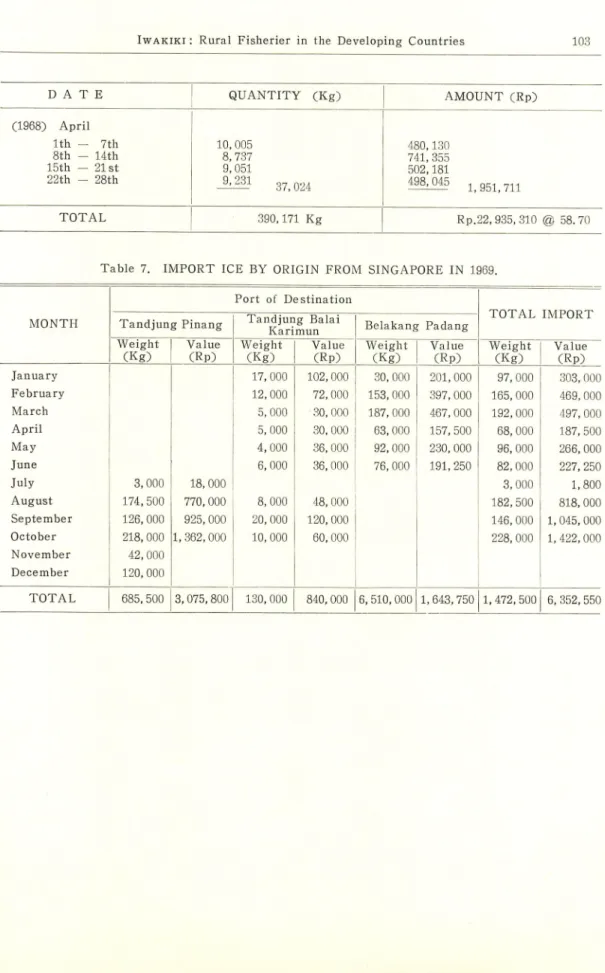
is about Rp. 7.500 to 8.000 per ton. (see tadle 7)
PKPI once conducted efficiently the import procedure of food stuffs, but after
prohibition of such importation the prices of fishing net etc., rise about 30 % which
94 Mem. Fac. Fish., Kagoshima Univ. Vol. 23 (1974)
(D) Problems in fish prices
The above mentioned pre-modernized character of fish marketing reflects adversely
to fixation of fish prices. Although the data from statistical analysis is in
sufficient, the problems can be summarized as follows:
Judging only from the retail prices in the consumption market, the price fluctua tion through a year and price fluctuation among each species of fish are in general
seemed to be not so big. This might come from the reason that there are low
stabilization of consumption, very small difference in quality and simplification of catching method.
However, the prices in the processing area are fluctuating badly by many rea s o n s .
The fluctuation of prices between good catch and poor catch moves more sharp
ly than the amount of catching quantity.
For exmple, the prices of Chinese Mackerel or shore-caught fish differ from Rp. 50 to 100 per kg. and so do the salted & dried fish from Rp. 65 to 145 per kg. In the remote places for fish collector, Rp. 40 for one piece of Skipjak in the
morning market drops to Rp. 15, - in the evening sale.
This fluctuation is by no means caused by lack of transportation and storage
facilities. The conditions are the same in the case of export.
Generally speaking, quality and price of export fish is far better than those of domestic sale, and the prices in auction effects not only to the exporter but also
to fishermen. The market prices in Singapore usually fluctuate depending on the
amount of supplying fish and quality of fish.
The average prices of one kati (625 grams) of Spanish Mackeral fluctuate from S $ 0.80 to S $ 0.30. It also goes without saying that the reason is found in the fact that there is no freezing, storing, and transportation facilities which easily
control the export quantity.
Note:
The organization of the Indonesian Fisheries cooperative association is classified into four na tional (State) province. District and word.
IKPI (INDUK KOPERASI .PERIKANAN INDONESIA) GKPI (GABUNGAN KOPERASI PERIKANAN INDONESIA) PKPI (PUSAT KOPERASI PERIKANAN INDONESIA) KPI (KOPERASI PERIKANAN INDONESIA)
PKPI of Tg. Pinang has 9 KPI, and is belonged to GKPI of Pekan Baru. The member of PKPI is only about 800 and that of KPI is 129.
2.000 to 4.000 people out of total 13.000 of the fishermen in Riau Archipelago are estimated to be a member of the cooperative association
Any body is allowed to enter the cooperative association, but which is mostly participated by
a considerably big scale of fishermem, and partly a broker.
KPI in Tg. Pinang runs credit business, mutual insurance, relief of wreckage and export business. PKPI in Tg. Pinang was founded in 1962 who opened an office one time in 1968 in Uban for conducting export business, still enjoy export business and agent on the
con-Iwakiri : Rural Fisheries in the Developing Countries 95
fidene of fishermen.
IV. Outline of development project.
(A) Basic scheme.
The main reason why such big scale of export development scheme on coastal
fishing villages as no other South-East Asian countries have established is on the
positive profit expected in this scheme, since the fishery in Riau Archipelago is
•favoured with the stable and ever-expanding tendency of market like Singapore.
The control of fish broker, which prevents fishermen from economic develop ment at present, must be emerged from step by step.
As there is small and weak producers who are scattered here and then, there
is room for activity of pre-modernized brokers. And if production of fishermen
is centralized or made on big scale, brokers will eventually convert themselves to
modern trades or manufactures as our history shows.
Therefore, in the development project on fish marketing in Riau, the guide line
for the production activity must be given in advance.
This guide line in this area
must be put the importance on the stabilization and improvement in the present
fishery structure rather than putting on utilization of bigger type of fishing boats.
In this pilot plan, the proposal must be made on the operation of high productivity in the more expended fishing ground by means of organizing collective fishing
association where there are capable fishermen selected from each fishing village,
modernized small type of boats, and proper fishing net as gillnet for Spanish ma
ckeral or shrimp trawler net.
For this purpose, the guarantee of credit for fishermen is well given by PKPI
who can collect catches exclusively.
Kelong and its like are desired to decrease gradually leaving partly their room
for some catching place.
To maintain constant catch by introduction of this steps is the best way to
prepare for marketing.
Secondly, as the theme is on the fish exportation projects, the guide line also
must be by no means directed for obtaining facilities which enable fishermen to
transport their catches on good condition and regularly in the main fishing bases.
Therefore, it can be proposed that big and small scale of cold storage ice-plant
to be installed,
and
freezing
equipment and several number
of
middle
size
carriers which are well controlled by project manager for fish collection to be
arranged.
Although the profit in this project is positive, 5.000-6.000 tons of export per gear
is only a small portion of the present export amount, and which will not be
prs-sure to the existing broker and exporter.
But this will work (serve) stimulant
to the modernization of business operation of the present dealers by such ways
like concentration of fresh fish on the projected bases.
Profitable it may be, it must also be kept in mind that the very important things
Mem. Fac. Fish., Kagoshima Univ. Vol. 23 (1974)
to carry out the complicated business and leadership to the fishermen under severe
competition with existing broker and exporter.
In consideration of the improvement in near future on the post system of state
owned enterprises, responsibility for over all project and the system of divided
allotment for each business operation must be proposed.
As withdrawal of loan to the fishermen in the form of fishing boat and gears is
closely connected with collection of catches and export operation, it must be put
under the control of PKPI.
The organization which can be tied up with the state enterprise concerned who is the processes of cold storage and carrier must be established.
In this project, permission of import operation on provisions etc. from Singapore
is prerequisite.
(In this project, no reference is made on domestic delivery of salted & dried
fishes. Although technical improvement on processing of this item is easy to
attain, this matter will be taken up in the second development project since there are still many problems to improve in response to consumption market or pre-modernized in the sales structure.)
Remark.
The first part was announced at the SEAFDEC technical seminar on south china sea fisheries
resources on May 1973.
The latter part was submitted to Directorate General of Fisheries of Indonesia on December
co Eh < o m o z Q Z <: z w s ft! W a CO fa o ft! W ca & Z a CO CO w fa o z o H o Q O ft! fa H
Iwakiri : Rural Fisheries in the Developing Countries
o o o o <~> t o o o CO r-j CD CD o (-> CD CD o o o CD o IO o o CO OJ CD O o T-t -=# irj o CJ en o CD IO CD o CD o CO t - oo 00 OJ oo CO T-i CM o CO o "^ 00 O o o CO CO CM CM O CO ^H rH CXI rH OS OJ CO CO rH CO OJ rH CM 00 LO LO CO CD CO rH 00 00 rH CO •^ r - 00 CO LO CO t s CM CM CD I - CM o r*- h- rvi h- CO tH m no no t o CT. - CO CO CO CO T—i o CD Ih CO CD *"# O r - 00 rH CO rH CD r u If") M* h - CM CJ CM IO IO IO i n CD o O CD OJ LO fr- CO CO O CVi 00 rH O LO OJ ^ O rH o OJ LO 00 CM CM CO CO CM crt CD rH CD 00 CO CD rH rH r^ OJ rH CO - ^ IO •<# CO CO CO 00 CO "<* r-- CM LO CO rH Cf} rH CM cm o CD CM o :-r- CM CO 00 r - CD •—: r~i CO •^1 CO IO CD o l> o co •^ CO O oo o IO CM CJ h- CM O CD CD T-l i n CO CO T-l rH CO CD CD CO CD rH CM t - 00 O LO t> LO CM v-i O o T-i rH OJ CO CO o T-l CD OJ LfJ t> CD CD 1-1 rH CD O CO on rH h- O on r^ CO IO CO ^ CO CO ^p r - ^ OJ rH LO CO 3 rH rH T-\ CM CM rH ^ vH CO CD CM CD CO O •~> CO h- x—i -:-: •m 7M i n tH - . r - rH CO — • O CD CD r - IO CO CO Of) h - CO IO 0() CM •^ r*- CO h- i n CJ i^- i n CD OJ i n IO CO
g LD rH o CO t - LfJ OJ LO oci o CO co o OJ co OJ - ^ rH rH I> "rt< OJ 00 i H E> <D CDrH CO OJ o -=F on T-H rH h» o CO CO CO IO CO "rt< o CO CO CO "rt< OJ i n CM O PL. tH rH rH CM CM rH CO rH CM LO CM rH r-- CD rH i n •v— CO C l : n ~ i-- CI H • — - OO r j CO O OJ " CD CM tH LD CD CD CO O CD ^ CM CO IO -=# h- O 00 CM n j •*& CO CD rH r - CO ^H rH o CO l > CM CM LfJ OJ rH LfJ CO CM - ^ CM CO **** •^ O t> CO 00 t> "# tH CO OJ o -tf CO CM t-H r-- o r^- CO CO IO CO CM o CM "* CO - ^ OJ IO CM LO rH T-l rH CM CM CM T-\ CO T-l CM CM O O O o CO r~> CJ co O o ~1 CD o CD CD CD CD CD CD CD CD CD O CD CD o CD CD CD CD o O (.\l CD CD CJ C3 < • o O CO LfJ fr- OJ o LO • ^ CO o LO o CO O CO LO O O t> CO OJ O o f -CD LD r - LO CM CO CO T^ h- r j rH OJ CO r^ •^ o h~ ^f h- •HH co CO CM i n CO O - * rH rH rH CO -* CO rH T-l T-l - ^ CM CO CO rH rH CM r - CM CO rH CO «efl IO OJ O i n fJJ ^ IO -,-n i n r ^ O o i n 1 - e n •—> o n T-l m - H — : <~: O I> CO n j C J C J eo c ) CO h- x-\ ^H C J rH OJ OJ r ^ CD OJ -^ •*# CJ ^H o O CD CM CM LO CJ> L> CO CO CO OJ CO •^ CM CO LO 00 CO LO CO l> i> CO fr- o CD d •*t» CO IO CM 00 CO Tj< 1^ O y-i OJ CO CO •^ CD h- CO 00 CO on OO IO CM o crt CO 2 LD - # t-1 1-1 1-1 OJ - ^ CO rH rH rH *# CM CO rH CO rH rH CO t - CM CO ** i n O h - CO i n CO ( ~ f~i m CO vH CO CO CO o CD S CD {—> O fr-CO CM o t-1 "^ CM of) o r^- on m CD CJ CM rH 1^- CD t n CO IO 1 - - n o CD CXI CM o OJ OJ CO L> o CM LO OJ CM o CO OJ 00 CD CO CO OJ L» OJ o CO ,4 Oj ^ CO CO CO CM OJ CO 1^- CO O t_( CO OJ •^f OJ h- CO "# CO m "# oo CM CM CO CM rH h- CM t-l rH CM •^H rH CM *-• rH o IO CD •^ CM o fM O": C\1 ^ CD T—i IO r - O CD m ^H o o CO o O o l> 3 CD o CM o -ct< O rH CO rH O CO rH r-l CD CD CD O CD CD - ^ CD CD o o CM o CO CO o o 00 CO LO CJ> CD rH CO LfJ LO CO t>- o o LO O O o P CD CO IO Cm CO CM OJ CO CM CM O n r p o o rH CO h- 00 CM CO *<# • ^ CO CM o LO •^J* CM r-i rH rH CO CO !> rH T-i rH T-t t - l CO T-l CM rH CM rH rH CM t - CM CO LD CO O C~J CM 00 CO rm CM r-- - T CO IO h- O CM r~> i n o O CO CD o o rH LO CD CO IO o CO IO rH rH c~) CO CJ CO IO C-) o OJ cm CM o LO CO CO ^ 00 CO LO CO CO rH 00 LO *# cr,} OJ o - * LD O o o O CD rH ^LO ^IO CMo CO CM 00 ^ CM CM CO CO CO O O rH 00 r^ CM CM i n • ^ -«* n j CM OJ T-t CO CO h- rH x-i t-1 rH CO rH CO CM rH CM h- CM T-\ T-t T-l O o <"> n CD o o •'~ CD o CD O O r•) CD O CD O o C J r) CD O o CD C J CD O o CD CD f "J CD o CJ n CD a o CJ <~i o CD CD rD r j CD o o o o O LO O •^ o LO OJ r-t o O O O o o O o CJ LO O o LfJ •<* CD rH CO •^ CO •^ - ^ OJ ^ IO t o CO CM CO IO m CD h- CO CD C7J CO CD CM a o CM t> CO ^ CM LO CO CO CO CM CM rH T-\ OJ CM CM CD L--T-i - I Wl 00 CO CM '••1 "f CM i n CD CD CD i n f - CJ CJ O CO COT-i oCD OCD coi OS o LO CO00 •"*t o COCO CMCM CMo CM-* COrH [ >i n r HCM oo C">O CDCD 00IfJ i n00 CDLO LfJCD OJLD LO w CD O CO o CM CO o ^** CO 00 OJ CO CO CO O h- i n i n CO CO CO OJ OJ LO LO CM J=3 crt CXI i n CM CO rH T-H 00 T-\ rH fc-no 00 e n r ^ o CD 00 i n CD c-> — CD m r~> o O O co CD <-•> rH CM r - CM o O CM CO CJ CD CD f "> KJ oc.") CD CD •** o o CM CO "* CO O x-t [ > CO ^ O LfJ o CJ) O O o LO CO fr* LO O d CO CD CO (M CO r ^ CM CO en h- CO IO CO CM t*- CO CO O h* CM OJ h* •^H CD l> o3 t-\ CO - ^ rH CM LO CM LO CO rH r-l rH OJ ^ CM CD r-> CD CD O O CD n o o o CD CD o CTJ O CD CD CO n CD C J C J O o CJ CJ CD CM OJ CO O •^ o o O LO CJ 00 ^ LO - ^ 00 CM CM OJ CO CM o o O t-1 CO LO 00 fc-CD rH CXI IO CO IO CO IO ^ CM rH CO ^H CM CO rH H • ^ CO en CO CM "*f< h- OJ Tjl o T3 0 u CO LO •<rt* rH v-l CO ^» CM OJ T-i CM CM OJ rH 1-1 fr-LO CO O O "tf ^ IO n o i - - CO O - n CD •** i n -=t< o CD CD CO OJ O ^H C t -Ph ID CD CO r> O en CO OJ CD Cf") OJ CD CD CJ CD a ) LO oo o CD O O t - CO CO ^H CO O CO CO CO 00 ^ LO CJ O O L> l> rH •H rH CD t—1 CO a C~) •^H CO CM CO CM CD rH CO o CM OJ CO OJ Tt< CO "«*• CM • ^ h- CO LO LO CM LO CO rH CO - ^ CM OJ ^J* r-i rH T-H rH CO rH rH CO /~N crt d crt + j crt crt M crt tH crt crt bo d CD tH d a d crt crt ~7> crt tH crt *d crt bo d crt crt u crt bo crt tH crt PQ tH d a crt CO X do t-1 crt crt u crt -M crt Ih2 PQ H C/J d crt a crt tHcrt u crt Q t3 03 QJ tn crt crt P-l d a d crt d d crt d crt & Eh CO H bo bo crt d u crt crt crt bo P H h d d d d CO CO bo d bo d d crt x i J w t-l t-c d o< a crt crt crt crt trt (1) W d A o +* crt a 2crt crt a a crt a U crt crt crt a crt a crt a crt a crt crt crt crt crt J5 rt crt CO d crt c0 d j3 'crt s "t-i < CO Prf CO Q CO i-J P P P P M w M W CO CO CO CO PQ 'A 'A 97 H r/l Ih 3 A z R II !3 tH Z <D a O, ja J^ c« rft H a 3 3 Q Q >i c) (H 3 cfl Tt 3 o 3 Fi ft 3 II M J3 60 3 o. ca crt CP « Si CD J3 ^ 3 O fa
Table 2. NUMBER OF THE POPULATION, FISHERMEN AND FISHING VESSELS IN RIAU ARCHIPELAGO 1968/1969*). Number of Fishermen Numbe r of Fishing Vessels NAME OF REGION Indonesian fishermen Part-timer fishermen Foreign fishermen Sailing boats Motor boats Large size Mediu m size Small size 1968 1969 1968 1969 1968 1969 1968 1969 1968 1969 1968 1969 1968 1969 Bintan Selatan 1,074 1,074 370 370 15 14 1 — 65 65 227 297 43 44 Bintan Utara 310 — 120 — 2 — — — — — 235 — 11 — Bintan Timur 361 387 6 7 — — — — 132 132 — — 44 45 Tembilahan -— — -— — — — — — — — — — Batan — — — — — — — — — — — — — _ Singkep 510 520 250 230 50 50 — — — — 350 400 50 50 Lingga 750 -300 — — — — — 43 — 192 — 22 — Senajang -— — — — — — — — 611 — 26 — Karimun 1,191 1,467 117 Ill 154 154 — — 255 — 233 — 106 — Kundur 124 80 — 110 — — — 1 38 70 83 91 157 28 Morosulit 596 363 — — 11 7 — 7 — 7 82 287 212 230 Siantan 440 -850 — — — 5 — 150 — 1,050 — 130 — Bunguran Timur -— 350 459 — — — — 48 68 278 282 24 27 Bunguran Barat -— 232 — — — 1 — 10 — — — 11 _
Selasan Midai Djemadja
TOTAL 5,356 3,891 2,595 1,287 232 255 7 8 741 344 3,241 1,357 836 433 *> = 1969 -preliminary data. g a w 3 3 O
Table 3. THE SITUATION OF FISHING GEARS IN RIAU ARCHIPELAGO IN 1969/1970. The name of fishing gear used fishermen The name of fishing gears used by fisherme Kelong Djaring (nets) Pantjing (Fish Hook) Bubu Pukat Tarik Togok Djala Betai Katak Bilis Pantai Nylon Belanak Tam-ban Hoetja Karang 1) 2) 3) 1) 2) 3) 1) 2) 3) 1) 2) 3) 1) 2) 3) 1) 2) 3) 1) 2) 3) 1) 2) 3) 1) 2) 3) 1) 2) 3) 1) 2) 3) 1) 2) 3) 1) 2) 3) 1) 2) 3) Bintan Selatan 53 61 19 41 2 5 4 17 51 84 2 2 11 26 2 4 6 20 7 Bintan Utara 14 5 11 3 1 66 1 10 4 1 201 1 1 Bintan Timur 5 7 95 111 7 5 11 Tembilahan Bantan 25 5 14 1 6 11 6 Singkep 4 33 43 138 8 1 12 Lingga 28 3 8 Senajang 2 10 12 46 1 2 5 39 Karimun 24 104 23 85 3 6 1 Kundur 44 4 4 15 Morosulit 26 155 Siantan Burguran Timur 12 2 49 Bunguran Barat 15 8
Serasan Midai Djemadja
TOTAL 72 -98 132-213 47 -173 99 138 48 1.63 1 412 36 6 3 11 -26 85-3 8 4 -205 24 -6415 -• 5 1 39 1 Note : 1) Number of fishing gears which have licence issued by local fishery authority.
2)
Number
of
fishing
gears
adopted
from
A-from
and
B-from
issued
by
local
fishery
authority.
3)
Number
applications
of
fishing
gears
who
never
yet
permitted
by
local
fishery
authority.
3 > •x, c *n a TO o o gTable
4.
EXPORT
OF
FISH
AND
OTHER
RELATED
SEA
PRODUCTS
FROM
RIAU
ARCHIPELAGO
BY DESTINATION OF SINGAPORE ANE MALAYSIA IN 1969 Fresh fish Fresh shrimp*) Dried fish and Processed waste shrimp product Otl er related sea product shrimp (Abon Udang) Sea weed Snail (Siput/Tolak) Weight (kg) Value (Rp) Weight (kg) Value (Rp) Weight (kg) Value (Rp) Weight (Kg) Value (Rp) Weight (Kg) Value (Rp) Weight (Kg) Value (Rp) January 42, 000 4, 357, 000 3,000 90, 000 15, 000 300,000 February 55,250 5,804,500 2,000 80, 000 3,750 95, 000 March 32,900 2, 975, 000 5,000 125, 000 April 25,600 2,800,000 14,000 210,000 May 26,100 2,845,000 52, 475 890, 000 27,000 705,000 June 24,000 2,431,250 1,000 75, 000 29,000 1,050,000 5,000 78,000 July 4,000 299,000 2,500 82,000 August 22,000 1, 394,000 4,500 178,500 3,000 30,000 September 20, 500 1,786,000 3,000 174,500 9,000 224,000 1,000 27, 500 October 22,000 1,800, 000 3,000 245,000 November 29, 000 2,310,000 1, 500 112, 500 787 787 62,703 18,850 December 43, 000 3,327,000 2,000 145, 000 1,200 36,000 40,689 255, 750 12,000 247, 000 TOTAL 346,850 32,129,750 17, 500 1, 012,500 1,987 36, 787 172, 867 2,414,600 90, 000 1,984,000 1,000 7,500 Export fresh shrimp by port of Tandjung Pinang. p a- W p TO o 3 p a 3 < o3
Table 5. INTER-INSULAR TRADE OF FISH AND OTHER RELATED SEA PRODUCTS BY PART OF ORIGIN TANDJUNG PINANG IN 1969. Name of Dried Fish Teri/Bilis Tan ban Sotong Sepat Trasi Weight(Kg) Value(Rp) Weight(Kg) Value (Rp)
Weight(Kg)!
Value
(Rp)
Weight(KS) Value (Rp) Weight(Kg) Value (Rp) January | 76,963 8,123,500 8,570 693, 000 1,070 220, 000 February 39,174 ' 4,854, 750 16,222 469,800 1,202 152,200 March 85, 967 8, 389,600 21, 645 2,136, 000 82 16, 000 April 110,109 | 10,477,100 30, 340 1,912, 550 550 110, 000 May 20,665 2,768, 500 23,850 1,871,800 June 35,350 4,413,000 19, 702 999,900 1,361 [ 381,650 July-105,718 | 11,212,950 36, 655 2, 053, 000 769 254,000 400 24,000 August 132,873 i 14,189,295 8,174 838, 300 406 101,500 September 192,755 21,540,160 5,900 475, 960 2,270 475,000 October 241,329 1 23,301,630 3,000 296, 900 1,670 582,000 November295,550
1
26,859,490
5,375 369, 900 1, 084 392, 000 1,000 40, 000 December 139,155 13,683,000 2,486 190, 250 TOTAL 1,471,628 148, 821, 515 171,919 12,484,860 10, 464 2,684,350 400 24,000 1,000 40, 000 3 > JO >H 3 W O o C 3102 Mem. Fac. Fish., Kagoshima Univ. Vol. 23 (1974)
Table 6. SALES AMOUNT OF FRESH FISHES IN TANDJUNG PINANG'S MARKET.
D A T E (1969) July 1st — 7th 8th — 14th 15th — 21st 22nd - 28th 29th - 31st (1969) August 1st — 7th 8th - 14th 15th - 21st 22nd - 28th 29th - 31st (1969) September 1st - 7th 8th — 14th 15th — 21st 22nd - 28th (1969) October 1st — 7th 8th - 14th 15th — 21st 22nd - 28th (1969) November 1st - 7th 8th - 14th 15th — 21st 22nd - 28th (1969) December 1st — 7th 8th - 14th 15th - 21st 22nd - 28th (1969) January 1st — 7th 8th - 14th 15th — 21st 22nd - 28th (1969) February 1 s t — 7th 8th — 14th 15th — 21st 22nd - 28th (1969) March 1st - 7th 8th — 14th 15th - 21st 22th — 28th QUANTITY (Kg) 8, 0951/s 8,514 9, IO2V2 9, 3691/2 4,174 8, 6761/2 9,124 7,609 8,889 2,045 7,886 7,782 7,793 5,052 9,683 9,527 9,356 10,481 8,011 10,017 9,978 8, 575 10,116 10,202 10,197 10,589 39, 2551/2 36,340y2 28, 513 39,047 36, 581 41,104 11,232 10, 592 10,445 10,565 42,834 10,116 13,686 10,109 9, 970 11,150 12,409 11,265 10,759 13, 881 45, 591 AMOUNT (Rp) 565,575 662, 21.0 650,855 639,875 293,580 607,885 679,600 516,560 608, 360 167, 930 525, 220 525,176 505, 298 485,810 627,220 570,955 601, 205 530,510 552,075 614,865 584,275 520,590 611, 880 400, 240 523,245 569,065 645,31.5 658,890 586,760 632,315 533, 545 647, 055 464, 385 564, 420 597,100 541, 485 456,485 515,905 2,812,075 71.63 2,580,335 71.00 2,041,504 71.599 2,329,890 59.668 2,271,705 62.100 2,104,430 51.197 2, 523, 280 58. 908 2,209,405 30.349 2,110,975 46.30
Iwakiki : Rural Fisherier in the Developing Countries 103 D A T E QUANTITY (Kg) AMOUNT (Rp) (1968) April 1th — 7th 8th - 14th 15th - 21st 22th - 28th 10,005 8,737 9,051 a' -Jdl 37,024 '180,130 741, 355 502,181
498'045
1,951,711
TOTAL 390,171 Kg Rp.22, 935,310 @ 58.70Table 7. IMPORT ICE BY ORIGIN FROM SINGAPORE IN 1969.
Port of Destination
TOTAL IMPORT
MONTH Tandjung Pinang Tandjung Balai
Karimun Belakang Padang
Weight (Kg) Value (Rp) Weight (Kg) Value (Rp) Weight (Kg) Value (Rp) Weight (Kg) Value (Rp) January 17, 000 102,000 30,000 201,000 97,000 303,000 February 12,000 72,000 153, 000 397, 000 165, 000 469,000 March 5,000 30, 000 187,000 467, 000 192,000 497, 000 April 5, 000 30, 000 63, 000 157, 500 68, 000 187,500 May 4,000 36,000 92,000 230,000 96,000 266,000 June 6,000 36,000 76, 000 191,250 82,000 227, 250 July 3,000 18, 000 3, 000 1,800 August 174,500 770,000 8, 000 48, 000 182,500 818,000 September 126, 000 925, 000 20,000 120, 000 146, 000 1, 045, 000 October 218, 000 1, 362, 000 10, 000 60, 000 228, 000 1,422,000 November 42,000 December 120, 000 TOTAL 685, 500 3, 075, 800 130,000 840, 000 6, 510,000 1,643,750 1, 472, 500 6, 352, 550