序 文 微生物が認識される以前から酒類醸造は経験的に行 われ,品質の向上が図られてきたが,欧米でも酒類醸 造にかかわる微生物の科学的な解明は 19 世紀のパス ツールの登場を待たなければならなかった.日本の伝 統的な酒類の醸造工程が研究され,初めて酵母が分離 されたのは 19 世紀末でそれほど時代的隔たりはなく, 生態学,形態学,生理学的な相違からさまざまな学名 が付けられ,識別されていた.清酒酵母は Kozai & Yabe(1895)により初めて米麹から純粋分離され, Yabe(1897)により Saccharomyces sake と命名され た.その後,Nakazawa(1909)は清酒由来の試料か ら清酒酵母を分離し,Saccharomyces tokyo,Saccha︲ romyces yedo と 命 名 し た. ま た, 泡 盛 酵 母 は Inui (1901)が泡盛醪から分離し,Saccharomyces awamo︲ ri と命名した.一方,焼酎醪からは 1915〜1960 年頃 に多様な焼酎酵母が分離され,それぞれに異なる学名 が付けられている(西谷,1982).そして,2010 年に 日本の清酒,泡盛,焼酎が「國酒」と称されるように なった(佐藤,2013)ことから,清酒酵母,泡盛酵母, 焼酎酵母をまとめて,国酒酵母(kokushu yeast)と呼 ぶことができる.一方,酵母分類学の進展とともに, 1931 年にオランダの Stelling-Dekker により清酒酵母 は S. cerevisiae の一変種(variety)としてまとめられ た(Stelling-Dekker, 1931).そして,これを機に日本 の醸造における異なる学名が付された酵母は,The yeasts, a taxonomic study(以下 The yeasts)で Sac︲ charomyces cerevisiae のシノニムとして記載されるよ うになっていった(Lodder & Kreger-van Rij, 1952; Van der Walt, 1970;Yarrow, 1984;Vaughan-Marti-ni & Marti1984;Vaughan-Marti-ni, 1998, 2011).また,S. awamori につい ては,当初,子嚢胞子形成が不明確であったため, Candida robusta として議論され,The yeasts 第 3 版 (Yarrow, 1984)まで分類位置が不明(incertae sedis)
となっていたが,The yeasts 第 4 版(Vaughan-Marti-ni & Marti版(Vaughan-Marti-ni, 1998)ではじめて S. cerevisiae のシノニ ムとして記されたという経緯をもつ株も含まれる.S. cerevisiae は自然界の多様な環境から分離されるだけ でなく,酒類,パンを始めさまざまな食品製造および 醸造過程にかかわる株を包む複合群と理解されてい る.したがって,国酒酵母は S. cerevisiae という種に 包含されると認識され,それ以上の分類学的検討はあ まり行われていないが,多くの清酒酵母,泡盛酵母の 株に対する分類学的検討により,その独自性の解明が
The yeasts, a taxonomic study 第 5 版の Key to species による
国酒酵母の分類学的特徴付け
森谷千星,小泉麻衣子,中山俊一,鈴木健一朗,門倉利守
*東京農業大学応用生物科学部醸造科学科 〒156-8502 東京都世田谷区桜丘 1-1-1
清酒,泡盛,焼酎が「國酒」に位置づけられ,国酒醸造に用いられる清酒酵母,泡盛酵母,焼酎酵母は国酒酵母(kokushu yeast)と総称できる.これらの酵母は,1952 年に出版された The yeasts, a taxonomic study(以下 The yeasts)で清酒酵 母が Saccharomyces cerevisiae に分類されたことを機に,ほとんどが分類学的には S. cerevisiae として扱われている.しか し,S. cerevisiae は多様な起源を有する複合群として成り立っており,実際には国酒醸造に適した酵母は,独自の特性を有し ている.そこで,多くの国酒由来の酵母を収集し,分類学的特性を再確認することを目的に,The yeasts 第 5 版の Saccharomyces 属 Key to species に従って,国酒由来の酵母 96 株の特徴付けを行った.Key to species の 7 項目の生理学的 試験のうち,特にビタミン欠如培地での生育試験において,S. cerevisiae は陰性とされているのに対し,国酒由来の酵母の 90 株は陽性を示した.Key to species の結果から,これら国酒酵母は S. cerevisiae とは異なる性質を有し,他の種とも一致 しない一群を形成し.本研究では国酒酵母を含む Saccharomyces 属の表現性状で改めて整理を行い,その結果は Saccharomyces 属の種レベルの分類体系の再構築の基盤となるとともに,実用上の有用菌株の選択にも貢献するものと考え られた.
キーワード:Saccharomyces cerevisiae, sake yeast, awamori yeast, shochu yeast, taxonomy, characteristics
*Corresponding author
E-mail: [email protected] Accepted: August 20, 2020
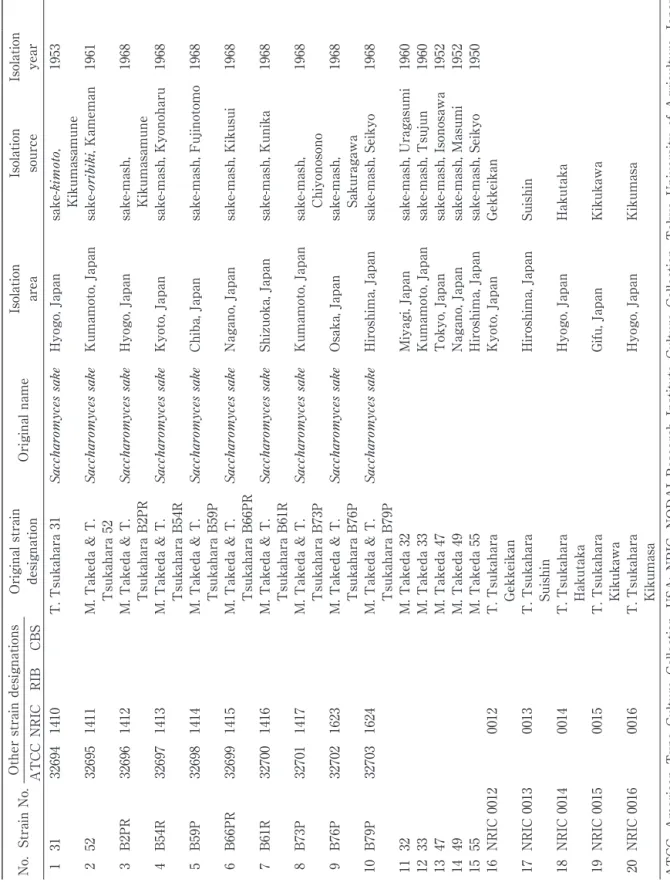
試みられ,いくつかの国酒酵母の特性が報告されてき た(竹田・塚原,1971,1975;竹田ら,1983;中田 ら,1984,1985a, b).さらに,最近では多くの国酒醸 造で利用されている日本醸造協会頒布の「きょうかい 酵母®」(以後,協会酵母と称す)や県試験場などの実 用酵母として,アルコール発酵能,香味成分生成能が 高い等,多様な醸造上優良な株が選抜されている.こ れらの酵母の特性については,協会酵母の代謝機構解 明(浅野,2007;渡辺・高木,2016),醸造特性にかか わる遺伝子の同定(赤尾ら,2018;根来ら,2017),協 会酵母と実験室酵母の比較(加藤・下飯,2010),協会 酵母の系統進化(赤尾,2014)等の報告がある.しか し,これらの研究に用いられた株は系統的には限定的 であり,胞子形成能の衰退などから Gallone et al. (2016)が述べているように,産業的に馴化され,収斂 した酵母である可能性も考えられる.最近は S. cerevi︲ siae の多様性の解明にはゲノム情報を用いた解像度の 高い系統解析が行われるようになってきた.そのなか で国酒酵母の分類学的位置を明確にするためには,よ り多くの国酒由来の酵母,特に古くに分離された株を 集めてその分離源,醸造特性などの情報とともに表現 性状に基づく分類を明らかにしておく必要がある.そ こで,できるだけ多様な由来の清酒酵母,泡盛酵母, 焼酎酵母を集め,現在酵母分類学の基準となっている The yeasts 第 5 版 の Saccharomyces 属 Key to spe-cies に基づいて同定を試み,国酒醸造に関連した酵母 の分類学的な性質と,国酒酵母の実用的な特性や識別 との関連を調べ,典型的な S. cerevisiae のそれと比較 検討することとした. 材料と方法 1)供試菌株 本研究に使用した酵母は,清酒由来の株を Table 1, 泡盛・焼酎由来の株を Table 2 に,他の S. cerevisiae 株を Table 3 に示し,通し番号 1-96 を付した.清酒由 来の酵母は,竹田・塚原(1970,1971)により各種清 酒醪から分離された研究室保存株(Table 1 通し番号 1-15 以下同様),塚原ら(1961)により各種清酒醪から 分離され NRIC に寄託された NRIC 株(16-20;41-43, Table 1),Kozai & Yabe(1895)により米麹から分 離された S. sake の IFO 株と S. sake と付された NI (長尾研究所)株(21-23),Nakazawa(1909)により 清酒酛から分離された S. tokyo および S. yedo の IFO 株 と S. tokyo,S. yedo と 付 さ れ た NRIC 株 と NI 株 (24-29),清酒醸造に汎用されている協会清酒酵母 11 株(30-40)を含む計 43 株を用いた.泡盛由来の酵母 は,竹田・塚原(1971)により泡盛醪から分離された 研究室保存の S 株(44-56),Inui(1901)により泡盛 醪から分離された S. awamori と付された NRIC 株と NI 株,泡盛の麹から分離された S. awamori の OUT 株(金子,2013)(57-59),玉城ら(1981)により泡盛 醪から分離された泡盛 1 号(Awamori No. 1)(60)を 含む計 19 株を用いた.焼酎由来の酵母は,竹田・塚原 (1971)により各種焼酎醪から分離された研究室保存 の S 株(63-90),日本の焼酎醪から分離された S. bata︲ tae の NRIC 株 3 株(91-93),菅間(1972)により米焼 酎醪から分離された協会焼酎 2 号の SH-4 株(94),甘 藷焼酎醪から宮崎県工業試験場によって分離された宮 崎株(95)(柏田,1990),泡盛醪から鹿児島県試験場 によって分離された鹿児島株(96)(高峯ら,1992)を 含む計 34 株を用い,国酒由来の酵母として全 96 株を 供試した.対照として,S. cerevisiae には,国酒由来 の酵母を含め,かつては原名(original name)として 多様な学名を有し,現在は S. cerevisiae のシノニムと して記載されている酵母が多く存在していることか ら,S. cerevisiae のシノニムとして学名の記載のある S. cerevisiae 株 23 株(Table 3)を供試した.
2)The yeasts 第 5 版の Saccharomyces 属 Key to species による同定試験
The yeasts 第 5 版 の 試 験 方 法(Kurtzman et al., 2011)に準じて,Saccharomyces 属の Key to species に用いられている以下の 7 項目の試験,すなわち,ビ タミン欠如培地での生育試験,37℃における生育試 験,melibiose 資 化 性,glycerol 資 化 性,D-mannitol 資化性,inulin 資化性,maltose 発酵性を行った.供 試菌株の前培養は,試験管当たり 10 ml の YM 液体培 地(Glucose,関東化学 1%;Yeast extract,DIFCO 0.3%;Malt extract,DIFCO 0.3%;Hipolypepton, 日本製薬 0.5%;pH 無調整)で 25℃,2 日間静置培養 したものを用いた(培地濃度%はすべて w/v,以下同 じ).
(1)ビタミン欠如培地での生育試験用培地
Yeast vitamin free base(FORMEDIUM)1.7%, glucose 1.0%の液体培地を試験管に 10 ml ずつ分注し た物をビタミン欠如培地とした.また,対照には Yeast nitrogen base(DIFCO)0.67%,glucose 1.0% の液体培地をビタミン完全培地として用いた.前培養 した菌体を滅菌水で 3 回洗浄後,滅菌水 10 ml に懸濁 し た 物 を, 試 験 培 地 に そ れ ぞ れ 1 白 金 耳 接 種 し,
Table 1
Strains of yeast derived from sake used in this study
No.
Strain No.
Other strain designations
Original strain designation
Original name Isolation area Isolation source Isolation year Notes ATCC NRIC RIB CBS 1 31 32694 1410 T. Tsukahara 31 Saccharomyces sake Hyogo, Japan sake-kimoto , Kikumasamune 1953 2 52 32695 1411
M. Takeda & T. Tsukahara 52
Saccharomyces sake Kumamoto, Japan sake-oribiki , Kameman 1961 3 B2PR 32696 1412
M. Takeda & T. Tsukahara B2PR
Saccharomyces sake Hyogo, Japan sake-mash, Kikumasamune 1968 4 B54R 32697 1413
M. Takeda & T. Tsukahara B54R
Saccharomyces sake Kyoto, Japan sake-mash, Kyonoharu 1968 5 B59P 32698 1414
M. Takeda & T. Tsukahara B59P
Saccharomyces sake Chiba, Japan sake-mash, Fujinotomo 1968 6 B66PR 32699 1415
M. Takeda & T. Tsukahara B66PR
Saccharomyces sake Nagano, Japan sake-mash, Kikusui 1968 7 B61R 32700 1416
M. Takeda & T. Tsukahara B61R
Saccharomyces sake Shizuoka, Japan sake-mash, Kunika 1968 8 B73P 32701 1417
M. Takeda & T. Tsukahara B73P
Saccharomyces sake Kumamoto, Japan sake-mash, Chiyonosono 1968 9 B76P 32702 1623
M. Takeda & T. Tsukahara B76P
Saccharomyces sake Osaka, Japan sake-mash, Sakuragawa 1968 10 B79P 32703 1624
M. Takeda & T. Tsukahara B79P
Saccharomyces sake Hiroshima, Japan sake-mash, Seikyo 1968 11 32 M. Takeda 32 Miyagi, Japan sake-mash, Uragasumi 1960 12 33 M. Takeda 33 Kumamoto, Japan sake-mash, Tsujun 1960 13 47 M. Takeda 47 Tokyo, Japan sake-mash, Isonosawa 1952 14 49 M. Takeda 49 Nagano, Japan sake-mash, Masumi 1952 15 55 M. Takeda 55 Hiroshima, Japan sake-mash, Seikyo 1950 16 NRIC 0012 0012 T. Tsukahara Gekkeikan Kyoto, Japan Gekkeikan 17 NRIC 0013 0013 T. Tsukahara Suishin Hiroshima, Japan Suishin 18 NRIC 0014 0014 T. Tsukahara Hakutaka Hyogo, Japan Hakutaka 19 NRIC 0015 0015 T. Tsukahara Kikukawa Gifu, Japan Kikukawa 20 NRIC 0016 0016 T. Tsukahara Kikumasa Hyogo, Japan Kikumasa ATCC, American Type Culture Collection, USA; NRIC, NODAI Research Institute Culture Collection, Tokyo University of Agriculture, Japan; RIB, National
Research Institute of Brewing, Japan; CBS, Centraalbureau voor
Table 1
Continued
No.
Strain No.
Other strain designations
Original strain designation
Original name Isolation area Isolation source Isolation year Notes ATCC NRIC RIB CBS 21 IFO 0304 0001 GIB, B-5 Saccharomyces sake sake-rice koji 1895 22 IFO 0309 0005
GIB (strain Sikenzyo)
Saccharomyces sake 23 NI 7245 Saccharomyces sake 24 IFO 0244 0006 435 GRIF (R. Nakazawa) Saccharomyces tokyo Japan sake-moto 25 NRIC 0024 0024 Nagao Inst. Saccharomyces tokyo 26 NI 7459 Saccharomyces tokyo 27 IFO 0249 0007 436 GRIF (R. Nakazawa) Saccharomyces yedo Japan sake-moto 28 NRIC 0023 0023 Nagao Inst. Saccharomyces yedo 29 NI 7476 Saccharomyces yedo 30 K1 0001 6001 Hyogo, Japan sake-moto , Sakuramasamune 1906 sa ke ye as t K yok ai no . 1 31 K2 6002 Kyoto, Japan sake-mash, Gekkeikan 1912 sa ke y ea st K yo kai no . 2 32 K3 0002 6003 Hiroshima, Japan Suishin 1914 sa ke y ea st K yo ka i n o. 3 33 K4 0003 6004 Hiroshima, Japan 1924 sa ke ye as t K yok ai no . 4 34 K5 0004 6005 Hiroshima, Japan sake-moto , Kamoduru 1922 sa ke y ea st K yo ka i n o. 5 35 K6 0005 1001 Akita, Japan Aramasa 1930 sa ke y ea st K yo kai no . 6 36 K7 1685 1003 Nagano, Japan sake-shinshu , Masumi 1946 sa ke y ea st K yo kai no . 7 37 K9 0007 1006 Kanazawa, Japan Koro 1952 sa ke y ea st K yo kai no . 9 38 K10 1008 Tohoku, Japan sake-mash 1952 sa ke ye as t K yok ai no . 10 39 K14 6008 Kanazawakokuzei -kyoku, Japan sake-mash 1991 sa ke ye as t K yok ai no . 14 40 K15 6009 Akita, Japan sake-mash 1986, 87 sa ke ye as t K yok ai no . 1 5 41 NRIC 0009 0009 T. Tsukahara 40 2Y , w ild t yp e sak e yea st 42 NRIC 0010 0010 T. Tsukahara 409 Y , wil d typ e sa ke yea st 43 NRIC 0011 0011 T. Tsukahara 41 0Y , w ild ty pe s ak e yea st ATCC, American Type Culture Collection, USA; NRIC, NODAI Research Institute Culture Collection, Tokyo University of Agriculture, Japan; RIB, National Research Institute of Brewing, Japan; CBS, Centraalbureau voor Schimmelcultures, Fungal and Yeast Collection, Netherlands; IFO, Institute for Fermentation,
Osaka, Japan; NI, Nagao Institute, Tokyo, Japan (defunct); GIB,
See RIB; GRIF, Government Research Institute of Formosa, Taiwa
Table 2
Strains of yeast derived from
and
used in this study
No.
Strain No.
Other strain designations
Original strain designation
Original name Isolation area Isolation source Isolation year Notes ATCC NRIC RIB CBS A w am or i y eas t 44-56 S1 -3, 5 -8 , 1 0-12 , 1 4-16 M. Takeda Okinawa, Japan awamori -mash 1964 57 NRIC 0018 0018 Saccharomyces awamori 58 NI 7214 Saccharomyces awamori 59 OUT 7009 CLMR Saccharomyces awamori Okinawa, Japan awamori -koji 1930 60 Awamori No. 1 Tamashiro Okinawa, Japan awamori -mash 1981 61 IFO 2110 Okinawa, Japan 1965 Okinawa strain 62 NRIC 1487 1487 Awamori (Kawachi) Sho chu y eas t 63-90 S1 8-25, 27 - 33, 35 -3 9, 41 -4 5, 47-49 M. Takeda
Kumamoto or Kagoshima, Japan
shochu
-mash of rice
koji
, rice, wheet,
sweet potato and rice bran etc. at the
shochu factory 1964 91 NRIC 0019 0019 Saccharomyces batatae 92 NRIC 1383 1383 CLMR (K. Saito) Saccharomyces batatae Hachijojima, Tokyo, Japan
93 NRIC 1388 1388 CLMR (H. Naganishi) Saccharomyces batatae shochu moromi 1907 94 SH-4 6852 Sugama (NRIB)
Kuma, Kumamoto, Japan
rice shochu -mash 1965 shochu yeast Kyokai no. 2 95 A11 Miyazaki, Japan sweet potato shochu -mash 1951 96 A12
Ind. Exp. Sta. Kagoshima (T. Katsuta)
Kagoshima, Japan awamori -mash 1952 ATCC, American Type Culture Collection, USA; NRIC, NODAI Research Institute Culture Collection, Tokyo University of Agriculture, Japan; RIB, National Research Institute of Brewing, Japan; CBS, Centraalbureau voor Schimmelcultures, Fungal and Yeast Collection, Netherlands; NI, Nagao Institute, Tokyo, Japan (defunct); OUT, Department of Biotechnology, Graduate School of Engineering, Osaka University, Japan; IFO, Institute for Fermentation, Osaka, Japan; CLMR,
Table 3
Strains of
and its synonyms used in this study
Species
Strain No.
Other strain designations
Original strain designation
Original name Isolation area Isolation source Notes ATCC NRIC CBS DBVPG NRRL S. cerevisiae IFO 10217 T 18824 1560 1171 6173 Y-12632
A.C. van Wijk
Saccharomyces cerevisiae
Netherlands
Brewer's top yeast
IFO 0253 2367 423 6048 Y-1536 Saccharomyces chodati Switzerland wine Type strain of Saccharomyces chodati IFO 0614 10615 381 6049 Y-1566 H. Naganishi Saccharomyces willianus spoild beer Type strain of Saccharomyces willianus IFO 0751 10596 1419 Y-379 Saccharomyces carlsbergensis IFO 1046 13007 1396 1782 6175 Y-2416 R.B. Gilliland Saccharomyces diastaticus super-attenuated beer Type strain of Saccharomyces diastaticus IFO 1049 1401 R.B. Gilliland Saccharomyces steineri IFO 1226 0087 382 6043 P. Lindner Saccharomyces logos Brazil Logos brewery Type strain of Saccharomyces logos IFO 0210 9804 1390 400 6174 Y-12633 A. Guilliermond Saccharomyces chevalieri Cote D'Ivoire Palm wine Type strain of Saccharomyces chevalieri IFO 1833 5635 6295 Y-12637
A.E. van Kerken
Saccharomyces coreanus South Africa grape must Type strain of Saccharomyces coreanus IFO 1836 16041 5378 Y-12656 J. Santa Maria Saccharomyces norbensis Spain alpechin Type strain of Saccharomyces norbensis IFO 1837 5155 6296 Y-6680 V.I. Kudriavzev Saccharomyces prostoserdovii grape must Type strain of Saccharomyces prostoserdovii IFO 1950 0083 1395 6039 Y-1529 N.H. Claussen Saccharomyces ellipsoideus Type strain of Saccharomyces ellipsoideus IFO 1991 2247 6172 YB-4237
J.P. van der Walt
Saccharomyces capensis South Africa grape must Type strain of Saccharomyces capensis IFO 1994 16043 4903 6301 Y-6677 J. Santa Maria Saccharomyces hienipiensis Spain alpechin Type strain of Saccharomyces hienipiensis IFO 1997 14085 3093 6601 Y-12657 Saccharomyces oleaceus Spain alpechin Type strain of Saccharomyces oleaceus IFO 1998 16044 3081 6302 Y-6679 J. Santa Maria Saccharomyces oleaginosus Spain alpechin Type strain of Saccharomyces oleaginosus IFO 10055 14084 4054 6292 Y-12617 J. Santa Maria Saccharomyces aceti Spain red wine Type strain of Saccharomyces aceti NRIC 0055 0055 M. Kozaki, A-2 Saccharomyces italicus Japan Apple juice NRIC 1400 48554 1400 2421 Saccharomyces italicus Japan
Japanese kefyr grain
NRIC 0032 0032 K. Suminoe Saccharomyces mandshuricus NRIC 1362 1362
CLMR (H. Naganishi, strain normal) Saccharomyces mandshuricus forma I
moromi of Chinese wine kaoliangchiu NRIC 1374 1374
OUT 7005 (Y. Ohtani, forma I)
Saccharomyces agglutinans Kumamoto, Japan sh re dd ed d rie d sw ee t po ta to w hi ch s an k in the sea NRIC 1382 1382 GRIF (R. Nakazawa) Saccharomyces anamensis ATCC, American Type Culture Collection, USA; NRIC, NODAI Research Institute Culture Collection, Tokyo University of Agriculture, Japan; CBS, Centraalbureau voor Schimmelcultures, Fungal and Yeast Collection, Netherlands; DBVPG, Industrial Yeast Collection, Dipartamento di Biologia Vegetale e Biotecnologia Agroambientale, Università di Perugia, Italy; NRRL, Agricultural Research Service Culture Collection, National Center for Agricultural Utilization Research, USA; IFO, Institute for Fermentation, Osaka, Japan; CLMR, Central Laboratory, South Manchurian
Railway Co. Ltd.; OUT, Department of Biotechnology, Graduate Sc
hool of Engineering, Osaka University, Japan; GRIF, Government
25℃,10 日間培養した. (2)37℃での生育試験用培地 YM 液体培地に培養用高品質寒天(フナコシ)1.5% を加えた YM 斜面培地を 37℃での生育試験用培地と した.前培養した菌体を試験培地に 1 白金耳接種し, 37℃,3 週間培養した. (3)炭素源資化性試験
Yeast nitrogen base 0.67%,炭素源 0.5%,培養用高 品質寒天 1.5%を加えて,試験管に 7 ml ずつ分注した 斜面培地を炭素源資化性試験培地とした.また,炭素 源 は glycerol( 関 東 化 学 ),melibiose( 関 東 化 学 ), D-mannitol(関東化学),inulin(関東化学)を用い た.前培養した菌体を滅菌水で 3 回洗浄後,滅菌水 10 ml に懸濁したものを,試験培地にそれぞれ 1 白金 耳接種し,25℃,3 週間培養した. (4)Maltose 発酵性試験
Yeast extract 0.45%,Hipolypepton 0.75%を, Durham 管入りの小試験管に 2.6 ml ずつ分注後,オー トクレーブ殺菌し,別殺菌した maltose(関東化学) 6%溶液を終濃度 2%に添加したものを maltose 発酵 性試験培地とした.前培養した菌体を試験培地に 1 白 金耳接種し,25℃,2 週間培養した. 結果と考察
1)The yeasts 第 5 版の Saccharomyces 属 Key to spe-cies による国酒由来の酵母の性質
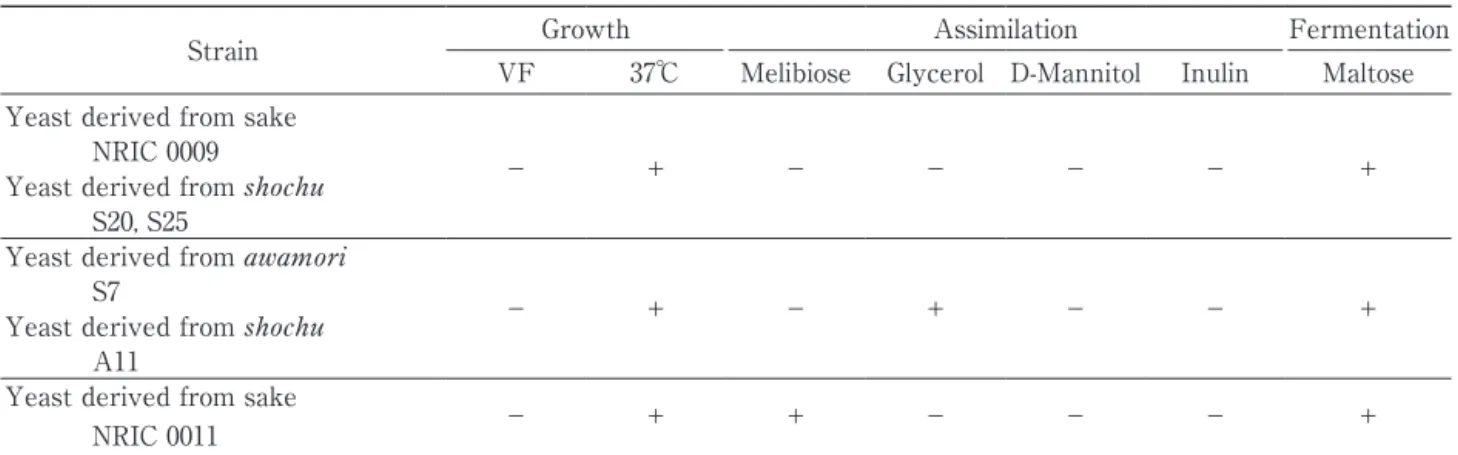
結果をまとめたものを Table 4 に示す.国酒由来の 酵母 96 株中 53 株(グループ 1)が,ビタミン欠如培 地での生育試験+,37℃における生育試験+,melibi-ose 資化性-,glycerol 資化性-,D-mannitol 資化性 -,inulin 資化性-,maltose 発酵性+という性質で あり,35 株(グループ 2)が,ビタミン欠如培地での 生育試験+,37℃における生育試験+,melibiose 資 化 性-,glycerol 資 化 性+,D-mannitol 資 化 性-, inulin 資化性-,maltose 発酵性+という性質であっ た.このことから,Key to species の同定試験 7 項目 によって国酒由来の酵母の性質は大きく 2 つのグルー プと,それらとは異なる 8 株に分けられた.Maltose の 発 酵 に つ い て は NRIC 0012 と S23 の 2 株 が- で あったが,弱い清酒酵母の存在も報告されており(向 井ら,1998),これらはビタミン欠如培地での生育は + で あ っ た こ と か ら,maltose 発 酵 は 例 外 的 に- (rarely-)として,清酒由来の NRIC 0012 は国酒由 来の酵母のグループ 1 に,焼酎由来の S23 はグループ 2 と合わせて考えていくことにした.グループ 1 とグ ループ 2 は,glycerol 資化性の違いによって分かれ, 清酒由来の酵母の全 44 株中 27 株が glycerol を資化 し,泡盛由来の酵母の全 19 株中 13 株および焼酎由来 の酵母の全 34 株中 29 株が資化しなかった.したがっ て,清酒由来の酵母が glycerol を資化するのに対し て,泡盛および焼酎由来の酵母は資化しない傾向に あった.Glycerol の資化性は,The yeasts 第 5 版に おける S. cerevisiae の standard description では vari-able(V)であるのに対し,ビタミン欠如培地におけ る生育試験は-と記載されていることから,国酒由来 の酵母においても glycerol 資化性は V とすれば,2 グループはまとめられ,S. cerevisiae とはビタミン欠 如培地での生育試験が+であることで,これを国酒酵 母の主体をなす一群(以下,国酒酵母群という)とし た. 2)他の S. cerevisiae のシノニムの株との比較 The yeasts では,多く試験株の性質に基づいて S. cerevisiae の standard description が定められている ことから,国酒酵母群は S. cerevisiae の多くの株と性 質が異なると考えられる.そこで,対照のシノニムの 株を含む S. cerevisiae 23 株の結果を Table 5 に示す. S. cerevisiae のシノニム全 23 株中 9 株は The yeasts 第 5 版における S. cerevisiae の standard description と一致していた.しかし,それ以外の 14 株でも 11 株 は,ビタミン欠如培地における生育試験-で,そのう ち 37℃における生育試験-が 2 株,maltose 発酵性- が 3 株,melibiose 資化性+が 8 株で,melibiose 資化 性+の株のうち,maltose 発酵性-が 2 株,D-manni-tol 資化性+が 2 株で,いずれも S. cerevisiae の stan-dard description とは異なった.また,残りの 2 株は, 国酒酵母一群を形成するものと同様にビタミン欠如培 地での生育試験が+であることから S. cerevisiae の standard description と異なり,うち 1 株は melibiose 資化性+であったが,NRIC 0055 と NRIC 1382 の 2 株は,国酒酵母群のグループ 2 と一致していた.そこ で,国酒酵母群でも分離当時に学名が付された株には melibiose 資化性が+である株が存在したように,同 じ S. cerevisiae でも分離当時に学名を付された多様な S. cerevisiae のシノニムの株には standard descrip-tion とは一致しない性質をもつ株が存在することが明 らかとなった.これは,S. cerevisiae が The yeasts 第 3 版以降に多くの種が統合されたことにより,現在で も「複合群」を形成していることに起因しているもの と考えられる.しかし,本研究で供試した S. cerevi︲
Table 4 Physiological properties of yeast strains derived from based on the key to species for the genus of The yeasts 5th ed.
Strain Growth Assimilation Fermentation
VF 37℃ Melibiose Glycerol D-Mannitol Inulin Maltose
Group 1
Yeast derived from sake
+ + - - - - + 31, B2PR, B59P, 49, 55, NRIC 0013, NRIC 0014, NRIC 0016, NI 7245, NRIC 0024, NI 7459, NRIC 0023, NI 7476, NRIC 0010
Yeast derived from awamori S1, S2, S3, S5, S6, S8, S10, S11, S12, NRIC 0018, NI 7214, Awamori no.1, NRIC 1487 Yeast derived from shochu
S18, S19, S21, S22, S24, S27, S28, S29, S30, S31, S32, S33, S35, S36, S39, S41, S42, S43, S44, S45, S48, S49, NRIC 0019, NRIC 1383, NRIC 1388, SH-4 S23 + + - - - - - Group 2
Yeast derived from sake
+ + - + - - + 52, B54R, B66PR, B61R, B73P B76P, B79P, 32, 33, 47, NRIC 0015, IFO 0304, IFO 0309, IFO 0244, IFO 0249, K1, K2, K3, K4, K5, K6, K7, K9, K10, K14, K15
Yeast derived from awamori S14, S15, S16, OUT 7009, IFO 2110
Yeast derived from shochu S37, S38, S47, A12
NRIC 0012 + + - + - - -
+, positive; -, negative. Vitamin-free medium test was based on Yeast vitamin free base (FORMEDIUM) containing
(NH4)2SO4 as N source. Carbon source utilization test was based on Wickerham medium. VF, growth without vitamins;
37℃, growth at that temperature
siae のシノニム全 23 株中 20 株はビタミン欠如培地で の生育試験が-で S. cerevisiae と一致しているのに対 し,国酒由来の酵母は 96 株中 90 株が+で,ほぼ明確 に区別される.そして,The yeasts における S. cere︲ visiae の standard description を決定する際の試験株 として,清酒酵母が用いられていた The yeasts 第 2 版および第 3 版では,ビタミン欠如培地での生育試験 が variable(V)で表されているのに対して,試験株 として用いられなくなった The yeasts 第 4 版からは -と記載されている.これらのことは,S. cerevisiae の standard description に対し,国酒由来の酵母を除 外したことに起因している.また,この性質を The yeasts 第 5 版 に お け る Saccharomyces 属 の 7 種 の standard description(Vaughan-Martini & Martini, 2011)とも比較しても,国酒酵母群は,Saccharomy︲ ces 属のいずれの種の性質にも一致しなかった(Table 6). 以上のことから,国酒酵母群は S. cerevisiae とその シノニム株およびその他の Saccharomyces 属の各種 と比較しても表現性質上特異な一群を形成することが 明らかとなった.このことから,国酒酵母群の分類学 的 特 性 は,The yeasts 第 5 版 の Key to species に
Strain Growth Assimilation Fermentation
VF 37℃ Melibiose Glycerol D-Mannitol Inulin Maltose
Yeast derived from sake
- + - - - - +
NRIC 0009
Yeast derived from shochu S20, S25
Yeast derived from awamori
- + - + - - +
S7
Yeast derived from shochu A11
Yeast derived from sake
- + + - - - +
NRIC 0011
+, positive; -, negative. Vitamin-free medium test was based on Yeast vitamin free base (FORMEDIUM) containing
(NH4)2SO4 as N source. Carbon source utilization test was based on Wickerham medium. VF, growth without vitamins;
37℃, growth at that temperature
Table 5 Physiological properties of the strains of and its synonyms based on the key to species for the genus of The yeasts 5th ed.
Strain Growth Assimilation Fermentation
VF 37℃ Melibiose Glycerol D-Mannitol Inulin Maltose
IFO 0253, IFO 0614, IFO 1046, IFO 1049, IFO 1226, IFO 1950, IFO 1991, IFO 10055, NRIC 1374
- + - + - - +
IFO 1998, IFO 0751, NRIC 0032,
NRIC 1362 - + + + - - + IFO 10217T, IFO 1837 - - - + - - + IFO 1994, IFO 1997 - + + + + - + IFO 1833, IFO 1836 - + + + - - - IFO 0210 - + - + - - - NRIC 0055, NRIC 1382 + + - + - - + NRIC 1400 + + + + - - +
+, positive; -, negative. Vitamin-free medium test was based on Yeast vitamin free base (FORMEDIUM) containing
(NH4)2SO4 as N source. Carbon source utilization test was based on Wickerham medium. VF, growth without vitamins;
37℃, growth at that temperature
従って,maltose 発酵性+(rarely-),melibiose 資 化 性-,glycerol 資 化 性 V,D-mannitol 資 化 性-, inulin 資化性-,ビタミン欠如培地での生育試験+, 37℃における生育試験+であると,定義づけることが できると考えられた.しかし,国酒由来の酵母のなか でもこの一群に含まれなかった 6 株や,S. cerevisiae のシノニムのなかで国酒酵母群と同じ性質を示した S. italicus NRIC 0055,S. anamensis NRIC 1382 につ いて,今後遺伝子による系統解析などを用いてさらに 検討する必要があると考えられた.国酒酵母群の特異 性の要因となったビタミン欠如培地での生育に関して は,これまでにそれぞれのビタミン要求性について検 討されている.S. cerevisiae はビオチンやパントテン 酸,チアミン,イノシトールなど,複数のビタミンを 要求することが報告されている(篠原ら,1996;鈴 木,1961a, b).一方で国酒酵母は,他の醸造酵母とは 異なり,共通してビオチン要求性がないとされ(竹 田・塚原,1962;竹田ら,1983),清酒酵母の協会 7 号と実験室酵母の S288c による比較ゲノム解析から も,協会 7 号にのみビオチン生合成にかかわる遺伝子 BIO6 の存在(Akao et al., 2011)が報告されている. このようにビタミン要求性のないことの重要性は,分 子生物学的にも支持されている.したがって,S. cere︲ visiae と同定された国酒由来の酵母は複数のビタミン
を要求する可能性が示され,ビオチンを含め詳細に調 べる価値があると考えられる.
3)The yeasts 第 5 版の Key to species による国酒酵 母の再同定
S. cerevisiae とそのシノニム株およびその他の Sac︲ charomyces 属の各種に対しても,国酒酵母群が特異 な一群を形成していることが明らかとなったため,改 め て The yeasts 第 5 版 の Saccharomyces 属 Key to species に従った同定を試みた.Key to species の試 験順に従って,ビタミン欠如培地での生育試験が+ で,maltose 発酵性が+の株は S. bayanus に同定され ることから,国酒由来の酵母の全 96 株中 90 株は,S. bayanus に同定されることになる.しかし,S. baya︲ nus は 37℃における生育試験が-であることから,国 酒酵母群は S. bayanus とも明確に区別された.また, それ以外の国酒由来の酵母 6 株についても再同定し た.まず,清酒由来の NRIC 0009,泡盛由来の S7,焼 酎由来の S20,S25,A11 の 5 株は,ビタミン欠如培 地での生育試験が-,melibiose 資化性が-,37℃に おける生育試験が+,D-mannitol 資化性が-である ことから S. cerevisiae に同定された.次に,清酒由来 の NRIC 0011 は,ビタミン欠如培地での生育試験が -,melibiose 資化性が+であることから S. mikatae に同定された.しかし,実際には S. mikatae は D-mannitol 資化性が+で,37℃における生育試験が- であることから,この株は S. mikatae とも異なった. これらのことから,国酒由来の酵母の多くは The
yeasts 第 5 版 の Saccharomyces 属 Key to species に よって S. cerevisiae ではなく,異なる種に同定される という結果となった.そして,国酒由来の酵母のなか で S. cerevisiae に同定される株は,少数であった.し たがって,The yeasts の指標では,国酒酵母の同定は 的確に行えないことが明らかとなった. 以上のことから,本研究に用いた国酒由来の酵母は 96 株のうち一群を形成する国酒酵母群 90 株が,The yeasts 第 5 版の Key to species ではいずれの種とも 一致せず,それは glycerol の資化で 2 群に分けられ た.分離当時に国酒由来の酵母は,さまざまな特異性 から区別されていたが(竹田・塚原,1971,1975), The yeasts 第 4 版以降からは Saccharomyces 属を区 別するための指標として,ビタミン欠如培地における 生育試験が導入されたにもかかわらず,国酒由来の酵 母の同定に適切に使われていないことが明らかとなっ た.そこで本研究では,国酒由来の酵母の特性を多く の S. cerevisiae のシノニムも含めて現在の指標により 検討し,国酒酵母が一群を形成するような特異性を保 持していることを明確にした. これにより,酵母分類学における Saccharomyces 属 のなかで国酒由来の酵母の表現型による識別が可能で あることが改めて示され,国酒酵母の分類学的な定義 付けの一つとなると考えられた.さらに,近年自然界 から分離され国酒醸造に利用されている酵母は,ビタ ミン欠如培地での生育が可能であることが報告されて いることから(木下ら,2008),本研究の結果は,新規 の株を分離し,国酒醸造に適した株を選抜するための Table 6 Comparison of the physiological properties of the yeast strains with the species
Species Growth Assimilation Fermentation
VF 37℃ Melibiose Glycerol D-Mannitol Inulin Maltose
Kokushu yeast + + - v - - +/(-) S. cerevisiae - + - v - - + S. cariocanus - - - - + - - S. paradoxus - + - v + - v S. mikatae - - + - + - S S. kudriavzevii - - - v v + + S. bayanus + - v + v - + S. pastorianus - - - v - - + S. arboricola + - + - v - -
+, positive; -, negative; V, variable; S, positive but slow; (-), rarely negative. Vitamin-free medium test was based on
Yeast vitamin free base (FORMEDIUM) containing (NH4)2SO4 as N source. Carbon source utilization test was based on
Wickerham medium. VF, growth without vitamins; 37℃, growth at that temperature. The data for kokushu yeast are based on the 90 of 96 kokushu strains studied. The data for Saccharomyces species are cited from Vaughan-Martini & Martini (2011).
識別法としても有効であると考えられる.本研究は, Saccharomyces 属酵母のなかで,国酒酵母の表現性状 の独自性を明らかにし,The yeasts 第 5 版の Key to species の問題点を明らかにした.Key to species の 違いだけでは分類学的な結論は導き出せないものの, 国酒酵母が S. cerevisiae とは異なる一群を形成するこ とは,The yeasts にもあるようにテクノロジーの分 野である醸造学的な選択には価値があるものと考えら れる.また,最近では清酒酵母などの系統学的な特徴 が報告されており,著者らもそれらを見出しているが (未発表),種の議論までにはいたっておらず,今回の 結果を基にして,今後,分類学的な結論については遺 伝子の系統解析などと併せて慎重に検討したいと考え ている. 謝 辞 菌株の提供にご協力頂いた大阪大学大学院工学系研 究科の金子嘉信博士に謝意を表します. 文 献
Akao, T., Yashiro, I., Hosoyama, A., Kitagaki, H., Horikawa, H., Watanabe, D., Akada, R., Ando, Y., Harashima, S., Inoue, T., Inoue, Y., Kajiwara, S., Kitamoto, K., Kitamoto, N., Kobayashi, O., Kuhara, S., Masubuchi, T., Mizoguchi, H., Nakao, Y., Nakazato, A., Namise, M., Oba, T., Ogata, T., Ohta, A., Sato, M., Shibasaki, S., Takatsume, Y., Tanimoto, S., Tsuboi, H., Nishimura, A., Yoda, K., Ishikawa, T., Iwashita, K., Fujita, N. & Shimoi, H. 2011. Whole-genome sequencing of sake yeast Saccharomyces cerevisiae Kyokai no. 7. DNA Res. 18: 423-434. 赤尾 健 2014.ゲノムから見た清酒酵母の系統分化 と育種への新たな視点.化学と生物 52:223-232. 赤尾 健,周 延,渡辺大輔,岡﨑直人,下飯 仁 2018.優良きょうかい清酒酵母菌株を判別可能な DNA マーカーの設定と保存菌株への適用.醸協 113:631-641. 浅野忠男 2007.清酒酵母の有機酸生成に関する研究. 生物工学会誌 85:63-68.
Gallone, B., Steensels, J., Prahl, T., Soriaga, L., Saels, V., Herrera-Malaver, B., Merlevede, A., Roncoroni, M., Voordeckers, K., Miraglia, L., Teiling, C., Steffy, B., Taylor, M., Schwartz, A., Richardson, T., White, C., Baele, G., Maere, S. & Verstrepen, K.J. 2016.
Domestication and divergence of Saccharomyces cerevisiae beer yeasts. Cell 166: 1397-1410.
Inui, T. 1901. Untersuchungen uber die niederen Organismen welche sich bei der Zubereitung des alkoholischen Getrankes “Awamori” betheiligen. J. Coll. Sci. Imp. Univ. Tokyo 15: 465-476.
金子嘉信 2013.(60 周年記念特別企画「還暦を迎えた 微生物株」4)OUT 7009(大阪大学大学院工学研 究科生命先端工学専攻,OUT).日本微生物資源学 会誌 29:31-32. 柏田雅徳 1990.宮崎県工業試験場.醸協 85:561. 加藤 拓,下飯 仁 2010.清酒酵母の一倍体の取得と 実験室酵母との交配による醸造特性の遺伝解析.醸 協 105:500-506. 木下友香理,門倉利守,数岡孝幸 2008.花から分離し た酵母の性質と清酒醸造における特長.東京農業大 学農学集報 53:100-106.
Kozai, N. & Yabe, K. 1895. Üeber die bei der Sakebereitung beteiligten Pilze (Vorl. Notiz). Central. f. Bakt. Abt., II 1: 619-620.
Kurtzman, C.P., Fell, J.W., Boekhout, T. & Robert, V. 2011. Methods for isolation, phenotypic, characterization and maintenance of yeasts, In Kurtzman, C.P., Fell, J.W. & Boekhout, T. (eds.), The Yeasts, A Taxonomic Study, fifth edition. vol. 1, p. 87-110, Elsevier Science Publishers B.V., Amsterdam.
Libkind, D., Hittinger, C.T., Valério, E., Gonçalves, C., Dover, J., Johnston, M., Gonçalves, P. and Sampaio, J.P. 2011. Microbe domestication and the identification of the wild genetic stock of lager-brewing yeast. Proc. Natl. Acad. Sci. U S A. 108: 14539-14544.
Lodder, J. & Kreger-van Rij, N.J.W. 1952. The Yeasts: A Taxonomic Study, North-Holland Publishing Company, Amsterdam.
向井伸彦,岡田 彦,鈴木昭紀,高橋利郎 1998.ビー ル酵母とその他の醸造用酵母のビール醸造特性.釀 協 93:967-975. 中田久保,穂坂 賢,坂井 劭 1984.泡盛酵母の分類 学的研究.醸協 79:647-650. 中田久保,黒木裕章,谷口好正,穂坂 賢,坂井 劭 1985a.焼酎酵母の分類学的研究.醸協 80:476-479. 中田久保,穂坂 賢,坂井 劭 1985b.泡盛,焼酎,
清酒酵母および他の Saccharomyces cerevisiae 間の 差異.醗酵工学会誌 63:509-515.
Nakazawa, R. 1909. Zwei Saccharomyceten aus Sakehefe. Central. f. Bakt. Abt., II 22: 529-540. 根来宏明,小高敦史,松村憲吾,秦 洋二 2017.清酒 酵母のリンゴ酸高生産に寄与する変異遺伝子の同定 と育種への応用.化学と生物 55:434-437. 西谷尚道 1982.焼酎酵母研究のあゆみ(I).醸協 77:599-605. 佐藤宜之 2013.「國酒プロジェクト」に端を発した政 府の取り組みについて.醸協 108:700-706. Stelling-Dekker, N.M. 1931. Die sporogenen Hefen.
Verh. K. Ned. Akad. Wetensch., Afd. Natuurk., Sect. 11, 28: 1-547. 篠原 隆,押田明成,柳田藤寿 1996.ワイン酵母のビ タミン要求性と生育温度の影響.山梨大学醗酵研究 所研究報告 31:1-8. 菅間誠之助 1972.しょうちゅう酵母.醸協 67:672-677. 鈴木弥彦 1961a.パン酵母に及ぼすビタミン効果の研 究(第 1 報).日本農芸化学会誌 35:648-654. 鈴木弥彦 1961b.パン酵母に及ぼすビタミン効果の研 究(第 4 報).日本農芸化学会誌 35:1244-1248. 高峯和則,瀬戸口真治,亀沢浩幸,美坂幸子,浜崎幸 男 1992.鹿児島県工試酵母の分類学的研究.鹿児島 県工業技術センター研究報告 5:5-11. 竹田正久,塚原寅次 1962.酵母とビタミン B 群に関 する研究(第 2 報).醸協 57:1109-1111. 竹田正久,塚原寅次 1970.清酒酵母の特性.東京農業 大学農学集報 14:199-209. 竹田正久,塚原寅次 1971.Saccharomyces sake の特 性(第 3 報) 醸造酵母(分離株)の同定.東京農業 大学農学集報 16:59-67. 竹田正久,塚原寅次 1975.清酒酵母(Saccharomyces sake)の分類学的研究.発酵工学雑誌 53:103-111. 竹田正久,中里厚実,塚原寅次 1983.Saccharomyces sake と焼酎酵母,泡盛酵母の相違.醗酵工学会誌 61:11-14. 玉城 武,忍頂寺晃嗣,高江洲朝清,下地 博,玉那 覇勉 1981.泡盛 1 号酵母の形態学的,生理学的諸性 質.醸協 76:198-201. 塚原寅次,坂井 劭,竹田正久 1961.清酒酵母の分類 について.東京農業大学農学集報 創立 70 周年記念 論文集 特別号:221-231.
Van der Walt, J.P. 1970. Genus 16. Saccharomyces Meyen emend. Reess, In Lodder, J. (ed.), The Yeasts, A Taxonomic Study, second revised and enlarged edition. p. 555-604, North-Holland Publishing Company, Amsterdam.
Vaughan-Martini, A. & Martini, A. 1998. 44. Saccharomyces Meyen ex Reess, In Kurtzman, C.P. & Fell, J.W. (eds.), The Yeasts, A Taxonomic Study, fourth revised and enlarges edition. p. 358-371, Elsevier Science Publishers B.V., Amsterdam. V a u g h a n - M a r t i n i , A . & M a r t i n i , A . 2011.
Saccharomyces Meyen ex Reess (1870), In Kurtzman, C.P., Fell, J.W. & Boekhout, T. (eds.), The Yeasts, A Taxonomic Study, fifth edition. vol. 2, p. 733-746, Elsevier Science Publishers B.V., San Diego.
渡辺大輔,高木博史 2016.ここまでわかった!きょう
かい酵母(清酒用)の高発酵力を生み出す RIM15
変異遺伝子.醸協 111:638-647.
Yabe, K. 1897. On the origin of sake yeast (Saccharomyces Sake). Coll. Agric. Tokyo. Bull. 3: 221-224.
Yarrow, D. 1984. Genus 22. Saccharomyces Meyen ex Reess, In Kreger-van Rij, N.J.W. (ed.), The Yeasts, A Taxonomic Study, third revised and enlarged edition. p. 379-395, Elsevier Science Publishers B.V., Amsterdam.
Taxonomic characterization of kokushu yeast based on the Key to species of The yeasts, a taxonomic study 5th edition
Chise Moriya, Maiko Koizumi, Shunichi Nakayama, Ken-ichiro Suzuki and Toshimori Kadokura Department of Fermentation Science, Faculty of Applied Bio-Science, Tokyo University of Agriculture
Kokushu (sake, shochu, and awamori), an alcohol of Japanese origin, is traditionally brewed from rice and other materi-als. It is brewed by saccharification of koji and alcoholic fermentation of yeast. Since the 19th century, many strains of yeast have been isolated and studied taxonomically for kokushu brewing. Since the book “The yeasts, a taxonomic study” was published in 1952, all the original names assigned to these yeast strains are the synonym of Saccharomyces cerevisiae. Nonetheless, kokushu can be fermented exclusively by specific kokushu yeast strains. To confirm this, 96 yeast strains were collected, taxonomically characterized, and used for comparison with other strains of the genus Saccharomyces. Then, seven tests were performed as described as “Key to species” of the book “The yeasts, a taxonomic study (5th ed.)” most of the kokushu yeast strains formed a homogeneous cluster and were separated from other species of the genus Saccharomyces. Of the 96 kokushu yeast strains that were studied and grown on vitamin-free medium, growth difference from Saccharomyces cerevisiae was observed in 90 strains. These results showed that kokushu yeast strains are unique in their phenotypic characteristics; thus, more information can be obtained from these strains for taxo-nomic studies on getaxo-nomics and selection of yeast strains possessing specificity for kokushu brewing.