Original paper (regular paper)
Spirulina subsalsa var. salina var. nov.: Thermo-Halotolerant
Cyanobacteria Accumulating Two Kinds of Compatible Solute,
Originated from the Sultanate of Oman
Yoichi Kuroiwa
1*, Rashid S. Al-Maamari
2, Masaharu Tasaki
1, Kazuo Okamura
1, Mark
Sueyoshi
1, Ayaka Nakashima
3, Eriko Yoshida
3and Kengo Suzuki
31 Shimizu Corporation, Institute of Technology, 3–4–17 Etchu-jima, Koto-ku, Tokyo, 135–8530, Japan 2 Sultan Qaboos University, P. O. Box 33, Al-Khoudh, PC 123, Sultanate of Oman
3 Euglena Co., Ltd., Yokohama Leading Venture Plaza 1,
75-1 Ono-cho, Tsurumi-ku, Yokohama-shi, Kanagawa 230-0046, Japan *TEL: +81–3–3820–5504 FAX: +81–3–3820–5955
*E-mail: [email protected]
(Received; 7 January, 2014/Accepted; 22 July, 2014)
Microalgal samples were collected from natural hypersaline sources in Oman. This resulted in the screening of thermo-halotolerant cyanobacteria, strain BAH8-10-45, having closed helically coiled trichomes and accumulating glycine betaine and O-a-D-glucopyranosyl-(1→2)-glycerole as compatible solutes. Morphological observation of BAH8-10-45 suggests that this strain belongs to the genus Supirulina Turpin ex Gomont and the species of Spirulina. subsalsa Oersted ex Gomont. Halospirulina has been proposed as a genus for cyanobacteria which has similar morphology to that of S. subsalsa but has halotolerance in range of 3–13 wt/vol % or higher. For BAH8-10-45, no growth was recorded in the salinity levels of fresh-water and seafresh-water, while growth was confirmed in the range of 5–20 wt/vol %, indicating halotolerance different from even cyanobacteria belonging to Halospirulina. Descriptions for Halospirulina as well as the euryhaline character of Spirulina, were reviewed to examine classification for BAH8-10-45. Based on phycological taxonomy, mainly featuring morphological and physiological characteristics, Spirulina subsalsa var. salina var. nov. is proposed.
Key words: Spirulina subsalsa var. salina var. nov., Halospirulina, halotolerant, glycine betaine, O-a-D-glucopyranosyl-(1→2)-glycerole
1. Introduction
The increase in concentration of atmospheric carbon
dioxide (CO2) is considered to be one of the main causes
of global warming 63). Microalgae, which are photosynthetic
microorganism with oxygen evolution 11), transform solar
energy to chemical energy through CO2 fixation by
photo-synthesis and contribute to the reduction of atmospheric CO2 36,60). The transformed energy and carbon are mostly
stored in lipids or carbohydrates in the algae-based biomass
which are utilized as feedstock for bio-fuel 24,26) and fine
chemical industries 60). Microalgae have the potential not only
to reduce atmospheric CO2 but also to produce biomass on
an industrial scale 24,26).
Much of the Middle East is located in areas
geographi-cally suitable for CO2 fixation and algae-based biomass
production, due to high annual solar irradiance 57,59),
favor-able coastal climate (moderate temperature and low rain
fall) 14), and availability of unutilized land (e.g. desert,
sabkha). Additionally CO2 emissions from oil refineries 3)
and produced water from oil wells 12) could be used for such
biomass production. This study was carried out with a focus on utilizing the natural resources of the Sultanate of Oman
to reduce atmospheric CO2 and produce algae-based biomass
of commercial importance.
Recently, different compatible solutes have been
iden-tified in the cells of halotolerant microorganisms 5). Such
compounds may serve as an energy reservoir, a protectant
from a variety of physical and chemical stresses 30), and
a protein stabilizer in their living cells 34,37,46). Compatible
solutes have great potential for further commercial applica-tion. For example, their water-holding capacity may allow them to be used in additives, stabilizers, and sweeteners for
agrichemical 10,48), food 46), cosmetic 34,37), and pharmaceutical
industries 34,46).
During this study, thermo-halotolerant cyanobacteria (strain BAH8-10-45) accumulating glycine betaine and O-a-D-glucopyranosyl-(1→2)-glycerole (an isomer of gluco-sylglycerol) were successfully isolated, as the first steps towards fine-chemicals production from algae-based biomass in the Sultanate of Oman. From the morphological point of view, the strain BAH8-10-45 is closely related to genus
Spirulina Turpin ex Gomont characterized by closed
heli-cally coiled trichomes, gliding motility, invisible cross-walls, and no sheaths.
In 1827, genus Spirulina was proposed by Turpin as
Spirulina oscillarioides 58). Gomont then proposed the genus
Spirulina and genus Arthrospila in 1892 21), following their
initial concideration by Stizenberger in 1852 53), resulting
in the official listing of the genus Spirulina as Spirulina
Turpin ex Gomont 21). Subsequently in 1932, as a result
of a proposal by Geitler, the genus Spirulina and genus
Arthrospila were combined into the single genus of Spirulina
(strains of previous genus Spirulina were placed into the
section Euspirulina in the re-established genus Spirulina) 19).
The single genus Spirulina continued for a while based on this “Geitlerian system” but a new proposal was made to redivide it into two genera of Spirulina and Arthrospila (Spirulina Turpin ex Gomont and Arthrospila Stizenberger ex Gomont) as part of the new classification system proposed by Anagnostidis and Komárek in 1988, taking into account new morphological knowledge acquired with
an electron microscope 2). In the mid-1990’s, phylogenetic
analysis using the 16S rRNA gene sequence confirmed that there is a clear distinction between the genus Spirulina and
genus Arthrospila in terms of the phylogenetic lineage 43).
Evaluation results based on the phylogenetic analysis using the 16S rRNA gene sequence suggested that there would be further diversity in terms of the phylogenetic lineage within the genus Spirulina in that Spirulina major and Spirulina
subsalsa would be classified as being from separate
phylo-genetic lineages. In the latest Bergey’s manual of systematic bacteriology published in 2001, Spirulina Turpin ex Gomont
and Arthrospila Stizenberger were listed separately 8). It was
also described that some strains in genus Spirulina character-ized as halotolerant, formed a tight monophyletic cluster by phylogenetic analysis using the 16S rRNA gene sequence.
Prior to the publication of Bergey’s manual, Nübel et al. officially proposed in 2000, the new genus of Halospirulina characterized by halotolerance and forming a tight
mono-phyletic cluster in phylogenetic analysis 45). Halospirulina
is characterized by the use of its physiological specificity concerning salinity, described as, “Halotolerant, able to grow at salinity between 3–13% or above but not at a freshwater salinity”. The establishment of the new genus of Halospirulina subsequently stirred up opposition from mainly the viewpoint of phycological taxonomy on the grounds that classification of Halospirulina did not follow the International Code of Botanical Nomenclature because of the absence of the diagnosis in Latin and the description of the new genus based on the difference of physiological character concerning halotolerance which was extremely
rare for the phycological classification 32). Moreover, in 2003,
Margheri et al. obtained some strains of genus Holospirulina by 16S rDNA restriction analysis which were able to grow at a salinity between 3–13% but also grew in freshwater of which the salinity is below the lower limit described as
the description of the genus Halospirulina 39). Such findings
indicated that there might be a problem with the description of the genus Halospirulina according to concerning halo-tolerance. At the XVIIIth International Botanical Congress (IBC) held in Melbourne in 2011, International Code of Nomenclature (ICN) eliminated the requirement of Latin
names for algae, fungi and plants 31). Currently, some
organi-zations related to phycological taxonomy have adopted the
genus Halospirulina 22). However, the problem concerning
halotolerance, for diagnosis of the genus Halospirulina, has remained.
The strain BAH8-10-45, isolated in this study, was closely related to the genus Halospirulina because of its morpho-logical characteristics and its halotolerance in a high salinity conditions. Detailed analysis has, however, indicated that strain BAH8-10-45 has a specific halotolerance which differs from the “ability to grow at a salinity between 3–13% or above” as description of the genus Halospirulina or “growth range including fresh water of which the salinity is 3 wt/vol
% or below” described by Margheri et al. in 2003 39).
The present study aimed to screen microalgae which were producing compatible solutes, and to also identify the classification of the glycine betaine and O-a-D-glucopyranosyl-(1→2)-glycerole producing strain BAH8-10-45 which was discovered during this search. During the work, the existing
diagnosis of the genus Halospirulina 45) were re-examined
and the euryhaline described in the diagnosis on Spirulina
Turpin ex Gomont was reviewed 21). The classification of
BAH8-10-45 has been clarified based on the phycological taxonomy mainly featuring the morphological and physi-ological characteristics of the strain.
2. Materials and Methods
2.1. Sampling and algal screeningEnvironmental samples (soil, water, microbial mat and salt crystals) were collected from the shoreline at Shannah (20°44’N/58°41’E) and the surface of salt pan in Barr Al-Hikman (20°34’N/58°20’E).
These samples were collected in sterile plastic bottles and stored in a dark environment at ambient temperature. For screening of thermo-halotolerant microalgae, aliquots of environmental samples were suspended in 20 ml sterile IMK medium (Wako Pure Chemical Industries, Ltd., Japan) containing NaCl at 10–30 wt/vol %, and incubated under cool white light at 45°C. After the growth of microalgae was confirmed visibly (within 1–5 days), liquid culture was repeated for faster growth and screening of microalgae. Pure cultures were obtained after several rounds of serial dilution in liquid media to eliminate contamination, and inoculated onto solid media. Solid media were prepared with IMK medium containing NaCl at 10–20 wt/vol % with 1 wt/vol % Difco agar (Becton, Dickinson and Company) on steril-ized petri dishes (Becton, Dickinson and Company). After 1–2 weeks, the isolates formed colonies on solid media.
2.2. Halotolerance and thermotolerance assays
For halotolerance assays, the isolated strain was inoculated into 100 ml flasks containing 20 ml of IMK medium at ten different salinity concentrations (0, 0.5, 1, 3, 5, 10, 15, 20, 25 and 30 wt/vol %). For thermotolerance assays, the isolated strain was inoculated into 100 ml flasks containing 20 ml of IMK medium at nine different temperatures (20, 25, 30, 35, 40, 45, 50, 55, and 60°C) under the optimum growth salinity of each of the isolates. Triplicate cultures were grown under cool white light. Biomass was measured every two days using the dry weight method to determine the maximum growth density.
Evaluation of halotolerance of Halospirulina
tapeti-cola CCC Baja-95. Cl. 2T which is type strain of the genus
Halospirulina followed the method used by Nübel et al. 45).
The modified 1/2 Provasoli’s enriched seawater culture
medium 51) was adjusted by NaCl to different total salinities,
was used for halotolerance assays. Algal cultures took place at 40°C and the dry weight was measured every other day.
2.3. Light microscopic observation
Photomicrographs of Fig. 1 were taken using a digital camera (Nikon DS-L2) with a microscope (Nikon BX-51) equipped with Nomarski interference contrast (DIC) illumi-nation.
For comparison of the cell size among strains of S.
subsalsa and relates under the microscopic observation.
Spirulina sabsalsa NIES-27 was cultured in MA medium 27)
at 25°C, and H. tapeticola CCC Baja-95. Cl. 2T was cultured
in modified 1/2 Provasoli’s enriched seawater medium 51) was
adjusted to 7 wt/vol % in total salinities with NaCl 45).
2.4. Extraction of compatible solutes and measurement of
13C-NMR
Compatible solute was extracted from BAH8-10-45 cells, grown in IMK medium at 15 wt/vol % NaCl, essentially as
described by Borowitzka et al. 5). The solute was freeze-dried
and dissolved in D2O for further NMR analyses.
Natural-abundance 13C NMR spectra of the solute were recorded
at 100 MHz on a JEOL JNM-400A spectrometer. The chemical shifts were recorded in ppm using 3-(trimethylsilyl) propionate-2,2,3,3-d4 (TSP-d4) as an internal standard. The recorded chemical shifts were then compared with those of literature values for O-a-D-glucopyranosyl-(1→2)-glycerol
and glycine betaine to determine the components 44).
2.5. PCR amplification
To determine a partial 16S rRNA gene sequence of isolates, a small number of cells were collected from a micro-bial colony on solid media using a needle and suspended in a PCR solution. This PCR solution (50 ml) contained 1.25 U AmpliTaq Gold DNA polymerase (Applied Biosystems), 0.5 ml 10×PCR buffer, 0.2 mM of each dNTP, and 50 pmol
of each primer (primers 27F and 1492R 61)). Amplification
conditions were as follows: 2 min activation of the poly-merase at 95°C, followed by 35 cycles consisting of 30 s at 94°C, 30 s at 50°C, and 2 min at 72°C, and finally 7 min of extension at 72°C. The PCR product was electrophoresed through a 0.8 wt/vol % agarose gel with TBE buffer, and then purified with a QIAquick gel extraction kit (QIAGEN). A nucleotide sequence of a PCR product was determined using a Bigdye terminator v3.1 cycle sequencing kit (Applied Biosystems) and a model 3730 DNA sequencer (Applied Biosystems).
2.6. Phylogenetic analysis
The 16s rRNA nucleotide sequences determined were aligned with reference sequences obtained from the
GenBank ®4) database using Clustal W version 1.83 55) and
edited manually using BioEdit Sequence Alignment Editor
ver. 7.0.9. 23) A phylogenetic tree was constructed using the
neighbor-joining method with K2 (Kimura-2-parameter 29))
+I+G model in MEGA ver. 5.0 54). Bootstrap values were
calculated based on 1000 replicates.
3. Results and Discussion
3.1. Selection of thermo-halotolerant microalgaeFrom the results of thermo-halotolerant screening, four algal mixed cultures (SHN3, BAH12, BAH13 and BAH8) were screened, and algal strains (SHN3-30-45, BAH12-20-45, BAH13-20-45 and BAH8-10-45) were isolated from each mixed culture (Table 1). Photomicrographs of the four isolates are shown in Fig. 1a-d. All isolates are simply identi-fied using the “Key to the form-genera of Subsection I or III”
in Bergey’s Manual of Systematic Bacteriology 8).
BAH12-20-45 and BAH13-20-45 are unicellular, ovoid, Fig. 1. Photomicrographs of isolated thermo-halotorerant algal
strains originated from the Sultanate of Oman.
a: strain BAH12-20-45 (at 20 wt/vol % total salinities); b: strain BAH13-20-45 (at 20 wt/vol %); c: strain SHN3-30-45 (at 20 wt/vol %); d–f: strain BAH8-10-45 (at 10 wt/vol %). Bar=10 mm
without mucilaginous envelope, and with binary fission in one plane in subsequent generations. BAH12-20-45 has the cell width of 2.5–4.2 mm and the cell length of 4.1–7.1 mm. BAH13-20-45 has the cell width of 2.9–5.5 mm and the cell length of 5.5–10.6 mm. These morphological features indicated that BAH12-20-45 and BAH13-20-45 are closely related to genus Cyanothece. According to the description of the Bergey’s manual, genus Cyanothece are divided into three clusters on the phylogenetic tree of cyanobacteria based on 16s rRNA gene sequences. Cluster 3 contains strains PCC 7418, PCC 9718, MPI95AH11, MPI95AH13, MPI96AL06, MPI96P408, MPI96AL03, and Syn C1 P22, differing from cluster 1 and cluster 2 in growing well at salinity greater than that of seawater (3 wt/vol % NaCl) and tolerating salinities as high as 20 wt/vol % NaCl, reflecting their original habitat,
in a solar evaporation pond 8). According to the
descrip-tion by Garcia Pichel et al., the strain MP195AH13 has diverse at the cell shape, the fusiform (Dactylococcopsis-like
shape) is sometimes obserbed as one of its cell shape 18). The
fusiform also obserbed at the strain BAH12-20-45 showing by the arrow in Fig. 1a. After the publication of latest Bergey’s manual (2001), Margheri et al. proposed the new genus Halothece in 2008, as the new classification for the
strain MPI96P605 in the genus Cyanothece 40). The genus
Halothece is considered to consist of a group of strains,
ranging from those similar to the genus Cyanothece to those of which the similarity of the 16S rRNA gene sequence is above 91% with Halothece californica MPI96P605 as the
type strain 40).
Morphological characteristic of BAH12-20-45 and BAH13-20-45 has similar to those of the Cyanothece mentioned above, and similarity with H. californica MPI 96P605 was higher than 91% (data not shown). According to some morphological features, BAH12-20-45 and BAH13-20-45 were identified Halothece sp..
BAH8-10-45 is characterized by filamentous, closed heli-cally coiled trichomes, with invisible cross-walls, no sheaths, gliding motility, helix widths between 3.7 and 4.5 mm, and thrichome widths between 1.2–1.6 mm. These morphological features indicated that BAH8-10-45 is closely related to
genus Spirulina Turpin ex Gomont 8). According to above
mentions, BAH8-10-45 was identified as Spirulina sp.. SHN3-30-45 is characterized by filamentous, straight cylindrical trichomes, with gliding motility, and absence of constrictions between adjacent cells, and trichome widths between 2.9–4.0 mm. These morphological features indicated that SHN3-30-45 is closely related to genus Geitlerinema
(Anagnostidis & Komárek) Anagnostidis 8). SHN3-30-45 was
identified as Geitlerinema sp. from the mentions above. Growth characteristics of the four isolates are shown in Table 1. Temperature tolerance for BAH12-20-45 ranged from 30–45°C, with an optimum at 40–45°C. Salinity tolerance ranged from 10–30 wt/vol % total salinity, with an optimum of 15 wt/vol %. Temperature tolerance for BAH13-20-45 ranged from 25–45°C, with an optimum at 35°C. Salinity tolerance ranged from 10–30 wt/vol % total salinity, with an optimum of 20 wt/vol %. Temperature tolerance for SHN3-30-45 ranged from 30–50°C, with an optimum at 35°C; no growth was observed at 55°C. Salinity tolerance ranged from 3–30 wt/vol % total salinity, with an optimum of 10 wt/vol %. Temperature tolerance for BAH8-10-45 ranged from 25–45°C, with an optimum at 30°C; no growth was observed at 50°C. Salinity tolerance ranged from 5–20 wt/vol % total salinity, with an optimum of 10 wt/vol %; no growth was observed at <5 wt/vol %.
According to the description of Borowitzka & Borowitzka 6),
Dunaliella species are known as halophilic chlorophytes,
and their commercial production was started in Australia, Israel and USA during the 1970s and 1980s. The optimum temperature for Dunaliel salina has been reported to be in the range 20–40°C, and growth salinity at <approx. 32 wt/ vol % saturation point. D. salina is the first micro alga to be used commercially to produce fine chemicals, because its extreme salinity tolerance simplifies maintenance of a unialgal culture, relatively free of competitors, pathogens
and predators 6). All our isolates are also characterized as
thermo-halotolerant similar to Dunaliella species. This indi-cates that these isolates are also suitable for simplifying maintenance of a unialgal culture for the commercial mass production. In addition, commercial production from D. Table 1. Characteristics of isolated thermo-halotolerant cyanobacteria originated from the Sultanate of Oman.
Characteristic SHN 3-30-45 BAH 8-10-45 BAH12-20-45 BAH13-20-45
Growth temp. range
(optimum temp.); °C 30–50 (35) 25–45 (30) 30–45 (40–45) 25–45 (35)
Growth salinity range
(optimum salinity); % 3–30 (10) 5–20 (10) 10–30 (15) 10–30 (20)
Width
(Mean<±SE>); mm 3.6 <±0.5> 4.1 <±0.2> 3.3 <±0.4> 3.9 <±0.8> Length
(Mean<±SE>); mm 970 <±420> 530 <±210> 5.4 <±0.9> 7.6<±1.7> Shape Filamentous, straight
cylindrical Filamentous, closed helically Unicellular, ovoid without mucilarinous envelope Unicellular, ovoid without mucilarinous envelope Morphological
identification Geitlerinema sp. Spirulina sp. Halothece sp. Halothece sp.
Isolation source Stagnant hyper saline pond
(salinity 19%) heliothermal shallow saline Microbial mat from shore (salinity 6%)
Microbial mat from surface
salina also requires a suitable, low-cost harvesting method 6).
Shelef et al. 49) also pointed out that cell size is an
impor-tant factor since low-cost filtration procedures are presently applicable only for harvesting fairly large cell size (e.g.
Coelastrum, Spirulina).
Among our four thermo-halotolerant isolates (SHN3-30-45, BAH12-20-45, BAH13-20-45, and BAH8-10-45), BAH8-10-45 was found to have fairly large cell size (Fig. 1d and Table 2) suitable for low-cost filtration procedures for mass production. In addition, cells of BAH8-10-45 accumulated glycine betaine and O-a-D-glucopyranosyl-(1→2)-glycerole (Fig. 2) as compatible solutes, indicating potential for production of fine chemicals of commercial importance.
Gabby-Azaria et al. pointed out glycine betaine accu-mulating under hypersaline growth conditions in S.
subsalsa 16) and Mackay et al. also described glycine betaine
in halotolerant species of Spirulina 38). There had been
reported glycine betaine accumulation in other species of
Spirulina, but BAH8-10-45 accumulated glycine betaine
and O-a-D-glucopyranosyl-(1→2)-glycerole as compatible solutes. It was suggested that BAH8-10-45 have character-istic compatible solute accumulation different from other halotolerant species of Spirulina.
Glycine betaine and O-a-D-glucopyranosyl-(1→2)-glycerole have great potential for further commercial application. Glycine betaine have been known to function as
osmo-protectant, for reduction of plant stress from salt 30) and
drought 10,48), as skin protection from ultraviolet induced
cell damage 34), and as inhibitor of b-amyloid formation in
Alzheimer’s disease 34), used in agricultural, cosmetic, and
pharmaceutical industries. O-a-D-glucopyranosyl-(1→2)-glycerole is also expected to have potential in cosmetic, food,
and pharmaceutical industries 37,46).
Table 2. Diagnostic and descriptive features or observed features of cyanobacteria having with tightly coiled trichomes.
Organisms Trichome width (mm) Helix width (mm) Trichome length (mm)
Spirulina subsalsa NIES-27 1.5 <±0.1> 4.2 <±0.3> 390 <±160> Halospirulina tapaticola CCC Baja-95 Cl. 2T 1.5 <±0.1> 4.2 <±0.2> 530 <±250> Spirulina subsalsa BAH8-10-45 1.4 <±0.1> 4.1 <±0.2> 540<±210> Spirulina subsalsa Oersted ex Gomont 21,33) (0.8) 1–2 (2.2) (2) 3–5 (5.6) 150–500 (–700) Spirulina labyrinthiformis Kützing ex Gomont 21,33) 0.8–1.4 (1.5) 2–2.7 (3) 75–120 (–160) Halospirulina Nübel, Garcia-Pichel et Muyzer 45,33) 1.5 4 NA Halospirulina tapaticola Nübel et al. 45,33) 1.5–3 4–6 NA
Mean <±SE> mean values of at least 50 samples. NA: information not available.
Fig. 2. Natural abundance 13C NMR spectrum of an aqueous extract from cells of BAH8-10-45.
Each resonance is identified as to the particular solute molecule, B: glycine betaine; G: O-a-D-glucopyranosyl-(1→2)-glycerole (details of the identification, see reference 5,44)).
BAH8-10-45 was selected from isolates, to accumu-late compatible solutes and to have fairly large cell size suitable for low-cost filtration procedures for mass
produc-tion 49). Subsequently, the identification of BAH8-10-45 was
performed.
3.2. Identification of BAH8-10-45 3.2.1. Morphology of BAH8-10-45
Morphology of BAH8-10-45 (Fig. 1d–f) is characterized as follows: filamentous closed helically coiled trichomes, with invisible cross-walls and no sheaths. Trichome width is between 1.2–1.6 mm, and helix width is between 3.7–4.5 mm (Table 2). While the helix width is almost constant up to the head, the body is straight or slightly bent (as indicated by the arrow in Fig. 1e). Trichomes coiled counter-clockwise attach to one another at certain intervals, forming a helix (Fig. 1d). These trichomes are viscous and the cells are either solitary or aggregated (Fig. 1d). Trichomes regularly turn around spirally with little forward motion. Morphological
characteristics are similar to Spirulina Turpin ex Gomont 21).
According to above mentions, BAH8-10-45 was defined genus Spirulina.
Further morphological comparison was conducted with the
diagnosis of S. subsalsa in the original article by Gomont 21).
Gomont described the morphological characteristics of S.
subsalsa as “Trichomala pallide aeruginosa, in stratum saturate aerugineum aut aerugineo-lutescens agglomerate, vel inter varias Oscilliarieas sparsa, ambitu irregulariter tortuosa, rarissime recta, in spiram densam subirregularem, passim laxiusculam, aut rarius regularem, diametro 3 m and 5 m aequantem contorta, 1 m and 2 m crassa; anfractus contigui vel subcontigui (v.s.)”. The morphological
charac-teristics of BAH8-10-45 agreed with those of S. subsalsa described above. The trichome of BAH8-10-45 shown in Fig. 1 is either blue-green or greyish white (showing by the arrow in Fig. 1d) and inside of the trichome is homogenous (Fig. 1f). The helix is almost straight or slightly bent (showing by the arrow in Fig. 1e). Trichomes coiled regularly closed (Fig. 1d–f) and moves in a specific direction. The helix width is 3.7–4.5 mm compared to the standard width of 3–5 mm while the trichome width is 1.2–1.6 mm compared to the stan-dard width of approximately 1–2 mm. Further morphological comparison was made with the description of S. subsalsa by
Komárek and Anagnostidis (2005) 33). Their article described
the morphological diversity of S. subsalsa and correctly determined the trichome width and length to be (0.8) 1–2 (2.2) mm and 150–500 (700) mm respectively. The helix width was (2) 3–5 (5.6) mm. The morphological characteristics of BAH8-10-45 are similar to those of S. subsalsa.
Based on the above results, BAH8-10-45 was identified as
Spirulina subsalsa Oersted ex Gomont.
Table 2 shows the helix width and trichome width of
Halospirulina tapeticola CCC Baja-95 Cl. 2T and relates.
The results were showing that helix and trichome widths of
genus Halospirulina or H. tapeticola CCC Baja-95 Cl. 2T
closed to those of S. subsalsa. It is indicated that all of strain
of H. tapeticola CCC Baja-95 Cl. 2T. are identified as S.
subsalsa, same as strain BAH8-10-45 and S. subsalsa
NIES-27, based on the morphological identification described by
Komárek and Anagnostidis (2005) 33).
3.2.2. Salinity response of BAH8-10-45
There are two groupings of Spirulina according to halotol-erancy (Fig. 3); a higher tolerance group (growth at >15 wt/ vol %) and a lower tolerance group (no growth at >15 wt/ vol %). The lower tolerance group consists of S. subsalsa,
Spirulina labyrinthiformis and S. major. The higher
toler-ance group composed of Halospirulina strains and S.
subsalsa including BAH8-10-45. Among the higher
toler-ance group, all strains were able to grow at around seawater salinity (approximately 3–4 wt/vol %) except BAH8-10-45 (Fig. 3.). Around freshwater salinity (approximately less than 0.5 wt/vol %), Halospirulina sp. IR21 and PE1 strains were
able to grow as described by Margheri et al. 39). The strain
of Spirulina subsalsa BAH8-10-45 was unable to growth in freshwater, brackish-water and seawater salinities, and its halotolerance ranged from 5–20 wt/vol %.
By Gomont’s re-establishment of the genus Spirulina in 1892, S. major, S. labyrinthtiformis and S. subsalsa were
incorporated into the genus Spirulina 21). According to the
diagnosis of Gomont in 1892, the genus Spirulina, espe-cially S. subsalsa, is characterized by its habitat in diverse environmental conditions around the world as suggested
by its expression of “cosmopolitan” by many researchers 21).
Gomont’s original diagnosis of the distribution and habitat of
Spirulina Turpin ex Gomont also mentioned its euryhaline
using the expression of “hydrophilae vel halophilae” after the description of the diagnosis composed of its
morpho-logical characteristics 21). Fig. 3 sammarized halotolerance
of these three Spirulina species, i.e. S. major, S.
labyrin-thiformis and S. subsalsa including BAH8-10-45. The
halotolerance range of S. major and S. labyrinthiformis was generally between freshwater and salinity of 13 wt/vol %. In contrast, S. subsalsa was found to generally grow between freshwater and salinity of 20 wt/vol %. These results indicate that the euryhaline of the genus Spirulina, its distribution and habitat, ranging from freshwater, brackish-water, and seawater includes a much higher salinity of at least around
20 wt/vol %, at least. In the diagnosis of Gomont 21), it was
suggested that S. subsalsa has a typical euryhaline, meaning higher halotolerance than S. major or S. labyrinthiformis, the former described as “aquas salsas aut subsalsas” while the latter two were described simple as “aquas subsalsas”. Halotolerance of the S. subsalsa distinguished from others with an expression of “salsas”, is inferred to be between at least 13–15 wt/vol % and approximately 20 wt/vol % (Fig. 3).
3.2.3. Taxonomic consequences Taxonomic account
Spirulina subsalsa var. salina Kuroiwa et Tasaki var. nov.
Spirulina subsalsa var. salina (sa.li’na. L. adj. salina,
salted, saline). Fig. 1d.
above 20 wt/vol % able to grow at least 13–15 wt/vol % as total salinity. No growth at freshwater, brackish-water, and seawater. Morphological characteristics are the same as Spirulina subsalsa Oersted ex Gomont. The optimum growth temperature is observed at 30°C while no growth is observed at 20°C or 50°C. It accumulates glycine betaine and O-a-D-glucopyranosyl-(1→2)-glycerole as compatible solutes at 15 wt/vol % in total salinity.
Habitat: heliothermal hypersaline environment.
Type Locality: sere algal mat on the surface of marine sabkha (salt pan) in Barr Al-Hikman, the Sultanate of Oman (20°35′24.72′′N/58°16′8.69′′E).
Type: preserved specimen number NIES-3373, deposited in the Microbial Culture Collection at the National Institute for Environmental Studies (NIES), Ibaraki, Japan.
Type Strain: BAH8-10-45, isolated by Yoichi Kuroiwa. Castenholz et al. described some species belonging to genus Spirulina having worldwide distribution in freshwater,
brackish-water, and seawater 8). Spirulina species are also
common in inland saline lakes and in some hot springs at
temperatures as high as 50°C 7). The halotolerant
morpho-species of Spirulina have been observed in North America 8),
South America 41), Europe 17), Australia 13), Africa 35), and
Asia 1,9,42). Many ecological studies clearly indicate that the
distribution of morphospecies of Spirulina is widespread in hypersaline environments throughout the world.
In a hypersaline endoevaporitic microbial community in Eilat (Israel), morphospecies of Spirulina, both Halothece-like and Phormidium-Halothece-like cyanobacteria, were identified by
microscopic observation 49). Nübel et al. also described that
Halospirulina (characterized morphospecies of Spirulina), Oscillatoria limnetica-like, and Euhalothece group species
were detected by DGGE analysis, in the microbial mat in evaporation ponds of a saltern in Guerrero Negro, Baja California, Mexico (No. 6 pond: ca. 14% wt/vol total
salinity) 45). Ecological studies report the distribution of
Spirulina morphospecies in hypersaline environments at
Solar Lake, Eilat in Israel 49), Yallahs Salt Ponds in south
Jamaica 20), salterns of Alicante in Spain 47), coastal salt lakes
in Western Australia 28), salt pans of southeastern coast in
India 42), hypersaline microbial mats in Sultanate of Oman 1),
and solar salterns of Petchaburi in Thailand 9). These
ecological studies clearly show that phycological identifica-tion based on ‘genus or species’ phenotypes has not changed since establishment of genus Spirulina Turpin ex Gomont
and related species 21).
The proposal for the new genus of Halospirulina by Nübel
et al. 45) meant that at least two genera and two species (H.
tapeticola and S. subsalsa) exist in the grouping described
as “Spirulina morphospecies in hypersaline environments”
as pointed out by Komárek and Anagnostidis 33). It is difficult
to separately identify them based only on morphological Fig. 3. Growth yields of the Spirulina/Halospirulina strains in response to salinity.
The growth was defined as optimal; 75–100%, sub-optimal; 50–74%, weak; up to 49%. Originated from a: Nübel et al. (Salinity tolerance tested at total salinity 0–25 wt/vol %) 45), b: Margheri et al. (Salinity tolerance tested at total salinity 0–18 wt/vol %) 39) and c: This study
(Salinity tolerance tested at total salinity 0–30 wt/vol %). Classification based on originated articles or trichome morphology, generic and species names given are sensu Castenholz 8), Komárek & Anagnostidis 33) and Gomont 21).
observation, possibly creating a problem that multi-step iden-tification process, such as evaluation using the 16s rRNA gene sequence (phylogenetic analysis etc.) or evaluation of the halotolerance after the isolation of a strain, may be required. In this study, the results of the morphological observation of
H. tapeticola CCC Baja-95 Cl. 2T have re-confirmed that
this strain is morphologically identified as S. subsalsa 32), and
the same as S. subsalsa NIES-27 or S. subsalsa var. salina BAH8-10-45.
Nübel et al. commented on the conventional classifica-tion of cyanobacteria that, “morphological classificaclassifica-tion may provide insufficient taxonomic resolution and cyano-bacteria with similar or identical morphology may have slightly different physiology”. They proposed a new genus of Halospirulina based on the extreme halotolerance as a physiological characteristic can be used to define a
phyloge-netically coherent group 45).
Many phycological researchers have attempted over a period of some 100 years to clarify the diversity of the halotolerance of S. subsalsa Oersted ex Gomont, starting in 1892 by Gomont who used the words “aquas salsas aut
subsalsas” to describe its distribution and habitat 21). In 1932,
Geitler wrote, “In stehenden salzhaltigen Gewässern, in
Meer, in Brackwasser, in Thermen, auch in Hochmooren;
Kosmopolitisch” 19). In 2005, Komárek and Anagnostidis
wrote, “In marine biotopes and in inland salty and brackish stagnant waters, frequently also in mineral and thermal springs, sometimes (?) in freshwaters, bogs …; possibly
distributed worldwide, cosmopolitan” 33). As a result of their
work, it is now clearly established that diversity in terms of halotolerance as a morphological characteristic of S.
subsalsa. If it is necessary to present such character as a
classification, the diversity of halotolerance of the genus
Spirulina must be taxonomically evaluated and classified
with variety (or subspecies) or even lower taxonomic groups than the genus level where the morphological classifica-tion has been established. The findings of the present study suggest that as far as the halotolerance of those classified in the genus Spirulina is concerned, any effort to improve the classification accuracy should be based on a more detailed classification of the variety or subspecies, etc. mainly below
S. subsalsa.
After the description of a new genus by Nübel et al. 45),
Margheri et al. in 2003 verified the growth of Halospirulina strains (Strains IR21 and PE1) in freshwater and a salinity
of 3 wt/vol % or lower (Fig. 3) 39). It is indicated that there
are some strains, having the defining halotolerance of the genus Halospirulina, in this Halospirulina cluster. In this study, it was confirmed that BAH8-10-45 was also included in the Halospirulina cluster as described later. In addition, it is worth noting that our isolate BAH8-10-45 showed no growth below 5 wt/vol % total salinity (Fig. 3), although growth salinity response of genus Halospirulina, described as one of the character of the genus, ranged from 3–13 wt/
vol % total salinity or above 45). This strongly suggests that
there are at least three genotypes, based on growth salinity
response, in the Halospirulina cluster/genus.
Based on the above, it is evident that taxonomical status of genus Halospirulina and the taxonomical positions of strains in the Halospirulina cluster/genus are unclear. In addition, the taxonomical status of genus Halospirulina should be re-examined by further studies without making exceptions on the phycological taxonomy. From the diagnosis of the euryhaline characteristics of S. subsalsa in terms of its
distribution and habitat by Gomont in 1892 21), to the more
recent description by Komárek and Anagnostidis in 2005 33);
it was steadily established within the framework of conven-tional physiological taxonomy that there was a diversity of
S. subsalsa in terms of a physiological characteristic, namely
its halotolerance. Based on the results this study’s original descriptions, we propose that the halotolerant BAH8-10-45 having phenotype of S. subsalsa, should be placed under the species S. subsalsa, and we also propose Spirulina subsalsa var. salina for this strain. The description of this new taxo-nomical status is given above.
3.2.4. Molecular phylogenetic relationship of BAH8-10-45 among traditional morphospecies of Spirulina
The following evaluation using the 16S rRNA gene sequence has two purposes. One is to clarify the phylogenetic posi-tion of BAH8-10-45 which has been identified as Spirulina
subsalsa var. salina. The other is to clarify the phylogenetic
status of the “Highly halotolerant/Halospirulina cluster”
(sensu Nübel et al. 45)) as a new cluster that should be
included in the genus Spirulina.
Phylogenetic analysis of the 16S rRNA gene sequence also included comparable long sequences (from 101 to 1450 corresponding to Escherichia coli str. K-12 substr. MG1655 [U00096] numbering) of particularly well defined strains
belonging to cyanobacteria available in GenBank ®4) (Fig.
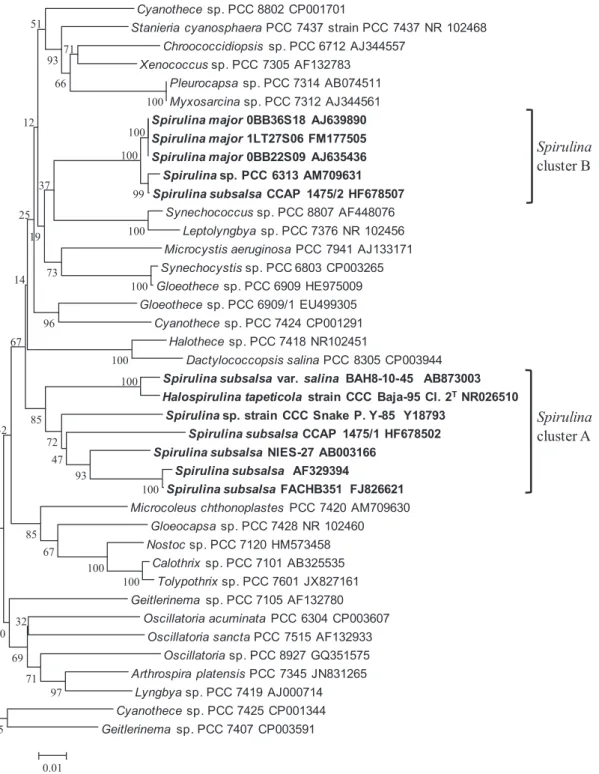
4a). The strains identified as Spirulina and available in GenBank were divided into two clusters (tentatively named
Spirulina cluster A and Spirulina cluster B) in the
phyloge-netic tree of cyanobacteria (Fig. 4a). The branching of these clusters was supported by high bootstrap values (96 or 100%) in Neighbor-Joining analysis (Fig. 4a).
Fig. 3b shows the phylogenetic analysis of the 16S rRNA gene sequences having a sequencial similarity to Spirulina (from 78 to 1469 corresponding to E. coli numbering). Five
Spirulina clusters (Spirulina cluster 1.1, 1.2, 1.3, 2 and 3)
were formed in the phylogenetic tree among Spirulina and related cyanobacteria. Cluster A was subdivided into four clusters (Spirulina cluster 1.1, 1.2, 1.3 and cluster 3). Cluster 1.1 contained traditional morphospecies of S. subsalsa. S.
subsalsa CCAP 1475/1 [HF678502], Spirulina sp. MPI S4
[Y18792], Spirulina sp. P7 [AF091109], uncultured bacte-rium clone GBI-65 [GQ441246], GBI-66 [GQ441247], and GBII-78 [GQ441342] were isolated from marine and brackish
water 4,45). Cluster 1.2 contained traditional morphospecies of
S. subsalsa. S. subsalsa NIES-27 [AB003166], S. subsalsa
[AF329394], S. subsalsa FACHB351 [FJ826621], and uncultured bacterium clone SA 82 [JQ738968] were isolated
strains in Cluster 1.2 exhibit drought resistance 4). Cluster
1.3 was “Highly halotolerant/Halospirulina cluster” (sensu
Nübel et al. 45)) containing traditional morphospecies of S.
subsalsa. Spirulina sp. EEW1 [HQ008224], Halospirulina
sp. CCC Baja-95 Cl. 3 [Y18790], Halospirulina sp. MPI
S3 [Y18789], H. tapeticola CCC Baja-95 Cl. 2T [Y18791],
and strain S. subsalsa var. salina BAH8-10-45 [AB873003]
were isolated from hypersaline environments 4,45) and exhibit
a hyper salt tolerance 4,45). Cluster 2 mainly contained
tradi-tional morphospecies of S. major strains. Spirulina sp. PCC 6313 [AM709631], S. major OBB36S18 [AJ639890],
S. major 1LT27S0 [FM177505], S. major OBB22S09
[AJ635436], Spirulina sp. GLS010 [FJ546714], Spirulina sp. [X75045], and S. subsalsa CCAP 1475/2 [HF678507] were isolated from a wide salinity range of habitats (freshwater,
blackish and marine) 21,45). Cluster 3 contained traditional
Fig. 4a. Neighbor-Joining phylogenic tree of cyanobacteria based on 16S rRNA gene sequences.
Numbers at nodes indicate bootstrap percentages from 1000 replicas obtained with distance and parsimony analyses, respectively; values were reported only at nodes where both methods gave bootstrap percentages as 100%. Accession codes of sequences retrieved from Gen Bank 4). The position of the 16S rRNA gene sequence of cyanobacteria with helical, tightly coiled trichomes were marked in bold. The
scale bar indicates 1% estimated sequence divergence. The analysis involved 46 nucleotide sequences of 16S rRNA gene. There were a total of 1284 positions in the final dataset.
morphospecies of S. labyrinthiformis strain exhibiting a thermotolerance. Spirulina sp. CCC Snake P. Y85 [Y18793], uncultured cyanobacterium clone SM2A06 [AF445707], and
SM1D12 [AF445678] were isolated from a hot spring 4,45).
BAH8-10-45 formed a distinct branching at the periphery of the Spirulina cluster 1.3 (Fig. 4b). The branching of BAH8-10-45 at the base of this group was supported by bootstrap values of 100% in the neighbor-joining analysis. The percentage of 16S rRNA gene sequence similarity among BAH8-10-45 and traditional morphospecies of Spirulina
were 90.8–97.8% (H. tapeticola CCC Baja-95 Cl. 2T:
97.8%, S. subsalsa NES-27: 92.1%, Spirulina sp. PCC
6313 as S. major 45): 90.9% and Spirulina sp. CCC Snake
P. Y85 as S. labyrinthiformis 45): 90.8% showing in Table
3). The percentage of similarity among BAH8-10-45 and related strains clearly justifies the definition of a new species
according to common bacteriological practice 50).
However, when the similarity within each cluster is evalu-ated regarding the current species belonging to the genus
Spirulina, the percentage of similarity within each species is
Fig. 4b. Neighbor-Joining phylogenic tree of Spirulina and related cyanobacteria based on 16S rRNA gene sequences.
Numbers at nodes indicate bootstrap percentages from 1000 replicas obtained with distance and parsimony analyses, respectively; values were reported only at nodes where both methods gave bootstrap percentages as 100%. Accession codes of sequences retrieved from Gen Bank 4). The position of the 16S rRNA gene sequence of BAH8: 10–45 was marked in bold. The scale bar indicates 2% estimated sequence
91.0–99.4% for S. subsalsa (Cluster 1.1: 97.5–99.4% (n=3), Cluster 1.2: 94.7–99.2% (n=2) and Cluster 1.3: 97.3–98.7% (n=4)), 98.8–100% for S. major (Cluster 2, n=5), and 100% for S. labyrinthiformis (Cluster 3, n=1). It is clear that the similarity threshold of the species belonging to the genus
Spirulina is equal to or slightly lower than threshold range
of 98.7–99% for new species of common bacteriological
practice 50). In other words, there appears to be a
situa-tion where clusters including species of the genus Spirulina in the phylogenetic analysis based on the 16S rRNA gene sequence correspond to the genus (or higher) which is a broad concept bundling species of most common bacteria. The similarity within S. subsalsa having three sub-clusters is low (91.0–99.4%). The range of similarity within each of the sub-clusters forming S. subsalsa is generally similar to that of S. major (Cluster 2), suggesting a possibility that the future progress of research may divide S. subsalsa into several species. Of the three sub-clusters forming S. subsalsa, Cluster 1.3 appears to show a different character in terms of halotolerance of its strains from strains forming other clus-ters of S. subsalsa. It must be noted that this difference was
used by Nübel et al. to propose the genus Halospirulina 45). If
halotolerance described above are re-arranged (for example, such condition pointed out by Margheri et al. in 2003 that a strain must be resistant to a salt concentration of 15 wt/vol
% or higher 39)) with related strains for the further
advance-ment of research, there is a possibility of new developadvance-ments in the near future. Such developments may include a change of the diagnosis of S. subsalsa in the genus Spirulina Turpin ex Gomont based on plant taxonomical evaluation and the establishment of a new species as a morpho/ecospecies. Another possibility is the introduction of a new genus with the condition that species grow with a salinity of approxi-mately 13–15 wt/vol % or higher or re-definition of the genus Halospirulina based on classification and analysis with emphasis on phylogenetic analysis using the 16S rRNA gene sequence.
Accordingly, until a new definition of this new taxonomic group is given to Cluster 1.3, this cluster is considered to be a S. subsalsa cluster based on the classification of the genus
Spirulina which is firmly established at present. If the strains
in this cluster are to be further classified using significant characteristics, a taxonomic group below S. subsalsa should be established in respect of the classification conforming to phycological taxonomy as in the case of BAH8-10-45 so that its status is clear. As far as evaluation of the phylogenetic analysis of the genus Spirulina is concerned, there appears to be a gap in the sense that the species and variety (or subspe-cies) in the classification based on phycological taxonomy generally correspond to such higher taxonomic groups as genus and species in the phylogenetic analysis and evaluation of the similarity of most common bacteria using the 16S rRNA gene sequence.
This gap between phylogenetic analysis using the 16S rRNA gene sequence and the conventional classification also exists within the taxonomy of most common bacteria. While
Table
3. 16S rRN
A gene
sequence similar
ities among the mor
phosp ecies of Spirulina . Strain GenBank Accession Number Spirulina cluster 1.1 Spirulina cluster 1.2 Spirulina cluster 1.3 Spirulina cluster 2 Spirulina cluster 3 1 2 3 4 5 6 7 8 9 10 11 12 13 14 15 16 Spirulina subs als a CC AP 1475/1 HF678502 1 100.0 97.8 97.5 92.7 92.8 92.8 91.7 91.2 91.6 91.0 92.7 92.3 92.7 92.5 92.4 91.5 Spirulina sp. strain MPI S4 Y18792 2 100.0 99.4 93.0 92.8 92.8 91.8 91.3 91.6 91.0 92.9 92.6 92.9 92.9 92.7 93.0 Spirulina sp. P7 AF091 109 3 100.0 92.9 92.6 92.5 91.6 91.1 91.6 91.2 92.6 92.5 92.6 92.3 92.1 92.3 Spirulina subs als a IAM M-223 A B003166 4 100.0 94.9 94.7 92.6 91.9 92.1 92.1 92.7 92.7 92.7 92.5 92.5 93.5 Spirulina subs als a AF329394 5 100.0 99.2 92.2 91.6 92.1 91.7 92.0 91.8 92.0 91.9 91.8 91.8 Spirulina subs als a FA CHB351 FJ826621 6 100.0 92.1 91.5 91.8 91.9 91.9 91.6 91.9 91.8 91.8 92.2 H al ospirulina sp.CCC Baja-95 Cl. 3 Y18790 7 100.0 98.3 98.7 98.0 92.0 91.8 92.0 91.9 91.7 91.0 H al ospirulina sp.MPI S3 Y18789 8 100.0 97.8 97.3 91.5 91.3 91.5 91.4 91.2 90.8 H al ospirulina tap etic ola CCC Baja-95 Cl. 2 T Y18791 9 100.0 97.8 91.7 91.8 91.7 91.5 91.3 91.1 Spirulina subsalsa v ar . salina B AH8-1 0-45 A B873003 10 100.0 91.2 91.2 91.2 91.1 90.9 90.8 Spirulina m aj or 0BB36S18 AJ639890 11 100.0 99.9 100.0 99.5 99.4 92.2 Spirulina m aj or 1L T27S06 FM177505 12 100.0 99.9 99.4 99.2 91.9 Spirulina m aj or 0BB22S09 AJ635436 13 100.0 99.5 99.4 92.2 Spirulina subs als a CC AP 1475/2 HF678507 14 100.0 98.8 92.0 Spirulina sp. PCC 6313 AM709631 15 100.0 92.0 Spirulina sp. CCC Snake P. Y-85 Y18793 16 100.0
the 16S rRNA gene is used as the most effective molecular marker for the taxonomical study of the bacteria, it has been pointed out that resolution regarding the taxonomy of species is limited for some existing taxonomic groups of bacteria of which the taxonomy has been finely established. In such cases, this limitation is sometimes compensated for by phylo-genetic analysis using the sequence of a specific housekeeping gene, such as the gyrB gene, of which the evolutionary speed
is faster than that of the 16S rRNA gene 25,52,56,62). Contrary to
the situation described above, phylogenetic analysis using the 16S rRNA gene sequence with the genus Spirulina suggests a possibility of analysis to the variety (or subspecies) level beyond the species level dealt with the existing classification system because of the slow evolutionary speed of the 16S rRNA gene. As such, this evaluation approach is inferred to offer an effective resolution when the evolutionary relation-ship of species/strains belonging to the genus Spirulina is to be evaluated.
The taxonomic work this time was conducted primarily with cyanobacteria obtained in the screening process of halophilic microalgae which autotrophically produce highly value-added compatible solutes from the viewpoint of their commer-cial production for industrial use. When this screening was planned, it was difficult to find effective screening conditions based on the existing taxonomical knowledge of microalgae which was largely confirmed to morphological information.
For the identification of BAH8-10-45 this time, as the historical background and definition of the genus
Halospirulina were somewhat problematic, the taxonomy
of this strain was clarified.
From the viewpoint of industrialists, we are hoping to see the establishment of at least the species and preferably the variety (or subspecies) as well, within the current phycological classification system so that diverse physiological data can be accumulated and systematized through the classification work, as in the case of most common bacteria to facilitate the utilization of cyanobacteria in a number of different industrial fields. In the case of most common bacteria, indus-trialists themselves can identify and classify them without the involvement of highly specialized experts. It is hoped that a similar environment allowing the easy classification of cyanobacteria can be established in the near future. In other words, this environment will allow the establishment of a new phycological classification system in which new genus, species and variety (or subspecies) can be backed by simple iden-tification results through readily available and convenient phylogenetic analysis using the 16S rRNA gene sequence. Although phylogenetic analysis using the 16S rRNA gene sequence as the starting point, has become a common prac-tice today in the case of cyanobacteria; the present situation appears to be that the phycological classification system for higher classes than genus to form the background has not yet been fully established.
Acknowledgments
This study has been generously supported by the Japan Cooperation Center, Petroleum (JCCP) under the auspices of the Ministry of Economy, Trade and Industry, Japan.
We are grateful to Dr. Y. Kasai, MBI Chair of Marine Biosciences, Kamaishi Research Laboratory, Kitasato University for his valuable suggestions and discussions on algal isolation and phylogenetic analysis. We would like to thank Dr. R. W. Castenholz, Culture Collection of Microorganisms from Extreme Environments, for his generous gift of the
strain H. tapeticola CCC Baja-95 Cl. 2T. Our thanks also
go to Dr. M. Kawachi (National Institute for Environmental Studies) and President T. Hasegawa (Ecorenaissance, Co., Ltd.) for their many helpful suggestions regarding taxonomic research.
References
1) Abed, R.M.M., S. Dobrestov, S. Al-kharusi, A. Schramm, B. Jupp, and S. Golubic. 2011. Cyanobacterial diversity and bioactivity of inland hypersaline microbial mats from a desert stream in the Sultanate of Oman. Fottea 11(1): 215–224. 2) Anagnostidis, K. and J. Komárek. 1988. Modern approach to
the classification system of cyanophytes. 3-Oscillatoriales. Arch. Hydrobiol. Suppl. 80(1-4): 327–472.
3) Babusiaux, D. 2003. Allocation of the CO2 and Pollutant
Emis-sions of a Refinery to Petroleum Finished Products. Oil & Gas Science and Technology—Rev. IFP. 58(6): 685–692.
4) Benson, D.A., M. Cavanaugh, K. Clark, I. Karsch-Mizrachi, D.J. Lipman, J. Ostell, and E.W. Sayers. “GenBank,” Nucleic Acids Research, Vol. 41, no. Database Issue, pp. D36–D42, 2013.
5) Borowitzka, M.A. 1980. Carbon-13 nuclear magnetic resonance study of osmoregulation in a blue-green algae. Science 210(7): 650–651.
6) Borowitzka, M.A. and L.J. Borowitzka. 1988. Dunaliella, pp. 27– 58. In M.A. Borowitzka, L.J. Borowitzka (eds.), Micro-algal Biotechnology. Cambridge University Press, Cambridge, U K. 7) Castenholz, R.W. 1977. The effect of sulfide on the blue-green
algae of hot springs. II. Yellowstone National Park. Microb. Ecol. 3: 79–105.
8) Castenholz, R.W. 2001. Phylum BX. Cyanobacteria: oxygenic photosynthetic bacteria, pp. 473–599. In D.R. Boone (ed.) and R.W. Castenholz, Bergey’s manual of systematic bacteriology, 2nd ed., vol. 1. Springer, New York, USA.
9) Chatchawan, A., Y. Peerapornpisal, and J. Komárek. 2011. Di-versity of cyanobacteria in man-made solar satern, Petchaburi Province, Thailand—a pilot study. Fottea 11(1): 203–214. 10) Chen, T.H.H. and N. Murata. 2002. Enhancement of tolerance
of abiotic stress by metabolic engineering of betaines and other compatible solutes. Curr. Opin. Plant. Biol. 5: 250–257. 11) Chihara. 1992. p2. In Chihara (ed.), Diversity and evolution of
algae. Shokabo, Tokyo, JAPAN. (in Japanese).
12) Davidova, I.M., S. Hicks, P.M. Fedorak, and J.M. Suflita. 2001. The influence of nitrate on microbial processes in oil industry production waters. J. Industrial Micro. Biotech. 27: 80–86. 13) Diez, B., K. Bauer, and B. Bergman. 2007. Epilithic
cyanobacte-rial communities of a marine tropical beach rock (Heron Island, Great Barrier Reef): diversity and diazotrophy. Appl. Environ. Microbiol. 73: 3656–3668.
14) Evans, J.P., R.B. Smith, and R.J. Oglesby. 2004. Middle East climate simulation and precipitation processes. 2004. Int. J. Climatol. 24: 1671–1694.
a maximum likelihood approach. J. Mol. Evol. 17: 368–376. 16) Gabbay-Azaria, R., E. Tel-Or, and M. Schonfeld. 1988. Glycine
betine as an osmoregulant and compatible solute in the marine cyanobacterium Spirulina subsala. Arch. Biochem. Biophys. 264(1): 333–369.
17) Garcia, C.M., R. Garcia-Ruiz, M. Rend’on, F.X. Niell, and J. Lucena. 1997. Hydrological cycle and interannual variability of the aquatic community in a temporary saline lake (Fuente de Piedra, Southern Spain). Hydrobiologia. 345: 131–141. 18) Garcia-Pichel, F., U. Nübel, and G. Muyzer. 1998. The
phylog-eny of unicellular, extremely halotolerant cyanobacteria. Arch. Microbiol. 169: 469–482.
19) Geitler, L. 1932. Cyanophyceae, p. 916. In Kolkwitz (ed.), Ra-benhorst’s Kryptogamenflora von Deutschland, Österreich und der Schweiy, Vol. 14 Akademische Verlag, Leipyig. Johnson Repint Co., New York, USA.
20) Golubic, S. 1980. Halophily and halotolerance in cyanophytes. Origins of Life 10: 169–183.
21) Gomont, M. 1892. Monographie des Oscillariées (Nostocacées homocystées). Annales des Sciences Naturelles, Botanique, Se-ries 7(16): 91–264.
22) Guiry, M.D. and G.M. Guiry. 2014. AlgaeBase. World-wide electronic publication, National University of Ireland, Galway. http://www.algaebase.org [Accessed on 17 April 2014]. 23) Hall, T.A. 1999. BioEdit: a user-friendly biological sequence
alignment editor and analysis program for Windows 95/98/ NT. Nucl. Acids. Symp. Ser. 41: 95–98.
24) Harun, R., M. Singh, G.M. Forde, and M.K. Danquah. 2010. Bioprocess engineering of microalgae to produce a variety of consumer products. Renewable and Sustainable Energy Re-views. 14: 1037–1047.
25) Holmes, D.E., K.P. Nevin, and D.R. Lovley. 2004. Comparison of 16S rRNA, nifD, recA, gyrB, rpoB and fusA genes within the family Geobacteraceae fam. nov. Int. J. Syst. Evol. Microbiol. 54: 1591–1599.
26) Huang, G.H., F. Chen, D. Wei, X.W. Zhang, and G. Chen. 2010. Biodiesel production by microalgal biotechnology. Applied En-ergy 87: 38–46.
27) Ichimura, T. 1979. Media for blue-green algae, pp. 294–305. In K. Nishizawa and M. Chihara (eds.), Methods in algalogical studies.Kyoritsu, Tokyo. (In Japanese).
28) John, J., M. Hay, and J. Paton. 2009. Cyanobacteria in benthic microbial communities in coastal salt lakes in Western Austra-lia. Algol. Stud. 130: 125–135.
29) Kimura, M. 1980. A simple method for estimating evolution-ary rates of base substitutions through comparative studies of nucleotide sequences. J. Mol. Evol., 16: 111–120.
30) Klähn, S. and M. Hagemann. 2011. Compatible solute biosyn-thesis in cyanobacteria, Environ. Microbiol. 13(3): 551–562. 31) Knapp, S., J. McNeill, and N.J. Turland. 2011. Changes to
publication requirements made at the XVIII International Bo-tanical Congress in Melbourne—what does e-publication mean for you? BMC Evol. Biol., 11(251): 2–4.
32) Komárek, J. 2010. Recent changes (2008) in cyanobacterial taxonomy based on a combination of molecular background with phenotype and ecological consequences (genus and species concept). Hydrobiologia 639: 245–259.
33) Komárek, J. and K. Anagnostidis. 2005. Cyanoprokaryota 1. Teil: Chroococcales, pp. 141–156. In Süßwasserflora von Mitte-leuropa, Pascher, A. (eds.), Band 19/1: 1–548. Gustav Fischer, Jena Stuttgart Lübek Ulm.
34) Kondepudi, K.K. and T.S. Chandra. 2011. Identification of os-molytes from a moderately halophilic and amylolytic Bacillus sp. strain TSCVKK. Eur. J. Exp. Bio. 1(1): 113–121.
35) Krienitz, L., A. Ballot, K. Kotut, C. Wiegand, S. Pütz, J.S. Metcalf, G.A. Codd, and S. Plugmacher. 2003. Contribu-tion of hot spring cyanobacteria to the mysterious deaths of Lesser Flamingos at Lake Bogoria, Kenya. Microbiol. Ecol. 43: 141–148.
36) Li, Y. 2008. Biofuels from microalgae. Biotechnol. Prog 24: 815–820.
37) Luley-Goedl, C., T. Sawangwan, M. Mueller, A. Schwarz, and B. Nidetzky. 2010. Biocatalytic process for production of a-glucosylglycerol using sucrose phosphorylase. Food Technol. Biotechnol. 48(3): 276–283.
38) Mackay, M.A., R.S. Norton, and L.J. Borowitzka. 1984. Organ-ic osmoregulatory solutes in cyanobacteria. J. Gen. MOrgan-icrobiol. 130: 2177–2191.
39) Margheri, M.C., R. Piccardi, S. Ventura, C. Viti, and L. Giovannetti. 2003. Genotypic diversity of Oscillatoriacean strains belonging to the Genera Geitlerinema and Spirulina determined by 16S rDNA restriction analysis. Curr. Microbiol. 46: 359–364.
40) Margheri, M.C., S. Ventura, J. Katovský, and J. Komárek. 2008. The taxonomic validation of the cyanobacterial genus Halo-thece. Phycologia 47(5): 477–486.
41) Montoya, H. 2009. Algal and cyanobacterial saline biofilms of the grande coastal lagoon, Lima, Peru. Natural Resources and Environmental Issues. 15(23): 127–134.
42) Nagasathya, A. and N. Thajuddin. 2008. Cyanobacterial Di-versity in the Hypersaline Environment of the Saltpans of Southeastern Coast of India. Asian J. Plant Sci. 7: 473–478. 43) Nelissen, B., A. Wilmotte, J-M. Neef, and R.D. Wachter. 1994.
Phylogenetic Relationships Among Filamentous Helical Cyano-bacteria Investigated on the Basis of 16S Ribosomal RNA Gene Sequence Analysis. Syst. Appl. Microbiol. 17: 206–210. 44) Norton, R.S. 1979. Identification of mollusc metabolites by
natural-abundance 13C NMR studies of whole tissue and tissue
homogenates. Comp. Biochem. Physiol. 63(B): 67–72. 45) Nübel, U., F. Garcia-Pichel, and G. Muyzer. 2000. The
halo-tolerance and phylogeny of cyanobacteria with tightly coiled trichomes (Spirulina Turpin) and the description of Halospi-rulina tapeticola gen. nov., sp. nov. Int. J. Syst. Evol. Microbiol. 50: 1265–1277.
46) Ojima, T., W. Saburi, T. Yamamoto, and T. Kudo. 2012. Char-acterization of Halomonas sp. strain H11 a-glucosidase acti-vated by monovalent cations and its application for efficient synthesis of a-D-glucosylglycerol. Appl. Envoron. Microbiol. 78(6): 1836–1845.
47) Rodriguez-Valera, F., A. Ventosa, G. Juez, and J.F. Imhoff. 1985. Variation of environmental features and microbial populations with salt concentrations in a multi-pond saltern. Microb. Ecol. 11: 107–115.
48) Sakamoto, A. and N. Murata. 2002. The role of glycine betaine in the protection of plants from stress: clues from transgenic plants. Plant, Cell and Environment. 25: 163–171.
49) Shelef, G., A. Sukenik, and M. Green. 1984. Microalgae har-vesting and processing: a literature review. Solar Energy Re-search Institute, U.S. Department of Energy Technical Report (SERI/STR-231-2396).
50) Stackebrandt, E. and J. Ebers. 2006. Taxonomic parameters revisited: tarnished gold standards. Microbiol. Today 33: 152– 155.
51) Starr, R. and J.A. Zeikus 1987. UTEX—the culture collection of algae at the University of Texas at Austin. J. Phycol. 23: 1–47. 52) Stenkova, A.M., M.P. Isaeva, E.P. Bystritskaya, K.V. Guzev,
V.A. Rasskazov, and A. Rakin. 2012. The molecular phylogeny of the gyrB gene: a molecular marker for systematic charac-terization of the genus Yersinia. Advances in Experimental Medicine and Biology 954: 53–56.
53) Stizenberger, E. 1852. Spirulina und Arthrospira (nov. gen.) Hedwigial 1: 32–33.
54) Tamura, K., D. Peterson, N. Peterson, G. Stecher, M. Nei, and S. Kumar. 2011. MEGA5: Molecular Evolutionary Genetics Analysis using Maximum Likelihood, Evolutionary Distance, and Maximum Parsimony Methods. Mol. Biol. Evol. 28(10): 2731–2739.
W: improving the sensitivity of progressive multiple sequence alignment through sequence weighting, positions-specific gap penalties and weight matrix choice. Nucl. Acids Res. 22(22): 4673–4680.
56) Tourova, T.P., A.V. Korshunova, E.M. Mikhailova, D. Sh. Sokolova, A.B. Poltaraus, and T.N. Nazina. 2010. Application of gyrB and parE Sequence Similarity Analyses for Differentia-tion of Species within the Genus Geobacillus. Microbiologiya. 79(3): 356–369.
57) Trieb, F., C. Schillings, M. O’Sullivan, T. Pregger, and C. Hoyer-Klick. 2009 Global Potential of Concentrating Solar Power. SolarPaces Conference Berlin, September: 1–11. 58) Turpin, P.J.F. 1827. Spiruline Oscillarioide, pp. 509–510. In
F.G. Levrault (ed.), Dictionnaire des sciences naturelles, dans lequel, Le Normant, rue de Seine, Paris, FR.
59) Ummel, K. and D. Wheeler. 2008. Desert power: the economics of solar thermal electricity for Europe, North Africa, and the
Middle East. Working paper of the Center for Global Develop-ment. 156: 1–46.
60) Walker, T.L., S. Purton, and D.K. Becker. 2005. Microalgae as bioreactors. Plant Cell Rep. 24: 629–641
61) Watanabe, K., N. Hamamura, and N. Kaku. 2004. Molecular iden-tification of microbial populations in petroleum-contaminated groundwater. pp. 237–244. In J.M. Walker, J.F.T. Spencer, and A.L.R. Spencer (eds.), Environmental Microbiology; Methods and Protocols. Humana Press, Totowa, NJ.
62) Yamamoto, S. and S. Harayama. 1995. PCR Amplification and Direct Sequencing of gyrB Genes with Universal Primers and Their Application to the Detection and Taxonomic Analysis of Pseudomonas putida Strains. Appl. Environ. Microbiol. 61(3): 1104–1109.
63) Yun, Y. and J. M. Park. 1997. Development of gas recycling photobioreacter system for microalgal carbon dioxide fixation. Korean J. of Chem. Eng. 14(4): 297–300.