INTRODUCTION
Young athletes with spondylolysis commonly complain about low back pain (LBP) (1). Lumbar spondylolysis is a stress bone fracture that frequently occurs in athletes with repetitive trunk movements (2, 3). Forty - seven percent of young athletes with LBP were reported to have lumbar spondylolysis (4). The ideal treatment of athletes with spondylolysis is attainment of bone union without surgical intervention and prevention of progression to nonunion of pars interarticularis. Most sports physicians agree that the treatment of spondylolysis should include a rest period with or without bracing, to allow healing, and rehabilitation, and that ath-letes can return to their sports activities once they become as-ymptomatic (5 - 7).
Sairyo, Sakai and Fujii suggest that bone union is more likely to occur at very early, early, and progressive stages of spondylolysis, respectively (8 -10). Fujii et al. reported that the spinal level and the stage of the defects were predominant factors associated with bone union (10). Recent studies suggest that bone union is more likely to occur in unilateral active spondylolysis, compared to the bilateral and pseudobilateral active spondylolysis (8 -10). Athletes with uni-lateral spondylolysis are prone to 12 times more mechanical stress at contralateral pedicle and pars interarticularis (11, 12).
However, most reports have not analyzed the potential role of physical fitness factors such as muscle strength and flexibility on spondylolysis. Some studies recommend trunk muscle strength exercises and stretching during conservative treatment for
spon-dylolysis (5, 13). In particular, lack of extensibility in hamstring muscles is associated with decreased pelvic mobility (14, 15), which is evident in studies showing that poor hamstring extensi-bility is associated with limited hip rotation (16), thoracic hy-perkyphosis (17), spondylolysis (18), disc herniation (19), changes in lumbopelvic rhythm (20), and low back pain (21). However, the relationship between physical function and lumbar separation in spondylolysis remains unclear. The purpose of this study was to identify not only predisposition to spondylolysis but also the physical characteristics associated with “bone union” following conservative spondylolysis treatment among pediatric and adoles-cent athletes.
MATERIALS AND METHODS
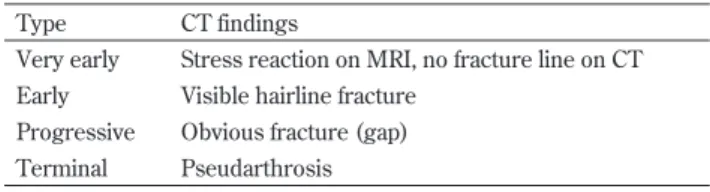
Inclusion and exclusion criteriaThis retrospective study included the review of clinical records and radiological findings in 183 patients with a chief complaint of LBP who received a final diagnosis of early or progressive lumbar spondylolysis, received conservative treatment, and At first pres-entation, lumbar spondylolysis was diagnosed based on plain radiography, computed tomography (CT), and magnetic reso-nance imaging (MRI). Based on CT results, spondylolysis was classified into one of four categories : very early, early, progres-sive, and terminal (9, 10) (Table 1) (Fig. 1).
A very early defect was defined as a stress reaction on MRI, without an apparent fracture line on CT. An early defect was de-fined as a fissure in the pars. In the progressive category, the defect, albeit still narrow, had a round edge. A wide and sclerotic defect was considered to be in the terminal stage (10). CT studies were performed using a 16 - slice CT unit (SOMATOM Emotion ;
ORIGINAL
High defect stage, contralateral defects, and poor flexibility are
negative predictive factors of bone union in pediatric and
adolescent athletes with spondylolysis
Kazufumi Yamazaki1, Shintaro Kota1, Daisuke Oikawa1, and Yoshiji Suzuki2, MD
1Department of Rehabilitation Kikugawa municipal General Hospital, Shizuoka, Japan,2Department of Orthopedic Surgery, Kikugawa municipal
General Hospital, Shizuoka, Japan
Abstract : Purpose : To identify predisposition to spondylolysis and physical characteristics associated with “bone union” following conservative spondylolysis treatment among pediatric and adolescent athletes. Methods : We retrospectively analyzed pediatric and adolescent athletes with spondylolysis who underwent conservative treatment and rehabilitation for three or more consecutive months following sports activity cessation. Patients with terminal spondylolysis or who did not discontinue sports activities were excluded. We compared physical fitness factors in the union and nonunion groups and examined the association between bone union and spondylolysis severity by logistic regression analysis. Results : Of 183 patients with spondylolysis who underwent rehabilitation over a four -year period, 127 patients with 227 defects were included in the final analysis. Bone union was achieved in 66.5%% (151/227) of the pars interarticularis defects and 70.1%% (89/127) of the patients. On multivariate analysis, stage of pars interarticularis defect (odds ratio [OR], 0.26 ; p = 0.0027), stage of contralateral pars interarticularis defect (OR, 0.51 ; p = 0.00026), and straight leg-raising test (OR, 1.06 ; p = 0.028) were signifi-cantly associated with bone union. Conclusions : High defect stage, stage of the contralateral pars interarticu-laris defect, and poor flexibility were negative prognostic factors of bone healing in athletes with spondylolysis. J. Med. Invest. 65 : 126-130, February, 2018
Keywords :conservative treatment, spondylolysis, tight hamstring
Received for publication November 27, 2017 ; accepted January 31, 2018. Address correspondence and reprint requests to Kazufumi Yamazaki, Kikugawa General Hospital, Shizuoka Prefecture, Kikugawa City, Higashiyokochi 1632 Japan and Fax : +81 0537 - 35 - 4484.
Siemens, Erlangen, Germany). All patients were examined by plain radiographs and CT scans at first visit and during follow - up at six months or later. The stage of the pars interarticularis defect was scored using the very early, early, progressive, or terminal classifica-tion. The stage of the pars interarticularis defect in the contralateral side and/or at another level was also scored.
All patients completed the nonoperative treatment protocol as recommended, discontinued sports activities and underwent reha-bilitation. Additionally, patients were instructed to wear a brace for at least three consecutive months. To immobilize the trunk, a hard brace or a Darmen - type soft corset with an extension block was used. Different types of brace/orthosis were prescribed for patients depending on the stage of the fracture lines. A Darmen -type soft corset with an extension block was prescribed for patients who had a very early and early pars defect. A hard brace was pre-scribed for patients who had progressive pars defects or terminal stage of contralateral pars defect. In addition, patients with pain at rest and during activities of daily living were treated with thoracolumbar orthosis. Furthermore, 49 patients were treated with low -intensity pulsed ultrasound.
The rehabilitation program was identical for all patients and em-phasized abdominal muscle strengthening, hamstring stretching, and pain - free core stability exercises at the hospital twice per month until treatment completion. After approximately three months of conservative treatment, progressive low - intensity sports activities were allowed for patients who did not have symp-toms during flexion - extension and rotational trunk movements and had bone union by on follow - up CT.
Trunk fitness was evaluated by the modified Kraus Weber (K -W) test (22). Subjects were in a supine position, with knees ex-tended and hands interlocked behind the neck. An examiner held the subject’s feet on the floor, while the subjects rolled into a sitting position so their forearms touched their thighs. Therefore, the sub-jects moved through an approximate 90"range of motion. In this
study, a modified K - W test was used to calculate the score based on the number of correctly performed sit- ups with straight legs in one minute. Body flexibility and muscle tightness were evaluated by finger - floor distance (FFD), straight leg - raising (SLR) test, and heel - buttock distance (HBD). Pain was evaluated using a numeri-cal rating snumeri-cale (NRS). All physinumeri-cal examinations and measure-ments were performed by a physical therapist at first treatment visit.
The study was approved by the Ethics Committee of Kikugawa municipal General Hospital. (approval number, 101).
Bone union evaluation
Approximately every 1.5 months after diagnosis, a CT scan was performed to evaluate bone union. Specifically, the pars interarticu-laris at the level of spondylolysis was evaluated using 2 - mm - thick slices. Bone union was defined as bone continuity that was con-firmed in at least three out of four slices. Patients who retained pars interarticularis defects at five months after diagnosis were defined as those with nonunion. One spine surgeon performed stage classification by CT and bone union evaluation for all patients. Statistical analysis
The chi - squared test, the Mann - Whitney U test, the Student’s t-test, were performed for comparison of the union and nonunion groups. Chi - square test was used to compare categorical variables. Mann - Whitney U test was used to compare vertebral level and the stage of the pars defect and the number of pars interarticularis defects. Student’s t- test was used to compare NRS, FFD, HBD, SLR, Modified K - W test, and Treatment period. Significant factors with ap value of !0.05 in univariate analysis were included as inde-pendent variables in the subsequent multivariate analysis. Multi-variate analysis was performed by logistic regression using these significant independent variables, with bone union as the depend-ent variable. All statistical analyses were performed using the freely available R statistical software package (version 3.1.2.).
RESULTS
In total, 56 patients among 183 patients diagnosed with spondy-lolysis who were conservatively treated over the six years of the study period were excluded, including 33 patients who were diag-nosed with terminal spondylolysis and 23 patients who did not cease sports activities. Therefore, 127 patients were included in the final analysis. There were 227 defects in 127 patients. With treat-ment, all patients returned to their preinjury activity levels. Table 2 shows the number of cases with spondylolysis at each vertebral level and the stage of the pars interarticularis defect in the union and nonunion groups at the initial presentation. There was a signifi-cant difference in the pars interarticularis defect stage between the two groups. Specifically, in the non - union group, there were 76 defects in 38 patients, including very early, early, and progressive stage spondylolysis in 3, 10, and 44 pars interarticularis lesions, respectively. Conversely, in the union group, there were 151 de-fects in 89 patients, including very early, early, and progressive stage spondylolysis in 16, 76, and 26 laminae, respectively. In addi-tion, there was a significant difference in the stage of the contralat-eral pars interarticularis defect between the union and nonunion groups. There were 6 (15.8%) and 60 (67.4%) cases of unilateral spondylolysis in the union and nonunion groups, respectively (Table 3). Comparison of the characteristics at the initial presenta-tion between the union and nonunion groups is shown in Table 4. Univariate analysis revealed a significant difference in the SLR test between the two groups (p = 0.011), but there were no significant differences in sex, age, period of rest and activity restrictions, low -intensity pulsed ultrasound treatment, or NRS, FFD, and HBD Table 1. Summary of spondylolysis classification and scoring
Type CT findings
Very early Stress reaction on MRI, no fracture line on CT Early Visible hairline fracture
Progressive Obvious fracture (gap) Terminal Pseudarthrosis
CT, computed tomography ; MRI, magnetic resonance imaging
Fig.1. Computed tomography (CT) classification of pediatric lumbar spondylolysis, as reported by Fujiiet al. and Sakai et al. Stress reaction on MRI, no fracture line CT (A) A hairline fracture is visible in the early stage (B), a clear bone gap is apparent in the progressive stage (C), and pseudarthrosis occurs in the terminal stage (D). MRI, magnetic reso-nance imaging ; CT, computed tomography
tests between the two groups (Table 4). The sporting activities of the two groups were also compared (Table 5). By multivariate analysis, SLR [odds ratio (OR), 1.06 ;p = 0.028], stage of the pars interarticularis defect (OR, 0.26 ;p !0.0027), and stage of the con-tralateral pars interarticularis defect (OR = 0.51,p = 0.00026) were significantly associated with bone union (Table 6).
DISCUSSION
In the current study, we aimed to identify radiological variables and physical fitness factors that were associated with the suc-cessful union of defects in patients with spondylolysis. Stage of the defect was the most predominant predictor of a successful union, and stage of the contralateral pars interarticularis defect also was associated with the success of a defect union. Additionally, our analysis indicated that despite the cessation of sports activities, body flexibility might influence the success of a defect union. Fur-thermore, we found that not only higher defect stage and contralat-eral defect but also body flexibility was a negative predictive factor of bone union in athletes with spondylolysis. Previous studies suggested that bone union was more likely to occur in very Table 2. Vertebral level and stage of the pars defect
Factor Group Nonunion Union P value
n 38 89 L2 Rt (%) Early 0 (0.0) 2 (50.0) 1 Progressive 0 (0.0) 1 (25.0) Terminal 1 (100.0) 1 (25.0) L2 Lt (%) Early 0 (0.0) 2 (100.0) 0.333 Progressive 1 (100.0) 0 (0.0) L3 Rt (%) Very early 0 (0.0) 1 (16.7) 0.226 Early 1 (33.3) 5 (83.3) Progressive 1 (33.3) 0 (0.0) Terminal 1 (33.3) 0 (0.0) L3 Lt (%) Very early 1 (25.0) 2 (40.0) 0.19 Early 0 (0.0) 2 (40.0) Progressive 3 (75.0) 0 (0.0) Terminal 0 (0.0) 1 (20.0) L4 Rt (%) Very early 1 (12.5) 7 (26.9) 0.012 Early 2 (25.0) 15 (57.7) Progressive 5 (62.5) 2 (7.7) Terminal 0 (0.0) 2 (7.7) L4 Lt (%) Very early 0 (0.0) 1 (4.2) 0.115 Early 1 (16.7) 15 (62.5) Progressive 5 (83.3) 7 (29.2) Terminal 0 (0.0) 1 (4.2) L5 Rt (%) Very early 1 (3.6) 5 (11.9) 0.002 Early 4 (14.3) 16 (38.1) Progressive 17 (60.7) 7 (16.7) Terminal 6 (21.4) 14 (33.3) L5 Lt (%) Early 2 (8.0) 19 (45.2) 0.003 Progressive 12 (48.0) 9 (21.4) Terminal 11 (44.0) 14 (33.3)
Table 3. Stage of the pars defect
Factor Group Nonunion Union p value
n 38 89
Stage of the contralateral pars
defect (%) None 6 (15.8) 60 (67.4) !0.001 Very early 0 (0.0) 1 (1.1)
Early 3 (7.9) 10 (11.2) Progressive 21 (55.3) 15 (16.9) Terminal 8 (21.1) 3 (3.4) Stage of the other level pars
defect (%) None 35 (92.1) 68 (76.4) 0.25 Very early 0 (0.0) 1 (1.1)
Early 0 (0.0) 3 (3.4) Progressive 0 (0.0) 7 (7.9) Terminal 3 (7.9) 10 (11.2) Number of pars interarticularis
defects at other levels (%) 0 5 (62.5) 15 (41.7) 0.738 1 1 (12.5) 7 (19.4) 2 2 (25.0) 13 (36.1) 3 0 (0.0) 1 (2.8)
Table 4. Physical fitness factors that may influence the union of pars defects of the lumbar spine in children and adolescents
Factor Nonunion Union p value
n 38 89
Age, years 13.82"2.46 14.40"1.71 0.124 Male sex (%) 27 (71.1) 67 (75.3) 0.661 LIPUS treatment (%) 18 (52.9) 31 (47.0) 0.674 Numerical rating scale 4.5"3.1 4.0"2.9 0.382 Finger - floor distance !7.37"13.66 !6.61"15.71 0.795 Heel - buttock distance 5.97"5.63 8.03"6.09 0.077 Treatment period 76.78"41.74 74.10"34.75 0.712 Straight leg - raising test 59.87"11.36 63.82"9.59 0.047 Modified K - W test 26.05"10.01 27.88"8.26 0.287 LIPUS, low - intensity pulsed ultrasound ; Modified K - W test, modified Kraus - Weber test
Values are means"SD or numbers (%)
Table 5. The types of sports played for pars defects of the lumbar spine in children and adolescents.
Factor Sport Nonunion Union
n 38 89 Sports (%) Badminton 1 (2.6) 2 (2.2) Ballet 0 (0.0) 1 (1.1) Baseball or softball 9 (23.7) 24 (27.0) Basketball 1 (2.6) 6 (6.7) Karate 1 (2.6) 3 (3.4) Kendo 1 (2.6) 1 (1.1) Soccer 8 (21.1) 20 (22.5) Swimming 2 (5.3) 1 (1.1) Table tennis 1 (2.6) 0 (0.0) Tennis 1 (2.6) 3 (3.4) Track and Field 3 (7.9) 11 (12.4)
Volleyball 10 (26.3) 16 (18.0) Water polo 0 (0.0) 1 (1.1)
early, early, and progressive spondylolysis stages (8 -10). Several studies recommended stretching hamstrings during conserva-tive treatment of spondylolysis and preservation of hamstring flexibility to prevent LBP (6, 13, 23). Our study lends further support for the significance of hamstring stretching for preserva-tion of flexibility.
A higher defect stage for contralateral pars interarticularis was also identified as a negative predictive factor of bone union in ath-letes with spondylolysis. The results showed that bony union rate was 84.2% in the very early stage, 88.4% in the early stage, and 37.1% in the progressive stage, which were low compared with previous study (9). In our study, the patients with very early stage pars defect, who could not achieve bone union had terminal con-tralateral pars defect or early return to sports in less than 60 days. Unilateral spondylolysis is likely to achieve bone union with con-servative therapy (10), leading to the consideration that it is a clini-cally benign condition compared to bilateral spondylolysis. Blanda et al. found that union was achieved in 87% of athletes with unilat-eral lesions and that 87% of the athletes in whom nonunion was diagnosed had bilateral defects (24). Syset al. also found that healing was complete in all athletes with unilateral lesions, in five out of nine athletes with bilateral lesions, and in none of the athletes with pseudobilateral lesions (25). Moreover, patients with acute spondylolysis were reported to be likely to achieve bone union with conservative therapy for three months, compared to those with chronic spondylolysis (8, 9).
Reportedly, multi - level spondylolysis is very rare. A previous report indicated that the incidence of multi - level spondylolysis was approximately 1.5% among symptomatic patients (26). Conversly, other studies reported that stress on L4 pars interarticularis, which was reduced in the presence of L5 spondylolysis, was increased during lateral bending lumbar motion in biomechanical analysis (12). Futhermore, unilateral spondylolysis might lead to stress fractures or sclerosis at the contralateral side because of an in-crease in stress in the region (11). However, in the current study, there was no significant difference in the frequency of other verte-bral level defects between the two groups.
We also observed that there was a significant difference in the SLR test between the union and nonunion groups. Multivariate analysis also suggested that poor flexibility was a negative predic-tive factor of bone union in athletes with spondylolysis. Athletes with tight hamstrings have limited hip movement, which could limit their overall extension, which puts extra strain on the lower lumbar spine (27). Tight hamstrings were shown to correlate strongly with LBP (20, 21). Esolaet al. reported that spino-pelvic rhythm (lumbar motion/pelvic motion) contributed to LBP and that the spino - pelvic rhythm was affected by tight hamstrings (20). Athletes with poor flexibility might be engaging in movements that might cause stress to the lumbar region, because tight hamstrings were associated with limited hip rotation and pelvic mobility (14 -16) and thoracic hyperkyphosis (17). The current study findings indicate that, despite cessation of sports activities, hamstring flexibility affects bone union. However, in this study, finger - floor distance was not different between groups. FFD represents flexi-bility combined with lumbar spine and hamstrings. Tight
ham-strings increase the movement of the lumbar spine during forward bending (20). As poor flexibility of hamstrings affects daily lumbar movement and posture, there is a possibility that the load on the defect is increased.
Evaluation of the severity of spondylolysis is useful to determine the appropriate treatment plan based on patients’ activities and goals. Furthermore, body flexibility affects bone union. Currently, during conservative therapy, cessation of all sports activities and wearing braces are recommended in addition to routine hamstring stretches and abdominal strengthening exercises. The main limita-tions of this study are retrospective study design and small sample size because of which it was not possible to clarify the findings of the follow - up or rehabilitation effect. We did not investigate the association of flexibility with posture and lumbar movement. Therefore, our results should only be interpreted as associations without causation. In the future, it is necessary to investigate the influence of rehabilitation intervention in conservative treatment.
CONCLUSIONS
A high defect stage, contralateral defects, and poor flexibility were negative predictive factors of bone union in athletes with spondylolysis. While managing these patients with conservative therapy, it is important to stabilize the lumbar vertebrae by en-couraging patients to use a thoracolumbar orthosis, improve body flexibility by routine stretching, and reduce the burden on the lumbar vertebrae.
CONFLICT OF INTERESTS
The authors have no conflicts of interest to disclose.
REFERENCES
1. Sakai T, Sairyo K, Suzue N, Kosaka H, Yasui N : Incidence and etiology of lumbar spondylolysis : review of the literature. J Orthop Sci 15 : 281 - 288, 2010
2. Jackson DW, Wiltse LL, Cirincoine RJ : Spondylolysis in the female gymnast. Clin Orthop Relat Res 117 : 68 - 73, 1976 3. Soler T, Calderón C : The prevalence of spondylolysis in the
Spanish elite athlete. Am J Sports Med 28 : 57 - 62, 2000 4. Micheli LJ, Wood R : Back pain in young athletes. Significant
differences from adults in causes and patterns. Arch Pediatr Adolesc Med 149 : 15 - 18, 1995
5. McCleary MD, Congeni JA : Current concepts in the diagno-sis and treatment of spondylolydiagno-sis in young athletes. Curr Sports Med Rep 6 : 62 - 66, 2007
6. El Rassi G, Takemitsu M, Woratanarat P, Shah SA : Lumbar spondylolysis in pediatric and adolescent soccer players. Am J Sports Med 33 : 1688 - 1693, 2005
7. El Rassi G, Takemitsu M, Glutting J, Shah SA : Effect of sports modification on clinical outcome in children and adolescent athletes with symptomatic lumbar spondylolysis. Am J Phys Med Rehabil 92 : 1070 - 1074, 2013
8. Sairyo K, Sakai T, Yasui N : Conservative treatment of lumbar spondylolysis in childhood and adolescence : the radiological signs which predict healing. Bone Joint J 97 : 206 - 209, 2009 9. Sakai T, Tezuka F, Yamashita K, Takata Y, Higashino K,
Nagamachi A, Sairyo K : Conservative treatment for bony healing in pediatric lumbar spondylolysis. Spine 42 : E716 - E 720, 2016
10. Fujii K, Katoh S, Sairyo K, Ikata T, Yasui N : Union of defects in the pars interarticularis of the lumbar spine in children and Table 6. Logistic regression analysis of predictors for bone healing
Factor OR (95% CI) p value (Intercept) 34.60 (0.80!1500.00) 0.065
SLR test 1.06 (1.01!1.12) 0.028 Stage of the pars defect 0.26 (0.11!0.63) 0.0027 Stage of the contralateral pars defect 0.51 (0.35!0.73) 0.00026
adolescents. The radiological outcome after conservative treatment. Bone Joint J 86 : 225 - 231, 2004
11. Sairyo K, Katoh S, Sasa T, Yasui N, Goel VK, Vadapalli S, Masuda A, Biyani A, Ebraheim N : Athletes with unilateral spondylolysis are at risk of stress fracture at the contralateral pedicle and pars interarticularis : a clinical and biomechanical study. Am J Sports Med 33 : 583 - 590, 2005
12. Sairyo K, Sakai T, Yasui N, Kiapour A, Biyani EA : Newly oc-curred L4 spondylolysis in the lumbar spine with pre - existe-nce L5 spondylolysis among sports players : case reports and biomechanical analysis. Arch Orthop Trauma Surg 129 : 1433 -1439, 2009
13. Álvarez - Díaz P, Alentorn - Geli E, Steinbacher G, Rius M, Pellisé F, Cugat R : Conservative treatment of lumbar spondy-lolysis in young soccer players. Knee Surg Sports Traumatol Arthrosc 19 : 2111 - 2114, 2011
14. Kendall PF, McCreary KE, Provance GP, Rodgers MM, Romani AW. Muscles : Testing and function with posture and pain. Williams & Wilkins, 1993.
15. Kiapour A : Biomechanical effects of spinal flexibility and ri-gidity on lumbar spine loading : a finite element analysis study. EC Orthopaedics 3 : 351 - 358, 2016
16. Kim SB, You JS, Kwon OY, Yi CH : Lumbopelvic kinematic characteristics of golfers with limited hip rotation. Am J Sports Med 43 : 113 - 120, 2015
17. Fisk JW, Baigent ML, Hill PD : Scheuermann’s disease. Clinical and radiological survey of 17 and 18 year olds. Am J Sports Med 43 : 113 - 120, 1984
18. Standaert CJ, Herring SA : Spondylolysis : a critical review.
Br J Sports Med 34 : 415 - 422, 2000
19. Harvey J, Tanner S : Low back pain in young athletes. A practical approach. Sports Med 12 : 394 - 406, 1991
20. Esola MA, McClure PW, Fitzgerald GK, Siegler S : Analysis of lumbar spine and hip motion during forward bending in subjects with and without a history of low back pain. Spine 21 : 71 -78, 1996
21. Mierau D, Cassidy JD, Yong - Hing K : Low - back pain and straight leg raising in children and adolescents. Spine 14 : 526 -528, 1989
22. Ito T, Shirado O, Suzuki H, Takahashi M, Kaneda K : Lumbar trunk muscle endurance testing : an inexpensive alternative to a machine for evaluation. Arch Phys Med Rehabil 77 : 75 -79, 1996
23. Sairyo K, Kawamura T, Mase Y, Hada Y, Sakai T, Hasebe K, Dezawa A : Jack - knife stretching promotes flexibility of tight hamstrings after 4 weeks : a pilot study. Eur J Orthop Surg Traumatol 23 : 657 - 663, 2013
24. Blanda J, Bethem D, Moats W, Lew M : Defects of pars interar-ticularis in athletes : a protocol for nonoperative treatment. Clin Spine Surg 6 : 406 - 411, 1993
25. Sys J, Michielsen J, Bracke P, Martens M, Verstreken J : Nonoperative treatment of active spondylolysis in elite ath-letes with normal X - ray findings : literature review and results of conservative treatment. Eur Spine J 10 : 498 - 504, 2001 26. Ravichandran G : Multiplelumbar spondylolyses. Spine 5 : 552
-557, 1980
27. De Luigi AJ : Low back pain in the adolescent athlete. Phys Med Rehabil Clin N Am 25 : 763 - 788, 2014