*)Correspondence: Institute of Educational Research, Tsinghua University, Beijing, China 100084 **)Correspondence: 史靜寰 , 清華大學教授 , 教育研究所常務副所長 , 中國北京 ,100084
Abstract ─ The knowledge-based society and its consequences have brought great changes in higher education. Universities in China are facing challenges from both constant global trends and ongoing domestic social transition. The quantitative expansion and qualitative improvment, in parallel with the relocation of the government’s power and market-oriented resource fl ow, form a complicated so-cial context and individual institutions now have more fl exibility in decision-making and self-gover-nance, though at the same time they have to be more responsible and accountable in doing their jobs. The paper uses macrocausal analysis combined with a case study to depict the complexity of univer-sity reform in China. Tsinghua Univeruniver-sity, particularly its efforts in reforming undergraduate educa-tion, will be discussed with the focus on strengthening undergraduate research. Generally speaking, Tsinghua’s major concern in undergraduate education during these years has been to improve quality rather than quantitative expansion, which affects the reformation of training objectives, curriculum development and major strategies in teaching and learning. The paper will show from these three aspects what Tsinghua has tried in practice on the bases of environmental changes and theoretical orientation.
(Received on October 10, 2006)
Strengthening Undergraduate Research
through Building Practice Competence for Innovation:
Context and the Experiences of Tsinghua University in China
Shi Jinghuan*
Institute of Educational Research, Tsinghua University
史 靜 寰
**
清華大學,教育研究所
1. Background: Changing Context of Higher
Education in China
We are now living in a knowledge-based society. Since the world economy is changing as knowledge supplants physical capital as the source of present (and future) wealth, knowledge becomes more important, so does higher education. The knowledge-driven growth model globally widens the regional and national gap and makes higher education, the knowledge-intensive sector, even more crucial for the development of regions and nations. “Without more and better higher education, developing countries will fi nd it increasingly diffi cult to benefi t from the global knowledge-based economy.” Higher education “is no longer a luxury, it is essential to future national social and economic development.”(The Task Force on Higher Education and Society, 2002.)
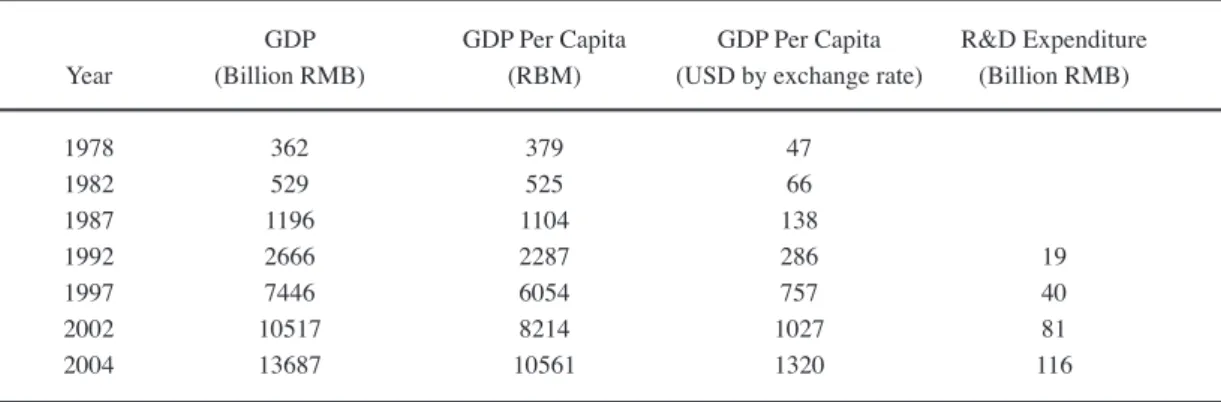
As the largest developing country in the world, China has undergone rapid economic growth, with the GDP increasing 8% or more per year for over 20 years. (see Table 1).
According to the analysis of the Development Program of the United Nations (UNDP), China’s gross national product in 2005 ranked fourth in the world,(1) but its level
of science and technology competitiveness only ranked around 26th in the last fi ve years.(2)
Over these years of opening up to the world, the Chinese government has become more and more aware of the importance of higher education to ensure the quality of the country’s workforce and to carry out cutting-edge research. The National Program of Educational Reform and Development issued by the Central government in 1993 made education a national strategic priority. The development of higher education was reaching its peak in
1998, marked by two big events which have had profound impacts. One was the offi cial goak of building up a few world-class universities in China as a national effort, which was named the “985 project”(3) and the other was
the government push to increase enrollment in higher education. In 1990, only 3.4 percent of the age cohort between 18 and 22 benefited from higher education, whereas this percentage reached 7.2 in 1995. The Action Plan for Invigorating Education in the 21st Century issued by the Ministry of Education and the State Council in 1998 declared that the rate should reach 11 percent by the year of 2000. A remarkable leap took place then, with new admissions rising from 1.15 million in 1998 to 2.84 million in 2001. In 2002 the internationally acknowledged threshold of mass higher education, 15% of the age cohort, was reached, with total enrollment of 16 million in all forms of higher education.
Table 1: The GDP and GDP per capita of China between 1978 and 2004
GDP GDP Per Capita GDP Per Capita R&D Expenditure Year (Billion RMB) (RBM) (USD by exchange rate) (Billion RMB)
1978 362 379 47 1982 529 525 66 1987 1196 1104 138 1992 2666 2287 286 19 1997 7446 6054 757 40 2002 10517 8214 1027 81 2004 13687 10561 1320 116
Source: China statistics Book (1979-2005)
Table 2: Average Student Numbers in Higher Education Institutions, 1998-2004
Year 1998 1999 2000 2001 2002 2003 2004 Increased times 2004 to 1998 National 3335 3615 5289 5870 6471 7143 7704 1.31 times Average numbers
Av. number in Bachelor 4418 5275 6916 8730 10454 11662 13561 2.07 times Av. number in Bachelor 4418 5275 6916 8730 10454 11662 13561 2.07 times Av. number in Bachelor
Degree institutions
Av. number in higher 1701 1975 2282 2337 2523 2893 3209 88.7% Vocational institutions
Source: China Education Statistics Year Book 1995-2004
According to the data in 2004, China had 3423 higher educational institutions, among which 684 provided full-time undergraduate programs, 1047 were higher vocational institutions, 505 served for adult part-time higher educational training and 1187 were private colleges. In 2004, over 4.2 million people were enrolled into these institutions, which was three times more than the number in 1998. Altogether, over 20 million students were studying in higher educational institutions, among whom 13 million were on-campus full-time students, which comprised 20% of the age cohort.(4)
As Martin Trow has pointed out, the growth “raises a number of questions central to the issues of the nature and functions of higher education” (Trow, 2005) and China right now is facing the challenges of the big growth in the number of students and the absolute size both of the systems and individual institutions in higher education.
Universities, especially research universities, are well-organized institutions in modern society. The big resources they command and high expectations engendered make them an “axial structure” of the society. “Now more than ever, universities have become the principal source of the three most important ingredients of progress in a modern, industrial society: expert knowledge, highly educated people, and scientifi c discoveries”(Derek Bok, 2003). Economic reform and changes in government policies in China provide strong stimulation for the universities to redefine their functions and roles in the society. Market competition has become part of current education policy and individual institutions fi nd themselves more fl exible in decision-making and self-governance, while at the same time having more responsibilities and accountability to both the government and society.
Generally speaking, higher education in China is facing challenges from the international trends of globalization, massifi cation and marketization, while internal reform and social transition aggravate the challenges for individual institutions.
2. Institutional Reform: Tsinghua University
as a Case Sudy
The evolution of Tsinghua University can be seen as a microcosm of the development of China’s modern higher education with a history of nearly 100 years. Tsinghua School ( 清華學堂 ) was established in 1911 as a preparatory school for students who were selected by the government and going to study at American higher education institutions. It became a college in 1925 and then got the official name National Tsinghua University in 1928. The Research Institute was set up in 1929. Although Western culture was pervasive in the early history of Tsinghua University, the faculty greatly valued the interactions between Chinese and Westerners, sciences and humanities and the ancient and modern. It was one of the best national comprehensive universities in China before 1949 with 5 colleges (Art, Law, Sciences, Engineering, and Agriculture) and 26 departments. After the founding of the People’s Republic of China, nationwide restructuring of higher educational institutions made Tsinghua a polytechnic institute which was designated “the cradle of engineers” in China’s industrialization. Since the early 1980s, Tsinghua has made a great effort to develop academic strengths other than engineering and has now become a comprehensive research-intensive university. Currently it has 13 colleges
and 53 departments with around 3000 faculty members, 13,000 undergraduates and 18,000 postgraduate students. Tsinghua University is among the first group of higher educational institutions in China to establish graduate schools and receive special funds from the central government through the “211 project” and “985 project.”(5)
Tsinghua University has been frequently ranked number 1 in a variety of national university assessments. Currently four of the nine standing members of China’s Polibureau, including China’s president Hu Jintao, one-fourth of the members of the Chinese Academy of Sciences and close to one-fifth of the members of the Chinese Academy of Engineering are Tsinghua alumni.
Since the 1980s research has been put at the top of the agenda of the university’s development strategy and the explosion of postgraduate education has accelerated the process.
The university’s expansion of students since the 1980s has been mainly at the postgraduate level. The total number of graduate students in 1981 was 435 and in 2005 it reached 18,443 increasing, more than 40-fold within a quarter of a century, among them 4997 were doctoral students. Engaging in graduate education, especially training for doctorial students, requires more research work, which necessitates better facilities, more specialized advisors and smaller working teams supported by extra research funding, which usually come from outside (government or enterprises) on a competitive basis. Ernest L. Boyer has clearly identified how growing graduate education, research dependency and collaboration of universities with government in scientific work, has moved the academic priority of American comprehensive universities from teaching to research (Ernest L. Boyer, 1990). The same shift can be witnessed in China begining in the 1980s, when higher education was experiencing high expectation from both government and society to generate knowledge and accelerate economic development.
As early as the late 1980s, Tsinghua University discussed the issue of building up a world-class university and in 1994 the discussion became a strategic development plan that was composed of three phases leading to the year of 2020. Now the university is undergoing the second phase, which is increasing the overall quality of education, making breakthroughs in some key subjects and trying to obtain a leading place in certain high technology and engineering fi elds.
Undergraduate education has always been the priority of the university, because Tsinghua has the privilege of selecting the best students from the unified national
entrance exam. Every year about 60% of the top 10 students in the entrance exam majoring in sciences and technology in all provinces are enrolled in Tsinghua. This provides both good resources and high pressure in undergraduate education.
3. Reforming Undergraduate Education:
Major Goals and Objectives
At a time when the national economy is increasingly emphasizing innovation, higher education is expected to equip students with a general education that encourages fl exibility and innovation – allowing the continual renewal of economic and social structures relevant to a fast-changing world (The Task Force on Higher Education and Society, 2002).
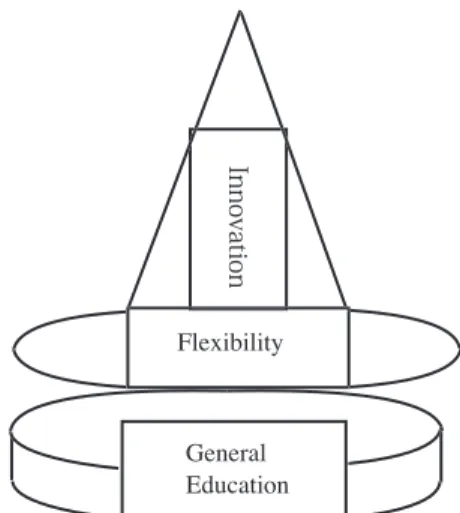
Several key terms that featureprominently in the above educational objectives recommended by the Task Force on Higher Education in 2002 are “general education”, “flexibility” and “innovation.” The three terms form the basic foundation on which the complicated educational process can be built. General education provides students with a solid basis and potential for receiving high-quality specialized professional training; flexibility enables students to turn their potential into reality and adjust themselves to fast-changing situations; innovation is the core essence, uplifting students to take leading roles in knowledge creation and societal development (see Diagram 1).
General education which is also called “liberal
Diagram 1: Structural relations of the three elements
education” in some cases has always been the major work of educational institutions caring about the holistic development of human beings. But in modern times, general education, or knowledge in breadth, has been challenged by education in concentrations, or knowledge in depth. Universities have to face the dilemma of explosive knowledge and limited learning hours in undergraduate education. Different agencies have tried different methods to solve the problem. The most recent undergraduate reform in Harvard University is to “craft a curriculum that is simpler in structure and that widens, not narrows, the choices open to the students.” Harvard’ s traditional Core Program is succeeded by a curriculum that both provides a rigorous foundation to a student’ s education and enhances choice (Harvard University Faculty of Arts and Sciences, 2004).
Flexibility is built upon the basic fact that in a rapid-changing society, higher education itself becomes a “moving target.” It cannot guarantee the education it provides will properly fit in the situations students will face in the future, so the university should “teach students not just what is known now, but also how to keep their knowledge up-to-date”, (The Task Force on Higher Education and Society, 2002). What Harvard University is trying to do in the new curriculum is to “expand the horizons of both faculty and students”, “to broaden the scope of a liberal education” and “to expand the choices open to the students”, (Harvard University Faculty of Arts and Sciences, 2004) and has provided us with a good example.
Innovation is the most important concept in the
General Education Flexibility
knowledge-based society. State governments consider it the priority of the national policy,(6) and academics use it
as a key word and framework to study changes in a state or institution. Education, especially research universities in higher education, plays a crucial role in cultivating innovative people who create knowledge and provide service innovatively. That is why the fi rst recommendation made by the Commission on Undergraduate Education at the University of California (Berkeley) in the Final Report published in 2000 was to “integrate inquiry-based learning into every phase of the undergraduate education” (Commission on Undergraduate Education, 2000).
Reform in higher education in China in recent years has followed the same trend globally, emphasizing general education that encourages flexibility and innovation. Taking Tsinghua as an example, while developing into a comprehensive research-intensive university, Tsinghua carefully readjusts its goals and objectives for undergraduate education, considering its historical heritage and the current social needs. Tsinghua decided on the school motto in its early stage. It comes from the Chinese Classic “Self-discipline and Social Commitment” ( 自強不息 , 厚德載物 ). It shows vividly the essence of a well-educated person in Chinese culture and society. Even in the era of being a “cradle for engineers”, Tsinghua’s graduates worked successfully as leading fi gures in many fi elds.
The overall training plan and curriculum reform, along with the readjustment of goals and objectives of undergraduate education since the 1980s in Tsinghua has shown three major features which can be summarized as: “reduction” (courses), “broadening” (of learning bases) and “fl exibility” (in arrangements).
1) Reducing total credits while strengthening overall qualities
For students enrolled in 2001 and thereafter, Tsinghua started a new educational plan for undergraduate programs. In the new plan, the total number of credits required for four years of undergraduate study reduced from 200 to 170, among which 140 are from taking courses and 30 from practical learning. The arranged courses were reduced from 70 to 40. While reducing formal course work, the new plan provides more room for student’s choices in participating in all kinds of activities geared to their overall development.
2) Broadening the knowledge base and enhancing general education
The new plan strengthens the integration of humanities
and sciences, emphasizing the combination of practice and research with the teaching process. In the new plan, the 170 compulsory credits are divided into three parts: humanities and social sciences (1/4), mathematics and natural sciences (1/4), major-related courses (1/2). In addition, all students need to partake in practical learning and a graduate design project to apply their knowledge (30 credits).
3) Making arrangements more fl exible and adaptable General education provides students with broader knowledge which makes them more flexible in fitting into the changing society. The institutional environment, including the management system and structures of the university, also needs to be flexible and adaptable for innovation. In recent years Tsinghua has worked hard to construct a friendly environment for the students’ cross-disciplinary learning, project-based learning and service learning. Since 1985, the university started to adopt a three-semester system, with a six-week summer semester mainly arranged for student’s practical teaching and learning. Science and engineering majors may engage in project-based inquiries or production-oriented internships; while humanity and social sciences majors conduct social surveys and take part in community-based learning. In the summer session of 2005, over 4000 undergraduate students were off campus for different projects or topics for practical learning. They work in teams with the guidance of professors and, more often on-site supervisors who are locally hired.
4. Strengthening Undergraduate Research
Teaching versus research at universities, especially research universities, has been an issue under discussion for many years. Ernest L. Boyer tried to “break out of the tired old teaching versus research debate and defi ne it in more creative ways” (Boyer, 1990). He suggested that a university professorate has four separate, yet overlapping, functions: discovery, integration, application and teaching knowledge. From the perspective of knowledge as a whole, the controversy over teaching and research seems fl awed or discovery, integration, application and teaching represent different dimensions and form a continuum, with each activity influencing and informing the other, rather than being four separate or opposite activities. Although Boyer was talking about scholarship and professorates, his theory was quite heuristic, stimulating us to think about undergraduate education which is a part of scholarshiptraining in a broader sense. The following discussion on strengthening undergraduate research In Tsinghua is based on the new realm of scholarship and the four elements are highly integrated.
A crucial decision that Tsinghua made in the mid-1990s was to maintain the size of its undergraduate population and focus on pursuing excellence, which moved Tsinghua from the largest school in terms of the total number of undergraduates in the country before the enrollment expansion to number 20 now. Considering the increased funding from the government and the growing expectations from society, the university must reform or reshape undergraduate education and provide higher quality and better value.
Currently, the major strategy of Tsinghua in raising the quality of undergraduate education is to strengthen undergraduate research through curriculum reform and form a research-oriented undergraduate training model. The university’s endeavors have been widely recognized and the project called “Building Research Intensive Undergraduate Education” led by the vice president managing teaching and learning affairs received a national reward in 2005.
Curriculum in higher education, as Fraser has pointed out, “is not always part of the commonly used language of academics” (Fraser, 2006). The term we used here is a curriculum “formalized into courses or programs of study including workshops, seminars, colloquia, lecture series, laboratory work, internships, and fi eld experiences” (Ratcliff, 1997). Since learning goes far beyond the arranged curriculum, we will also include the part outside of the classroom, traditionally called as extracurricular activities.
Fraser has summarized four categories of curricula. Tsinghua’s efforts tend to be moving from product focus, i.e. a teacher-directed, technical-interest curriculum, which is more in Categories A and B to process focus, i.e. student-centered learning which is in the Category C and D,(7) although the shift is not even in different departments
and may not be clear or accepted by all faculty members. 1) Setting up seminar series to stimulate students’ inquiries
How to organize teaching and learning has always been an issue in curriculum development. For the purpose of overall training of undergraduate students, particularly for their research capacity, many top research universities around the world have shown through their successful experiences that seminars work better than big classroom
teaching.(8) Since the 1990s, Tsinghua has organized
seminars for undergraduate students by renowned professors in various fields and the trial became an institutionalized Freshmen Seminar in 2003. This is open for the selection by freshmen on a cross-disciplinary basis, emphasizing inquiries through interactive discussions and hands-on activities guided by well-known professors. Nearly 250 freshmen seminars have been held with over 4,000 freshmen benefiting. Encouraged by the positive feedback, the university opened up senior seminars, i.e. seminar on specific topics. Now Tsinghua has formed a seminar series including freshmen seminars (professor + less than 15 freshmen), senior seminars (professor + less than 15 seniors), seminars on specifi c topics (professor + less than 15 undergraduates from different years but with the same interests in the topic). Through the seminars, undergraduate students not only receive necessary knowledge, but also learn to make linkages and to use their knowledge for further studies. Quite a number of undergraduates establish their constant interests in certain topics through the interactive discussions at the seminar and start their research, which may lead to postgraduate studies.
The seminar series, effectively leading students into the research process, plus one month intensive training in foreign languages for the freshmen before they start their academic studies in Tsinghua, which provides them with better language tools, are consider prominent elements in Tsinghua’s undergraduate program.
2) Establishing Student Research Training (SRT) as an extracurriculum activity
Research-based learning and inquiries are not just happening in classrooms or laboratories following traditional disciplinary divisions and processes. Gibbons et al. (1994) and Nowotny et al (2001)(9) used “Mode 2”
to describe the new pattern of knowledge production, which arouses both hot discussion and deep thinking about the ongoing changes of the context and knowledge production. The overall thesis raised by Gibbons may be doubtful, but the characters of “Mode 2” knowledge, for example, generated within a context of application, by much greater diversity of research teams, through transdisciplinary work, highly reflective and requiring novel forms of quality control, are quite inspiring. The university as a place for inquiry and for training future researchers, needs to realize the changing context and the emergence of new knowledge production.
program has become an active part of the whole process of undergraduate education in the university. Tsinghua carefully studied similar programs in the other well-known research universities, like Undergraduate Research Opportunities Program in the Massachusetts Institute of Technology (MIT), the Summer Undergraduate Research Fellowships Program in the California Institute of Technology (Caltech), The Undergraduate Research Apprentice Program (URAP) and Research Experiences for Undergraduates (REU) in the University of California at Berkeley, based on our own needs and conditions, and developed the Tsinghua SRT model, which incorporates extracurricular inquiry-based activities initiated by students who usually work in teams with invited professors working as supervisors. Inter- or multidisciplinary efforts are particularly encouraged. During the years of 2001 through 2005, 3156 SRT projects were implemented in Tsinghua with 5347 undergraduates involved and half of the students receiving credits (see Table 3). Some of the research products got national rewards and quite a number of them become either academic papers published in international journals or patents with high market values. Recently a special fund called the “Seed Fund” was set up as a part of the SRT to specifi cally support innovative projects initiated by students. It follows the procedure for the university’s research projects, which has competitive applications, accountable assessment of the progress and final demonstrations of the research findings to a committee composed of scholars and experts. Now the Seed Fund not only supports students in natural sciences and engineering, but also those who major in social sciences and humanities.
Curriculum reform is by no means easy work, especially in a comprehensive university with diversity of programs, well-established disciplinary areas and norms of teaching and learning. Frankly speaking, curriculum in higher education is a field that needs to be further
developed. There is no widely accepted curriculum theory that can support the reform at the university level and even no shared understanding of the concepts linking individuals’ thinking. Since we are still in the stage of separate exploration here and there, the individual institution’s initiative becomes even more important. Tsinghua has an institutionalized arrangement by which, every 3-4 years, there is a university-wide discussion on one or two urgent issues for the university’ s development. The most recent discussion was in 2005, focusing on the issue of how to reform learning through practice in a new situation. As a formal polytechnic university, Tsinghua has a tradition of emphasizing practical learning. In the process of transition to a comprehensive research university, it has been weakened to some extent. But what we will do is not just simply restore the tradition, but make it fit better into new situations, to the university’s long term goals and to the inherent laws of teaching and learning. After a year of intensive discussion on the topic, a shared consensus was reached in Tsinghua, under the slogan “Increasing student’ s practical competence for innovation.”
5. Increasing student’s practical competence
for innovation
In the new century, China started a national endeavor for “building capacity” and “raising quality”,(10) and
Tsinghua University responsed to the national effort by emphasizing learning through practice and increasing students’ practical competence for innovation.
Practice is not a new term. In philosophy it represents the human being’s intrinsic qualities, separating human beings from animals. Sociologists use the concept to distinguish individuals who interpret the world and play their roles using different practical knowledge. Education
Table 3: Number of students participating SRT in Tsinghua, 2001-2005
Total student numbers participating SRT
Year 2001 2002 2003 2004 2005
Projects 470 632 654 673 727
is considered a necessary dimension of social practice which is “a phenomenon typical of the existence of human beings” (Freire, 1999).
Practice in education is a word frequently used by scholars who emphasize the dynamic process of learning and the application of knowledge. When John Dewey (1859-1952) talked about “learning by doing” a hundred years ago, he purposely combined the learning process with the learning result. Later when Michael Polanyi (1891-1976) used the verb "knowing" and the noun "knowledge" as synonyms, his intention was to identify static "knowledge" and dynamic "knowing.” Wiyhout integrating or distinguishing the two, what they really want is to emphasize the dynamic properties of learning. Practice plays a crucial role in the dynamic learning process, which includes, but goes beyond the application of knowledge, because practice needs contextualization of the knowledge and to materialize the thoughts in a socially and technically complicated situation.
Practice is closely connected with innovation, because the process of innovation is a rhythm of search and selection, exploration and synthesis, cycles of divergent thinking followed by convergence. Explicit or articulate knowledge such as book knowledge or disciplinary
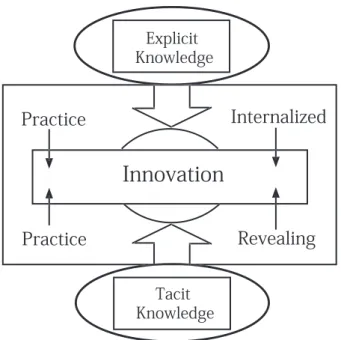
knowledge alone is not enough, innovation and real discovery require guesses, hunches and imagination, which are not necessarily displayed in propositional or formal terms. This is what Polanyi has called “tacit knowledge” (Polanyi, 1958). Tacit knowledge comprises a range of conceptual and sensory information that exists implicitly and many bits of tacit knowledge can be brought together to help form a new model or theory. Practice works nicely as the bridge between tacit and explicit knowledge; furthermore, it makes the explicit knowledge internalized and tacit knowledge revealing, which underpins the process of innovation (Diagram 2). Can practice become competence through training and be built up or increased? Our answer is yes. Human beings are undeniably, “programmed to learn” (Freire, 1999). Competence is overall ability arising from constant training and practice. Since the practice we are discussing here is not just with the traditional meaning of "the application of theory," which refers to the domain of operating the methods, techniques, knowledge and skills, it is a term that is concerned with the integration of tacit and explicit knowledge, patterned presuppositions, preferred ways of acting, knowledge traditions, and so forth, and the university alone can not be expected to
Diagram 2: Practice as a bridge of explicit and tacit knowledge
Innovation
Practice
Practice
Revealing
Internalized
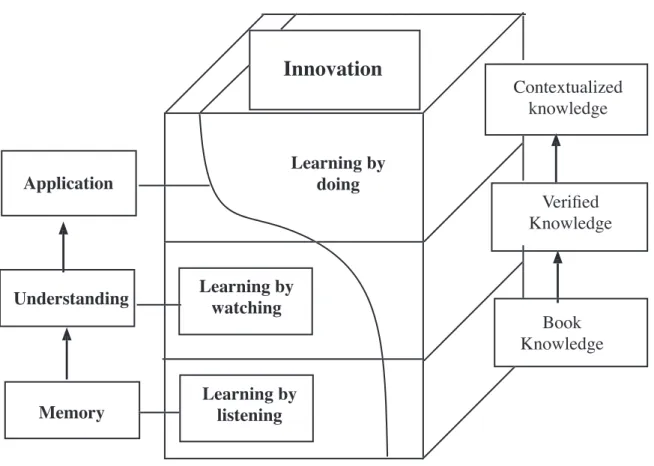
Explicit Knowledge Tacit KnowledgeDiagram 3: Three-tier and dimensional Structure of teaching and learning
do everything. But as an eminent training agency, the university has an important role in creating a favorable environment and atmosphere that can lead students in a dynamic learning process, stimulating them to experience the joys and disappointments of interactions, and engaging them in active practice based on personally and socially acquired knowledge.
University education may be seen as a synthesis of training in which different levels and types of teaching/ learning have different focuses and functions. Innovation is embedded in the competence formed by three-tier and three-dimensional training. (see Diagram 3).
Despite its crudeness, the three-tier, three-dimensional structure stresses the following points:
First, innovation is built on the solid foundation of teaching and learning, which may not be categorized as clearly as in the diagram, but has a sequence in correlation that can be grasped and designed. There is no doubt that learning practice is a complicated process in which listening, watching, doing mix. What is valuable for
separating them is to convince teachers to go beyond the level they are familiar with. For example, when teachers are comfortable with lecturing or presenting their knowledge to students, they may only have students with good memory of book knowledge or good understanding of approved knowledge. If they expect the students to be creative, they need to let them try to apply the knowledge with their own hands and minds, which may lead them onto the journey of discovery.
Second, practice in its narrow sense can be called “learning by doing” which is action-oriented and about the process of knowing. When learners are learning by doing, they not only use the knowledge they accumulate, but also contextualize it in the real world where knowledge becomes part of the life skill or meaningful information for the learners. Since contextualized knowledge is produced in practice and knowledge in this sense is working more as a tool by which we either act or gather new knowledge leading us to continued learning and innovation using new knowledge.
Innovation
Application
Learning by
doing
Contextualized
knowledge
Verifi ed
Knowledge
Book
Knowledge
Understanding
Learning by
watching
Third, the creativity necessary for innovation derives not only from obvious and visible expertise, but from invisible reservoirs of experience. Polanyi's theory of tacit knowledge, or implicit knowledge, as opposed to explicit knowledge, vividly shows how human beings acquire and use knowledge. Only when the knowledge that students have learned is applied in the context of real life and especially when it solves problem in practice, may we say with certainty that the learning process is effectively complete; otherwise we may only say that students have fulfilled certain course requirements and understand certain knowledge.
The university-wide discussion helps in the formation of a consensus based on a theoretical understanding of the topic and stimulates different departments and sections to try their own ways of designing the model fi tted for both the disciplinary requirement and the general goals of the university.
6. Conclusion
In the knowledge society, the university is no longer an ivory tower and some scholars even use the term “post-modern university” (Rip, 2004) or “entrepreneurial university” (Clark, 1998) to depict the new traits, such as the boundary-expanded, closer collaboration with enterprises and other agencies, diversified academic identities and market-sensible reactions. All the changes create a new environment and stimulate universities to readjust their educational objectives, contents and training strategies.
Tsinghua’s case is notable, for it represents both a convergent model, in which universities in China have been transformed into agencies that are adaptable to changing situations, and a unique experience of institutional transition from a polytechnic institute to a comprehensive research university.
In the national trend of quantitative expansion in higher education, Tsinghua chose to focus on increasing quality, which led to the organizational changes with a different strategy. Strengening undergraduate research from its basic orientation matches well with Tsinghua’ s target of building a world class university and meets the long term national goal in development. Some effective actions have been taken, such as setting up seminar series, supporting students’ research training and reforming specific deficits in the curriculum and program design. But it is also clear that these changes,
when taken together, represent only the early stages of a major rethinking of the shape of undergraduate education in Tsinghua. There needs to be an increasing institutional discretion in identifying visions, missions and actions with the changing context and demands.
As a well established institution, the university has its own organizational culture and heritage, which may facilitate or hinder the reform trials. There are different conceptual frameworks to study the correlation of culture and change in higher education. We will not get into detail but a glance at the previous work already refl ects change, especially comprehensive changes in higher education institutions as a cultural process.(11)
In the transition to a comprehensive university, Tsinghua carefully connects the long term goals with its strength in applied sciences and underpinning philosophy. Strengthening practical competence for innovation, as a major thesis for undergraduate reform, is new but not heterogeneous to the university’s inherent culture, properly initiates changes based on consensus, which can be reached on the campus among different fields and disciplinary areas, and provides enough space for the subunits to implement or create their own models, which may work as “bricks” to build new strength and cultural properties of the university. Although it is still too early to give an overall evaluation of the reform efforts, especially the results, and there is a much longer way to go to really form common views of practical competence in a knowledge-based society, what we may summarize from Tsinghua’s case is that in a rapidly changing society, a university needs to integrate its intrinsic institutional energy with outside stimulation, to create an atmosphere on the campus that facilitates newapproaches and related debates, to make good use of the embedded patterns of organizational behavior and beliefs and, based on them, build an institutional consensus that will promote reform.
Notes
1. UNDP. The world factbook. http://www.cia.gov/ cia/publications/factbook/rankorder/2001rank.html .This page was last updated on 13 June, 2006
2. The IMD international business school. World competitiveness yearbook (2000-2005).
3. Chairman Jiang Zemin said in his remark at the 100 years’ anniversary of Peking University in 1998 that “China needs to build up several world-class universities in order to realize the modernization”. In his speech at
Tsinghua University in 2001, he repeated again that we should accelerate the development of higher education and build up few world-class universities in China.
4. Madam Wu Qidi, the Vice Minister, Speech at the Workshop of the Undergraduate Education Evaluation, May 25, 2005
5. “211 project ” was started in 1993. 100 key universities and key disciplines were selected and receiving special funds from government. “985 project” was referring to May 1998 when Jiang Zemin declared his speech at Peking University that China need to construct a few world-class universities. The first group of “985 project” universities are Tsinghua University, Peking University, Nanjing University, Fudan University, Shanghai Jiaotong University, Xi’an Jiaotong University, University of Science and Technology of China, Harbin Institute of Technology and Zhejiang University.
6. The American President George W. Bush signed in early 2006 the report of “American Competitiveness Initiative”. The subtitle is “Leading the World Innovation”.
7. The four categories listed by Fraser are the followings: Category A: the curriculum is the structure and content of a unit (subject); Category B: the curriculum is the structure and content of a programme of study; Category C: the curriculum is the students’ ecperience of learning; Category D: the curriculum is a dynamic and interactive process of learning.
8. For example Harvard University stared Freshmen Seminar in the early 60s, MIT in mid 80s. One of the actions in the recent undergraduate reform in the University of California at Berkeley is to open up seminars for Freshmen and Sophomores.
9. In 1994, Michael Gibbons, Camille Limoges, Helga Nowotny, Simon Schwartzman, Peter Scott, and Martin Trow jointly published the book The New Production of Knowledge: The Dynamics of Science and Research in Contemporary Societies (London: Sage, 1994). The overall thesis has caused hot discussions and strong criticism. Several years later, for responding to the criticism and further explain the concepts, Helga Nowotny, Peter Scott, and Michael Gibbons published the book Re-Thinking Science: Knowledge and the Public in an Age of Uncertainty (Cambridge: Polity Press, 2001).
10. In the early 21 century, the Ministration of Education in China organized a group of scholars from different fields to prepare an overall analysis and a strategic plan for China’s education development in the future 50 years. The team worked out an important report “Education and Human Resources in China” published in
2002. It proposed a nationwide “capacity-building”. The Action Plan for Invigorating Education 2003-2007 issued by the Ministry of Education stared the project of “Quality Education in the New Century” and the focus is on strengthening student’s innovation and raise their practice competence.
11. Kezar, Adrianna and Eckel, Peter D. (2002) in their paper “The Effect of Institutional Culture and Change Strategies in Higher Education: Universal Principles or Culturally Responsive Concepts? ”, have made a rich review on a multidisciplinary literature on organizational culture and change. The Journal of Higher Education, Vol. 73.
References
Bok, Derek (2003), “Academic Values and the Lure of Profi t”, The Chronicle of Higher Education, 4/4/2003 Boyer, Ernest L. (1990), “Scholarship Reconsidered:
Priorities of the Professoriate,” The Carnegie Foundation for the Advancement of Teaching, 1-15. Clark, B. R. (1998), “Creating Entrepreneurial
Universities: Organizational Pathways of Transformation,” Oxford: Pergamon.
Commission on Undergraduate Education (2000), “Final Report,” University of California at Berkeley. Faculty of Arts and Sciences, Harvard University (2004),
“Report on the Harvard College Curricular Review,” p.3
Fraser, Sharon P. and Bosanquet, Agnes M. (2006), “The curriculum? That’s just a unit outline, isn’t it?,”
Studies in Higher Education 31, 269
Freire, Paulo (1999), “Education and Community Involvement”, in Manuel Castells: “Critical Education in the new Information Age”, Rowman & Littlefi eld Publishers, Inc. p. 83.
Kezar, Adrianna and Eckel, Peter D. (2002), “The Effect of Institutional Culture and Change Strategies in Higher Education: Universal Principles or Culturally Responsive Concepts? ”, The Journal of Higher
Education, 73
Michael Gibbons, Camille Limoges, Helga Nowotny, Simon Schwartzman, Peter Scott, and Martin Trow (1994), “The New Production of Knowledge: The Dynamics of Science and Research in Contemporary Societies,” London: Sage.
Helga Nowotny, Peter Scott, and Michael Gibbons (2001), “Re-Thinking Science: Knowledge and the Public in an Age of Uncertainty,” Cambridge: Polity Press.
Polanyi, Michael (1958), “The Study of Man,” the University of Chicago Press
Ratclisff, J. L. (1997), ‘What is a curriculum and what should it be?’ J.G. Gaff & J. L. Ratcliff (eds) “Handbook of the Undergraduate Curriculum: a Comprehensive Guide to Purposes, Structures, Practices, and Changes,” San Francisco, CA. Jossey-Bass. p.6
Rip, Arie (2004) “Strategic Research, Post-modern Universities and Research Training”, Higher
education Policy. 17, 159
The Task Force on Higher Education and Society (2002) “Higher Education in Developing Countries: Peril and Promise,” the World Bank
Trow, Martin (2005) ‘Refl ections on the Transition from Elite to Mass to Universal Access: Forms and Phases of Higher Education in Modern Societies since WWII,’ Philip Altbach, ed., “International Handbook of Higher Education,” Kluwer, 4-5