Journal of the Operations Reseach Society of Japan
Vo\. 19. No, 2. June. 1976
A NUMERICAL METHOD
FOR THE STEADY-STATE PROBABILITIES
OF A Gl/G/C QUEUEING SYSTEM IN A GENERAL CLASS
YUKIO TAKAHASHI, Tohoku UniversityYOSHINORI TAKAMI, Tokyo Institute of Technology (Received September 22. 1975)
Abstract.
A numerical method is proposed for solving the balance equations of the steady-state probabilities of a G~/G/c queueing system in a general class. The method is based on an iterative calculation of conditional prob-abilities, instead of absolute probprob-abilities, conditioned by the number of customers in the system. By skillfully exploiting a convergence property of the conditional probabilities, it provides a fairly accurate solution of the balance equations with relatively little computational burden.1. Introduction
In this paper, a numerical method is proposed for solving the balance equa-tions of the steady-state probabilities of a GI/G/c queueing system in a general class. The method is a direct application of the (modified) lumping method introduced in [6] for the stationary distribution of a Markov chain. It is based on an iterative calculation of conditional probabilities of the queueing system conditioned by the number of customers in the system. By using the conditional probabilities, rather than absolute probabilities, the system of linear equations of the steady-state probabilities is di,'ded into a set of smaller systems of linear equations, and it can be solved with less computational burden by exploiting convergence property of the conditional probabilities. Furthermore, errors included in the solution become fairly small. The computational time required for solving the balance equations by our method is nearly independent of the value of the utilization factor p. Hence, our method is effective even if p is near to l .
2.
Balance equations of the steady-state probabilities
For many queueing systems, the steady-state probabilities can be expressed as a solution of the balance equations of the form (2.4) below. As an example let us consider the
Ek/Erlc
queueing system. In the system, customers arrive147
148 Y Talcalwshi and Y. Takami
at a service facility with a channels in parallel via an Erlang process of
order
k
with mean rateAlk
If all channles are busy the customers form a single queue and are served in order of arrival. The service times are inde-pendent random variables subjecting to the Erlang distribution of order r with mean rillIn order to define states of the system, it is convenient to introduce stages for both the arrival process and the service processes at channels. A service at a channel is considered to consist of r consecutive exponential phases of service and each stage represents a phase of service. The stages for the arriv-al process are interpreted similarly. Then the state of the system can be represented by an ordered (r+2)-tuple of nonnegative integers
(2.1)
where n denotes the total number of customers in the system, j the stage of the arrival process and m.
-z.. the total number of customers in the ith stages of service. Let S n be the set of all possible states such that the total number of customers in the system is equal to
n.
Sincem
l + ••• + mr = min (a, n), the number of states in Sn is given by
(2.2)
where n'
=
min (a, n). We will number the states in Sn by a suitable rule and refer them by pairs(2.3) Let
(n; i) , i
=
1,2,···,8n ' n '"' 0,1,2,··· •P.
n-z.. denote the probability that the state of the system is (n; i)
in the steady state, and let an be the row vector with entries P ni ,
i
=
1 2 ••• 8 Then the balance equations of the system in the steady state " ' nare written as
(2.4) a D
n n n 1,2,3,··· ,
where An' Bn and en are matrices representing the intensities of the transition probabilities from states in Sn to states in Sn_l' Sn and
Steady-State Probabilities of a Gl/G/C Queueing System 149
sn+l respectively, and Dn is the diagonal matrix whose ith diagonal entry is equal to the sum of all entries in ith rows of matirces An' Bn and Cn In other words,
(2.5)
where
~
is theD is the diagonal matrix satisfying n
for n 2:, I
column vector of order ~3n with all entries equal to I
.
In this case, all the diagonal entries of Dn are equal to A + n'll Further
(2.6)
An
=
Aa ' Bn=
Ba,
Cn Ca and D n=
Da for n2:,aIf the utilization factor p
=
~A/akll < I , then the steady-state probabil-ities p •n1.. are uniquely determined by the balance equations (2.4) together
with the normalization constraint
00 sn
(2.7)
L L
n=Q i=l P. n1..
I .
We can show that a queueing system with more general interarrival time and service distributions has balance equations of a similar for~. Let G~ repre-sent a distribution which can be expressed as the distribution of the absorbing time of a continuous time absorbing Markov chain with p transient states and a singel absorbing state. The transient states of the chain correspond to the stages in the case of the Erlang distribution, and the absorption to the absorbing state represents the completion of, say, a service. A continuous time absorbing Markov chain with transient states labeled 1,2, ••• ,~ and an absorbing state labeled P+I is characterized by parameters qOi (i = 1,2,···,~) • lli (i
=
1,2, ••• ,i) and qij (i = 1,2, ••• ,~; j = 1,2,···,P+I) , where qOiis the probability of starting from state i , l/lli is the mean of an
expo-nentially distributed duration time at state i and qij is the conditional transition probability from state i to state j conditioqed that a transition from state i occurs. By suitably choosing these parameters, various distri-butions can be expressed as distridistri-butions of absorbing times of such absorbing Markov chains. Clearly, Erlang distributions and mixtures of them are G~
type distributions.
For a queueing system Gk/G~a , i.e., a queueing system with a channels having G
k
type inter arrival time distribution and a G~ type service150 Y. Talcahnshi and Y. Takami
distribution, the state of the system is represented by the (r+2)-tup1e in (2.1), too •. ' So the balance equations of the system are of the same form as in (2.4), though the matrices An' Bn and Cn may have more nonzero entries than in the case of the Ek/Er/a queueing system.
As will be shown later, when the balance equations are solved numerically, the computation becomes much simpler if the matrices Bn' n
=
0,1,2,···, are triangular matrices. If the absorbing Markov chains associated with the inter-arrival time distribution and the service distribution satisfy an acyclic condition that the conditional transition probabilitiesqij
=
0 fori
>j ,
then we can number the states in S so that B
n n becomes triangular. For
the purpose we may number the states in the order of
(2.8)
+
m a + ... + m nr -1 . r m1 2 r v + J a •The Er1ang distributions and mixtures of them can be expressed as distributions of the absorbing times of acyclic absorbing Markov chains. So for queueing systems with these distributions as interarriva1 time and service distributions, the matrices B can'be made triangular.
n
3. Equations for conditional probability vectors
SnNow let us consider a queueing system with the balance equations (2.4). Let liI
=
Cl. s a n d S=
(b .)=
~CI.
Then liIn is the probability that
n n n n n~ liI
n n
the number of customers in the system is equal to n and the ith entry
b
ni of Sn is the conditional probability that the state of the system is
(n; i) given that the number of customers in the system is equal to n •
Here we show that, if the values of the vectors Sn-1 and Sn+1 are
known, then the vector Sn is obtained by solving a system of linear equations of order 8
n + 2. The balance equations (2.4) are rewritten as
(3.1)
where for
SOBO
+
XOS
1A1zn Sn_1 Cn- 1
+
SnBn+
xnSn+1 An+1 n 1,2,3,··· , Xn=
liIn+1/liIn and zn=
1/Xn_1=
liIn_1/liIn . (3.1) provides Sn' but they contain two more unknown variables xn and we need two more equations. One is the normalization constraintequations So
Steady-State Probabilities of a G1/G/C Queueing System
(3.2) 1 .
To derive another one, we note that from (2.4) and (2.5)
(3.3)
for any n .. m ~ 1 • vanishes as m + 00 ,
Since tU + 0 as n -~ 00 n
and it implies that
the right side of (3.3)
(3.4) Z 13
c
t;. =n n-1 n-1 yt n 1,2,3,'" .
151
This is the other equation for I3
n • If, for n ~ 1 , we regard the equations (3.1), (3.2) and (3.4) as sn + 2 equations for sn + 2 variables x
n " zn and bni .. i
=
1,2,"',sn' then they form a system of linearly independ-ent linear equations. So, if the vectors Q and Q are given, the'"'n-1 '"'n+1
values of the variables can be obtained by solving the system of equations. Similarly, for n
=
0 , (3.1) and (3.2) form a system ofSo
+
1 linearly independent linear equations forSo
+
1 variablesXo
andbOi ' i
= 1,2," .. 'SO. Hence 130 can be obtained from these equations if 131 is given.4. Practical algorithm
As was shown in the preceding section, for a queueing system with the balance equations (2.4), the vector
I3
n 1:; calculated by solving the equations(3.1), (3.2) and (3.4) i f the vectors
I3
n- 1 and I3n+
1 are given. This indi-cates that the conditional probabilities are calculated by a Gauss-Seide1 type block iteration method. Here we will give a practical algorithm of such a method. The algorithm exploits a convergence property of the sequence {l3n}. As will be discussed in the next section, {l3
n} converges to a limit vector
13 as n + 00 under a weak condition, and :it is expected that the convergence is fast except for the cases with small P. So, the exp10itment of the convergence property makes the algorithm very efficient.
In the following algorithm l3(h) designates the hth approximation of
n
152 Y. Takahashi and Y. Takami
N is an integer such that Sn is considered to be sufficiently close to the limit vector S if n > N a n d E is a positive number such that if all the differences between the corresponding entries of S(h-1) and S(h) are
n n
less than in absolute value then S(h) is considered to be sufficiently
n close to Q I-'n
A practical algorithm
Step 1. Step 2. Step 3. Step 4. Step 5. Step 6.(The first iteration) Calculate S61) according to the procedure stated below using an appropriate initial approximation vector siO) Calculate S(l) n = 1,2,···,N, in order of n according to the
n '
procedure stated below using S(l) and S(O) where S(O) is an
n-1 n+1 ' n+1
appropriate initial approximation vector, but it will be efficient to use S(l) as S(O) for n __ > c
+
1 Put h=
2 •n-1 n+1
(The h-th iteration) Calculate S(h) according to the procedure
°
stated below using Sih-1) . Calculate
S~h)
, n = 1,2,···,N , in order of n according to the procedure stated below usingS~~i
(h) (h) (h-1)
and Sn+1' where SN-1 is used in place of SN+1 . (Test of convergence)
ing entries of S(h-1)
n
If all the differences between the correspond-and S(h) for n
=
0,1,2,···,N are lessn
than E in absolute value, then go to Step 4. Otherwise increase h by 1 and return to Step 2 •
(Calculation of zn) equation (3.4) using
Calculate zn' n
=
1,2,···,N , S(h) and S(h) •n-1 n
(Calculation of UJ) Calculate n
c(l - p)
and then calculate
recursive1y for n
=
1,2,···,N~
-1(c - n) / Z ···z 1 n
(Calculation of an) Calculate an by
Steady-State Probabilities of a G1/G/C Queueing System for n = O,I,2"",N •
The determination of
Wo
in Step 5 above is based on the relation(4.1) a-I
L
(a - n) Wn n=O a(l - p) 153which is satisfied for general queueing systems with S(h) in Steps I and 2 above can be obtained from
n
a channels. The vector S(h) and S(h-l) by
n-l n+l
the following procedure.
Procedure for calculating
(i)
(H)
(Hi)
(iv)
Solve the equations <I> (Dn - B ) = S (h) C and 1jJ (D - B )
n n-l n-l n n
for vector valued variables <I> and 1jJ respectively. Calculate y Calculate
n
y<l>+
1jJ • Calculate S(h) by normalizing n n as S (h-l) A n n+lFor n
=
0 ,sci
h) can be obtained only by normalizing the vector 1jJ defined in (i) as S(h) = _1_1jJo
1jJ ~OWe can modify the algorithm so that the parameter N is determined auto-matically. For the purpose, a test of convergence of the sequence {Sn} must be added in both Steps 1 and 2. This modification will be effective when the rate of convergence of the sequence {Sn} is not known.
We conclude this section with a notice about the case of triangular B 's . n Since D 's n are diagonal matrices and diagonal entries of B n 's are equal to zero, if the matrices B 's
n are upper tr:Langular matrices, then the entries
of the vectors and 1jJ in (i) of the above procedure can be obtained in order from the equations
(4.2) S(h) C D-I
+
<l>B D-I and 1/'n-l n-l n n n Y
In this case the algorithm uses no subtraction operation except for subtrac-tions in testing the convergence in Step 3. Thus we can expect that the solution of the balance equations obtained by this mehtod is very accurate
154 Y. TalmJmshi and Y. Takami
if Bn's are triangular matrices.
5. Convergence property of {Sn}
In the preceding section, we proposed an algorithm for solving the balance equations (2.4) which exploits the convergence property of the sequence
{Sn}
In this section we study the convergence property.Consider the balance equations (2.4) satisfying (2.6). Let f(8) is the vector valued generating function of a.
n
Multiplying the both sides of (2.4) with 8n and summing up for then we have (5.1) f(8)[D - 8C - B c c c 1 - - A ] 8 c 00 f(8) '\ a. L. n 8n . n=c n~c
If the matrix in the brackets of the left hand side of (5.1) is nonsingular, then
(5.2)
Consider the equation for 8
(5.3)
o .
Let 8
1 , 8 2' •.. be the roots of the equation larger than 1 and assume that none of 8.'s is a mUltiple root and that
J
(5.4)
Then from (5.2) f(8) must be expressed as
(5.5) f(8)
and hence
(5.6) n > C
in absolute value,
Thus the sequence converges to
Y
l and Z = l.U / l.U converges toSteady-State Probabilities of a G1/G/C Queueing System 155 81 > 1 as n ~ 00 under the assumption (5.4). The rate of convergence of the sequence
sequence
is governed by 1/81 and the rate of convergence of the is governed by 1 81 / 821 •
Now we shall examine the dependencies of 8
1 and 82 to the utilization factor p for two simple queueing systems M/E2/2 and E2/E2/2 The M/E
2/a queueing systems were studied by S~ Shapiro [5], and 81 and 82 can be calculated from an equation derived by him. In the case of M/E
2/2, they are given by 8 / p{p + 4 + /p2 + 8p } (5.7) 8 2 (2+p)/p
We note that 81/82 decreases as p increases while 1/8 1 increases with P
and that 8
1/82 ~ 1/3 and 1/81 ~ 1 as p ~ 1
The Ek/Eri2 queueing systems were studied by C. D. Poyntz & R. R. P. Jackson [4], and 81 and 82 can be obtained by solving an equation derived by them. In the case of E2/E2/2 the equation is easily solved and
(5.8)
8
1 /82 decreases as p increases, too, while 1/81 increases with p. In this case 81/82 approaches to 1/4 as
Thus we might as well conjecture that
p tends to 1 .
181 / 821 decreases as p increases in a general Gk/Gr/a queueing system. In computational experiments by the authors, no case occurred in which the conjecture was violated.
6. Relative merits of the method
In this section we will compare our method with a usual Gauss-Seide1 itera-tion method for a system of linear equaitera-tions of absolute probabilities. If one wants to use the Gauss-Seide1 iteration method for solving the system of balance equations (2.4), he must reduce it to a system of finitely many linear equations by insisting the condition that Cl 0 for
n n > N1
,
where N1 is chosen so that the residual probabilityI
wn is negligible. Since the rate ofn>N1
ap-156 Y. Takahashi and Y. TaluJmi
proaches to 1 On the other hand, if one wants to solve the balance equations by our method, he must calculate an for n ~ NZ' where NZ is chosen so
that is considered to be sufficiently close to the limit i f n > NZ. Since the rate of convergence of
expect that NZ decreases as p
{a} is governed by n
approaches to 1 .
we may Of course one can also exploit the convergence of {~} in our method. So, the order of the system
n
of equations to be solved is nearly Ba x min (N1 ,NZ) in our method, while that is nearly B x N in the Gauss-Seide1 iteration method. Thus our method
a 1
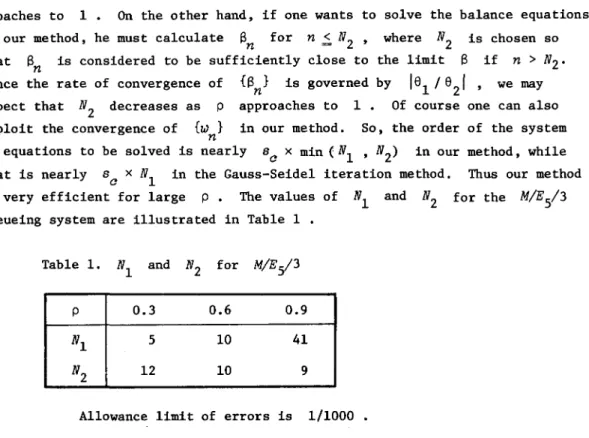
is very efficient for large p. The values of N1 and NZ for the M/E5/3 queueing system are illustrated in Table 1 •
Table 1. N1 and NZ for M/E5/3
p 0.3 0.6 0.9
N1 5 10 41
NZ 1Z 10 9
Allowance limit of errors is 1/1000.
The second merit of our method is accuracy of the solution. In our method
a
's , n > N ,n are not neglected but are taken into account in calculation of ~ 's
n So, it is expected that our method provides accurate values not only of a 's but also of other characteristic quantities of the queueing
n
system such as moments of queue length. (Compare with the case of the Gauss-Seide1 iteration method in which a 's n > N, are set equal to the zero
n '
Furthermore, as was noted in Section 4 , if matrices
vector.) B 's are
n
triangular matrices, our method can solve the balance equations without any subtraction operation except for subtractions for testing the convergence of a(h) So, it is expected that errors arising in the process of computation
n
will be neg1ibib1y small.
The third merit of our method is the fast convergence of This is due to the exp10itment of the convergence property of initial setting of a(O) in Step 1 of the algorithm.
n
to
in the
In a word, our method provides an accurate solution of the balance equations with relatively little computational burden.
Steady-State Probabilities of a G1/G/C Queueing System 157 In the program an array of size 15,000 was reserved for
S
's and then
authors tested cases with Sa ~ 500 by setting N
=
30 in most trials. By the experiments it seemed that 30 is sufficiently large for N if s < 100 •a
The computational data of a trial for the M/ES/3 queueing system is shown in Table 2.
Table 2. Computational data of a trial for the M/ES/3 queueing system
s 35
a
p 0.3, 0.6, 0.9
N 30
£ 0.00001
Number of iterations 9 for each p
Computational time excluding
times for compiling and linkage 20 ~ 22 seconds for each p
References
[1] Heffer, J. C., Steady-state solution of the M/Ek/a (c», FIFO) queueing system. INFOR J. Canadian
o.
R. S., vol. 17 (1969), 16-30.[2] Mayhugh, J. 0., & R. E. McCormik, Steady-state solution of the queue
M/E~p. Management Saienae, vol. 14 (1968), 692-712.
[3] Parzen, E., Stoahastia Proaesses, Holden-Day, Inc., San Francisco (1962). [4] Poyntz, C. D., & R. R. P. Jachson, 1be steady-state solution for the
queueing process En/Emlp, Opepational Reseapah Quapteply, vol. 24 (1973), 615-625.
[5] Shapiro, S., The m-server queue with Poisson input and gamma-distributed service of order two. Opepations Reseapah, vol. 14 (1966), 685-694. [6] Takahashi, Y., A lumping method for numerical calculations of stationary
distributions of Markov chains. Reseapah Repopts on InfoPmation Saiences, B - 18 (1975), Department of Infor~ltion Sciences, Tokyo Institute of Technology.
(Yukio Takahashi, Faculty of Economics, Tohoku University; Kawauchi Sendai 980, Japan.)