
2-stage Feature Selection for Intrusion Detection Systems by Using a Multi-Objective Genetic Algorithm
2
0
0
全文
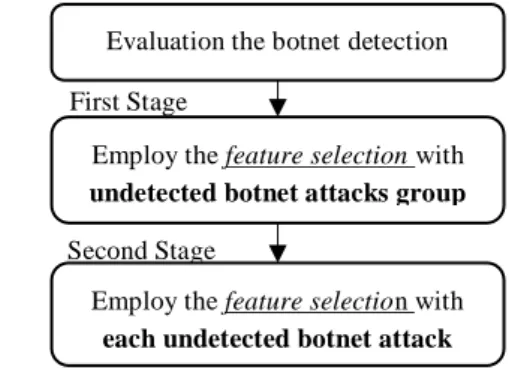
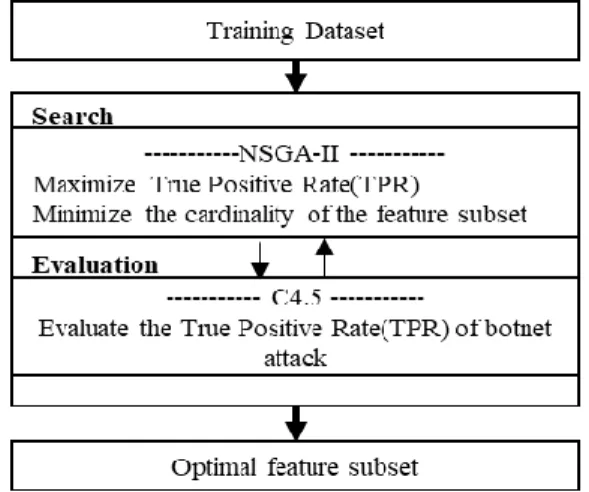
(2) IPSJ SIG Technical Report. method to choose the optimal feature. Compared with [2] obtaining the feature set just with highest true positive detection rate(TPR), our proposal takes true positive detection rate(TPR) and the cardinality of the subset the into consideration to obtain the optimal feature set. And the obtain TPR of botnet attack is evaluated by C4.5, an algorithm used to generate a decision tree developed by Ross Quinlan.. Figure 2. Feature selection 2.3 Experiments To apply our proposal, all experiments have been executed on a 2 processors machine Intel(R) Core(TM) i5-5200U [email protected] 2.19GHz, with 8 GB RAM, running window 10. ⚫ Analyze the botnet detection To analyze the evaluation of botnet detection, firstly we run classification on the full KDDCup99 dataset (743MB) with C4.5(J48 in Weka), without feature selection. Although the botnet was well detected (TPR:99.99%) in total, there were still 7 types of botnet attacks (belong to R2L and U2R attacks) could not be detected (lower than 50% TPR). They are embedded in the data portions of packets, and normally involve only a single connection. It took 863.94 seconds to build a model. 2-stage Feature Selection Proposal We run feature selection with C4.5 based wrapper method and NSGA-Ⅱ based multi-objective evolutionary search strategy on Weka to achieve a fine-grained botnet detection. First Stage To improve the left 7 types of botnet detection rate and lower the computational, firstly, we run feature selection with 10% KDD Cup99 dataset (77MB) to get the optimal set. The parameters set in experiment is as below: Number of generations: 10 Population size: 100 Fitness function 1: the average TPR of 7 types of botnet attack Fitness function 2: the number of selected features After experiment, we could see the trade-off relation between botnet detection accuracy and computational cost from figure 3. And protocol_type, service, src_bytes, lnum_root, same_srv_rate, dst_host_same_srv_rate, total 6 features were chosen. Then, we used the full KDDCup99 dataset with C4.5(J48 in Weka) to analyze the evaluation of botnet detection. Usually, the ⚫. ⓒ2019 Information Processing Society of Japan. Vol.2019-MPS-122 No.13 2019/3/1. more features we used in the classification task, the more time would be taken in building a mode. So, the number of features in figure 3 indicated the computational cost in IDSs. The figure 3 reflected the trade-off relation between botnet detection accuracy and the computational cost.. Figure 3. the trade-off relation between botnet detection accuracy and the number of features Second Stage According to the first stage experiment, the average TPR of left 7 types of botnet detection was improved. In this part, to gain a fine-grained level botnet detection, we focused on the botnet detection of each specified botnet. The parameters set in this experiment were almost same as the first stage, just only changing the Fitness function 1 into the TPR of one specified botnet attack, loadmoudle, rootkit, ftp_writite, multihop, or imap. The optimal features for each botnet attack were selected.. Figure 4. The TPR of botnet attack under different feature selection Finally, we evaluated detection ability for each botnet attack by using their selected optimal features. We also compare the TPR of each botnet attack under different feature selection method. The results were shown in figure 4.. 3. Concluding Remarks In the future, we intend to adjust the parameters in multiobjective genetic algorithm to achieve a better optimization between detection accuracy and computational cost in intrusion detection systems.. Reference E. Beigi, H. Jazi, N. Stakhanova and A. Ghorbani, Towards Effective Feature Selection in Machine Learning-Based Botnet Detection Approaches, in IEEE Conference on Communications and Network Security (CNS), pp. 247-255. (2014) [2] Alejandre FV, Cortés NC, Anaya EA. Feature selection to detect botnets using machine learning algorithms. In Electronics, Communications and Computers (CONIELECOMP), 2017 International Conference pp. 1-7. (2017) [1]. 2.
(3)
図
関連したドキュメント
Wormsinthehabituatedstatesevokedbyonesitetoucharestill
Optimal control problems for PDEs are most completely studied for the case in which the control functions occur either on the right-hand sides of the state equations, or the boundary
Their basic components are the representation of candidate solutions to the problem in a “genetic” form, the creation of an initial, usually random population of solutions,
For this reason, we make a comparison among three algorithms: the spherical interpolation algorithm implemented by using the zone structure on the sphere, the algorithm where
Experimental study shows that the proposed approach is feasible and effec- tive for the resource-constrained project scheduling problem with stochastic durations and that the
Furthermore, computing the energy efficiency of all servers by the proposed algorithm and Hadoop MapReduce scheduling according to the objective function in our model, we will get
The (GA) performed just the random search ((GA)’s initial population giving the best solution), but even in this case it generated satisfactory results (the gap between the
i We present the histogram of the maxima of bounded traffic rate on an interval-by- interval basis as a traffic feature for exhibiting abnormal variation of traffic under DDOS flood
