Oxford Learner’s Dictionary of Academic
Englishにおけるtentativenessを表す助動詞の
記述について
藤本 和子
1 オ ッ ク ス フ ォ ー ド 大 学 出 版 局 は、2014 年 に Oxford Learner’s Dictionary of
Academic English (OLDAE) を出版した。現在、英語教育において、English for
Academic Purposes (EAP)が重要視され、英語を母語としない学習者が英語圏へ留
学をし、さらには、英語圏でなくとも、世界中の大学で様々な科目が英語を用い て教授されるようになっていることから、学生は当然、英語でペーパーを書くこ とを要求される。OLDAE は、このようなグローバル時代における学生のニーズ に応えるべく出版された画期的な辞典であるといえよう。
オックスフォード大学出版局の学習者用英語辞典といえば、Oxford Advanced Learner’s Dictionary (OALD)がよく知られている。OALD第9版(2015年、OALD 9)が、 対象とする学習者のレベルは、upper-intermediateからadvancedレベル(CEFRでは、 B2からC2レベル)、OLDAEは、intermediateからadvancedレベル(CEFRでは、B1 からC2レベル)であり、OLDAEのほうがより幅広い学習者を対象としている。 1) 本稿では、まず、1) OLDAEの主な特徴について見てゆく。次に、2)アカデミッ クライティングに必要な tentativeness を表す手段の一つである助動詞に焦点を絞 り、これらの助動詞についてOLDAEとOALD 9の記述を比較する。そして、3) 大 1) 学習者のレベルについては、オックスフォード大学出版局のOxford 2015 ELT Catalogue が参考
になる。同カタログによると、例えば、intermediateレベルはSTEP英検2級、upper-intermediate レベルは準1級、advancedレベルは1級以上となっている。ただし、この基準はオックスフォー ド大学出版社独自のものであり、他の出版社の基準と必ずしも一致しているわけではない。
規模ネイティブスピーカーコーパスを利用して、人文・社会科学と自然科学の分 野において助動詞の使用頻度に異なりがあるかどうかについて調査する。
2 OLDAE の カ バ ー に は、 同 辞 典 は、‘the only learner’s dictionary to focus
exclusively on academic English’であると記述されている。まず、OLDAE の掲載 する語について、OALD 9 と比較してみよう。それぞれの収録語 ( 句 )・語義は、 OALD 9 が 185,000 であるのに対して、OLDAE は 22,000 であり、OLDAE の収録数 はOALD 9のおよそ8分の1である。これは、OALD 9と異なり、OLDAEが学術的 な語 ( 句 ) や語義に絞って掲載しているためであろう。語 ( 句 ) の定義に使用され ている語は、OALD 9は3,000語で、OLDAEは2,300語である。
OLDAEの収録する語(句)や語義について詳しく見てみよう。OLDAE (p. v)に よると、academic vocabulary は大きく 3 つのカテゴリーに分かれると述べられて いる。1つは、‘“subtechnical” or “general academic” vocabulary’ で、このカテゴリー には、動詞、形容詞、日常のものを表す名詞や、the、and、because、for、aboutといっ た機能語が含まれる。2つ目は、‘specialist subject vocabulary’ で、学問分野によっ て様々な語彙があり、学習者が英語を学ぶ学ばないに関わらず、それぞれの学 問分野で必要とされる専門的な語彙である。OLDAE が主として扱うのは、次の
3つ目のカテゴリーに属する語彙である。これは、上記の 2 つのカテゴリーの中
間に位置する‘general academic vocabulary’ である。つまり、学問分野を越えて用 いられ、一般英語でも用いられるが、アカデミックライティングでは、一般英語 と用いられ方が異なる、あるいは、学問分野によって用いられ方が異なる語彙 のことである。例えば、address (verb) の第 1 義は、OALD 9 では、‘ to write on an envelope, etc. the name and address of the person, company, etc. that you are sending it to
by mail’という、日常生活で必要とされる意味であるのに対して、OLDAEでは、‘ to
think about a problem or a situation and decide how you are going to deal with it ’ であ り、この意味は、学術的場面でより必要とされるといえよう(この OLDAE の第
1義は、OALD 9では、address (verb)で掲載されている5義のうち、第5義である)。
OLDAE には、学習者がこれらの語彙を適切に使用できるよう、コロケーション やワードパターンについての注記や、‘usage in academic English’ について4タイ
プのボックスが掲載されている。つまり、混同しやすい語を扱うWhich Word? (25 項目 e.g. actual/current/present/actually/currently/presently/at present、ゴシック体 の語のエントリーにボックス掲載。以下同様)、問題が起こりやすい文法項目を 扱う Grammar Point (15 項目 e.g. can 1/ cannot / able / unable)、似た意味をもつ語に ついてのThesaurus (42項目 e.g. argue/assert/claim/contend/maintain)、そして、ア カデミックライティングで役立つ様々な言語表現についての Language Bank (39 項目 e.g. about 2 ― Saying what a text is about) といったボックスが設けられている (OLDAE pp. xi-xiiに全ボックスのリスト掲載)。
OLDAEの収録語彙は、8,500万語のthe Oxford Corpus of Academic English (OCAE) の分析に基づいている。このコーパスは、大学学部学生用の教科書、学術論文な どからのデータから構成され、physical sciences、life sciences、social sciences、arts and humanitiesの大きく 4 つの学術分野にわたる語彙が収められている。OLDAE は さ ら に、the Academic Word List (AWL) (Coxhead, 2000) 2)や Academic Keyword
List (Paquot, 2010)などの学術語彙研究も参考にしている。AWL からの語には、
見出し語に AWL の情報が付されている。このようにOLDAEは、様々な学問分野
の学習者に役立つように収録語彙の抽出を試みてはいるが、OLDAE (p. R22)にも 言及されているように、学問分野によって、使用される語彙や論文形式は異なり、 すべての学問領域のための重要語彙を1つのリストにすることは極めて困難であ る。したがって、この問題に対処しようと、OLDAEは、コーパスOCAEに基づき、 上記の physical sciences、life sciences、social sciences、arts and humanities の 4 つの 学術分野のための、それぞれ 200-400 語の 4 つのリストを付属の CD-ROM におさ めている。参考までに、4つの学問領域の最初の5つの単語を挙げてみよう。
physical sciences
absolute (adjective) absorb (verb) absorption (noun) addition (noun) agent (noun)
life sciences
2) AWLについては、OLDAE (p. R22)やウェブサイトwww.victoria.ac.nz/lals/staff/averil-coxhead.aspx
absence (noun) abuse (noun) acid (noun) activate (verb) activation (noun)
social sciences
absence (noun) act (noun) actor (noun) address (verb) adopt (verb)
arts and humanities
absence (noun) academic (adjective) act (noun) address (verb) adopt (verb) OLDAEの特筆すべき特徴として、語義にコーパスからの5,000の完全文の用例 が掲載されていることである。これらの用例は、コーパスから直接掲載されたも のもあるが、学習者のために、コーパスの用例に手が加えられたものもある。い ずれにしても、用例がそれぞれの語の最も典型的なコロケーションや構造を含む ように掲載の工夫がなされている。 さらに興味深いのは、OLDAEは、学術英語の語彙習得のみならず、アカデミッ クライティングのスキルの向上のために、巻末に 48 ページの Oxford Academic
Writing Tutor (AWT)として、様々な分野におけるエッセイ、事例研究や、論文の
構成、論の展開方法、スタイル、特徴的な言語表現や言語使用についての情報を 掲載していることである。 3 本稿では、アカデミックライティングに必要とされる tentativeness を表す表 現のうち、助動詞に焦点を絞り、OLDAEの記述を分析してみたい。OLDAEには、 アカデミックライティングにおける‘tentative language’の使用の重要性について 以下のように述べられており、例として助動詞の could、may、might が挙げられ ている。3)
In academic writing, it is important to use tentative language when making claims. This does not mean you are uncertain about your claims, but shows you are aware that 3) OLDAE (p. AWT3) は、could、may、might 以外 の‘tentative language’の 例 と し て、 形 容 詞 の
possible や動詞の suggest を挙げるとともに、hedge のエントリーの、Hedging language について
の Language Bank ボックスを参照とある。さらに、p. R12 の Modal verbs の説明の中では、‘being
tentative’として、can、could、mayを掲載しており、ここでは、canが掲載され、mightは掲載さ れていない。
claims are based on limited data. You can do this by using hedging language:
Modal verbs such as could, may and might: These results could indicate . . .
Teamwork may be associated with better performance in the workplace. (p. AWT3) 3.1 ここでは、3 つの助動詞 could、may、might に注目をし、これらの助動詞の OLDAEとOALD 9のエントリー中の定義と例文を比較してみよう。 3.1.1 could Table 1 CouldのOLDAEとOALD 9の定義と例文 OLDAE OALD 9 定義と例文 定義と例文
1 used to show that sth is, was or might be
possible: On several points, the analysis could have gone deeper. /Figure 16.4 relates to the population in Wales, but a similar graph could be constructed for Scotland, England or Ireland. / ~ easily There may be changes that could easily be made to existing services./ ~always The town was impossible to besiege by land, as supplies could always be brought in by boat.
1 used as the past tense of ‘can’: She said
that she couldn’t come. /I couldn’t hear what they were saying. /Sorry, I couldn’t get any more.
2 used to ask if you can do sth: Could I use
your phone, please? /Could we stop by next week?
3 used to politely ask sb to do sth for you:
Could you babysit for us on Friday?
4 used to show sth is or might be possible:
I could do it now, if you like./Don’t worry ―they could have just forgotten to call./ You couldn’t have left it on the bus, could you?/‘Have some more cake.’ ‘Oh, I couldn’t, thank you ( = I’m too full).’
2 used as the past tense of ‘can’: British
industry could not supply the extra production and so goods had to be imported./He could speak English, French, Dutch, Danish and Portuguese.
5 used to suggest sth: We could write a
letter to the director./You could always try his home number.
3 used to politely ask sb to do sth for you:
Could we have a meeting sometime this
week? 6 used to show that you are annoyed that
sb did not do sth: They could have let me know they were going to be late!
7 (informal) used to emphasize how strongly
you want to express your feelings: I’m so fed up I could scream!
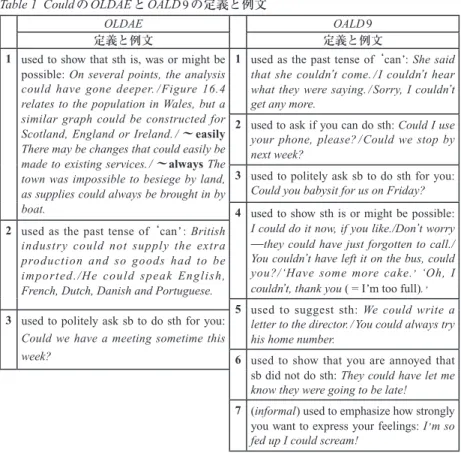
OLDAE と OALD 9 の could の定義と例文を比較すると、OLDAE の 3 義に対し て、OALD 9 では 7 義掲載されており、OALD9 には、第 7 義のように‘ informal’ な用法も掲載されている。注目すべきは、OLDAE では、tentativeness や hedge と 関係する‘possibility’の意味が第1義として掲載されていることである。OALD9 では、この意味は第 4 義である。さらに、例文を見てみると、どちらの辞典も 完全文の用例が掲載されているが、OLDAE のものは内容が学術的、あるいはア カデミックな場面での使用を考慮したものであるのに対して、OALD 9 の用例 は、日常生活の場面で使用されるものや、会話的な用例が多く、could の短縮形 も使用されている。OLDAE では、could のエントリー中に、academic English と general Englishの違いについて、注記 HELP‘The short form couldn’t is best avoided
in academic writing, unless you are quoting or deliberately using a less formal style’を掲 載し、アカデミックライティングでは、短縮形を用いることを避けるよう注意を 促している。
3.1.2 may
Table 2 MayのOLDAEとOALD 9の定義と例文
OLDAE OALD 9
定義と例文 定義と例文
1 used to say that sth is possible: Free trade
may lead to a deterioration of labour conditions in developed countries. / The patient may have developed an ulcer. / ∼
well However, after 10 or 20 minutes this
action may well be too late and the patient may be unable to swallow. / ∼ easily Children and teens who never express anger may easily go unnoticed.
1 used to say that sth is possible: That may
or may not be true. /He may have ( = perhaps he has) missed his train. /They
may well win. / There is a range of
programs on the market which may be described as design aids.
2 used when admitting that sth is true before
introducing another point, argument, etc: He may be a good father but he’s a terrible husband.
2 used when admitting that sth is true before
introducing another point or argument: She may have been old-fashioned in her approach, but she was an excellent teacher. / The findings suggest that confidence in the health service has been undermined less than may at first appear.
3 (formal ) used to ask for or give permission:
May I come in? /You may come in if you wish.
4 (formal) used as a polite way of making a
comment, asking a question, etc: You look lovely, if I may say so. / May I ask why you took that decision? / If I may just add one thing . . .
3 used to say that sth is allowed; used to ask
for or give permission: A representative of the Europian Commission may attend
meetings but may not vote. 5 ( formal) used to express wishes and hopes: May she rest in peace./Business has been thriving in the past year. Long
may it continue to do so. 4 used to express wishes and hopes: May we
wish you success and happiness in your nursing career.
6 (formal) used to say what the purpose of
sth is: There is a need for more resources so that all children may have a decent education.
OLDAEとOALD 9ともに第1義は、‘possibility’についての意味である。OALD9
は第3義から第6義まで‘formal’の語法注記が付されているが、OALD9のcan 1 の
エントリーのWHICH WORD ?ボックスの記述、‘ Can and cannot (or can’t) are the most common words used for asking for, giving or refusing permission. . . . May (negative
も分かるように、許可を求めたり与えたりなどの場合には、canが最もよく用い られ、may は丁寧で、形式ばった表現である。OLDAE の完全文の例文に対して、 OALD 9では、途中省略の用例も見られる。 3.1.3 might Table 3 MightのOLDAEとOALD 9の定義と例文 OLDAE OALD 9 定義と例文 定義と例文
1 used when showing that sth is or was
possible: Much popular culture is part of what might be considered global culture. / The next great earthquake to affect Asia might well be inland, perhaps along the Himalayas./ Yet, although the writers might reject any influence of feminist writing, their texts seem to reveal the opposite./These names might have been in Shakespeare’s mind as he was writing.
1 used as the past tense of may when
reporting what sb has said: He said he might come tomorrow.
2 used when showing that sth is or was
possible: He might get there in time, but I can’t be sure./I know Vicky doesn’t like the job, but I mightn’t find it too bad./The pills might have helped him, if only he’d taken them regularly./He might say that now (= it is true that he does), but he can soon change his mind.
3 used to make a polite suggestion: You
might try calling the help desk./I thought we might go to the zoo on Saturday.
4 (BrE) used to ask permission politely:
Might I use your phone? /If I might just say something. . .
5 (formal) used to ask for information: How
might the plans be improved upon?/And who might she be?
6 used to show that you are annoyed about
sth that sb could do or could have done: I think you might at least offer to help! / Honestly, you might have told me!
7 used to say that you are not surprised by
sth: I might have guessed it was you!
8 used to emphasize that an important point
has been made: ‘And where is the money coming from?’ ‘You might well ask!’
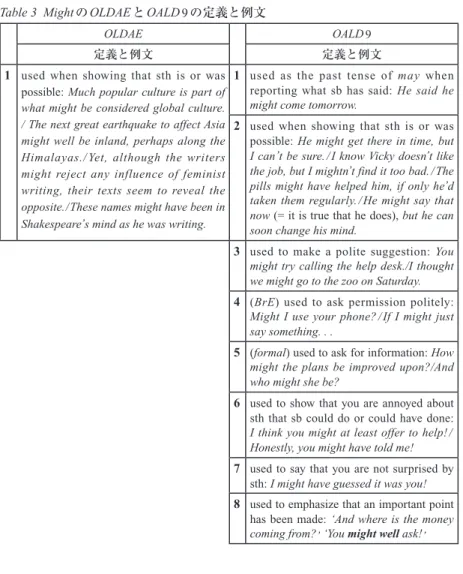
OLDAE は、tentativenessに関係する‘possibility’ を表す意味のみを掲載している。 OALD 9はこの意味を8義のうち、第2義に掲載している。例文の内容は、やはり、 OALD 9は話し言葉的な用例が多く、例文によっては助動詞の短縮形も使用され ている。
OLDAE の might のエントリーには、Grammar Point のボックスがあり、助動詞 might、could、may に つ い て、‘These modal verbs [ might, could and may ] are each used to talk about present or future possibility . . . ’ という記述がなされている。
3.2 助動詞could、may、mightについてOLDAEとOALD 9の定義と用例を比較し
ても、academic English を扱う OLDAE と general English と academic English の両方 を兼ね備えた OALD 9 との特徴の違いが明確に分かる。さらに、3 つの助動詞の 用例からも、OLDAE が人文・社会科学、自然科学の分野からバランスを考慮し て用例を掲載していることが分かる。 しかしながら、アカデミックライティングに必要とされる tentativeness や hedgeについての注記が、助動詞 could、may、might のエントリー中にもあれ ば、辞典利用者により役立つのではないだろうか。さらに、ここで生じる疑問は、 tentativenessやhedgeを表す助動詞の使用頻度は、人文・社会科学の分野と自然科 学の分野の間で違いが見られないのだろうかということである。第4章では、コー パスを用いて、学術英語における助動詞の頻度を調査してみたい。
4 ここでは、イギリス英語コーパスthe British National Corpus (BNC)4)とアメリ カ英語コーパスthe Corpus of Contemporary American English (COCA)5)を用いて、 イギリス英語とアメリカ英語それぞれの人文・社会科学と自然科学分野の書き言 葉のデータの間に、助動詞の頻度の違いがあるのかどうかについて調査する。 4) 本稿では、The CQP-Edition of BNCwebを使用。BNCは書き言葉と話し言葉からなるおよそ1億
語のコーパスである。Available at http://bncweb.lancs.ac.uk/ (accessed 19 April 2015).
5) COCA は、2015 年 5 月の時点で、1990 年から 2012 年までの書き言葉と話し言葉を集めた 4
億 5 千万語を超えるモニターコーパスである。最近のアップデートは、2012 年 6 月である。 Available at http://corpus.byu.edu/coca/ (accessed 28 April 2015).
BNC では、academic データから、人文・社会科学の分野である、humanities、 politics/law/education、social & behavioural sciences の 3 つ の サ ブ コ ー パ ス の 12,846,892語、自然科学分野は、medicine、natural sciences、technology computing
engineeringの3つのサブコーパスの3,246,862語を分析した。COCAは、サブコー パスacademicデータのうち、分野の不明な4,256,632語は除外し、人文・社会科学 の 分 野 は、education、geography/social science、history、humanities、law/political science、philosophy/religion の 6 つのサブコーパスの 65,135,730 語、自然科学は、 medicine、science/technologyの2つのサブコーパス20,775,800語を分析した。 本 稿 で は 3 つ の 助 動 詞 could、may、might に 焦 点 を あ て て い る が、BNC と COCAを用い、Biber et al. (1999: 483)の9つの‘central modal auxiliary verbs’、つまり、 can、could、may、might、shall、should、will、would、must の頻度を参考までに 調査した。これら9つの助動詞の頻度は、それぞれの否定形、短縮形も含む。人文・ 社会科学と自然科学の分野の助動詞の頻度に有意差があるかどうか調査するため に、log-likelihood testsを用いた。 4.1 BNC と COCA の検索結果を Tables 4-5 にまとめた。コーパス分析の結果、9 つの助動詞すべてにおいて、人文・社会科学と自然科学の分野の間に有意差が見 られる。BNC の can、may、COCA の can、may、will 以外のすべての助動詞の頻 度は、人文・社会科学分野のほうが、自然科学分野よりも有意に高い。助動詞の 頻度のランキングを見ると、BNCの人文・社会科学分野では、1位can、2位will、 3位 may、自然科学分野では、1 位 can、2 位 may、3 位 will であり、いずれの分野 にも助動詞mayが上位3位中に入っている。助動詞couldとmightはいずれの分野 も could が第 6 位、might が第 8 位である。COCA では、人文・社会科学分野では、 1位 can、2 位 would、3 位 will、自然科学分野では、1 位 can、2 位 will、3 位 may で ある。人文・社会科学分野では、mayは第4位、couldとmightはいずれの分野でも、 それぞれ第5位と第8位である。
3 つ の 助 動 詞 could、may、might に 注 目 し て み よ う。BNC、COCA と も に、 could と might は、人文・社会科学分野において有意に頻度が高い (BNC では、
couldとmightともに、p < 0.0001、COCAでは、couldが p < 0.01、mightが p < 0.0001)。 一方、mayは、BNC、COCAともに、自然科学分野における頻度のほうが人文・ 社会科学分野における頻度よりも有意に高い (BNC、COCA ともに p < 0.0001)。 検索結果から、自然科学分野のほうが、人文・社会科学分野よりも、記述により 確実性があることが推測される。そして、人文・社会科学分野では、助動詞の過 去形couldやmightを用いることにより、自然科学分野よりも断定を避ける傾向が あるといえるのではないだろうか。 Table 4 BNC_Academic 助動詞 人文・社会科学vs 自然科学 人文・社会科学 自然科学 RF RF LL p-value can/cannot/can’t 35672 10311 -140.62 < 0.0001
could/could not/couldn’t 15058 2799 238.77 < 0.0001
may/may not/mayn’t 27138 8997 -474.72 < 0.0001
might/might not/mightn’t 10009 1472 429.39 < 0.0001 shall/shall not/shan’t 3676 466 234.84 < 0.0001 should/should not/shouldn’t 16484 3336 143.8 < 0.0001
will/ ’ll/will not/won’t 28568 5725 270.17 < 0.0001
would/ ’d/would not/wouldn’t 27049 3932 1202.63 < 0.0001
must/must not/mustn’t 11737 2067 249.19 < 0.0001
RF= raw frequency; LL= log likelihood values。LL の−の値は、助動詞の頻度が、 自然科学分野よりも、人文・社会科学分野において低いことを表す。
Table 5 COCA_Academic 助動詞 人文・社会科学vs 自然科学 人文・社会科学 自然科学
RF RF LL p-value
can/cannot/can’t 140292 57604 -2510.14 < 0.0001
could/could not/couldn’t 62921 19572 9.45 < 0.01 may/may not/mayn’t 95531 33298 -191.61 < 0.0001 might/might not/mightn’t 34924 8762 423.05 < 0.0001 shall/shall not/shan’t 4647 415 880.17 < 0.0001 should/should not/shouldn’t 60841 17437 158.19 < 0.0001 will/ ’ll/will not/won’t 100352 36865 -526.14 < 0.0001 would/ ’d/would not/wouldn’t 116938 28092 1925.88 < 0.0001
must/must not/mustn’t 44520 12036 267.24 < 0.0001
RF= raw frequency; LL=log likelihood values。LLの−の値は、助動詞の頻度が、自然 科学分野よりも、人文・社会科学分野において低いことを表す。
ただし、これらの分析はあくまでも助動詞全体の頻度からの推測であり、助動 詞 could、may、might のコーパス用例をさらに分析し、個々の助動詞の用法を調 査する必要がある。つまり、助動詞が、2つのタイプの意味をもつという立場を とるとすれば、例えば、Biber et al. (1999: 485)では、‘intrinsic’ meaning と‘extrinsic’ meaningを 挙 げ て い る。 第 3 章 の OLDAE の tentativeness は、 後 者 の‘extrinsic’
meaningに関係する。BNCとCOCAのcould、may、mightの用例の意味も、2つの
タイプに分類することによって、より明確な結論を出すことができるはずである。 このことに関しては、改めて論じたいと思う。
5 本稿では、まず、OLDAE の主な特徴を見た。そして、OLDAE (p. AWT3) に
は、アカデミックライティングにおける‘tentative language’ を使用することの重 要性が述べられているが、学問分野における頻度情報は掲載されていないことか ら、アカデミックライティングに必要な tentativeness を表すための言語表現とし て、OLDAE (p. AWT3) の記述に基づき、助動詞 could、may、might に焦点を絞り、
人文・社会科学分野と自然科学分野でこれらの助動詞の使用頻度が有意に異なる ことを述べた。今後の課題としては、助動詞以外の‘tentative language’ にも調査 研究を広げてゆきたい。 Acknowledgements 本稿は、科学研究費補助金の交付を受けて行った研究成果の一部である(JSPS KAKENHI Grant Number 25370654)。
References
Aull, L. 2015. First-Year University Writing: A Corpus-Based Study with Implications for Pedagogy. Basingstoke: Palgrave Macmillan.
Biber, D. et al. 1999. Longman Grammar of Spoken and Written English. Harlow: Pearson Education Limited.
Coxhead, A. 2000. ‘A New Academic Word List’. TESOL Quarterly, 2000, 34(2), 213-238. Flowerdew, J. 2013. Academic Discourse. New York: Routledge.
Hyland, K. 2005. Metadiscourse: Exploring Interaction in Writing. London: Continuum. Leech, G. 2013. ‘Where Have all the Modals Gone? An Essay on the Declining Frequency
of Core Modal Auxiliaries in Recent Standard English’. In Marín-Arrese, J. et al. (eds.). 2013. English Modality, 95-115. Berlin: Mouton De Gruyter.
Marín-Arrese, J. et al. (eds.). 2013. English Modality. Berlin: Mouton De Gruyter.
Paquot, M. 2010. Academic Vocabulary in Learner Writing: From Extraction to Analysis. London: Continuum.
Quirk, R. et al. 1985. A Comprehensive Grammar of the English Language. Harlow: Longman Group Limited.
Oxford Advanced Learner’s Dictionary of Current English. 9th ed. 2015. Oxford: Oxford University Press. (OALD 9)
Oxford Learner’s Dictionary of Academic English. 2014. Oxford: Oxford University Press. (OLDAE)
Oxford 2015 ELT Catalogue. 2014. Oxford: Oxford University Press.
English Language Teaching. 2015. Oxford University Press. Available at https://elt.oup.com/ cat/subjects/dictionaries/monolingual/?cc=gb&selLanguage=en&mode=hub (accessed 3 May 2015).
Oxford Learner’s Dictionaries. 2015. Oxford University Press. Available at www.oxfordlearne rsdictionaries.com (accessed 1 June 2015).
Victoria University of Wellington. 2015. Victoria University of Wellington, New Zealand. Available at www.victoria.ac.nz/lals/staff/averil-coxhead.aspx (accessed 3 May 2015).