A Formative Assessment Design for Web-based Collaborative Project
Learning in Mathematics
Wen-Yi Chang
Department of Education,
National University of Tainan, Tainan, Taiwan
[email protected]
I-Hua Lin
Department of Education,
National University of Tainan,Tainan, Taiwan
[email protected]
Gwo-Jen Hwang
Graduate Institute of Digital Learning and
Education, National Taiwan University of
Science and Technology,
Taipei, Taiwan
[email protected]
Pi-Hsia Hung
Department of Education,
National University of Tainan, Tainan, Taiwan,
[email protected]
Abstract
The purpose of this study was to develop a formative assessment design to monitor the discussion abilities of elementary school students in a web-based collaborative learning project. A scoring rubric was constructed to evaluate the students' performance and progress in relation to concept relatedness, communication, questioning/ feedback, and information sharing. A total of sixty-two 5th and 6th graders were divided into eight groups and carried out tasks in four web-based project learning activities. Online discussion posts by the students were rated across six months and then analyzed with Hierarchical Linear Modeling. The results suggested that the formative assessment design was workable and useful to reveal the substantial improvement of the students’ discussion abilities when taking on the web-based collaborative learning project. In addition, the preliminary convergent and discriminating validity evidences also suggested that the scoring rubric is promising for further applications in the studies of collaborative project learning.
Keywords: web-based project learning, discussion abilities, collaborative learning.
1. Introduction
Project-based learning (PBL) has been recognized as an innovative and potential pedagogical method [1]. This student-centered learning approach emphasizes the connection between authentic learning experiences as well as the importance of shared goal and mutual support among learners, thus offering a promising alternative for future mathematics educational reform [2]. With the aid of computer technology nowadays, development of
web-based project learning approach is even more promising [3].
For PBL, collaboration is a critical element and a crucial ability because of its genuine nature of group work [1]. Krajcik, Czerniak and Berger [4] defined collaboration as a joint intellectual effort of students, peers, teachers, and community members to investigate a question or a problem. In the discussion of collaborative learning, it is noteworthy what the advance of computer technology may contribute. To begin with, the Internet provides learners with a handy opportunity to cooperate. By lessening the learning load of each team members, Internet access also provides better opportunities for learners to develop techniques that are required in their daily lives. Moreover, collaboration learning on the Internet goes beyond mere exchange of information. Instead, it provides a mutually cooperative and interactive procedure for learners to create and redefine learning [5]. When incorporating it into PBL, this learning approach, which is defined as web-based collaborative project learning (WCPL), would become a powerful instructional strategy and learning method. Among the skills involved in WCPL, discussion abilities, or the skills to express and communicate with others fluently and efficiently, are referred to as the most prominent implementation of collaboration [6].
With regard to math education, peer discussion generated by collaborative learning seems worthy of investigation. It has long been recognized that math teachers need to be informed of how their students approach math problems and what type of mathematical knowledge is applied when solving the problems. Knowing how students think during the process of learning and problem solving makes it possible for teachers to help their students overcome conceptual difficulties and that, in turn, improves learning. To this
end, formative assessment, defined as a self-reflective process that intends to promote student attainment, can be viewed as a diagnostic strategy of learning [7]. In the context of PBL, formative assessment is often used to determine students’ readiness for an inquiry task, to monitor performance on relevant aspects of engagement during the task such as communication, and to benchmark and establish students’ mathematical performance [8]. Along these lines, the purpose of this study is to develop a formative assessment design to evaluate the discussion abilities of elementary school students in a web-based collaborative learning project.
2. Method
2.1. Participants and Procedures
A total of 38 male and 24 female sixth grade students, from two schools in southern part of Taiwan, were included in this study. The samples of students were divided into eight groups, each of which comprised of 6 to 9 members. All of the participants were then required to join four web-based project learning units, which took up 80 minutes per week and lasted for a total of 24 weeks. Finally, a computerized adaptive testing in mathematics [9] was applied, and the participants' school test scores in math and Chinese were collected to address the validity issue.
2.2. Curriculum Design of the Project
The web-based learning project was composed of four units, covering content areas including numerical relativity, space and geometry, and statistics and probability. Each unit contained a driving question and two learning objectives, and each stood for 10 hours of learning (see Table 1). Participants' discussion dialogues, learning profiles and their feedback to the other team members were then collected and analyzed.
2.3. System Design of the Project
A web-based discussion platform was adopted for this study (see Figure 1). It was part of the “YP Learning Garden”, which was developed by Chen, Lin, Tzeng, Hung and Wang [10]. This learning website provides a web-based learning environment for elementary school students to search for information, to share ideas and to conduct online discussion. Students can also post questions or provide feedback to the questions or opinions of others. For the purpose of this study, all of the student posts in the discussion section were scored by two well-trained raters.
2.4. Assessment and Scoring Rubric Design
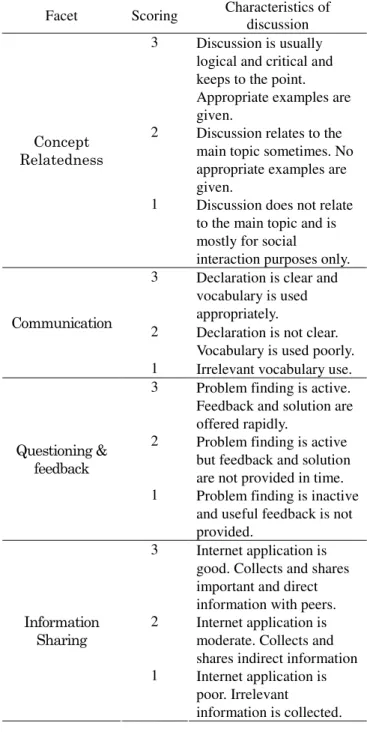
In this study, an online assessment was developed to evaluate the progress of discussion abilities of the students in the WCPL. The scoring rubric of this assessment was divided into four facets: (1) concept relatedness, (2) communication, (3) questioning & feedback, and (4) information sharing (see Table 2). Specifically, concept relatedness evaluates the value of content-related discussion, communication evaluates communicational clarity, questioning and feedback evaluates initiatives of asking questions or offering meaningful feedback, and information sharing evaluates students’ abilities of information searching, data refining and sharing. Discussion dialogues by the students were scored in a 3 point scale according to the characteristics of the discussion.
Table 1. Description of the Project Curriculum
Unit Time Driving Question Learning Objectives Numerical
Relativity
10hr How did Alice use magic to make things bigger and smaller?
*To learn ratio concept and to apply it to daily life
Space and Geometry (1)
10hr How do you make the largest shadow of an umbrella?
*To understand the relationship between geometry and numeric ratio
*To identify the relations of graphs Space
and Geometry (2)
10hr How do you make the spin top spin fast and continually?
*To develop spatial awareness *To observe spatial relations
Statistics And Probability
10hr In which city do the citizens get lost most easily?
*To investigate the characteristics of different cities
*To learn the concept of statistics and probability
Fig. 1 Discussion Platform of the Project System
Table 3 presents post examples of scoring point 1 and 3 regarding the facet of concept relatedness. The correlation coefficients of rater consistency between the raters in Unit 1 and 4 were .93 and .88 respectively. The
participants' best three performances within each unit were singled out and averaged to represent his/her discussion ability at the time of the unit learning. Hierarchical Linear Modeling(HLM) was then used to analyze the progress of discussion skills across all four units.
Table 2. Group Discussion Rubric
Facet Scoring Characteristics of discussion 3 Discussion is usually
logical and critical and keeps to the point. Appropriate examples are given.
2 Discussion relates to the main topic sometimes. No appropriate examples are given.
Concept Relatedness
1 Discussion does not relate to the main topic and is mostly for social
interaction purposes only. 3 Declaration is clear and
vocabulary is used appropriately.
2 Declaration is not clear. Vocabulary is used poorly. Communication
1 Irrelevant vocabulary use. 3 Problem finding is active. Feedback and solution are offered rapidly.
2 Problem finding is active but feedback and solution are not provided in time. Questioning &
feedback
1 Problem finding is inactive and useful feedback is not provided.
3 Internet application is good. Collects and shares important and direct information with peers. 2 Internet application is
moderate. Collects and shares indirect information Information
Sharing
1 Internet application is poor. Irrelevant
information is collected.
Table 3. Example of Discussion Posts with Different Scoring Points in Terms of Concept Relatedness Example of Scoring Point 1
A1:What is the final result of the experiment? What is the relationship between stones and the department store? B1:We measured the volume of the department store
when we went to the movie last week. A2: Which movie did you see?
B1: Harry Potter.
A2: That film is exciting. Example of Scoring Point 3
B1:Making paper airplanes is also a daily application of symmetry.
A1:We can make paper airplanes symmetric or
unsymmetrical.What do you think?
B2:We can make a paper airplane symmetric by just making the both sides identical!
S1:I thinkif the graph is symmetric, you can calculate half of the area and then multiply it by two. Then you get the total area of the graph. But if it is not symmetric in the first place, then you can use other ways to find out the area, but that will be more complicated.
2.5. Computerized Adaptive Testing in Math
Having completed the web-based learning project, a computerized adaptive testing in mathematics, developed by Hung [9], was administered to address the validity issue. Five mathematical components were incorporated in the assessment, including: (1) numbers and calculation, (2) quantities and measurements, (3) relationship, (4) shapes and space, and (5) statistics and probability.
3. Result
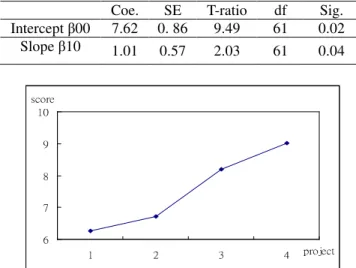
Table 4 illustrates the average scores of the participants’ discussion abilities when they worked on the WCPL. Among the four facets of discussion abilities, concept relatedness shows not only the largest growth (difference between project 1 and 4 is 1.06), but also the best final performance (2.38). The other three facets show only moderate growth. In addition, we applied HLM to further analyze the participants’ learning progress in discussion. Table 5 shows the growth slope profile of the students’ discussion abilities, and Figure 2 displays their progress in the collaborative learning projects. The average growth slope is 1.01 (p<0.05), which is to say that the participants demonstrated significant growth in their discussion performances. The stable increase in both individual and overcall facets suggest the effectiveness of the WCPL in developing students’ abilities of discussion.
The participants’ performances in computerized adaptive testing in Math as well as their school test grades
in mathematics and Chinese were also collected as related variables for this study. Table 6 shows the convergent and discriminant validity patterns. The correlation coefficients between discussion abilities and the three assessment scores are.69, .43, and .54 respectively. The pattern of correlation coefficients provides reasonable validity evidence for the development of the assessment and scoring rubrics of discussing ability in WCPL because these correlation coefficients are around moderate level. Table 4. Average of Participants’ Discussion Abilities
Presented in the Four Learning Units (N=62) Learning Unit Faects of Discussion Abilities 1 2 3 4 Concept Relatedness 1.32 1.45 2.12 2.38 Communication 1.57 1.55 2.04 2.24 Questioning & Feedback 1.45 1.76 1.96 2.13 Information & Sharing 1.92 1.96 2.08 2.26 Total 6.26 6.72 8.20 9.01
Table 5. Coefficients Estimated by Unconditional Models of HLM (N=62)
Coe. SE T-ratio df Sig. Intercept β00 7.62 0. 86 9.49 61 0.02 Slope β10 1.01 0.57 2.03 61 0.04 6 7 8 9 10 1 2 3 4 project score
Figure 2 Growth of Group Discussion Abilities Table 6 Correlation Coefficients of Group Discussion
Abilities, MCAT, and School Test Grades in Math and Chinese (N=62)
Correlation MCAT School Math School Chinese
Discussion
Abilities .69 **
.43** .54**
4. Conclusion
The aim of this study was to develop an assessment tool and a scoring rubric to evaluate the discussion abilities of students participating in the WCPL. The results showed that the facets of discussion adopted in this study were useful to reveal the learning progress of
students’ discussion abilities. Students demonstrated substantial improvement in the facet of concept relatedness and moderate growth in the other three. The results also suggested that the WCPL was helpful to enhance the discussion abilities of the students. The correlation coefficient between discussion abilities and other academic grades revealed that the assessment design was an appropriate and valid instrument to evaluate the students’ discussion performances in the web-based collaborative learning context. A well embedded formative assessment design to evaluating students’ discussion abilities could be helpful for monitoring and exploring students’ learning profiles in collaborative project learning.
Acknowledgement
This study is supported by the National Science Council of the Republic of China under contract number NSC 100-2631-S-011-003.
5. References
[1] W. Hung, D. H. Jonassen, and R. Liu, Problem-based learning. In J. M. Spector, J. G. van Merrienboer, M. D., Merrill, and M. Driscoll (Eds.), Handbook of research on educational communications and technology, 3rd ed., pp. 485-506. Mahwah, NJ: Erlbaum., 2008
[2] J. W. Thomas, A review research on project-based learning. The Autodesk Foundation, California, 2000.
[3] P. H. Hung, G. J. Hwang,Y. H. Lee, and T. H. Wu, “The problem refining progress for the 5th graders' ubiquitous inquiry,” Presented at the Asia-Pacific Conference on Technology Enhanced Learning 2011 (APTEL 2011), Aug. 2011.
[4] J. S. Krajcik, C. M. Czerniak, and C. Berger, Teaching Children Science: A Project-based Approach. Burr Ridge, IL: McGraw-Hill College, 1999.
[5] A. R. Kaye, Collaborative Learning through Computer conferencing. New York: Springer Verlag, 1992.
[6] J. L. Kolodner and K. Nagel, The design discussion area: a collaborative learning tool in support of learning from problem-solving and design activities, Presented at the 1999 conference on computer support for collaborative learning, December, 1999.
[7] D. J. Nicol and D. Macfarlane-Dick, “Formative assessment and selfregulated learning: a model and seven principles of good feedback practice”,Studies in Higher Education, 31(1), pp. 199-218, 2006
[8] C. M. Diezmann and T. Lowrie, “An instrument for assessing primary students’ knowledge of information graphics in mathematics”, Assessment in Education: Principles, Policy and Practice, 16(2), pp. 131-147, 2009.
[9] P. Hung, “The development and implementation of a computerized dynamic assessment system: A longitudinal investigation on the relationship among learning potential, working memory and achievement,” Technical report of National Science Council, NSC92-2521-S-024-001, 2004. [10] Y. Chen, I. Lin, Y. Tzeng, P. Hung, W. Wang, "Assessment Design for Mathematics Web Project-Based Learning," Presented at the International Conference on Computers in Education (ICCE'02), 2002