
Formal Reports Based on Interviews with Elders
9
0
0
全文
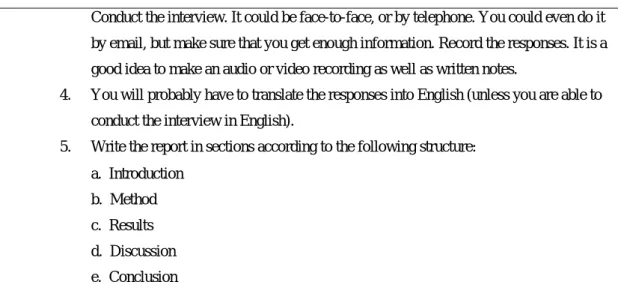
(2) Formal Reports Based on Interviews with Elders. My first experiences with teaching formal report writing came from teaching technical writing and business English to native speakers in Canada. Writing a formal report was a requirement of these courses. Students were tasked with writing a report based on interviews with someone interesting. The interviews could be in person, by telephone, through email, or even by mail. One student was able to write a report on African Wild Dogs, based on an email exchange with a researcher in Africa. Another student based her report on an interview with a First Nations person (i.e., a native Canadian) who was separated from her parents and forced to attend a residential school. Most students were able to find someone interesting to interview, and their reports were interesting to read. The structure of formal report components, each with a specific purpose, lends itself to a number of written assignments that are composed of the internal parts of a completed report. I wondered if my experiences with native speakers could be adapted to Japanese English language majors. I decided to try. I introduced this idea in a third year reading and writing class. The class had two ninetyminute classes per week for fifteen weeks. The reading part of the course was based on a graded reader version of Les Misérables by Victor Hugo (2008). It was rated as level 6 which is the highest level in the Penguin graded reader series. We alternated between reading Les Misérables and working on the written reports. The two parts of the course seemed to complement each other well. Other components included dialogue journals, written tests, and poster presentations.. The Assignment I introduced the topic and then handed out instructions for the project. There are five sections to the report, each with a specific purpose and its own report genre. The following is a sample assignment.. Formal Report Assignment Interview an older person (70 years old or older) and write a report on his/her life. Choose someone who has had an interesting life, and someone that you have access to. Completing the assignment will take several steps. 1.. Think of someone you can interview. Get their consent to do the interview.. 2.. Write up your questions (5-7 would be ideal).. 3.. 191.
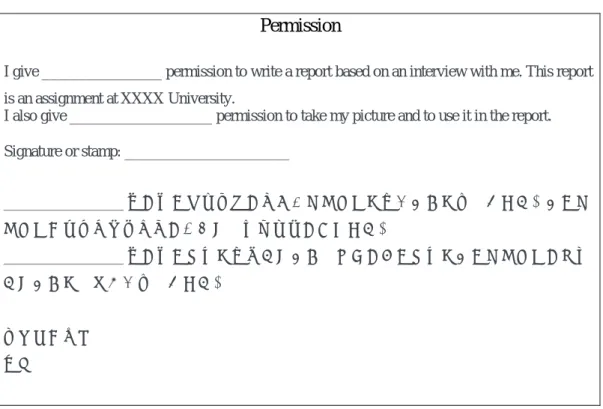
(3) 岐阜大学教育推進・学生支援機構年報 第5号 2019年. Conduct the interview. It could be face-to-face, or by telephone. You could even do it by email, but make sure that you get enough information. Record the responses. It is a good idea to make an audio or video recording as well as written notes. 4.. You will probably have to translate the responses into English (unless you are able to conduct the interview in English).. 5.. Write the report in sections according to the following structure: a. Introduction b. Method c. Results d. Discussion e. Conclusion. The first task is to think of a person and write your questions. I will reserve computer lab time for the writing, and I will give more information in future classes. This assignment will take some time to complete. I will ask for sections as the course progresses. Timeline April 24. Tell me who you will be interviewing and when the interview will take place.. May 11. Hand in a rough draft of the introduction. May 25. You should have completed your interview.. June 1. Hand in a second draft of your introduction, your method of inquiry and your results.. June 8. Share your introduction, method and results in a reading circle.. June 29. Hand in rough draft of your discussion and conclusion.. July 9. Hand in your full report. Note: The final draft should have a title page with a picture (if possible). Pages should be numbered, pictures and maps should have a caption, and all corrections should be made.. Figure 1. Formal Report Assignment After discussing the assignment, I also handed out a sample report to illustrate the various parts. I wrote it as if I had interviewed my grandfather for the report even though he had passed away some years before. Having a model adds to the clarity of the project.. Selecting someone to interview and getting permission It’s important for students to find someone to interview fairly quickly so the project can proceed smoothly. It is also important to get permission from the person being interviewed. I. 192.
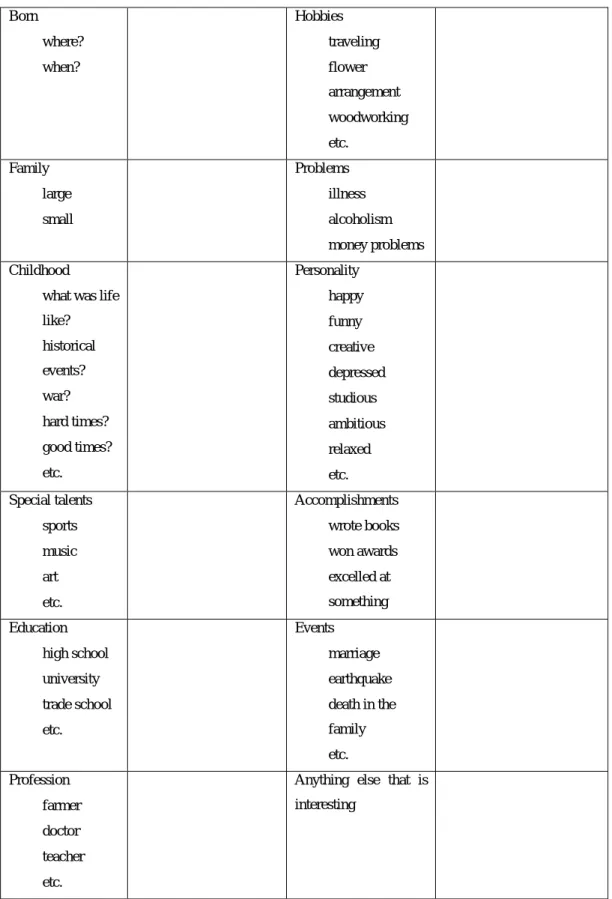
(4) Formal Reports Based on Interviews with Elders. required that students get permission from the person they plan to interview using the following form.. Permission I give ________________ permission to write a report based on an interview with me. This report is an assignment at XXXX University. I also give ___________________ permission to take my picture and to use it in the report. Signature or stamp: ______________________ ________________ 氏に私の口頭試問に基づきレポートを書くことを許可します。このレ ポートは関西外国語大学における、研究課題になります。 ________________ 氏に私の写真を撮影すること、並びにその写真をこのレポートに使用 することを、同じく許可します。 署名又は捺印 日付. Figure 2. Participant Permission. The Introduction The introduction should describe the person on whom the report is based. It should include biographical details about the person’s life. To prepare for it, I created a worksheet that was designed to give students ideas for their introduction. We also read the introduction from my sample report, and students were encouraged to use it as a model. Then they needed to brainstorm as much information as possible prior to writing their own introduction. The following worksheet aided the process. Students might need to gather more information from the person they are interviewing, or from other people that know the interviewee well. However, this works best if the interview is with someone that the person knows fairly well. At this point each student needs to write the first draft of their introduction and submit it. The teacher marks it, noting errors and giving recommendations and hands it back for the students to correct. This process is repeated at each stage to ensure that errors are eliminated.. 193.
(5) 岐阜大学教育推進・学生支援機構年報 第5号 2019年. Born. Hobbies. •. where?. •. traveling. •. when?. •. flower arrangement. Family. •. woodworking. •. etc.. Problems. •. large. •. illness. •. small. •. alcoholism. •. money problems. Childhood •. Personality. what was life. •. happy. like?. •. funny. historical. •. creative. events?. •. depressed. •. war?. •. studious. •. hard times?. •. ambitious. •. good times?. •. relaxed. •. etc.. •. etc.. •. Special talents. Accomplishments. •. sports. •. wrote books. •. music. •. won awards. •. art. •. excelled at. •. etc.. Education. something Events. •. high school. •. marriage. •. university. •. earthquake. •. trade school. •. death in the. •. etc.. family •. Profession •. farmer. •. doctor. •. teacher. •. etc.. etc.. Anything else that is interesting. Figure 3. Brainstorming worksheet for the Introdaction. 194.
(6) Formal Reports Based on Interviews with Elders. The Interview. Students need to arrange and carry out their interviews in a reasonable period of time. However, before their interview they need to compose some appropriate questions. Some students have trouble thinking of questions. To make sure each student has an appropriate set of questions, I ask them to brainstorm questions for homework. Then I collect, compile and redistribute them. This done, it shouldn’t be too difficult to select questions for their interview. Five or six questions should be enough. However, it somewhat depends on the interviewee. Some people are extremely talkative. A lot of older, retired people are thrilled when someone shows an interest in them, and they will talk on and on. Some people, however, may answer with short utterances. These people are difficult to interview, so students should be prepared to follow up with more questions. This is also something to consider when selecting someone to interview. Interviews need to be arranged, so a time and a place needs to be decided on. Some students may wish to do a telephone interview, and others may decide to do an interview by email. Students will need to find a way to record their interview by video, or audio recording, as well as be prepared to take notes at the time. Audio and video recordings are easily accomplished with a smart phone. More distant interviews can be via telephone, email or text messaging.. The Method Section The purpose of the method section is to inform the reader as to how the interview or interviews were conducted. It is a good idea to describe the tenor of the interview. Was it relaxed or tense? Was there anything else that effected the interview? In some cases, students may wish to have more than one interview. This is a short informative part of the report. An example from a student report is given below.. Method of Inquiry I interviewed Mr. Tanaka at his home in Osaka on April 25, 2011. He was 75 at the time. He was a little shy, but he was glad to talk with me about his life. The interview took 40 minutes. I recorded the interview with an audio recorder, and I also took pen and paper notes (T.C., personal communication, July 2011).. The Results Section. 195.
(7) 岐阜大学教育推進・学生支援機構年報 第5号 2019年. The results section reports how the questions were answered by the interviewee. It’s not necessary to transcribe the answers verbatim. A boiled down version is fine especially if the answers are very long, which is often the case. A good way to report on the interview is to organize it based on the questions. The questions and the question number should be written in bold and the answers in normal text format as in the following example.. Question 3: What do you like about my grandmother We have been married for 57 years.. During this time, we have had many. arguments, but in the end, we remain on good terms as before. Your grandmother’s mind is very broad. I have a bad temper, but your grandmother always supports me. When I decided to go to a poor village, she didn’t oppose my decision. She said yes without thinking. I respect her mind. The kids have all grown up and left home. Your grandmother accompanies me everywhere. We walk and enjoy the Yangtze River’s scenery together every day (K.C., personal communication, July 2012).. The Discussion Section The discussion section offers an opportunity for students to analyze the comments, pull out themes and articulate the issues that are important or of interest to the reader. Themes are often fairly obvious. Some comment on war, others emphasized the importance of culture, and others talk about education. People have different experiences in their lives as well as different perspectives and values. This is also an opportunity for students to express their own views on what the interviewee said. Here are a couple of examples from student reports:. Although he is my grandfather, I did not know about his war experiences. We learned about World War II, but we don’t know the real facts. Many Japanese soldiers returned from the war, and some are still alive, like my grandfather. Young people should listen to their experiences and know about the war (K.S., personal communication, July 2012).. 196.
(8) Formal Reports Based on Interviews with Elders. Mr. Yamaguchi never expects his son to be a great man. He just hopes that his son can do the things he wants to do. I think it is the right way to develop a better man. Let the children do the things they want to do, and these will be the things they are actually good at (E.S., personal communication, December 2011).. The Conclusion The conclusion is a short, but important section. It allows the writer to comment on the relevance of the report and also add any parting thoughts they may wish to make. Here is an example.. I enjoyed interviewing my grandfather. I also think he enjoyed talking to me. As a teacher, he tried his best to help students learn about the charm of traditional culture, and he still likes to help people even though he is 80 years old now. I respect him. I am proud of my grandfather, and I want to be like him (T.C., personal communication, July 2012).. Why do this type of project? First, I think this is an interesting project for students. It is necessary to invest quite a bit of time and effort in this project, but students feel a sense of accomplishment when it is completed. They must plan who they will interview, what they will say, arrange for the interview and decide how they will record it. Then they must reflect on their findings and write the report. It is more than the usual “dummy run” in which students merely write a practice piece. When students can develop their own sense of voice (Graves, 1982; Romano, 2004), they become an author (i.e. an authority). As John Dewey (1932), the well-known educational philosopher put it, there is “all the difference in the world between having something to say and having to say something” (p. 50). It also teaches students report writing skills which may be useful in their future lives. This project is also engaging for the teacher, so this project can be a stimulating shared experience, and students are generally receptive to it. Many have written about the value of publishing in some way (Graves, 1983: Featro & DiGregorio, 2016) even if this means simply sharing reports with each other. In my classes the completed reports were handed back during the last class and students could share their reports.. 197.
(9) 岐阜大学教育推進・学生支援機構年報 第5号 2019年. When completed, it should be a presentable finished product, in a report cover. Hopefully, it will be something the student keeps and perhaps shares. When I taught these courses, students reported a high degree of satisfaction. My student evaluations were consistently excellent. Comments indicated that this writing assignment was meaningful and advanced their competence as a writer. Enjoyable classes and glowing student evaluations don’t necessarily equate to educational value, but this type of assignment does resonate with students in a way that has sound educational benefits.. References. Dewey, J. (1932). The School and Society. Chicago: University of Chicago Press. Featro S. & DiGregorio, D. (2016). Blogging as an Instructional Tool in the ESL Classroom. TESL-EJ, 20 (1), 1-9. Graves, D. (1983). Writing: Teachers and children at work. Portsmouth, NH: Heinemann. Hugo, V. (2013). Les Misérables (N. Denny, Trans.). London: Penguin Books. Hugo, V. (2008). Les Misérables (Penguin Readers). Edinburgh Gate: Pearson Education. [jpbab00].(2015, June 20). 111 yearsa go-Dustin Hoffman-Little Big Man.[video file]. Retrieved from https://www.youtube.com/watch?v=7oaQGw2W8IU Millar, Stuart (Producer), & Penn, Arthur (Director). (1970) Little Big Man (Motion Picture). USA: Cinema Center Films. Review of the Literature regarding The Benefits of Student Publishing. (2019). Retrieved from https://www.publishingstudents.com/researchbenefits.html Romano, Tom (2004). The Power of Voice. Educational Leadership, 65 (4), 20-23. Spradley, James P. (1979). The Ethnographic Interview. New York: Holt, Rinehart and Winston.. 198.
(10)
図
関連したドキュメント
The denoising results for pixels near singularities are obtained by nonlocal means in spatial domain to preserve singularities while the denoising results for pixels in smooth
In 2003, Agiza and Elsadany 7 studied the duopoly game model based on heterogeneous expectations, that is, one player applied naive expectation rule and the other used
This paper deals with the a design of an LPV controller with one scheduling parameter based on a simple nonlinear MR damper model, b design of a free-model controller based on
In the study of dynamic equations on time scales we deal with certain dynamic inequalities which provide explicit bounds on the unknown functions and their derivatives.. Most of
These authors make the following objection to the classical Cahn-Hilliard theory: it does not seem to arise from an exact macroscopic description of microscopic models of
These authors make the following objection to the classical Cahn-Hilliard theory: it does not seem to arise from an exact macroscopic description of microscopic models of
Colmez (1998) and Perrin-Riou (1994) proved an explicit reciprocity law for tempered distributions over the formal group G m1. In this paper, the general explicit reciprocity law
According to the divide and conquer method under equivalence relation and tolerance relation, the abstract process for knowledge reduction in rough set theory based on the divide
