Original
Relationship Between Medication Independence and Medication
Caregiver s Burden during Medication-Assisted Process for
Patients with Alzheimer s Disease
Kikuo Eguchi1), Tohru Sonoda1)
and Noriyuki Ogawa2)
1)Department of Occupational Therapy, School of Health Science, Kyushu University of Health and Welfare
2)Department of Occupational Therapy, Faculty of Health Science, Kyoto Tachibana University
(Received: December 17, 2020)
Abstract
Aim: This study aims to clarify the characteristics of medication independence during medication-assisted process for patients with Alzheimer s disease (AD) residing in hospitals and facilities. The relationship with the medication caregiver s burden is also clarified.
Methods: We examined 44 patients with AD. We evaluated medication independence in patients with AD using a three-point scale and the burden of each patient s medication caregiver using a visual analog scale. The factor analysis was performed to clarify the characteristics of medication independence in the medication-assisted process for patients with AD. We also used a cluster analysis to classify patients with AD. The Mann-Whitney U test was used to compare medication independence, medication caregiver s burden and medication combinations for each cluster.
Results: The medication-assisted process for patients with AD includes two key characteristics: medica-tion administramedica-tion independence and independence in swallowing medicamedica-tion. We identified two groups of pa-tients with AD. Cluster 1 group had difficulty in independently administering their medication but who could swallow independently. Cluster 2 group was able to independently administer and swallow their medication. In other words, patients in cluster 1 tended to require total assistance with medication administration. However, regarding items of the medication administration independence, the burden reported by cluster 1 caregivers was significantly lower than that reported by cluster 2 caregivers. Additionally, cluster 1 received significantly more medication combinations than cluster 2. However, we found no significant between-cluster differences regarding items of independence in swallowing medication.
Discussion: The findings of this study suggest that given the requirements for assistance, for example, medication administration errors problems and modified the dosage forms coupled with the large number of medication combinations required by patients with AD, caregivers may prioritize risk mitigation during the medication-assisted process.
Conclusions: Caregivers should focus on medication administration and swallowing and should seek to es-tablish a balance between risk management and the patients remaining abilities.
(JJOMT, 69: 165―173, 2021)
―Key words―
alzheimer s disease, medication-assisted process, caregivers
Introduction
According to the World Alzheimer Report 2018, 50 million people worldwide were living with dementia in 20181)
. This number is projected to increase to more than 131 million by 2050 as the global population ages2)
. Thus, prevention, early diagnosis, and early treatment for dementia are important.
liv-ing in local communities, facilities, and hospitals. Moreover, in the actual clinical settliv-ing, those patients were taking some medicine. However, patients with AD had difficulty in taking medication owing to various symp-toms. Therefore, we assessed the existing literature to understand the current state of medication manage-ment in patients with AD.
In local communities, medications for older adults and/or people living with dementia are often managed and administered by informal caregivers3)
. These activities can be stressful for spousal caregivers4)
; thus, caregivers were the focus of this investigation. In contrast to medication management provided by caregivers in local communities, nurses are the central figures in the medication administration process at hospitals and medical facilities5)
. In addition, similar to hospitals and medical facilities, nurses are central to medication ad-ministration in long-term care6)
.
Thus, studies on the medication management of patients with AD have examined the roles of caregivers in local communities and the roles of nurses in hospitals and facilities.
On the other hand, during drug support for patients with AD at hospitals and facilities that we support, we realized that it would be easier to support these patients if the characteristics of medication independence were clear. We also had the empirical understanding that higher patient s medication independence would lower the burden of assistance required. Therefore, we examined the existing literature to determine the nu-merical accuracy of our clinical experience.
However, no studies have clarified the characteristics of medication independence or their relationship with the medication caregiver s burden in patients with AD residing in hospitals and facilities.
Therefore, in this study we aimed to clarify the characteristics of medication independence in the medication-assisted process for patients with AD residing in hospitals and facilities. In addition, we clarified the relationship between the medication independence and medication caregiver s burden. Furthermore, based on the results, we will examine future medication-assisted process for patients with dementia.
Methods Participants
One prefecture in Kyushu, where this study was conducted, has many hospitals and facilities. We ran-domly selected eight facilities and requested their cooperation; we ultimately established cooperative agree-ments with four facilities. These facilities were variously classified as general hospitals, psychiatric hospitals, and long-term care health facilities. We targeted those patients whose physicians had diagnosed them with AD using the ICD-10. We excluded patients with AD who had undergone a gastrostomy or received tube feeding but targeted all patients with AD who required medication. In addition, we obtained information on the tients with AD from the nurses and associate nurses who mainly provided the medication assistance to the pa-tients with AD.
Measurements
We investigated the degree of independent living for the demented elderly (Dementia Scale)7)8)
, the inde-pendence degree of daily living for the disabled elderly (Bed-fast Scale)7)
, and the number of medication combi-nations and dosage forms to determine the status and medication abilities of the patients with AD. The De-mentia Scale represents how independent the individual is during daily life activities relative to deDe-mentia se-verity. The Dementia Scale is assessed according to the following ranks: I, II (IIa and IIb), III (IIIa and IIIb), IV, and M. The Bed-fast Scale represents the degree of independence during the elderly s daily life. The Bed-fast Scale is assessed according to the following ranks: J, A, B, and C. A detailed description of each scale is shown in Table 1.
Survey methods and period
The traditional biomedical model of drug treatment is considered a linear process that begins with the in-itial presentation of the problem and extends to the final stage of drug administration. Here, the patient experi-ences a problem, he or she makes an appointment with the doctor, the patient attends the appointment, the doctor examines the patient, the doctor writes a prescription, the patient adheres to the prescription, the pa-tient takes the medication, and the initial problem is resolved/managed9)
dif-Table 1 Characteristics of patients with Alzheimer s disease
Hospital and facilities (%) General hospital 7/44 (15.9)
Psychiatric hospital 28/44 (63.6)
Long-term care health facilities 9/44 (20.5)
Sex (%) Males 11/44 (25.0)
Females 33/44 (75.0)
Mean age 88.0±7.4 Number of medication combinations 6.7±3.4
Ia IIab IIbc IIIad IIIbe IVf Mg Total (%)
Jh 0 0 0 0 0 0 0 0 (0.0)
Ai 1 1 2 9 1 0 0 14 (31.8)
Bj 0 2 2 9 1 4 0 18 (40.9)
Ck 0 0 1 7 0 3 1 12 (27.3)
Total (%) 1 (2.3) 3 (6.8) 5 (11.4) 25 (56.8) 2 (4.5) 7 (15.9) 1 (2.3) 44 (100.0)
Dosage forms (%) Tablet 43/44 (97.7) Oral jelly 4/44 (9.1)
Disintegrating 16/44 (36.4) Powder medicine 2/44 (4.5)
Granule 10/44 (22.7) Liquid 1/44 (2.3)
Capsule 10/44 (22.7)
Because ratios have been reported, total ratios may not be 100%.
aRank I indicates some sort of dementia, but the patient is almost completely independent in daily domestic and social activities.
Rank II indicates symptoms, behaviors, or communication difficulties that interfere with the person s daily life in some degree, but the person can live independently if someone is there to look after him/her.
bRank IIa indicates that the conditions listed in II are observed outside the house. Examples of observed symptoms and behaviors of IIa
are as follows: the person frequently gets lost and makes noticeable mistakes in activities that he/she was previously able to perform such as shopping, administrative work, and money management.
cRank IIb indicates that the conditions listed in II are also observed at home. Examples of observed symptoms and behaviors of IIb are as
follows: the person cannot manage their medications and cannot stay at home alone (i.e., cannot answer phone calls or visitors). Rank III indicates that symptoms, behaviors, or communication difficulties that interfere with the person s daily life are observed once in a while and require care.
dRank IIIa indicates that the conditions listed in III are observed primarily during the day. Examples of observed symptoms and
behav-iors of IIIa are as follows: the person has difficulty (cannot perform well or requires a lot of time) changing clothes, eating meals, defecat-ing, and urinating; the person frequently places objects in their mouth, gathers and collects items, wanders, is incontinent, raises his/her voice or makes strange noises, does not take care after using fire (e.g., for cooking), presents unclean behavior or abnormal sexual behav-ior, etc.
eRank IIIb indicates that the conditions listed in III are observed primarily at night-time. Examples of observed symptoms and behaviors
of IIIb are the same as those of IIIa.
fIndividuals with rank IV have symptoms, behaviors, or communication difficulties that interfere with the person s daily life. These
symp-toms are frequently observed and require constant care. Examples of observed sympsymp-toms and behaviors of IV are the same as those of III.
gRank M indicates that significant psychotic manifestations, problem behaviors, or severe physical diseases are observed and require
spe-cialized medical care. Examples of observed symptoms and behaviors of M are as follows: the person displays continual psychiatric symp-toms such as delirium, delusion, excitement, and harm to self or others and problematic behaviors caused by such psychiatric sympsymp-toms.
hRank J indicates some disabilities, but daily life is almost independent and the patient goes out independently. iRank A indicates that the person largely independent living indoors but does not go out without assistance.
jRank B indicates that the person requires some assistance indoors and mainly stays in bed during the day but maintains the sitting
posi-tion.
kRank C spends the daytime in bed and requires assistance in tasks such as excretion, eating, and changing clothes.
ficult to clarify a detailed medication-assisted process for patients with AD.
Therefore, we referenced the medication-assisted method reported by Ishii et al10)
. We confirmed the evaluation items and the medication-assisted process with five head nurses who had more than 15 years of ex-perience. We summarized the medication-assisted process as follows: (i) Can the subject self-administer the medication even if it is in a powder wrapping paper and placed on a desk? (ii) Can the patient unwrap the pow-der wrapping paper? (iii) Can the patient self-administer the medicine when a caregiver unwraps the powpow-der wrapping paper and passes the medicine to the patient? (iv) Can the patient unwrap the powder-wrapping pa-per? (v) Can the patient self-administer the medicine when a caregiver unwraps the powder wrapping paper and places it on the patient s hand? (vi) Can the patient place the medication in his/her mouth without drop-ping the medicine? (vii) If a caregiver places the medicine in the patient s mouth, can he/she swallow the medi-cine? (viii) Can the subject swallow the medicine with tea or water? Finally, (ix) Did a caregiver need to take extreme precautionary measures after placing the medicine in the patient s mouth?
Using these evaluation questions, we assessed medication independence in patients with AD using a three-point scale in which 1 = total assistance, 2 = partial assistance, and 3 = independence. The
medica-Table 2 Degree of medication independence and medication assistance burden for each assessment item Medication independence Medication assistance burden Mean±SD Mean±SD
(i) Can the subject self-administer the medication even if it is in a powder wrapping
paper and placed on a desk? 1.2±0.6 20.0±30.7
(ii) Can the patient unwrap the powder wrapping paper? 1.2±0.5 20.2±30.7
(iii) Can the patient self-administer the medicine when a caregiver unwraps the powder
wrapping paper and passes the medicine to the patient? 1.2±0.6 18.9±28.5
(iv) Can the patient unwrap the powder-wrapping paper? 1.2±0.5 20.2±30.7
(v) Can the patient self-administer the medicine when a caregiver unwraps the powder
wrapping paper and places it on the patient s hand? 1.3±0.6 19.8±30.4
(vi) Can the patient place the medication in his/her mouth without dropping the
medi-cine? 1.2±0.6 19.5±29.2
(vii) If a caregiver places the medicine in the patient s mouth, can he/she swallow the
medicine? 2.7±0.5 20.0±29.3
(viii) Can the subject swallow the medicine with tea or water? 2.8±0.5 17.7±28.1
(ix) Did a caregiver need to take extreme precautionary measures after placing the
medicine in the patient s mouth? 2.4±0.7 23.9±34.7
tion caregiver s burden was assessed using a visual analog scale in which 100 = a large burden and 0 = a small burden, based on the responses of each patient s primary medication caregiver.
All data were collected between March and May of 2018.
Statistical analysis
Demographic variables and each measurement item are expressed in terms of means and standard devia-tions or totals and propordevia-tions. The factor analysis used the medication independence score. In addition, the ceiling and floor effects (mean±1 standard deviation) were confirmed. Then, a factor analysis was performed to clarify the characteristics of medication independence in the medication-assisted process for patients with AD (maximum likelihood method, promax rotation). We also examined the content and reliability of the factors (Cronbach sα coefficient). We used a cluster analysis to classify patients with AD. The Mann-Whitney U test was used to compare medication independence and medication caregiver s burden for each cluster and to as-sess between-cluster differences. We also compared between-cluster differences for medication combinations using the Mann-Whitney U test.
We used Bell Curve Excel Statistics for WindowsⓇ(SSRI Japan) to perform all statistical analyses. Ethical consideration
This study was conducted in accordance with the ethical standards established by the Declaration of Hel-sinki. Additionally, the study protocol was approved by the author s university ethics review board (Approval No. 16-042). Informed consent was obtained from all patients with AD and their families prior to participation in this study. In addition, verbal and written consent was obtained. Furthermore, consent was obtained from the nurses and associate nurses who were mainly responsible for providing medication assistance to the pa-tients with AD.
Results
Characteristics of patients with AD, nurses and associate nurses
Patients included 44 individuals with AD. Table 1 presents their basic characteristics.
Nineteen nurses (43.2%) and 25 associate nurses (56.8%) answered questions assessing medication inde-pendence and the medication caregiver s burden of patients with AD, including 6 males (13.6%) and 38 females (86.4%). Age distribution was as follows: 5 individuals (11.4%) in their 20s, 11 (25.0%) in their 30s, 15 (34.1%) in their 40s, and 13 (29.5%) in their 50s.
Table 2 presents the mean and standard deviation values of each item to clarify patients medication inde-pendence and caregivers burden related to medication assistance.
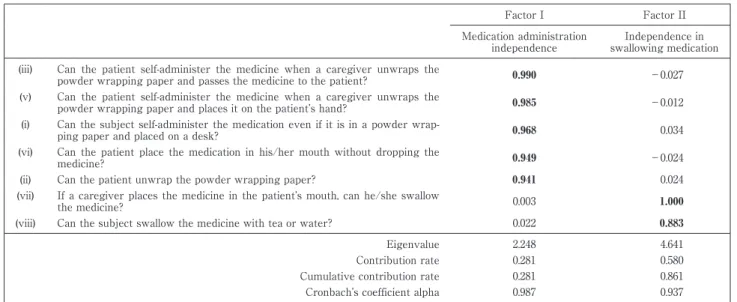
Characteristics of medication independence in the medication-assisted process for patients with AD
Table 3 Characteristics of medication independence in the medication-assisted process for patients with AD Factor I Factor II Medication administration independence Independence in swallowing medication (iii) Can the patient self-administer the medicine when a caregiver unwraps the
powder wrapping paper and passes the medicine to the patient? 0.990 −0.027
(v) Can the patient self-administer the medicine when a caregiver unwraps the
powder wrapping paper and places it on the patient s hand? 0.985 −0.012
(i) Can the subject self-administer the medication even if it is in a powder
wrap-ping paper and placed on a desk? 0.968 0.034
(vi) Can the patient place the medication in his/her mouth without dropping the
medicine? 0.949 −0.024
(ii) Can the patient unwrap the powder wrapping paper? 0.941 0.024
(vii) If a caregiver places the medicine in the patient s mouth, can he/she swallow
the medicine? 0.003 1.000
(viii) Can the subject swallow the medicine with tea or water? 0.022 0.883
Eigenvalue 2.248 4.641
Contribution rate 0.281 0.580
Cumulative contribution rate 0.281 0.861
Cronbach s coefficient alpha 0.987 0.937
Maximum likelihood method, promax rotation.
Factor loadings (>0.88) were entered into the factor and are displayed in boldface.
effect was recognized in items (vii), (viii), and (ix) whereas a floor effect was observed in items (i), (ii), (iii), (iv), (v), and (vi). However, in this study, all items were included in the analysis because all items indicate the medication-assisted process. The factor loading was set at 0.88 or higher. In the factor analysis, medication ad-ministration independence emerged as Factor I (α = 0.987), and independence in swallowing medication was determined to be Factor II (α = 0.937) (Table 3).
Cluster-specific characteristics of patients with AD
We conducted a cluster analysis based on the factor scores. We classified patients with AD into two dis-tinctive clusters (Table 4). Cluster 1 included patients with AD who found it difficult to independently adminis-ter their medication but were able to independently swallow it. Clusadminis-ter 2 included patients with AD who were able to independently administer and swallow their medication.
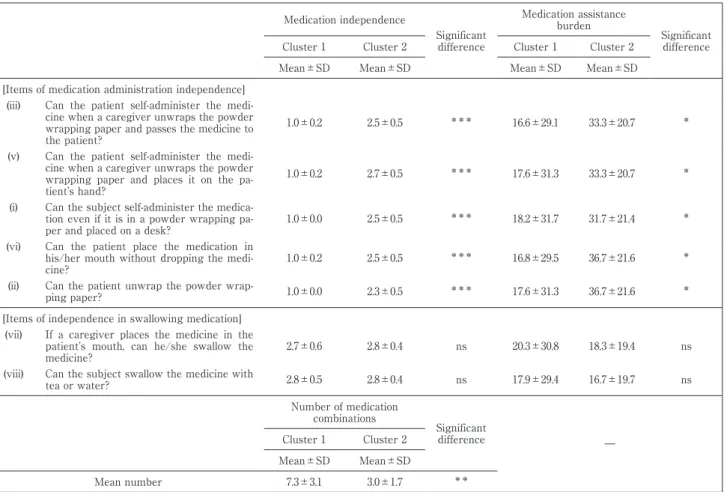
Table 5 presents cluster-specific comparisons of medication independence and the medication caregiver s burden and cluster-specific comparisons of medication combinations.
Discussion
This study aimed to clarify the characteristics of medication independence in the medication-assisted process for patients with AD residing in hospitals and facilities. We also clarified the relationship between medication independence and the medication caregiver s burden.
We identified two key characteristics in the medication-assisted process for patients with AD: medication administration independence and independence in swallowing medication. Therefore, the medication-assisted process must focus on the two points of medication administration and swallowing.
The clustering results showed that patients in cluster 1 tended to require total assistance with medication administration.
AD is primarily characterized by core feature of dementia and the behavioral and psychological symp-toms of dementia. These characteristics adversely affect virtually every individual component of the act of medication administration.
We incorrectly predicted that the burden associated with medication assistance would be high due to the tendency of patients in cluster 1 to require total assistance. Surprisingly, the burden reported by cluster 1 caregivers was significantly lower than that reported by cluster 2 caregivers.
Medication administration errors are very common and pose multiple threats to patient safety; they also remain a global problem5)11)
. Additionally, medication errors are one of the most common causes of adverse events among hospitalized patients12)
Table 4 Patients characteristics by cluster Cluster 1
Hospital and facilities (%) General hospital 3/7 (42.9)
Psychiatric hospital 26/28 (92.9)
Long-term care health facilities 9/9 (100.0)
Sex (%) Males 10/11 (90.9)
Females 28/33 (84.8)
Mean age 88.2±7.0 Number of medication combinations 7.3±3.1
Ia IIab IIbc IIIad IIIbe IVf Mg Total (%)
Jh 0 0 0 0 0 0 0 0 (0.0)
Ai 0 1 2 9 1 0 0 13 (34.2)
Bj 0 2 1 9 1 4 0 17 (44.7)
Ck 0 0 0 4 0 3 1 8 (21.1)
Total (%) 0 (0.0) 3 (7.9) 3 (7.9) 22 (57.9) 2 (5.3) 7 (18.4) 1 (2.6) 38 (100.0)
Dosage forms (%) Tablet 37/38 (97.4) Oral jelly 4/38 (10.5)
Disintegrating 15/38 (39.5) Powder medicine 2/38 (5.3)
Granule 9/38 (23.7) Liquid 1/38 (2.6)
Capsule 10/38 (26.3)
Cluster 2
Hospital and facilities (%) General hospital 4/7 (57.1)
Psychiatric hospital 2/28 (7.1)
Long-term care health facilities 0/9 (0.0)
Sex (%) Males 1/11 (9.1)
Females 5/33 (15.2)
Mean age 86.8±10.2 Number of medication combinations 3.0±1.7
Ia IIab IIbc IIIad IIIbe IVf Mg Total (%)
Jh 0 0 0 0 0 0 0 0 (0.0)
Ai 1 0 0 0 0 0 0 1 (16.7)
Bj 0 0 1 0 0 0 0 1 (16.7)
Ck 0 0 1 3 0 0 0 4 (66.7)
Total (%) 1 (16.7) 0 (0.0) 2 (33.3) 3 (50.0) 0 (0.0) 0 (0.0) 0 (0.0) 6 (100.0)
Dosage forms (%) Tablet 6/6 (100.0) Oral jelly 0/6 (0.0)
Disintegrating 1/6 (16.7) Powder medicine 0/6 (0.0)
Granule 1/6 (16.7) Liquid 0/6 (0.0)
Capsule 0/6 (0.0)
Because ratios have been reported, total ratios may not be 100%. See Table 1 for a description of each rank.
workload, and working in haste may increase the risk for omissions and other types of error and harm to the patients13)
. Therefore, nurses play important roles in preventing such errors11)
.
Given these findings, it is reasonable to postulate that the total assistance offered to patients with AD was focused primarily on reducing risk. Therefore, we believed that a medication caregiver s perceived burden rat-ings would be low.
Next, cluster 1 received significantly more medication combinations than cluster 2. Ishibashi reported that patients hospitalized in psychiatric facilities were at an increased risk of aspiration due to their frequent ad-ministration of psychotropic medications and age-related declines in feeding and swallowing functions14)
. Given this understanding, we predicted that cluster 1 would demonstrate a higher burden associated with medica-tion assistance because cluster 1 had significantly more challenges related to swallowing. However, we found no significant between-cluster differences.
In cluster 1, 37 patients (97.4%) consumed tablets and 15 patients (39.5%) required orally disintegrating tablets. The advantages of orally disintegrating tablets include ease of swallowing, safety, and rapid dissolution or disintegration in mouth without usage of water15)16)
. Moreover, the tablets were often crushed based on the physicians orders so that patients with AD could swallow them more easily. Therefore, it appeared that the caregivers of patients in cluster 1 modified the dosage forms to facilitate swallowing for patients with AD who
Table 5 Comparison of the degree of medication independence, medication assistance burden and number of medication
combina-tions in each cluster
Medication independence Significant difference Medication assistance burden Significant difference
Cluster 1 Cluster 2 Cluster 1 Cluster 2
Mean±SD Mean±SD Mean±SD Mean±SD
[Items of medication administration independence] (iii) Can the patient self-administer the
medi-cine when a caregiver unwraps the powder wrapping paper and passes the medicine to the patient?
1.0±0.2 2.5±0.5 *** 16.6±29.1 33.3±20.7 *
(v) Can the patient self-administer the medi-cine when a caregiver unwraps the powder wrapping paper and places it on the pa-tient s hand?
1.0±0.2 2.7±0.5 *** 17.6±31.3 33.3±20.7 *
(i) Can the subject self-administer the
medica-tion even if it is in a powder wrapping pa-per and placed on a desk?
1.0±0.0 2.5±0.5 *** 18.2±31.7 31.7±21.4 *
(vi) Can the patient place the medication in his/her mouth without dropping the
medi-cine? 1.0±0.2 2.5±0.5
*** 16.8±29.5 36.7±21.6 *
(ii) Can the patient unwrap the powder
wrap-ping paper? 1.0±0.0 2.3±0.5 *** 17.6±31.3 36.7±21.6 *
[Items of independence in swallowing medication] (vii) If a caregiver places the medicine in the
patient s mouth, can he/she swallow the medicine?
2.7±0.6 2.8±0.4 ns 20.3±30.8 18.3±19.4 ns
(viii) Can the subject swallow the medicine with
tea or water? 2.8±0.5 2.8±0.4 ns 17.9±29.4 16.7±19.7 ns Number of medication combinations Significant difference ― Cluster 1 Cluster 2 Mean±SD Mean±SD Mean number 7.3±3.1 3.0±1.7 **
ns: no significant difference, *p<0.05, **p<0.01, ***p<0.001 (Mann-Whitney U test)
required multiple or combined medications.
Based on the above findings, and given the requirements for assistance coupled with the large number of medication combinations these patients require, it is reasonable to assume that caregivers may prioritize risk mitigation over the patient s own remaining ability during the medication-assisted process for patients with AD.
However, administration of medication in an overprotected state may accelerate the decline of function in these patients. Therefore, caregivers should seek to establish a balance between risk management and the pa-tient s remaining abilities.
Conclusions
The findings of this study suggest that given the requirements for assistance, for example, medication ad-ministration errors problems and modified the dosage forms coupled with the large number of medication combinations required by patients with AD, caregivers may prioritize risk mitigation during the medication-assisted process. Therefore, caregivers should focus on medication administration and swallowing in the medication-assisted process and should seek to establish a balance between risk management and the patients remaining abilities. The results of this study should help provide caregivers with the opportunity to establish a better medication-assisted system for patients with AD.
Research Limitations
This study focused on the relationship between medication independence and medication caregiver s bur-den during medication-assisted process for patients with AD. Therefore, we did not collect information such as cognitive function (including dementia severity) and hand and eye function in patients with AD, which could
be a factor responsible for the results of the two groups. In addition, we did not collect information on the years of experience and education of the nurses or associate nurses. Therefore, it was not possible to verify the rela-tionship between such information and the medication independence or medication caregiver s burden. These details should be verified in the future and take further measures.
References
1) World Alzheimer Report 2018. Alzheimer s Disease International. https://www.alz.co.uk/research/world-report-2018 (ac-cessed 2020-4-24).
2) World Alzheimer Report 2016. Alzheimer s Disease International. https://www.alz.co.uk/research/world-report-2016 (ac-cessed 2020-4-24).
3) Gillespie R, Mullan J, Harrison L: Managing medications: the role of informal caregivers of older adults and people living with dementia. A review of the literature. The Journal of Clinical Nursing 23 (23-24): 3296―3308, 2014.
4) Polenick CA, Stanz SD, Leggett AN, et al: Stressors and resources related to medication management: associations with spousal caregivers role overload. Gerontologist 60 (1): 165―173, 2020.
5) Härkänen M, Blignaut A, Vehviläinen-Julkunen K: Focus group discussions of registered nurses perceptions of challenges in the medication administration process. Nursing & Health Sciences 20 (4): 431―437, 2018.
6) Thomson MS, Gruneir A, Lee M, et al: Nursing time devoted to medication administration in long-term care: clinical, safety, and resource implications. Journal of the American Geriatrics Society 57 (2): 266―272, 2009.
7) Daisuke K, Takeda T: III Section2 Evaluation Actually, Occupational Therapy of Dementia-Aiming at Social Inclusion 2nd ed. Ogawa N, Takeda T, editors. Tokyo, Ishiyaku Publishers, 2016, pp 124―148.
8) Arai H, Sumitomo K, Sakata Y, et al: Disease state changes and safety of long-term donepezil hydrochloride administration in patients with Alzheimer s disease: interim results from the long-term, large-scale J-GOLD study in Japan. Psychogeriatrics 16 (2): 107―115, 2016.
9) Hughes CM: Medication non-adherence in the elderly: how big is the problem? Drugs & Aging 21 (12): 793―811, 2004. 10) Ishii S, Shizuku Y, Harada M: Method of assisting medication for elderly people in nursing-care insurance facilities and its
de-gree of burden. Journal of Japanese Society of Hospital Pharmacists 39 (1): 37―40, 2003.
11) Härkänen M, Saano S, Vehviläinen-Julkunen K: Using incident reports to inform the prevention of medication administration errors. Journal of Clinical Nurising 26 (21-22): 3486―3499, 2017.
12) Lertxundi U, Corcóstegui B, Pharm MP, et al: Medication reconciliation in psychiatric hospitals: some reflections. Journal of Pharmacy Practice and Research 47 (1): 47―50, 2017.
13) Härkänen M, Vehviläinen-Julkunen K, Murrells T, et al: The contribution of staffing to medication administration errors: a text mining analysis of incident report data. Journal of Nursing Scholarship 52 (1): 113―123, 2020.
14) Ishibashi Y: Measures to improve eating and swallowing functions in psychiatric elderly wards. The Japanese Psychiatric Nursing Society 51 (3): 271―275, 2008.
15) !enel S, Comoglu T: Orally disintegrating tablets, fast-dissolving, buccal and sublingual formulations. Pharmaceutical Devel-opment and Technology 23 (5): 431, 2018.
16) Song Q, Guo X, Sun Y, Yang M: Anti-solvent precipitation method coupled electrospinning process to produce poorly water-soluble drug-loaded orodispersible films. An Official Journal of the American Association of Pharmaceutical Scientists 20 (7): 273, 2019.
Reprint request: Kikuo Eguchi
Department of Occupational Therapy, School of Health Sci-ence, Kyushu University of Health and Welfare, 1714-1, Yoshi-nomachi, Nobeoka, Miyazaki, 882-8508, Japan.
別刷請求先 〒882―8508 宮崎県延岡市吉野町 1714―1 九州保健福祉大学保健科学部作業療法学科 江口喜久雄
アルツハイマー型認知症患者の服薬支援プロセスにおける
服薬自立度と服薬介助者負担との関連性
江口喜久雄1) ,園田 徹1) ,小川 敬之2) 1)九州保健福祉大学保健科学部作業療法学科 2)京都橘大学健康科学部作業療法学科 ―キーワード― アルツハイマー型認知症,服薬支援プロセス,介助者 【目的】本研究では,病院や施設に入院もしくは入所しているアルツハイマー型認知症(以下,AD)患者に対する服 薬支援プロセスにおける服薬自立度ならびに服薬介助者負担との関連性を明らかにすることが目的である.【方法】AD 患者 44 名を調査した.AD 患者の服薬自立度を 3 段階尺度で評価し,各患者の服薬介護者負担を visual analog scale で測定した.因子分析を用いて,AD 患者の服薬支援プロセスにおける服薬自立の特徴を明らかにした.ま た,クラスター分析を用いて,AD 患者を類型化した.さらに,マン=ホイットニーの U 検定を用いて,類型化した各ク ラスター患者の服薬自立度,服薬介護者負担および服薬数を比較した. 【結果】AD 患者の服薬支援プロセスには,服薬投与自立と服薬嚥下自立という 2 つの特徴的なプロセスが認められ た.また,AD 患者を 2 つのグループに類型化することができた.クラスター 1 のグループの患者は,自ら薬を投与す ることは困難であったが,薬の嚥下は可能であった.一方,クラスター 2 のグループの患者は,自ら薬を投与すること ができ,嚥下も可能であった.つまり,クラスター 1 の患者は,薬を投与する際に全面的支援が必要である傾向が認め られた.しかし,服薬投与自立の項目に関しては,クラスター 1 の服薬介護者負担はクラスター 2 よりも有意に低かっ た. さらに,クラスター 1 はクラスター 2 よりも有意に多くの薬を服用していたが,服薬嚥下自立の項目に関しては, 服薬介護者負担においてクラスター間の有意差は認められなかった. 【考察】この研究結果は,服薬誤投与の問題や AD 患者が必要とする多数の服薬数のために剤形変更などの支援の状況 を考慮すると,介護者は服薬時のリスク軽減を優先する可能性があることを示唆していることが考えられる. 【結論】服薬介護者は,服薬投与と嚥下に焦点を当て,リスク管理と患者の残存能力のバランスに注目することが必要 である. [COI 開示]本論文に関して開示すべき COI 状態はない (日職災医誌,69:165─173,2021)