鳥取大学研究成果リポジトリ
Tottori University research result repository
タイトル
Title
Performance Evaluation of Intra-Palm Propagation
Signals as Biometrics
著者
Auther(s)
Nakanishi, Isao; Inada, Takashi; Sodani, Yuta; Li,
Shigang
掲載誌・巻号・ページ
Citation
Proceedings of 2013 International Conference on
Biometrics and Kansei Engineering (ICBAKE2013) : 91
-94
刊行日
Issue Date
2013
資源タイプ
Resource Type
会議資料 / Conference Paper
版区分
Resource Version
著者版 / Author
権利
Rights
© © 2013 IEEE. Personal use of this material is
permitted. Permission from IEEE must be obtained
for all other uses, in any current or future media,
including reprinting/republishing this material
for advertising or promotional purposes, creating
new collective works, for resale or redistribution
to servers or lists, or reuse of any copyrighted
component of this work in other works.
DOI
10.1109/ICBAKE.2013.17
Performance Evaluation of Intra-Palm Propagation Signals as Biometrics
Isao Nakanishi, Takashi Inada, Yuuta Sodani, and Shigang Li Graduate School of Engineering
Tottori University
4-101 Koyama-minami, Tottori, 680-8552 Japan Email:{nakanishi,li}@ele.tottori-u.ac.jp
Abstract—The use of intra-palm propagation signals as
biometrics is proposed. The intra-palm propagation signal is an electromagnetic wave propagated in the palm. In this study, intra-palm propagation signals are measured using dedicated measuring devices and their verification performance based on the Support Vector Machine is evaluated using twenty-one subjects. The equal error rate is approximately 25 %.
Keywords-biometrics; intra-palm propagation signal; SVM
I. INTRODUCTION
Almost all of biometric modalities are studied as an alternative to a conventional authentication method such as the password or the ID card. However, there are applications in which the conventional method is unusable.
One of the applications is user management, in which successive authentication such as continuous authentication [1] or on-demand authentication [2] is required. Users are required to present their biometric data successively; there-fore, the password and the ID card are inapplicable. In such an application, only the biometrics is applicable. However, not all biometric modalities are usable. Only the modalities that make it possible to present biometric data transparently are applicable.
Considering the situation of user management, it is imag-inable that users are controlling a system while griping or touching something of the system such as a handle of a vehicle or a mouse device of a computer. In such a case, palms are an interface between the system and the users. Thus, we have proposed to use intra-palm propagation signals as transparent biometrics [3].
We confirmed that intra-palm propagation signals were measurable by using the proposed measuring system and surely propagated in palms. However, the verification per-formance based on the Euclidian distance was very low. In this study, we introduce the support vector machine (SVM) into the verification stage in order to improve the verification performance. The effectiveness of the SVM had already confirmed in Ref. [4].
In Sect. II, we explain about the measurement of intra-palm propagation signals. Next, we introduce the feature ex-traction and verification method in Sect. III. The verification is performed based on the SVM. In Sect. IV, the verification performance of intra-palm propagation signals is evaluated
Signal
Generator OscilloscopeDigital
+
+
-Electromagnetic Wave
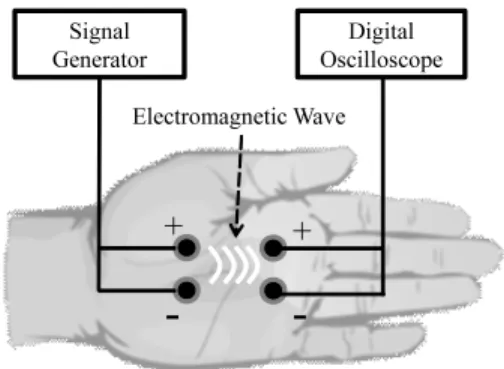
-Figure 1. The measuring system of intra-palm propagation signals.
in the experiments using twenty-one subjects. Finally, the concluding remarks are presented in Sect. V.
II. MEASUREMENT OFINTRA-PALMPROPAGATION
SIGNALS
A. Intra-Palm Propagation Signal
Figure 1 shows a basic structure of the measuring system of intra-palm propagation signals. It is based on the wave-guided type circuit for intra-body communication [5]. An input signal form a signal generator is flowed in a palm through a pair of electrodes. On this occasion, a weak elec-tromagnetic wave is leaked and then propagated to another pair of electrodes. The propagated signal is detected and then recorded by a receiver such as a digital oscilloscope. B. Dedicated Measuring Devices
It is unrealistic and inconvenience to put electrodes on a palm every time measurement (authentication) is performed. Thus, we prepared dedicated measuring devices as shown in Fig. 2.
The left side one is made by making a plaster cast of a palm and the electrode is diverted form the metal part of a gel-padded disposal electrode. The base of the right side one is a mouse device and cupper plates are used as electrodes. The alignment of the electrodes in both devices is 5 cm length and 2 cm width.
(a) Plaster cast type (b) Mouse device type
Figure 2. Dedicated measuring devices for intra-palm propagation signals.
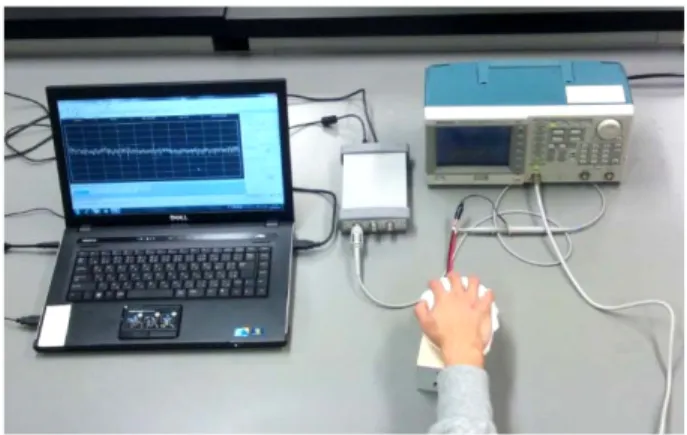
Figure 3. A measurement scene using the dedicated measuring device.
C. Measurement
By using the dedicated measuring devices, we measured intra-palm propagation signals from twenty-one subjects. The measurement was done twice on a day and repeated 30 times (days). A measurement scene is shown in Fig. 3. An input signal from the signal generator was a pseudo white
noise of 4 Vp−p and 100 MHz bandwidth.
The subjects sat on a chair and washed out stain on thier palm. After that, they put their palms on a dedicated measuring device and kept themself at rest. In the meantime, intra-body propagation signals were measured by the digital oscilloscope of which sampling frequency was 200 MHz and then saved in a computer.
III. VERIFICATIONUSINGINTRA-PALMPROPAGATION
SIGNALS
A. Feature Extraction
In this study, the amplitude spectrum of an intra-palm propagation signal is used as individual feature. However,
User: A User: B User: C User: D User: Z
A Genuine User the Other Users
A Learning Model (a) 1vsALL SVM User: A User: B User: A User: C User: A User: D User: A User: Z
A Genuine User the Other User A Learning Model A Learning Model A Learning Model
A Learning Model
(b) 1vs1 SVM
Figure 4. Comparing of the balance of learning data between 1vsALL SVM and 1vs1 SVM.
in order to suppress intra-individual variation, the spectrum is averaged and normalized. The averaging is achieved as follows: measured intra-palm propagation data are equally divided into several parts, an amplitude spectrum is obtained from each part, and an averaged spectrum is obtained by ensemble-averaging all amplitude spectra. The normalizing is achieved by equalizing the means of all amplitude spectra. B. Verification Based on SVM
In Ref. [3], the verification performance of intra-palm propagation signals was evaluated based on the Euclidean distance between the spectral values at each frequency bin but it was not so high to confirm that the intra-palm propagation signal has the ability to be a new biometric modality.
In this paper, the Support Vector Machine (SVM) [6] is introduced into the verification. The SVM is a strong classifier based on learning, of which advantage over other classifiers such as neural-networks is that the SVM has no local minimum problem. However, the SVM is basically two-class classifier; therefore, if the SVM is simply applied in multi-class classification (one versus all SVM: 1vsALL SVM), the unbalance of learning data is caused as (a) in Fig. 4, where the solid-line box indicates the learning data for each user and the dashed-line box presents a learning model. The unbalance of learning data brings the degradation of verification performance. Therefore, some ingenious scheme is required when the SVM is applied in verification.
As one of the schemes, we introduce the one versus one (1vs1) SVM [7], which constructs a learning model comparing a genuine user with the other (another) user. The 1vs1 SVM resolves the unbalance problem shown as (b) in Fig. 4. On the other hand, the 1vs1 SVM needs many learning models and a final decision rule for considering the
A
Measurement
All Users
B C
Z
Averaging & Normalizing
Feature Extraction
Learning by 1vs1 SVM
AvsB AvsC AvsZ
BvsC BvsZ YvsZ AvsD BvsD Learning Models
Learning
Measurement
An Applicant as “B”
?
Averaging & Normalizing
Feature Extraction
Verification
Evaluation by Models
Specify the Models for “B”
BvsA BvsC BvsD BvsZ
Decision by Majority Rule
+/- +/- +/-
+/-Figure 5. Verification procedure based on 1vs1 SVM.
results from the models corresponding to a genuine user. In this study, we use the majority rule.
Figure 5 shows the proposed verification procedure based on 1vs1 SVM for the intra-palm propagation signal. For all users of a system, models are constructed in the learning stage. Each model is learned by teaching to output “+1“ for the intra-palm propagation spectra of a genuine user and “-1“ for those of another user.
In the verification stage, firstly, an applicant of the system presents genuine user‘s name and then his/her intra-palm propagation signal is measured once. After smoothing, nor-malizing, and feature extracting, the intra-palm propagation spectrum is evaluated in all models corresponding to the genuine user. Then if the number of the models that output positive value is larger than a threshold, that is, based on the majority rule, the spectrum is regarded as of the genuine user and the applicant is permitted to use the system.
IV. VERIFICATIONEXPERIMENTS
A. Conditions
In order to evaluate the verification performance of the intra-palm propagation signal based on the 1vs1 SVM, we carried out the verification experiment using the intra-palm propagation signals measured in Sect. II.
SVMlight [8] was used as SVM tool kit. Forty data
(spectra) from each subject were used for the learning of models and the rest twenty data from each subject were used for verification.
The spectral amplitudes at one hundred frequency bins (dimensions) were obtained by the FFT and then they were equally divided into ten parts. In this experiment, ten amplitude spectral values in the optimal part for each
user (subject) were used as individual feature. Not only the optimal part of the frequency band but also the op-timal parameters for the SVM were found by using the grid searching, that is, round-robin formula. The parameter ranges are summarized in Table I.
Table I
PARAMETER RANGES IN THE GRID SEARCHING.
Cost Parameter 0.001, 0.002,· · · , 0.009, 0.010, 0.015,· · · , 0.095, 0.10, 0.15,· · · , 0.95, 1.0, 2.0,· · · , 9.0, 10.0 Kernel Function Polynomial: d 1, 2, 3 RBF: δ 0.001, 0.002,· · · , 0.009, 0.010, 0.015,· · · , 0.095, 0.10, 0.15,· · · , 0.95, 1.0, 2.0,· · · , 9.0, 10.0 B. Results
Figure 6 shows error rate curves: False Rejection Rate (FRR) and False Acceptance Rate (FAR). The horizontal axis corresponds to a threshold value in the majority rule. From these results, it is confirmed that the Equal Error Rate (EER) was approximately 25 % without relation to the shape and the material of devices.
Even using the SVM as a powerful verification method, the verification rate was not so high yet. Therefore, it is necessary to reexamine the measuring method of intra-palm propagation signals and the feature extraction method from them. For instance, a white noise was used as an input signal in order to obtain all spectral values efficiently. However, the variation of the spectral values of the white noise is larger and then it might increase intra-individual variation in the intra-palm propagation spectrum and degraded the verification performance. In addition, using the white noise made impossible to use the phase information of propagated signals.
We are now examining the use of a specified signal that consists of several sinusoidal waves with different phases. This scheme suppresses the intra-individual variation and increases the dimension of an individual feature. Therefore, the verification performance may be improved.
V. CONCLUSIONS
We have proposed the use of intra-palm propagation signals as biometrics. However, the verification performance of the conventional method was low. Thus, we introduced the SVM into the verification stage and evaluated the veri-fication performance. As a result, we obtained the EER of approximately 25 % among twenty-one subjects.
There are some problems to be studied further. Reexami-nation of methods for measuring of intra-palm propagation signals and feature extracting from them is necessary in order to achieve higher verification rate. In addition, the
(a) Plaster cast type
(b) Mouse device type
Figure 6. Error rate curves.
number of subjects must be increased for improving the reli-ability of the results obtained in the experiments. Moreover, it is confirmed that the variation of the electrode position on a palm influences on verification performance. Therefore,
a new structure of the measuring device is required for stabilizing the electrode position.
ACKNOWLEDGMENT
A part of this work was supported by JSPS KAKENHI Grant Number 22560377.
REFERENCES
[1] A. Altinok and M. Turk, “Temporal Integration for Continuous Multimodal Biometrics”, Proc. of 2003 Workshop on Multi-modal User Authentication, pp. 207-214, Dec. 2003. [2] I. Nakanishi, S. Baba, and C. Miyamoto, “On-Demand
Biomet-ric Authentication of Computer Users Using Brain Waves”, in Zavoral F. et al. (Eds.), NDT2010, Part I, CCIS 87, Springer, pp. 504-514, Jul. 2010.
[3] T. Inada, I. Nakanishi, Y. Sodani, and Shigang Li, “Biometric Authentication Using Intra-Palm Propagation Signals”, Proc. of International Technical Conference on Circuits/Systems, Computers and Communications (ITC-CSCC2012), Jul. 2012. [4] I. Nakanishi and Y. Sodani, “SVM-Based Biometric Authenti-cation Using Intra-Body Propagation Signals”, Proc. of 2010 7th IEEE International Conference on Advanced Video and Signal Based Surveillance (AVSS2010), pp. 561-566, Sep. 2010.
[5] K. Hachisuka, A. Nakata, T. Takeda, K. Siba, K. Sasaki, H. Hosaka and K. Itao, “Development of Devices for Commu-nication through Human Bodies (in Japanese)”, Micromecha-tronics, Bulletin of the Horological Institute of Japan, vol. 46, no. 2, pp. 53–64.
[6] N. Cristianini and J. Shawe-Taylor, An Introduction to Support Vector Machines and other kernel-based learning methods, Cambridge University Press, 2000.
[7] C. Hsu and C. Lin, “A Comparison of Methods for Multiclass Support Vector Machines”, IEEE Trans. Neural Networks, vol. 13, no.2, pp. 415-425, Mar. 2002.
[8] T. Joachims, “SVMlight Support Vector Machine”,