• 検索結果がありません。

A study of dynamical processes in the middle atmosphere associated with a sudden stratospheric warming using a high-resolution and high-top general circulation model

N/A
N/A
Protected

Academic year: 2021

シェア "A study of dynamical processes in the middle atmosphere associated with a sudden stratospheric warming using a high-resolution and high-top general circulation model"

Copied!
2
0
0

読み込み中.... (全文を見る)

全文

(1)

A study of dynamical processes in the middle atmosphere associated with a sudden stratospheric warming using a high-resolution and high-top general circulation model

Haruka Okui

1

, Kaoru Sato

1

, Dai Koshin and Shingo Watanabe

2

1

Department of Earth and Planetary Science, The University of Tokyo, Tokyo, Japan

2

Japan Agency for Marine-Earth Science and Technology, Yokohama, Japan

Dynamical events called stratospheric sudden warmings (SSWs) greatly alter the thermal and dynamical conditions in the whole middle atmosphere. In past several SSW events, it has been reported that the stratopause once disappears after warmings and reforms at an elevated height [e.g., Siskind et al., 2007; Manney et al., 2008, 2009], which is called the “elevated stratopause” (ES). Tomikawa et al. [2012] showed that the ES forms and descends to the climatological height of the stratosphere due to the westward gravity wave (GW) forcing (GWF), while some studies indicated that planetary wave (PW) forcing (PWF) plays a key role in the initial formation of the ES [e.g., Limpasuvan et al., 2012, 2016]. Despite these intensive researches, the relative contributions of GWs and PWs to the ES formation remain to be elucidated. Yamashita et al. [2013]

suggested the importance of the lateral propagation of GWs [Sato et al., 2009, 2012] in the ES formation. To elucidate the mechanisms of the dynamical processes associated with SSWs such as the ES, we conduct a quantitative study using the outputs of the simulation of the 2018/2019 SSW event carried out by a GW-permitting general circulation model that covers from the troposphere to the mesosphere and lower thermosphere (MLT). A quantitative and three-dimensional analysis is conducted from the point of view of the interplay of GWs and PWs in the middle atmosphere [Sato and Nomoto, 2015].

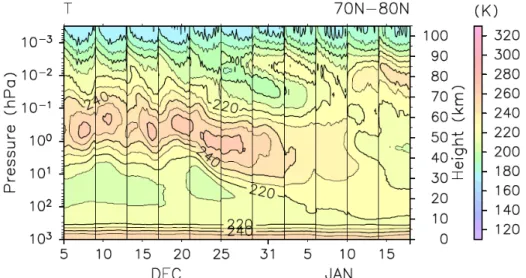
In the 2018/2019 event, the ES forms around 10 January, 2019 after the major warming on 1 January (Fig. 1). In addition, it is observed that a significant temperature maximum appears in the polar upper mesosphere around 28 December prior to the disappearance of the stratopause, which is referred to as the “double stratopauses” (DS). Then we focused on the formation of the DS and ES and analyzed the role of wave forcing in these phenomena.

First, before the DS formation, maxima of static stability N

2

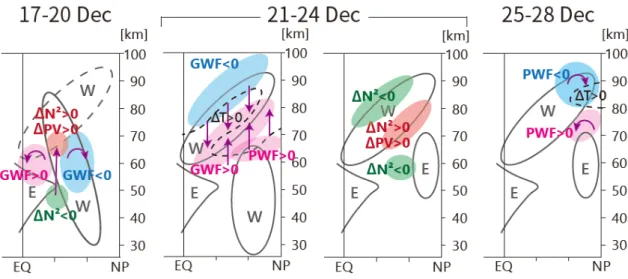
and potential vorticity (PV) are formed in the regions between positive and negative GWF. Then PWF>0 is observed on the polar side of this PV peak. It is suggested that this PWF acts to eliminate the anomalous PV gradient. Subsequently, PWF<0 appears in the polar MLT and the DS is formed at z~85 km.

Therefore, plausible processes of the DS formation are that 1) the residual mean vertical wind driven by GWF induces the formation of the PV maxima due to increase of N

2

, 2) the barotropic (BT)/baroclinic (BC) instability occurs on the polar side of the PV maxima, 3) and then PWs are generated and exert forcing in the polar upper mesosphere which induces downwelling and the associated temperature maximum (Fig. 2).

Second, on 10 January when the ES formed, both GWF and PWF are strongly negative at z>80 km in the winter polar region.

Therefore, it is indicated that these wave forcings are responsible for the ES formation. The eastward jet is reformed in the polar mesosphere on that day. This fact suggest that the eastward jet enables the GW and PW propagation into the polar upper mesosphere. The eastward jet recovery occurs mainly due to the radiative cooling in the polar night region. It is considered that the latitudinal gradient of the temperature and thus the height of the recovered jet and the ES are significantly affected by the temperature structure associated with the DS.

Figure 1 Time-height sections of zonal and 70°N – 80°N regional mean temperature. The

vertical lines represent the boundaries of the model runs.

(2)

Figure 2 A schematic illustration of the formation mechanism of the DS in the meridional sections. “W” and “E” denotes westery and eastery winds. Δ means the anomaly of each value. The purple vectors indicate the direction of residual mean circulation.

References

Limpasuvan, V., Orsolini, Y. J., Chandran, A., Garcia, R. R., and Smith, A. K. (2016). On the composite response of the MLT to major sudden stratospheric warming events with elevated stratopause. J. Geophys. Res. Atmos., 121,4518–4537,

doi:10.1002/ 2015JD024401.

Limpasuvan, V., Richter, J. H., Orsolini, Y. J., Stordal, F., and Kvissel, O. K. (2012). The roles of planetary and gravity waves during a major stratospheric sudden warming as characterized in WACCM. J. Atmos. Sol.-Terr. Phys., 78–79, 84–98.

https://doi.org/10.1016/j.jastp.2011.03.004.

Manney, G. L., Krüger, K., Pawson, S., Minschwaner, K., Schwartz, M. J., Daffer, W. H., et al. (2008). The evolution of the stratopause during the 2006 major warming: Satellite data and assimilated meteorological analyses. J. Geophys. Res., 113, D11115. https://doi.org/10.1029/2007jd009097.

Manney, G. L., Schwartz, M. J., Krüger, K., Santee, M. L., Pawson, S., Lee, J. N., Daffer, W. H., Fuller, R. A., and Livesey, N.

J. (2009). Aura Microwave Limb Sounder observations of dynamics and transport during the record-breaking 2009 Arctic stratospheric major warming. Geophys. Res. Lett., 36, L12815. https://doi.org/10.1029/2009GL038586.

Sato, K., and Nomoto, M. (2015). Gravity wave-induced anomalous potential vorticity gradient generating planetary waves in the winter mesosphere. J. Atmos. Sci., 72, 3609–3624. https://doi.org/10.1175/JAS-D-15-0046.1.

Sato, K., Tateno, S., Watanabe, S., and Kawatani, Y. (2012). Gravity Wave Characteristics in the Southern Hemisphere Revealed by a High-Resolution Middle-Atmosphere General Circulation Model. J. Atmos. Sci., 69, 1378–1396, https://doi.org/10.1175/JAS-D-11-0101.1.

Sato, K., Watanabe, S., Kawatani, Y., Tomikawa, Y., Miyazaki, K., and Takahashi, M. (2009). On the origins of gravity waves in the mesosphere. Geophys. Res. Lett., 36, L19801, https://doi.org/10.1029/2009GL039908.

Siskind, D. E., Eckermann, S. D., Coy, L., McCormack, J. P., and Randall, C. E. (2007). On recent interannual variability of the Arctic winter mesosphere: Implications for tracer descent. Geophys. Res. Lett., 34, L09806.

https://doi.org/10.1029/2007GL029293.

Tomikawa, Y., Sato, K., Watanabe, S., Kawatani, Y., Miyazaki, K., and Takahashi, M. (2012). Growth of planetary waves and the formation of an elevated stratopause after a major stratospheric sudden warming in a T213L256 GCM. J. Geophys. Res.

Atmos., 117, D16101. https://doi.org/10.1029/2011JD017243.

Yamashita, C., England, S. L., Immel, T. J., and Chang, L. C. (2013). Gravity wave variations during elevated stratopause

events using SABER observations. J. Geophys. Res. Atmos., 118, 5287–5303. https://doi.org/10.1002/jgrd.50474.

Figure 1    Time-height sections of zonal and 70°N – 80°N regional mean temperature. The  vertical lines represent the boundaries of the model runs
Figure 2    A schematic illustration of the formation mechanism of the DS in the meridional  sections

参照

関連したドキュメント

An example of a database state in the lextensive category of finite sets, for the EA sketch of our school data specification is provided by any database which models the

The edges terminating in a correspond to the generators, i.e., the south-west cor- ners of the respective Ferrers diagram, whereas the edges originating in a correspond to the

Eskandani, “Stability of a mixed additive and cubic functional equation in quasi- Banach spaces,” Journal of Mathematical Analysis and Applications, vol.. Eshaghi Gordji, “Stability

In this, the first ever in-depth study of the econometric practice of nonaca- demic economists, I analyse the way economists in business and government currently approach

Let X be a smooth projective variety defined over an algebraically closed field k of positive characteristic.. By our assumption the image of f contains

Here we continue this line of research and study a quasistatic frictionless contact problem for an electro-viscoelastic material, in the framework of the MTCM, when the foundation

We present sufficient conditions for the existence of solutions to Neu- mann and periodic boundary-value problems for some class of quasilinear ordinary differential equations.. We

the existence of a weak solution for the problem for a viscoelastic material with regularized contact stress and constant friction coefficient has been established, using the