§5.
RadonConcentration and Air Exchange Rate in an Experimental Hall
Yamanishi, H., Obayashi, H., Sakuma, Y.
Nakatsuka, H., Tsuji, N., Nakayoshi, H., Achiwa, K. (Japan Airconditioning Service Co. L TO.) Shima, M. (Gifu College of Medical Technology) lida, T., Nagamine, K. (Dept. Nucl. Eng., Nagoya Univ.)
Radon ( 222Rn) is one of radioactive nuclides in the natural environment, which emanates as an inert gas from the ground and concrete walls of building.
The concentration of radon will be high in a heavily shielded laboratory with low ventilation rate, such as in a building for nuclear fusion experiments. It is expected to develop a method for measuring air exchange rate in an
experimental hall by means of radon observation.
For this study, it is important to evaluate radon concentration levels within a given controlled room and to find out factors causing its variations.
The room No. 1231 ofNIFS was used as a model room. Atmospheric radon concentration in the room was measured with an air-flow type ionization chamber. CO gas was used as a tracer for measuring air exchange rate in the room.
These and other items were continuously measured in a closed room.
Variation of indoor radon concentration is described by the following equation :
dQin _ EF ')Q· (Q· Q )
T - V-
1\, m - V m- outwhere Qin' Q
0ut is indoor and outdoor radon concentration respectively, A is decay constant of radon, v is air exchange rate of the room, E is radon exhalation rate from walls, F is surface area of walls, and V is volume of the room. The equation shows radon concentration in the room is mainly governed by air exchange and radon exhalation from walls.
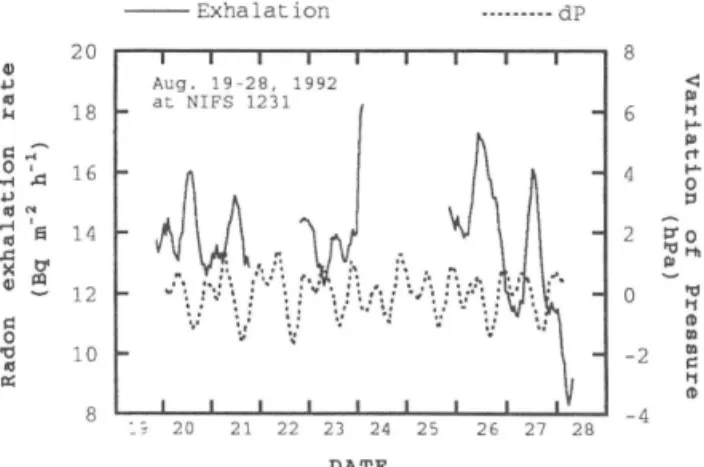
In the present work, radon exhalation rate from walls was estimated from the measured radon concentration and the air exchange rate. Figure 1 shows hourly exhalation rate and variation of atmospheric pressure. A short-term change in exhalation rate may be due to fluctuations of atmospheric pressure.
Radon exhalation rate from walls has also seasonal variation as shown in Figure 2. Taking the general characteristic of exhalation and water content of wall material into account, a long -term variation of radon exhalation rate from walls may be subjected to absolute humidity in the room.
The actual mechanism of the time variation of radon exhalation rate is still under consideration.
4)
~
Ill
~ Q 0 ..-i
~
Ill .-l
..c:: Ill
><
4)
Q '0 0 Ill (t:
- -Exhalation ····-dP
20 8
<
Aug. 19-2 B, 1992
~'"_' J . I»
18 6 11 ...
.... I» rt
:s:: 16 ...
0 t:l
~ Ei 14 2 ::ro
0' '· : ~ :, :·..
. ..
~HIe
12 ,/\ :·.i \ :· ·: ~ :·.; . i ~ ,". : ~~··; : ~ :.:-. ::: . t- 0 ttl\j .
v v v ·.:
~i:/ -: \j \:
11 (1) CD10 -2 CD ~
11 (1)
DATE
Fig. 1. Relationship between radon exhalation rate and variation of atmospheric
pressure.
30 I I I
~ 25 1- r..
-
~
.:
1-
c .... 20
"""
'
-·~
:c
'
.. -•..
_~ ....
~·
e
15- -
..c ;.< ~ r::r
=
c '-" 10
0
- ·-- ..
-"Q
· ·-- --- --1
~
~ 5
- • -
0 I I J
Jan. Jan.
1992 1993 1994
YEAR