journal or
publication title
Senri Ethnological Studies
volume 94
page range 1‑15
year 2016‑12‑10
URL http://hdl.handle.net/10502/00008550
1
Edited by Kazunobu Ikeya and Robert K. Hitchcock
PURPOSE OF THIS VOLUME
The interactions among hunter-gatherers and neighboring agricultural, pastoral, and urban societies have been an important and longstanding theme in cultural anthropology. Numerous studies have addressed hunter-farmer relations specifically (Peterson 1978a, b; Spielmann and Eder 1994; Takeuchi 2014), and have examined exchange and trade relationships, consignment relationships (e.g.
offering labor), and intermarriage relationships. Historical approaches have been commonly and effectively used for reconstructing interactions between foragers and other groups (see, for example, Leacock 1954; Hitchcock 1987; Kehoe 1989;
Krech 1999; Morrison and Junker 2002). Over the past several hundred years of the colonial to post-colonial periods, some hunter-gatherers have become farmers, herders, or migrant laborers whereas others have become specialists of various kinds.
This volume adresses the manner in which hunter-gatherer societies co-exist with their neighbors, and how they remain resilient despite myriad changes in government policies, land use, the market economy, and the environment. Ethno- historical approaches are also emphasized, as shown in Part I of this volume.
Archaeology and ethnoarchaeology have also contributed to our understanding of hunter-gatherers and their neighbors (Ogawa 1996, 2000; Binford 2001; Sellet, Greaves, and Yu 2006; Kelly 2013). Circumstances and conditions in Asia, Africa and South America are compared from a global perspective.
This volume aims to elucidate the relationships between hunter-gatherers and neighboring peoples from global to local anthropological viewpoints, particularly from the 17
thcentury A.D. to the present time. The main regions covered are (1) Asia, including Japan, Laos, Malaysia, Nepal, Thailand, and Russian Siberia, (2) Africa, including Botswana, Cameroon, Gabon, Namibia, and Tanzania, and (3) South America, including Brazil and Colombia. This volume provides data basic to understanding the issues related to the processes undergone by hunter-gatherers in the recent past and present, and how they maintain their relationships with others in different areas.
Introduction
Kazunobu Ikeya
National Museum of Ethnology
Robert K. Hitchcock
Univesity of New Mexico
The papers in this book are drawn from three continents. Asia, which covers 44,579,000 km
2, contains at least 150 peoples who either regard themselves or are viewed by researchers as being hunter-gatherers (Lee and Daly 1999; Hitchcock 2003; Erni 2008; Fortier 2009; Gardner 2014); Africa, which covers 30,220,000 km
2, contains at least 200 peoples who either are or were until relatively recently hunter-gatherers (Lee and DeVore 1976; Lee and Daly 1999; Hitchcock
et al2006; Hewlett 2014); and South America which covers 17,819,000 km
2and contains at least 90 peoples who either are or were until relatively recently hunter- gatherers (Lee and Daly 1999; Hurtado
et al 2005; Varese 2006; Codding andKramer 2016). There is significant diversity in the demography and social structures of these groups, who range from a few hundred in number such as the Mlabri of Laos and Thailand, the Sihan of Malaysia (Kato, Chapter. 9), and the Hadza (1,100) and the Sandawe of Tanzania (40,000) (Yatsuka, Chapter. 4) and the Baka of Cameroon, the Central African Republic, and the Congo Republic (>70,000) (Rupp 2011; Bahuchet 2014; Lewis and Simons 2015). All of these groups have complex interactions with peoples who have different livelihoods and political systems.
As demonstrated in this volume, there is a wide range of interactions between foragers and non-foraging peoples (farmers, herders, agropastoralists and complex urban societies). These interactions include exchange of forest products for agricultural products, as occurs in the Central African rainforest, the Amazon, and southeast Asia, providing products made by foragers, such as wooden bowls, exchanged for cloth, metal tools, and other goods, as done by the Raute of Nepal (Imamura, Khanal, and Kawamoto, Chapter. 5; Fortier 2009: 121 133), laboring for other people in fields or on cattle posts and ranches (e.g. the Hai//om of Namibia, Hitchcock, Chapter. 13), hunting for other people, as done by groups like the Awá-Guajá (Forline, Chapter. 11), Baka, (Oishi, Chapter. 8), and Evenki (Safanova, Chapter. 3). An important role of foraging peoples is noted by Mora (Chapter. 1), who points out that the Guagibo of the Colombian and Venezuelan Llanos offered more than goods to farmers, since they provided information, a critical resource in a socially and politically changing landscape.
Some relationships between foragers and their neighbors were symbiotic, whereas others were competitive, and still others were structured in such a way that they were exploitative. Non-farming peoples attempted to co-opt foragers, incorporating them as laborers, fishers, metal-workers, messengers, or soldiers. In southern Africa, for example, some members of San groups were brought into the military, whereas others were pressed into service as game scouts, forest guards or trackers. In some cases, neighboring groups used the labor of foragers in their fields or homes, where they served as domestic workers. In Asia, Africa and South America some members of foraging peoples became healing specialists using various methods that include herbalism, trance-curing, laying on of hands, and divining, obtaining unseen knowledge through, for example, ‘throwing the bones’
or scapulimancy (Wallace 1966; Morley and Wallis 1978). It was not uncommon
for foragers to use their extensive ethnobotanical knowledge to gather medicinal plants that they traded to neighboring groups for goods and cash.
HISTORY OF HUNTER-GATHERERS AND NEIGHBOR RELATIONS
Foraging represents the longest-lasting and most resilient form of human and hominid adaptation, having survived for millions of years (Scarre 2013). Only in the past 10,000 or so years have some modern humans (Homo sapiens sapiens) shifted from mobile foraging to agriculture, herding and diversified production and economic systems. Agriculture and livestock production diffused widely. Foragers established social and economic links with their neighbors and sometimes fought with them. Some foragers withdrew deeper into the forests, savannas, deserts, or mountains and attempted as much as possible to avoid contact. Most hunter- gatherers, however, had complex relationships with their neighbors. This is exemplified by the Raute of the Himalayas, who hunted monkeys, among other animals, but who also took part in royal hunts, some on elephant-back, with Nepali villagers. Like hunter-gatherers in many places, the Raute provided to villagers fish that they caught themselves. They also worked occasionally in the fields of villagers, where they harvested crops and guarded ripening crops from wild and domestic animals and people (Fortier 2009). Complex interactions with their neighbors can also be seen among the Sihan of Borneo, Malaysia who engage in patron-client relations and who also work for Chinese traders (see Kato, Chapter. 9).
It is interesting to examine whether foragers wished to retain their identity as hunter-gatherers, gaining a portion of their subsistence from the bush, but also whether the people seen today as foragers were villagers and farmers who reverted to hunting and gathering as a result of drought, famine, warfare, or some other kind of cataclysmic event. This question was raised, for example, in the case of the Mlabri (Oota
et al. 2005; Fortier 2009: 41 42) and examined in this volumeby Nan and Nakai and Ikeya. Is foraging a more recent adaptive strategy for the Mlabri, or is it of long standing? Similar questions can be asked regarding South American groups such as the Siriono of Bolivia or the Kaingang of Brazil, who appeared to resent that they were foragers and who had likely once been farmers.
In some cases there were oscillations over time between foraging and farming, whereas in others foragers essentially became ‘professionals’ (Fox 1969).
What relationships have hunter-gatherers maintained with other groups in various areas? It is sometimes assumed that there were two developmental processes. In one hunter-gatherers became agriculturalists and the former disappeared, and in the other hunter-gatherers coexisted with agricultural peoples (Hutterer 1977; Headland and Reid 1989; Junker 1996; Hewlett 2014). Some food-producing peoples gave up farming and herding, and became hunter-gatherers (Holmberg 1950; Lathrap 1968; Greaves and Kramer 2014).
Fig. 1 shows the distribution of hunter-gatherers’ and agricultural peoples
Figure 1 The interaction between hunters and farmers in the world after the diff usion of farming Source: Bellwood 2005: p.7
living in western Asia about 10,000 years ago. In that age, agricultural peoples lived in the “Fertile Crescent”, including modern-day Iran, Iraq, Israel, Jordan, Syria, and Turkey. Hunter-gatherers resided around them. However, the relationships prevailing between them are not fully understood, although archaeological evidence suggests complex interactions. The relationship between the hunter-gatherer Jomon and the agricultural, Yayoi people in prehistoric Japan remains an important research theme (Akazawa 1982; Ikeya
et al. 2009). About2,000 years ago, what were the impacts on the Jomon of the expansion of Yayoi into their areas (Fig. 2)? Did such effects create a situation that enabled co-existence? According to recent studies, the start of the Yayoi Era dates back 500 years earlier than once believed (Charles Keally personal communication), suggesting that the age when the Jomon and Yayoi peoples maintained an interdependent relationship was longer than conventionally accepted. Nevertheless, few data indicate the nature of the shared relationships.
Thereafter, hunter-gatherers had contact with pastoralists, fishing peoples,
merchants, and craft workers, as well as with farmers in different parts of the
world. They obtained agricultural and livestock products, ceramics, metal tools,
cloth, and other accessories by trading with neighbors the meat and skins of
animals they hunted and forest products they gathered. They also provided labor,
working for agriculturalists and pastoral groups as herders, field hands and
household servants. Further, hunter-gatherers sometimes created new social
relationships with others through conjugality and exchange. Alternatively, some
hunter-gatherer groups are known to have lost their own languages and to have
H/G H/G H/G
H/G
H.G
H/G
Figure 2 Hunter-gatherer and land use in the world about 1500: premodern nation-building and hunter-gatherers
adopted those of their neighboring agricultural or pastoral people. This occurred, for example with the Batwa of Central Africa.
In the 15
th17
thcenturies, hunter-gatherers often were assimilated into pre-modern nations or colonies. Some groups migrated to remote regions, beyond the control of others, or had different relationships with people such as kings, colonial officers, ivory and fur traders, domain lords, and entrepreneurs engaged in logging and petroleum or mineral extraction. As colonial systems expanded, some hunter-gatherers resisted what they saw as an onslaught of hunters, traders and settlers. Some became involved in nativistic and revitalization movements (e.g., the Ghost Dance of the Great Plains and Great Basin of North America, or cargo cults in what is now Papua New Guinea) (Linton and Hallowel 1943; Kehoe 1989). As such social movements strengthened, some hunter-gatherers came to identify themselves as ‘natives’ or First Nations, and claimed land rights by negotiating with nation-states or the judiciary. This is the case, for example, with the G/ui, G//ana and Bakgalagadi of the Central Kalahari region in Botswana.
As explained above, the relationships of hunter-gatherers with others can be summarized as being a history in which some maintained their relationships with different neighboring peoples, others competed with them for resources, and yet others resisted any involvement, preferring to remain separated and interacting relatively little, if at all, with either neighboring peoples or nation-states.
DEVELOPMENT OF PREVIOUS STUDIES
Conventional anthropology, particularly that addressing the relationship
between hunter-gatherers and agricultural peoples, has included discussions in ethnological studies that focus mainly on peoples in tropical and sub-tropical regions (Kent 2002). This was discussed particularly addressing the Agta, in northeastern Luzon, of the Philippines (Headland 1986) and the San of the Kalahari (Lee and DeVore 1976; Wilmsen 1989). There followed studies about hunter-gatherers in various parts of Africa, as in the cases of the Congo Basin (Hewlett 2014), the Kalahari and adjacent areas of southern Africa (Hitchcock
et al 2006; Biesele and Hitchcock 2010), and East Africa, including the Sandawe(Yatsuka, Chapter. 4) and the Hadza (Marlowe 2010).
It is useful to examine the Batwa of Central Africa, including the Baka of Cameroon, the Central African Republic and the Republic of Congo (Oishi, Chapter. 8) and the Babongo of southern Gabon (Matsuura, Chapter. 10). Batwa peoples are found in nearly a dozen Central African countries (Bahuchet 2014). In all of them the Batwa comprise a small minority, generally averaging less than 1 percent of the total population (e.g., 0.3 percent in the Central African Republic, 1.1 percent in the Democratic Republic of Congo, and slightly less than 1 percent in Equatorial Guinea and Gabon Matsuura 2006, Chapter. 10). Although hunter- gatherers dominated the globe 20,000 years ago, today they represent but a small percentage of the world’s people. In Botswana, for example, the various San groups together comprised less than 3.3 per cent of the population in 2015, and in Zimbabwe the Tshwa San make up less than one percent. In most African countries in which hunter-gatherers occur, they are at the bottom of the multi- tiered socioeconomic and political system.
Although African and Asian comparative studies have accumulated embracing the long period from pre-historic times to the present (Ikeya
et al 2009), noneconsiders Asia, Africa and South America. In the following section, previous studies regarding the relationships between hunter-gatherers and neighboring peoples are summarized, based on historical and contemporary approaches.
1) Historical approach
Studies of the relationships of hunter-gatherers with their neighboring peoples in a particular past age have been done mainly in the fields of archeology, ethnohistory, ethnoarchaeology, and historical anthropology. However, the durations of the periods examined differ. Three periods are described: 1,000 2,000 years from the prehistoric age to the present (Headland and Reid, 1989; Ikeya
et al 2009); some hundreds of years from the prehistoric age to that of pre-modernnations (Tezuka, 2009); and, in Africa, interactions in the southernmost part of the continent especially over the past 2,000 years (Mitchell and Whitelaw 2005).
In addition, the theme of this approach has been the reality and formation or
change in relationships between hunter-gatherers and their neighbors. For example,
Japanese scholars have conducted numerous historical studies among the Ainu
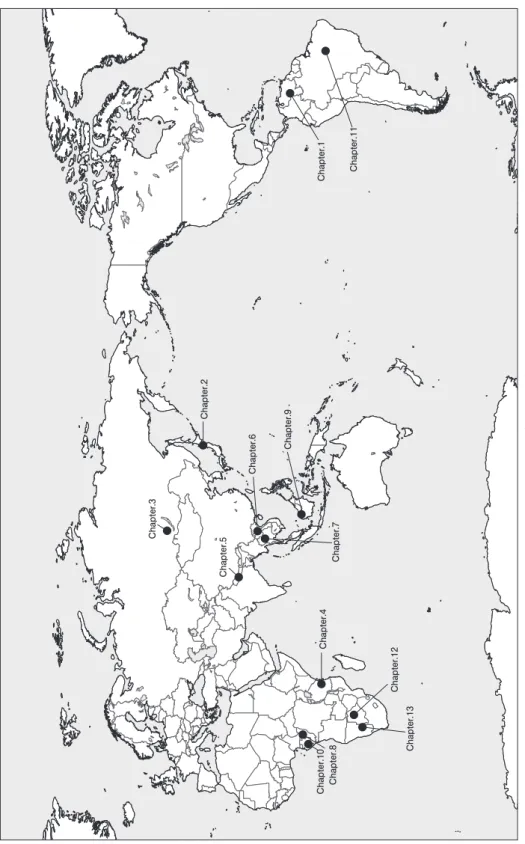
during the Edo Period (Fig. 3). They examine the relationships between the
characteristics of Ainu society under a clan system during the Edo Period (1603
Figure 3The study area in this volume
Chapter.3 Chapter.5
Chapter.2 Chapter.6 Chapter.9 Chapter.1 Chapter.11
Chapter.7Chapter.4 Chapter.8Chapter.10 Chapter.12 Chapter.13
1868), and the nature of relationships between the Ainu and tradesmen under the Matsumae Clan.
2) Contemporary approach
The relationship between contemporary hunter-gatherers and neighboring peoples has been understood in a wider political and economic framework.
Contemporary hunter-gatherers have been influenced by national policies on settlement, migration and social and economic development. In addition, it is known that some groups have engaged in revitalization and secessionist movements (e.g. in Malaysia during the 1950s). In particular, this approach addresses mutual relationships in such contexts.
Three kinds of ethnographical relationship model can be identified throughout the world: (1) economic, including exchange and trade, and consignment relationships (e.g. offering labor); (2) sociopolitical, such as intermarriage, hierarchical; and (3) socio-cultural.
Economic relationships
In some cases, exchanges are tied into complex and long-distance international trading systems. This can be exemplified by forest products (e.g., meat, honey, resins, and fragrant woods) from forested regions of Southeast Asia, which occupied a pivotal position as trade goods both within and outside the region, notably with China. Other examples are the commercial ivory, skin and fur trading in savannas, deserts and Sub-arctic environments (Wilmsen 1989; Rupp 2011; Leacock 1954). It is important to ascertain whether hunter-gatherers could exist in tropical rainforests without access to yams, manioc, cassava, and other carbohydrates (Headland 1987), since this is a subject of a major debate among anthropologists (Bahuchet, McKey and De Garine 1991; Bailey et al 1989).
Consignment relationships between hunters-gatherers and agriculturalists which still occur, such as supplying consignments of forest products, seem to have a long history. Moreover, they have influenced greatly the societies’ mutual economic and political relationships. The consignment relationships of farming, herding and fishing labor have been found worldwide. Although it is imperative to examine each regional context and situation, it might be that such a relationship falls within the rubric “patron-client.”
Sociopolitical relationships
Intermarriage might occur in an intensified stage of exchange between hunter-
gatherers and farmer societies, especially where the likelihood is diminishing that
hunter-gatherers can maintain an independent way of life, and thus where
assimilation becomes an increasingly attractive option. However, it cannot be
inferred that it occurs only under such circumstances, and although the flow of
genes is often
from hunter-gatherers to farmers, it is also known or suspected thatfarmers in marginal areas who abandon food-production assimilate into forager
societies, sometimes through marriage. The ‘River Bushmen’ of Botswana and the Nama of Namibia are two possible examples (Barnard 1992). DNA studies of contemporary populations now provide insights into such processes, documenting, for example, the strong contribution by women of Khoisan origin into some South African Bantu-speaking societies (Richards
et al 2004; Salas et al 2002). Wheresuitable conditions for preservation exist, tracing such relationships through the analysis of palaeo-DNA recovered from ancient skeletal remains can be anticipated.
Sociocultural relationships
Cultural relationships exist between hunter-gatherers and neighboring people.
There are, for example, artistic, ideological and sociolinguistic relationships, with non-foraging peoples adopting the songs, dances and symbolism of foraging peoples. Some is reflected, for example, in rock art showing forager-settler interactions in the Maluti-Drakensberg region of South Africa and Lesotho. It is not unlikely that music played with a thumb piano by San originated from agricultural people of Bantu descent. However, the music was introduced to the San in camps where they were seeking wild watermelons in a drought year, and encountered the Kalahari agricultural people (Ikeya, Chapter. 12). Thereafter, playing the instrument became popular among the San. Further, cases of hunter- gatherers speaking the language of a neighboring agricultural people are well known. In such cases, the hunter-gatherers might lose their own language completely or might be bilingual. A few cases in which neighboring agricultural people speak the language of hunter-gatherers are also known. Many hunter- gatherer societies worldwide are multi-lingual.
As shown by a number of comprehensive analyses of hunters and gatherers
(Binford 2001; Kelly 2013), there is significant diversity among foragers, who
occupy areas ranging from the savannas of eastern Africa to the Llanos of South
America, and from the Himalayas and other mountain areas to the tropical forests
of Asia, Africa and South America. Some societies were egalitarian, based on the
sharing of goods and services, whereas others were delayed return societies with
unequal access to goods, power and status (Woodburn 1982). Some hunter-
gatherer groups were mobile, whereas others were sedentary, with some groups
shifting back and forth between residential mobility and permanent residence in
villages. This is demonstrated, for example, in the Central Kalahari region of
Botswana (Ikeya, Chapter. 12), by the Awá-Guajá of Brazil (Forline, Chapter. 11),
the Sihan of Malaysia (Kato, Chapter. 9) and the Mlabri of Laos and Thailand
(Nan, Chapter. 7, Natai and Ikeya, Chapter. 6). In some cases, foraging groups
settled down in the absence of outside forces, whereas in others they were forced
to settle down or to resettle by the states in which they lived. This is illustrated,
for example, by the Aché Indians of eastern Paraguay or the Aboriginals of
Australia. Some foraging and former foraging groups resisted such attempts at
forced sedentarization, engaging in social movements to promote their rights and,
in some cases, going to court, as in Botswana (Ikeya, Chapter. 12; Sapignoli 2015). Some foragers and former foragers participate in international meetings of indigenous peoples, such as those of the United Nations Permanent Forum on Indigenous Issues (UNPFII), or regional international meetings in Africa, Asia and South America.
These processes are having differential effects. As Fortier (2009: 42) observes regarding the Rautes of Nepal and other peoples, “As happens with foragers worldwide as they acculturated into surrounding farming communities, post- foraging women sometimes marry their sedentary neighbors. This is a process also seen in other parts of Asia, Africa and South America.” The processes of assimilation and acculturation have differential effects on individuals, communities and societies. There are numerous cases, some outlined in this volume, where foragers have opted not to assimilate into the nation-states in which they reside and have actively resisted acculturation. One major problem facing many foraging and post-foraging peoples is that nation-states, private companies and international organizations are expanding their activities in remote places where many indigenous peoples reside. Many populations are growing rapidly, so there is an increasing demand for the natural resources which in the past have sustained foraging peoples. Many important plant, animal, mineral, and energy resources have been privatized, forcing indigenous and other peoples to compete with states and transnational corporations. The increasing number of Chinese traders and merchants in remote parts of Asia, Africa and South America is having social and economic impacts, as is the widespread expansion of hydroelectric projects in places ranging from the Amazon Basin to Borneo, and from southwestern Ethiopia to Laos.
The ‘spheres of exchange’ studied by social scientists are changing, with greater emphasis now being placed on the period extending from the 17
thcentury to the present, and focusing on commercial, market-oriented systems of exchange.
In some cases, foraging peoples are taken advantage of, becoming enmeshed in debt relationships and owing money to private entrepreneurs. Taking out loans has become a common strategy among former foraging peoples, with examples ranging from the Hai//om of Namibia and the G/ui and G//ana San of Botswana to the Evenkis of Russian Siberia. Gaining social, economic and political autonomy has become an objective of some societies. There are also ‘isolated tribes’ in Peru and Brazil that seek to remain apart from other groups and from the State.
Problematical is the reduction of intact forest in the Amazon and dry forests in the Llanos of South America. “Fracking”, or hydraulic fracturing for oil production purposes occurs in diverse areas like the Oriente Region of Ecuador, the Okavango Delta (now a World Heritage Site) in Botswana, and the Central Kalahari Game Reserve.
Protests against the operations of transnational corporations now have less
impact than in the past, as exemplified by the Niger Delta, in Nigeria, Ecuador,
northern Angola, and Borneo. However, progress is being made at the local level.
Some foragers, such as the Raute, are what Fortier (2009: 52) calls ‘political pragmatists.’ On the one hand they seek to avoid politics, but, on the other, maintain as much as possible cordial relations with political elites and government authorities. Some members of foraging and part-time foraging societies ally themselves with other groups to ensure their options in the complicated, challenging and diverse world of today. Such strategies both pose risks and provide opportunities in the transitional situations under which so many hunting and gathering groups have existed in Asia, Africa and South America during the past four centuries.
REFERENCES Akazawa, T.
1982 Maritime Adaptation of Prehistoric Hunter-Gatherers and their Transition to Agriculture in Japan. Affluent Foragers (Senri Ethnological Studies 9), pp.213 258.
Bahuchet, S.
2014 Cultural Diversity of African Pygmies. In B. S. Hewlett (ed.) Hunter-Gatherers of the Congo Basin: Cultures, Histories, and Biology of African Pygmies, New Brunswick and London: Transaction Publishers. pp.1 29.
Bahuchet, McKey and De Garine 1991
Bailey, R. C., G. Head, M. Jenike, B. Owen, R. Rechtman and E. Zechenter
1989 Hunting and Gathering in Tropical Rain Forest: Is It Possible? American Anthropologist 91(1): 59 82.
Barnard, A.
1992 Hunters and Herders of Southern Africa: A Comparative Ethnography of the Khoisan Peoples. Cambridge: Cambridge University Press.
Bellwood, P.
2005 First Farmers: The Origins of Agricultural Societies, Blackwell Publishing, USA Biesele, M. and R. K. Hitchcock
2010 The Ju/’hoan San of Nyae Nyae and Namibian Independence: Development, Democracy, and Indigenous Voices in Southern Africa. New York: Berghahn Books.
Binford, L. R.
2001 Constructing Frames of Reference: An Analytical Method for Archaeological Theory Building Using Ethnographic and Environmental Data Sets. Berkeley:
University of California Press.
Blurton-Jones, N.
2016 Demography and Evolutionary Ecology of Hadza Hunter-Gatherers (Cambridge Studies in Biological and Evolutionary Anthropology). Cambridge: Cambridge University Press.
Codding, B. F. and K. L. Kramer (eds.)
2016 Why Forage? Hunters and Gatherers in the 21st Century. Albuquerque: University of New Mexico Press.
Erni, C. (ed.)
2008 The Concept of Indigenous Peoples in Asia: A Resource Book. Copenhagen:
International Work Group for Indigenous Affairs.
Fortier, J.
2009 Kings of the Forest: The Cultural Resilience of Himalayan Hunter-Gatherers.
Honolulu: University of Hawai’i Press.
Fox, R. G.
1969 ‘Professional Primitives’: Hunters and Gatherers of Nuclear South Asia. Man in India 49(2): 139 160.
Gardner, P. M.
2014 The Status of Research on South Indian Foragers. The Eastern Anthropologist 67(3 4): 231 255.
Greaves, R. D. and K. L. Kramer
2014 Hunter-gatherer use of wild plants and domesticates: archaeological implications for mixed economies before agricultural intensification. Journal of Archaeological Science 41: 263 271.
Habu, J.
2004 Ancient Jomon of Japan. Cambridge: Cambridge University Press.
Habu, J., J. M. Savelle, S. Koyama and H. Hongo (eds.)
2003 Hunter-Gatherers of the North Pacific Rim (Senri Ethnological Studies 63) pp.1 277.
Headland, T. N.
1986 Why Foragers Do Not Become Farmers: A Historical Study of a Changing Ecosystem and Its Effect on a Negrito Hunter-Gatherer Group in the Philippines.
2 vols. Ph.D Dissertation, University of Hawaii, Manoa.
1987 The Wild Yam Question: How Well Could Independent Hunter-Gatherers Live in a Tropical Rain Forest Ecosystem? Human Ecology 15(4): 463 491.
Headland, T. N. and L. Reid
1989 Hunter-Gatherers and Their Neighbours from Prehistory to the Present. Current Anthropology 30: 43 66.
Hewlett, B. S. (ed.)
2014 Hunter-Gatherers of the Congo Basin: Cultures, Histories, and Biology of African Pygmies. New Brunswick and London: Transaction Publishers.
Hitchcock, R. K.
1987 Socioeconomic Change among the Basarwa in Botswana: An Ethnohistorical Analysis. Ethnohistory 34(3): 219 255.
2003 Human Rights and Indigenous Peoples in Africa and Asia. In D. P. Forsythe and P.
C. McMahon (eds.) Human Rights and Human Diversity: Area Studies Revisited, pp.205 228. Lincoln: University of Nebraska Press.
Hitchcock, R. K., K. Ikeya, M. Biesele, and R. B. Lee (eds.)
2006 Updating the San: Image and Reality of an African People in the 21st Century (Senri Ethnological Studies 70). Osaka, Japan: National Museum of Ethnology.
Holmberg A.
1950 Nomads of the Long Bow: The Sirionó of Eastern Bolivia (Institute of Social Anthropology, Publication 10). Washington: Smithsonian Institution.
Hurtado, A. M., C. A. Lambourne, P. James, K. Hill, K. Cheman, and K. Baca
2005 Human Rights, Biomedical Science, and Infectious Diseases among South American Indigenous Groups. Annual Review of Anthropology 34: 639 665.
Hutterer, K. L. (ed.)
1977 Economic Exchange and Social Interaction in Southeast Asia: Perspectives from
Prehistory, History, and Ethnography. Ann Arbor: Center for South and Southeast Asian Studies, University of Michigan.
Ikeya, K.
1998 Interaction between San and Kgalagadi in the Colonial Era. In Bank, A. (ed.) Proceedings of the Khoisan Identities and Cultural Heritage Conference, pp.59 64. Cape Town: Arts and Culture Trust.
1999 Historical Dynamics of the Socioeconomic Relationships between the Nomadic San and the Rural Kgalagadi. Botswana Notes and Records 31: 19 33.
2005 Socioeconomic Relationships between Herders and Hunters: A Comparison of the Kalahari Desert and Northeastern Siberia. In K. Ikeya and E. Fratkin (eds.) Pastoralists and Their Neighbors in Asia and Africa (Senri Ethnological Studies 69) pp.31 44.
Ikeya, K., H. Ogawa, and P. Mitchell (eds.)
2009 Interactions between Hunter-Gatherers and Farmers: from Prehistory to Present (Senri Ethnological Studies 73). Osaka, Japan: National Museum of Ethnology.
Junker, L.
1996 Hunter-Gatherer Landscapes and Lowland Trade in the Prehispanic Philippines.
World Archaeology 27(3): 389 410.
2002 Long-Term Change and Short-Term Shifting in the Economy of Philippine Forager-Traders. In B. Fitzhugh and J. Habu (eds.), Beyond Foraging and Collecting: Evolutionary Change In Hunter-Gatherer Settlement System, pp.339 386. New York: Springer.
Kehoe, A. B.
1989 The Ghost Dance: Ethnohistory and Revitalization. Fort Worth: Holt, Rinehart, and Winston.
Kelly, R. L.
2013 The Lifeways of Hunter-Gatherers: The Foraging Spectrum. Cambridge:
Cambridge University Press.
Kent, S. (ed.)
2002 Ethnicity, Hunter-Gatherers, and the “Other”. Washington and London:
Smithsonian Institution Press.
Krech, S.
1999 The Ecological Indian: Myth and History. New York: Norton.
Lathrap, D.
1968 The ‘Hunting’ Economies of the Tropical Forest Zone of South America: An Attempt at Historical Perspective. In R. Lee and I. DeVore (eds.) Man the Hunter, pp.23 29. Chicago: Aldine.
Leacock, E.
1954 The Montagnais ‘Hunting Territory’ and the Fur Trade (American Anthropological Association Memoir 78).
Lee, R. B. and R. Daly (eds.)
1999 The Cambridge Encyclopaedia of Hunters and Gatherers. Cambridge: Cambridge University Press.
Lee, R. B. and I. DeVore (eds.)
1976 Kalahari Hunter-Gatherers: Studies of the !Kung San and their Neighbours.
Cambridge: Harvard University Press.
Lewis, P. and G. F. Simons
2015 Ethnologue: Languages of the World. Dallas: SIL International.
Linton, R. and A. I. Hallowell
1943 Nativistic Movements. American Anthropologist 45(2): 230 240.
Marlowe, F. W.
2010 The Hadza: Hunters-Gatherers of Tanzania. Berkeley and London: University of California Press.
Matsuura, N.
2006 Sedentary Lifestyle and Social Relationship among Babongo in Southern Gabon.
African Study Monographs. Supplementary Issue (2006) 33: 71 93.
Morley, P. and R. Wallis (eds.)
1978 Culture and Curing: Anthropological Perspectives on Traditional Medical Beliefs and Practices. Pittsburgh, Pennsylvania: University of Pittsburgh Press.
Morrison K. and L. Junker (eds.)
2002 Forager-Traders in South and Southeast Asia: Long Term Histories. Cambridge:
Cambridge University Press.
Ogawa, H.
1996 Syuryo-Saishumin Negrito no Kokogaku: Kyosei Kankei ga teikisuru shomondai (Archaeology of the Negrito Hunter-Gatherers: The Archaeological Problems on the Symbiotic, Independent Relationship between Hunter-Gatherers and Farmers).
In H. Stuart (ed.) Shuryo-Saisyumin no Genzai (Gatherer-Hunters, Today), pp.183 222. Tokyo Gensosha. (in Japanese)
2000 Shuryo-Saishu Syakai to Noko-Syakai no koryu: Sougo Kankei no Shikaku.
(Prehistoric Interactions between Hunter-Gatherers and Farmers: Special Reference on the Interdependency). In H. Ogawa (ed.) Koryu-no Kokogaku (Archaeology of Interactions), pp.266 295. Tokyo: Asakura Shoten. (in Japanese)
Oota, H., B. Pakendorf, G. Weiss, A. von Haeseler, S. Pookajorn, W. Sethheetham-Ishida, D.
Tiwawech, T. Ishida and M. Stoneking.
2005 Recent Origin and Cultural Reversion of a Hunter-Gatherer Group. PLoS Biology 3(3): 536 542.
Peng, F. and P. Geiser
1977 The Ainu: The Past to the Present. Hiroshima: Bunka Hyoron Publishing Company.
Peterson, J. T.
1978a The Ecology of Social Boundaries: Agta Foragers of the Philippines. Champaign:
University of Illinois Press.
1978b Hunter-Gatherer/Farmer Exchange. American Anthropologist 80: 355 371 Richards, M., V. Macaulay, A. Carracedo and A. Salas.
2004 The Archaeogenetics of the Bantu dispersals. In M. Jones (ed.) Traces of Ancestry:
Studies in Honour of Colin Renfrew, pp.75 88. Oxford: Oxbow Press.
Rupp, S.
2011 Forests of Belonging: Identities, Ethnicities, and Stereotypes in the Congo River Basin. Seattle: University of Washington Press.
Salas, A., M. Richards, T. De la Fe, M.-V. Lareu, B. Sobrino, P. Sánchez-Diaz, V. Macaulay and A. Carracedo
2002 The Making of the African mtDNA landscape. American Journal of Human Genetics 71: 1082 1111.
Sapignoli, M.
2015 Dispossession in the Age of Humanity: Human Rights, Citizenship, and Indigeneity in the Central Kalahari, Anthropological Forum: A Journal of Social Anthropology
and Comparative Sociology 25(3): 285 305.
Scarre, C.
2013 The Human Past: World Prehistory and the Development of Human Societies.
Third Edition. London: Thames and Hudson.
Sellet, F., R. Greaves and P. Yu (eds.)
2006 Archaeology and Ethnoarchaeology of Mobility. Gainesville, FL: University Press of Florida.
Solway, J. S. and R. B. Lee
1990 Foragers, Genuine or Spurious? Situating the Kalahari San in History. Current Anthropology 31(2): 109 146.
Spielmann, K. and J. F. Eder
1994 Hunters and Farmers: Then and Now. Annual Review of Anthropology 23: 303 323.
Takeuchi, K.
2014 Interethnic Relationships between Pygmies and Farmers. In B. Hewlett(ed.) Hunter-Gatherers of the Congo Basin: Cultures, Histories, and Biology of African Pygmies, pp.290 320. New Brunswick, USA and London, U.K.: Transaction Publishers.
Varese, S.
2006 Witness to Sovereignty: Essays on the Indian Movement in Latin America.
Copenhagen: International Work Group for Indigenous Affairs.
Wallace, A. F. C.
1966 Religion: An Anthropological View. New York: Random House.
Wilmsen, E. N.
1989 Land Filled with Flies: A Political Economy of the Kalahari. Chicago: The University of Chicago Press.
Woodburn J.
1982 Egalitarian Societies. Man (n.s.) 17(3): 431 451.