20
Published by Research Institute for Humanity and Nature Proceedings of the Online International Symposium on the Sanitation Value Chain 2020 (SVC2020)
https://doi.org/10.34416/svc.00033
Sanitation Value Chain Vol. 5 (1) pp.020–021, 2021
* Correspondence
Oral presentation
Application of Upflow Anaerobic Sludge Blanket (UASB) Reactor Technology for Wastewater Treatment:
Technical, Environmental and Socio-Economic Assessment in Developing Countries
Philomina M. A. ARTHUR1*, Yacouba KONATE1, Boukary SAWADOGO1
1 Laboratory for Water, Hydro-systems and Agriculture (LEHSA), International Institute for Water and Environmental Engineering (2iE), Burkina Faso
Keywords: developing countries, sustainability, UASB reactor, wastewater treatment systems
Wastewater management is one of the major challenges faced by most developing countries in Sub-Sahara Africa. Population growth and urbanization have led to the generation of large volumes of wastewater, which are discharged into the environment without treatment due to inadequate infrastructure. Wastewater contains contaminants and pathogens that are harmful to public health and the receiving ecosystems. Wastewater is however rich in organic matter and nutrients which can be harnessed into useful resources. Conventional wastewater treatment technologies implemented in high-income countries are usually not suitable for low-income countries due to high installation and operational costs. Thus the need for an efficient and economically feasible wastewater treatment technology in developing countries cannot be overlooked. The Upflow Anaerobic Sludge Blanket (UASB) reactor technology which requires low energy consumption, produces less sludge and generates biogas as bi-product may be an appropriate alternative for developing countries.
Sustainable wastewater management is one that does not only focus on eliminating water pollution but also seeks to minimize environmental burdens and potential impacts from wastewater treatment systems, preserve human health and recover nutrients from wastewater. As the global community shifts towards attaining sustainability, several research works have been carried out to assess the sustainability of wastewater treatment systems in developed countries, these studies consequently lacking in the context of developing countries. This case-study based research is thus intended to evaluate the sustainability of the Mudor Wastewater Treatment Plant (MWWTP) located in Accra, the capital city of Ghana. The MWWTP employs the UASB reactor technology with post- treatment units to treat municipal wastewater generated in various suburbs of Accra.
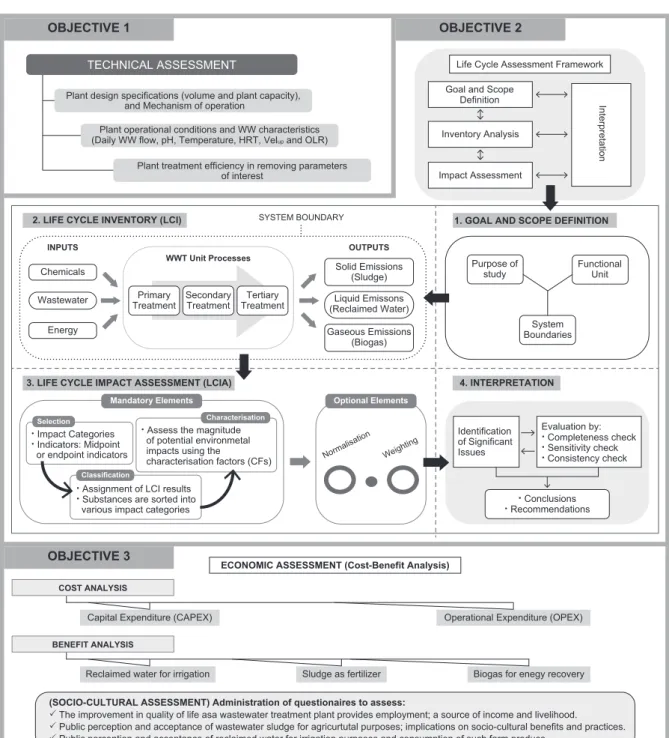
The first objective of this study is to assess the performance of the treatment plant by determining the pollutant removal efficiency of parameters of interest. Secondly, the life cycle analysis (LCA) technique will be employed to evaluate the environmental burdens and potential impacts associated with the various unit processes during operations of MWWTP. Finally a socio-economic assessment will be conducted. The cost-benefit analysis approach will be employed to determine the total cost of running the plant (Capital and Operational Expenditure).
The corresponding benefits from bi-products such as biogas and sludge with energy recovery potentials, sludge as fertilizer and nutrient-rich reclaimed water for irrigation practices will also be evaluated. The socio-cultural implications regarding public perception and acceptance of wastewater sludge for agricultural purposes, irrigation with treated wastewater and consumption of food crops cultivated with this waste stream will also be assessed.
Methodology for the study objectives has been conceptualised in the chart below (Figure 1):
21
Proceedings of the Online International Symposium on the Sanitation Value Chain 2020 (SVC2020)
Sanitation Value Chain Vol. 5 (1) pp.020–021, 2021
From the study, the following results will be expected to be achieved:
● Establishment of the performance and pollutant removal efficiency of the municipal-scale UASB reactor coupled with the post-treatment by Trickling Filter.
● Identification of environmental hot spots in the Mudor WWTP system operations with significant environmental burdens that requires consideration for improvement.
● Establishment of the socio-economic impacts of the Mudor WWTP.
OBJECTIVE 1 OBJECTIVE 2
TECHNICAL ASSESSMENT
Plant design specifications (volume and plant capacity), and Mechanism of operation
Life Cycle Assessment Framework Goal and Scope
Definition
OBJECTIVE 3
Plant operational conditions and WW characteristics (Daily WW flow, pH, Temperature, HRT, Velup and OLR)
Plant treatment efficiency in removing parameters of interest
Inventory Analysis
Impact Assessment
1. GOAL AND SCOPE DEFINITION 2. LIFE CYCLE INVENTORY (LCI)
3. LIFE CYCLE IMPACT ASSESSMENT (LCIA) 4. INTERPRETATION
Interpretation
Solid Emissions (Sludge) OUTPUTS SYSTEM BOUNDARY
WWT Unit Processes
Reclaimed water for irrigation Sludge as fertilizer Biogas for enegy recovery
Capital Expenditure (CAPEX) Operational Expenditure (OPEX)
BENEFIT ANALYSIS
Liquid Emissons (Reclaimed Water) Gaseous Emissions
(Biogas) Chemicals
Energy INPUTS
Wastewater
Impact Categories
Indicators: Midpoint or endpoint indicators
(SOCIO-CULTURAL ASSESSMENT) Administration of questionaires to assess:
The improvement in quality of life asa wastewater treatment plant provides employment; a source of income and livelihood.
Public perception and acceptance of wastewater sludge for agricurtutal purposes; implications on socio-cultural benefits and practices.
Public percention and acceptance of reclaimed water for irrigation purposes and consumption of such farm produce.
Assignment of LCI results
Substances are sorted into various impact categories
Assess the magnitude of potential environmetal impacts using the
characterisation factors (CFs)
Identification of Significant Issues Tertiary
Treatment Secondary
Treatment Primary
Treatment
Purpose of
study Functional
Unit
System Boundaries
Conclusions
Recommendations Normalisation
Weighting
Evaluation by:
Completeness check
Sensitivity check
Consistency check Characterisation
Classification
Mandatory Elements Selection
Optional Elements
ECONOMIC ASSESSMENT (Cost-Benefit Analysis) COST ANALYSIS
Figure 1. Research Methodology.