1
Changes in serum levels of angiopoietin-like protein-8 and glycosylphosphatidylinositol- anchored high-density lipoprotein binding protein 1 after ezetimibe therapy in patients
with dyslipidemia
Akihito Ideishi, MD
a*, Yasunori Suematsu, MD, PhD
a*, Kohei Tashiro, MD
a,
Hidetaka Morita, MD
a, Naoko Kumagai-Koyanagi, MD, PhD
a,b, Takashi Kuwano, MD, PhD
a, Shin-ichiro Miura, MD, PhD
a,ca
Department of Cardiology, Fukuoka University School of Medicine, Fukuoka, Japan
b
Division of Cardiology, Sada Hospital, Fukuoka, Japan.
c
Department of Cardiology, Fukuoka University Nishijin Hospital, Fukuoka, Japan
*
These authors contributed equally to this manuscript.
Running head: Changes in angiopoietin-like protein-8 levels
Keywords: ezetimibe; metabolic syndrome; dyslipidemia; angiopoietin-like protein-8;
glycosylphosphatidylinositol-anchored high-density lipoprotein binding protein 1.
Correspondence:
Shin-ichiro Miura
Professor and Chairman, Department of Cardiology, Fukuoka University School of Medicine, 7- 45-1 Nanakuma, Jonan-Ku, Fukuoka, 814-0180, Japan.
Tel :+81-92-801-1011 Fax:+81-92-865-2692 E-mail:[email protected]
2
Introduction
Ezetimibe reduces serum low-density lipoprotein cholesterol (LDL-C) levels by inhibiting the intestinal absorption of cholesterol through the blockade of Niemann-Pick C1 Like1
1, 2, 3. In the ZENITH trial, we reported that ezetimibe significantly decreased serum LDL-C levels and may be especially effective in dyslipidemic (DL) males with metabolic syndrome (MetS) and relatively lower ratios of LDL-C to high-density lipoprotein cholesterol (HDL-C)
4.
Angiopoietin-like protein-8 (ANGPTL8) is one of a group of secreted glycoproteins composed of eight members (ANGPTL1-8)
5. ANGPTL8 has been reported to be associated with lipid metabolism
6-11. ANGPTL8 levels were significantly positively correlated with triglyceride (TG) and LDL-C levels, and negatively correlated with HDL-C levels
12, 13. ANGPTL8 promotes ANGPTL3 cleavage and binds to the N-terminus of ANGPTL3. The complex of ANGPTL8 and the N-terminus of ANGPTL3 inhibits lipoprotein lipase (LPL) and suppresses lipolysis of chylomicrons
5. Abu-Farha et al. reported that the ANGPTL8 levels in a MetS group were higher than those in a non-MetS group
14, whereas ANGPTL8 levels at baseline in a newly developed MetS group were lower than those in a non-MetS group during 3.5 years of follow-up
15. The ANGPTL8 level was inversely correlated with the incidence of MetS even after multivariate adjustments
15. Thus, the association of the ANGPTL8 level with lipid metabolism in MetS remains unclear
16.
Glycosylphosphatidylinositol-anchored high-density lipoprotein binding protein 1 (GPIHBP1) associated with LPL, which is inhibited by the complex of ANGPTL8 and ANGPTL3, is also involved in lipid metabolism. GPIHBP1 is positively correlated with LPL and inversely
correlated with remnant-like particle cholesterol (RLP-C) and small-dense LDL-C
17. GPIHBP1
is a protein in lymphocyte antigen 6 and an essential partner of LPL
18. GPIHBP1 captures LPL
3
on the abluminal plasma membrane of capillary endothelial cells, and stabilizes the structure of LPL.
However, the associations between the serum lipid profile and ANGPTL8 or GPIHBP1 levels after ezetimibe therapy in DL patients remain to be elucidated. Therefore, using blood samples from the ZENITH trial, we investigated the effects of ezetimibe on ANGPTL8 and GPIHBP1 in all DL patients, and also compared patients with MetS to those without MetS.
Methods Study design
The ZENITH trial was prospectively performed from January 2009 to August 2011 at Fukuoka
University Hospital and its related hospitals in the Kyushu area of Japan
4. Untreated DL patients
or patients who had been pretreated with statin and had undergone a 4-week washout period were
enrolled. Serum samples were collected before and after 16 weeks of treatment with 10 mg/day
ezetimibe. Written informed consent was obtained from all patients. In this study, we excluded
some patients from the ZENITH trial due to an insufficient volume of blood sample, and finally
analyzed ANGPTL8 and GPIHBP1 levels in 38 patients. Various parameters were investigated
before and after 16 weeks of ezetimibe treatment in all patients. In addition, the patients were
also divided into metabolic syndrome (MetS) (n=22) and Non-MetS (n=16) groups, and various
parameters were compared between these groups. The procedures were performed in accordance
with the Declaration of Helsinki and the ethical standards of the Independent Review Board of
Fukuoka University. This investigation was approved by the Independent Review Board of
Fukuoka University (2017M160).
4
Measurements of various parameters
Age, gender, body mass index (BMI), and history of hypertension (HTN), diabetes mellitus (DM), and coronary artery disease (CAD) were evaluated. BMI was calculated as weight/height
2(kg/m
2). MetS was defined based on the following diagnostic criteria
19. In Japan, MetS is defined as a waist circumference over 85 centimeters (males) or 90 centimeters (females) and two or more of the following three criteria: the presence of HTN (systolic blood pressure over 130 mmHg and/or diastolic blood pressure over 85 mmHg), DM (fasting blood sugar over 100 mg/dl), or DL (fasting TG level over 150 mg/dl and/or fasting HDL-C level less than 40 mg/dl).
In this study, we also defined HTN or DM based on appropriate medical treatment. Serum levels of white blood cells, high-sensitivity C-reactive protein, blood urea nitrogen, creatinine, aspartate aminotransferase, alkaline phosphatase, total cholesterol (TC), TG, LDL-C, HDL-C, RLP-C, and markers of cholesterol synthesis (lathosterol/TC) and absorption (campesterol/TC, sitosterol/TC) were evaluated at the Fukuoka University Hospital Laboratory Unit or by SRL Inc. (Tokyo, Japan), as reported previously
4. ANGPTL8 and GPIHBP1 were detected using a Human
GPIHBP1 Assay Kit (#27179) and a Human ANGPTL8 Assay Kit (#27795) (Immuno-Biological Laboratories Co, Ltd, Gunma, Japan).
Statistical analyses
All data analyses were performed using the SAS (Statistical Analysis System) Software Package (Ver. 9.4, SAS Institute Inc., Cary, NC, USA) at Fukuoka University (Fukuoka, Japan).
Continuous variables with a normal distribution were expressed as mean ± standard deviation
and compared by Student’s t-test. Continuous variables with a non-normal distribution were
expressed as median (interquartile range) and compared by the Wilcoxon rank sum test.
5
Categorical variables were compared by a Chi-square analysis. Paired variables were analyzed by a paired t-test for continuous variables with a normal distribution and by a Wilcoxon signed rank test for continuous variables with a non-normal distribution. The Spearman Rank
Correlation Coefficient was used to evaluate associations. We defined p value < 0.05 as significant.
Results
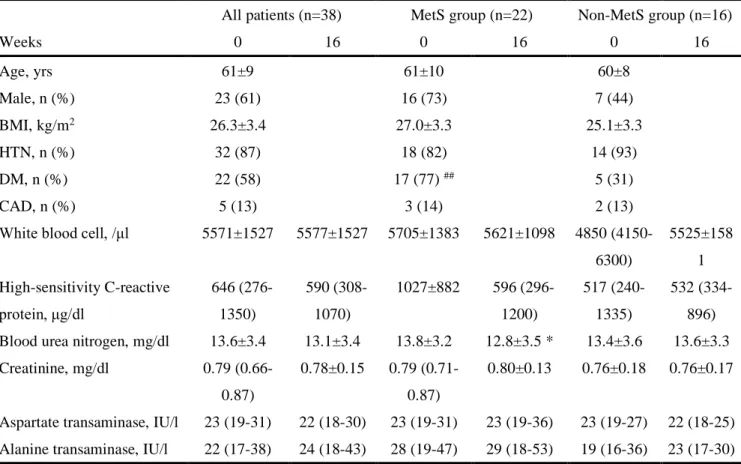
Patient characteristics at baseline in all patients and in the MetS and Non-MetS groups Patient characteristics at baseline are shown in Table 1. Average age and BMI in all patients were 61±9 years and 26.3±3.4 kg/m
2, respectively. The percentages of (%) male, HTN, DM, and CAD in all patients were 61%, 87%, 58% and 13%, respectively. %DM in the MetS group was
significantly higher than that in the Non-MetS group.
Changes in biochemical parameters between before and after ezetimibe treatment in all patients and in the MetS and Non-MetS groups
Changes in biochemical parameters between before and after ezetimibe treatment are shown in Table 1. Although blood urea nitrogen after treatment in the MetS group significantly decreased, there were no significant changes in white blood cells, high-sensitivity C-reactive protein, creatinine, aspartate transaminase or alanine transaminase in all patients or in the MetS and Non- MetS groups.
Changes in the lipid profile between before and after ezetimibe treatment in all patients
and in the MetS and Non-MetS groups
6
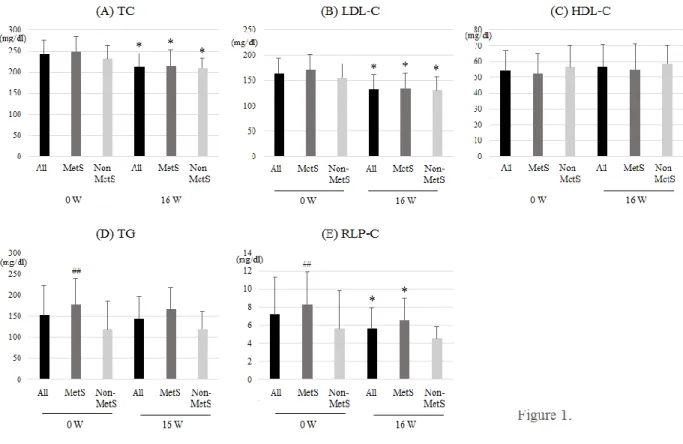
Changes in the lipid profile between before and after ezetimibe treatment are shown in Figure 1.
Before treatment, TG and RLP-C levels in the MetS group were significantly higher than those in the Non-MetS group. After 16 weeks of treatment, the levels of TC and LDL-C were
significantly reduced in all patients and in the MetS and Non-MetS groups. The levels of HDL-C and TG in all patients and in the MetS and Non-MetS groups were not significantly changed after 16 weeks of treatment. The level of RLP-C after 16 weeks was significantly reduced in all patients and in the MetS group, but not in the Non-MetS group.
Changes in ANGPTL8 and GPIHBP1 between before and after ezetimibe treatment in all patients and in the MetS and Non-MetS groups
Changes in ANGPTL8 and GPIHBP1 between before and after ezetimibe treatment are shown in Figure 2. There were no significant differences in the levels of ANGPTL8 and GPIHBP1 at baseline among all patients and the MetS and Non-MetS groups. The level of ANGPTL8 in all patients was significantly reduced by 16 weeks of treatment with ezetimibe. Although the levels of ANGPTL8 in the MetS and Non-MetS groups decreased after treatment, these changes were not significant. The levels of GPIHBP1 in all patients and in the MetS and Non-MetS groups were significantly reduced by 16 weeks of treatment with ezetimibe.
Changes in the sterol/TC ratios after treatment with ezetimibe in all patients and in the MetS and non-MetS groups
Figure 3A-C shows the changes in the sterol/TC ratio after treatment with ezetimibe.
Lathosterol/TC in the MetS group was significantly higher than that in the non-MetS group
before treatment, whereas there were no significant differences in campesterol/TC or
7
sitosterol/TC between the MetS and non-MetS groups before treatment. Lathosterol/TC was significantly increased after treatment in all patients and in the MetS and non-MetS groups, and campesterol/TC and sitosterol/TC were significantly decreased.
The changes in ANGPTL8 and campesterol/TC before and after ezetimibe treatment (ΔANGPTL8 and Δcampesterol/TC) are shown in Figure 3D. ΔANGPTL8 was negatively associated with Δcampesterol/TC.
Associations between the lipid profile and ANGPTL8 or GPIHBP1 before ezetimibe treatment in all patients and in the MetS and Non-MetS groups
The associations between the lipid profile (LDL-C, HDL-C and TG) and ANGPTL8 before treatment with ezetimibe are shown in Figure 4. ANGPTL8 before treatment was significantly negatively associated with HDL-C and positively associated with TG in all patients (Figure 4B and 4C) and in the MetS group (Figure 4E and 4F), but not in the Non-MetS group (Figure 4H and 4I). There were no associations between ANGPTL8 and LDL-C in any of the groups (Figure 4A, 4D and 4G). In addition, GPIHBP1 was not associated with either LDL-C or RLP-C before treatment with ezetimibe (data not shown).
Discussion
This is the first investigation of whether ezetimibe changes serum ANGPTL8 and GPIHBP1 levels in DL patients and whether there are any differences between MetS and Non-MetS groups.
Ezetimibe decreased serum levels of ANGPTL8 and GPIHBP1 in addition to reducing TC and
LDL-C. In addition, ezetimibe significantly decreased RLP-C levels in the MetS group, but not
in the Non-MetS group.
8
The most important finding in this study is that ezetimibe decreased serum levels of ANGPTL8 in all patient. This reduction of ANGPTL8 might be a newly recognized effect of ezetimibe therapy. Lower ANGPTL8 levels keep LPL activity high and accelerate the lipolysis of chylomicron
5. In other words, high LPL activity is not necessary under a lower chylomicron condition as a result of the blockade of cholesterol uptake by ezetimibe, and subsequently
ANGPTL8 levels should be increased. Thus, there is a discrepancy between this concept and our results regarding changes in ANGPTL8 levels. ANGPTL8 is predominantly expressed in the liver or white and brown fat tissues
16. Ezetimibe might affect the reduction of ANGPTL8 in the liver. Ezetimibe is expected to act on the liver to improve nonalcoholic fatty liver disease, insulin sensitivity, and hepatic steatosis
20. Altmann et al. reported that the liver expressed around 90% of the level of NPC1L1 messenger ribonucleic acid relative to that in the small intestine in human
21. Ezetimibe might suppress ANGPTL8 production via NPC1L1 in the liver. In addition, the
inhibition of cholesterol absorption by ezetimibe might induce the reduction of ANGPTL8, since ΔANGPTL8 was negatively associated with Δcampesterol/TC. Further studies will be needed to resolve this issue.
GPIHBP1 was significantly reduced after ezetimibe therapy in all patients, and in the MetS and Non-MetS groups. Ezetimibe reduces plasma chylomicrons
22and ameliorates intestinal chylomicron overproduction
23as a result of blockage of cholesterol uptake. GPIHBP1 would become unnecessary under ezetimibe treatment, because GPIHBP1 is needed to carry LPL under hyperchylomicronemia. Moreover, GPIHBP1-deficient mice were sensitive to cholesterol intake.
The plasma TG levels in GPIHBP1-deficient mice fed a low-cholesterol diet were significantly
higher than those in mice fed a high-cholesterol diet. In wild-type mice, a high-cholesterol diet
had little or no effect on plasma TG levels.
24Thus, the reduction of GPIHBP1 may be a result of
9
the pharmacological action of ezetimibe.
Next, we discuss the similarities and differences between the MetS and Non-MetS groups in this study. Before ezetimibe treatment, ANGPTL8 was significantly positively associated with TG and negatively associated with HDL-C in all patients and in the MetS group, but not in the Non-MetS group. Although the mechanism of the association between ANGPTL8 levels and lipid metabolism in MetS is unclear, our results at baseline were consistent with those in previous reports
12, 13. Both the MetS and Non-MetS groups showed significant reductions of LDL-C and GPIHBP1 after treatment with ezetimibe. Although both groups showed a reduction in ANGPTL8 after treatment with ezetimibe, these reductions were not significant. Thus,
ezetimibe treatment induced similar changes in LDL-C, ANGPTL8 and GPIHBP1 levels in both groups. On the other hand, the groups differed with respect to reductions in RLP-C after
ezetimibe treatment. Ezetimibe significantly decreased RLP-C levels in the MetS group, but not in the Non-MetS group. Before treatment, RLP-C levels in the MetS group were significantly higher than those in the Non-MetS group. In this regard, ezetimibe exerted a stronger anti- atherogenic effect through the reduction of RLP-C levels in the MetS group than in the Non- MetS group.
This study has several limitations. First, the sample size was small. Notwithstanding this limitation, our results raise the possibility of new mechansims of ezetimibe therapy. Second, it would be helpful to understand the roles played by ANGPTL3 and LPL on the suppressive effect of ezetimibe on ANGPTL8. Third, although we set a 4-week washout period for patients in whom DL had been pretreated with statin, the legacy effect of statin treatment should be considered.
In conclusion, this is the first report to support the possibility of a new effect of ezetimibe
10
therapy. Ezetimibe significantly decreased the serum level of LDL-C, but not TG or HDL-C, while reducing ANGPTL8 and GPIHBP1. Ezetimibe significantly decreased RLP-C levels in the MetS group, but not in the Non-MetS group.
Acknowledgements
ZENITH Trial Investigators: Keijiro Saku, MD, Keita Noda, MD, Shin-ichiro Miura, MD, Naoko Koyanagi, MD, Rie Koyoshi, MD, Atsushi Iwata, MD (Fukuoka University Hospital, Fukuoka); Hidenori Urata, MD (Fukuoka University Chikushi Hospital, Fukuoka); Masahiko Seki, MD (Seki Internal Clinic); Toshiki Hiratsuka, MD (Hiratsuka Clinic); Yoichi Tanabe, MD (Tanabe Clinic); Kazuaki Fujisawa, MD (Fujisawa Internal Clinic); Jin Miyawaki, MD
(Miyawaki Clinic); Fumihiro Hoshino, MD (Murakamikarindo Hospital); Masatsugu Oga, MD (Oga Internal Circulatory Clinic); Masaki Kohara, MD (Kohara Clinic); Fumitada Hattori, MD (Nagao Hospital); Yutaka Tachikawa, MD (Tanaka Hospital).
Conflict of Interest None to declare.
CRediT author statement
Akihito Ideishi: Conceptualization, Methodology, Validation. Yasunori Suematsu: Validation, Writing - Original Draft. Kohei Tashiro: Investigation, Validation. Hidetaka Morita:
Investigation. Naoko Kumagai-Koyanagi: Validation. Takashi Kuwano: Visualization. Shin-
ichiro Miura: Supervision, Writing- Reviewing and Editing.
11
References
[1]
H.R Davis, E.P. Veltri, Zetia: inhibition of Niemann-Pick C1 Like 1 (NPC1L1) to reduce intestinal cholesterol absorption and treat hyperlipidemia, J. Atheroscler. Thromb. 14 (2007) 99-108.[2]
J.J. Clarenbach, M. Reber, D. Lutjohann D, K. von Bergmann, T. Sudhop T, The lipid-lowering effect of ezetimibe in pure vegetarians, J. Lipid. Res. 47 (2006) 2820-2824.[3]
T. Sudhop, D.Lutjohann, A. Kodal, M. Igel, D.L. Tribble, S. Shah, I. Perevozskaya, K. von Bergmann, Inhibition of intestinal cholesterol absorption by ezetimibe in humans, Circulation. 106 (2002) 1943-1948.[4]
N. Kumagai, S. Miura, B. Zhang, K. Noda, K. Saku, Zenith Trial Investigators, Effects of ezetimibe on hypercholesterolemia in the lipid profile in patients with metabolic syndrome: Zenith Trial, IJC.Metabolic & Endocrine. 1 (2013) 7-12.
[5]
M. Luo, D. Peng, ANGPTL8: An Important Regulator in Metabolic Disorders, Front Endocrinol.(Lausanne). 9 (2018) 169.
[6]
M.E. Cannon, Q. Duan, Y. Wu, M. Zeynalzadeh, Z. Xu, A.J. Kangas, P. Soininen, M. Ala-Korpela, M.Civelek, A.J. Lusis, J. Kuusisto, F.S. Collins, M. Boehnke, H. Tang, M. Laakso, Y. Li, K.L. Mohlke, Trans-ancestry Fine Mapping and Molecular Assays Identify Regulatory Variants at the ANGPTL8 HDL-C GWAS Locus, G3. (Bethesda). 7 (2017) 3217-3227.
[7]
J. Gomez-Ambrosi, E. Pascual-Corrales, V. Catalan, A. Rodriguez, B. Ramirez, S. Romero, N. Vila, P.Ibanez, M.A. Margall, C. Silva, M.J. Gil, J. Salvador, G. Fruhbeck, Altered Concentrations in Dyslipidemia Evidence a Role for ANGPTL8/Betatrophin in Lipid Metabolism in Humans, J. Clin.
Endocrinol. Metab. 101 (2016) 3803-3811.
[8]
L.F. Haller, I.J. Mintah, L.M. Shihanian, P. Stevis, D. Buckler, C.A. Alexa-Braun, S. Kleiner, S. Banfi, J.C. Cohen, H.H. Hobbs, G.D. Yancopoulos, A.J. Murphy, V. Gusarova, J. Gromada, ANGPTL8 requires ANGPTL3 to inhibit lipoprotein lipase and plasma triglyceride clearance, J. Lipid. Res. 5812 (2017) 1166-1173.
[9]
R.L. Hanson, F. Leti, D.Tsinajinnie, S. Kobes, S. Puppala, J.E. Curran, L. Almasy, D.M Lehman, J.Blangero, R. Duggirala, J.K. DiStefano, The Arg59Trp variant in ANGPTL8 (betatrophin) is associated with total and HDL-cholesterol in American Indians and Mexican Americans and differentially affects cleavage of ANGPTL3, Mol. Genet. Metab. 118 (2016) 128-137.
[10]
M. Luo, Z. Zhang, Y. Peng, S. Wang, D. Peng, The negative effect of ANGPTL8 on HDL-mediated cholesterol efflux capacity, Cardiovasc. Diabetol. 17 (2018) 142.[11]
Y. Wang, F. Quagliarini, V. Gusarova, J. Gromada, D.M. Valenzuela, J.C. Cohen, H.H. Hobbs, Mice lacking ANGPTL8 (Betatrophin) manifest disrupted triglyceride metabolism without impaired glucose homeostasis, Proc. Natl. Acad. Sci. U S A. 110 (2013) 16109-161114.[12]
C.C. Chen, H. Susanto, W.H. Chuang, T.Y. Liu, C.H. Wang, Higher serum betatrophin level in type 2 diabetes subjects is associated with urinary albumin excretion and renal function, Cardiovasc. Diabetol.15 (2016) 3.
[13]
H. Ghasemi, H. Tavilani, I, Khodadadi, M. Saidijam, J. Karimi, Circulating Betatrophin Levels Are Associated with the Lipid Profile in Type 2 Diabetes, Chonnam. Med. J. 51 (2015) 115-119.[14]
M. Abu-Farha, J. Abubaker, I. Al-Khairi, P. Cherian, F. Noronha, S. Kavalakatt, A. Khadir, K.Behbehani, M. Alarouj, A. Bennakhi, N. Elkum, Circulating angiopoietin-like protein 8 (betatrophin) association with HsCRP and metabolic syndrome, Cardiovasc. Diabetol. 15 (2016) 25.
[15]
H. Wang, Y. Lai, C. Han, A. Liu, C. Fan, H. Wang, H. Zhang, S. Ding, W. Teng, Z. Shan, The Effects of Serum ANGPTL8/betatrophin on the Risk of Developing the Metabolic Syndrome - A Prospective Study, Sci. Rep. 6 (2016) 28431.[16]
J. Ye, Y. Qin, D. Wang, L. Yang, G. Yuan, The Relationship between Circulating ANGPTL8/Betatrophin Concentrations and Adult Obesity: A Meta-Analysis, Dis. Markers. 2019 (2019) 509686013
[17]
Y. Muraba, T. Koga, Y. Shimomura, Y. Ito, Y. Hirao, J. Kobayashi, T. Kimura, K. Nakajima, M.Murakami, The role of plasma lipoprotein lipase, hepatic lipase and GPIHBP1 in the metabolism of remnant lipoproteins and small dense LDL in patients with coronary artery disease, Clin. Chim. Acta.
476 (2018) 146-153.
[18]
C. Liu, L. Li, D. Guo, Y. Lv, X. Zheng, Z. Mo, W. Xie, Lipoprotein lipase transporter GPIHBP1 and triglyceride-rich lipoprotein metabolism, Clin. Chim. Acta. 487 (2018) 33-40.[19]
P.L. Huang, A comprehensive definition for metabolic syndrome, Dis. Model. Mech. 2 (2009) 231-237.[20]
T.G. Simon, K.E. Corey, R.T. Chung, R. Giugliano, Cardiovascular Risk Reduction in Patients with Nonalcoholic Fatty Liver Disease: The Potential Role of Ezetimibe, Dig. Dis. Sci. 61 (2016) 3425-3435.[21]
S.W. Altmann, H.R. Davis, L.J. Jr., Zhu, X. Yao, L.M. Hoos, G. Tetzloff, S.P. Iyer, M. Maguire, A.Golovko, M. Zeng, L. Wang, N. Murgolo, M.P. Graziano MP, Niemann-Pick C1 Like 1 protein is critical for intestinal cholesterol absorption, Science. 303 (2004) 1201-1204.
[22]
O.C. Mangili, A.C. Moron Gagliardi, L.C. Mangili, C.H. Mesquita, L.A. Machado Cesar, A. Tanaka, E.J. Schaefer, R.C. Maranhao, R.D. Santos, Favorable effects of ezetimibe alone or in association with simvastatin on the removal from plasma of chylomicrons in coronary heart disease subjects,Atherosclerosis. 233(2014) 319-325.
[23]
M. Naples, C. Baker, M. Lino, J. Iqbal, M.M. Hussain, K. Adeli, Ezetimibe ameliorates intestinalchylomicron overproduction and improves glucose tolerance in a diet-induced hamster model of insulin resistance, Am. J. Physiol. Gastrointest. Liver. Physiol. 302 (2012) G1043-1052.
[24] M.M. Weinstein, Y. Tu, A.P. Beigneux, et al. Cholesterol Intake Modulates Plasma Triglyceride Levels in GPIHBP1-deficient Mice. Arterioscler Thromb Vasc Biol. 30 (2010) 2106-2113.
14
Figure legends
Figure 1.
Serum levels of total cholesterol (TC) (A), low-density lipoprotein cholesterol (LDL-C) (B), high-density lipoprotein cholesterol (HDL-C) (C), triglyceride (TG) (D) and remnant-like
particle cholesterol (RLP-C) (E) at weeks 0 and 16 after ezetimibe treatment in all patients and in the metabolic syndrome (MetS) and Non-MetS groups.
*p<0.05 vs. week 0 in each group.
##p<0.01 vs. Non-MetS group.
15
Figure 2.
Serum levels of angiopoietin-like protein-8 (ANGPTL8) (A) and glycosylphosphatidylinositol- anchored high-density lipoprotein binding protein 1 (GPIHBP1) (B) at weeks 0 and 16 after ezetimibe treatment in all patients and in the metabolic syndrome (MetS) and Non-MetS groups.
*p<0.05 vs. week 0 in each group.
Figure 3.
Changes in the lathosterol/total cholesterol (TC) (A), campesterol/TC (B) or sitosterol/TC (C)
ratios before and after treatment with ezetimibe in all patients and in the metabolic syndrome
(MetS) and non-MetS groups.
16
Association between the changes in angiopoietin-like protein-8 (ANGPTL8) and campesterol/TC at weeks 0 and 16 after ezetimibe treatment (ΔANGPTL8 and Δcampesterol/TC) (D).
**p<0.01 vs. week 0 in each group.
##p<0.01 vs. Non-MetS group.
Figure 4.
Associations of serum angiopoietin-like protein-8 (ANGPTL8) levels with low-density
lipoprotein cholesterol (LDL-C) (A, D, G), high-density lipoprotein cholesterol (HDL-C) (B, E,
H) or triglyceride (TG) (C, F, I) levels before ezetimibe treatment in all patients (A-C) and in the
metabolic syndrome (MetS) (D-F) and Non-MetS groups (G-I).
17
Table 1. Patient characteristics and biochemical parameters in all patients, MetS and Non-MetS groups.
All patients (n=38) MetS group (n=22) Non-MetS group (n=16)
Weeks 0 16 0 16 0 16
Age, yrs 61±9 61±10 60±8
Male, n (%) 23 (61) 16 (73) 7 (44)
BMI, kg/m2 26.3±3.4 27.0±3.3 25.1±3.3
HTN, n (%) 32 (87) 18 (82) 14 (93)
DM, n (%) 22 (58) 17 (77) ## 5 (31)
CAD, n (%) 5 (13) 3 (14) 2 (13)
White blood cell, /μl 5571±1527 5577±1527 5705±1383 5621±1098 4850 (4150- 6300)
5525±158 1 High-sensitivity C-reactive
protein, μg/dl
646 (276- 1350)
590 (308- 1070)
1027±882 596 (296- 1200)
517 (240- 1335)
532 (334- 896) Blood urea nitrogen, mg/dl 13.6±3.4 13.1±3.4 13.8±3.2 12.8±3.5 * 13.4±3.6 13.6±3.3 Creatinine, mg/dl 0.79 (0.66-
0.87)
0.78±0.15 0.79 (0.71- 0.87)
0.80±0.13 0.76±0.18 0.76±0.17
Aspartate transaminase, IU/l 23 (19-31) 22 (18-30) 23 (19-31) 23 (19-36) 23 (19-27) 22 (18-25) Alanine transaminase, IU/l 22 (17-38) 24 (18-43) 28 (19-47) 29 (18-53) 19 (16-36) 23 (17-30) MetS, metabolic syndrome; BMI, body mass index; HTN, hypertension; DM, diabetes mellitus; CAD, coronary artery disease. *p<0.05 at week 0 in each group. ##p<0.01 vs. MetS group at week 0.
Erratum:
1. In Table 1 footnote: please change “##p < 0.01 vs. at week 0 in the MetS group” to “##p <
0.01 vs. at week 0 in the Non-MetS group”.
2. The paragraph of 2.2: Measurements of various parameters in the Methods section, please change “aspartate aminotransferase, alkaline phosphatase” to “aspartate transaminase, alanine transaminase”.
3. We added the unit in Figure 3. And in Figure 3 (B): The 16 weeks-averages in All, MetS, and
Non-Mets groups were same as 0 week-data in each group by mistakes. The correct figure is
attached by PPT.
18