東北公益文科大学総合研究論集第30号 抜刷 2016年7月20日発行
Interdependence between the Exchange Rates of ASEAN-4 and the Major Economies of Asia
Sultonov Mirzosaid
1. Introduction
China, Japan and India are the three major economies in Asia that are measured by nominal GDP. In China, the annual percentage growth rate of GDP at market prices, based on constant local currency, was 9.9% in the last 30 years and 8.6% in the last five years
1. The rapid speed of economic growth has made China the largest economy in Asia, surpassing Japan in 2010. China is expected to become the world’s largest economy between 2020 and 2030 (The Guardian, 2011).
Japan has held the title of the largest economy in Asia, and the second largest in the world, for more than 40 years. However, around 1990, the Japanese economy entered a long period of deflation and recession. Growth slowed down and prices declined persistently, making Japanese consumers and producers extremely pessimistic (Ohno, 2006). To pull the country out of economic stagnation, a new program of economic reform called ‘Abenomics’ was initiated by the Prime Minister of Japan, Shinzō Abe, in December 2012. Abenomics had effects on weakening of the Japanese yen, a rise in the stock market indices, and a fall in unemployment rate. However, the average annual growth rate of the Japanese economy over the past five years has remained very low at around 1.5%.
The Indian economy is the third largest economy in Asia, with a high average annual growth rate of 6.4% over the last 30 years and 7.3% over the last five years.
Since the last quarter of 2014, India has become the world’s fastest growing economy, replacing China (DNA, 2015).
The exchange rate is a central issue in international economics and one of the most
1
World Bank national accounts data and OECD National Accounts data files are the source of information on macroeconomic indicators used in the paper.
研究論文
Interdependence between the Exchange Rates of ASEAN-4 and the Major Economies of Asia
Sultonov Mirzosaid
important determinants of a country’s economic health. In this paper, we attempt to analyse the dynamic linkages and causal relationship between the exchange rates of the four major member economies of the Association of Southeast Asian Nations (Indonesia, Malaysia, the Philippines and Thailand, which comprise the ASEAN-4), and the three major economies of Asia (China, Japan and India). The economic growth, foreign trade and exchange rate policies of the major Asian economies are expected to have important implications on the exchange rate policies of other Asian economies, in particular, ASEAN-4.
The Chinese national currency, RMB, is one of the most heavily traded currencies in the foreign exchange market. RMB plays the role of a secure currency in emerging Asian economies (Henning, 2012). Since 2006, the Chinese government allowed the RMB exchange rate to float slightly around its fixed base rate, and announced that the flexibility of the exchange rate will be gradually increased. The Chinese government has made a good progress in reforming China’s monetary and financial systems.
November 30, 2015 the Executive Board of the International Monetary Fund (IMF) announced about its decision to include Chinese RMB in the Special Drawing Right (SDR) basket as it met all existing criteria. Effective from October 1, 2016, Chinese RMB is determined to be a freely usable currency and will be included in the SDR basket
2.
The Japanese yen is one of the four most traded currencies in the foreign exchange market. It has a freely floating exchange rate. The yen started to depreciate against the U.S. dollar with the implementation of Abenomics in 2012, after a long period of appreciation.
According to the International Monetary Fund (IMF), India, Indonesia, the Philippines and Thailand were reported to have floating exchange rates, while Malaysia’s exchange rate policy comprised managed arrangements (IMF, 2014).
2
IMF’s Executive Board Completes Review of SDR Basket, Includes Chinese Renminbi. Press Release No.
15/540. November 30, 2015.
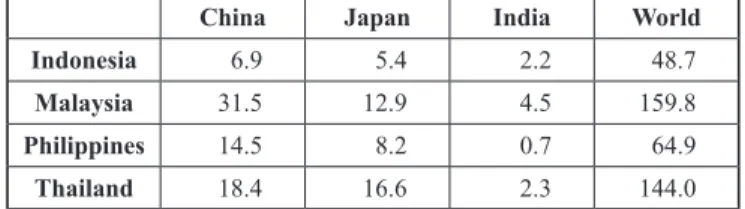
Table 1: Bilateral Trade as a Percentage of GDP for 2010-2014
China Japan India World
Indonesia 6.9 5.4 2.2 48.7
Malaysia 31.5 12.9 4.5 159.8
Philippines 14.5 8.2 0.7 64.9
Thailand 18.4 16.6 2.3 144.0
Source: Calculations are based on data from UN Commodity Trade Database and WB WDI.
Notes: The values are average of five years data as a percentage of GDP for each ASEAN country.
From 2010 to 2014, Indonesia’s average annual bilateral trade with major Asian economies was 14.5% of its GDP and 29.8% of its total foreign trade. The mentioned indicators were 48.9% and 30.6% for Malaysia, 23.4% and 36.1% for the Philippines, and 37.3% and 25.9% for Thailand (Table 1).
The flow of foreign direct investment (FDI) from the major Asian economies to ASEAN-4 was USD 28,738 million for 2010 to 2013, which included FDI of USD 4,608 million from China and USD 23,733 million from Japan. A significant volume of foreign trade and flow of FDI may cause a high correlation between the exchange rates of the major Asian economies and the ASEAN-4 economies (Table 2).
Table 2: FDI Flows from Major Economies to ASEAN-4 for 2010 ̶ 2013
China Japan India
Indonesia 2 155 7 879 168
Malaysia 458 3 790 229
Philippines 1 409 9 828 …
Thailand 586 2 236 …
Source: UNCTAD FDI/TNC database.
Notes: The values are in millions of U.S. dollars.
Changes and volatilities in the exchange rates of major Asian economies may significantly affect exchange rates of ASEAN-4 that do heavily depend on foreign trade with major Asian economies. Different issues related with exchange rates of various countries members of the ASEAN for the period of 2010 to 2015 were partially covered by some studies. In particular, Masujima (2015) estimated the quarterly equilibrium exchange rates of nine Asian currencies, including some ASEAN countries with the behavioral equilibrium exchange rates from 2006 to 2014. Kawai and Pontines (2014) examined the behavior of the Chinese RMB exchange rate and its impact on other currencies in emerging East Asia during the period 2000 to 2014. Soleymani and Chua (2014) investigated the impact of currency depreciation on bilateral trade between Malaysia and China over the period 1993 to 2012. Though, no previous empirical studies have exclusively analyzed dynamic interactions and causality relationship between exchange rates of ASEAN countries and three major Asian economies during the last five years.
The next two chapters present data and models used in estimations of dynamic conditional correlations, causality-in-mean and causality-in-variance between the logarithmic exchange rate return. Chapter four explains the findings from these estimations. The last chapter concludes the paper.
2. Data
Logarithmic return series of average weekly representative exchange rates are used for the estimations, based on the data reported by the IMF for the period from January 2, 2010, to July 25, 2015.
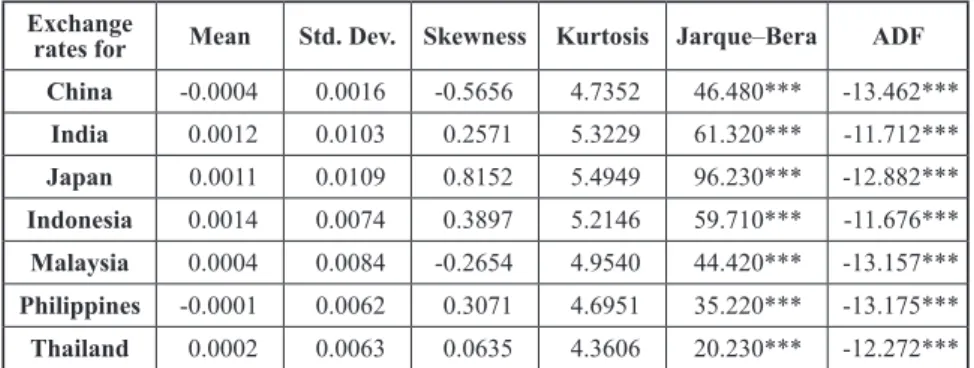
Descriptive statistics for the data are presented in Table 3. The mean and standard deviation of the variables are very close to zero. Skewness values for China and Malaysia show the distribution slightly skewed on the left, demonstrating longer tails on lower returns; for the other countries, the distribution is skewed on the right, demonstrating longer tails on higher returns. The kurtosis values are a little higher than the normal distribution. The Jarque–Bera test indicates that the null hypothesis of
‘normal distribution’ is rejected at the 1% significance level for all variables. The
standard Augmented Dickey–Fuller (ADF) test statistics (Dickey and Fuller 1979, 1981) reject the null hypothesis of a unit root at the 1% significance level. Data description justifies the use of Generalised Autoregressive Conditional Heteroscedasticity (GARCH) type models.
Table 3: Descriptive Statistics for Logarithmic Return Series Exchange
rates for Mean Std. Dev. Skewness Kurtosis Jarque–Bera ADF China -0.0004 0.0016 -0.5656 4.7352 46.480*** -13.462***
India 0.0012 0.0103 0.2571 5.3229 61.320*** -11.712***
Japan 0.0011 0.0109 0.8152 5.4949 96.230*** -12.882***
Indonesia 0.0014 0.0074 0.3897 5.2146 59.710*** -11.676***
Malaysia 0.0004 0.0084 -0.2654 4.9540 44.420*** -13.157***
Philippines -0.0001 0.0062 0.3071 4.6951 35.220*** -13.175***
Thailand 0.0002 0.0063 0.0635 4.3606 20.230*** -12.272***
Notes: *** in Jarque–Bera test indicate that the null hypothesis of “normal distribution”
is rejected at 1% significance level. *** in ADF mean smaller than the critical value at 1% significance level.
3. Methodology
First, we test structural changes for exchange rates returns series. Assuming the structural change points unknown, we make use of the test procedure proposed by Andrews (1993) and Andrews and Ploberger (1994). Based on Akaike’s information criterion (AIC), Bayesian information criterion (BIC) and log-likelihood ratio the dummy variables for structural breaks will be used in some equations of further estimations.
In the next step, we estimate the dynamic conditional correlation between exchange
rates returns of ASEAN-4 and major economies of Asia. We estimate the parameters of
dynamic conditional correlation (DCC) bivariate generalized autoregressive
conditionally heteroskedastic (GARCH) models (Bollerslev, 1986; Engle, 2002). The
mean equation of the model can be written as
t i t
t
Cx D
y = ω + + + ε (1)
The variance equation of the model can be written as
2
1 1 ,
2 , 2
, it j
p j
q
j j
j t i j i
t i
i
a
i −= − =
∑ + ∑
+
= ω ε β σ
σ . (2)
We model the conditional means of the returns as vector autoregressive (VAR) processes and the conditional co-variances as DCC-GARCH processes in which the variance of each disturbance term follows a GARCH(1,1) process. We use AIC, BIC, log-likelihood ratio and the Ljung–Box Q test to select the lag order for VAR and define the parameters of GARCH.
Variances and co-variance derived from the above equations are used in the estimation of the dynamic conditional correlation coefficients.
Finally, we use the cross-correlation function (CCF) approach developed by Cheung and Ng (1996) to examine the causal relationships in mean and variance between the logarithmic exchange rate returns. We use an autoregressive (AR) model and an exponential GARCH (EGARCH) model (Nelson, 1991) to calculate the conditional mean of
t i i t k
i i
t
a y D
y = ω + ∑=1 − + + ε (3) and conditional variance
i i t p
i
q
i i
i t i i t i
t
) = + ∑=( z
− + (| z
− | − 2 / ) + ∑= ln(
−) + D
ln(
−) + D
ln( σ
2ω
1γ α π
1β σ
2, (4)
where z t = ε t / σ t .
We use the standardized residuals from Equations 3 and 4 to test the causality in
mean and causality in variance applying CCF. A generalized version of Cheung and Ng
(1996) chi-square test statistic suggested by Hong (2001) with an asymptotic critical
value of 1.645 and 2.326 at the 5% and 1% levels are used to test the hypothesis of no
causality from lag 1 to a given lag of k in the cross-correlation coefficients.
4. Empirical Findings
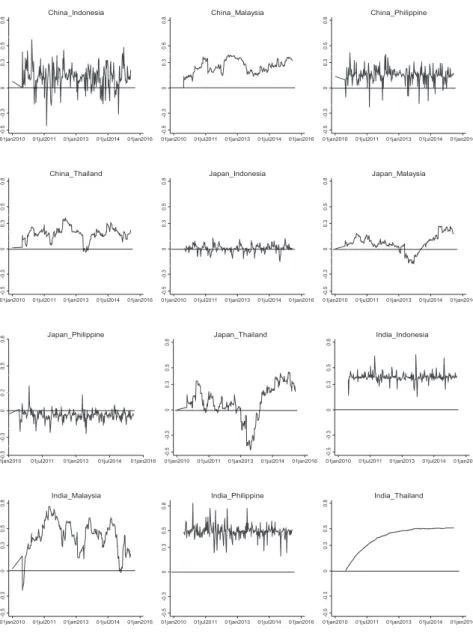
The dynamic conditional correlations between the exchange rate returns of China and ASEAN-4 are mostly positive and sufficiently high, ranging from the average minimum of -0.17 to the average maximum of 0.44, with an average mean of 0.18 and an average standard deviation of 0.09. In general, dynamic conditional correlation coefficients of China with Malaysia and Thailand are higher and less volatile, while those with Indonesia and Philippines are not as high but more volatile (Figure 1).
The dynamic conditional correlations between the exchange rate returns of Japan and ASEAN-4, in general, are not very high, ranging from an average minimum of -0.26 to an average maximum of 0.28, with an average mean of 0.03 and an average standard deviation of 0.10. The coefficients of dynamic conditional correlation with Indonesia are unstable and very close to zero, and those with the Philippines are also unstable and mostly negative. The coefficients of dynamic conditional correlation with Malaysia and Thailand are negative from April 6, 2013 to August 2, 2014, but high and positive thereafter.
The dynamic conditional correlations between the exchange rate returns of India
and ASEAN-4 are positive and high, ranging from the average minimum of 0.03 to the
average maximum of 0.67, with the average mean of 0.42 and average standard
deviation of 0.11. The conditional correlations coefficients with Malaysia and Thailand
have been increasing during the first two years. The coefficients with Thailand are the
most stable.
Figure 1: Dynamic Conditional Correlation between Exchange Rates Returns of Major Asian economies and ASEAN-4
A comparison of the coefficients of dynamic conditional correlations between the exchange rate returns of the major Asian economies and ASEAN-4 demonstrate a
00.60.80.50.3-0.3-0.5
01jan2010 01jul2011 01jan2013 01jul2014 01jan2016 China_Indonesia
00.40.30.20.10.30.80.5-0.5-0.3
01jan2010 01jul2011 01jan2013 01jul2014 01jan2016 China_Malaysia
00.40.2-0.20.30.50.8-0.5-0.3
01jan2010 01jul2011 01jan2013 01jul2014 01jan2016 China_Philippine
00.40.30.20.10.80.5-0.5-0.3
01jan2010 01jul2011 01jan2013 01jul2014 01jan2016 China_Thailand
00.1.1.1-.1.20.50.80.3-0.5-.2-0.3
01jan2010 01jul2011 01jan2013 01jul2014 01jan2016 Japan_Indonesia
00.30.8.20.5-0.3-.2-.1.1.2-0.5
01jan2010 01jul2011 01jan2013 01jul2014 01jan2016 Japan_Malaysia
0-0.40.20.5-0.3-0.5-.4.2-.2.40.8
01jan2010 01jul2011 01jan2013 01jul2014 01jan2016 Japan_Philippine
00.8-0.50.5-0.30.3
01jan2010 01jul2011 01jan2013 01jul2014 01jan2016 Japan_Thailand
0.50.30.8-0.5-0.30
01jan2010 01jul2011 01jan2013 01jul2014 01jan2016 India_Indonesia
00.80.50.3-0.3-0.5
01jan2010 01jul2011 01jan2013 01jul2014 01jan2016 India_Malaysia
0.80.30.5-0.5-0.30
01jan2010 01jul2011 01jan2013 01jul2014 01jan2016 India_Philippine
00.50.30.8-0.5-0.3
01jan2010 01jul2011 01jan2013 01jul2014 01jan2016 India_Thailand