YAMADA Azusa
in Second Language Listening
Abstract
Many second language learners tend to have listening difficulties, because listening is a very complicated process. One of the major listening difficulties is lexical segmentation. In listening activities, learners cannot see word boundaries, so learners have to segment connected spoken English by themselves. According to Field (2003), one of the causes of breakdown of lexical segmentation is modified pronunciation of words in connected spoken English such as linking, elision and weak forms. Field says that it is effective for learners to be aware of and practice those modified pronunciations. There are some empirical studies (Brown and Hilferty, 1986; Tanaka and Yamanishi, 2011; Khaghaninezhad and Jafarzadeh, 2014) supporting Field’s idea. However those studies did not focus on practice methods. Effective practice methods to improve lexical segmentation are still not clear. Therefore, the current study focused on practice methods for improving lexical segmentation especially dictation and shadowing. The current experimental study compared these two methods.
The experimental study was conducted to investigate two research questions:
(1) Are there any differences between dictation and shadowing to improve lexical segmentation skills? and (2) Are there any differences between the participants who improved more and who improved less? In other words, Research Question 1 compared dictation and shadowing. Research Question 2 compared the participants who improved more and who improved less.
26 university students who major in English language and literature participated in the experimental study. Their English proficiency was low or intermediate level. The participants were randomly divided into two groups: the dictation and shadowing group. The participants in the dictation group practiced the target forms through dictation. The participants in the shadowing group practiced the target forms through shadowing. First, the participants took the pre-test which was a dictation test. The participants were given the same explicit lessons about linking, elision and weak forms. Then, they practiced the forms through dictation or shadowing as homework for three weeks. Finally, they took the post-test and answered the questionnaire and review sheet.
The results showed that both the dictation and shadowing group improved their lexical segmentation skills. However, the shadowing group significantly
improved. On the other hand, the dictation group did not significantly improve.
Therefore, the results for Research Question 1 is that dictation and shadowing may both be effective to improve lexical segmentation skills, but shadowing may be more effective than dictation. The result for Research Question 2 is that participants who improved lexical segmentation skills have more metacognition.
Introduction
Communication abilities in English are regarded as important skills which should be developed in English classes in the Japanese education system (MEXT, 2013). The Ministry of Education, Culture, Sports, Science and Technology (2013) argues English education in Japan should aim to use language in classes and develop communication abilities in English. Listening skills are essential in order to achieve the goal of Japanese English education. To communicate with others, learners should have not only speaking abilities but also listening abilities. Therefore, listening skills are crucial skills in English education in Japan.
Listening abilities should be developed in English education, but listening is a very complicated process, so learners tend to have many listening difficulties. One of the listening difficulties is lexical segmentation.
The current study focuses on lexical segmentation skills. The experimental study compared practice methods: dictation and shadowing to develop lexical segmentation skills.
Previous Studies Difficulty with Lexical Segmentation
According to Vandergrift (2008), one of the major listening difficulties faced by second language learners is lexical segmentation. Field (2003) says that it is necessary to understand words in the stream of speech to comprehend the text in listening. However, learners cannot see word boundaries in listening unlike reading, so lexical segmentation is difficult for second language listeners (Field, 2003). Goh’s study (2000)
reported that learners felt difficulty with lexical segmentation because of connected speech. Goh’s study investigated listening difficulties faced by 40 Chinese second language listeners learning English in preparation for undergraduate studies. The average age of the listeners was 19. Goh asked the listeners to keep a diary about their listening difficulties as activities of their listening course. One of the findings the study reported was that the listeners reported they could not segment English speech when they tried to listen to English. The next section explains one of the causes and suggested solutions for breakdown of lexical segmentation.
Cause and Solutions for Lexical Segmentation Problems
According to Field (2003), one of the causes of breakdown in lexical segmentation in natural English speech is the modified pronunciation of words. In English speech, modified forms such as linking and elision, rather than citation forms, appear in the pronunciation of words. These modified forms affect learners’ lexical segmentation (Field, 2003).
Therefore, Field (2003) suggests that learners should be aware of and practice those modified pronunciations of words in order to improve lexical segmentation skills. Field states that one effective practice method is dictation. The current study focuses on dictation and also shadowing. The next section explains dictation and shadowing.
Methods for Practicing: Dictation and Shadowing
This section explains dictation and shadowing as methods for practicing listening. Tamai (2005) states that dictation and shadowing correspond in that both teaching methods promote subvocalization.
Subvocalization is when people pronounce words silently in their mind as an inner voice (Richards and Schmidt, 2002). Yanagihara (1995)
states that dictation and shadowing are activities, in which learners listen to English spoken language while paying attention very carefully.
Yanagihara states that dictation and shadowing differ in that in dictation learners reproduce what they heard by writing. On the other hand, in shadowing learners reproduce what they heard by speaking (Yanagihara, 1995). The activities may differ in the influence on learners’ mind. Tamai (2005) states that dictation influences learners’
knowledge-based activities because learners access their long-term memory to retrieve their knowledge of grammar, vocabulary and spelling in order to write what they heard. On the other hand, Tamai (2005) and Kadota (2007) argue that shadowing influences learners’
technique for listening such as phoneme perception. The current study focuses on these methods for practicing lexical segmentation.
Dictation. Dictation is a traditional teaching method for listening in second language learning (Nation and Newton, 2009). Nation and Newton explain that dictation is a technique in which “the learners receive some spoken input, hold this in their memory for a short time, and then write what they heard” (Nation and Newton, 2009, 60). Some previous empirical studies (Yanagihara, 1995; Kiany and Shiramury, 2002) showed that dictation was effective to improve listening comprehension.
Shadowing. Shadowing is used as a general method to develop listening proficiency in junior and senior high school (Tamai, 2005;
Kadota, 2007), and shadowing is a major training method for interpreters (Tamai, 2005; Kadota, 2007). Tamai defines shadowing as
“an act or a task of listening in which the learner tracks the heard speech and repeats is as exactly as possible while listening actively to the in-coming information” (Tamai, 2005, 34). It seems that shadowing
is a famous method especially in Japan, so experiments relating to shadowing are few in foreign studies.
Tamai (2005) and Hamada (2016) states that shadowing is most beneficial for low-proficiency learners because shadowing influences bottom-up skills, and high proficiency learners already have high bottom-up skills. According to Kadota (2007, 2012), shadowing is effective to automatize phoneme perception. In the perception phase, listeners judge what kind of sounds they heard (Kadota, 2007, 2012).
Kadota states that shadowing improves this perception phase.
There are some empirical studies supporting the theoretical background of shadowing and researching the effectiveness of shadowing on listening skills (Yanagihara, 1995; Tamai, 2005; Hamada, 2016). As explained above, Yanagihara (1995) revealed that both dictation and shadowing improved the participants’ listening comprehension. In addition, Yanagihara also revealed that shadowing was more effective for low proficiency participants than dictation.
Previous Experimental Studies
There are some experimental studies which show the positive effects on learners’ lexical segmentation abilities by explicit teaching and practicing modified forms and English phonological rules (Brown and Hilferty, 1986; Tanaka and Yamanishi, 2011; Khaghaninezhad and Jafarzadeh, 2014). Brown and Hilferty’s research (1986) reported that explicitly teaching reduced forms over four weeks was effective for EFL Chinese learners who studied English at the language center. In the study, the 16 participants in the control group practiced discriminating minimal consonants pairs. The 16 participants in the experimental group were taught reduced forms explicitly for ten minutes in each daily
lesson. After the presentation of reduced forms, the participants in the experimental group practiced the reduced forms by dictation for four weeks. This study employed dictation tests as the pre and post-test.
Their results found the reduced forms dictation post-test scores of the experimental group were improved (Brown and Hilferty, 1986). This study concluded that explicit teaching was effective, but they did not discuss the effect of dictation practices. As Field (2003) states, being aware of and practicing modified forms is effective. Not only explicit teaching but also dictation practices might influence the results of their study, so the effects of dictation should be given more attention.
Khaghaninezhad and Jafarzadeh also found that teaching reduced forms was effective for 50 EFL Iranian learners who were learning English at a private language intuition. The participants were from 16 to 37 years old. In this research study, only the experimental group was taught reduced forms in English class. The participants in the control group were given regular English classes. First, the participants carried out fill-in-the-blank dictation exercises which included reduced forms.
The teachers gave a presentation about the phonological rules of reduced forms which were included in the dictation. Then, the participants wrote down some examples of reduced forms which were similar to what they had learned. Lastly, the participants practiced speaking using reduced forms. All participants participated in the English lessons twice a week for ten weeks. All lessons were 35 minutes. This research study showed that only the participants in the experimental group improved remarkably on the scores of the listening comprehension test and the reduced forms recognition test, which was a fill-in-the-blank dictation test. (Khaghaninezhad and Jafarzadeh, 2014). This study suggests that explicitly teaching and practicing reduced forms are effective for lexical
segmentation. However, the study employed several different methods to practice reduced forms. Therefore, it is not clear which methods are effective for practice recognition of reduced forms.
There is also an experiment in a Japanese setting (Tanaka and Yamanishi, 2011). Tanaka and Yamanishi (2011) found that phonetics and phonology based teaching is effective for Japanese university students to acquire skills to perceive English phonetic and phonological characteristics. In their experiments, teachers taught phonetic and phonological characteristics of English explicitly in listening classes for 15 weeks. The sound focus lessons were 30 minutes, and the regular English lessons were 60 minutes. In the sound focus lessons, the participants were given a presentation of phonetic and phonology rules, and they practiced the rules by dictation. Also, in the regular English lessons, the participants did dictation, shadowing and role-playing to apply phonetics and phonological rules practically. Their results showed that the participants’ abilities to perceive those characteristics improved in all categories (Tanaka and Yamanishi, 2011). This study also shows that explicit teaching and practicing reduced forms are effective.
However, the study did not focus on practice methods, and the study employed several practice methods. Therefore, it is not clear which methods influenced the results more effectively.
Through this literature review, it was found that teaching and practicing modified forms explicitly was effective to improve perception of reduced forms. However, effective teaching methods still remain to be investigated. Brown and Hilfery (1986), Tanaka and Yamanishi (2011) and Khaghaninezhad and Jafarzadeh (2014) did not focus on teaching methods in their study. It is not clear which practice methods are effective for lexical segmentation. Therefore, the current study focuses
on practice methods and compares two methods: dictation and shadowing.
Experimental Study Research Questions
The current study focused on the following two research questions.
1. Are there any differences between dictation and shadowing as methods to improve the abilities to segment English spoken language?
2. Are there any differences between learners who improved their segmentation skills more and those who improved less?
In other words, Research Question 1 compared dictation and shadowing.
Research Question 2 compared participants who improved more and who improved less.
Participants, Context and Setting
The participants were 26 Japanese EFL learners majoring in English language and literature at a women’s university in Tokyo. Their English teacher described their English proficiency as low or intermediate levels. 26 participants were randomly divided into two groups: the dictation group and the shadowing group. Both groups were given the same explicit lectures and materials. Also the procedure for practice was the same, but only the way of practicing was different. The study was conducted in a classroom context. Instruction of target sounds was given during regular class time. In the end, the data for 23 participants were used for the purposes of the current study.
Target Forms
The target sounds were three kinds of sound change: linking, elision
and weak forms. These three kinds of sound change were chosen because these sound changes are important elements to improve the segmentation ability in second language listening (Field, 2003).
Linking. Linking is a process in which the last sound or syllable of one word links up with the first sound of the next word (Richards and Schmidt, 2002). In English speech, the last consonant of one word often links up with the initial vowel of the following word (Hattori, 2012;
Richards and Schmidt, 2002). For example, in the sentence can I…, the last sound of /n/ in can links up with the following sound /əi/ in I (Hattori, 2002). English has other phenomena of linking. However, only this type of linking was the focus of this experimental study.
Elision. Elision is a phenomenon in which a sound or sounds are left out in speech (Richards and Schmidt, 2002). In English, the consonants /t/, /d/ and /h/ tend to be left out in speech (Fukazawa, 2015;
Takebayashi, 1996). Takebayashi (1996) explained that consonants, especially alveolar plosive /t/ and /d/, are often omitted when consonants appear continuously, such as next time and cold dinner (italics means an omitted sound). According to Fukazawa (2015) and Takebayashi (1996), the /h/ sound in weak forms are also omitted. For example, /h/ in he is omitted, and he is pronounced as /i/. In elision, other sounds are also left out, but in this experiment, elision of /t/, /d/ and /h/ were chosen as target sounds.
Weak Forms. Takebayashi (1996) explained almost all monosyllabic functional words are pronounced in a different way from their citation forms because of vowel reduction. Strong vowels change, and those are called weak forms (Takebayashi, 1996). According to Roach (1983) there are four patterns in which functional words are pronounced as strong forms: (1) when a functional word appears at the end of a sentence, (2)
when a functional word is compared with other words, (3) when stress is put on functional word for emphasize, and (4) when a functional word is pronounced as a quoted word.
The current study focused on the rules explained above in order to choose target forms items for the pre and post-test. Technology-based acoustic analysis of the audio was not used in this study for categorizing the sound changes in the pre and post-test. In general school, it is difficult for English teachers to conduct acoustic analysis of sound changes in speech sounds of teaching materials by special equipment every time. In addition, this study aims to contribute to the field of English language education rather than phonetics. Therefore, the target sounds in the tests were selected based on general phonetic rules. The chosen target sounds in the tests were also checked by the author through listening to the audio of the source. The target sounds in the practice materials were also chosen based on these procedures. For the teaching materials, the textbook (Fukazawa, 2015) for pronunciation was cited partially.
Overview of Research Design
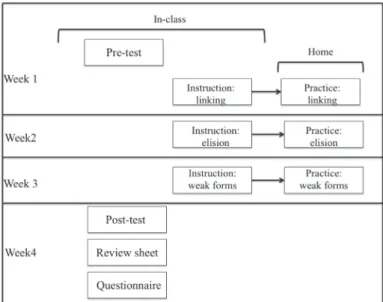
The outline of the experiment is explained. Figure 1 describes the overview of the experimental study. This experimental study was conducted over a four-week period. In Week One, participants were given a pre-test and lecture on linking. Then, the participants practiced linking four times a week for one week. Next, in Week Two, the participants were given a lecture on elision, and the participants practiced elision four times a week for one week. In Week Three, the participants were taught weak forms. Then, the participants practiced weak forms for one week. Finally, in Week Four, the participants
completed the post-test, the review sheet and the questionnaire.
Figure 1 Overview of the experimental study
Materials
Pre-test and Post-test. The pre-test and the post-test were a fill- in-the-blank dictation test such as used by Khaghaninezhad and Jafarzadeh (2014) using the audio of Pixar Animation Studio’s movie
“Cars” (Lasseter, 2006). The same dictation test was used in the pre-test and post-test in order to compare the participants’ progress in perceiving the same sound changes between the pre and post-test. The dictation test was composed of 10 questions. Some parts of the movie script including the sound changes were deleted. All the erased parts corresponded to the target sounds; 9 items of linking, 20 items of elision and 11 items of weak forms and 17 control items. The total number of target items was 40. The length of the movie audio used for the tests was
about 5 minutes.
Instructional Material (In-class). Three handouts made by the author were used as instructional materials for linking, elision and weak forms. The three handouts were composed of similar contents. The definition of the sound change was introduced first. Second, some examples of the sound changes were presented. Finally, the participants completed fill-in-the-blank dictation exercises.
Practice Material (Homework). The materials for practice were based on the web site titled “TED” and handouts made by the author.
The presentation “Try Something New for 30 Days” by Mutt Catts (Catts, 2011) on the web site was used for practicing through dictation or shadowing. This presentation was chosen because the presenter’s English pronunciation was easy to perceive, and because the words used in the presentation were easy and general. The length of this presentation was about three minutes. This presentation was divided into three sections about 30 seconds to one minute. One section was used for practice of each sound change each week.
Three types of handouts made by the author were used for practice.
The handouts were (1) scripts of the TED presentation (Catts, 2011) for practicing, (2) colored coded scripts of the presentation for confirming and (3) handouts for reviewing practice. In the scripts of the presentation, some parts including the target sounds of those scripts were deleted for dictation or shadowing practice of the deleted parts.
Second, the colored coded scripts of the presentation were the presentation scripts with the highlighted target sounds. The three kinds of target sounds were colored in different colors. These colored scripts were used for confirming the target sounds after the participants finished practicing. Third, the handouts for reflection were used to elicit
written reactions about practice by the participants. These three types of handouts were given to all the participants each week.
Review Sheet. The review sheet was used after the post-test for checking problems and for writing down reasons why the participants had difficulties with filling in the blank on their own. The whole script of the post-test was printed on the handout, and there were spaces to take notes. The participants wrote down their comments in the space freely.
Questionnaire. This questionnaire was used in order to find differences between the participants who could improve their segmentation skills remarkably and the participants who could not. The questionnaire included questions about participants’ previous study of the target sounds, participants’ understanding of the target sounds, methods of practice; dictation or shadowing, and experiences of staying abroad.
Procedure
The details of the procedure are described. For the pre-test, the participants were given the dictation sheet. They could listen to the movie audio three times. The first time, the movie audio was played at the normal speed. The second time, the movie audio was played with pauses of 15 seconds after the blanks. The third time, the movie audio was played at the normal speed again.
Participants were taught the three kinds of sound changes explicitly for three days using the handouts made by the author. The length of each lecture was about ten minutes. First, the participants were given the definition of the sound changes. Second, the participants learned the rules and the sounds of the sound changes using the examples of the
sound changes. Third, the participants practiced the sound changes by using exercises with blanks to fill in through dictation. Finally, the participants repeated the pronunciation of the sound changes. The lecture was conducted by the author. The examples of the sound changes and the sentences used in dictation were pronounced by a bilingual professor.
After the lectures, the participants practiced the sound changes by themselves using the web site “TED Talks”. The participants were given three kinds of handouts, scripts for practicing, scripts for confirming and handouts for reflection. Each participant practiced the target sounds through each method four days a week for three weeks. After every practice section, participants reflected on their own practice and wrote down their reactions about their learning while practicing after every practicing time.
Analysis
Pre and Post-test. The method of scoring the pre-test and post-test are explained in this section. All words in the test were divided into four categories: linking, elision, weak forms, and non-target words. Each word with a sound change was assigned to only one category. The non- target words were wards that did not contain target sound change. For example, drove and finally were three points: (1) /v/ of drove connects with /ən/ of and, so this is linking, (2) /d/ of and is omitted, so this was elision and (3) finally was a non-target word. For linking, one point was given if the first word which linked up with a following word was written correctly. For elision, one point was given if a word which included elision was written correctly. For weak forms, one point was given if a word which included weak forms was written correctly. For non-target
words, one point was given if a word which was not related to the target sounds was written correctly.
Review Sheet. On the review sheet, the participants wrote reasons why they could not recognize certain items on the test after they took the post-test. The number of comments related to the target sounds was counted. One point was given if the participants mentioned that they could not perceive the parts because of the target sounds. In the end, the number of comments about target sounds per person was calculated.
Questionnaire. The questionnaire responses were analyzed in two ways. For the multiple-choice questions, percentages were calculated.
For the description type questions, some tendencies were analyzed by comparing the dictation and shadowing groups, and by comparing the participants who improved their score more and those who improved less.
Results
Research Question 1. The current study investigated two research questions; (1) Are there any differences between dictation and shadowing as methods to improve the abilities to segment English spoken language? and (2) Are there any differences between learners who improved their segmentation skills more and those who did less?
The first section describes the results related to Research Question 1.
The pre-test and the post-test were analyzed in order to address Research Question 1. First, the mean scores for the pre-test and the post-test for each group were analyzed to find out if the practice methods were effective or not. Then, the gain scores for each category were analyzed to find out if there were differences between dictation and shadowing as methods to improve lexical segmentation abilities.
The current study employed the non-parametric Wilcoxon Signed Rank statistic using the SPSS v.21 program to compare the mean scores of the pre and post-test and test for statistically significant differences between each group. Alfa was set at 0.05 for all statistical calculations using the Wilcoxon Signed Rank statistic in the current study. The current study employed the non-parametric Wilcoxon Signed Rank statistic because the number of participants in each group was small, and also because the current study was conducted in a classroom setting, so the current study did not meet the assumptions of parametric tests (Turner, 2014). The current study also employed t-test to compare the gain scores of the dictation group and the shadowing group and investigate statistically differences between the gain scores of the dictation and the shadowing group. The number of participants was larger because the gain scores were compared among all participants, so t-test was employed (Turner, 2014).
Dictation Group. Table 1 shows the results of the dictation group.
The results of the dictation test suggest that dictation was not effective in significantly improving the lexical segmentation skills. Comparing the mean scores for the pre and post-test, participants scored higher on the post-test than on the pre-test. However, there were no statistical differences between the mean scores for the pre-test and the post-test.
Each category was analyzed through the Wilcoxon Signed Rank statistic to compare the mean scores of the pre and post-test. It was revealed that there were no statistically significant differences between the mean scores of the pre and post-tests overall nor for any of the target sounds.
Therefore, it means that dictation practices over three weeks were not effective to significantly improve the participants’ lexical segmentation skills.
Table 1 The mean scores for each category in the dictation group All target
Mean
Non-target Mean Linking
Mean
Elision Mean
Weak forms Mean Dictation (n=10)
pre-test 14.20 4.50 6.30 3.40 10.40
post-test 16.70 5.60 6.80 4.30 11.50
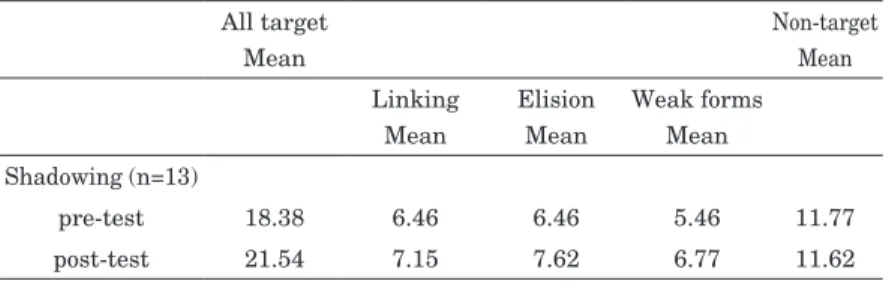
Shadowing Group. Through analyzing the results of the pre and post-test for the shadowing group, the results suggest shadowing was effective to improve lexical segmentation skills. Table 2 shows the results. The mean score for the post-test was higher than the mean scores of the pre-test, and also there were statistical differences between the mean scores of the pre-test and the post-test. The non-parametric Wilcoxon Signed Rank statistic was used in order to find statistical differences between the pre-test and the post-test. It showed that there was 95% certainty that there were statistical differences between the pre-test and the post-test of the target categories, all target (p=.003), linking (p=.030), elision (p=.011) and weak forms (p=.015). On the other hand, there was 95% certainty that there was no statistical significance in non-target words. Therefore, it means that shadowing practices over
Table 2 The mean scores for each category in the shadowing group All target
Mean
Non-target Mean Linking
Mean
Elision Mean
Weak forms Mean Shadowing (n=13)
pre-test 18.38 6.46 6.46 5.46 11.77
post-test 21.54 7.15 7.62 6.77 11.62
three weeks were effective to improve the lexical segmentation skills of the participants in the shadowing group.
Dictation Group and Shadowing Group. This section explains the compared results of the dictation and the shadowing group. Table 3 shows the gain scores of the dictation group and the shadowing group.
There was no statistical difference between both groups’ gain scores based on the t-test.
In conclusion, the results showed that the shadowing group showed their improvement statistically, on the other hand, the dictation group did not. However, the gain scores between the two groups were not statistically different. It is difficult to conclude which methods are more effective, but it is possible to say that the dictation group did not improve significantly and that the shadowing group improved more significantly. The extent to which the participants improve their lexical segmentation skills were a little different. In other words, both methods improved lexical segmentation skills, but shadowing was more effective than dictation.
Table 3
The gain scores of each category in the dictation group and the shadowing group All target
Mean
Non-target Mean Linking
Mean
Elision Mean
Weak forms Mean
Dictation (n=10) 2.50 1.10 0.50 0.90 1.10
Shadowing (n=13) 3.15 0.95 1.16 1.31 -0.15
Research Question 2. Research Question 2 was “Are there any differences between learners who improved their segmentation skills more and learners who improved less?”. In order to investigate Research Question 2, all the participants were divided into two groups based on
their gain scores. Table 4 shows the number.
Table 4
The number of participants who had gain scores more or less than average Gain scores more than average Gain scores less than average
Dictation (n=10) 4 6
Shadowing (n=13) 4 9
The review sheet and the questionnaire were analyzed in order to find out if there were differences in participants’ reactions between the participants whose gain scores were more than average and whose gain scores were less than average.
Comments on the Review Sheet. On the review sheet, the participants wrote the reasons why they could not perceive to specific parts correctly in the post-test after the test. The number of comments about the target sounds was counted in order to find differences between the participants who could improve their score more and the participants who could less for the research question 2. Table 5 shows the results.
The number of comments about the target sound changes by the participants whose gain score was more than average was 1.9. On the other hand, the participants whose gain score was less than average mentioned the target sound changes 1.2 times per person. The participants who improved their score more mention the sound changes
Table 5
The number of comments about the target sound changes was mentioned as the reasons for listening breakdown
Participants The average number of comments Participants whose gain score was more
than average (n=8) 1.9
Participants whose gain score was less than
average (n=15) 1.2
more than the participants who did not significantly improve their score.
The results for Research Question 2 suggest that the participants who improved more have more metacognition.
Questionnaire. As explained above, the questionnaire was analyzed in two ways. As a result, there were no obvious differences and tendencies in the answers.
Discussion
The following section discusses possible factors for the results of the pre and the post-test. There are two possible factors, improving phoneme perception and working memory.
Improving Phoneme Perception. Improvement of the shadowing group was statistically significant. Tamai (2005) and Kadota (2007) say that shadowing influences technical aspects of learners’ listening skills.
In addition, Kadota (2007) and Hamada (2016) state that shadowing leads to automatization of phoneme perception. In addition, according to Tamai (2005) and Hamada (2016), shadowing is beneficial for low- proficiency learners because low-proficiency learners’ bottom-up skills, which high proficiency learners already have, are improved through shadowing. The participants in the current study were generally low proficiency listeners. Therefore, the shadowing group may improve their scores more than the dictation groups.
Working Memory. Participants’ limited working memory might influence those results (Brunfaut and Revesz; 2015, Goh ;2000). In dictation activities, the participants listen to and hold sentences in their short-term memory while writing the sentence and listening to following information. In addition, the participants have to recall the spelling.
Dictation may require a larger working memory compared with
shadowing. Second language learners’ working memory is limited, so it could be that the participants could not afford to pay attention to the target sound changes while practicing. Therefore, the dictation group may not have increased their post-test score significantly.
Conclusion
The current study investigated differences between dictation and shadowing in effectiveness on improving lexical segmentation skills.
Also the study investigated differences between the participants who improved more and who improved less. The results for Research Question 1 showed that both dictation and shadowing might be effective to improve lexical segmentation skills. However, shadowing had stronger evidence than dictation. The results for Research Question 2 suggested that the participants who improved more might had more metacognition. There are some limitations in this study, but the results were found under these conditions. The final part explains limitations.
Limitations
There are a number of limitations to the current study. First, the number of participants was a small number. Second, the period for conducting the study was short term. Third, the condition of the experiment was not controlled strictly. In the current study, practicing the target sound changes through dictation or shadowing was given to the participants as homework, so their way of practicing was not controlled exactly by the author though the order of practicing was presented on the handout for doing homework. Fourth, the proficiency of the participants’ listening in the two groups was not necessarily at same level.
References
Brown, J.D, and Ann Hilferty. 1986. “The Effectiveness of Teaching Reduced Forms of Listening Comprehension.” RELC Journal 17. 59-70.
Cars. Dir. John Lasseter. Pixar Animation Studios. 2006. DVD.
Cutts, Matt. “Try Something New for 30 Days.” TED: Ideas Worth Spreading.
March 2011.
<https://www.ted.com/talks/matt_cutts_try_something_new_for_30_day>
Field, John. 2003. “Promoting Perception: Lexical Segmentation in L2 Listening.”
ELT Journal 57. 325-334.
Fukazawa, Toshiaki. 2015. go no Hatsuon Perfect Jiten. [The Perfect Dictionary of English Pronunciation]. Tokyo: Alc.(深澤俊昭『英語の発音パーフェクト 学習辞典』)
Goh, Christine C.M. 2000. “A cognitive Perspective on Language Learners’
Listening Comprehension Problems.” System 28. 55-75.
Hamada, Yo. 2016. “Shadowing: Who Benefits and Hou? Uncovering a Booming EFL Teaching Technique for Listening Comprehension.” Language Teaching Research 20. 35-52.
Hattori, Noriko. 2012. Ny mon go Onsēgaku. [The Introduction of English Phonetics]. Tokyo: Kenkyūsya.(服部範子『入門英語音声学』)
Kadota, Shūhē. 2007. Shadowing to Ondoku no Kagaku. [The science of Shadowing and Oral reading]. Tokyo: Cosmopier.(門田修平『シャードーイ ングと音読の科学』)
Kadota, Shūhē. 2012. Shadowing, Ondoku to go Sh toku no Kagaku. [Science of Shadowing, Oral Reading and English Acquisition]. Tokyo: Cosmopier.
(門田修平『シャドーイング・音読と英語習得の科学』)
Khaghaninezhad, Mohammad Saber, and Ghasem Jafarzadeh. 2014.
“Investigating the Effect of Reduced Forms Instruction on EFL Learners’
Listening and Speaking Abilities.” English Language Teaching 7. 159- 171.
Kiany, Reza G, and Ebrahim Shiramiry. 2002. “The Effect of Frequent Dictation on the Listening Comprehension Ability of Elementary EFL Learners.”
TESOL Canada Journal 20. 57-63.
The Ministry of Education, Culture, Sports, Science and Technology. Grōbarukani Taiō sita Eigo Kyōiku Kaikaku Jisshi Keikaku [The Plan of the English Educational reform for Globalization].(文部科学省『グローバル化に対応し た英語教育改革実施計画』) <http://www.mex.go.jp/b_menu/houdou/25/12/__
icsFiles/afieldfile/2013/12/17/1342458_01_1.pdf>.17 December 2013. 1 December
2014.
Nation, I. S. P. and J. Newton. 2009. Teaching ESL/EFL Listening and Speaking.
New York: Routledge.
Richards, C, Jack, and Richard Schmidt. 2002. Longman Dictionary of Language Teaching & Applied Linguistics. 3rd ed. Essex: Pearson Education Limited.
Roach, Peter. 1983. Ego Onsēgaku Oninron [English Phonetics and Phonology].
Trans. Takashi Shimaoka and Hiroshi Miura. Tokyo: Taisyūkan.(島岡丘・
三浦弘『英語音声学・音韻論』)
Takebayashi, Shigeru. 1996. go Onsēgau [English Phonetics]. Tokyo: Kenkyūsya.
(竹林滋『英語音声学』)
Tamai, Ken. 2005. Listening Shidō toshiteno Shadowing no Kōka ni Kansuru Kenky . [The study of the effects of shadowing as a method for teaching listening]. Tokyo: Kazama Syobō(玉井健『リスニング指導法としてのシャ ドーイングに関する研究』)
Tanaka, Eri, and Hiroyuki Yamanishi. 2011. “An Anallysis of the Effectiveness of a Phonetics/Phonology-Based English Listening Class.” JALT Journal 33. 49-66.
Turner, L. Jean. 2014. Using Statistics in Small-Scale Language Educational Research. New York: Routledge.
Vandergrift, Larry. 2008. “Learning Strategies for Listening Comprehension.”
Language Learning Strategies in Independent Settings. Ed. Stella Hurd and Tim Lewis. Bristol: Multilingual Matters. P. 84-103.
Yanagihara, Yumiko. 1995. “A Sutudy of Teaching Methods for Developing English Listening Comprehension: The Effects of Shadowing and Dictation.”
Language Laboratory 32. 73-89