• 検索結果がありません。

R^KRn TANAKA A

N/A
N/A
Protected

Academic year: 2021

シェア "R^KRn TANAKA A"

Copied!
4
0
0

読み込み中.... (全文を見る)

全文

(1)

THE BULLETIN OF OKAYAMA UNIVERSITY OF SCIENCE No. 46 A pp. 9-12(2010)

Presumption of Kinetic Constants by Simulation of A Production Process of Optical Isomers under Esterase Reaction

Mitsuo TANAKA and Ryoji MITSUI

Department ofBiochemistry, Faculty ofScience, Okayama University ofScience,

1-1 Ridai-cho, Kita-ku, Okayama city, Okayama 700-0005, Japan (Received September 15, 2010; accepted November 9, 2010)

We performed a site-specific and asymmetric hydrolysis of prochiral 2-phenyl-l,3-propanediol diacetate by a bacterial esterase. Several kinetic constants were presumed from the production experiment of 5-form isomer and fl-form isomer. Reaction rate constant (k) and Km value (KDm) were 13.7 mole/g/h and 1.92 x 10'2 mole/1, respectively, from the experimental data. In this experiment, the

hydrolysis by esterase followed first order reaction in order that the initial substrate concentration was very low. Reaction rate constants for tf-form isomer production (kR+l) and iS-form isomer production (*S+2) were 6.85 mole/g/h and 6.85 mole/g/h, respectively. When Km values for hydrolysis of R-form isomer (J^m) and that of 5-form isomer (A^) were assumed to be 1.92 x 10"2 mole/1 each, reaction rate constants for hydrolysis of 5-form isomer (Ars+4) and that of jR-form isomer (#R+3) were 2.95 mole/g/h and

7.75 mole/g/h, respectively.

Keywords: Presumption of kinetic constants; Optical isomers; 5-form; /?-form; Esterase reaction.

Introduction

Optically pure 2-substituted-l,3-propanediol derivatives are useful chiral building blocks which are required for the synthesis of bioactive compounds. Therefore, we performed a site-specific and asymmetric hydrolysis of prochiral 2-phenyl-l,3-propanediol diacetate by a bacterial esterase (Ref. 1). And also, several kinetic constants were presumed from the production experiment of S-form and /?-form.

1. Experimental

The hydrolysis by esterase was carried out as described previously (Ref. 1).

2. Theoretical consideration

The hydrolysis process to /?-form (R) and S-form (5) as isomers and then to diol (Do) of diacetate (Da) by esterase assumes as follows.

Da

KD,

KD,

R ^KRn

/f*+3

Do (1)

For simplification, if each step of this reaction (Eq. (1)) is Michaelis-Menten type, and substrate and product inhibitions do not occur, the enzyme reaction rate is generally obtained from the following equation.

v = kE0Ss/(Km + Ss) (2)

Where, Eo is initial enzyme concentration, k is reaction rate constant, Km is Michaelis constant, and Ss is

(2)

10 Mitsuo Tanaka and Ryoji Mitsui

substrate concentration.

If the substrate concentration (Da) is very low compared with Km value (A^m), Eq. (2) is expressed with Eq.

(3).

kE0Ss/Km = kE0Da/Km (3)

That is, this enzyme reaction proceeds under a first order reaction rate for the substrate. Therefore, reaction rate equation of each step is expressed as follows.

(4)

(5) (6)

-dDa/dt = (klm 2

dR/dt = kR+lE0Da/KDm - k^

dS/dt = A^/A^mDa - k\4E0S/Ksm

And also,

Do = (Da,o - Da) - (R (7)

Where, Da,o is initial substrate concentration.

When the equation (4), (5) and (6) are integrated sequentially, the following equations are obtained.

Da = Da,oExp(-(*R+1 + It?+2)Eot/K?m) R = (*RWDa,o//^m)(*R+3/KRm - (*

(1 - Exp(-(kR+3/!?m - (*R+1 + ks+2)/KDm)E0t)) S = (^s+2Eo2D

(8)

(9)

(10) 3. Presumption of kinetic constants by simulation of experimental values

First, from the experimental data of substrate hydrolysis (Da), the hydrolysis rate constant (k) and Michaelis

constant CKDm) must be presumed. Therefore, Eq. (2) was integrated, and the following equation was obtained.

Vm = AE0 = (A:m/t)ln(Ss/Ss,o) + (Ss - Ss,o)/t (11)

Where, * = kR+l + *s+2, kR+J = ks+2, Km = KDm, Ss,o = Da,o and Ss = Da. And Eo and Da,o were 2.5 x 10"3 g/1

and 0.01 mole/1 (=10 mM), respectively, from the experimental data (Ref. 1).

en
O en 1

LO '

0

D 9a.

0 0.01

(Ss,o - Ss)/t

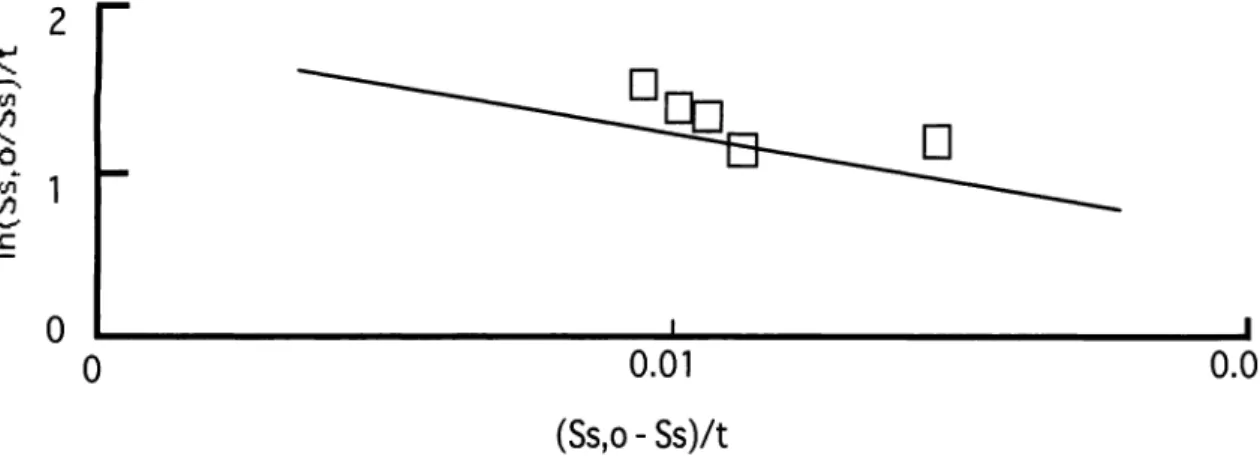
Fig. 1. Decision of kinetic constants (k and Km (=

0.02

i for hydrolysis of diacetate (Da).

(3)

Presumption of Kinetic Constants by Simulation of A Production Process of Optical Isomers under Esterase Reaction 11

As shown in Figure 1, from the relationship of ln(Sso/S)/t and (Ss,o - S)/t, k and Km (= A:Dm) were about 13.7 mole/g/h and 1.92 x 10"2 mole/1, respectively.

Next, by using these values obtained experimentally, another kinetic constants must be presumed. For simplicity, Michaelis constants for S-form isomer (Ksm ) and /?-form isomer (A*m ) were assumed as equal to Michaelis constant for substrate (A?m). Hydrolysis rate constants for S-form isomer (£s+4) and /?-form isomer (k\3) were presumed as 2.95 mole/g/h and 7.75 mole/g/h, respectively.

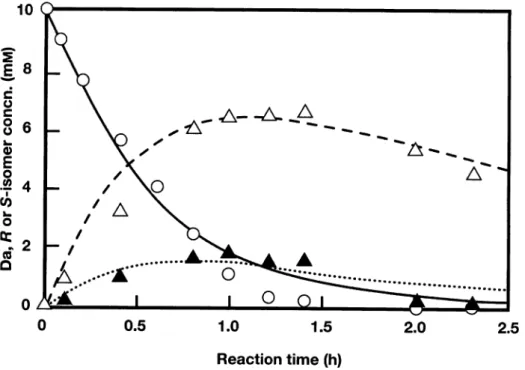
Figure 2 is the result simulated as ^m = 1.92 x 10"2 mole/1, *R+1 = ks+2 = 6.85 mole/g/h, and K?m = Ksm=\ .92 x 10" mole/1, *R+3 = 7.75 mole/g/h and ks+4 = 2.95 mole/g/h. Where, Eo = 2.5 x 10"3 g/1, Da,o = 10 mM.

^ A- -A. J± ^

Reaction time (h)

Fig. 2. Comparison with experimental values and result of simulation. Experimental values: O; Concn.

of substrate (Diacetate), A; Concn. of S-form isomer, A; Concn. of /?-form isomer, Calculation result:

Solid line; Concn. of Da, Broken line; Concn. of S-form isomer, Dotted line; Concn. of fl-form isomer.

4. Discussion

In the case of kR+l = ks+2 = kR+3 = ks+4 = 6.85 mole/g/h, that is, all of the reaction rate constants are equal, if Michaelis constant for R-fonn isomer is 1.70 x 10"2 mole/1, and that for S-form isomer is 4.45 x 10"2 mole/1, similar simulation result can be obtained. Apparently from Eq. (2), if the reaction rate constant is the same value each other as the above case, in the case that Michaelis constant is lower, the reaction velocity must be higher. That is, the hydrolysis velocity of S-form isomer is lower than that of fl-form isomer. This result shows that the affinity to #-form isomer of the esterase used is higher than that to S-form isomer. Those values seem to be suitable. Moreover, those Michaelis constants are not in conflict with the assumption of Eq. (3).

Consequently, from data shown in Figure 1, those kinetic constants with a higher accuracy may not be obtained.

That is, the values of kR+3, *S+4, A^m and A:sm are not decided unequivocally in order to the lack of experimental data. However, the values of k?+3/KRm and ks+4/J^m are, respectively, 4.04 x 10² 1/g/h and 1.54 x 10² 1/g/h unequivocally. Incidentally, k/KDm = 7.13 x 10²¹/g/h.

Conclusions

The result of simulation is relatively good compatible with the experimental values. Therefore, esterase reaction in this experiment is first order reaction, and from the above theoretical consideration, kinetic constants of esterase used in experiment could be presumed. That is, Michaelis constant for hydrolysis of substrate (Km=

K m) is 1.92 x 10'2 mole/1, reaction rate constant for hydrolysis of substrate (k) is 13.7 mole/g/h, ^+1 = ks+2 = a

half of k, Michaelis constant for hydrolysis of /?-form isomer (A:Rm) and that of S'-form isomer (/Csm) is 1.92 x 10'2

mole/1, and reaction rate constant for hydrolysis of /?-form isomer and that of S-form isomer is 7.75 mole/g/h and

2.95 mole/g/h, respectively.

(4)

12 Mitsuo Tanaka and Ryoji Mitsui

Notation

Da ; Substrate concentration at arbitrary reaction time (mole/1).

Da,o ; Initial substrate concentration (mole/1)

Do ; Diol concentration at arbitrary reaction time (mole/1) Eo ; Initial enzyme concentration (g/1)

Ss,o ; Initial substrate concentration (mole/1)

Ss ; Substrate concentration at arbitrary reaction time (mole/1) t; Time of hydrolysis (h)

R ; R- form isomer concentration at arbitrary time (mole/1) S ; S- form isomer concentration at arbitrary time (mole/1) v; Reaction velocity (mole/l/h)

Vm ; Maximum velocity of enzyme reaction (= kE0) (mole/l/h) Km ; Michaelis constant (mole/1)

ATDm ; Michaelis constant for hydrolysis of substrate (diacetate) (mole/1) KKm ; Michaelis constant for hydrolysis ofR- form isomer (mole/1) Ksm ; Michaelis constant for hydrolysis of S- form isomer (mole/1)

k ; Hydrolysis rate constant of substrate (mole/g/h)

kR+\ ; Hydrolysis rate constant to R- form isomer (mole/g/h)

£R+3; Hydrolysis rate constant to diol (mole/g/h)

£s+2; Hydrolysis rate constant to S- form isomer (mole/g/h) ks+4; Hydrolysis rate constant to diol (mole/g/h)

References

1. Ryoji Mitsui, Seiho Shinya, Yuichi Ichikawa, Kenta Kudo, Takuo Tsuno, and Mitsuo Tanaka : Site-Specific

and Asymmetric Hydrolysis of Prochiral 2-Phenyl-l,3-propanediol Diacetate by a Bacterial Esterase from an

Isolated Strain, Biosci.Biotechnol. Biochem.Jl (8), 1858 -1864 (2007).

Fig. 1. Decision of kinetic constants (k and Km (=
Figure 2 is the result simulated as ^m = 1.92 x 10"2 mole/1, *R+1 = ks+2 = 6.85 mole/g/h, and K?m = Ksm=\ .92 x 10" mole/1, *R+3 = 7.75 mole/g/h and ks+4 = 2.95 mole/g/h

参照

関連したドキュメント

If in the infinite dimensional case we have a family of holomorphic mappings which satisfies in some sense an approximate semigroup property (see Definition 1), and converges to

For a compact complex manifold M , they introduced an exact cube of hermitian vector bundles on M and associated with it a differential form called a higher Bott-Chern form.. One

This set will be important for the computation of an explicit estimate of the infinitesimal Kazhdan constant of Sp (2, R) in Section 3 and for the determination of an

The idea of applying (implicit) Runge-Kutta methods to a reformulated form instead of DAEs of standard form was first proposed in [11, 12], and it is shown that the

A conjecture of Fontaine and Mazur states that a geo- metric odd irreducible p-adic representation ρ of the Galois group of Q comes from a modular form ([10]).. Dieulefait proved

For the class of infinite type hypersurfaces considered in this paper, the corresponding convergence result for formal mappings between real-analytic hypersurfaces is known as

Section 3 is first devoted to the study of a-priori bounds for positive solutions to problem (D) and then to prove our main theorem by using Leray Schauder degree arguments.. To show

Then the strongly mixed variational-hemivariational inequality SMVHVI is strongly (resp., weakly) well posed in the generalized sense if and only if the corresponding inclusion