多素子MIMOを用いるマクロセルにより統治された異 種混合無線ネットワークのためのリソース割当と干 渉制御
?, 万明
https://doi.org/10.15017/1931936
出版情報:Kyushu University, 2017, 博士(工学), 課程博士 バージョン:
権利関係:
.
Resource Allocation and Interference Management for Heterogeneous
Networks Governed By Massive MIMO Macro Cell
Wanming Hao
Graduate School of Information Science and Electrical Engineering Kyushu University
This dissertation is submitted for the degree of Doctor of Engineering
Kyushu University March 2018
Acknowledgements
I would like to express my special appreciation and thanks to my supervisor Assoc. Prof.
Muta Osamu for his support and guidance. I am very grateful for the pleasant research environment and the tremendous opportunity to pursue a Ph.D. he gave me. His prudence and perseverance for research became a model for me. He gave me many chance to attend national and international conference to improve myself. Besides this, he gave me lots of useful advice during our weekly meeting. He helped me improve my paper, presentation and encourage me to exploit my full potential in academic studies. I will cherish the friendship with him.
I would like to thank Prof. Furukawa Hiroshi. His expertise and wisdom in the research area are significant value to me. His exceptional motivation, vision and integrity will always be an inspiring role model for my future career. I also would like to thank Prof. Okamura Koji and Assoc. Prof. Jitsumatsu Yutaka for their comments and advice for improving my thesis. I also would like to thank Dr. Haris Gacanin for his help in modifying my paper, and gave me many useful advice for writing and presentation.
I would like to thank my colleague in our laboratory, namely Dr. Togashi Hiroaki, Mr.
Kojima Yuki, Mr. Kageyama Tomoya, Mr. Matsuzaki Kouki and so on. I also would like to thank my roommates, Mr. Kai Wen and, Mr. Xiaochen Yang. I also would like to thank my friends, Miss Ting Cheng, Mr. Shiyan Feng, Mr. Liang Shang and so on. They gave me lots of help in my life and research.
Last, my special gratitude goes to my family for their unconditional love and infinite encouragement. Thank you all for supporting me in all my pursuits.
Wanming Hao
Fukuoka, Japan, March, 2018
Abstract
Given the 1000x capacity increase requirement for the next-generation cellular networks, massive multiple input multiple output MIMO (mMIMO), small cells (SCs) and cognitive radio (CR) have been proposed as important techniques. Therefore, the mMIMO coexists with CR or SCs to form an mMIMO heterogeneous network (HetNet), i.e., mMIMO-CR HetNet and mMIMO-SC HetNet, will be promising schemes. However, it brings more challenges due to the combination, especially for pilot contamination and interference management. The theme of this thesis is to propose advanced schemes for improving the achievable capacities (including per-user transmission rate and system sum rate) in mMIMO-HetNet by reducing the pilot contamination and coordinating the interference, which is divided to three parts.
For the first part (i.e., chapter 2), we study the pilot allocation problem in mMIMO homo- geneous network for reducing the pilot contamination. To reduce the required complexity for finding the optimum pilot allocation, we propose a low-complexity pilot allocation algorithm.
In addition, to improve users’ fairness, we formulate a fairness aware pilot allocation problem and solve the formulated problem using a similar algorithm. Simulation results show that our proposed pilot allocation scheme can improve per-user transmission rate by about 17% in comparison with the conventional pilot allocation scheme.
For the second part (i.e., chapters 3 and 4), we study the pilot and power allocation problems in mMIMO-CR HetNet. We first propose a price-based iterative pilot allocation algorithm to obtain a win-win paradigm between primary network (PN) and cognitive network (CN) in chapter 3. The results show that the PN and CN can obtain positive revenue, which implies that pilot sharing concept between PN and CN is effective in improving the performance of both PN and CN. Next, to avoid producing serious interference from the CN to PN, we investigate the power allocation problem of the CN in mMIMO-CR HetNet with pilot contamination in chapter 4. We propose an orthogonal pilot sharing scheme at pilot transmission phase, where cognitive users are allowed to use pilots for channel estimation only when there are temporarily unused orthogonal pilots. Following this, we formulate the power allocation optimization problem of the CN to maximize the downlink sum rate of the CN subject to the total transmit power and primary users’ signal to interference plus noise ratio (SINR) constraints. Then, we propose an iterative algorithm to solve the formulated
problem. The numerical results show that our proposed scheme can improve the sum rate of the CN by about 10% in comparison with the conventional scheme.
For the third part (i.e., chapters 5 and 6), we investigate the pilot allocation and inter- ference management problems in mMIMO-SC HetNet. We first propose a pilot allocation scheme for maximizing ergodic downlink sum rate of the system in chapter 5, where the uplink pilot overhead and inter-tier interference are jointly considered. Then, we propose a low complexity one dimensional search algorithm to obtain the optimum pilot allocation.
In addition, we propose two suboptimal pilot allocation algorithms to simplify the compu- tational process and improve users’ fairness, respectively. Simulation results show that our proposed scheme can improve the sum rate of the system by about 12% in comparison with the conventional scheme. Based on this, we investigate the dynamic SC clustering strategy and their precoding design problem for interference coordination in mMIMO-SC HetNet in chapter 6. An interference graph-based dynamic SC clustering scheme is proposed. Based on this, we formulate an optimization problem to design precoding weights at macro base station and clustered SCs for maximizing the downlink sum rate of SC users subject to the power constraint of each SC base station. A non-cooperative game-based distributed algorithm is proposed to solve the formulated problem. Simulation results show that our proposed scheme can improve the sum rate of SC users by about 40% in comparison with the conventional scheme.
In conclusion, through the above analysis and results, this thesis clarifies that the proposed schemes (pilot allocation, power allocation, SC clustering, and precoding design) are effective in increasing the achievable capacities in two types of NetNets (i.e., CR-type and SC-type) governed by mMIMO macro cell.
Table of contents
List of figures xi
List of tables xiii
List of abbreviations xv
1 Introduction 1
1.1 Background . . . 1
1.1.1 Massive MIMO and Heterogeneous Network . . . 1
1.1.2 Cognitive Radio Type Heterogeneous Network with Massive MIMO 3 1.1.3 Small Cell Type Heterogeneous Network with Massive MIMO Macro Cell . . . 5
1.2 Technical Challenges for Heterogeneous Network with Massive MIMO . . 5
1.2.1 Application of Massive MIMO to Heterogeneous Network . . . 5
1.2.2 Challenges for Cognitive Radio Type Heterogeneous Network with Massive MIMO . . . 7
1.2.3 Challenges for Small Cell Type Heterogeneous Network with Mas- sive MIMO Macro Cell . . . 8
1.3 Motivations and Contributions of This Thesis . . . 8
1.3.1 Motivations of This Thesis . . . 8
1.3.2 Contributions of This Thesis . . . 9
1.4 Organization of This Thesis . . . 9
2 Pilot Allocation for Massive MIMO Homogeneous Network 11 2.1 Introduction . . . 11
2.2 System Model . . . 12
2.3 Problem Formulation and Solution . . . 14
2.3.1 Problem Formulation Based on Sum Rate Maximization . . . 15
2.3.2 Proposed Sum Rate Maximization Scheme . . . 15
2.3.3 Problem Formulation Based on Users’ Fairness . . . 18
2.4 Numerical Results and Discussion . . . 20
2.5 Conclusions . . . 24
3 Pilot Allocation for Cognitive Radio Type Heterogeneous Network with Mas- sive MIMO 25 3.1 Introduction . . . 25
3.2 System Model and Proposed Scheme . . . 26
3.2.1 System Model . . . 26
3.2.2 Proposed Scheme . . . 29
3.3 Simulation Results and Discussions . . . 30
3.4 Conclusions . . . 33
4 Power Allocation for Cognitive Radio Type Heterogeneous Network with Mas- sive MIMO 35 4.1 Introduction . . . 35
4.2 System Model . . . 36
4.2.1 Uplink Training Transmission . . . 38
4.2.2 Downlink Data Transmission . . . 39
4.3 Problem Formulation . . . 40
4.4 The Solution of The Optimization Problem . . . 42
4.4.1 Problem Transformation . . . 42
4.4.2 Problem Solution . . . 44
4.5 Performance Analysis of the PN and CN with mMIMO . . . 47
4.5.1 MP→∞andMS is fixed . . . 47
4.5.2 MS→∞andMP is fixed . . . 49
4.5.3 MS→∞andMP→∞ . . . 50
4.6 Numerical Results and Discussions . . . 51
4.7 Conclusions . . . 58
5 Pilot Allocation for Small Cell Type Heterogeneous Network with Massive MIMO Marco Cell 59 5.1 Introduction . . . 59
5.2 System Model . . . 60
5.3 Problem Formulation and Solution . . . 62
5.3.1 Ergodic Downlink Rate of The MU and SU . . . 62
5.3.2 Problem Formulation . . . 63
Table of contents ix
5.3.3 Problem Solution . . . 65
5.4 Simulation Results and Discussions . . . 68
5.5 Conclusions . . . 72
6 Small Cell Clustering and Precoding Design for Small Cell Type Heterogeneous Network with Massive MIMO Marco Cell 75 6.1 Introduction . . . 75
6.2 System Model and Problem Formulation . . . 77
6.2.1 System Model . . . 77
6.2.2 Problem Formulation . . . 79
6.3 SC Clustering Scheme for Interference Coordination . . . 80
6.4 CSBD Precoding Design for MBS . . . 83
6.5 Non-Cooperative Game-Based Precoding Design for Clustered SCs . . . . 85
6.5.1 The Formulated Non-Cooperative Game Model . . . 87
6.5.2 The Solution of the Non-Cooperative Game . . . 88
6.5.3 NE Searching Algorithm . . . 91
6.6 Numerical Results and Discussions . . . 92
6.7 Conclusions . . . 99
7 Conclusions and Future Works 101 7.1 Conclusions . . . 101
7.2 Future Works . . . 102
References 105
Appendix A 111
Appendix B 113
Appendix C 115
Appendix D 119
Appendix E 121
Appendix F 123
List of figures
1.1 Global mobile data traffic growth. . . 2
1.2 Global mobile devices and connections growth. . . 2
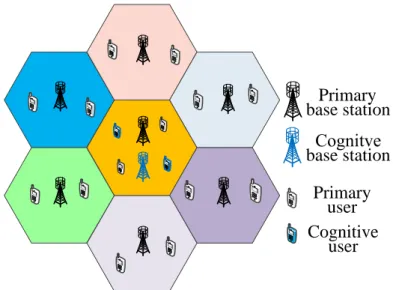
1.3 The CR type HetNet model. . . 3
1.4 The SC type HetNet model. . . 4
1.5 The wireless spectrum utilization. . . 4
2.1 Uplink interference model for the multi-cell mMIMO system. . . 13
2.2 Iteration diagram for pilot allocation in the proposed algorithm. . . 16
2.3 The model of the inter-cluster interference and different colors denote the different clusters. . . 21
2.4 The average uplink rate versus the number of BS antennas with different algorithms (K=4). . . 22
2.5 The average uplink rate versus the number of users per cell. . . 22
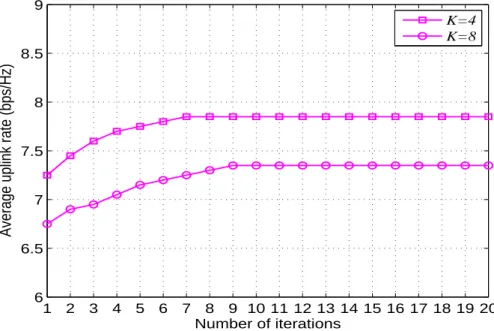
2.6 The average uplink rate versus the number of iterations. . . 23
2.7 CDF versus users’ uplink achievable rate (bps/Hz) (K=4,M=100). . . 23
3.1 System model for spectrum-sharing mMIMO networks. . . 26
3.2 Proposed pilot allocation algorithm flow diagram. . . 29
3.3 The relation among PCS, PN and CN. . . 30
3.4 Revenue versus (1-p). . . 31
3.5 NIP versus (1-p). . . 31
3.6 Pilot lease price versus iteration step when p=0.8. . . 32
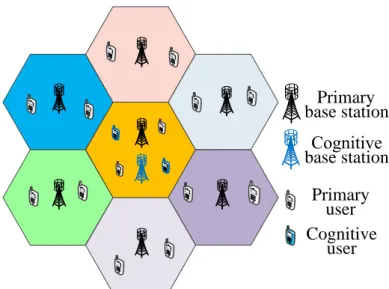
4.1 System model for mMIMO-CR networks. . . 37
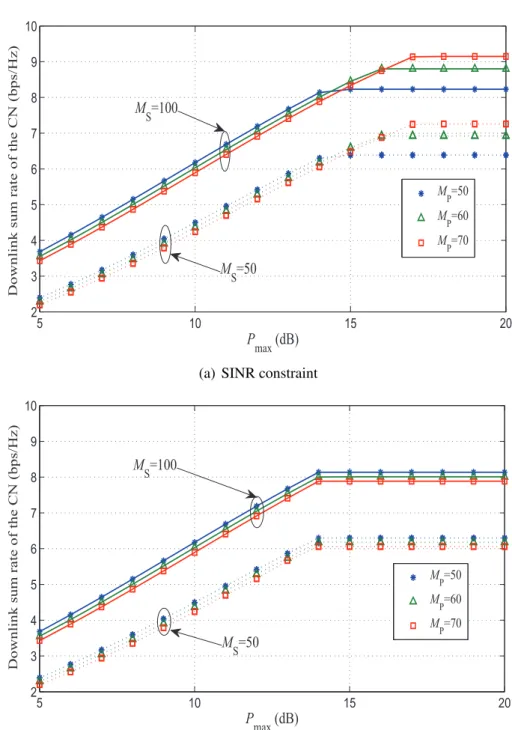
4.2 Downlink sum rate of the CN versusPmaxwithη=8 dB. . . 52
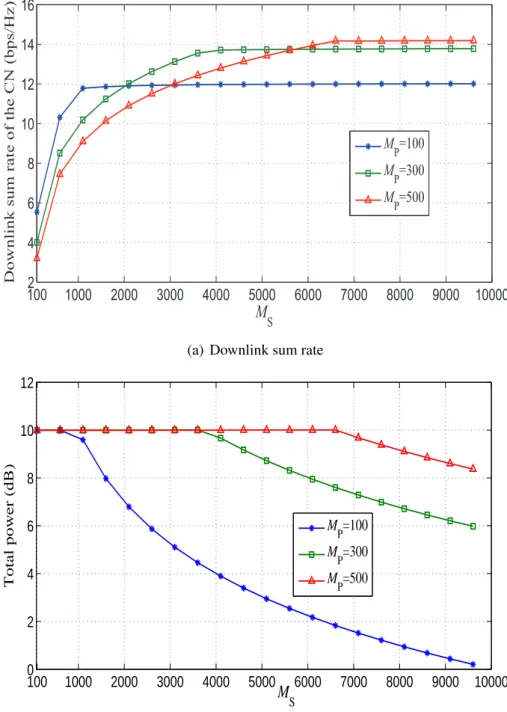
4.3 Downlink sum rate and corresponding transmit power of the CN versusMS withη=8 dB,Pmax=10 dB. . . 53
4.4 Downlink sum rate of the CN versusMPwithη=8 dB,Pmax=10 dB. . . . 55
4.5 Downlink sum rate of the CN versusη under differentPmax. . . 55
4.6 Downlink sum rate of the CN versusMS withη=8 dB,Pmax=10 dB under
different number of active CUs. . . 56
4.7 Downlink sum rate of the CN versusMP withη=8 dB,Pmax=10 dB under different number of active CUs. . . 56
4.8 Downlink sum rate of the CN versus iteration number. . . 57
5.1 The mMIMO-SC HetNet model. . . 60
5.2 Illustration of approximation in Algorithm 4. . . 67
5.3 The ergodic downlink rate versusNMwithK=50 andKO=20. . . 69
5.4 The ergodic downlink sum rate versusKOwithNM=500 andK=50. . . . 70
5.5 The ergodic downlink sum rate versusNM withK=50. . . 70
5.6 The ergodic downlink sum rate versusKwithNM=500. . . 71
5.7 The CDF of SU’s ergodic downlink rate withNM=500 andK=50. . . 72
6.1 System model for small cluster-based two-tier downlink mMIMO-SC HetNet. 77 6.2 An example for interference graph. . . 80
6.3 An example for SC clustering withγth=-100dB. . . 81
6.4 An example for SC clustering withγth=-105dB. . . 81
6.5 Downlink sum rate of SUs versus iteration number. . . 93
6.6 Downlink sum rate of SUs versus interference price. . . 94
6.7 Downlink sum rate of SUs versus interference threshold. . . 94
6.8 Downlink sum rate of SUs versus interference price. . . 95
6.9 Downlink sum rate of SUs versus number of SUs. . . 95
6.10 Downlink sum rate of SUs versus transmit power. . . 96
6.11 Transmit power versus available transmit power at each SBS. . . 96
6.12 Downlink sum rate of MUs versus number of MBS antenas. . . 97
6.13 Downlink sum rate of MUs versus number of SBS antenas. . . 97
List of tables
2.1 The utility of pilot allocation . . . 17
2.2 Simulation Parameters. . . 20
5.1 Simulation parameters. . . 68
6.1 Simulation Parameters. . . 92
List of abbreviations
Acronyms / Abbreviations
AWGN Additive White Gaussian Noise BBU Baseband Processing Unit
BS Base Station
CBS Cognitive Base Station
CC Cognitive Cell
CCU Central Control Unit
CDF Cumulative Distribution Function
CN Cognitive Network
CoMP Coordinated Multiple Process
CR Cognitive Radio
CSBD Clustered Small Cell Block Diagonalization CSI Channel State Information
CU Cognitive User
DoF Degree Of Freedom
FCC Federal Communications Commission
H-CRAN Heterogeneous Centralized Radio Access Network HetNet Heterogeneous Networks
MBS Macro Base Station
MF Match Filter
MIMO Multiple Input Multiple Output MIP Mixed Integer Programming
mMIMO Massive Multiple Input Multiple Output MMSE Minimum Mean Squared Error
MRC Maximum Ratio Combining MRT Maximum Ratio Transmission
MU Macro User
NE Nashi Equilibria PBS Primary Base Station
OFDMA Orthogonal Frequency Division Multiple Access
PC Primary Cell
PCS Price Control Side
PN Primary Network
PU Primary User
QoS Quality Of Service RRH Remote Radio Head SBS Small Cell Base Station
SC Small Cell
SINR Signal To Interference Plus Noise Ratio
SU Small Cell User
SVD Singular Value Decomposition TDD Time Division Duplex
List of abbreviations xvii WCDMA Wideband Code Division Multiple
ZF Zero Forcing
Chapter 1 Introduction
1.1 Background
Over the past a few decades, the wireless communications and networks have witnessed an unprecedented growth and steady evolution from the first to the fourth generation wireless networks. Meanwhile, some advanced techniques, like wideband code division multiple access (WCDMA), orthogonal frequency division multiple access (OFDMA) etc., have significantly contributed towards this gradual evolution. However, in recent years, the mobile data traffic (e.g., mobile video conference, streaming video and online game, etc.) and the advanced communication devices (e.g., smartphones, tablets and laptops, etc.) have been increasing rapidly. Fig. 1.1 and Fig. 1.2 show the demand for mobile data traffic and devices from 2016 to 2021, respectively [1]. The global mobile data traffic is expected to increase to 49 exabytes per month by 2021, and the number of mobile devices and connections are expected to grow to 11.3 billion by 2021. Although the increasing smartphones and multimedia services satisfy users’ experiences and requirements, the recent mobile network has not achieved enough capacity to provide such huge increase of the video traffic in future [2]-[4]. As a result, how to satisfy the increasing traffic requirement has become one of challenges in future mobile networks. Two promising techniques to solve this issue are massive multiple input multiple output (mMIMO) and heterogeneous network (HetNet) concepts.
1.1.1 Massive MIMO and Heterogeneous Network
mMIMO is an effective technique to improve the capacity, where the base station (BS) is equipped with a large number of antennas to serve multiple users with the same time frequency resource, i.e., the number of user terminals is much less than the number of BS
7 11 17 24 3549 8
7EB
49EB
0 10 20 30 40 50 60
2016 2017 2018 2019 2020 2021
Exabytes per month
Year
Fig. 1.1 Global mobile data traffic growth.
8.68 9.2 10.610 11.3
8
11.3
0 2 4 6 8 10 12
2016 2017 2018 2019 2020 2021
Billions of devices
Year
Fig. 1.2 Global mobile devices and connections growth.
antennas [5]. In this case, the huge throughput can be obtained because of the high degrees of freedom for mMIMO BS. Meanwhile, it has been verified that the full advantage of the mMIMO can be exploited by using simple linear-based approaches such as maximum ratio transmission (MRT), maximum ratio-combining (MRC) or zero forcing (ZF) [6]. The effects of fast fading, intra-cell interference and uncorrelated noise tend to disappear as the number of BS antennas grows enough large.
On the other hand, the HetNet is also a promising scheme to improve capacity. Different from the conventional homogeneous network which is governed by only one type of network, HetNet is defined as the combination of different types of networks. We can categorize HetNet into two types in a viewpoint of what system coexists, i.e., cognitive radio (CR) type and small cell (SC) type. In the former case, the primary network (PN) and cognitive network (CN) coexist to form a CR-type HetNet as shown in Fig. 1.3, where both networks have different priorities. In the later case, the macro cell (MC) network and SC network coexist to form a SC-type HetNet as shown in Fig. 1.4, where both networks have the same priority
1.1 Background 3
Primary base station
Cognitive base station
Primary user Cognitive
user
Fig. 1.3 The CR type HetNet model.
unlike the CR type. In this study, it is assumed that both types of HetNets are governed by MC with mMIMO to improve the system capacity. In the following sections, these two types of HetNets are explained, respectively.
1.1.2 Cognitive Radio Type Heterogeneous Network with Massive MIMO
The advantages of the CR-type HetNet can be summarized as follows: It is well known that more spectrum can bring higher throughput, but it seems that the wireless spectrum has crowded, and no more possible assignments for new users or services. However, the real problem of the spectrum scarcity has been shown by Federal Communications Commission (FCC) due to the fixed assignment of radio resource [7]. For example, Fig. 1.5 shows that the spectrum are not used at all time, and there always exists spectrum idle. Therefore, how to fully utilize those temporarily unused spectrum and improve the spectrum utilization is critical. Based on this, the CR technology has been proposed [8], which is defined as an intelligent wireless communication system that is aware of its surrounding environment in real-time. The CR can scan the frequency band of interest to assess the presence of active primary users (PUs) through a spectrum sensing process. For a given sensing result, CR needs to implement an adequate protocol for using the spectrum, namely spectrum access technique. There are three main spectrum access schemes: underlay, interweave and overlay [9]. Under the underlay design, cognitive users (CUs) are allowed to share the licensed spectrum with PUs as long as the interference to PUs is below a given threshold.
By contrast, under the interweave design, CUs are requested to use the licensed spectrum
Signal Interference
Macro BS
Small cell BS Macro user Small cell user
Fig. 1.4 The SC type HetNet model.
2
Research Background (1/3) -- Cognitive Radio (CR) ---
Cognitive radio (CR)is an effective approach for improving the spectrum utilization Fig. 1.5 The wireless spectrum utilization.
only when the spectrum are not used by PUs. Similarly with the first design, under the overlay design, CUs are allowed to share the licensed spectrum with PUs. However, CUs are requested to cooperate with PUs’ communication by using some sophisticated signal processing and coding technology, while obtaining the chance for their own communication.
From the above analysis, it is clear that the CR technology coexisted with primary MC is treated as the HetNet, and different priority should be considered, namely the PUs have the high priority to use the resource. In other words, transmission power and available resources for the CN are strictly restricted unlike the PN.
We have analyzed the advantages of mMIMO and HetNet in improving the capacity in previous section. Therefore, to future improve the performance of the CR-type HetNet, the
1.2 Technical Challenges for Heterogeneous Network with Massive MIMO 5 primary BS (PBS) and cognitive BS (CBS) can be equipped with a large number of antennas and form a CR-type HetNet with mMIMO. Hereafter, we denote it as mMIMO-CR HetNet in this thesis.
1.1.3 Small Cell Type Heterogeneous Network with Massive MIMO Macro Cell
For the SC-type HetNet, it is well known that the deployment of SCs can effectively improve the throughput of the system. For example, in a multi-user network, users in the coverage of a cell share the available bandwidth. Thus, reducing the cell size and deploying more cells also reduce the coverage of per cell, and in turn increases the bandwidth available to each user. Meanwhile, the deployment of SCs shortens the distance between terminals and BSs, and thus 1) lowering the transmit power, 2) improving the signal to noise ratio and 3) realizing the dense spectrum reuse, such as femtocells, picocells and microcells. In addition, different from the CR-type HetNet, all users own the same priority to use resource.
Similar to the mMIMO-CR HetNet, all BSs can be also equipped with a large number of antennas in the SC-type HetNet for improving the achievable capacity of the system.
However, we know that there are two classes of BSs. One is the macro BS (MBS) that has the high transmit power and large coverage area. The other is the SC BS (SBS) that has the low transmit power and small coverage area, and its physical size is also small. Therefore, it is unnecessary and difficult to equip a large number of antennas at SBS. Based on the above discussion, in this study, it is assumed that a large number of antennas is equipped on only MBS coexisted with SCs to form a SC-type HetNet with mMIMO MC. Hereafter, we denote it as mMIMO-SC HetNet in this thesis.
1.2 Technical Challenges for Heterogeneous Network with Massive MIMO
1.2.1 Application of Massive MIMO to Heterogeneous Network
We have analyzed the advantages of the mMIMO-CR and mMIMO-SC HetNets in the previous subsection. However, there also exist technical challenges for the application of mMIMO techniques. In general, the precoding is used at mMIMO BS to cancel multi-user interference. In this case, the channel state information (CSI) should be obtained by channel estimation. Channel estimation is usually based on pilot, including uplink pilot (from users to the BS) and downlink pilot (from the BS to users). For the downlink pilot, the demand
of the orthogonal pilots (here, orthogonal pilots means that the different pilot codes are orthogonal) is huge when there are a large number of BS antennas. This is because that each antenna needs to be allocated one orthogonal pilot. As a result, the huge number of orthogonal pilots is required due to the pilot overhead and thus it results in decreasing the transmission efficiency. On the contrary, when the uplink pilot is used, namely each served users transmits one orthogonal pilot. In this case, the number of orthogonal plots is equal to the number of users. In general, the number of served users is much less than that of the BS antennas. Therefore, the pilot overhead is small for the uplink pilot transmission, which is usually used in mMIMO system [5]. According to this, the time division duplex (TDD) is adopted because the estimated uplink CSI can be used for downlink. Here, in TDD systems the pilot and data transmission occupy different time in each frame. Although the orthogonal pilots can be used at each cell, they have to be reused in different cells due to the limited coherence time. As a result, different users will use the same pilot, which causes pilot interference (i.e., pilot contamination) [10]. Therefore, when the mMIMO is applied in HetNet, the pilot contamination must be considered and solved.
We first analyze the basic pilot contamination problem in mMIMO homogeneous network.
We assume that a total ofLcells share the same set ofK pilot signals. In each cell, the BS is equipped with a large number of antennasM to serveK user terminals. In this case, the received signal of the jth BS can be written as
rj=√ pu
L
∑
l=1
Gjlxl+nj, (1.1)
where puis the average transmit power of each terminal,Gjl is theM×K channel matrix between theK terminals in thelth cell and the BS antennas in the jth cell, where[Gjl]mk= gm jkl=p
βjklhm jkl,xl denotes the transmit symbols from thelth cell, andnj is vector of receiver noise. Let ˆGj jdenotes the estimate for theM×K propagation matrix between the M base station antennas of the jth cell, and theK terminals in the jth cell, which can be written as
Gˆ j j=√ pt
L
∑
l=1
Gjl+vj, (1.2)
where pt is the pilot transmit power, andvjdenotes the received noise. The BS processes its received signal by MRC and yields
ˆr=GˆHj jrj=
"
√pt
L
∑
l=1
Gjl+vj
#H"
√pu
L
∑
l=1
Gjlxl+nj
#
. (1.3)
1.2 Technical Challenges for Heterogeneous Network with Massive MIMO 7 AsM grows infinity the L2-norm of these vector grows proportional to M, while the inner products of uncorrelated vectors grows at a lesser rate. For a largeM, the products of identical quantities remain significant and we have
1 MGHjl
1Gjl2 =D1/2¯
βjl1
HHjl
1Hjl2 M
! D1/2¯
βjl2
, (1.4)
whereDβ¯jlis aK×Kdiagonal matrix andβ¯jl
k=βjkl,Hjlis aM×Kfast fading coefficients matrix and
Hjl
mk=hm jkl. AsMgoes into infinity we have M1HHjl
1Hjl2 →IKδl1l2, where IK is theK×Kidentity matrix. Then, we have
1 M√
ptpuˆrj→
L
∑
l=1
Dβ¯jlxl. (1.5)
Thekth component of the processed signal becomes 1
M√
ptpurˆk j→βjk jxk j+
∑
l̸=j
βjklxkl. (1.6)
Therefore, the user’s rate can be written as Rlk =log2 1+ βlkl2
∑l̸=jβjkl2
!
. (1.7)
From (1.7), it is clear that the user’s rate is affected by pilot contamination from other cells. Therefore, how to reduce the pilot contamination is a key problem when the mMIMO technique is applied. In this thesis, we will first investigate the pilot contamination and propose effective pilot allocation schemes in a homogeneous mMIMO network to reduce pilot contamination, which will be the fundament for investigating the mMIMO-CR and mMIMO-SC HetNets.
1.2.2 Challenges for Cognitive Radio Type Heterogeneous Network with Massive MIMO
We have analyzed that pilot contamination should be considered in mMIMO. Since PBS and SBS are all equipped with a large number antennas, it is necessary to investigate the pilot allocation problem in mMIMO-CR HetNet. In addition, for CR HetNet, it is well known that the PN has the high priority to use the resource. In other words, although the CN is allowed to share the resource with PN, the serious interference produced by CN to
PN should be avoided. Otherwise, the communication of the PN will be affected. Based on this, when the CN shares the resource with PN, the CBS must control the transmit power so that the produced interference to PN below to a tolerated level. Therefore, except for the pilot allocation, power allocation to CUs must be considered, which is also a challenge in mMIMO-CR HetNet.
1.2.3 Challenges for Small Cell Type Heterogeneous Network with Mas- sive MIMO Macro Cell
Since the MBS is equipped with a large number of antennas, the pilot contamination should be considered in mMIMO-SC HetNet. Different from the mMIMO-CR HetNet, the MUs and SUs have the same priority to use the resource. In this case, the MUs’ and SUs’
interference should all be effectively coordinated. In fact, from the Fig. 1.4, it is clear that the SU’s interference from the MBS is serious due to the high transmit power of the MBS.
In addition, when there are a lot of SCs covered with MC, the interference among SCs has to be considered. As a result, how to reduce the interference from the MBS to SUs and coordinate the interference among SCs are also critical and challenges in mMIMO-SC HetNet. Based on this, for the interference from the MBS to SUs, effective precoding design must be considered. For the interference coordination among SCs, SC clustering should be one of the solutions.
1.3 Motivations and Contributions of This Thesis
1.3.1 Motivations of This Thesis
Based on the above analysis, it is clear that there exists a common challenge to apply mMIMO technique to CR- and SC-HetNets, i.e., pilot contamination. Meanwhile, there are also different challenges for these two types of HetNet. Concretely, in mMIMO-CR HetNet, we need to consider how to control the transmit power of the CBS to avoid producing serious interference to PUs. In mMIMO-SC HetNet, we need to consider how to coordinate the interference among MUs and SUs, and the interference among SCs. Based on this, the motivation of this paper is how to solve the above challenges in these two types of HetNets.
To this end, objective of this thesis is divided into the following three parts to investigate the above challenges.
1.4 Organization of This Thesis 9
•The first part is to study the pilot allocation problem in mMIMO homogeneous network and clarify that the pilot allocation is effective to improve the capacity for a mMIMO network (i.e., chapter 2).
•The second part is to study the pilot and power allocation problems in mMIMO-CR HetNet where CN and PN have different priorities (i.e., chapters 3 and 4).
•The third part is to study the pilot allocation and interference management problems in mMIMO-SC HetNet where SC and MC have the same priority (i.e., chapters 5 and 6).
1.3.2 Contributions of This Thesis
The key contributions of this thesis are summarized as follows:
•We propose a low complexity pilot allocation algorithm to maximize the uplink rate of the mMIMO homogeneous network. Meanwhile, to improve the users’ fairness, we formulate a fairness aware pilot allocation as maximization problem of sum of user’s logarithmic and apply the similar algorithm to obtain the solution (i.e., chapter 2).
• We propose a price-based iterative pilot allocation algorithm to obtain a win-win paradigm between PN and CN in mMIMO-CR HetNet (i.e., chapter 3). Next, we propose an iterative power allocation algorithm to maximize the downlink sum rate of the CN subject to the transmit power and the SINR constraints of the PUs in mMIMO- CR HetNet (i.e., chapter 4).
•We propose an optimum pilot allocation scheme to maximize the downlink sum rate of the mMIMO-SC HetNet. Meanwhile, two suboptimal algorithms are proposed to simplify the optimization process and improve the SUs’ fairness, respectively (i.e., chapter 5). Next, to reduce the interference among SCs, an interference graph-based dynamic SC clustering scheme is proposed. Then, a non-cooperative game-based precoding design algorithm is proposed to maximize the downlink sum rate of the SUs in mMIMO-SC HetNet (i.e., chapter 6).
1.4 Organization of This Thesis
This thesis is organized in seven chapters, which are summarized as follows:
Chapter 1 provides a broad introduction on target system and related techniques, i.e., mMIMO, mMIMO-CR HetNet and mMIMO-SC HetNet. Next, we study the basic problem
in chapter 2, namely the pilot allocation problem in a mMIMO homogeneous network. Then, we study the pilot and power allocation problem in mMIMO-CR HetNet. We divide two chapters (i.e., chapters 3 and 4) to consider them. Specifically, in chapter 3, we study the pilot allocation problem based on the infinite number antenna at BS. After that, the limited number antenna and power allocation at BS is studied in chapter 4. To this end, we study the pilot allocation and interference management problems in mMIMO-SC HetNet. We still divide two chapters (i.e., chapters 5 and 6) to consider the above problem. Specifically, in chapter 5, we only investigate the pilot allocation problem in mMIMO-SC HetNet. Based on the chapter 5, we study the SC clustering and precoding design to solve the interference problem in chapter 6. Chapter 7 summarizes this thesis and gives the future research direction.
Chapter 2
Pilot Allocation for Massive MIMO Homogeneous Network
2.1 Introduction
In this chapter, we will investigate how to reduce pilot contamination by effective pilot allocation so as to improve the performance of the mMIMO system. In fact, pilot contamina- tion problem has been studied widely in the literature [11]-[15]. In [11], a pilot assignment scheme is proposed to mitigate pilot contamination problem, where the allocation of pilot sequences is optimized to maximize the signal-to-interference power ratio on the uplink.
The work in [12] proposes the users scheduling per cell in order to maximize the spectral efficiency, but for the given number of users in each cell, the approach does not take into consideration the pilot allocation strategy. In [13], a fractional pilot reuse scheme is proposed, where users in different cells are allowed to reuse the same pilot sequence if they are close to their BSs. Otherwise, if users are located far away from BS in different cells, the orthogonal pilot sequences must be used. Thus, the pilot allocation is not considered for users located closely to their BSs. In [14], a graph coloring based pilot allocation is proposed to reduce the pilot contamination. The authors first construct an interference graph according to the strength of potential pilot contamination between any two users in different cells with the same pilot. Then, they allocate pilots among users in order to minimize potential pilot contamination term in the graph. In [15], the authors assume that a subset of pilots is owned by each cell and then, cells may cooperate to utilize pilots from other cells and support more users. However, the pilot-to-user allocation is not considered. Although some pilot allocation schemes in works [11]-[15] are proposed to improve the capacity of the system, they are all
not global optimum pilot allocation schemes when considering the sum rate maximization of the system.
In this chapter, we assume that an uplink communication is established in two phases: (i) pilot and (ii) data signaling. Thus, by reducing the interference between utilized pilots from adjacent cells, the (data) uplink user sum rate may be improved. The optimum pilot allocation is decided by a central control unit (CCU) that acts as master BS. Then, we formulate the pilot allocation optimization problem of maximizing the uplink sum rate of the mMIMO systems. To decrease the complexity, we propose an iterative pilot allocation optimization algorithm, where the original problem is transformed into a number of subproblems which can be solved as one-to-one matching problem. The Hungarian algorithm [16] can be applied to find the optimum pilot allocation problem in each subproblem. In addition, to improve the users’ fairness, we formulate a users’ fairness aware pilot allocation as maximization problem of sum of user’s logarithmic rate and use a similar algorithm to obtain the corresponding pilot allocation.
2.2 System Model
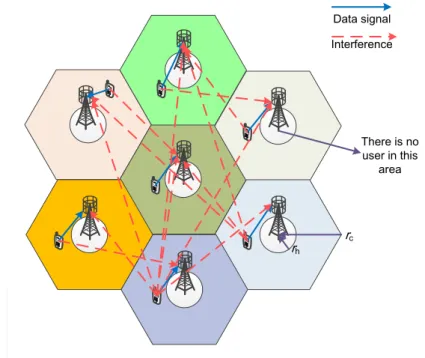
We consider an uplink multi-cell system composed of Lhexagonal cells as shown in Fig.
2.1. The radius of each cell isrc, and white area in each cell denotes the cell-hole (users are not located within the center disk of radiusrh). One of the BSs works as CCU, while each BS is equipped withMantennas and servesK(M≫K) single-antenna users. We assume that there is time-frequency coherent block ofSsymbols in each frame. K orthogonal pilot signalsΨΨΨ= [ψψψ1,ψψψ2,· · ·,ψψψK]T ∈CK×K(ψψψi= [ψi1,· · ·,ψiK]T)are reused in adjacent cells due to the limited coherence time, while different users in each cell use orthogonal pilots to avoid severe interference, and we assume thatΨΨΨΨΨΨH=IK. Here,(·)T and (·)H denote the transpose and Hermitian transpose, respectively.
During the training phase, the received signal at the BS of thel-th cell can be expressed as:
Yl=√ pp
L
∑
j=1 K∑
k=1
hl jkψψψTk +Zl, (2.1) where ppdenotes the pilot transmit power,Zl ∈CM×K is an independent and identically distributed (i.i.d.) additive white Gaussian noise (AWGN) defined asC N (0, δz2),hl jk ∈ CM×1is the channel coefficient between BS in thel-th cell and thek-th user in the j-th cell.
hl jk=p
βl jkgl jk, whereβl jkandgl jk∼C N (0,IM)denote the large-scale fading coefficient and small-scale fading vector, respectively.
2.2 System Model 13
c h
Fig. 2.1 Uplink interference model for the multi-cell mMIMO system.
The channel estimate of thek-th user in thel-th cell is obtained by correlatingYlwith ψψψ∗k as follows:
h˜llk=hllkψψψTkψψψ∗k+
L
∑
j̸=l K∑
i=1
hl jiψψψTi ψψψ∗k+ 1
√ppZlψψψ∗k
=hllk+
L
∑
j̸=l K
∑
i=1
f[θ(j,i),θ(l,k)]hl ji+wlk,
(2.2)
where(·)∗denotes the complex conjugate,wlkdenotes the equivalent noise,ψψψθ(j,i)(θ(j,i)∈ {1,· · ·,K}) denotes that the θ(j,i)-th pilot is used by the i-th user in the j-th cell with θ(j,k)̸=θ(j,k′) whenk̸=k′. In the above expression, f[·]∈ {0,1} represents the pilot reuse index, f[θ(j,i),θ(l,k)] =1 whenθ(j,i) =θ(l,k), else f[θ(j,i),θ(l,k)] =0.
During the data phase, the received signal at the BS of thel-th cell can be expressed as:
yl=√ pt
L
∑
j=1 K
∑
k=1
hl jkxjk+nl, (2.3)
where pt denotes the uplink data transmit power,xjk denotes the data transmitted by thek-th user in thel-th cell withE[|xlk|2] =1 andnl∼C N (0, σl2IM)denotes the noise, whereE[·]
denotes the expectation operator.
Using the channel estimate of the k-th user in (2), the matched-filter (MF) detector is applied to obtain the decision variables of thek-th user as:
˜
xlk=h˜Hllkyl=√
pthHllkhllkxlk
| {z }
Desired signal
+√ pt
K n̸=k
∑
hHllkhllnxln
| {z }
intra−cell interference
+√ pt
L
∑
j̸=l K i=1∑
L m=1
∑
K n=1
∑
f[θ(j,i),θ(l,k)]hHl jihlmnxmn
| {z }
pilot contamination
(2.4)
+√ pt
L m̸=l
∑
K
∑
n=1
hHllkhlmnxmn
| {z }
inter−cell interference
+ ωlk
|{z}
uncorrelated noise
,
whereωlk=hHllknl+∑Lj̸=l∑Ki=1f[θ(j,i),θ(l,k)]hl jiHnl+wlkHnl. In (2.4), the first term denotes the desired signal component, the second term denotes the intra-cell interference, the third term denotes the pilot contamination, the fourth term denotes the inter-cell interference, and the last term denotes the uncorrelated noise after MF filtering. According to (2.4), the average uplink rate of the user can be expressed as
rlk =E (
log2 1+
hHllkhllk
2
INlk+|ωlk|2/pt
!)
(2.5)
where INlk= ∑K
n̸=k
hHllkhlln
2+ ∑L
m̸=l K
∑
n=1
hHllkhlmn
2+ ∑L
j̸=l K
∑
i=1 L
∑
m=1 K
∑
n=1
f[θ(j,i),θ(l,k)]
hHl jihlmn
2
.
2.3 Problem Formulation and Solution
In this section, we first formulate a pilot allocation optimization problem to maximize uplink sum rate of the system. Then, we propose a low-complexity algorithm to obtain the optimal solution. Next, considering users’ rate fairness, we formulate a fairness aware pilot allocation as maximization problem of sum of user’s logarithmic rate and use the similar method to solve the formulated problem.
2.3 Problem Formulation and Solution 15
2.3.1 Problem Formulation Based on Sum Rate Maximization
We formulate the pilot allocation optimization problem for maximizing uplink sum rate of the system as follows:
max
θ θθ
R(θθθ) =
L
∑
l=1 K
∑
k=1
(1−η)rlk
s.t θ(l,k)∈ {1,2,· · ·,K},∀l,k, (2.6) θ(l,k)̸=θ(l,k′),k̸=k′,
whereθθθ = [θ(l,k)]LxKdenotes the pilot allocation index for each user,η=K/S. Note that accurate CSI is needed to estimate user’s raterlk for solving the optimization problem (2.6).
However, based on the fact that CSI can not be obtained before determining pilot allocation, it seems that it is not possible to solve the problem (2.6).
According to [17], when the number of BS antennasM goes to infinity, the uplink rate can be approached using only large-scale fading coefficients as
rlk≈log2 1+ βllk2
∑Lj̸=l∑Ki=1f[θ(j,i),θ(l,k)]βl ji2
!
. (2.7)
It can be observed from (2.7) that the uplink rate in the optimization problem can be approximated with only the large-scale fading coefficients, which can be easily tracked by the BSs. Here, we propose to use approximated rate in (2.7) for solving the problem (2.6).
The details of the proposed algorithm to solve (2.6) is mentioned in next subsection.
2.3.2 Proposed Sum Rate Maximization Scheme
Problem (2.6) is known as mixed integer programming (MIP) problem. The challenge of this problem is the discrete nature of the pilot allocation index. Exhaustive search can be used to find the optimum pilot allocation, but it requires high computational complexity given asO((K!)L). Thus, exhaustive search is not feasible solution for a large number of users in multi-cell mMIMO system.
To decrease the computational complexity, we decouple (2.6) intoLsubproblems, where in each subproblem, we aim at optimizing the pilot allocation ofK users in one particular cell and fix pilot allocation in otherL-1 cells. Based on the above description, we can get one of subproblems as follows:
Uplink sum rate Convergence
1 2 3
4
5
6 1 7
2
1st step Iteration step
The pilot allocation for a particular cell at each iteration
2nd step 3rd step 4th step 5th step
6th step 7th step
8th step 9th step
Fig. 2.2 Iteration diagram for pilot allocation in the proposed algorithm.
max
θθ θm
Rm(θθθ−m,θθθm) (2.8) s.t. θ(m,k) ={1,2, . . . ,K},∀k
θ(m,k)̸=θ(m,k′),k̸=k′ whereRm(θθθ−m,θθθm) =
L
∑
l=1 K
∑
k=1
(1−η)log2
1+ β
2 llk
∑Lj̸=l∑Ki=1f[θ(j,i),θ(l,k)]βl ji2
,θθθ−mdenotes the pi- lot allocation decision matrix except for them-th cell, andθθθmthe pilot allocation matrix in them-th cell. For (2.8), since pilot allocation in other cells have been decided in advance (at the beginning, we assume that the pilots are randomly allocated in these cells), we just need to allocate pilots to users in them-th cell for maximizing the sum rate of the system.
Exhaustive search is not feasible because the required complexity is given as (O(K!)) and significantly increased with a largeK.
To reduce the required complexity for finding the optimum solution, we propose a low- complexity pilot allocation scheme. Since we have fixed pilot allocation in otherL−1 cells, the problem (2.8) is reduced to a one-to-one matching problem, namelyK users select K pilots. Next, we define the one-to-one matching problem as follows:
Definition: We assume that there are K users and K pilots, and we need to allocate the K pilots to K users. The allocation rule is that every user is assigned one pilot and each pilot is only assigned to one user. Each possible allocation between the i-th pilot and the k-th user is associated a utility Uik(the Uikcan be regarded as the revenue of the k-th user when it uses the i-th pilot), which is given in Table 2.1.
2.3 Problem Formulation and Solution 17 Table 2.1 The utility of pilot allocation
Pilot
User 1 2 3 · · · K
1 U11 U12 U13 · · · U1K 2 U21 U22 U23 · · · U2K 3 U32 U32 U33 · · · U3K ... · · · . .. ... K UK1 UK2 UK3 · · · UKK
Then, the matching problem can be presented by the following optimization problem:
maxcnm
K
∑
n=1 K
∑
m=1
cnmUnm
s.t. ∑K
n=1
cnm=1, ∀n, (2.9)
K
∑
m=1
cnm=1, ∀m, cnm∈ {0,1}, ∀n,m,
wherecnmdenotes the binary assignment variable, andcnm=1 means that pilotnis allocated to userm, andcnm=0, otherwise.∑Kn=1cnm =1 denotes that each pilot is only allocated to one user,∑Km=1cnm=1 denotes that each user is only allocated one pilot.
As for the problem (2.9), the optimal matching problem can be solved by applying the well-known Hungarian algorithm [18], which is a combinatorial optimization algorithm that solves the assignment problem in polynomial time. Therefore, the subproblem (2.8) can be solved by using the similar method. We rewrite the subproblem (2.8) as follows:
max
θθθm
K a=1
∑
K p=1
∑
capRapm (θθθ−m,θθθm)
s.t. Rapm(θθθ−m,θθθm) =
Rm(θθθ−m,θθθm), θ(m,a) = p,
K
∑
a=1
cap =1, ∀a, (2.10)
K p=1
∑
cap =1, ∀p, cap∈ {0,1}, ∀a,p.
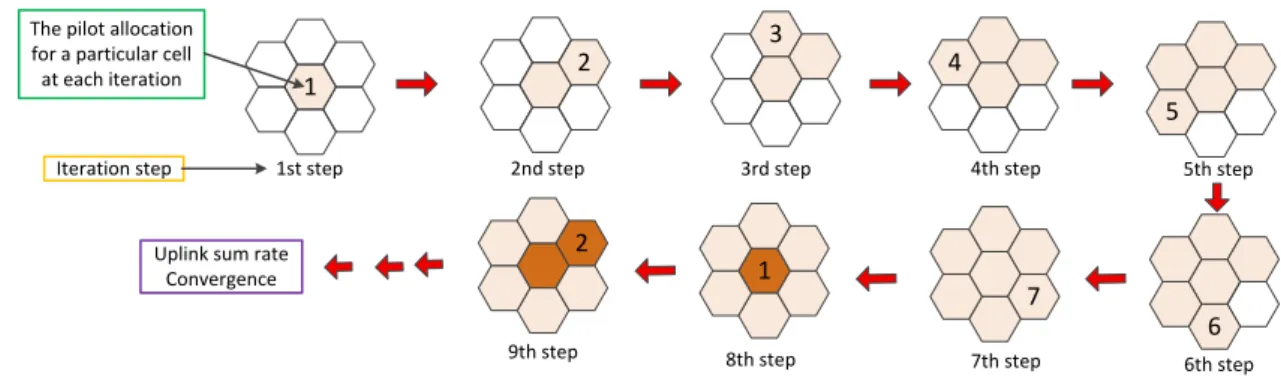
whereaandbdenote the pilots and users index in them-th cell, respectively. We can find that the subproblem (2.10) is also an one-to-one matching problem and the optimum pilot allocation can be obtained by applying the Hungarian algorithm. Next, we move to the next cell and use the same method to optimize pilot allocation for next subproblem. After multiple iterations, the global optimum pilot allocation for problem (2.6) can be obtained according to the Proposition 1. To describe our proposed algorithm more clearly, we present the iterative diagram in Fig. 2.2. For example, at the first step, them=1 in problem (2.10), namely, we only optimize the pilot allocation at the 1st cell while fixing pilot allocation in other cells.
After solving problem (2.10), we can obtain the uplink sum rate. Then, similar to the first step, we optimize the pilot allocation at the 2nd cell as the second step of Fig. 2.2. This process is continued until the uplink sum rate is converged. We also summarize the above method in Algorithm 1.
Proposition 1: For given L and K, global optimum pilot allocation converges after a finite number of iterations.
Proof: In solving each subproblem (iteration), the pilot allocation is obtained according to the Hungarian method, and the sum rate of the system is maximized in this optimization (iteration). Therefore, the objective of problem (2.6) increases over each iteration until converges.
2.3.3 Problem Formulation Based on Users’ Fairness
When the pilot allocation is optimized for maximizing the sum rate of the system, the cell- edge user’s rate (i.e., users’ fairness) is not taken into account. If the same pilot is allocated to cell-edge users at different cells, the pilot contamination occurs and it intensively deteriorates
2.3 Problem Formulation and Solution 19 Algorithm 1:Proposed SR-M Algorithm
1 Initializecell indexl, pilot allocationθθθ−l (assumel=1), toleranceε, iterative indext=1.
2 repeat
3 Obtain the optimum pilot allocationθθθl at thelth cell according to the Hungarian method.
4 Get the pilot allocation resultsθθθt.
5 Compute the uplink rum rate according toR(θθθt).
6 Updatet←t+1,l←l+1.
7 ifl>Lthen
8 Updatel←1.
9 end if
10 untilR(θθθt+1)−R(θθθt)<ε;
11 Obtainoptimum pilot allocationθθθt.
the rates of these users. Thus, users’ fairness aware pilot allocation should be considered.
For this purpose, we formulate the pilot allocation optimization problem for maximizing the sum of user’s logarithmic rate as follows:
max
θθ θ
R(θθθ) =
L
∑
l=1 K
∑
k=1
log((1−η)rlk)
s.t θ(l,k)∈ {1,2,· · ·,K},∀l,k, (2.11) θ(l,k)̸=θ(l,k′),k̸=k′.
As for problem (2.11), we can use the similar algorithm to problem (2.6) to obtain the corresponding pilot allocation. The algorithm consists of the following four steps:
1. Divide problem (2.11) intoLsubproblems.
2. Optimize pilot allocation for users in one cell while fixing pilot allocation in others cell.
3. Move to the next cell and do the same optimization as step 2.
4. Repeat steps 2 and 3 until sum logarithmic rate log((1−η)rlk)converges.
We call the above algorithm as user’s fairness aware (UF-A) algorithm. Since the similar algorithm in (i.e., Algorithm 1) is applied, we omit the detailed explanations of the algorithm.
The related results will be presented in simulation section directly.
Table 2.2 Simulation Parameters.
Parameters Value
Radius of cellrc 500 m
Radius of cell holerh 100 m
Number of usersK 2≤M≤8
Number of BS antennasM 10≤M≤500
Number of cellsL 7
Transmit power of users 0dBm Time-frequency coherent block sizeS 100 symbols
Bandwidth 20 MHz
Noise Power -174dBm/Hz
2.4 Numerical Results and Discussion
In this section, we evaluate the average uplink rate of the proposed pilot allocation schemes.
We consider anL=7 typical hexagonal cellular network where each BS is equipped with Mantennas, and there areK users in each cell. Therefore, the proposed algorithm works to maximize total sum rate of 7 cells as defined in problem (2.6). We assume that cell radius isrc=500 meters, and cell-hole radiusrh=100 meters. The large-scale fading coefficient captures the path-loss effect as followsβl jk=1/dl jkα [19], wheredl jk denotes the distance between thel-th BS and thek-th user in the j-th cell, andα =3.8 is the path-loss exponent.
Users are distributed randomly within each cell, and Monter-Carlo method is applied with 104simulation for single user having random location in each trail. Note that (2.5) is used to compute the uplink rate of each user, while the approximated user-rate in (2.7) is used to solve the problems (2.6). The system parameters are summarized in Table 2.2.
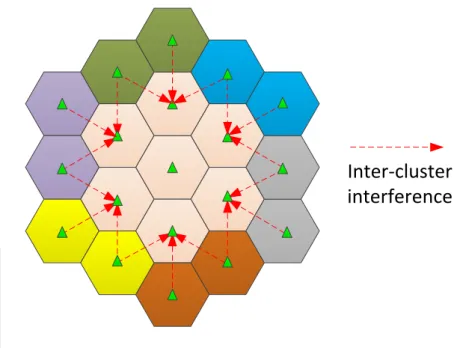
In fact, similarly to [20], the inter-cluster interference should be also considered. Fig. 2.3 shows system model where there are multiple clusters (different colors stand for different clusters). Since there is no any cooperation among clusters, the cluster cannot know necessary information of adjacent clusters such as user’s location information and pilot allocation formation. Thus, the average interference power from outer-cluster cells should be estimated without the above information. For this purpose, we propose the following approximate scheme. We only consider the interference from adjacent outer-cluster cells due to the very slight interference for non-adjacent outer-cluster cells. When each cell estimates the average interference from outer-cluster cells, the BS’location is assumed as the user’s location.
Fig. 2.4 plots the average uplink rate versus number of BS antennas with different algorithms when the number of users in each cell is 4. It can be clearly found that the average
2.4 Numerical Results and Discussion 21
Inter-cluster interference
Fig. 2.3 The model of the inter-cluster interference and different colors denote the different clusters.
uplink rate increases with M under all algorithms, and the average uplink rate under the proposed SR-M algorithm is almost the same with that under the exhaustive search algorithm.
In exhaustive search scheme, the best pilot allocation to maximize the average uplink sum rate is selected among all possible candidates. In random allocation scheme, pilot allocation is randomly determined regardless of the achievable uplink sum rate. We can find that the average uplink rate of the proposed UF-A algorithm is lower than that of the proposed SR-M algorithm and is higher than that of the random allocation algorithm. The reason is that the achievable sum rate has to be sacrificed for improving the users’ fairness with the proposed UF-A algorithm. In addition, we can also find that per-user rate can be improved by about 17% by using the proposed SR-M algorithm in comparison with the random allocation algorithm.
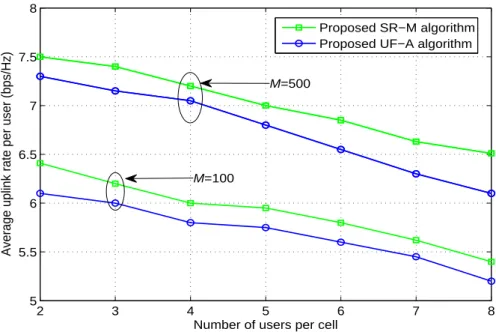
Fig. 2.5 shows that the average uplink rate per user versus the number of users in each cell with different algorithms. We can find that the average uplink rate decreases withK increases. In fact, there are two reasons for this result. The first is that (1-η) decreases asK increases, which reduces the uplink rate per user. The second is that the degree of freedom (DoF) of the BS antennas decreases with the number of serviced users increases, which leads to the decline of the average rate. It is also easy to understand that more number of BS antennas leads to higher rate. Although the average uplink rate decreases with the number
10 50 100 150 200 250 300 350 400 450 500 2
3 4 5 6 7 8
Number of BS antennas
Average uplink rate per user (bps/Hz)
Exhaustive search algorithm Proposed SR−M algorithm Proposed UF−A algorithm Random allocation scheme
Fig. 2.4 The average uplink rate versus the number of BS antennas with different algorithms (K=4).
2 3 4 5 6 7 8
5 5.5 6 6.5 7 7.5 8
Number of users per cell
Average uplink rate per user (bps/Hz)
Proposed SR−M algorithm Proposed UF−A algorithm
M=100
M=500
Fig. 2.5 The average uplink rate versus the number of users per cell.
2.4 Numerical Results and Discussion 23
1 2 3 4 5 6 7 8 9 10 11 12 13 14 15 16 17 18 19 20 6
6.5 7 7.5 8 8.5 9
Number of iterations
Average uplink rate (bps/Hz)
K=4 K=8
Fig. 2.6 The average uplink rate versus the number of iterations.
2 3 4 5 6 7 8 9 10
0 0.1 0.2 0.3 0.4 0.5 0.6 0.7 0.8 0.9 1
Achievalable rate of the user (bps/Hz)
CDF
Proposed SR−M algorithm Proposed UF−A algorithm GC−PA algorithm [14] Classical scheme [17]
Fig. 2.7 CDF versus users’ uplink achievable rate (bps/Hz) (K=4,M=100).
of users, the uplink sum rate increases, and we can get it by the proposed low complexity algorithms according to Fig. 2.5. On the other hand, we can get that the uplink sum rate of the system will increase when it services more users, but the average uplink rate per each user will decrease, which lowers each user’s experience. Therefore, in practice, the tradeoff between number of serviced users and each user’s experience needs to be considered .
Fig. 2.7 shows the cumulative distribution function (CDF) curve of users’ uplink achiev- able rate withK=4 andM=100. The graph coloring based pilot allocation (GC-PA) [14]
and classical random pilot allocation scheme [17] are compared with our proposed schemes.
We can find that that the uplink rate with our proposed SR-M algorithm is higher than that with GC-PA algorithm. Meanwhile, it can be verified that the user’s rate is more concentrated with UF-A algorithm than that with SR-M algorithm, which means that the UF-A improves the users’ fairness. In addition, it is clear that the classical scheme has the worst performance compared with other algorithms.
2.5 Conclusions
In this chapter, we have proposed an optimum pilot allocation scheme to improve uplink sum rate in mMIMO systems. Firstly, we formulate the pilot allocation optimization problem for maximizing uplink sum rate of the system. Since the high complexity for solving the original problem, we transform the formulated problem into several subproblems. In each subproblem, we obtain the optimum pilot allocation by applying Hungarian method. Through multiple iterations, the optimum pilot allocation is found. For improving users’ fairness, we formulate the maximization problem of sum of user’ logarithmic rate and use the similar algorithm to obtain the corresponding pilot allocation. Simulation results show that per-user rate can be improved by about 17% by using the proposed SR-M algorithm in comparison with the conventional random allocation algorithm.