九州大学学術情報リポジトリ
Kyushu University Institutional Repository
オンラインマルチストローク文字の認識に関する研 究
蔡, 文杰
九州大学システム情報科学府情報知能工学 / (株)オーリッド(O-RID)
https://doi.org/10.15017/25255
出版情報:Kyushu University, 2012, 博士(工学), 課程博士 バージョン:
権利関係:
2012 年度 博 士 論 文
Studies on Online Multi-Stroke Character Recognition
2012 年 6 月 25 日
情報知能工学専攻 ( 学籍番号 : 3IE09011E)
蔡 文杰
九州大学大学院システム情報科学府
Abstract
This thesis copes with the issues of online multi-stroke character recognition, and focuses on two topics related to the recognition task: (i) This thesis reviews the approaches for solving the stroke-order variation problem, and conducts a compar- ative comparison for clarifying the relative superiority of five methods of stroke correspondence. The five methods are cube search (CS), bipartite weighted match- ing (BWM), individual correspondence decision (ICD), stable marriage (SM), and deviation-expansion model (DE). (ii) This thesis proposes a novel method to re- duce the time and spatial complexity of CS remarkably, by dividing Kanji character reference pattern into radical reference patterns, and reorganizing the stroke corre- spondence search graph of CS.
Acknowledgements
There are several people who I need to thank for helping me get to this point, and they could never all fit on a single page of a dissertation.
First I would like to give heartful thanks to my supervisor, Prof. Seiichi Uchida, Kyushu University, for his advice during my doctoral research endeavor for the past years. Without his guidance and determination, I would not be the student that I am today. As my supervisor, he has constantly forced me to remain focused on achieving my goal. His observations and comments helped me to establish the overall direction of the research, and to move forward with investigation in depth. I thank him for providing me the opportunity to work with a talented team of researchers.
I would like to express my appreciation to my former supervisor, the late Hiroaki Sakoe, Emeritus Professor of Kyushu University, who helped me to start my doctoral research. He passed away due to sickness caused by his hard work of research. He led me into the world of character recognition, and taught me to know how to be a real researcher.
I would like to express my sincere thanks to my advisor, Prof. Rin-ichiro Taniguchi, Kyushu University, and Prof. Koichi Kise, Osaka Prefecture University. They gave me so many good suggestion, to help me to accomplish my thesis smoothly. I also would like to thank Prof. Ken’ichi Morooka, Kyushu University, for his important comments and suggestions during his reviewing of my thesis.
Lastly, I would like to thank staff members of my laboratory and company. In laboratory, members helped me a lot when I was not in university. In company, my company and co-workers always supported me when I was busy in doctoral research.
Contents
1 Introduction 1
1.1 Background . . . 1
1.2 Purpose of the studies . . . 5
1.2.1 Comparative study of stroke correspondence search methods for stroke-order variation . . . 6
1.2.2 An efficient radical-based algorithm for stroke-order free on- line Kanji character recognition . . . 7
1.3 Organization of the thesis . . . 7
2 Review of online character recognition 9 2.1 History of online character recognition . . . 9
2.2 Handwriting data . . . 12
2.3 Basic process of online character recognition . . . 14
2.3.1 Segmentation . . . 15
2.3.2 Preprocessing . . . 16
2.3.3 Feature extraction . . . 17
2.3.4 Character recognition . . . 19
2.3.5 Post-processing . . . 19
2.4 Online character recognition strategy . . . 20
2.4.1 Structural method and statistical method . . . 20
2.4.2 Coarse and fine strategy . . . 22
2.4.3 Radical-based method . . . 22
2.4.4 Classifier combination strategy . . . 23
2.5 Discussion on online recognition methods . . . 24
3 Cube search 26 3.1 Introduction . . . 26
3.2 Basic principle of stroke correspondence search . . . 27
3.3 Cube search (CS) . . . 28
4 Comparative study of stroke correspondence search methods for stroke-order variation 31 4.1 Introduction . . . 31
4.2 Review of stroke-order free methods . . . 35
4.2.1 Multiple prototype approach . . . 36
4.2.2 Offline feature approach . . . 37
4.2.3 Stroke correspondence approach . . . 38
4.3 Details of five representative methods based on stroke correspondence approach . . . 41
4.3.1 General problem of determining optimal stroke correspondence 42 4.3.2 Cube search (CS) . . . 43
4.3.3 Bipartite weighted matching (BWM) . . . 43
4.3.4 Individual correspondence decision (ICD) . . . 44
4.3.5 Stable marriage (SM) . . . 46
4.3.6 Deviation-expansion model (DE) . . . 47
4.3.7 Comparison of computational complexity . . . 48
4.4 Comparative experiment and evaluation . . . 48
4.4.1 Experimental setup . . . 48
4.4.2 Experimental results . . . 51
4.4.3 Performance analysis . . . 51
4.5 Discussions . . . 56
4.6 Toward forensics by stroke-order variation . . . 58
4.7 Summary . . . 60
5 An efficient radical-based algorithm for stroke-order free online Kanji character recognition 61 5.1 Introduction . . . 61
5.2 Radical-based cube search . . . 62
5.3 Design policy of reference character . . . 66
5.4 Experimental results and discussions . . . 67
5.5 Summary . . . 68
6 Conclusion 69
Chapter 1
Introduction
1.1 Background
Handwriting recognition has been a popular area of research for several decades under the field of pattern recognition and image processing, because of its various application potentials like postal automation, bank cheque processing, automatic data entry, etc. For example, for the automatic data entry, which is rapidly growing with the widespread development of various forms of electronic input devices, hand- writing recognition is faster than keyboard for multi-stroke large-alphabet languages like Chinese or Japanese Kanji [1, 2].
When writers write their own character styles, it brings variations in handwriting characters. The variations, including shape, size, stroke-number, stroke-order, tilt- ing angle, and writing speed, etc. [3], are most difficult in recognition. Figure 1.1 shows an example of different writing styles. It should be noted that the two hand- writing Chinese characters “king” have different stroke-orders and stroke-numbers.
The numerals in this figure indicate the stroke-orders. Thus, for a practical sys-
Figure 1.1: Two handwriting Chinese character “king” with different stroke-orders and stroke-numbers.
tem of handwriting recognition, it needs to cope with the natural handwriting of a wide range of different writers and writing styles. Meanwhile, a practical system of handwriting recognition should be convenient for operation, scalable to the device’s capability and accurate. In fact, the variations in the above mentioned features among characters, such as stroke-order and stroke-number, are important factors for improving character recognition accuracy.
Handwriting recognition can be divided into two categories: online and offline. An important difference between online and offline handwriting recognition (or OCR) is the fact that spatial and temporal information is available in the former, while only spatial information is available in the latter. For the online case, basically it acquires a string of (x,y) coordinate pairs from an electronic pen touching a pressure sensitive digital tablet, and the character patterns are expressed as the trajectory of pen tip motion. For the offline case, the patterns are expressed as images from scanners, digital cameras or other digital input sources, and recognized by conventional OCR techniques [1, 2, 4].
Although the offline and online handwriting recognition techniques have different approaches, they share a lot of common problems and solutions. For some solutions,
online data are converted to the form of offline data (image) and employ the methods of offline handwriting recognition to recognize the character patterns. Conversely, offline data can also be converted by line thinning to sequences of points similar to online data (but without the temporal information), then achieve character recog- nition by the methods of online handwriting recognition [2, 5, 6, 7, 8, 9].
This thesis copes with online multi-stroke character recognition. Online multi- stroke character recognition is gaining renewed interest because of the new develop- ment of new pen devices and their applications. Compared to several decades ago, we now have more accurate electronic tablets, more compact and powerful comput- ers, and better recognition algorithms. The most common device is the electronic tablet or digitizer, typically with a resolution of 200 points/in, a sampling rate of 100 points/s. An indication of “inking” or pen-down, written by using a stylus that captures information of the pen tip, generally its position, velocity, or acceleration as a function of time [4]. An advantage of online devices is that they capture the temporal or dynamic information of the writing. This information consists of the stroke-numbers, the stroke-orders, the writing direction for each stroke, and the writing speed within each stroke. A stroke is the writing from pen-down to pen- up. Most online devices capture the trace of the handwriting or line drawing as a sequence of coordinate points.
Owing to the availability of both temporal stroke information and spatial shape information, online character recognition has a potential to yield higher accuracy than offline recognition. Online recognition also provides good interaction and adap- tation capability because the writer can respond to the recognition result to correct the error or change the writing style. For desktop applications, online recognition is
well-suited to text entry for large alphabets like oriental languages (e.g., Japanese Kanji and Chinese), because the current design of the keyboard is meant for the Latin-based language input [1, 10]. Although there are many input methods based on this keyboard have been developed for oriental language entry, they still suffer for slow input or steep learning curve. If we use handwriting as an input, all of these obstacles will be omitted. However, the recognition of Chinese characters is different from western handwriting recognition and poses a special challenge, because cur- rent online recognition still suffers from several weaknesses involving sensitivity to stroke-order, stroke-number, and stroke characteristics variations [8].
A practical recognition system of online multi-stroke character should be stroke- order free to cope with characters with stroke-order variation. Although there are many researches for solving the stroke-order free recognition problem, the problem has not been solved yet. To cope with stroke-order variation, several approaches, such as multiple prototype approach, offline feature approach, and stroke corre- spondence approach, have been proposed. However, since no extensive comparative study has been made so far, none knows the relative characteristics and performance of the past approaches.
This thesis tries to clarify the relative superiority of stroke-order free recognition approaches from the viewpoints of recognition accuracy and efficiency. In particular, we focus on stroke correspondence approach that is theoretically the most reliable approach among several approaches, and try to conduct a quantitative and quali- tative evaluation of five representative methods through an experiment. The five representative methods are cube search (CS) [11, 12], bipartite weighted match- ing (BWM) [13], individual correspondence decision (ICD) [14, 15], stable marriage
(SM) [16], and deviation-expansion model (DE) [17]. Furthermore, as an application example of the stroke correspondence methods, we consider personal identification by extracting the stroke-order of an online input pattern [18].
Cube search method (CS), one of the above mentioned five methods and proposed by Sakoe and Shin [11, 12], is an promising stroke-order analysis method for online character recognition. However, since CS is with O(N ·2N−1) time complexity for anN-stroke character, a more efficient method is hoped to improve the performance of CS, in case of the multi-stroke character with largeN (e.g., Chinese character or Japanese Kanji character).
This thesis will propose a novel and efficient method based on radical decom- position to resolve the time complexity problem of CS. A Chinese character has an average of 8-10 strokes, the simplest characters have one stroke, and the most complicated characters have more than 30 strokes. While the stroke-numbers of characters are high, each character is made from about 500 kinds of component sub-characters (called radicals) in predefined positions and written in a predefined order. In character recognition, the radical-based approach attempts to decompose the character into radicals and classifies the character based on the component parts and their placement. We employ the radical decomposition strategy into CS and get exciting result [19, 20].
1.2 Purpose of the studies
For online multi-stroke character recognition, this thesis conducts a comparative study for clarifying the relative superiority of five methods of stroke correspondence,
and proposes a novel method to reduce the time and spatial complexity of CS.
1.2.1 Comparative study of stroke correspondence search methods for stroke-order variation
For stroke-order free online multi-stroke character recognition, stroke-to-stroke correspondence search between an input pattern and a reference pattern plays an important role to deal with the stroke-order variation. Although various methods of stroke correspondence have been proposed, no comparative study for clarifying the relative superiority of those methods has been done before. In this chapter, we firstly review the approaches for solving the stroke-order variation problem. Then, five representative methods of stroke correspondence proposed by different groups, including CS, BWM, ICD, SM, and DE, are experimentally compared, mainly in regard of recognition accuracy and efficiency. The experimental results on an online Kanji character database, showed that 99.17%, 99.17%, 96.37%, 98.54%, and 96.59%
were attained by CS, BWM, ICD, SM, and DE, respectively as their recognition rates. Extensive discussions are made on their relative superiorities and practical- ities. Based on our results, for the performance of recognition accuracy, relative superiority of CS and BWM over ICD, SM, and DE are established. Additionally, the application of these methods of stroke correspondence to personal identification is addressed.
1.2.2 An efficient radical-based algorithm for stroke-order free online Kanji character recognition
We investigate improvements of the promising stroke correspondence analysis al- gorithm of online multi-stroke character ― CS, based on dynamic programming (DP) and graph search. By dividing Kanji character reference pattern into radical reference patterns, the stroke correspondence search graph is decomposed into intra- radical graphs and an inter-radical graph. This reorganization remarkably reduces the time and spatial complexity of stroke correspondence search DP. It also improves the recognition performance of the CS by prohibiting unnatural stroke correspon- dence between different radicals. Experimental results on an online Kanji character database showed significant improvements both in operation speed and recognition accuracy.
1.3 Organization of the thesis
The rest of this thesis is organized as follows. Chapter 2 gives a brief review on the processing of online multi-stroke character recognition. Chapter 3 detailedly intruduces the CS, a promising method of stroke correspondence. After that, in Chapter 4, five representative methods of stroke correspondence including CS are detailed and experimentally compared. Then, extensive discussions are made on their relative superiorities and practicalities. Additionally, the application of these methods to forensics is addressed. To improve the operational speed of CS that shows its relative superiority of accuracy over other methods in Chapter 4, Chap-
recognition algorithm based on CS and radical-based reference model. Chapter 6 gives some concluding remarks for the thesis.
Chapter 2
Review of online character recognition
2.1 History of online character recognition
The research of online character recognition started in the 1960s and has been receiving intensive interest from the 1980s. It is a very challenging research since the beginning of the 1960s, when the first attempts to recognize isolated handwritten characters were performed [6, 21, 22]. Since then, numerous methods have been proposed and tested. Since the 1990s, compared to the research in the 1980s, the research efforts aimed to further relax the constraints of handwriting, such as the adherence to standard stroke-orders and stroke-numbers for multi-stroke characters, and the restriction of recognition to isolated characters only. Especially for the oriental language characters with multi-stroke, like Japanese Kanji and Chinese, the target of online recognition in the 1990s has shifted from the character with regular writing to the character with fluent writing and stroke-order and stroke-
number variation.
During recent years, the task of online character recognition has gained a renewed interest and an immense importance in every day applications, mainly due to the increasing popularity of the personal digital assistant (PDA) and digital pen. For the past few years, electronic gadgets such as smart phones, PDAs and tablet PCs have become very popular, especially among the younger generations. The trend is even more obvious in Asian countries like Japan, Korea and China [23, 24]. As these devices become more personal and are made smaller, they reach some physical limitations for having keyboard. Also, data entry for scripts having large alphabet size like oriental languages is difficult when use keyboard. Thus, an alternate man- machine interface is necessary for these devices. The most natural way of entering data would be to use the communication skills of person developed for thousands of years, namely speech and handwriting. So, data entry using pen-based devices is gaining popularity in recent times. An even more important advantage of pen- computing to the oriental languages is that the current design of the keyboard is meant for the Latin-based language input. Although there are many input methods based on this keyboard have been developed, they still suffer for slow input or steep learning curve. If we use handwriting as an input, all these obstacles will be omitted.
The difficulty of designing a practical system of online character recognition is commonly explained as follows: First, for small devices like PDAs and smart phones, the limitations in computational power and memory size are disadvantageous to the system design for these devices. Second, for a writer independent solution, the system has to discriminate between a great variety of different writing styles of users [25]. Even more difficult for online recognition, the handwriting data that looks
similar in a graphical (i.e., offline) representation, can has a different sequential (i.e., online) representation. Thus, a practical handwriting recognition system requires to be convenient for operation, scalable to the device’s capability, accurate, and can deal with the natural handwriting of a wide range of different writers and writing styles. Until now, various kinds of online recognizer have been developed. However, currently even the best recognizer does not yet perform sufficiently well as a primary text input method.
Online character recognition techniques have been widely implemented into com- mercial products in recent years. Besides the application of input of PDAs, smart phones, and tablet PCs, one of other interesting technologies is that it can provide high level of interactivity. In the last few years, recognition techniques of online multi-stroke character are applied to some instructional tools to help children learn to write. The aim of these systems is to help young children to become good writers with fluent movements and a good quality of writing in a shorter time, by using of the real time comparing results like stroke-orders or stroke-numbers between children’s characters and templates [26, 27]. Another important application of online character recognition technique is writer verification to judge whether two character sets are from the same writer or not (writer verification), or classify a test character set to a nearest reference character set of known writer (writer identification) [2, 28, 29, 30].
Since the beginning of the 1960s, many pieces of work have been done focusing on online character recognition of Roman, Japanese, Chinese, and Korean scripts, and various approaches have been proposed by the researchers towards handwritten character recognition of them. It should be noted that, the handwriting recognitions of other languages like Indian (i.e., Bangla) and Arabic are also drawing increasing
attention in recent years [31, 32, 33, 34].
2.2 Handwriting data
The handwriting data of pen trajectory has special characteristic and format. It consists of two kinds of information: spatial information and temporal informa- tion. Online character data is typically a dynamic, digitized representation of the pen movement, generally describing sequential information about position, velocity, acceleration, or even pen angles as a function of time [25]. In recent years, the UNIPEN database [35] has become the most popular publicly available data collec- tion in online character recognition research. UNIPEN represents a writing curve as a series of so-called pen-down and pen-up components. Each component contains a sequence of pen tip information sampled from the writer’s pen movement, usually with regular interval in time. The pen-up and pen-down information is captured to distinguish the stroke between pen-down and pen-up.
Although the input device (tablet) also provides other information such as pen pressure, pen tilts, etc., basically the pen positions (x,y) and directional features are used as the primary information. For the pen position feature, it accepts a string of (x,y) coordinate pairs from an electronic pen touching a pressure sensitive digital tablet. For the directional feature, it can be extracted directly from the online trajectory.
For the data of large number of tablet digitizers, the main measuring precision is characterized by resolution, accuracy and sampling rate. A basic function of the digitizing tablet within a pen-computer is to detect the stylus on the writing
surface and measure its position at its nominal sampling rate. The sampling rate generally varies from 50-200 Hz depending on the application, typically sampled at 100 samples per second [3]. Finer resolution is received with the higher sampling rate, which can accurately measure the fast strokes while reverse is the case for rough resolution.
Based on such a handwriting data mentioned above, the online character recog- nition has a number of distinguishing features. These features can help online char- acter recognition to get more accurate results and practicability than the offline character recognition [1]:
• It is a real time process. While the digitizer captures the data during the writing, the character recognition system can carry out the recognition with or without a lag. Furthermore, the writers can give immediate feedback to the recognizer for improving the recognition rate, as they keeps drawing the symbols on the tablet and observes the results.
• Not only the spatial information, it also captures the temporal and dynamic information of the pen trajectory. This information consists of the number and order of pen strokes, the direction of the writing for each pen stroke and the speed of the writing within each pen stroke.
• Very little pre-processing is required. The operations, such as smoothing, de- slanting, de-skewing, detection of line orientations, corners, loop and cusps are easier and faster with the pen trajectory data than on pixel images.
• Segmentation is easy. Segmentation operations are facilitated by using tem-
handwriting characters.
2.3 Basic process of online character recognition
To output correct recognition results, a practical online character recognition sys- tem has some basic process. In a practical system, the input to the system is a sequence of handwritten character patterns. Prior to any recognition, the acquired data is generally preprocessed to segment the signal into meaningful units, reduce spurious noise, and normalize the various aspects of the trace. The handwriting se- quence should be firstly segmented into character (or word) patterns according to the temporal and shape information. Often, the boundary between characters cannot be determined unambiguously before character recognition, so candidate charac- ter patterns are generated and recognized and the correct patterns are selected in contextual processing at the end of the process chain [36, 37, 38].
Generally, to recognize the segmented (candidate) character patterns, it involves the following steps: preprocessing, description, and classification [3, 23]. Preprocess- ing involves noise elimination, shape normalization, etc. Pattern description is also referred to as feature extraction, it represents the input pattern either statistically by feature vectors or structurally by various levels of primitives. Classification is classifying the input pattern into a character class predefined in a reference model database, and often decomposed into coarse classification and fine classification. The model database (also called reference database or recognition dictionary) contains the reference models or classification parameters for coarse classification and fine classification.
2.3.1 Segmentation
Segmentation refers to the processing that must be performed to get a represen- tation of the various basic units that the recognition algorithm will have to process.
It generally works at two levels. The first level deals with the whole message and focuses on, e.g., line detection, word segmentation as well as separating nontextual inputs (e.g., gesture commands, equations, diagrams, etc.) from text [39, 40]. At this level, the goal is to define spatial zones or temporal windows, or both, that allow the extraction of disjoint basic units. At the second level, the methodology focuses on segmenting the input into individual characters or even into sub-character units, such as strokes [2, 4, 41, 42, 43]. This processing is among the most challenging, particularly for the recognition of cursive script. In most cases, this segmentation is tentative and is corrected later during classification.
The accuracy of segmenting characters, especially for connected characters, is es- sential for the performance of a character recognition system. For oriental languages like Chinese, because the key for Chinese recognition is individual character recogni- tion, usually the main effort is focused on segmenting pages into lines, then directly into characters. The word segmentation is generally ignored if semantic information (word lexicon) is not available. Since in Chinese, the characters are always written in “print fashion , or not connected, in some sense segmentation is easier than in other languages such as English [7]. Two widely used techniques, vertical projection and connected component analysis, are able to help to cope with the problem. On the other hand, Chinese characters usually consist of more than one radical and even some radicals themselves are characters, and handwriting strokes of adjacent char-
acters may join. For western languages like English, generally word segmentation is important and the individual character segmentation is more challenging because of the cursive handwriting [7, 44].
2.3.2 Preprocessing
The isolated character data, directly collected from users are often incomplete, noisy and inconsistent. They are needed to be pre-processed before applying to the system in order to get the correct classification. All the ways (techniques) to refine the data suitable for analyzing are included under the pre-processing technique.
Re-sampling, noise elimination, and shape normalization are the basic techniques of pre-processing. Different systems use a variety of different techniques, they vary from one script to another and depending on the goal as well.
Some of the existing techniques are explained below [3, 8, 21, 45].
• Re-sampling: The strings of sampled point coordinate as functions of time are recorded along the pen trajectory during the pen movement over the surface of the sensitive screen. This facilitates to track the number of strokes and their order within a character. The length of the strokes (number of coordinates in a string) varies even users write with the same speed. In order to achieve a constant number of coordinates in every string or in constant distance, re- sampling is necessary so that sample points are spaced evenly along the arc length of each stroke. Re-sampling also helps to reduce the anomalous cases such as having a large number of samples at the same position when the user holds down the pen at a point.
• Noise Elimination: A stroke inevitably contains noises, typically come from many sources. Hand fluctuation during writing and digitizing error of the input devices are the major sources. The noisy sequence in addition to the information sequence may not rigorously harm the character in offline graph- ical representation, while severely affect on online data sequence. The noise reduction techniques used in most systems are basically deal with smoothing, filtering, wild point correction, stroke connection, break corrections, etc.
• Normalization: The main purpose of normalization is to reduce the pattern variations caused by writer specific characteristics (e.g., speed, size, slant, and rotation), recording hardware (e.g., online ink resolution) and noises. Basi- cally, recognition is better for only in case of nominal size of writing as well as standard orientation and a nominal slant. Common normalization proce- dures involve correction of baseline drift, compensation of writing slant, and adjustment of the script size, etc.
2.3.3 Feature extraction
Feature extraction is also referred to as pattern description. Quality feature selec- tion can greatly decrease the workload and simplify the subsequent design process of the classifier. Features should contain information required to distinguish between the classes, be sensitive to irrelevant variability of the input, and also be limited to permit efficient computation of discriminant functions and to limit the amount of training data required. When writers write their own styles, it brings variations in handwriting characters, and causes lots of difficulties in recognition. It is easy
for classifier to recognize the symbol if it has feature with sufficient distinguishing characteristics. Different systems use different varieties of feature, have different accuracies and goals as well. The feature used in one system may not fit with the other systems. Features taken from the same input data can be variably used [3, 25].
Feature extraction often represents the input pattern either statistically by feature vectors or structurally by sequence of various levels of primitives which generally are strokes or line segments consisting of feature points, or feature points themselves [21].
One stroke can be divided into a few of line segments (or only one line segment).
Line segment representation is especially suited to regular-style characters, because the regular-style characters are composed of mostly straight-line segments. Another primitive of the character is the standard strokes. Mostly in Chinese, Japanese, and Korean characters, the case is used. Since large number of symbols should be used to complete the characters of these languages, many standard strokes (or line segments) are defined as the basic components of the characters. In online character recognition, the directional feature of the line segment or the feature point is also a very important feature, and can be calculated directly by the starting and ending positions of line segment or the online pen points. Typically, the directional features are of eight types, coded from 0→7. Not only in the mentioned scripts (Japanese, Chinese, and Korean) but also in Roman, the directional codes are used as features.
Input patterns represented as feature point sequences can be matched with char- acter models represented as feature point sequences, higher-level primitives (such as stroke), or hierarchical structures. Similarly, input patterns represented as line segments can be matched with character models represented as line segments, or higher-level structures.
2.3.4 Character recognition
The methods of online isolated character recognition can be roughly divided into two categories: structural methods and statistical methods. Structural methods are based on stroke analysis, especially for multi-stroke characters. The character models of structural methods can be further divided into stroke-order dependent models or stroke-order free ones, and stroke-number dependent models or stroke- number free ones. Statistical methods mainly utilize the holistic shape information, so it is easier to achieve stroke-order and stroke-number independence [21, 46].
In online character recognition, the input pattern is matched with the reference model of each (candidate) class and the class with the minimum matching distance is taken as the recognition result. We will discuss the character recognition techniques detailedly in Section 2.4.
2.3.5 Post-processing
So far, neither of above approaches, structural or statistical, has led to commer- cially acceptable results for the processing of isolated cursive script. Although the performance of online systems is generally higher than that of offline systems, the user requirements of almost no online recognition errors have limited the market applications to simple well-segmented handwritten characters. From this point of view, the specific post-processing for reading errors and rejecting them, is neces- sary and can give a commercial advantage. A feasible approach for character string recognition is widely employed by integrating segmentation and recognition based on over-segmentation.
Linguistic context knowledge is widely employed in post-processing. Generally, during the procedure of character recognition, the classification (or matching) mod- ule provides not only the candidate class index, but also the scores (probabilities, similarities, or distances) to a number of candidate classes. In addition, in the seg- mentation procedure, the handwritten character string is firstly segmented into many small basic units (over-segmentation) at possible positions because the handwritten characters (especially for cursive writing) are generally difficult to be segmented correctly. The linguistic context can provide valuable information for selecting the optimal class from this set of candidates and optimal character segmentation results based on those segmentation units [36, 37, 47]. For page-based handwritten text recognition dealing with sentences of long text, the integration of segmentation and recognition in contextual processing has particular importance.
2.4 Online character recognition strategy
2.4.1 Structural method and statistical method
As above mentioned, over the last decades, online multi-stroke character recogni- tion has covered two distinct families of classification methods: structural methods and statistical classification methods.
Structural methods are based on stroke analysis. It represents the input pattern structurally by various levels of primitives [3, 48]. The character models of structural methods can be further divided into stroke-order dependent models and stroke-order free ones. Statistical methods mainly utilize the holistic shape information, and represent the input pattern statistically by feature vectors [49]. So it is easier to
achieve stroke-order independence.
The structural representation scheme has long been dominating the online Chi- nese character recognition technology, whereas the statistical scheme (or statistical- structural hybrid scheme) are receiving increasing attention in recent years. Chi- nese characters are known to be naturally structured patterns, and it is commonly admitted that considering structural information would be beneficial in the Chi- nese character recognition systems. In statistical representation, the input pattern is described by a feature vector, while the model database (also called parameter database) contains the classification parameters. Statistical methods are currently offering the highest performances since they are more suited to handle imprecision and variation of writing styles, including stroke connections, stroke-order variability and shape distortions. Besides, statistical models are easier to learn from samples in comparison with structural models that often require a tedious manual design task.
On the other hand, there is a statistical-structural hybrid scheme. The statistical- structural scheme is only used for describing the reference models. It takes the same structure as the traditional structural representation, yet the structure elements (primitives) and/or relationships are measured probabilistically. HMMs can be re- garded as instances of the statistical-structural representation [50, 51, 52, 53].
Rule-based methods can be treated as a kind of structural methods. In rule-based methods, the prior knowledge of character structure and writing appears as heuristic rules or constraints [21, 54, 55, 56]. The constraints can be used to efficiently reduce the search space of structural matching. The rules represent the knowledge of basic strokes allowed for a character and the invariant geometric features of strokes.
2.4.2 Coarse and fine strategy
To speed up the recognition of the large category set, a fast coarse classification procedure is commonly used to first prune the search candidate classes to which the input pattern is expected to belong to. Then, the input pattern is classified into one of these candidate classes in the fine classification stage [21, 23]. This two-stage recognition strategy has been widely adopted by now. Character recognition of a large vocabulary, like Chinese and Japanese, commonly employs coarse and fine classification scheme for improving both the classification speed and accuracy.
Coarse classification can be accomplished by class set partitioning or dynamic candidate selection. In class set partitioning, the character classes are divided into disjoint or overlapping groups. The input pattern is first assigned to a group or multiple groups and then, in fine classification, the input pattern is compared in detail with the classes in the group(s). In dynamic candidate selection, a matching score (similarity) is computed between the input pattern and each class and a subset of classes with high scores is selected for detailed classification. The average number of candidates can be significantly reduced without loss of precision via selecting a variable number of candidates by confidence evaluation.
2.4.3 Radical-based method
Radical-based approaches decompose a large set of characters into a smaller set of radicals. Then, the problem is converted to radical extraction and optimization of combination of the radical sequences. In particular, for the Chinese character recog- nition, radical-based approaches are widely employed because modeling of radicals is
a simpler task compared to modeling the whole characters as the number of radicals is only in few hundreds. An overall recognition result of a character is obtained by combining the results of a few relevant radicals [4, 23, 57]. This approach need less examples for training but would require large amount of work to manually create the radical composition and order of characters.
When a reference model is constructed, the constituent radical prototypes are rescaled to the actual sizes and aspect ratios. During the matching between a reference model and an input pattern, the deformation vectors of a constituent radical are scaled back to square box and used to adjust the radical prototype.
In a structured representation of reference models, the radical models are shared by different characters such that a character model is constructed dynamically by using the constituent radicals. This strategy can largely save the storage space of model database, considering the fact that hundreds of distinct radicals are shared by thousands of characters.
2.4.4 Classifier combination strategy
One effective approach to improve the performance of handwriting recognition is to combine multiple classifiers. However, it’s not a simple problem to collect votes from different classifiers while adopting proper voting weight strategy [8, 58, 59, 60, 61].
In online multi-stroke character recognition, recently a combination of classification decisions from online and pseudo-online classifiers is performed to improve the recog- nition of online classifier only. The attained exciting results demonstrate that the pseudo-online representation by converting relevant online information to the offline
better than those based solely on pure online information.
2.5 Discussion on online recognition methods
Despite the higher accuracies achieved so far, some problems still remain unsolved.
The rule-based approach proposed in the 1960s was abandoned for many years be- cause of the difficulties encountered in formulating general and reliable rules as well as in automating the generation of these rules from a large database of characters.
This approach has been rejuvenated recently with the incorporation of fuzzy rules and grammars that use statistical information on the frequency of occurrence of par- ticular features. However, from a global point of view, for this approach to survive, robust and reliable rules will have to be defined.
In the past researches, HMM was introduced into Hiragana recognition with 46 classes, and educational Kanji character recognition with 881 classes, in which each character was independently modeled by an HMM. In this simple approach, the total size of models was proportional to the number of characters to recognize.
Even for a small subset of Japanese characters, one study [62] required the model size of approximately 2MB and considered to be already too large for small-sized applications, such as PDAs. Moreover, the required model size would increase if we take into account a number of possible variations of stroke-orders of handwriting Kanji, since they are composed of up to 30 strokes for each and may be written in writer’s own stroke-orders.
For Chinese characters, the main problem in online recognition is to overcome the stroke-order and stroke-number variations existing in multi-stroke characters. The
current systems can recognize regular script with high accuracy, whereas the recog- nition of cursive style still remains unsolved and requires more intensive research efforts because people naturally write this way. The cursive handwriting defined here is the faster handwriting approach of the standard Chinese characters. Due to many strokes in Chinese characters, during the writing of these characters, certain transformation of the characters happened: (i) Stroke-order variation. It is due to writer cannot remember all of the correct stroke-order of large number of Chinese character. (ii) Intra-character ligatures. This is due to no pen-lift between two con- secutive strokes. It is normal in the Latin language as well. (iii) Strokes missing.
This is very obvious for shorter strokes in between two strokes. The writer tends to omit these strokes to proceed to the following one. (iv) Shape deforms.
For stroke-order problem, stroke correspondence searching is a key technique for handwriting recognition. Stroke correspondence approach is theoretically the most reliable approach to estimate the actual stroke-order of input pattern explicitly, and can cope with even rare stroke-order variations of each class. Also, if we analyze the stroke-order variation, we can get important information to identify the writer, or give a hint for more beautiful handwriting, and so on. The technique to establish the stroke correspondence also can be applied into the various fields that need order analysis of feature sequences, such as DNA analysis, gesture recognition, etc.
In this thesis, we focus on the stroke-order issue of isolated multi-stroke characters and study stroke correspondence approach.
Chapter 3
Cube search
3.1 Introduction
As mentioned above, in this thesis, we focus on the stroke-order issue of isolated multi-stroke characters. Stroke correspondence approach is theoretically the most reliable approach to estimate the actual stroke-order of input pattern, even for the rare stroke-order variations of each class. In this chapter, we will detailedly introduce a typical method of stroke correspondence called cube search (CS).
The CS, proposed by Sakoe and Shin [11, 12, 63, 64, 65], is an effective stroke-order analysis algorithm for online character recognition. In CS, an N-dimensional cube graph stroke-order generation model is defined for N-stroke character to impose bijection property on the stroke correspondence. Then, the stroke correspondence search problem is formulated as an optimal path search problem on the cube graph.
An efficient dynamic programming (DP) is used to search for the shortest path on the cube graph, with O(N ·2N−1) time complexity. In the following, we will first introduce the basic principle of stroke correspondence search, then give detailed
introduction about CS.
3.2 Basic principle of stroke correspondence search
We define the input character as a stroke sequence,
A=A1A2. . . Ak. . . AN, (3.1) where the kth stroke Ak is the time sequence representation of local feature (e.g., moving direction and coordinate of pen-point).
Ak =a1ka2k. . . aik. . . aIk, I =I(k).
Similarly, we define the reference character as,
B =B1B2. . . Bl. . . BN, (3.2)
Bl=b1lb2l. . . bjl. . . bJ l, J =J(l).
We define stroke distance δ(k, l) = D(Ak, Bl) as the dissimilarity measure be- tween the input stroke Ak and the reference stroke Bl, and calculate it by DP- matching [11, 74]. The character distance betweenA and B becomes ∑
kδ(k, l(k)).
The family of mappings {l = l(k)} generates stroke-order variations. Therefore, it is a reasonable way to search for the optimal stroke-to-stroke correspondence by the following minimization problem.
D(A, B) = min
l(1),...,l(k),...,l(N)
[ N
∑
k=1
δ(k, l(k)) ]
. (3.3)
A bijection constraint should be imposed on the mapping l = l(k) to keep the
: Binary expression of state numbern l 䠖Transition by lth
reference stroke : State number n ( )
0000
1000
0100
0010
0001
1100
1010
0110
1001
0101
0011
1110
1101
1011
0111
1111
0 1 2 3 4
1 2 3 4
2 3 4 1 3 4 1 2 4 1 32
3 4
2 4 2 3 1 4 1 3 1 2
1 2
3
4 (0)
(8)
(4)
(2)
(1)
(12)
(10)
(6)
(9)
(5)
(3)
(14)
(13)
(11)
(7)
(15)
Input stroke number k δ (2,3)
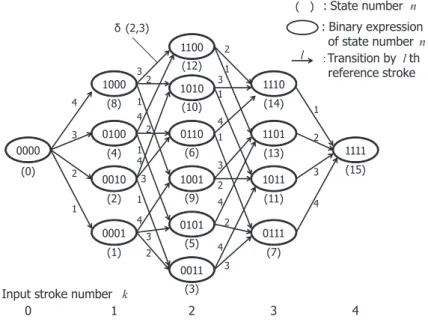
Figure 3.1: Cube search graph (N = 4).
3.3 Cube search (CS)
CS [11, 12] is a global optimization method for stroke correspondence search.
Figure 3.1 is an example of the mechanism of CS for generating bijective stroke- order variations. It is an N-dimensional cube graph for N-stroke character. In CS, the N-dimensional cube graph is used for representing stroke correspondence;
every path from the leftmost node to the rightmost node represents a stroke cor- respondence l(1), . . . , l(k), . . . , l(N) and the graph can represent all (N!) possible correspondences.
Specifically, as shown in Fig. 3.1, the graph is comprised of 2N nodes and each of them is indexed by an N-bit binary number for identifying each node and con- trolling the selection of node-to-node transition (edge) as flags. Each bit position corresponds to the reference pattern stroke numberl, and the bit value 1 means that this reference stroke has already been matched to some input stroke up tok. With
input stroke transition k−1 → k, an edge is selected for causing a new reference stroke match. Let thelth reference stroke be matched to the kth input stroke, then the lth bit of node number is inverted as 0→ 1. For example, the node “1100” in- dicates that the first and the second input strokes corresponds to the third and the fourth reference strokes respectively, or, the fourth and the third reference strokes respectively, with the input stroke transition 1→2.
CS treats the stroke correspondence problem as a global path optimization prob- lem under the condition that the two nodes linked by an edge should have only one different bit. For example, there is an edge from the node “0100” to “1100”.
This edge indicates that the second input stroke corresponds to the fourth refer- ence stroke. Clearly, any path from the leftmost node “0000” to the rightmost node “1111” will satisfy this condition and represents a bijective correspondence.
Since each edge indicates that a specific input stroke corresponds a specific refer- ence stroke, the stroke distance δ(k, l) is attached to the edge. For example, the distanceδ(2,4) will be attached to the edge from the node “0100” to “1100”.
Consequently, the optimal stroke correspondence problem is organized as a min- imum distance path problem. The objective function is the summation of δ(k, l) along the correspondence l = l(k), and the obtained minimum summation is used as character distance. Therefore, the problem is formulated as,
D(A, B) = min
l(1),...,l(k),...,l(N)
[ N
∑
k=1
δ(k, l(k)) ]
. (3.4)
An efficient DP algorithm is used to search for the “globally” minimum distance path on the cube graph. In DP terminologies, the input stroke number k stands for stage, the node stands for state, edge cost or equivalently stroke distance stands
for local cost, and their sum total stands for objective function. The recurrence equation of DP is formulated as,
G(n) = min
m [G(m) +δ(k, l)], (3.5)
whereG(n) is the minimum cumulative distance to the state n and there should be the relation that the binary number n has k “1”-bits and two binary numbers m and n are different only at the lth bit. The character distance D(A, B) is obtained asG(n) at the final state n=“1111”. The time complexity of CS is O(N ·2N−1).
Since the computational complexity of the original CS is an exponential order of N, we need to introduce some technique to reduce the complexity for practice (especially, when deal with a multiple stroke character with large N). The beam search acceleration technique or pruning technique has been often used at a cost of global optimality. The CS with beam search (abbreviated as CSBS) provides suboptimal solution with far less computations than CS.
However, for characters with large N, CS is still time-consuming, even when the beam search is resorted to. Note that if we can consider that each multi-stroke character is comprised of radicals, we can expect that there is few stroke-order confusion in different radicals and then reduce computations drastically [20]. In Chapter 5, we start from CS, and derive an efficient radical-based method to solve the computational complexity problem of CS.
Chapter 4
Comparative study of stroke
correspondence search methods for stroke-order variation
4.1 Introduction
Online multi-stroke character recognition is gaining renewed interest because of the new development of new pen devices and their applications. An important distinction between online and offline handwriting recognition (or OCR) is the fact that spatial and temporal information are available in the former, while only spatial information is available in the latter. For the online case, character patterns are expressed as the trajectory of pen tip motion during writing. For the offline case, the patterns are expressed as scanned images and recognized by conventional OCR techniques.
A practical online multi-stroke character recognition system should be stroke-
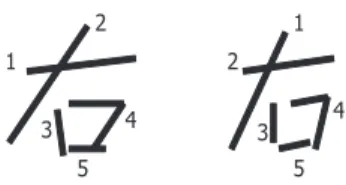
order freeto cope with characters with stroke-order variation. In fact, for multiple stroke characters like Chinese characters or Japanese Kanji characters, the number of strokes of a single character often exceeds 20 and their stroke-order varies in many ways. Figure 4.1 shows a simple and typical example of stroke-order variation of a Japanese Kanji character, “right”.
Although there are several researches for solving the stroke-order free recognition problem, the problem has not been solved yet. Moreover, since no extensive com- parative study has been made so far, none knows the relative characteristics and performance of the past approaches. In other words, there has been no research that helps to choose the most suitable stroke-order free recognition approach for individual applications.
The main contributions of this chapter are twofold.
• A review is made to clarify the relative superiority of stroke-order free recog- nition approaches from the viewpoints of recognition accuracy and efficiency.
• Especially for stroke correspondence approach, theoretically the most reliable approach among several approaches, we conduct a quantitative and qualitative evaluation of five representative methods through an experiment, by using 17,983 samples of online Japanese Kanji character.
To cope with stroke-order variation, several approaches, such as multiple proto- type approach, offline feature approach, and stroke correspondence approach, have been proposed. Our investigation shows that, in the past decade, the conventional multiple prototype approach was frequently reported, especially for Hidden Markov Models (HMMs) based methods. This approach is simple and prepares several pro-
1
1 2
2
3 4 3 4
5 5
Figure 4.1: Example of stroke-order variation.
totypes with typical stroke-order variations for each class. It might be attributed to the emerging application of HMMs in online multi-stroke character recognition during recent years, and it is short of effective strategy to cope with stroke-order variation. The offline feature approach was also intensively studied in the past decade and gave exciting recognition result. This approach converts the motion trajectory into a 2D image to avoid stroke-order variation problem. The stroke correspondence approach, which was intensively studied in 1980s and 1990s, is the traditional strategy to cope with stroke-order variation. This approach first opti- mizes the stroke correspondence between an input pattern and a reference pattern and then evaluates the dissimilarity between those patterns.
In this chapter, we focus on the stroke correspondence approach. This is because the stroke correspondence approach has the following promising characteristics:
• It is theoretically the most reliable approach among several approaches.
• It is possible to estimate the actual stroke-order of the input pattern explicitly and thus useful to analyze stroke-order variation. It can provide important in- formation to identify the writer, or give a hint for more beautiful handwriting, and so on.
• The stroke correspondence approach can cope with even rare stroke-order vari-
ations of each class.
• The technique to establish the stroke correspondence is still very important because it can be applied into the various fields that need order analysis of feature sequences, such as DNA analysis, gesture recognition, etc.
Since the stroke correspondence approach is formulated as an optimization prob- lem, its characteristics depend on its optimization criterion and optimization strat- egy. Several research groups have proposed promising stroke correspondence-based methods for stroke-order free online multi-stroke character recognition, based on different formulations of the optimization problem.
In this chapter, a comparative study is made to clarify the relative superiority of representative stroke correspondence-based methods from the viewpoints of recog- nition accuracy and efficiency. Specifically, we pick up the following five methods:
• The cube search method (CS) by Sakoe and his colleagues [11, 12].
• The bipartite weighted matching method (BWM) by Hsieh et al. [13].
• The individual correspondence decision method (ICD) by Wakahara and his colleagues [14, 15].
• The stable marriage method (SM) by Yokota et al. [16].
• The deviation-expansion model method (DE) by Lin et al. [17].
Note that our comparative experiments adhere to “stroke-number fixed” condition, where no stroke concatenation occurs. This is because we try to concentrate on the influence of stroke-order variations on recognition performance of those methods.
stroke order-free recognition methods
multiple prototype offline feature stroke correspondence
optimal suboptimal
• J.J. Lee, 2001
• M. Nakai, 2003
• M. Nakai, 2001
• H. Tanaka, 1999
• H. Oda, 2006
• H. Sakoe, 1997
• Y. Katayama, 2008
• A.J. Hsieh, 1995
• J. Liu, 1996
• J. Zheng, 1997
• J. Zheng, 1999
• K. Odaka, 1982
• J.W. Chen, 1996
• K.S. Chou, 1996
• M.J. Joe, 1995
• T. Yokota, 2003
• C.K. Lin, 1993
Figure 4.2: Classification of methods of dealing with stroke-order variation.
In the following, we begin with a brief review on the methods of online multi-stroke character recognition in Section 4.2. In Section 4.3, the basic principle of stroke correspondence search and some details of the above five methods are summarized.
Our test results and analysis will be presented in Section 4.4. Section 4.5 gives an extensive discussion on the five methods. Section 4.6 addresses the application of stroke correspondence search in forensics, and Section 4.7 provides some concluding remarks.
4.2 Review of stroke-order free methods
In online multi-stroke character recognition, the problem of stroke-order variation has been studied for many years. Various methods have been published to solve the problem [21]. As shown in Fig. 4.2, we roughly divide the methods of dealing with stroke-order variations into three classes, i.e., multiple prototype, offline feature, and stroke correspondence. Furthermore, we divide the stroke correspondence approach
into two classes, i.e., optimal approach and suboptimal approach.
4.2.1 Multiple prototype approach
The multiple prototype approach is the simplest approach to cope with stroke- order variations. In this approach, several prototypes with different stroke-order variations are prepared for every class. In general, the patterns with typical stroke- order variations are collected as the prototypes. When an input pattern is recog- nized, the most similar prototype is simply selected and then the input pattern is recognized as the class of the prototype.
Lee et al. [66] have proposed a method based on the multiple prototype approach using HMMs. First, each online character pattern is represented as a sequence of straight-line segments (i.e., stroke), and modeled by HMM. Then, typical stroke- orders of each class are selected by clustering the training pattern of the class. For each of the selected stroke-order, an individual HMM is prepared. Consequently, the multiple HMMs are prepared for each class. Further, for efficient representation of variations, those HMMs are combined to form a single HMM architecture, called a multiple parallel-path HMM [66].
In [52], Nakai et al. proposed a multiple prototype approach with a hierarchical structured dictionary. In this dictionary, the common subpattern stroke-orders are for reducing higher time complexity drastically. The dictionary is represented as a network and constructed hierarchically by using shared subnets which define stroke- order rules of Kanji subpatterns. Based on the dictionary network, thousands of stroke-order variations of Kanji patterns can be produced using a small number of subpattern stroke-order rules. They successfully applied it to their previous study
of substroke-based HMM [53], and showed that the recognition speed was fast.
The merit of the multiple prototype approach is its simplicity. However, it is clear that it is difficult to define typical stroke-order variations for general use. In addition, it can not cope with rare stroke-order variations. Furthermore, its time complexity is large when allowing huge variations.
4.2.2 Offline feature approach
The offline feature approach employs “inking” process that converts an online character pattern into a 2D image. Then we can apply OCR techniques to recognize the online character patterns, need not deal with stroke-order variations explicitly.
Tanaka et al. [67] converted an online character pattern into a bitmap image, and then, an offline classifier was applied to recognize it. In order to improve recognition accuracy, a classifier combination strategy is adopted, where this offline classifier and another online classifier are combined. The offline classifier works as a coarse classifier to provide candidates for the online classifier, so that the time complexity of the online classifier can be decreased.
Oda et al. [68] also proposed a combined classifier, composed of an online classifier and an offline classifier. For the latter classifier, the online character patterns are converted to bitmap images. In [68], in order to decrease time complexity and memory size, they proposed several approaches to reduce the dictionary sizes of the online and offline classifiers significantly, especially for the offline dictionary.
Specifically, for the online classifier, they employed a structured character pattern representation dictionary based on the common subpatterns of Kanji patterns, to
discriminant function (MQDF2) is used, and its dictionary size is drastically reduced by reducing parameters for MQDF2.
4.2.3 Stroke correspondence approach
The stroke correspondence approach determines the optimal or suboptimal stroke correspondence between an input pattern and a reference pattern. If the actual stroke-order of the input pattern can be estimated, it is possible to eliminate the ef- fect of stroke-order variations, even when rare stroke-order variation occurs. In addi- tion, the stroke-order information estimated by the stroke correspondence approach can be utilized to identify the writer, to give a hint for more beautiful handwriting, and so on.
In the following, we will briefly introduce some methods based on the stroke correspondence approach. As shown in Fig. 4.2, those methods are classified into two classes, that is, methods for optimal stroke correspondence and the methods for suboptimal stroke correspondence. Generally speaking, the former gives more accurate correspondence with larger computations (This fact will be first proven experimentally by this chapter). Note that among the following methods, CS, BWM, ICD, SM, and DE, will be detailed in Section 4.3, then compared experimentally and discussed in Sections 4.4 and 4.5.
In this chapter, the classification between optimal and suboptimal is done whether a method can give the globally optimal solution of the stroke correspondence problem formulated later. Thus, some method becomes suboptimal if it gives an optimal solution in, e.g., a constrained problem.
Methods for optimal stroke correspondence
As introduced in Chapter 3, in CS [11, 12] Sakoe and Shin formulate the stroke cor- respondence search problem as a shortest path search problem on anN-dimensional cube graph. This cube graph is introduced to impose the bijection property on the stroke correspondence between an N-stroke input pattern and an N-stroke refer- ence patterns. An efficient dynamic programming (DP) algorithm is used to search for the shortest path on the cube graph. Note that CS can be extended to be a stochastic stroke correspondence model [50]. In this case, the cube graph becomes an HMM.
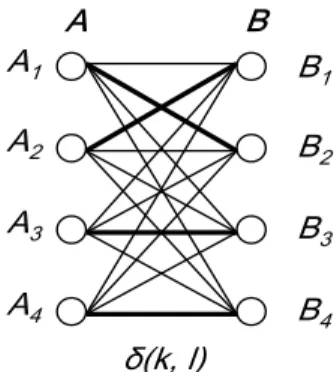
Hsieh et al. [13] proposed a straightforward stroke correspondence method by defining the stroke matching problem as BWM, where the stroke distances are served as the weights of edges of anN×N bipartite graph. The BWM problem is to find the minimum weight perfect matching of the bipartite graph. Hsieh et al. formulated this minimization problem as integer programming (IP) problem, and applied the Hungarian algorithm to solve this IP problem.
In [69], Liu et al. represented both of the reference pattern and the input pattern as complete attributed relational graphs (ARG). In a complete ARG, its nodes and arcs describe line segments and relations between any two segments, respectively.
They defined a measure for the optimal correspondence of nodes and arcs between two ARGs. The correspondence searching is formulated as a heuristic search problem in a state space tree. An A* algorithm is used to perform the heuristic search.
In [70], to overcome the shortcoming of being too strict description of primitive (strokes or line segments) relationship in popular ARG, Zheng et al. proposed so-