D
o w
i ndbr eaks r educ e t he w
at er c ons um
pt i on of
a c r op f i el d?
著者
SU
G
I TA M
i c hi aki
j our nal or
publ i c at i on t i t l e
Agr i c ul t ur al and For es t M
et eor ol ogy
vol um
e
250- 251
page r ange
330- 342
year
2018- 03- 15
権利
( C) 2017 El s evi er B. V.
U
RL
ht t p: / / hdl . handl e. net / 2241/ 00151170
Do windbreaks reduce the water consumption of a crop field?
Michiaki Sugita
Faculty of Life and Environmental Sciences, University of Tsukuba
Correspondence to: Michiaki Sugita, Faculty of Life and Environmental Sciences, University of Tsukuba, Tsukuba, Ibaraki 305-8572, Japan. E-mail:
Abstract
Two ratios,
0 00 0
* *
( )
( )
c a c avc
u u u u
c
c avc u u c a
u u
q q r r
A
r r
q q
for the canopy layer and
equivalent ratio Ag for the soil layer, were proposed for use to assess if soil evaporation
(Eg) and canopy transpiration (Ec) decrease when wind speeds are reduced by
windbreaks by a fraction of α, with qa being the specific humidity of the air, qc* the
saturated specific humidity of the canopy layer, rc the canopy resistance, and ravc the
aerodynamic resistance for moisture transfer. These ratios can be organized to form
criteria, ∆Ec < 0 (Ac < 1) and ∆Eg < 0 (Ag < 1). Thus ∆E < 0 if Ac < 1 and Ag < 1. If
only one of the ratios is smaller than unity, the sign of ∆E depends on that of ∆Eg + ∆Ec.
The criteria were examined by a dual-source crop community model to simulate energy
and water balances of a crop field with data obtained in the Nile Delta. It was found
that both ∆E ≥ 0 and ∆E < 0 were possible and ∆E was mainly determined by Eg
during the fallow and early stages of the cropping seasons and by Ec in the late
cropping period. Overall, the scale of the roughness elements hc and soil moisture θ
were found to be the major factors to determineEc, Eg, and E. A larger hc tends
Keywords dual-source crop community model; maize; Nile Delta; evapotranspiration;
1 Introduction
Effects of introducing windbreaks (WBs) on crop fields are one of the subjects
that have drawn much interest in agricultural meteorology as well as in other disciplines
(see, e.g., van Eimern et al. (1964) and Rosenberg (1979) for a review of earlier studies,
and Cleugh (1998), Steven (1998), Cleugh (2002), Brandle et al. (2004) and Helfer et al.
(2009) for a review on more recent works). This was because WBs have been
expected to produce positive effects in a wide range of practical applications in
agronomy. Evapotranspiration reduction has been one of them.
In spite of the long history of the WBs studies, however, we do not appear to
have a full understanding of evapotranspiration differences caused by an introduction of
WBs. For example, a review of Brandle et al. (2004) states that “Evaporation from bare
soil is reduced in shelter… Evaporation from leaf surface is also reduced…” as if there
is no exception. Campi et al. (2009, 2012) appear to be in this position. McNaughton
(1988) and Cleugh (1998, 2002), on the other hand, mentioned that both decrease and
increase of evapotranspiration were possible (see below in Section 2.3 for more details).
In reality, there have been studies that reported increase (e.g., Baker et al., 1989),
decrease (e.g., Miller et al, 1973; Campi et al., 2009, 2012), and both decrease and
contradiction is perhaps not surprising because the influence of WBs on crop fields is
quite complex.
McNaughton (1983) argued one such complexity of WBs that there are both
direct and indirect effects on evapotranspiration of WBs. The direct effects arise from
an altered turbulent exchange between the surface and the atmosphere. The indirect
effects represent changes in evapotranspiration due to modified crop characteristics
developed in different microclimates caused by WBs. Field studies based on
measurements in a crop field with WBs often observe the combined effects of the direct
and indirect effects. Theoretical approaches often focus on part(s) of such effects.
Thus the purposes of our study were (i) to revisit this problem of whether or not,
evapotranspiration should decrease by the introduction of WBs; and (ii) to clarify major
factors that cause the evapotranspiration differences due to WBs. In order to achieve
these goals, first, we summarize available theories to study WBs influences, followed
by the Methods section which introduces dual-source and single-source crop
community models and dataset to be used in numerical experiments to simulate and
compare energy and water balance with and without WBs. Finally, the Results and
Discussion section list and discuss our findings. We focus our study on the direct
crop community. However, to facilitate comparison with previous studies, results from
the single-source model are also presented. Also, in our experiments, the microclimate
including temperature, humidity, and wind speeds in the internal boundary layer above
the vegetated surface in the leeward of WBs is assumed given.
2 Theory
2.1 Influence of wind speeds reduction on a crop community
To study the influence of WBs, it was first assumed that a crop community
consists of two layers, the canopy layer and the soil layer. Surface latent heat fluxes are
expressed by the following bulk transfer equations (see, e.g., Brutsaert, 1982; Garratt,
1992)
*
( )
*
( )
e c a
e c
c avc
p c a
c avc L q q L E =
r r c e e
r r
(1)
*
( )
*
( )
e g a
e g
g avg
p g a
g avg
L q q
L E =
r r
c e e
r r
(2)
for the soil layer. Le is the latent heat of vaporization; is the atmospheric density; cp
is the specific heat of air at constant pressure; γ is the psychrometric constant; ea and qa
are respectively the vapor pressure and specific humidity both in the air; and e* and q*
are the saturated value of vapor pressure and specific humidity at single-source surface
temperature. In Eqs. (1) – (2), and in the rest of this study, the subscript g and c
represent the soil layer and canopy layer, respectively, and those without a subscript
indicates the whole community. Thus Eg is the soil evaporation; Ec is the canopy
transpiration; and E is the crop community evapotranspiration. rc is the canopy
resistance; rg is the soil resistance; and ravc and ravg are the aerodynamic resistance for
scalar transfer. Similarly, the sensible heat fluxes Hc and Hg are formulated by the
following bulk equations (e.g., Brutsaert, 1982; Garratt, 1992)
c p hc c a
H = c C u T T (3)
g p hg g a
where Ch is the bulk transfer coefficient for sensible heat which is assumed to be the
same as Ce, an equivalent coefficient for water vapor. Tais the air temperature, T is the
single-source surface temperature, and u is the wind speed.
When wind speed is reduced above each layer, the following reaction should
take place according to Eqs. (1) and (2):
1
( )
c avc
c avc c
E
u r
r r H
(5)
and
1
.
( )
g avg
s avg g
E
u r
r r H
(6)
An up or downward arrow beside each variable(s) indicates an increase or a
decrease of the variable(s), respectively. From the 1st to the 2nd term of Eqs. (5) and (6),
turbulence is weakened as shown by the increase of ravcand ravg, which should then
reduce the turbulent exchanges of Ec, Hc, Eg, and Hg (3rd and 4th terms). However, the
decrease of the outgoing fluxes (4th term) would induce an increase of source
concentration, i.e., the single-source surface temperature Tcand Tg, as well as saturated
*
*
4
c a c
c a c
c c
c c c
c nc
c
T T E
q q H
E T
H q E
T R H (7) and
*
* 4g a g
g g a
g g
g g g
g ng
g
T T E
H
q q
E T
H q E
T R H (8)
where Rn is the net radiation;
is the Stefan-Boltzmann constant; T is in K. From the3rd term of Eqs. (7) and (8), there are two separate paths, one indicating increases of the
gradients leading to the fluxes increases (negative feedback), and another showing a
decrease of the net radiation, and the resulting decrease of H and E fluxes (positive
feedback). Because there are feedback loops, an equilibrium should be reached (at
least temporarily) for a given condition, somewhere in Eqs. (5) and (7), and Eqs. (6) and
(8). The key variables that determine the equilibrium position are Tc and Tg because
they link the bulk equations Eqs. (1) – (4) with energy balance equations of the crop
community (see A.1.1. in the Appendix). Thus the equilibrium must be reached at the
2.2 Criteria to determine the fate of evapotranspiration
In view of Eqs. (1) and (2), it is convenient to define the ratio Ac
0
0 0 0
0 0 0 0 * * * * ( ) ( ) ( ) ( )
cu u c a c a
c
c avc c avc
c u u u u u u
c a c avc
u u u u
c avc u u c a
u u
E q q q q
A
r r r r
E
q q r r
r r q q (9)
and the ratio Ag
0
0 0 0
0 0 0 0 * * * * ( ) ( ) ( ) ( )
g u u g a g a
g
s avg s avg
g u u u u u u
g a u u g avg u u
g avg
g a u u
u u
E q q q q
A
r r r r
E
q q r r
r r q q (10)
to argue the fate of Eg, Ec, and E when u becomes weaker from uu0 to uu0
( 0 1 ). As is clear, whether WBs should reduce evapotranspiration can be judged by comparing the magnitude of the change in the gradient of the q concentration and
that in resistances for the humidity transport. When the gradient change is larger (Ac > 1
or Ag > 1), the equilibrium is reached in the 2nd – 4th term in the upper path of Eqs. (7) –
< 1 or Ag < 1), the equilibrium is likely reached in Eqs. (5) – (6) and Ec and Eg should
decrease. Thus Ac and Ag can be organized to formulate the following criteria,
0 1
0 1 ,
0 1 c c c c A E A A (11)
0 1 0 1 0 1 g g g g A E A A (12) and
1 10 1 1
1 1
1 1
0 1 1
1 1
1 1
0 1 1
1 1
c g
c g c g
c g c g
c g
c g c g
c g c g
c g
c g c g
c g c g
A A
A A E E
A A E E
A A
E A A E E
A A E E
A A
A A E E
A A E E
(13)
in which symbols and represent the logical operation of “and” and “or” respectively.
In our study, the Δx symbol represents the difference between x for α = 1.0 and x for a
2.3 Analysis based on the Penman-Monteith equation
It is also possible to study E in a simpler manner if one assumes a single-source model. McNaughton (1988) and Cleugh (1998, 2002) have introduced this
approach by using the Penman-Monteith (P-M) equation given by
_ _
* 1
1 /
n p a a
PM
e c PM a PM
s R G c e e
E
L s r r
(14)
where EPM is the evapotranspiration; Rn is the net radiation; G the soil heat flux; s is the
slope of the saturation vapor pressure (ea*) curve at Ta; ra_PM is the aerodynamic
resistance; and rc_PM is the surface resistance.
Whether evapotranspiration would be reduced when wind speed u was decreased
can be studied by evaluating the sign of EPM /u. It is convenient for this purpose to replace ra_PM with
2
0 0 0 0
0 0
1 /
ln ln
e av
v m
v
k
C u r
z d z d z d z d
z L z L
(15)
where z is the measurement height of u, Ta, and ea; d0 is the zero-plane displacement
stability correction function with the subscript v and m representing vapor and
momentum transport (e.g., Brutsaert, 2005); and L is the Obukhov length. With a
simple manipulation, it is possible to show
_ _ _ 0 0 0c c eq PM
c c eq c c eq
r r E r r u r r (16)
where rc_eq is the equilibrium canopy resistance defined by
_ * a a c eq eq q q r E (17)in which Eeq is the equilibrium evaporation.
1
eq n
e
s
E R G
L s
. (18)
As can be understood by referring to Eq. (17), rc_eq is the canopy resistance that would
be necessary to produce E =Eeq under the actual dryness of the air (qa* − qa).
Note that McNaughton (1988) and Cleugh (1998) used different expressions
from Eqs. (16) – (17). McNaughton (1988)’s version is
* * *0 ( )
0 ( )
0 ( )
a a eq
PM
a a eq
a a eq
q q D
E
q q D
u
q q D
and Cleugh (1998)’s version reads,
0
0
0
PM eq PM PM
eq eq PM
E E
E
E E
u
E E
(20)
in which Deq E req c PM_ /. It is easy to show that Eqs. (16) - (17) can be converted into Eq. (19) or Eq. (20).
In our study, we mainly focus on the framework given in sections 2.1 – 2.2;
however, to facilitate a comparison with previous studies, Eq. (16) will also be
examined.
3 Methods
3.1 Dual-source crop community model
A dual-source crop community model was used to understand how soil
evaporation Eg and transpiration Ec would respond to reduced wind speeds by means of
WBs under given soil, vegetation, and meteorological conditions. The model consists
of the canopy layer and the soil layer, and energy and water balance of the two layers
The details of the model are explained in the Appendix. Briefly, those processes
above the soil surface were formulated by means of three energy balance equations for
the canopy layer, for the soil layer, and for the crop community; it was assumed that
interactions between the atmosphere and the canopy layer, and those between the
atmosphere and the soil surface work side by side, and the sum of the two fluxes results
in the community level flux to satisfy the conservation equations (Kondo and Watanabe,
1992). Subsurface hydrological processes from the surface down to water table were
also included in the model. They were formulated based on previous proposals with
locally calibrated parameters whenever possible. Soil moisture content θ was then
derived as the residual of the soil water balance equations and used to estimate the soil
resistance ravgand the canopy resistance ravc which control Eg and Ec, respectively.
3.2 Dataset
A dataset obtained in an irrigated crop field without WBs in the Nile Delta in
Egypt was used as inputs to the model. The details of the site, measurements, and
experiments are explained in El-Kilani and Sugita (2017) and Sugita et al. (2017);
in the central part of the Delta. An eddy correlation system together with
meteorological and hydrological instruments was mounted on and around a 5-m tower
at the center of a 200 by 200 m crop field (see Table 3 of Sugita et al. (2017) for the
details of the measurements). In our analysis, those data obtained in the summer of
2011 were mainly used. The 2011 summer season consists of a fallow season (May 21
– June 13) and a summer cropping season (June 14 – September 17) in which maize
(Zea mays L., cv., Three Ways Cross (Hybrid) 324) was cultivated using the furrow
irrigation method with an irrigation interval of approximately two weeks. Other
relevant variables of vegetation, soil, irrigation, etc. were also measured in this field.
3.3 Numerical experiments
3.3.1 Experiment I
In this experiment, nine sets of simulated outputs of energy and water balance
components for a hypothetical crop field were generated for the 2011 summer season
under various assumed conditions. El-Kilani and Sugita (2017) also produced six
similar sets. In each set, simulations were carried out with wind speeds u specified as a
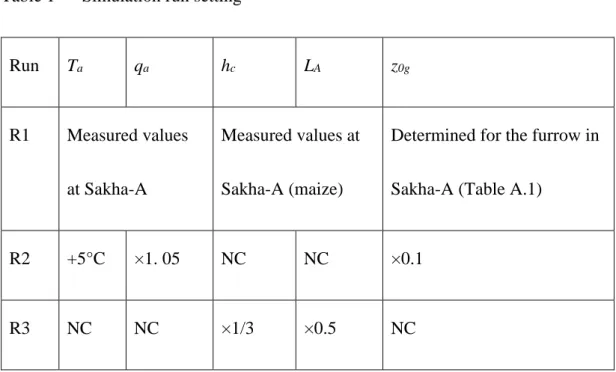
study, three sets of outputs (run R1 – R3; Table 1), each with =0.1, 0.9 and 1.0, were
chosen out of these 15 sets so that the selected cases represent a wide variety of
conditions and results of Ec, Eg, and E.
Run R1 is the baseline case representing the maize field without WBs with the
measured meteorological variables used as inputs. Run R2 represents the case in which
Ta, qa, and the soil surface roughness z0g were altered from those of run R2. We varied
z0g to represent the surface condition of a different irrigation method. The z0g value for
the furrow irrigation is generally larger than that for a flat soil surface using drip and
basin irrigation. By varying qa, the case of altered microclimate in the so-called quiet
and wake regions in the leeward of WBs can be realized. The magnitude of the qa
variation was determined from the observed differences between qa in the leeward and
in the windward of WBs in a field experiment in the Nile Delta (El-Kilani and Sugita,
2017). In the same experiment, the Ta differences were found negligible; nevertheless,
we varied Ta in run R2 to see the influence of a different climatic condition.
The setting of run R3 is the same as that of run R1 except for the size of the
crop, and the crop height (hc) and leaf area index LAI (LA) were altered from those of
zone depth zrz, and the canopy cover fraction fcc, while the change of hcalters
momentum and scalar roughness lengths (see Appendix).
3.3.2 Experiment II
This experiment was intended to focus specifically on the influence of the scale
of roughness elements on ΔE, ΔEc, and ΔEg under the same condition as run R1 of
experiment I. However, the simulations were carried out only for one day, August 1,
selected arbitrarily from the midseason stage of maize. This was because
meteorological conditions do not affect much in the outcome of ΔE, ΔEc, and ΔEg (see
also the results presented in section 3.3) and that increased soil moisture to saturation
did not produce markedly different simulated results for August 1, as was found in a
preliminary analysis.
The same model was used except that the soil water balance part was disabled
and water content value on this day determined in run R1 was prescribed as an input.
The canopy height hc was varied from the actual value of 2.2 m in the range of 0.1 < hc
on Aug.1) was adopted regardless of hc in this experiment. The difference between the
result for = 0.1 and those for 1.0 was examined.
4 Results and discussion
4.1 Different responses of the canopy and soil layers
Fig. 1a and b indicate the relation between ΔE and Ec for the two cases of α = 0.1 and 0.9 based on the outputs of the experiment I. Clearly, both E > 0 and E < 0 occurred, which agree with McNaughton (1988) and Cleugh (1998, 2002), and
assessments of observational studies mentioned in the Introduction section. It was
found that E > 0 accounts for approximately 50 - 60%. A general positive correlation (R2 = 0.83 - 0.85) can be noticed between Ec and ΔE, if we ignore the points with Ec= 0 during the fallow season and other outlier points among the results of run R2 (α = 0.1) during the crop development stage when LA and hc were still small
and soil surfaces were not fully covered by vegetation.
g
E
< 0 constitutes 32% while that of Ec< 0 and Eg> 0 accounts for 21%. In the case of α = 0.1, the percentages are 36% and 8%, respectively.
These results tend to imply that a single-source treatment of a crop community is
likely an oversimplification if we need to study all stages of the cropping season. On
the other hand, if the only target is the stages with mature canopy, it is likely acceptable
to work with a single-source model.
Fig. 1e and f show whether the criterion given by Eq. (16) produced predictions
of ΔE which agree with the ΔE results of the simulation runs. For this purpose, the
outputs of runs R1, R2 and R3 of experiment I were organized accordingly and shown
in Fig.1e for α=0.1, and in Fig.1f for α=0.9. The value of rc_PM was determined by
inverting Eq. (14) with the simulated values of E, Rn, G, and by setting ra_PM = rav in Eq.
(17). It is immediately clear that there are cases which do not agree with what Eq. (16)
suggests in both figures.
There should be at least four possible causes which induced failure of the
criterion Eq. (16) to predict ΔE. First is the case when the sins of ΔEc and ΔEg were
different. Failure is possible in this case because the canopy and the soil layers are
open triangles or green squares symbols based on Eqs. (9) and (10). The majority of
those points against Eq. (16) are found for rc PM_ /rc eq_ 1 and E 0, but some are for
_ / _ 1
c PM c eq
r r and E 0. The second cause is related to the fact that Eq. (16) is based on the derivative of the P-M equation evaluated at uu0 to estimate the change in E for an infinitely small change of u while E was determined for a finite difference of uu0 and uu0; naturally they are not necessarily the same. The third cause originates from the fact that (16) does not consider the change in Rn resulting from the
single-source surface temperature changes as indicated by Eqs. (7) and (8). Finally, the
assumption in the derivation of the P-M equation,
* *
* s a
a s a
e e de
s
dT T T
, could be the
source of disagreement. It is this assumption that allows us to use
ea*ea
, instead of the specific humidity difference between evaporating surface and the atmosphere
qs qa
, as one of the driving forces of evapotranspiration.4.2 Factors that influence Ec, Eg, and E
Since surface fluxes are closely linked to the turbulent exchange between the
candidate to investigate as the main factor to determine Ec, Eg, and E. This was studied with the results of experiment II (Fig. 2a – c).
Fig. 2a indicates that
00 * 0.1 * c a u u c a u u q q q q
> 1 and
0
0
( )
( )
c avc u u c avc u u r r r r
> 1 for all hc
values. This was caused by the increase of *
c
q and ravcas u decreased and the turbulent
exchange was suppressed (Eq. (5)). Rnc always decreased as u decreased (Eq. (7)).
It can also be noticed that 0
0
0.1
( )
( )
c avc u u c avc u u r r
r r
decreased while
00 * 0.1 * c a u u c a u u q q q q
increased when hc increased. As a result, Ac kept increasing and became larger than 1.0
at hc=1.93 m. This is where Ec started to take positive values. Thus Ec tends to
decrease when u is reduced for a smaller canopy while Ec increases are more likely to
occur for a larger canopy. This is qualitatively in agreement with the assessment of
Cleugh (1998) who showed, based on the P-M equation, the increase of the possibility
of E reduction as the aerodynamic resistance increased (that is, as hc decreased).
The fact that 0
0
0.1
( )
( )
c avc u u c avc u u r r
r r
decreased as hc increased means that (rcravc) is
more sensitive to the u change when the scale of the roughness elements is smaller.
This can be understood by evaluating
21 / 1 /
c avc h h
r r C u C u
u u
for a
hc = 0.2 m, d0 = 2/3hc, and zov = 6.8 10-3),
rc ravc
u
= − 42 at u=2 m/s (z = 10 m/s).
For a large canopy, Ch = 0.006 (z0 = 0.15 m, hc = 2 m, d0 = 2/3hc, and zov= 2.0 10-2 m),
and
rc ravc
u
= −63 for the same wind speed. Therefore,
0
0
0.1
( )
( )
c avc u u c avc u u r r
r r
is 50%
larger for the small canopy.
The same observations can be made for the soil layer (Fig. 2b) except that Ag < 1
and Eg< 0 all the time and their dependence on hc is weak. As a result, the relation
between E and hc is similar to that between Ecand hc except that E< 0 for all hc
values examined. Overall, it can be concluded that the size difference of the roughness
elements affects mainly Ec, and to a lesser degree Eg.
3.3 Seasonal changes in Ec, Eg, and E
In order to investigate how other factors than the roughness scale influence
evapotranspiration differences due to WBs, a comparison was made between the
Fig. 3a and b clearly show the same dependence of Ec, Eg, and Eon the roughness size observed in Fig. 2a - c: the canopy part is more sensitive to the
roughness scale than the soil surface part; and 0
0
0.1
( )
( )
c avc u u c avc u u
r r
r r
decreased,
00 * 0.1 * c a u u c a u u q q q q
increased, and Ac increased as hc increased, particularly at later stages
of the cropping season (after the middle of July). In this periods, ΔEc≫ΔEg and thus
ΔEc essentially controls the fate of ΔE. ΔEc (and thus ΔE) shows a general decrease as
hc increased. However, these changes are not monotonous, unlike the case of Fig. 2a -
c. For example, 0
0
0.1
( )
( )
c avc u u c avc u u
r r
r r
shows periodic peaks in response to irrigation events.
The same behavior can also be observed for
00 * 0.1 * c a u u c a u u q q q q
. Those changes were
caused by the increases in the θ value and resulting decreases in rc and rg. This agrees
with Cleugh (1998) in general who indicated that wet soil conditions tended to result in
the reduction of E. Also noticed in the figures are that the impact of irrigation was more
pronounced in the early stages of the cropping season. This is because the root zone
became deeper at later stages (Sugita et al., 2017) and therefore the soil moisture
In addition, it can be noted that in the fallow and early cropping seasons
(through the middle of July), ΔE = ΔEg or ΔE≒ΔEg and thus behavior of ΔEg is
important. ΔEg is mostly positive and shows periodic negative values. The cases of
ΔEg < 0 correspond to the periods of increased θwith irrigation events. This is why
ΔEg > 0 most of the time during the fallow season with small θ without irrigation
events.
Seasonal changes in meteorological elements such as incoming radiation, air
temperature, humidity and wind speed did not significantly affect Ec, Eg, and E. This is partly because the climate in Egypt is stable (Sugita et al., 2017) and seasonal
fluctuations in these elements were small during the cropping season. Therefore this
part of the results could be area specific. Indeed, a comparison of the simulated results
of different Ta and/or qa values (results not shown) has indicated that the increased Ta
and qa tend to enhance the magnitude of Ec and Eg for α < 1 while the increase of
qa alone weakened Ec and Eg.
Overall, factors which affected the seasonal changes in Ec and Eg can be summarized as the height of the roughness elements and surface resistance mainly
5. Conclusions
In order to study the influence of windbreaks on crop evapotranspiration, two
ratios (Eqs. (9) and (10)) have been proposed using the framework of a dual-source crop
community model. They were organized to form the criteria given by Eqs. (11) - (13)
to determine whether windbreaks could reduce evapotranspiration (ΔE < 0).
It was shown that both ΔE > 0 and ΔE < 0 occurred in the results of the
numerical experiments under three different conditions with two cases of wind speeds
reduction by a fraction of α = 0.1 and 0.9 using the dataset obtained in a crop field in the
Nile Delta. The results with ΔE > 0 account for approximately 50 - 60%. Generally,
∆E > 0 can be observed as canopy height increased. This was because the main factor
that determines ∆Ec and ∆Eg is the turbulent exchange which is influenced by the
roughness scale. An additional contribution was made by the soil moisture increase
due to irrigation events which reduce surface resistance for humidity transport above the
soil and canopy layer. As a result, ∆Ec and ∆Eg decreased with θ increases.
speeds were found to have a minor influence in the case of the dataset obtained in the
Nile Delta.
The results with different signs of ΔEc and ΔEg account for 42% (α = 0.1) and
53% (α = 0.9). In these cases, the sign of ΔE was determined mostly by ΔEg during the
fallow and early cropping seasons and by ΔEc as the canopy height increased. The
correlation between ΔEc and ΔEg was very weak. ΔEc and ΔE, on the other hand, show
a higher correlation in the later stages of cropping season with mature canopy. As a
result, a single-source treatment of a crop community is not recommended to study
windbreaks influences, particularly in the early stages of the cropping season when the
soil surface plays an important role in the surface-atmosphere interaction; this can be
treated better by the dual- or multi-layer crop community models. Indeed, the criterion
(16) proposed based on the Penman-Monteith (P-M) equation did not always produce
correct predictions of ΔE.
Acknowledgements
Authors are also grateful for El-Kilani, Rushdi M.M. (Cairo University) for
University) and Hoshino, A. (Univ. Tsukuba) for providing us with their soil moisture
and soil physics data, for Kubota, A. and Maruyama, S. (Univ. Tsukuba) for sharing
their results on plant physiology and observation, for Fukuda, T., Matsuno A., Shimizu,
T., Tsuchihira, K., Irigaki, Y. and Tsuji, I. (Univ. Tsukuba) for their participation in the
field observations, and for Osada, A., Kamitani, T., Sayed El Nehlak, Hassan Mohamed
Abd El Baki, and Hussein Al Nadar, among others (WAT project office, JICA) for
supporting field observations for this study. Finally, the authors also express their
appreciation to Satoh, M. (Univ. Tsukuba) without whose initiatives and leadership the
experiment for this study would not have been possible. This research has been
supported and financed, in part, through SATREPS of JST/JICA.
Appendix
A.1 Dual-source crop community model
A.1.1 Energy balance
The energy balance equation can be expressed as,
4 4(1 ) (1 ) 2(1 )
nc c sd su ld c g c c c e c
R f R R R f T f T H L E (A.1)
4 4(1 )
ng c sd su ld c c g g e g
R f R R R f T T H L E G (A.2)
for the soil layer, and as
4 4(1 )
n sd su ld c g c c g e g c e c
R R R R fT f T H L E H L E G (A.3) for the crop community. In Eqs. (A.1) – (A.3), Rsd and Rsu are the downward and
upward short-wave radiation; Rld is the downward long-wave radiation; fc is the canopy
transmissivity; and G is the soil heat flux.
A.1.1.1 Resistance parameterizations
The soil resistance rg was estimated by
1
1
1.75 0
( )
273.16
b s g
g a r
T D
(A.4)
(Kondo et al., 1990) where D0 = 2.23×10⁻⁵ m2/s is the molecular diffusivity at soil
surface temperature Tg = 0°C, and a1 and b1 are the soil-type specific constants. Model
calibration with the data during the fallow period allowed determination of these
The canopy resistance rc was estimated based on the so-called Jarvis-type
models (e.g., Jacquemin and Noilhan, 1990),
*
,min/ 1 2 3 4
c st A sd a a a
r r L f R f e e f T f (A.5)
where rst,min is the minimum bulk stomatal resistance, f1 through f4 (0 f 1 ) are
respectively a function of Rsd, that of (ea* – ea), and so on. The same functional forms
of Jacquemin and Noihen (1990) were adopted, but the coefficients were determined by
the resistance measurements of maize in the Sakha-A field (Kubota, 2014, personal
comm.). They are,
,min 1 ,max 1 1 st st r f F r F
(A.6)
where rst, max is the maximum bulk stomatal resistance and F is another function
1 0.55 sd gl A R F R L
(A.7)
and
2
* 2
* *
2
0.1 10 hPa
1 10 hPa
a a
b
a a a a
e e f
a e e e e
(A.8)
The value of rst, min was also adopted initially from the in situ measurements by Kubota
(2014, personal comm.), but in the calibration stage, it was adjusted to produce the best
cropping season of maize, after the parameters of rg had been calibrated (see section
A.3). The final value together with coefficients a2 and b2 are listed in Table A.1. Other
functions are
23 1 3 a ref, a
f a T T (A.9)
where a3 = 0.0016 (Jacquemin and Noihan, 1990) is a coefficient, and Ta,ref is the air
temperature that produces the smallest rst, and
4
w fc w f
. (A.10)
in which θw is θ at the wilting point and θfc is the field capacity.
The values of rac and rag were determined from Eq. (15) and the equivalent
equation for the soil layer from bulk transfer coefficients (see below in section A.1.1.2).
A.1.1.2 Bulk transfer coefficients
The bulk transfer coefficients of the maize community for sensible heat Ch were
determined from Eq. (15) for each time step with momentum roughness z0and scalar
roughness z0h by assuming similarity between the sensible heat and latent heat transport.
z0hg. Finally, the bulk transfer coefficients for the canopy layer Chc were determined
from
hc h hg
C C C . (A.11)
The momentum roughness of the soil surface z0gwas determined by applying
the method of Toda and Sugita (2003) in which the z0g value was selected, that
produced the best agreement of friction velocity u* values estimated from the profile
equation in the surface layer,
0 0
*
0
( ) ln m
z d z d
u u z
k z L
(A.12)
and those measured by the eddy correlation method(Sugita et al., 2017). The
application was made to the data during the fallow season when d0=0 and z0=z0g. The
selected z0g value (Table A.1) is larger than the textbook value for bare soil surfaces.
This is reasonable as the Sakha-A field was cultivated using furrow irrigation (the bed
interval: 0.8 m, and the bed width and height: 0.2 m each). The larger z0g obviously
reflects this rougher surface condition.
The scalar roughness length of the soil surface z0hg was also determined by the
same procedure. However, instead of u* values, the sensible heat fluxes H were
0 0
* 0
( ) ln
g a h
p h
z d z d
H
T T z
kuc z L
(A.13)
and in the analysis, d0 = 0 and z0h = z0hg were assigned.
Also determined were the momentum roughness z0 and the scalar roughness for
sensible heat z0h of the crop community. The determination was made several times
during the maize cropping season by applying the same procedure outlined above. The
following regression equations were derived that relate canopy height hc with z0 and z0h
2 3
=0.0292 + 0.000828 0.00573 + 0.0135
0 c c c
z h h h (A.14)
2
=exp 6.76 0.284 0.677
0h c c
z h h
from which daily values were estimated.
A.1.1.3 Wind speeds below canopy
For the application of Eqs. (2) and (4), the wind speeds below canopy at z = zg
were estimated from the measured wind speeds above the canopy. zg = 0.1 m was
arbitrarily selected. First, ( )u hc was estimated from the measurement at z = 5.78 m by
applying the wind profile equation Eq. (A.12). Then the wind profile function below
4
( g) ( ) expc 1 g / c
u z u h a z h (A.15)
was applied to ( )u hc for the case of hc > 0.1 m, with the coefficient a4 = 2.0 based on
Inoue and Uchijima (1979). The estimated u z( g) was finally converted to u at z = 5.78
m by applying (A.12) for use in the model. When hc 0.1 m, the measured u at z =
5.78 m was simply used in the model by ignoring the small canopy.
Note that wind profile functions such as (A.15) have been developed from the
horizontal equation of motion in the absence of a pressure gradient and the Coriolis
force but with a momentum sink term due to the presence of stems and leaves below a
canopy. Assumptions were then made that the shear stress is proportional to the wind
speed gradients by means of eddy viscosity Km and that the sink term is proportional to
u(z), the foliage drag coefficient cdf and the foliage surface area Af. (A.15) can be
obtained if we assume of a constant value of Afcdf and a constant mixing length (and
thus Km). Other functions can be obtained by assuming a different form of Km (e.g.,
Cowan, 1968). Also, adopting different closure scheme other than the mixing length
approach allows derivation of different forms (e.g., Yi, 2008); however, this approach is
not without criticism (Finnigan et al, 2015). Massman et al. (2017) adopted a
parameterization of u*/u(hc) as a function of height and proposed a wind profile model
profile and another near the surface. It was aimed to represent a realistic wind profile
near the surface, which should be close to a logarithmic shape with u(z) approaching
zero at z0.
Although it was tempting to use the model by Massman et al. (2017) as it likely
produces a more realistic value of u z( g)near the surface, it was decided not to adopt
this model at present since it was tested only by one profile measurement for maize. In
contrast, (A.15) has been tested and used extensively and successfully in the literature.
However, to test uncertainties to use (A.15), u z( g)values from (A.15) were changed by
±15% in the numerical experiments, and the results were compared against those from
simulations without change of u z( g). The conclusions obtained in our study with
(A.15) were found to remain the same with ±15% changes of u z( g)values.
A.1.1.4 Canopy transmittance and coverage
The canopy transmittance fc and LAI (LA) were determined by a canopy analyzer
(Li-cor, LAI2200 or LAI2000) several times during the maize cropping season at
made around noon for the fc measurement, and shortly after sunset for LA. These data
were used to determine the following empirical equation
1 1.015 1 exp 0.633
c A
f L (A.16)
which was used to estimate the daily value of fc as a function of LA in the model.
The canopy cover fraction fcc was necessary to estimate infiltration of rainfall
differently under the canopy and in the canopy gaps. However, no rainfall was recorded
during the 2011 summer season, and fcc was therefore not used for our study.
Nevertheless, for the sake of completeness, the empirical function adopted in the model
is given below as
0.551
34.097
cc A
f L . (A.17)
in which its functional form and coefficients were determined by comparing the
measured LAand fcc values. The values of fcc were determined by image processing of
digital camera images taken at a nadir-looking position at eight locations in the field
(Tsuchihira, 2011; see also Byambakhuu et al, 2010 for the details of the method).
The water balance equations for the crop community including the soil layer
beneath the surface are given by
w s
g rz rz c
dS dS
I W I E
dt dt (A.18)
s
i r g g
dS
P P I E
dt (A.19)
in which Pi is the irrigation, Pr is the rainfall, Ss is the surface water storage resulting
from Pi or Pr, Ig is the infiltration into the soil at soil surface, Irz is the drainage from the
bottom of the root zone z = zrz, Wrz is the upward capillary flux evaluated at zrz, and Sw is
the water storage in the form of soil moisture in the soil layer. Also, the community
level evapotranspiration is given by
g c
EE E . (A.20)
The thickness of the soil layer was arbitrarily determined as 0.17 m for the fallow
season and set equal to the depth of the root zone (zrz) during the cropping season which
was given as a function of LA (see below in section A.1.2.3).
Soil water content was estimated as a residual of Eq. (A.18) – (A.19) by
considering two cases. The first case was when the top of the capillary fringe on water
table was within the soil layer. In this case, saturation was simply assumed in the soil
layer. Then, the mean θ in the soil layer was estimated in the model by solving soil
water balance Eq. (A.18) for Sw. To determine which case applies, the depth to water
table (zgw) was used. The depth of the capillary rise was assumed constant at air entry
value (Hb) (see Table A.1).
A.1.2.1 Depth to water table
Groundwater level was measured continuously in an observation well of a depth
of 2 m. The timing and amount of the irrigation were also recorded (Sugita et al.,
2017). They were used to derive the relation between zgw and the elapsed time t (d)
measured from the end of the last irrigation event. It was found that the relationships
observed in different events looked similar, and therefore it was decided to estimate zgw
in meters by the following empirical function fitted to the measurements,
5
1.1 1 exp 0.115 / 2
gw
z t
. (A.21)
A.1.2.2 Soil water balance components
In Eq. (A.19), Pr can be neglected for the present purpose to apply the model in
an i-th time step was determined from S i( )S i( 1) P ii( 1) I ig( 1) t in which
Δt is the time step employed for the model implementation (=1 d). The infiltration into
the soil at surface Ig was estimated from the following expression of Milly (1986),
1 0.5 5
5 2
0
4
1 1 1 gc
g
a i
I a
A
(A.22)
which makes use of the infiltration capacity (Philip, 1957). In Eq. (A.22), a5 is a constant
and assumed as 1/2 of the hydraulic conductivity Ks (Table A.1); A0 is the sorptivity and
was estimated from
1/ 2 0
0.165 0.67
0 1.458 u s
A K d
(A.23)(Eq. (11) of Milly (1986)), in which is the matric head, and uis at satiation with
=0 (Table A.1). The values of A0 for different depth ranges of the root zone were
calculated by Eq. (A.23) and are listed in Table A.1). igc is the cumulative infiltration
(Philip, 1957) given by
1/ 2
0 5
gc
i A a (A.24)
in which τ is the elapsed time measured from the start of the irrigation event.
Parameters in these equations (Table A.1) were derived from soil samples taken in the
Sakha-A field and subsequent laboratory experiments (Fujimaki and Hoshino, 2010,
The drainage Irz from the bottom of the root zone z = zrz was determined by
( )
rz rz
I K (A.25)
in which K( ) is the unsaturated hydraulic conductivity as a function of soil water
content θ at zrz. The K( ) values of soil samples taken in the Sakha-A field were
determined by Fujimaki and Hoshino (2010, Personal comm.). The parameter a6 (Table
S.1) of the following expression by Brooks and Corey (1966) was determined by fitting
Eq. (A.26) to the data,
6 6
( 2 3 )/
( )
a a s
s
K K
. (A.26)
The upward capillary flux Wrz was set equal to zero because soil water potential
measurements at two levels (−0.7 and −0.9 m) above water table indicated steady
downward moisture flux (Fujimaki, personal comm., 2013).
A.1.2.3 Root zone depth
The depth of the root zone was determined from root distribution measurements
of Tsuchihira (2011), and additionally from the data of Fujimaki (2014, personal
of 0.2×0.2×0.1 m taken from the surface to −0.5 m at a 0.1-m interval. For our study,
the following functional relationships were established for the maximum depth zrz
obtained for maize using the drip irrigation and using the furrow irrigation.
0.483exp / 1.092 0.49 (furrow)
0.550 exp / 0.352 0.56 (drip)
A rz
A L z
L
. (A.27)
In the case of zrz < 0.1 m, zrz = 0.17 m was arbitrarily assigned.
A.2 Model implementation
The simulation was carried out starting on April 1 in experiment I, to provide a
spin-up period for the model to produce reasonable soil moisture at the beginning of the
summer season on May 21.
The model was solved for each time step by employing an iteration procedure.
More specifically, initial guess values of Tg and Tc were assigned and this allowed initial
estimations of Hg, Eg, Hc, and Ec from Eqs. (1) - (4), which were then inserted into the
right-hand side of Eqs. (A.1) – (A.3) and Eqs. (A.18) – (A.19) to examine whether or
not the energy balance of each layer closed sufficiently. If the closure was not
balance closure; this process was repeated until the closure had been achieved
sufficiently (<5 W/m2) for both (A.1) and (A.2).
The model was operated at a daily time step. The atmospheric stability was
considered. This was because evapotranspiration takes place mainly during daytime
under unstable atmospheric conditions, and even if daily averaging was employed,
resulting daily mean fluxes of H, E and u* usually indicate unstable conditions.
Therefore the daily values of the Obukhov length L were determined from the measured
daily mean values of H, LeE and u* and were used in all simulation runs. Note that a
more accurate treatment should have been an iteration procedure, in which the first H
and LeE values produced by the model, and u* obtainable from the wind speed data and
the profile equation Eq. (A.12) with assumed neutral stability, can be used to derive the
first estimate of L, which in turn allows the second estimate of the fluxes, and so on.
However, this is quite complicated and was not adopted because the stability correction
functions s are only a mild function of z/L.
A preliminary analysis carried out to compare the results from hourly simulation
and those from daily simulation did not show significant differences so that the
A.3 Model calibration
The estimated values of E and Eg were compared with the measurements in
order to calibrate the coefficients in Eqs (A.4) and (A.5). As mentioned above, it was
aimed to produce the best agreement between the measured E and the simulated E
values, on average. A regression constant a = 1.00, the coefficient of determination R2
= 0.94 for a regression equation through the origin yax (x and y represent the simulated and the measured variables), and the RMS difference = 0.51 mm (defined as
2 0.5/ i i
x y n
) were obtained for the fallow season; similarly, a = 0.99, R2 = 0.97,and the RMS difference = 0.70 mm were obtained for the cropping season. On average,
the model reproduced E values (or Eg during the fallow season) reasonably well (see
also Fig. A.1.
A comparison was also made visually between the measured and the simulated
time series variables of E, θ, and Rlu, the upward long wave radiation (Fig. A.2).
Although the time changes in all three variables are well reproduced by the model, the
agreement in terms of magnitude is not necessarily excellent, particularly for θ.
not propagate into the evapotranspiration estimation too much. This was partly because
References
Baker, G.L., Hatfield, J.L., Wanjura, D.F., 1989. Influence of wind on cotton growth
and yield. Trans. ASAE, 32, 97-104.
Brandle, J.R., Hodges, L., Zhou, X.H., 2004. Windbreaks in North American
agricultural systems. Agrofor. Syst., 61, 65-78.
Brooks, R.H., Corey, A.T., 1966. Properties of porous media affecting fluid flow.
Proc. Am. Soc. Civ. Eng., J. Irrigation Drainage Div. IR2, 61-68.
Brown, K.W., Rosenberg, N.J., 1972. Shelter-effects on microclimate, growth and
water use by irrigated sugar beets in the great plains. Agr. Meteorol., 9, 241-263.
Brutsaert, W., 1982. Evaporation into the Atmosphere: Theory, History, and
Applications. D. Reidel Pub. Co., Dordrecht.
Brutsaert, W., 2005. Hydrology: An Introduction. Cambridge University Press,
Cambridge.
Byambakhuu, I., Sugita, M., Matsushima, D., 2010. Spectral unmixing model to assess
land cover fractions in Mongolian steppe regions. Remote Sens. Environ., 114,
Campi, P., Palumbo, A.D., Mastrorilli, M., 2009. Effects of tree windbreak on
microclimate and what productivity in a Mediterranean environment, Eur. J. Agron.,
30, 220-227. doi:10.1016/j.eja.2008.10.004
Campi, P., Palumbo, A.D., Mastrorilli, M., 2012. Evapotranspiration estimation of crops
protected by windbreak in a Mediterranean region. Agri. Wat. Manage, 104,153–162,
doi:10.1016/j.agwat.2011.12.010
Cleugh, H.A., 1998. Effects of windbreaks on airflow, microclimates and crop yields.
Agroforestry Systems, 41, 55-84.
Cleugh H.A., 2002. Parameterising the impact of shelter on crop microclimates and
evaporation fluxes. Australian J. Exp. Agricul., 42, 859-874.
Cowan, I.R., 1968. Mass, heat and momentum exchange between stands of plants and
their atmospheric environment. Q. J. R. Meteorol. Soc. 94, 523-544, doi:
10.1002/qj.49709440208
El-Kilani, R.M.M. and Sugita, M., 2017. Irrigation methods and water requirements in
the Nile Delta. In: M. Satoh and S. Aboulroos, eds. Irrigated Agriculture in Egypt-